Introduction
Nonbiomineralized fossils have the capacity to preserve morphologies and taxa that do not normally make their way into the fossil record, but this opportunity comes with a cost: soft-bodied organic material can only enter the fossil record after potentially profound chemical changes have taken place (Briggs Reference Briggs1999, Reference Briggs2003). Such changes can render the fossil material difficult to interpret. Among the different ways soft-bodied fossils are preserved, how faithfully do different preservation pathways record the taxonomic makeup of a population, and how well do they compare with one another with respect to different measures of preservation quality? To address this question, the preservational pathways under comparison should be derived from source populations that are as similar as possible to ensure that taxonomic and fossil quality differences are primarily due to differential taphonomy. This can be surprisingly difficult, since exceptional soft-bodied fossil deposits are often separated by hundreds or thousands of kilometers and tens or hundreds of millions of years. The Green River Formation offers an unusual opportunity, as insect fossils here are typically preserved by keroginization as carbonaceous compressions (Dayvault et al. Reference Dayvault, Codington, Kohls, Hawes and Ott1995; Duncan Reference Duncan1997), but at some localities they are known to be mineralized in hematite (Anderson and Smith Reference Anderson and Smith2012), likely an oxidation product of primary pyrite (Fig. 1).
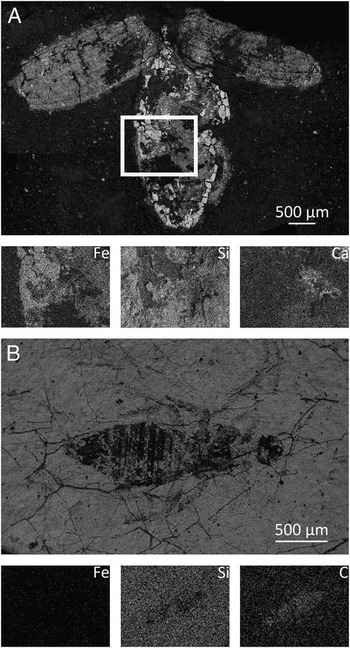
SEM images (backscatter mode) and energy-dispersive X-ray spectroscopy (EDS) maps of insects from the Green River Formation showing the contrast in composition between Paleoburn preservation and fossil preservation from elsewhere in the formation. A, Paleoburn beetle 10-11-B39-#1 with a box showing the location of EDS maps for iron, silicon, and calcium. The beetle material is associated strongly with iron, while silicon and calcium are associated with background silicates and calcite overgrowths, respectively. The beetle is made of iron oxide, but oxygen is not shown due to its ubiquitous presence in all mineral phases. B, Anvil Points thrips APK-M3 with EDS maps for iron, silicon, and carbon. The keroginized insect shows enrichment in carbon and a deficiency in silicon, while neither the fossil nor the matrix has an appreciable amount of iron.

This study compares the preservation of insects between a keroginized insect site and a mineralized insect site, the Anvil Points and Paleoburn sites, respectively, in the Green River Formation from the Piceance Creek Basin in Colorado. Previous studies of soft-bodied fossil deposits have suggested that mineralization by pyritization does not typically preserve fossils with as much fidelity as do carbonaceous compressions (compare Briggs et al. [Reference Briggs, Raiswell, Bottrell, Hatfield and Bartels1996a]; Wang et al. [Reference Wang, Zhao, Zhang, Fang and Zheng2012] to Lin [Reference Lin2006]; Huang et al. [Reference Huang, Engel, Cai, Wu and Nel2012]) due to biases imparted by the mineralization process itself (Yuan et al. Reference Yuan, Xiao, Li, Yin and Cao2001). This study tests this hypothesis by comparing patterns of taxonomic diversity, preservational fidelity of individual insect body parts, measures of body articulation, and the body area of insects from these two sites. We predict that there will be a bias toward the preservation of more recalcitrant and heavily sclerotized insects, such as beetles, at the Paleoburn site. Compared with those from the keroginized Anvil Points, insects preserved at the Paleoburn also should have lower preservational fidelity of anatomical detail for individual body parts. Paleoburn insects also may show a bias toward larger-sized specimens, as small insects may be rendered unrecognizable by decay or degraded entirely (Smith et al. Reference Smith, Cook and Nufio2006). Although Paleoburn insects may be more disarticulated than their Anvil Points counterparts as a symptom of greater microbial degradation, mineralization should occur after burial and after the threat of disarticulation has mostly ended. Thus, there should not be significant articulation differences between the sites.
Background
Comparing Soft-Bodied Preservational Pathways
Many different preservational pathways are available for the mineralization of soft-bodied organisms, like keroginization via carbonaceous compressions (Butterfield Reference Butterfield1995; Xiao et al. Reference Xiao, Yuan, Steiner and Knoll2002; Gaines et al. Reference Gaines, Briggs and Yuanlong2008; McNamara et al. Reference McNamara, Briggs and Orr2012), phosphatization (Martill Reference Martill1988, Reference Martill1995; Xiao and Knoll Reference Xiao and Knoll2000; Butterfield Reference Butterfield2002; Shen et al. Reference Shen, Aldridge, Williams, Vandenbroucke and Zhang2013), calcification (Briggs et al. Reference Briggs, Siveter and Siveter1996b; Bomfleur et al. Reference Bomfleur, McLoughlin and Vajda2014; McLoughlin et al. Reference McLoughlin, Bomfleur, Grimm and Vajda2014), and aluminosilicification (Gabbott Reference Gabbott1998). Hybrid preservation, in which two or more different preservation pathways are simultaneously associated with the same fossil, is not uncommon. In Burgess Shale−type deposits, clays and organic matter may preserve soft-bodied organisms together (Orr et al. Reference Orr, Briggs and Kearns1998; Anderson et al. Reference Anderson, Schiffbauer and Xiao2011), as can pyrite and organic matter (Gabbott et al. Reference Gabbott, Xian-Guang, Norry and Siveter2004). All three of these pathways are found at the Gaojiashan Lagerstätte (Cai et al. Reference Cai, Schiffbauer, Hua and Xiao2012; Schiffbauer et al. Reference Schiffbauer, Xiao, Cai, Wallace, Hua, Hunter, Xu, Peng and Kaufman2014). Four pathways—keroginization, phosphatization, calcification, and preservation in calcium sulfate—may be found associated with the frogs of Libros, Spain (McNamara et al. Reference McNamara, Orr, Kearns, Alcalá, Anadón and Mollá2009). Much rarer are sites where similar original populations—similar taxa in the same formation or group—are preserved along very different preservational pathways. Because of this, it is actually surprisingly difficult to ask which preservational pathways are “better” at preserving soft-bodied fossils, at what scale, and how taphonomic biases differ between different pathways. Keroginized and pyritized soft-bodied fossils offer the opportunity to make such a comparison. Keroginization into carbonaceous compressions and pyritization can both preserve the moderately to strongly recalcitrant components of soft-bodied fossil material such as hairs, arthropod cuticles, algenin, plant tissues, and graptolite periderm in both marine and lacustrine settings (Tegelaar et al. Reference Tegelaar, De Leeuw, Derenne and Largeau1989; Butterfield Reference Butterfield1990, Reference Butterfield1995; Briggs et al. Reference Briggs, Raiswell, Bottrell, Hatfield and Bartels1996a; Briggs Reference Briggs2003; Farrell et al. Reference Farrell, Martin, Hagadorn., Whiteley and Briggs2009; Barling et al. Reference Barling, Martill, Heads and Gallien2015). There are also localities, including the Yixian Formation in China (Wang et al. Reference Wang, Zhao, Zhang, Fang and Zheng2012) and the Green River Formation (Duncan Reference Duncan1997; this study), where pyritized and carbonaceous compression fossils of the same taxa may be preserved within the same formation.
But why should keroginization and pyritization impart different taphonomic biases on soft-bodied material in the first place? Pyritization occurs when the ionic constituents necessary for mineralization (ferrous iron and/or sulfide) are actively generated by microbial activity (e.g., Fenchel and Finlay Reference Fenchel and Finlay1995; Petrovich Reference Petrovich2001; Schiffbauer et al. Reference Schiffbauer, Xiao, Cai, Wallace, Hua, Hunter, Xu, Peng and Kaufman2014). Only the degradation of organic matter by microbes produces these ions with a concentration gradient suitable for soft-bodied fossilization (Raiswell et al. Reference Raiswell, Whaler, Dean, Coleman and Briggs1993; Briggs Reference Briggs2003). Thus, there is a certain expectation of significant amounts of degradation and correspondingly low preservation quality when pyritization preserves soft tissue (Yuan et al. Reference Yuan, Xiao, Li, Yin and Cao2001). In addition, this bias to lower preservation quality is particularly acute for labile materials, because it is the decay of these components that produces the ions for the pyritization of more recalcitrant soft-bodied materials (Schiffbauer et al. Reference Schiffbauer, Xiao, Cai, Wallace, Hua, Hunter, Xu, Peng and Kaufman2014).
Compared with pyritization, keroginization represents a relatively direct translation of original organic material into the fossil record, involving the partial or complete chemical transformation of organic material into aliphatic and cyclic hydrocarbons (Stankiewicz et al. Reference Stankiewicz, Scott, Collinson, Finch, Mösle, Briggs and Evershed1998; Briggs Reference Briggs1999; Gupta et al. Reference Gupta, Michels, Briggs, Evershed and Pancost2006; McNamara et al. Reference McNamara, Briggs, Orr, Gupta, Locatelli, Qiu, Yang, Wang, Noh and Cao2013). Further, preservation via keroginization benefits from a minimum of degradation (Butterfield Reference Butterfield1995). Schiffbauer et al. (Reference Schiffbauer, Xiao, Cai, Wallace, Hua, Hunter, Xu, Peng and Kaufman2014) hypothesized that the time fossils spent in the bacterial sulfate reduction (BSR) zone of the sediment column before they were buried into the methanogenesis zone determined their extent of pyritization over keroginization. Sulfate reduction is a more energy-efficient metabolism than methanogenesis (Fenchel and Finlay Reference Fenchel and Finlay1995) and outcompetes methanogens for substrates (e.g., Robinson and Tiedje Reference Robinson and Tiedje1984). Therefore, for a given amount of time, a potentially pyritized organism in the BSR zone will undergo more degradation than a buried organism in the methanogen zone.
Given the greater amount of microbial decay inherent in pyritization, it is not surprising that the total pyritization of individual soft-bodied fossils is a relatively rare preservation pathway (e.g., Briggs et al. Reference Briggs, Raiswell, Bottrell, Hatfield and Bartels1996a; Butterfield Reference Butterfield2003), while keroginization is common in both marine (Hofmann Reference Hofmann1994; Butterfield Reference Butterfield1995) and lacustrine settings (McNamara et al. Reference McNamara, Briggs and Orr2012; Greenwalt et al. Reference Greenwalt, Rose, Siljestrom, Goreva, Constenius and Wingerath2015). In rare circumstances, very fine-scale details may be preserved with pyrite (i.e., the Crato Formation [Osés et al. Reference Osés, Petri, Rodrigues, Galante, Rizzutto, Silva and Pacheco2014]), or large amounts of labile material may be pyritized (i.e., the Llanfawr Mudstone [Botting et al. Reference Botting, Muir, Sutton and Barnie2011]). More frequently, keroginized fossils have been shown to have greater preservational fidelity and preserve more labile materials at a variety of scales. Compare, for example, chuarids of the Lantian Formation (Yuan et al. Reference Yuan, Xiao, Li, Yin and Cao2001) with the discoids and thalli of the Miaohe biota (Xiao et al. Reference Xiao, Yuan, Steiner and Knoll2002), the sponges of the Llanfawr Mudstone (Botting et al. Reference Botting, Muir, Sutton and Barnie2011) with those of the Burgess Shale (e.g., Briggs et al. Reference Briggs, Erwin and Collier1994), or the finely preserved cuticular details of Crato Formation insects (Barling et al. Reference Barling, Martill, Heads and Gallien2015) with the ultrastructural cuticular details that may be found on kerogenous insects (e.g., Stankiewicz et al. Reference Stankiewicz, Briggs, Evershed, Flannery and Wuttke1997; McNamara et al. Reference McNamara, Briggs, Orr, Gupta, Locatelli, Qiu, Yang, Wang, Noh and Cao2013).
Nevertheless, before this study there had not been a quantitative comparison of the taphonomic biases within deposits where similar original populations, from approximately the same time and including the same taxa, are preserved by two different preservation pathways in similar depositional environments. The Green River Formation is considered to be an ideal site for such a comparison, since its insects can be both keroginized and preserved as iron oxide, likely after pyrite (Fig. 1). It is also a relatively young formation, deposited between 53 and 48 Ma (Smith et al. Reference Smith, Carroll and Singer2008), and the insects preserved here are identical to modern ones at the family and sometimes genus levels (e.g., Scudder Reference Scudder1876; Cockerell Reference Cockerell1925, Reference Cockerell1926; Kohls Reference Kohls2006; personal observation). Thus, the identity and histological composition of insects preserved at the Green River Formation are well constrained, allowing for comparison of the resultant preservational qualities of keroginization and pyritization.
The Green River Formation and Its Insects
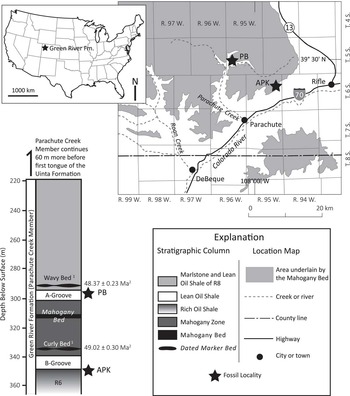
The Green River Formation is a lacustrine deposit in the Rocky Mountain region of the United States that has multiple depocenters in Wyoming (the Green River and Washakie Basins), Utah (the Uinta Basin), and Colorado (the Piceance Creek Basin). The individual basins were separated or joined together in various configurations over their 5 Myr durations (Smith et al. Reference Smith, Carroll and Singer2008, Reference Smith, Chamberlain, Singer and Carroll2010). This study concentrates on insects from the Piceance Creek Basin depocenter (Fig. 2). Its lithology consists primarily of marlstones, oil shales, and salt deposits, with lesser amounts of sandstones, siltstones, mudstones, packstones, grainstones, and stromatolitic carbonates concentrated toward the basin margins (Bradley Reference Bradley1929; Cole and Picard Reference Cole and Picard1978; Grande Reference Grande1984; Tänavsuu-Milkeviciene and Sarg Reference Tänavsuu-Milkeviciene and Sarg2012). The sedimentology and mineralogy of the Anvil Points site is typical for profundal laminated marlstones of the Green River Formation (Duncan Reference Duncan1997; Cole and Picard Reference Cole and Picard1978; Tänavsuu-Milkeviciene and Sarg Reference Tänavsuu-Milkeviciene and Sarg2012). The Paleoburn is sedimentologically similar to the Anvil Points, but mineralogically it is richer in quartz and hematite, poorer in carbonates, and deprived of kerogen, likely through secondary weathering (Duncan Reference Duncan1997; personal observation).
Map of the Piceance Creek Basin of Colorado and a general stratigraphic column of the upper Parachute Creek Member. The small map of the United States in the upper left corner shows the relative position of the Piceance Creek Basin within Colorado. Abbreviations: PB, Paleoburn site; APK, Anvil Points site. Map modified from Donnell (Reference Donnell2009); stratigraphic column modified from Walker (Reference Walker2015), used with permission. Marker bed references: 1, Duncan (Reference Duncan1997) and Cashion and Donnell (Reference Cashion and Donnell1972); 2, Smith et al. (Reference Smith, Carroll and Singer2008).

Stratigraphically, the Green River Formation in the Piceance Creek Basin consists of the basal Cow Ridge Member (which intertongues with the Wasatch Formation), the lower Garden Gulch Member, and the Parachute Creek Member, which takes up the vertical bulk of the formation (Johnson Reference Johnson1984; Young Reference Young1995). Toward the top of the formation, the Parachute Creek Member intertongues with the siliciclastic Uinta Formation (Donnell Reference Donnell2009). The Anvil Points and Paleoburn sites are located near one another in the Piceance Creek Basin in the upper portions of the Parachute Creek Member (Fig. 2). The Paleoburn site is located in the Parachute Creek Valley (O’Sullivan and Hail Reference O’Sullivan and Hail1987) in the upper reaches of the A-groove. The A-groove is the lean zone (L8) above the oil-rich Mahogany Ledge (Duncan Reference Duncan1997; D. Kohls personal communication 2014). The Anvil Points site is approximately 10 km to the ESE of the Paleoburn site (O’Sullivan Reference O’Sullivan1986), stratigraphically beneath the Mahogany Bed in oil zones R7, L6, and R6 (Duncan Reference Duncan1997).
There are many descriptions of insects collected from the depocenters of the Green River Formation, including the Piceance Creek Basin (e.g., Scudder Reference Scudder1876, Reference Scudder1890; Cockerell Reference Cockerell1909, Reference Cockerell1921; Carpenter Reference Carpenter1955; Dayvault et al. Reference Dayvault, Codington, Kohls, Hawes and Ott1995; Duncan Reference Duncan1997; Shcherbakov Reference Shcherbakov2006). Our knowledge of insect resources in the Piceance Creek Basin has been greatly enhanced by David Kohls, whose collection efforts in the 1980s, 1990s, and 2000s added new fossil localities in the vicinity of the Roan Plateau and Battlement Mesa. Much of this collection is stored at the National Museum of Natural History and the Natural History Museum at the University of Colorado–Boulder, where this study took place. Kohls initially discovered both of the fossil sites compared in this paper: the Paleoburn site, where insects are preserved as iron oxide, and the Anvil Points site, where they are keroginized. Specimens used in this study were collected from the field in the Fall of 2011 and were sourced from the collections at the University of Colorado–Boulder Natural History Museum. Specimens referenced in this paper currently curated at the University of Colorado Natural History Museum are designated “UCM.”
Methods
Multiple indicators of preservational quality were analyzed or measured from the two sites sampled in this study to test the hypothesis that soft-bodied fossils preserved by mineralization pathways like pyritization require fundamentally greater degrees of microbial degradation to effect fossilization compared with keroginization. If this is true, then the greater amounts of microbial decay will produce a bias toward more recalcitrant insect orders, lower preservational fidelity, and larger body sizes (as small insects may be degraded beyond recognition) at the mineralized Paleoburn site compared with the keroginized Anvil Points site.
The mineralization and keroginization processes both take place during the diagenetic stage of taphonomy (e.g., Martínez-Delclòs et al. Reference Martínez-Delclòs, Briggs and Peñalver2004). Both the Paleoburn and Anvil Points sites are unbioturbated, profundal lacustrine carbonates, so it is expected that the biostratinomic history of the insects should be similar, but this cannot be assumed. Biostratinomic bias would primarily influence the articulation states of insects but could also influence the relative abundance of fossilized insects (e.g., Wilson Reference Wilson1980) and the body sizes of the preserved insects (e.g., Smith and Moe-Hoffman Reference Smith and Moe-Hoffman2007), confounding interpretations of the mineralization process. Including several measures of articulation among the studied taphonomic indices will allow for a more complete understanding of the taphonomic history of the insects at the Paleoburn and Anvil Points sites. This will prevent the misapplication of results from this study on comparisons between mineralized and keroginized soft-bodied fossil deposits in general.
With the exception of the measurements of the relative abundance of insect orders, each preservation-quality indicator had two separate analyses comparing different groups of fossil insects. The first analysis compared all the insects from the Paleoburn site with all the insects from the Anvil Points site, and the second analysis compared only the beetles from the Paleoburn site with the beetles from the Anvil Points site. Beetles were chosen for special consideration in the analyses because they dominate the preserved insects at the Paleoburn site (see “Results”) and are also dominant in the insect fossil record (Smith et al. Reference Smith, Cook and Nufio2006). Compared with many other insects, beetles tend to have thick, sclerotized exoskeletons, and their membranous wings, tucked beneath their elytra, are usually not preserved. They have been shown to have different preservation potential compared with many other insects (Stankiewicz et al. Reference Stankiewicz, Briggs, Evershed, Flannery and Wuttke1997; McNamara et al. Reference McNamara, Briggs and Orr2012). Because of this differential preservation, there was concern that the more abundant nonbeetle orders found at the Anvil Points site could bias taphonomic comparisons between the mineralized and keroginized sites.
Insect Taxonomy and the Relative Abundance of Insect Orders
All insects from the Paleoburn and Anvil Points sites were assigned to the lowest taxonomic rank possible, primarily with the use of Borror and White (Reference Borror and White1970) and McAlpine et al. (Reference McAlpine, Peterson, Shewell, Teskey, Vockeroth and Wood1981). Classifications could usually be made to order, occasionally to family, and rarely to genus. Thus, order-level designations were considered for the purposes of the current study. If an insect could not be assigned to an order with any degree of confidence, it was simply labeled “Insecta.” The proportions of the relative abundance of insect orders between the two sites were compared using chi-squared tests.
Preservation-Quality Scores
Preservation quality was recorded in a quantitative manner by assigning scores for different categories of insect morphology. These morphological categories included the wings, legs, antennae, eyes, head, thorax, and abdomen. This large number of morphological categories was chosen in the hopes that any subtle taphonomic differences that might be lost in a coarser analysis would be retained here. For example, it might be possible that the relatively large and robust thoracic regions of insects are preserved well whether they are keroginized or mineralized, but that finer details, like those of eyes and antennae, could be lost or obscured at one site or the other.
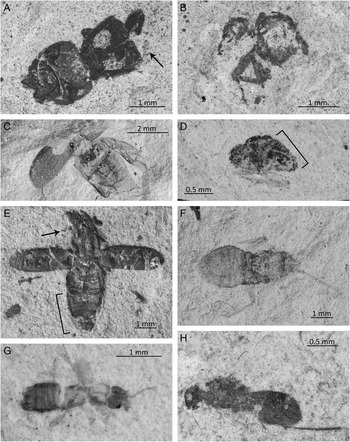
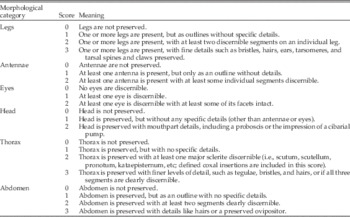
The maximum score possible for a category was a reflection of the morphological variability within each category. For example, the antennae have only three scores (0: not preserved; 1: present; 2: showing segmentation), whereas the thorax has four potential scores (0: not preserved; 1: present without detail; 2: showing major sclerites like the kataepisternum or pronotum; 3: showing fine cuticular details like hairs or all three thoracic segments clearly). For the categories of legs and antennae, the quality score was assessed based on the best-preserved leg or antenna. In addition, the elytra of Coleoptera and the basal hemelytra of Heteroptera were included as part of the thorax, since their greater sclerotization renders their cuticle more like that of the thorax than membranous wings. A complete list of all the possible scores for morphological categories and a rubric for their determination are given in Table 1. Examples of different preservation-quality scores for the abdomen are shown in Figure 3.
Examples of different quality scores for insect abdomens, one of several morphological categories analyzed for preservation quality in this study. Higher scores indicate greater preservation quality. A, Specimen 10-11-B32-#18, a potential beetle from the Paleoburn, receives a score of 0 for its lack of an abdomen (arrow points to where it should be). B, Specimen 10-11-B59-#4, a crane fly from the Paleoburn, also receives a score of 0 for its missing abdomen. C, Specimen UCM72689, an Anvil Points beetle, receives a score of 1 for its preserved abdomen with ambiguous segmentation. D, Specimen UCM76085, an Anvil Points fly, receives a score of 1 due to the lack of distinctive segmentation on its abdomen (bracketed). E, Specimen 10-11-B10-#1, a Paleoburn beetle, receives a score of 2 for the good segmentation shown by its abdomen (bracketed). Note that while the thorax, abdomen, and elytra are clearly defined, the head appears to have been obscured by iron-oxide overgrowth (arrow). The head is scored a 0, or “absent.” Although there likely is a head beneath the iron oxide, it cannot be proven with certainty simply by observing the specimen. F, Specimen UCM76532, a true bug from the Anvil Points, receives a score of 2 for its well-preserved abdominal segmentation. G, Specimen UCM76505, an Anvil Points rove beetle, receives a score of 3 for its abdomen with many fine hairs preserved in detail. It was immersed in alcohol to highlight the contrast of the hairs. H, Specimen 10-11-B63-#3, a Paleoburn wasp, receives a score of 3 for its well-preserved ovipositor.

Possible quality scores and the features to which they correspond for the morphological categories considered in the present study.

The Preservational Fidelity of Anatomical Details
The proportions of the quality scores of the morphological categories were determined for each site, and chi-squared tests were performed for each morphological category. These tests only compared the scores of present morphologies (i.e., scores of 1 or greater), and represent tests of preservational fidelity of anatomical detail. Thus, scores of 1 or higher compared in these tests shall hereafter be termed “preservation-fidelity scores.” Absent morphologies with a score of 0 were considered separately in articulation-state analyses. The preservation of eyes is an exception to this scheme. Because eyes do not disarticulate from insects in the same sense that body parts like legs or antennae do (e.g., Duncan et al. Reference Duncan, Titchener and Briggs2003), their absence is better considered a component of preservation fidelity rather than articulation. Further, because very few Paleoburn insects had eyes with facets, an eye score of 2 was combined with that of 1 in analyses. Thus, the preservation fidelity of eyes was analyzed using a chi-squared test of the proportion of “discernible” (scores of 1 and 2) and “indiscernible” (score of 0) eyes between the sites.
In initial analyses, the preservation-fidelity scores of all morphological categories were compared with chi-squared tests. However, there were several distribution patterns that proved unsuited for analysis. For example, in many categories one score would dominate the preservation-fidelity scores for one or both sites. For other categories, most specimens from one or both sites simply did not preserve the morphology in question at all (i.e., a quality score of 0, which was not included in preservational-fidelity tests). In the present study, only morphological categories in which a single quality score was not overwhelmingly represented were considered. These included the categories of legs, eyes, thoraces, and abdomens (although the results of all analyzed categories, except the wings, are included in the Supplementary Table). The number of preserved wings at the Paleoburn proved to be so low that wings were excluded both from preservation-fidelity score analyses and articulation-state analyses, and thus are not considered further in this paper.
Insect Articulation
The articulation of insects was recorded and analyzed in three ways. The first used the preservation-quality scores of the individual morphological categories to assess their articulation state. A designation of “absent” was assigned to scores of 0 and “present” was assigned to scores of 1 or more. The proportions of presence and absence were compared for each morphological category using chi-squared tests. Since the expected number of individuals for morphological category articulation states could be small, sometimes Pearson’s chi-squared was not an appropriate statistic, and in these cases the Fisher’s exact test of contingency tables was used.
Articulation was also analyzed by counting the number of legs and antennae present on each insect. The counts of leg numbers were calculated for each site and their proportions compared using chi-squared tests, or Fisher’s exact test when appropriate. The proportions of antennae numbers were also initially statistically compared, but since very few insects had only one antenna, this was not included in the final analysis.
Finally, articulation was measured by comparing the completeness of entire insect bodies between sites (see the Supplementary Table). Each articulation state listed was found at least once between the sites. For analysis, these states were grouped into three categories, because many individual articulation states were represented only once or twice among the analyzed insects. “Fully articulated” insects were preserved with a head, thorax, and abdomen (regardless of whether or not they had their membranous wings). “Partially articulated” insects were preserved with at least two of their major bodily components directly articulated (including if one of these components was the membranous wings). “Disarticulated” insects consisted only of isolated components or components that were entirely separate from one another. The articulation states of the insects were tallied and compared using chi-squared tests of contingency tables.
Body Area of Insects
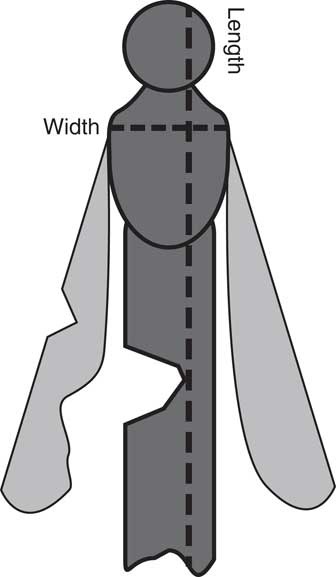
Stereomicroscopic analysis was used to measure body area. The lengths and widths of insects were measured based on photomicrographs using ImageJ. An insect’s “length” constituted the longest straight line on an insect’s body from its anteriormost point to its posteriormost point available for measurement (Fig. 4). This was not always necessarily on the midline, and if it was not, the length measured ran as close to parallel to the original midline as possible. An insect’s “width” constituted the longest straight line on an insect’s body or preserved body part(s) approximately perpendicular to the insect’s length. Beetles presented a particular challenge in width measurements, since the elytra could sometimes obscure the abdomen, and the abdomen was often the widest part of the insect’s body. Whenever this occurred, the elytra were not included in the width measurement unless it was obvious they were flush with the body. Otherwise, wings or elytra were generally not considered part of an insect’s width, unless they were the only morphologies preserved. In these cases, the basal-to-apical dimension of the largest available wing or elytron was the length, and the dimension perpendicular to this the width.
A cartoon illustrating an example of how insect dimensions were measured in this study. The length follows the longest contiguous anteriormost to posteriormost line in the fossil parallel to the midline. In this instance, this is not the midline itself, as there is a gap in preservation in the abdomen that crosses the fossil’s long axis. The width is perpendicular to the length but does not include the wings.

Insect orientation was initially included when scoring the preservation quality and measuring the completeness and body dimensions of insects. Initial analyses revealed a lack of meaningful trends in the collected data, and most insects were preserved dorsoventrally regardless of site. However, non–dorsoventrally preserved insects could not be accurately measured for true, transverse width. Thus, only insects preserved in the dorsoventral position had their dimensions statistically analyzed in order to keep the definition of “width” consistent.
Statistical analysis was accomplished first by multiplying the lengths and widths of individual insects together to calculate an area, which was log transformed for greater normalcy of distribution. For each site, distribution normalcy was checked with Shapiro-Wilk tests and examination of diagnostic plots. As all log-transformed area distributions were shown to be normal or nearly so, one-way ANOVA was used to compare the distribution of areas for all Paleoburn insects with all Anvil Points insects and the Paleoburn beetles with the Anvil Points beetles.
All statistical analyses were performed in JMP Pro, Version 11. Full spreadsheets of all the data recorded, including raw morphological data on the insects and all statistical data, are available as a Supplementary Table at Dryad (doi:10.5061/dryad.mf19q). Photos and information about the specimens can be requested from the University of Colorado Natural History Museum.
Results
Taxonomic Composition of the Paleoburn and Anvil Points Sites
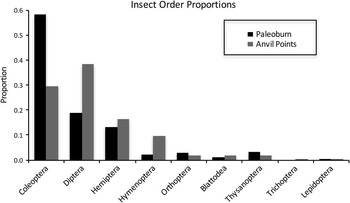
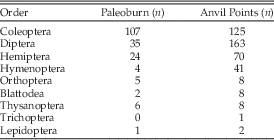
In total, 690 insects were analyzed for this study: 224 insects were described from the Paleoburn and 466 were described from Anvil Points. Of the 224 insects identified at the Paleoburn site, 184 (82%) could be identified to order, and 426 of 466 insects (91%) could be identified to order at the Anvil Points site. Eight insect orders were identifiable at the Paleoburn, and nine were identified at Anvil Points. At both sites, the Coleoptera (beetles), Diptera (flies), and Hemiptera (true bugs, leafhoppers, aphids, and kin) are the most abundant orders but their proportions are very different (Table 2, Fig. 5). The Coleoptera, Diptera, and Hemiptera constitute 58.2%, 19.0%, and 13.0% of the insects identified to order at the Paleoburn and 29.3%, 38.3%, and 16.4% of the insects identified to order at Anvil Points, respectively. There are also a moderately large number of Hymenoptera (bees, wasps, and ants) at Anvil Points (9.6%), but these are quite rare at the Paleoburn (2.2%). Among the minor orders, there are comparable proportions of Orthoptera (crickets and grasshoppers), Thysanoptera (thrips), and Blattodea (cockroaches) between the two sites. Rare orders include the Trichoptera (caddisflies, not represented at all at the Paleoburn and by one individual at Anvil Points) and Lepidoptera (butterflies and moths).
The proportional distribution of insects identified to order from the Paleoburn, where insects are mineralized as iron oxides, and Anvil Points, where insects are keroginized as carbonaceous compressions. Although eight orders are shared between the sites, their proportional distribution is considerably different. The most abundant insects at the Paleoburn are the beetles, whereas at Anvil Points the most abundant insects are the flies.

Taxonomic tallies of the insects identified to order from the Paleoburn and Anvil Points sites.

A chi-squared test shows that the relative abundance of orders is significantly different between the sites (χ2=85.4; p<10−4; df=8), and this is not surprising. At the Anvil Points site, the Diptera constitute the plurality of the insects identified, but there are major contributions to the total from the Coleoptera, Hemiptera, and Hymenoptera as well (Table 2, Fig. 5). At the Paleoburn site, 58.2% of the insects identified to order are Coleoptera, while only 19% belong to the next most abundant order, the Diptera. As predicted, the most abundant order at the Paleoburn is the Coleoptera, which have a tendency to be well armored and heavily sclerotized.
Preservational Fidelity for Individual Morphological Categories
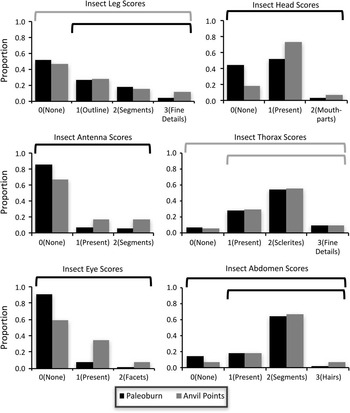
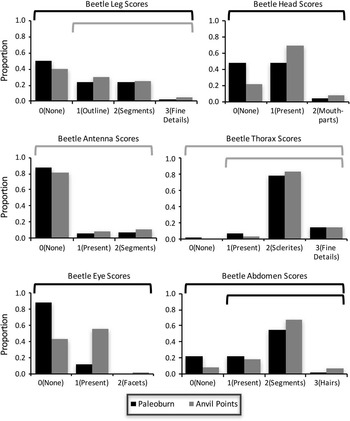
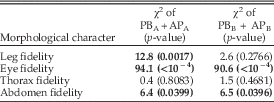
Generally, the distribution of quality scores confirmed our predictions: the iron-oxide insects of the Paleoburn tended to have less preservational fidelity of anatomical details (if the specific morphology was preserved at all) compared with the kerogenous Anvil Points insects (Table 3, Figs. 6, 7). When comparing all Paleoburn insects with all Anvil Points insects, the distribution of scores for leg (χ2=12.8; p=0.0017; df=2), eye (χ2=94.1; p<10−4; df=1), and abdomen (χ2=6.4; p=0.0399; df=2) preservation fidelity was statistically significant between the sites, but the distribution of scores for thorax preservation fidelity was not (χ2=0.4; p=0.8083; df=2). When comparing only the beetles from the Paleoburn and Anvil Points sites, the distribution of thorax scores was not significantly different (χ2=1.5; p=0.4681; df =2), but differences in eye (χ2=90.6; p<10−4; df=1) and abdomen distributions (χ2=6.5; p=0.0396; df=2) were. Leg preservation-fidelity scores were not significantly different between the sites (χ2=2.6; p=0.2766; df=2). In every instance in which there was a significant difference between iron oxide and keroginized morphological categories, the higher preservation-fidelity scores tended to belong to the insects and beetles from the keroginized Anvil Points.
The distribution of quality scores for the individual morphological categories of the insects from the Paleoburn and Anvil Points sites. Brackets over the scores indicate that a chi-squared or Fisher’s exact test assessed the significance of proportional differences between sites. A bracket over all the potential scores indicates an articulation-state test for the morphological category (except for eye scores, where this indicates a preservational-fidelity test comparing the proportions of “discernible” and “indiscernible” eyes), and a bracket over the nonzero quality scores indicates a preservational-fidelity test for the morphological category. A black bracket denotes significance, while a gray bracket denotes nonsignificance. Although there is individual variation from trait to trait, higher scores tend to belong to Anvil Points specimens.

The distribution of quality scores for the individual morphological categories of only the beetles analyzed from the Paleoburn and Anvil Points sites. The meaning of the brackets is the same as in Fig. 6. Some categories, like legs and thoraces, show similar distributions of scores between sites, but higher scores are still generally assigned to Anvil Points beetles.

Results of chi-squared tests for differences between the fossil sites in the preservational fidelity of anatomical detail for individual morphological categories. Statistically significant values are given in bold. Abbreviations for the groups compared: PBA+APA, the group comparing all insects from the Paleoburn and Anvil Points sites; PBB+APB, the group comparing all beetles from the Paleoburn and Anvil Points sites.

Measures of Articulation
Articulation States for Individual Morphological Categories
Contrary to our predictions, the comparison of the articulation states of the individual morphological categories were often significantly different between the iron-oxide insects of the Paleoburn and the kerogenous insects of the Anvil Points (Table 4, Figs. 6, 7). When all Paleoburn insects were compared with all Anvil Points insects, the traits of antennae, heads, and abdomens were found to be preserved significantly less frequently at the Paleoburn (p<10−4 for each morphological category; Table 4). There was no significant difference in the frequency of preservation of legs and thoraces between the sites. For thoraces, this is not surprising as virtually all the insects had their thorax preserved at both the Paleoburn and Anvil Points. The lack of a significant difference for legs could likely be explained by the fact that an insect only needs to have one of its six legs preserved for legs to be counted as “present.”
Results of chi-squared tests for differences between the fossil sites for some indicators of insect articulation. These include the presence or absence of individual morphological categories and the number of preserved legs on fossils. An asterisk (*) indicates that a Fisher’s exact test was used, and the value given is the Fisher’s exact test table P (p-value in parentheses). Statistically significant values are given in bold. Abbreviations for the groups compared: PBA + APA, the group comparing all insects from the Paleoburn and Anvil Points sites; PBB + APB, the group comparing all beetles from the Paleoburn and Anvil Points sites.

Nonetheless, when the comparison between the Paleoburn and Anvil Points sites was confined to beetles, the differences in leg articulation state were significant (χ2=4.9; p=0.0271; df=1), due to a decrease in the proportion of insects with no preserved legs at the Anvil Points site when only the beetles were examined. The differences in the articulation state of antennae were not significant (χ2=2.6; p=0.1082; df=1) when only the beetles were considered, due to an increase in the proportion of antenna absence at Anvil Points. The frequency of preservation of these two morphologies changed little between analyses at the Paleoburn, which is not surprising, considering that most insects at the Paleoburn are beetles. The significance state for the other morphological categories did not change between analyses (Table 4).
Number of Articulated Legs and Antennae
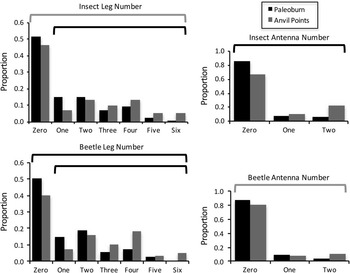
The distribution of the number of preserved legs followed patterns similar to the preservation-fidelity score distributions and articulation-state distributions of the individual morphological categories. When the Paleoburn and Anvil Points sites were compared, larger numbers of legs tended to be found at the Anvil Points site. Still, all possible leg counts were represented, with the exception of Paleoburn beetles, for which there were no examples of beetles with six legs (Fig. 8). Leg numbers were significantly different between the two sites (Table 4), whether all insects were considered (χ2=47.9; p<10−4; df=5) or just the beetles (Fisher’s exact test P=5.80 × 10⁻⁷; p=0.0101). Antennae number did not prove to have the same amount of distribution variation as leg number, and most insects did not have preserved antennae at all (Fig. 8).
The distribution of quantity counts for the numbers of legs and antennae preserved on insects for both the sites analyzed in this study. Brackets over the counts indicate that a chi-squared or Fisher’s exact test assessed the significance of proportional differences between sites. A bracket over all the potential counts indicates an articulation-state test for the morphological category, and a bracket over the nonzero counts for legs indicates a test comparing the number of legs possessed by specimens between sites. A black bracket denotes significance, while a gray bracket denotes nonsignificance. While the variation in leg number proved amenable to statistical analysis, the variation in antenna number was best explained with a simple articulation-state test, since the preservation of one antenna was relatively rare at both sites.

Completeness of Entire Insect Bodies
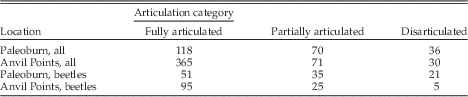
For all sites, fully articulated specimens were the most common, while there were large numbers of partially articulated specimens, and relatively few disarticulated specimens (Table 5). The specific articulation states of partially articulated and disarticulated specimens varied widely, with thoraces and abdomens (T+A), heads and thoraces (H+T), and isolated elytra (E) being particularly abundant between the sites (see the Supplementary Table). The partial articulation state of T+A was particularly common at the Paleoburn site, where 50 of the 224 specimens had this state when considering all insects, and 29 of 107 specimens were assigned this state when considering only beetles.
Distribution of articulation states assessing the completeness of entire insect bodies for the insects found at the sites analyzed in this study.

When comparing the Paleoburn and Anvil Points sites for all specimens, it is interesting to note that the two sites have nearly equal numbers of partially articulated (70 and 71, respectively) and disarticulated (36 and 30, respectively) specimens, despite the fact that there were 466 specimens considered at the Anvil Points site compared with the Paleoburn’s 224 (Table 5). Not surprisingly, when statistically comparing all Paleoburn insects to all Anvil Points insects, the distribution of articulation states was highly significantly different (χ2=47.879; p<10−4; df=2), as it was when comparing the Paleoburn beetles to the Anvil Points beetles (χ2=23.518; p<10−4; df=2). In both analyses, there were greater degrees of disarticulation at the Paleoburn.
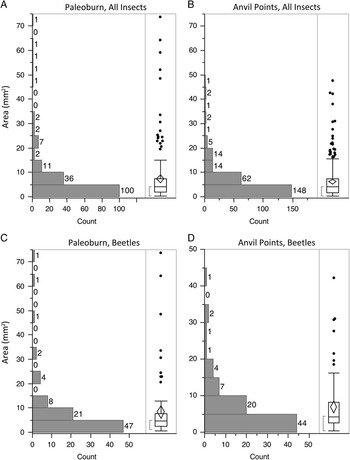
Measured Body Area of Insects
The analyses comparing the body sizes of the fossil insects were the opposite of what we had predicted, as there were no significant size differences between iron-oxide and carbonaceous compression insects at the Green River Formation. The raw distributions of areas of insects and beetles from the Paleoburn and Anvil Points sites (Fig. 9) conform to log-normal distributions (see the Supplementary Table). The mean areas of insects and beetles from the Paleoburn (7.40 mm2 and 8.38 mm2, respectively) are larger than those of the insects and beetles from the Anvil Points (6.23 mm2 and 6.93 mm2, respectively), but these differences are not significant (Table 6). One-way ANOVA of the log-transformed body areas for the analysis comparing all insects from the Paleoburn with all insects from the Anvil Points (F 413,1=0.2865; p=0.5928) is not significant, nor is the analysis comparing Paleoburn beetles with Anvil Points beetles (F 163,1=0.4733; p=0.4925).
The distribution of untransformed measurements of areas from the Paleoburn and Anvil Points sites. Areas reported are in square millimeters. Numbers on each column in the histogram are the total number of specimens in each bin. Box-and-whisker plots also showing the mean (diamond) and outliers are to the right of the histograms. A, The areas of all dorsoventral Paleoburn insects. B, The areas of all dorsoventral Anvil Points insects. C, The areas of all dorsoventral Paleoburn beetles. D, The areas of all dorsoventral Anvil Points beetles.

The means and standard deviations of the body areas of the insects analyzed in this study and the results of ANOVA tests comparing the distributions of the log-transformed areas for the two analysis groups. Abbreviations for the groups compared: PBA + APA, the group comparing all insects from the Paleoburn and Anvil Points sites; PBB+APB, the group comparing all beetles from the Paleoburn and Anvil Points sites.

Discussion
Taphonomic Bias of Insects between Iron-Oxide Mineralization and Keroginization
As predicted, the preservation quality of mineralized insects at the Paleoburn site of the Green River Formation was consistently lower and indicated greater degrees of decay and degradation than at the Anvil Points site, where insects are keroginized. For example, among insects identifiable to order, a significantly greater proportion of the generally better-sclerotized and armored beetles were preserved at the Paleoburn site compared with the Anvil Points site (Fig. 5). This would be expected if greater decay had already destroyed, or rendered unrecognizable, individuals from more fragile orders. However, this overall trend of poorer preservation quality at the Paleoburn was not as strong as originally predicted. Looking again at the distribution of taxa, the total numbers of orders at the iron-oxide Paleoburn and keroginized Anvil Points sites were very similar (Table 2). Only the caddisflies (Trichoptera) were present solely at the Anvil Points site. Although this study did not emphasize family-level comparisons, many common families were also recognizable at both sites, including ground beetles (Carabidae), weevils (Curculionidae), rove beetles (Staphylinidae), and crane flies (Tipulidae; see the Supplementary Table). This corroborates previous evidence that has shown that family-level identification is possible even with relatively poor quality lacustrine insect specimens (Smith and Moe-Hoffman Reference Smith and Moe-Hoffman2007).
Individual morphological components were more often absent or of lower preservational fidelity at the Paleoburn site compared with the Anvil Points site (Figs. 6–8), but these differences often did not rise to the level of statistical significance (Tables 3, 4). When comparing all insects between the Paleoburn and Anvil Points, the preservation-fidelity score distributions were significantly different for three of the four morphological categories considered (leg, eye, and abdomen fidelity were significantly different; thorax fidelity was not). Given the preponderance of beetles preserved at the Paleoburn, it might be expected that if the taxonomic signal imparted by the large numbers of insects from other orders at the Anvil Points site were removed there would be greater similarity in the preservational quality between the two sites. This is indeed the case for preservational fidelity of individual morphological categories. Only the differences in eye and abdomen scores remained significantly different when analyzing only the beetles from the Paleoburn and Anvil Points sites.
We had initially predicted that the articulation state of insects should be similar between the two sites. In fact, preservation-quality differences between the preservation pathways were much more evident when considering patterns of articulation compared with the preservational fidelity of anatomical details. Three of the four analyzed individual morphological categories had significantly different articulation-state distributions, regardless of whether all insects or only beetles were compared (Table 4). In addition, Paleoburn insects always had significantly fewer preserved legs (Table 4) and were significantly more disarticulated when body completeness was considered (all insect analysis: χ2=47.879; p<10−4; df=2; beetles-only analysis: χ2=23.518; p<10−4; df=2). Thus, it seems that if mineralized Paleoburn insects can survive the potential of disarticulation they can be preserved with a degree of fidelity similar to their keroginized counterparts as long as effects of taxonomic bias are taken into account.
The Timing of Insect Degradation
While the difference in preservation quality between the Paleoburn and Anvil Points sites was expected, the concentration of these differences in measures of articulation was not. The predicted reason for the lower quality of Paleoburn insects is the extended period of microbial decay needed to generate the ions—sulfide and potentially ferrous iron—that mineralized them. The bulk of mineralization should take place during early diagenesis, when burial and isolation allow for the establishment of microenvironments proximal to the organism that can promote mineralization over outright decay (Raiswell et al. Reference Raiswell, Whaler, Dean, Coleman and Briggs1993; Briggs and Kear Reference Briggs and Kear1994; Sagemann et al. Reference Sagemann, Bale, Briggs and Parkes1999). Gross disarticulation should take place during the biostratinomy stage, before final burial and mineralization, since freshly deceased organisms require prolonged decay and disturbance before they will disarticulate (Martínez-Delclòs and Martinell Reference Martínez-Delclòs and Martinell1993; Duncan et al. Reference Duncan, Titchener and Briggs2003; Smith et al. Reference Smith, Cook and Nufio2006). Disarticulation during reworking after mineralization is a possibility, but not a likely one at the finely laminated profundal shales of the Green River Formation, which are indicative of quiet-water deposition (Tänavsuu-Milkeviciene and Sarg Reference Tänavsuu-Milkeviciene and Sarg2012). The iron enrichment found in the Paleoburn insects is also common to the entire outcrop, and they were likely mineralized in situ (personal observation). Thus, it seems likely that the greater degree of disarticulation of insects at the Paleoburn site reflects a greater duration of time or exposure to higher levels of energy in the biostratinomy stage before the insects’ final transport to and burial in the Paleoburn locality.
It is difficult to estimate the extent and exact source of biostratinomic differences at this point in time. The Paleoburn and Anvil Points sites were both deposited when Lake Uinta was at its broadest and deepest, and the location of its shoreline—and thus the transport distance to the site of fossilization—is poorly constrained (Tänavsuu-Milkeviciene and Sarg Reference Tänavsuu-Milkeviciene and Sarg2012). The similar low-energy sedimentological conditions shared by the sites also offer few clues as to the source of biostratinomic differences. In truth, these differences may not have been great. Body-size differences in insect fossils can be a result of biostratinomic effects (Wilson Reference Wilson1980; Smith et al. Reference Smith, Cook and Nufio2006; Smith and Moe-Hoffmann Reference Smith and Moe-Hoffman2007), but the body sizes of Paleoburn and Anvil Points insects and beetles are not significantly different from one another. Differences in insect taxonomic proportions, which are significant in this study, may also be indicative of differential biostratinomy (Wilson Reference Wilson1980; Smith Reference Smith2000), but this trend is equivocal (Smith and Moe-Hoffmann Reference Smith and Moe-Hoffman2007; Thoene-Henning et al. Reference Thoene-Henning, Smith, Nufio and Meyer2012). Further, the effects of mineralization were predicted to produce a bias toward the preservation of more recalcitrant orders (i.e., beetles), and this trend was, in fact, observed (Fig. 5). Differences in taxonomic proportions are therefore likely to be, at most, only partially attributable to biostratinomic differences.
An additional source of taphonomic bias to consider is that of finer details lost during later diagenesis. In the case of the Paleoburn insects, there is a strong possibility that many individual specimens were initially mineralized with finer levels of detail and higher preservation-fidelity scores, but during the later oxidation and “rusting” that pervades the Paleoburn rocks, these details may have been obscured. Sometimes, oxidation could even lead to the change of the articulation state of an insect. Figure 3E shows one example where the head of a beetle has been obscured by an overgrowth of iron oxide. The head of this beetle was given a score of 0, or an articulation state of “absent,” since no direct evidence of a head was visible. Many other Paleoburn insects show iron-oxide overgrowths or “haloes” that reduce detail and were obviously late diagenetic (Walker et al. Reference Walker, Dahlberg, Anderson, Leckey and Smith2013).
Thus, it appears that the lower preservational quality seen at the Paleoburn site compared with the Anvil Points site is a taphonomic bias that emerged over multiple taphonomic stages, but the circumstances that produced this composite bias are compatible with one another. The greater concentration of ions (sulfate and ferrous iron, assuming initial pyritization) that promoted the mineralization of insects at the Paleoburn would require a mechanism for their concentration in the water column or pore water in the first place. The Paleoburn site could have been deposited in an isolated area within Lake Uinta, perhaps subaqueously bound by a silled basin that allowed for a local salinity profile to develop that was different from the lake at large. The Paleoburn area of the lake could also have been supplied with water or sediment carrying a greater abundance of ions. In the latter case, more energetic nearshore and onshore conditions would favor the delivery of more ions to the deeper lake. Higher-energy conditions would be sympathetic to the greater amounts of disarticulation of insects that occurred before their final transport and burial in the profundal Paleoburn sediments. The elevated ion concentrations in the Paleoburn pore waters would promote the establishment of microbial communities that would ultimately mineralize the insects. This mineralization would require the insects’ partial degradation, resulting in a reduction of the preservational fidelity of morphological details that were not well-sclerotized. Individuals from less sclerotized families and orders may have been degraded entirely, leading to a preferential preservation of sclerotized beetles. Once mineralized, the pyrite, and later hematite, insects would be highly susceptible to further oxidation. The resultant dissolution or recrystallization of iron minerals would have the potential to destroy finer details during late diagenesis.
Carbonaceous compression insects of the Green River Formation, on the other hand, were likely preserved in open lake situations, possibly far from direct fluvial input sources that could supply sulfate and iron ions and disturb and disarticulate insect carcasses during times of higher runoff. With a low supply of ions useful in microbial metabolism and low-energy conditions, “regular” Green River Formation insects like those found at Anvil Points (and other locations throughout the formation) would experience a minimum of microbial degradation and physical disturbance. This would allow for their keroginization with relatively high preservational fidelity and high degrees of articulation. Even infiltration of late diagenetic oxidizing fluids, which could dissolve away the organic carbon, can leave behind molds that still preserve the impressed details of former insects (personal observation), unobscured by the rusty overgrowths typical of Paleoburn insects.
Implications for Comparisons of Mineralized and Keroginized Soft-Bodied Fossils
For paleontologists who study mineralized soft-bodied fossil deposits, or who are interested in comparing keroginized and partially or fully mineralized soft-bodied fossils from other periods and depositional environments, the results of the present study offer some general guidelines to direct their investigations. First, articulation-state differences between the two sites studied here are due to the loss of body parts other than the thorax at the mineralized Paleoburn. When deposits are compared, they should have similar biostratinomic histories so that biases in articulation are not introduced, particularly to more peripheral morphologies. Fortunately, this is the case for numerous Paleozoic soft-bodied Lagerstätten, many of which are obrution deposits (e.g., Seilacher et al. Reference Seilacher, Reif and Westphal1985; Xian-Guang et al. Reference Xian-Guang, Aldridge, Bergström, Siveter, Siveter and Xiang-Hong2004; Farrell et al. Reference Farrell, Briggs and Gaines2011; Gaines et al. Reference Gaines, Hammarlund, Hou, Qi, Gabbott, Zhao, Peng and Canfield2012).
Second, when taxonomic comparisons are to be made between keroginized and mineralized organisms, it is best to base them on the most heavily sclerotized portions of the body. This is particularly true of the body core. The thorax, usually the most heavily sclerotized component of an insect, is preserved comparably well at both the Paleoburn and Anvil Points sites. Further, a score of 2 is most common at the sites, indicating that the average thorax has some finer details preserved. With this in mind, when describing new organisms that can be both keroginized and mineralized, it is best to base the descriptions on features of the most heavily sclerotized portions of the body, like the body core. Features on limbs or other appendages should be of secondary importance. This will increase the likelihood that the organism could be recognized in both keroginized and partially or fully mineralized deposits. For example, the dorsal sclerites of lobopods could make a better basis for descriptions, rather than appendage claws (Xian-Guang et al. Reference Xian-Guang, Aldridge, Bergström, Siveter, Siveter and Xiang-Hong2004).
Third, when comparing the relative taphonomic bias on preservation fidelity imparted by mineralization, it is best to examine morphologies adjacent to the body core. In the current study, differences in preservation fidelity between keroginized and pyritized insects were most strongly expressed in morphologies adjacent to and more labile in composition than the thorax. Specifically, finer details of the abdomen and legs and the discernibility of the eyes were often lost at the Paleoburn site. Alternatively, many older soft-bodied deposits contain organisms of uncertain taxonomy, and these may have poorly constrained histologies (Butterfield Reference Butterfield1995, Reference Butterfield2002; Briggs Reference Briggs2003; Zhang and Briggs Reference Zhang and Briggs2007). If these organisms are represented in both keroginized and mineralized deposits, the relative preservational fidelity of their tissues between preservation pathways can offer clues as to their original composition and functional nature. These interpretations will be enhanced if compared alongside better-known organisms from these deposits.
Finally, quantitative comparisons of the compositions of keroginized and mineralized communities should be done between groups with similarly recalcitrant histologies. In this study, as predicted, more recalcitrant taxa were represented in greater proportion at the mineralized Paleoburn site. Recalcitrant taxa are likely overrepresented in other mineralized deposits as well, at least when compared with keroginized deposits. Thus, the Hunsrück Slate’s proportion of arthropods is not directly comparable to their proportion in the Burgess Shale, since more labile groups will likely not be represented at the same rates in the pyritized Hunsrück Slate. The less sclerotized and rare taxa of a mineralized site can be found, however, although it may take a large sample size and a great collection effort. For example, only recently has the anomalocaridid-like Schinderhannes bartelsi been found at the Hunsrück Slate (Kühl et al. Reference Kühl, Briggs and Rust2009).
It is important to note that the greater taphonomic bias toward lower preservation quality in mineralized fossils—and use of the guidelines above—applies only when the mineralizing components are actively generated by microbial activity. Pyritization is most typical of this mineralization style. Other mineralizing pathways, like aluminosilicification and phosphatization, can effect fossilization very rapidly and preserve even labile materials like muscles with high fidelity (Martill Reference Martill1990; Wilby and Briggs Reference Wilby and Briggs1997; Gabbott Reference Gabbott1998). Still, this study demonstrates that with a careful eye and a large sample size, soft-bodied fossils preserved along pathways like pyritization can be almost as paleontologically valuable as their keroginized counterparts.
Summary
This study compared the preservation quality of insects from the mineralized Paleoburn site and the keroginized Anvil Points site at the Green River Formation in the Piceance Creek Basin of Colorado in order to test whether mineralization by preservation pathways like pyritization have a more negative influence on the overall preservation quality of soft-bodied fossil material than keroginization. This greater bias toward more recalcitrant matter and lower preservational fidelity should be due to the greater activity of the microbial community required to generate ferrous iron and sulfide ions, compared with the relatively direct preservation of organic matter into kerogenous fossils (Fenchel and Finlay Reference Fenchel and Finlay1995; Briggs Reference Briggs1999; Yuan et al. Reference Yuan, Xiao, Li, Yin and Cao2001; Gupta et al Reference Gupta, Michels, Briggs, Evershed and Pancost2006; Wang et al. Reference Wang, Zhao, Zhang, Fang and Zheng2012; Schiffbauer et al. Reference Schiffbauer, Xiao, Cai, Wallace, Hua, Hunter, Xu, Peng and Kaufman2014). However, the mineralization process, which occurs after taphonomic isolation in early diagenesis, should not impart a bias on articulation patterns between pathways (Martínez-Delclòs and Martinell Reference Martínez-Delclòs and Martinell1993; Duncan et al. Reference Duncan, Titchener and Briggs2003; Martínez-Delclòs et al. Reference Martínez-Delclòs, Briggs and Peñalver2004; Smith et al. Reference Smith, Cook and Nufio2006).
As predicted, there is a bias toward lower preservation fidelity of morphologies and more recalcitrant organic material when comparing mineralization with keroginization. The generally robust beetles were preserved in greater proportions and the relatively delicate flies in lower proportions at the Paleoburn compared with the Anvil Points site. Preservation-fidelity scores of individual morphological categories were also usually lower, sometimes significantly so, at the Paleoburn site. However, the differences in measures of articulation between the Paleoburn and Anvil Points sites were greater than those seen for the distribution of preservation-fidelity scores. This greater disarticulation of the Paleoburn specimens likely occurred during the biostratinomy phase of taphonomy.
Thus, the taphonomic bias toward lower overall preservation quality of Paleoburn insects was imparted in more than just the early diagenesis stage, when initial mineralization occurred, but also earlier in the biostratinomy stage, and later during late diagenesis, when rusting and iron-oxide crystal overgrowth at the Paleoburn site could further obscure details of potentially high-quality specimens. A shared set of depositional circumstances can explain this bias incurred during multiple stages of the taphonomic process. The increased ion concentration required for mineralization over keroginization would be encouraged by increased ion delivery, and thus higher-energy conditions that could lead to disarticulation. The precipitated minerals would also be susceptible to later diagenetic oxidation. It would be interesting to see whether the taphonomic biases seen between keroginized and pyritized insects at the Green River Formation could be replicated for the keroginized and pyritized insects of other sites like the Jehol Biota (Wang et al. Reference Wang, Zhao, Zhang, Fang and Zheng2012). Such comparisons are likely to reveal shared environmental attributes that promote the pyritization of soft-bodied fossils in lacustrine settings.
Overall, while mineralized insects do not show preservation quality that is as high as those preserved by keroginization, the differences are not as great as might be expected. The results of this study suggest that direct quantitative comparisons between keroginized and mineralized soft-bodied fossil deposits are possible, as long as certain precautions are taken. Specifically, biostratinomic histories should be similar between deposits, and compared organisms should be of similar organic grade and morphological structure, thus minimizing sources of differential taphonomy (e.g., isolating comparisons only to beetles in this study). When comparing the taxonomic composition of mineralized and keroginized fossil deposits, these comparisons should be based on the morphologies of fossils’ highly sclerotized body cores. On the other hand, preservation-fidelity bias imparted by mineralization is best judged by an analysis of body parts adjacent to the body core. Further, rare mineralized examples can still be preserved very well, and the taxa represented by the two pathways should be broadly similar. This is encouraging for those who study soft-bodied fossil deposits preserved via mineralization pathways, particularly pyritization. This study suggests that with sufficiently large sample size and close inspection, the inherent bias against these mineralized fossils compared with their keroginized counterparts can be minimized such that the two are roughly comparable in terms of their potential usefulness to paleontology and paleobiology.
Acknowledgments
We thank D. Kohls for his guidance, assistance with specimen collection, and for introducing us to the Paleoburn site. T. Karim aided with sample collection, as did L. Walker, who also photographed some of the specimens of Figure 3 and permitted us to use the stratigraphic column of Figure 2. Further photographs were provided by D. Zelagin. The University of Colorado Invertebrate Paleontology group gave helpful feedback throughout the life of the project, as did D. Budd and C. Nufio. We thank the editor, reviewer J. Schiffbauer, and an anonymous reviewer for critical comments that greatly improved the manuscript. We also thank Encana Oil & Gas for permission to access the Paleoburn site. A Colorado Scientific Society Steven S. Oriel Memorial Fund Research Grant provided funds for E.P.A. to visit the Green River Formation. This grant, a Western Interior Paleontological Society Karl Hirsch Memorial Grant, a University of Colorado Natural History Museum Research Award, and a University of Colorado–Boulder Department of Geological Sciences and Shell Oil Company Shell Research Award to E.P.A. provided funds for microscopy work establishing the composition and preservation state of the Green River Formation insects. We also thank the National Science Foundation for providing funding to support the research and digitization of the University of Colorado Natural History Museum fossil insect collections used in this study (EF1305066 and EAR1123802).
Supplementary Material
Data available from the Dryad Digital Repository: http://doi.org/10.5061/dryad.mf19q