Undoubtedly, coronavirus disease 2019 (COVID-19) has created a major public health catastrophe worldwide. There is a relationship between demographic and pre-existing medical conditions and the disease severity in patients with COVID-19. Reference Javanmardi, Keshavarzi and Akbari1 Understandably, people with a past history of chemical war injury may be considered as an at-risk population given the consequences of their injuries. These individuals include a large population in different countries, such as Iran, the United Kingdom, Iraq, Afghanistan, and the United States of America. Reference Oster, Morello and Venning2 People with chemical war injury may suffer from serious consequences, such as respiratory disease, heart failure, and immunodeficiency, due to the exposure to chemical gas warfare (eg, mustard gas). Reference Gerber3 Based on the World Health Organization (WHO) reports, chemical warfare agents have affected thousands of people worldwide and these individuals often have a poor health status. Reference Darchini-Maragheh, Nemati-Karimooy and Hasanabadi4,5 During the years 1980 to 1988, Iraq used chemical weapons against Iran (both against the army and the general population) almost 260 times and victimized more than 100,000 people. Reference Ghaednia Jahromy, Mohsenian and Rezagholizamenjany6
The aim of the current study was to determine whether COVID-19 is associated with a different presenting clinical picture or a more severe course of illness (eg, intubation and death) in people with a past history of chemical war injury; this information might help us understand the severity and the gravity of COVID-19 in these people.
Methods
The current study is a multicenter retrospective study in Fars Province, Iran, from August 22 to October 4, 2020. All consecutive patients who were referred to and were admitted at health-care facilities anywhere in Fars Province (located in the south of Iran with a population of 4,850,000 people) were included. These patients had a confirmed COVID-19 diagnosis by a positive result on quantitative real-time polymerase chain reaction (qRT-PCR) testing of nasopharyngeal and oropharyngeal samples, or a probable COVID-19 diagnosis by a positive chest computerized tomography (CT) scan characteristic for COVID-19, or a possible COVID-19 diagnosis by clinical manifestations (ie, history and physical exam) compatible with COVID-19. All people with a past history of chemical war injury and a recent COVID-19 diagnosis were selected from the database. We also included 2 control groups from the same database of patients who were hospitalized with COVID-19 (double the size of the patient group, each): (I) Control group: age- and sex-matched group without any underlying diseases, (II) Pseudocontrol group: age- and sex-matched, and also matched for the underlying medical problems (eg, diabetes, heart disease, pulmonary disease, etc.).
All the required data of the included patients such as age, sex, COVID-19 symptoms, underlying diseases (self-declared), intensive care unit (ICU) admission, the need for intubation, and the final outcome (dead or discharged) were extracted from the recorded database of the Fars electronic registry of COVID-19 patients. This study was approved by the Shiraz University of Medical Sciences ethics committees with the code: IR.SUMS.REC.1399.022.
Statistical Analysis
The data are described with proper descriptive statistics (qualitative variables with frequency and percentage and quantitative variables with mean ± standard deviation [SD]). The proportions were compared with Pearson chi-squared test in univariate analyses. Kaplan-Meir statistics and log-rank test were used to evaluate the survival over time between the groups. Variables with a P value less than 0.2 in univariate analyses were included in a logistic regression analysis model, and the odds ratio (OR) and 95% confidence intervals (CIs) were calculated. All the statistical analyses were conducted with the Statistical Package for Social Sciences (SPSS) version 22, and the statistical significance was considered as less than 0.05.
Results
During the study period, the total number of the people who were hospitalized with COVID-19, was 8500 patients; 46 people with a past history of chemical war injury were hospitalized with COVID-19 (all were men). The age range of the patients with a past history of chemical war injury was 46-86 y old, and the mean (±SD) was 59.91 (±8.55) y. The presence of pre-existing medical illnesses in patients with a past history of chemical war injury was as follows: hypertension (26.08%), pulmonary diseases (23.91%), diabetes (23.91%), cardiac diseases (8.69%), neurological disorders (4.34%), cancer (2.17%), and renal diseases (2.17%). The reported complications after the chemical war injury was pulmonary problems in 61.11% and skin problems in 14.61%. (the rest did not remember or had multiple issues). Fifteen (32.60%) patients had suffered from sulfur mustard gas, 2 others from nerve agents, and others were not aware of the kind of the chemical substance that they suffered from.
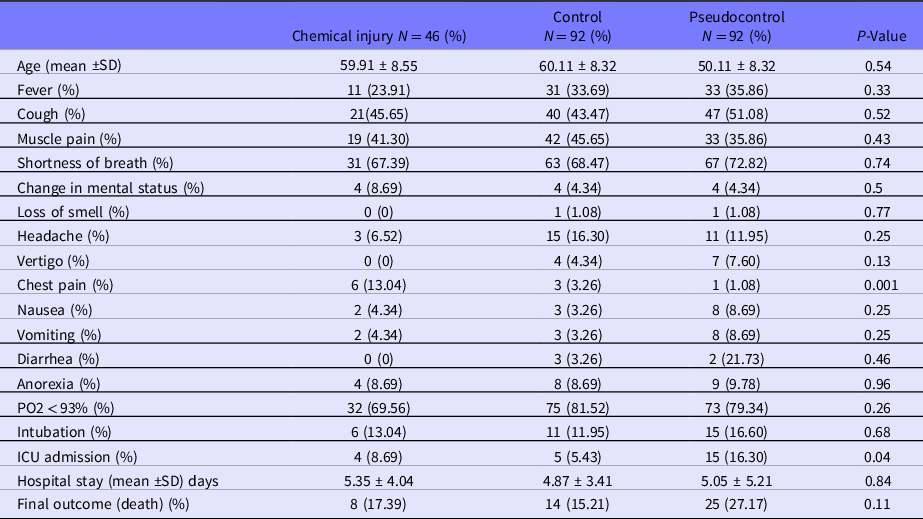
Table 1 shows the presenting signs and symptoms of the patients who were admitted with COVID-19. Chest pain was significantly more frequent among patients with COVID-19 and a past history of chemical war injury compared with that in others. Other clinical manifestations of COVID-19 were similar between the groups. Duration of hospital stay and intubation rates were not significantly different between the groups, but ICU admission happened more often in the pseudocontrol group. Mortality rates were 17.39%, 15.21%, and 27.17% in patients with a past history of chemical war injury, the control group, and the pseudocontrol group, respectively; the difference was not statistically significant. The survival time was not significantly different between the groups (log-rank = 2.79; P = 0.24).
Characteristics of the studied patients

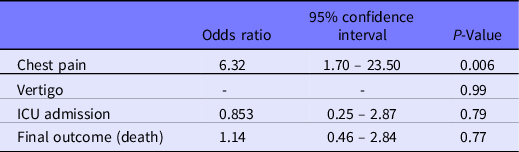
We included the variables with a P < 0.2 (in univariate analyses) (ie, vertigo, chest pain, ICU admission, and the final outcome) in a regression analysis model. Table 2 shows the factors in association with a previous history of chemical war injury in a regression analysis model. People with COVID-19 and a past history of chemical war injury significantly more often presented with chest pain (OR = 6.32). The other variables lost their significance.
COVID-19 related factors in association with a previous history of chemical war injury in a regression analysis model

Discussion
In the current study, we observed that the presenting clinical manifestations and the outcome of COVID-19 in people with a past history of chemical war injury were similar to other groups of patients. There is no comparable study in the literature yet, but our results negate a previous hypothesis that was published in 2020 on the subject of interest. Reference Farnoosh, Ghanei and Khorramdelazad7
The only exception was “chest pain” that was more often a presenting manifestation of COVID-19 in people with a past history of chemical war injury compared with that in others. In a study of 34,000 Iranian survivors of mustard gas exposure, 14,450 (42.5%) people had pulmonary problems Reference Khateri, Ghanei and Keshavarz8; therefore, it is not surprising to more often present with chest pain (in COVID-19) when there is a past history of chemical war injury, as we observed in the current study. Mustard gas has both acute and chronic adverse effects on the respiratory system. Acute adverse effects of this chemical agent include cough, shortness of breath, and burning sensation in the chest, hemoptysis, inflammation of the airways, pneumonia, and acute respiratory distress syndrome. Over time, these problems may become chronic. Reference Farnoosh, Ghanei and Khorramdelazad7 Our observations that a past history of a chemical war injury does not add to the risk of COVID-19 and does not modify its clinical picture are intriguing and should be replicated in other studies.
While we cannot provide any concrete explanation for the observation that mortality of COVID-19 in people with a past history of chemical war injury was similar to that in other groups of patients in Iran, we can speculate that ethnicity and race may play roles here. A previous study of COVID-19 patients from the United States showed that the relative mortality and case-fatality rates of black veterans, when compared with white veterans, were 2.83 (CI 2.56-3.14; P < 0.001) and 0.75 (CI 0.68-0.82; P < 0.001), respectively. Reference Luo, Jeyapalina and Stoddard9 In another study from the United States, among patients with COVID-19, the risks for respiratory, neurological, renal complications, and sepsis were higher among non-Hispanic Black or African American patients, patients of other races, and Hispanic or Latino patients compared with those in non-Hispanic White patients, even after adjusting for age and underlying medical conditions. Reference Cates, Lucero-Obusan and Dahl10 We do not have such racial diversities in Iran and we cannot provide such data in the current study.
Limitations
We only studied the hospitalized patients with COVID-19, and the results could be different in the general population (including asymptomatic and mild cases of COVID-19). In addition, we did not have access to the whole medical records of the patients to clarify the full clinical picture of these patients. Furthermore, we did not inquire about other problems (eg, posttraumatic stress disorder) that might have relations with symptoms, such as chest pain in this special group of patients.
Conclusions
A past history of a chemical war injury does not add to the risk of COVID-19, and does not significantly modify its clinical picture either.
Supplementary material
To view supplementary material for this article, please visit https://doi.org/10.1017/dmp.2021.137
Data availability statement
The data used in this study are confidential and will not be shared.
Author Contributions
Ali A. Asadi-Pooya, MD: Designed and conceptualized the study; analyzed the data; drafted and revised the manuscript. Others: Data collection, analyzed the data, and revised the manuscript.
Conflict of interest
Ali A. Asadi-Pooya, MD: Honoraria from Cobel Daruo, RaymandRad, Sanofi, and Tekaje; Royalty: Oxford University Press (book publication). Others: none.