Introduction
Voxel-based morphometry (VBM) in chronic schizophrenia consistently shows significant reduction in regional grey-matter density in the insula (Glahn et al. Reference Glahn, Laird, Ellison-Wright, Thelen, Robinson, Lancaster, Bullmore and Fox2008; Segall et al. Reference Segall, Turner, van Erp, White, Bockholt, Gollub, Ho, Magnotta, Jung, McCarley, Schulz, Lauriello, Clark, Voyvodic, Diaz and Calhoun2009). Consistent reduction in volume of the anterior cingulate has also been reported in schizophrenia (Baiano et al. Reference Baiano, David, Versace, Churchill, Balestrieri and Brambilla2007). Grey-matter reductions in these regions appear early in the course of illness. In addition to those with first episode of illness, individuals with prodromal symptoms who later develop frank psychosis also show significant reductions in insular and anterior cingulate grey matter (Pantelis et al. Reference Pantelis, Velakoulis, McGorry, Wood, Suckling, Phillips, Yung, Bullmore, Brewer, Soulsby, Desmond and McGuire2003; Borgwardt et al. Reference Borgwardt, Riecher-Rössler, Dazzan, Chitnis, Aston, Drewe, Gschwandtner, Haller, Pflüger, Rechsteiner, D'Souza, Stieglitz, Radü and McGuire2007; Ellison-Wright et al. Reference Ellison-Wright, Glahn, Laird, Thelen and Bullmore2008; Meisenzahl et al. Reference Meisenzahl, Koutsouleris, Gaser, Bottlender, Schmitt, McGuire, Decker, Burgermeister, Born, Reiser and Möller2008). The anterior insula and anterior cingulate together constitute a ‘salience network’, one of the three major intrinsic connectivity networks identified using functional connectivity analysis (Seeley et al. Reference Seeley, Menon, Schatzberg, Keller, Glover, Kenna, Reiss and Greicius2007).
The salience network is thought to act as a system equipped to identify the most homeostatically relevant material from a myriad of internal and external stimuli occurring in multiple modalities (Seeley et al. Reference Seeley, Menon, Schatzberg, Keller, Glover, Kenna, Reiss and Greicius2007). It sets up activity in a central executive network embracing lateral prefrontal and parietal regions to operate as required on identified stimuli. Using latency analysis for blood oxygen level-dependent (BOLD) activation patterns, temporal precedence of insular activation during event transitions and in the resting state has been demonstrated (Sridharan et al. Reference Sridharan, Levitin and Menon2008). In particular, using Granger causality analysis, Sridharan et al. (Reference Sridharan, Levitin and Menon2008) demonstrated that insular activation in response to external stimuli causes BOLD activation in multiple nodes in the central executive network together with deactivation across the nodes of the network that Raichle et al. (Reference Raichle, MacLeod, Snyder, Powers, Gusnard and Shulman2001) have designated as the default mode network (DMN). In summary, the salience network is considered to play an important role in detecting the salience of internal and external stimuli and enabling a switch between large-scale networks related to self-monitoring and task processing when required (Menon & Uddin, Reference Menon and Uddin2010). The salience network has also been implicated in processing prediction error signals (Bossaerts, Reference Bossaerts2010).
The relationship between grey-matter reduction seen across the two nodes of the salience network and the clinical features of schizophrenia remains unknown. Inappropriately excessive salience attached to external events is thought to be associated with delusions, while such salience when attached to self-generated responses may contribute to hallucinations (Kapur, Reference Kapur2003). Aberrant salience in schizophrenia is postulated to be associated with inappropriate prediction error signals (Corlett et al. Reference Corlett, Murray, Honey, Aitken, Shanks, Robbins, Bullmore, Dickinson and Fletcher2007). Given the importance of the biological mechanism of salience dysregulation in producing reality distortion in schizophrenia (Kapur, Reference Kapur2003), in this study we examined the relationship between grey-matter volume of the regions constituting the salience network (anterior insula and anterior cingulate) and severity of reality distortion in chronic schizophrenia.
Method
Participants
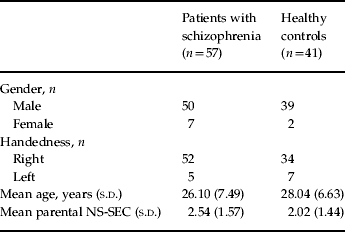
A sample of 57 patients satisfying DSM-IV criteria for schizophrenia and 42 healthy controls was recruited to take part in a study approved by Nottinghamshire and Derbyshire regional ethics committees. All participants provided written informed consent prior to study participation. The diagnosis of schizophrenia was made in a clinical consensus meeting among a team of research psychiatrists (P.F.L., P.M. or V.J.) using all available information including a review of case files and a standardized clinical interview. All patients were in a state of clinical stability [defined as no more than 10 points change in illness severity comprising both symptom burden and level of function as measured by the Global Assessment of Functioning (GAF) scale (APA, 1994) in the 6 weeks preceding the scan]. For both groups, potential subjects with diagnosed neurological or Axis I disorder (other than schizophrenia), current substance dependence or evidence of significantly lowered intelligence (on the basis of the Quick Test; Ammons & Ammons, Reference Ammons and Ammons1962) were excluded. All patients were receiving treatment with atypical antipsychotic medications and had no change in their prescriptions for the 6 weeks preceding the scan. All patients were on atypical antipsychotics at the time of the scan. The average dose of chlorpromazine equivalents was 288.7 (range 100–1200) mg. Chlorpromazine equivalent doses were computed for oral antipsychotic medication using data presented by Woods (Reference Woods2003). In the case of risperidone Consta injection, 25 mg Consta injection every 14 days was taken to equate to 4 mg oral risperidone per day, in accordance with the recommendation of the British National Formulary (Joint Formulary Committee, 2008). The healthy control group included 42 subjects with no personal history of psychiatric or neurological disorder, or history of psychotic illness in first-degree relatives and was matched in age (±3 years) and socio-economic status [measured using National Statistics – socio-economic status (NS-SEC); Rose & Pevalin, Reference Rose and Pevalin2003] to the patient group. One control subject was excluded in the final analysis due to a movement artifact in the magnetic resonance imaging (MRI) scan that precluded volumetric computations. Table 1 summarizes the demographic and clinical variables.
Demographic features of the sample

s.d., Standard deviation; NS-SEC, National Statistics – socio-economic status.
MRI
Magnetic resonance scans were acquired using a Philips 3T imaging system (Philips Healthcare, The Netherlands) equipped with an eight-channel phased array head coil. The scanning protocol included a single high-resolution three-dimensional T1-weighted magnetization-prepared rapid gradient-echo (MP-RAGE) volume of isotropic voxel size 1×1×1 mm3, flip angle 8° and field of view 256×256×160 mm3. A total of 160 slices of 1 mm thickness each were collected in an acquisition matrix 256×256 mm and in-plane resolution 1×1 mm2.
Surface extraction
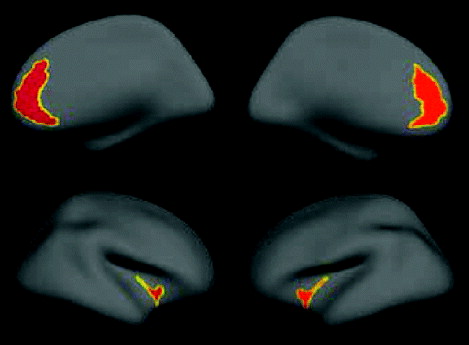
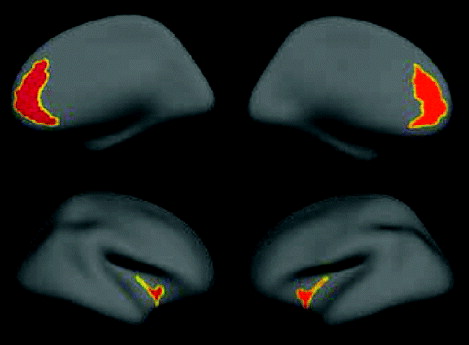
Surface extraction and cortical parcellation were carried out using freesurfer version 4.5.0 (Fischl & Dale, Reference Fischl and Dale2000). The preprocessing was carried out according to the description available online (http://surfer.nmr.mgh.harvard.edu/). Briefly, following skull-stripping and intensity correction, the grey-matter/white-matter boundary for each cortical hemisphere was determined using tissue intensity and neighbourhood constraints. The resulting surface boundary was tessellated to generate multiple vertices across the whole brain before inflating. All surfaces were visually inspected following an automated topology fixation procedure, and remaining minor defects were manually corrected as recommended by the software guidelines. The expansion of the resulting grey-matter/white-matter (GM/WM) interface created the pial surface with a point-to-point correspondence. This was followed by spherical morphing and spherical registration. Finally the parcellations were obtained by inverting the spherical morphing procedure to map back the average spherical representation onto each subject's inflated surface. The parcellations were obtained using the Destrieux sulcogyral-based atlas, which follows the anatomical conventions of Duvernoy (Destrieux et al. Reference Destrieux, Fischl, Dale and Halgren2010). Insular parcellations are derived using the central sulcus of the insula, which runs antero-inferiorly from the superior segment of the circular sulcus of the insula. The gyral region anterior to this sulcus constitutes the anterior insula. The anatomical definition of the anterior cingulate (sulcus and gyrus) follows the description given by Vogt et al. (Reference Vogt, Berger and Derbyshire2003). Further description is available online (http://surfer.nmr.mgh.harvard.edu/fswiki/DestrieuxAtlasChanges). Fig. 1 displays the two regions on a reconstructed average brain surface.
Anterior cingulate and anterior insula parcellations. The top row shows the medial aspect of an average reconstructed cortical surface displaying the anterior cingulate sulcogyral region included in the present study. The bottom row displays the anterior insula on the lateral surface of both hemispheres.
Symptom assessment
Patients with schizophrenia were interviewed by a research psychiatrist (V.J., P.M. or L.P.) and symptom scores assigned according to the Symptoms and Signs in Psychotic Illness (SSPI) scale (Liddle et al. Reference Liddle, Ngan, Duffield, Kho and Warren2002). The interviews were carried out on the same day as the scans. The SSPI scale measures the symptom burden in the past week before the interview. Reality distortion syndrome scores are obtained by summing up the scores for delusions and hallucinations.
Statistical analysis
The volume of the salience network regions was analysed using a repeated-measures analysis of covariance (ANCOVA), with the regions of the salience network and hemisphere as within-subject factors and diagnosis as a between-subjects factor. Total brain volume was treated as a covariate. Follow-up tests were carried out using independent-sample t tests using the Bonferroni–Holm family-wise correction for multiple testing (Holm, Reference Holm1979). To test the relationship between reality distortion and the regional volumes, non-parametric Spearman's correlation was used with a priori statistical significance at α of 0.05 (two-tailed) employing the Bonferroni–Holm correction for multiple testing in the four regions. We also carried out exploratory non-directed vertex-wise searches across the whole brain to test for other brain regions correlated with severity of reality distortion. Volume maps at full-width half maximum of 15 mm derived using freesurfer were used for the covariate analysis using the Query Design Estimate Contrast (QDEC) tool in freesurfer. False discovery rate (FDR) correction was used to control for multiple testing (Genovese et al. Reference Genovese, Lazar and Nichols2002).
Results
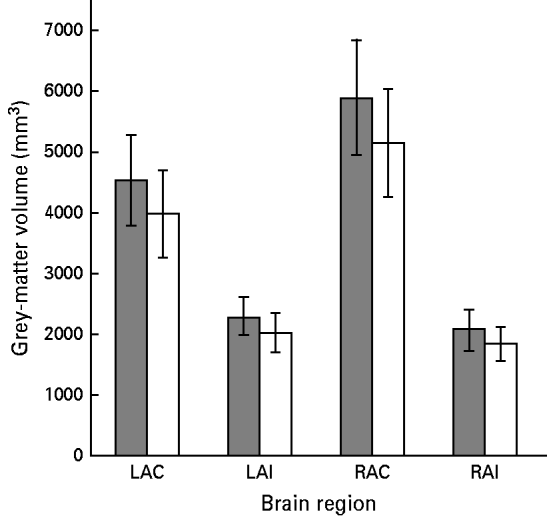
There were no significant differences in demographic features such as age [t(1, 96)=−1.32, p=0.17] or parental socio-economic status (Mann–Whitney U test, Z=−1.94, patients>controls, p>0.05) between the two groups. The mean GAF score for the patient sample was 63.3 (range 35–90). The mean score on reality distortion among the patient group was 3 out of a maximum of 8 (range 0–7), indicating that despite clinical stability the current sample included patients with delusions and/or hallucinations on the day of the study. The mean total score on the SSPI was 10.28 out of a maximum of 80 (range 0–29). The mean score on the Psychomotor Poverty dimension was 2.86 (range 0–9) and 0.74 (range 0–4) on the Disorganization dimension. Diagnosis was a significant predictor of the volume of salience network regions [F(1, 95)=22.85, p<0.001]. Total brain volume also had a significant effect on the regional volumes [F(1, 95)=44.70, p<0.001], but there was no significant difference between the two groups in the total brain volume [t(1, 96)=1.03, p=0.30]. Regions×diagnosis interaction was also noted in the ANCOVA model [F(1, 95)=7.95, p=0.006]. Post-hoc independent t tests revealed significant reduction in the volume of the right anterior cingulate [t(1, 96)=3.91, p<0.005], right anterior insula [t(1, 96)=3.56, p<0.005], left anterior cingulate [t(1, 96)=3.69, p<0.005] and the left anterior insula [t(1, 96)=3.97, p<0.001]. Fig. 2 illustrates the volumetric differences across the two groups. Total brain volume was not significantly related to reality distortion (Spearman's r=−0.20, p=0.12). Reality distortion correlated significantly with left anterior cingulate [Spearman's r=−0.35, p=0.032, 95% confidence interval (CI) −0.56 to −0.10] and left anterior insula volume (Spearman's r=−0.32, p=0.04, 95% CI=−0.54 to −0.07). A trend in the same direction not reaching statistical significance was noted for the right anterior cingulate (Spearman's r=−0.25, p=0.13) and right anterior insula (Spearman's r=−0.19, p=0.17).
Grey-matter volumes in the left anterior cingulate (LAC), left anterior insula (LAI), right anterior cingulate (RAC) and right anterior insula (RAI) in control subjects ( ) and schizophrenia patients (□). Values are means, with standard deviations represented by vertical bars. All comparisons were statistically significant after correcting for multiple testing.

In the exploratory covariate analysis no brain regions were correlated with the severity of reality distortion after correction for multiple comparisons. However, in several regions the correlation was significant prior to correction. These regions include the left anterior cingulate (uncorrected p=0.009), left insula (uncorrected p=0.01), left middle frontal gyrus (uncorrected p=0.01), left parahippocampal region extending to the temporal pole (uncorrected p=0.01), left precuneus (uncorrected p=0.01) and left middle temporal region (uncorrected p=0.02), right anterior cingulate (uncorrected p=0.01), right post-central gyrus (uncorrected p=0.02), right superior temporal region (uncorrected p=0.02) and the right temporo-parietal junction extending to the inferior parietal region (uncorrected p=0.02).
Discussion
Using volumetric analysis, we have shown that the severity of reality distortion persisting during a stable phase of illness in medicated patients with schizophrenia is negatively correlated with grey-matter volume in the anterior insula and anterior cingulate cortex, the cardinal regions of the salience network. This relationship is more pronounced on the left than the right hemisphere. A left-sided preponderance has been observed in other studies seeking structural correlates of positive symptoms (Shapleske et al. Reference Shapleske, Rossell, Chitnis, Suckling, Simmons, Bullmore, Woodruff and David2002; Koutsouleris et al. Reference Koutsouleris, Gaser, Jäger, Bottlender, Frodl, Holzinger, Schmitt, Zetzsche, Burgermeister, Scheuerecker, Born, Reiser, Möller and Meisenzahl2008). Shapleske et al. (Reference Shapleske, Rossell, Chitnis, Suckling, Simmons, Bullmore, Woodruff and David2002) found that in a group of non-hallucinating patients with schizophrenia, right insular deficits were pronounced. But when hallucinating patients were compared with non-hallucinating patients, the left insula emerged as the single deficient cluster. Consistent with some VBM studies (Chua et al. Reference Chua, Wright, Poline, Liddle, Murray, Frackowiak, Friston and McGuire1997), our exploratory whole-brain analysis did not show any brain regions that survived FDR correction. Nevertheless, at uncorrected thresholds, multiple regions previously reported to be correlated with hallucinations and delusions including the salience network, parahippocampal gyrus (Spencer et al. Reference Spencer, Moorhead, McIntosh, Stanfield, Muir, Hoare, Owens, Lawrie and Johnstone2007), superior and middle temporal region (Nenadic et al. Reference Nenadic, Smesny, Schlösser, Sauer and Gaser2010), inferior parietal region (Wright et al. Reference Wright, McGuire, Poline, Travere, Murray, Frith, Frackowiak and Friston1995) and post-central gyrus (García-Martí et al. Reference García-Martí, Aguilar, Lull, Martí-Bonmatí, Escartí, Manjón, Moratal, Robles and Sanjuán2008; Nenadic et al. Reference Nenadic, Smesny, Schlösser, Sauer and Gaser2010) were noted. These uncorrected results must be interpreted with caution, as our study was not powered to detect differences at the whole-brain level.
Salience network in schizophrenia
Our finding of reduced grey matter in the anterior insula and anterior cingulate is consistent with numerous studies investigating the morphology of these regions in schizophrenia (Baiano et al. Reference Baiano, David, Versace, Churchill, Balestrieri and Brambilla2007; Glahn et al. Reference Glahn, Laird, Ellison-Wright, Thelen, Robinson, Lancaster, Bullmore and Fox2008). The clinical relevance of the diffuse grey-matter loss observed in schizophrenia remains a subject of speculation. However, the recent delineation of the three major intrinsic connectivity networks (the salience network, the central executive network and the DMN) concerned with the allocation of attention to either external or internal stimuli is beginning to provide a foundation for understanding the clinical consequences of the observed widespread grey-matter deficits (Skudlarski et al. Reference Skudlarski, Jagannathan, Anderson, Stevens, Calhoun, Skudlarska and Pearlson2010).
The DMN is a set of regions postulated to be engaged in a ‘resting’ mode of introspective mental activity (Gusnard & Raichle, Reference Gusnard and Raichle2001). These regions, which include the medial frontal cortex, medial parietal cortex and angular gyrus bilaterally, characteristically show reduced neural activity when attending to tasks. Accumulating evidence suggests that coordination between various intrinsic connectivity networks is impaired in schizophrenia (Liu et al. Reference Liu, Kaneko, Ouyang, Li, Hao, Chen, Jiang, Zhou and Liu2010). White et al. (Reference White, Joseph, Francis and Liddle2010a) observed lagged correlation between activation of the salience network and deactivation of the DMN during processing of somatosensory stimuli in healthy controls, but this correlation was significantly weaker in patients with schizophrenia. Furthermore, White et al. (Reference White, Joseph, O'Regan, Head, Francis and Liddle2010b) reported that in healthy individuals event-related alpha and theta electroencephalograph activity was associated with activation of the salience network and deactivation of the DMN in healthy controls but not in patients with schizophrenia.
Reality distortion and the salience network
Our results suggest that the two nodes constituting the salience network play an important role in the clinical symptoms of delusions and hallucinations in schizophrenia. Dysfunction of the salience network might result in misattribution of salience to ordinarily inconsequential events, which might in turn result in hallucinations and/or delusions (Kapur, Reference Kapur2003). Aberrant salience attached to internal events such as inner speech could result in hallucinations. Evidence for disruption in the salience network during auditory hallucinations was observed in a functional MRI study of patients with psychosis (Sommer et al. Reference Sommer, Diederen, Blom, Willems, Kushan, Slotema, Boks, Daalman, Hoek, Neggers and Kahn2008). In this study, silent word generation activated both nodes of the salience network in addition to language areas in the cortex. However, spontaneous auditory hallucinations produced activation of the bilateral insula and language areas, but not the anterior cingulate. Furthermore, functional MRI studies investigating the time course of hallucinations report involvement of these two regions in the period immediately preceding hallucinatory experience (Shergill et al. Reference Shergill, Brammer, Amaro, Williams, Murray and McGuire2004; Hoffman et al. Reference Hoffman, Anderson, Varanko, Gore and Hampson2008).
It is noteworthy that our finding indicates that severity of reality distortion is greater in cases with a decreased volume of cortex in the salience network, whereas the abnormalities reported using functional imaging indicate increased activity at least in the insula. This is similar to the observation regarding hippocampal and parahippocampal abnormalities, insofar as grey-matter volume is reported to be decreased in schizophrenia relative to that in controls (Nelson et al. Reference Nelson, Saykin, Flashman and Riordan1998), but medial temporal overactivity has been reported in functional studies (Liddle et al. Reference Liddle, Friston, Frith, Hirsch, Jones and Frackowiak1992; Silbersweig et al. Reference Silbersweig, Stern, Frith, Cahill, Holmes, Grootoonk, Seaward, McKenna, Chua, Schnorr, Jones and Frackowiak1995; Shergill et al. Reference Shergill, Brammer, Williams, Murray and McGuire2000). It is plausible that a structural deficit might result in damage to either afferent fibres to the region, or local network connections that result in inability to produce appropriate inhibition of neural activity in the region.
Disrupted reward prediction error signalling is related to the propensity to form delusions (Corlett et al. Reference Corlett, Murray, Honey, Aitken, Shanks, Robbins, Bullmore, Dickinson and Fletcher2007). Dopamine is released when there is a reward prediction error, i.e. when a stimulus proves to be more rewarding than originally expected. The bilateral insula is the most prominent cortical region to show differential activation in healthy controls compared with those with psychosis during reward prediction errors (Murray et al. Reference Murray, Corlett, Clark, Pessiglione, Blackwell, Honey, Jones, Bullmore, Robbins and Fletcher2008). The insula expresses a high level of dopamine transporter relative to other cortical regions (Wang et al. Reference Wang, Volkow, Fowler, Ding, Logan, Galley, MacGregor and Wolf1995). Task-related activation of the insula is modulated by the availability of dopamine (Prata et al. Reference Prata, Mechelli, Picchioni, Fu, Toulopoulou, Bramon, Walshe, Murray, Collier and McGuire2009). Grey-matter density at brain regions including the insula and anterior cingulate cortex correlated positively with the dopamine (D2/D3) receptor binding potential in a positron emission tomography study (Woodward et al. Reference Woodward, Zald, Ding, Riccardi, Ansari, Baldwin, Cowan, Li and Kessler2009). Our observation of reduced grey matter in the insula and anterior cingulate suggests a disruption of the allocation of salience and related dopaminergic signalling in response to contextually appropriate stimuli. It is plausible that in the presence of increased dopaminergic signalling generated in other brain regions, the failure to attach salience to contextually appropriate stimuli might facilitate the attribution of salience to contextually inappropriate stimuli. Furthermore, our finding of association between persistent reality distortion in clinically stable patients and the structural abnormality in the salience network indicates that in cases with delusions and hallucinations that respond only partially to treatment with dopamine blockers, any underlying structural abnormality might be more pronounced.
Limitations
The sample in our study consisted of patients who were all medicated with antipsychotics at the time of MRI acquisition. This might have confounded the results, though the effect of antipsychotics on brain structure continues to be a matter of debate. The most robust finding is an increased basal ganglia volume, while there is conflicting evidence regarding other brain regions (Navari & Dazzan, Reference Navari and Dazzan2009; Smieskova et al. Reference Smieskova, Fusar-Poli, Allen, Bendfeldt, Stieglitz, Drewe, Radue, McGuire, Riecher-Rössler and Borgwardt2009). We have demonstrated an association between grey-matter deficits in the salience network and current severity of reality distortion in a stable phase of illness but have not tested for a relationship with severity of acute symptoms. As our study sample was predominantly male, caution should be exercised in generalizing to a mixed sex sample.
Conclusions
For the first time, we have shown that volumetric deficits across the salience network in schizophrenia are related to reality distortion. Our results suggest that the clinical symptoms of psychosis that have previously been associated with dopamine-mediated aberrant salience may also be linked to a disrupted intrinsic connectivity network which plays a pivotal role in information processing. However, the mechanism by which diminution of grey matter in the insula might interact with postulated excessive dopaminergic signalling, possibly generated elsewhere in the brain, remains to be elucidated.
Acknowledgements
This work was supported by a New Investigator grant from the University of Nottingham and a Interdisciplinary Research Award from the Nottingham Institute of Neuroscience, University of Nottingham. We are grateful to the volunteers who participated in this study and would like to thank Kathrin Doege, Antonio Napolitano, Kay Head, Dawn-Marie Walker and Dorothee Auer for assisting the data acquisition.
Declaration of Interest
P.F.L. has received honoraria for academic lectures from Eli Lilly, AstraZeneca, Janssen-Cilag, Bristol–Myers Squibb, Pfizer and fees for serving on advisory panels for Pfizer and Eli Lilly and Bristol–Myers Squibb.