Introduction
Once children reach school age, the domain of language in which development is most obvious is that of pragmatics, which is the ability to take context and knowledge about specific conversation partners into account in order to use and interpret language appropriately (e.g., Airenti, Reference Airenti and Cummings2017). One aspect of pragmatic competence is the ability to interpret non-literal language such as verbal irony, which is where a speaker's communicative intent does not align with the literal meaning of the utterance (e.g., Dynel, Reference Dynel2019). The current study is concerned with prototypical forms of verbal irony where the speaker intends the opposite of the utterance's literal meaning. For example, where a speaker says ‘That was a great shot!’ on seeing a footballer completely miss the goal.
From a very early age, children hear verbal irony from their parents (e.g., Banasik-Jemielniak, Reference Banasik-Jemielniak2019; Recchia, Howe, Ross & Alexander, Reference Recchia, Howe, Ross and Alexander2010) and during the school years they are increasingly exposed to verbal irony in children's books and films. Mastery of irony is important in the longer term for social relationships since irony is often used to soften insults (e.g., Dews, Kaplan & Winner, Reference Dews, Kaplan and Winner1995) and becomes increasingly integral for the banter and insults used by adolescents to maintain social relations with their peers (e.g., Aijmer, Reference Aijmer2019).
The degree to which a listener can easily determine whether an utterance is intended ironically depends on a number of factors, some of which can be learnt based on language experience and some of which concern the listener's own cognitive and socio-cognitive abilities. Regarding the role of previous exposure to irony, clearly the frequency with which communities use irony varies cross-culturally (see e.g., Banasik-Jemielniak & Bokus, Reference Banasik-Jemielniak and Bokus2019, for a discussion). In addition, both adults and children take into account factors such as the speaker-addressee relationship (e.g., Whalen, Doyle & Pexman, Reference Whalen, Doyle and Pexman2019) and speaker occupation (e.g., Katz & Pexman, Reference Katz and Pexman1997), indicating that they draw on their past exposure to irony to consider the likelihood that a speaker intended an utterance ironically. Indeed, certain utterances (e.g., ‘Smart move!’) may be more likely to be interpreted ironically than literally; that is, their ironic intent has become a conventionalised meaning component of that particular word combination (e.g., Burnett, Reference Burnett2015). Even the cue of prosody or ‘ironic tone of voice’ could potentially be learned on the basis of experience with the input.
In the current study, our focus is instead on those cognitive and socio-cognitive abilities at the level of the individual child, which are highly likely to be implicated in the child's ability to correctly determine if an utterance is intended ironically or literally when additional scaffolding from prosody or conventionality is removed. These cognitive and socio-cognitive abilities have been much discussed as potential causes of difficulties in atypical populations regarding their ability to interpret irony (e.g., Adachi, Koeda, Hirabayashi, Maeoka, Shiota, Wright & Wada, Reference Adachi, Koeda, Hirabayashi, Maeoka, Shiota, Wright and Wada2004; Caillies, Bertot, Motte, Raynaud & Abely, Reference Caillies, Bertot, Motte, Raynaud and Abely2014). What has received less attention is the potentially important role that these socio-cognitive and cognitive skills may play in the large range of individual differences in irony interpretation ability within typically-developing children from the same community (e.g., Zajaczkowska & Abbot-Smith, Reference Zajączkowska and Abbot-Smith2019).
One likely socio-cognitive underpinning of irony interpretation, which has received much attention in the irony acquisition literature to date, is that of mentalising - often termed ‘Theory of Mind’ (see Filippova, Reference Filippova and Matthews2014, for a review). Mentalising refers to an individual's ability to understand that others may have desires, knowledge and beliefs which differ from one's own (e.g., Harris, Reference Harris1992). Traditionally, the method of choice for assessing mentalising has been tests of false belief understanding. Indeed, many studies have found that irony interpretation in children is related to their performance on these types of false belief understanding and related tasks (e.g., Banasik, Reference Banasik2013; Filippova & Astington, Reference Filippova and Astington2008; Nilsen, Glenwright & Huyder, Reference Nilsen, Glenwright and Huyder2011).
However, there are a number of problems which make it difficult to draw firm conclusions from this literature about the role of mentalising in irony interpretation. First, there are a few studies which did not find significant relationships between measures of mentalising and irony interpretation (e.g., Massaro, Valle & Marchetti, Reference Massaro, Valle and Marchetti2014; Zajączkowska & Abbot-Smith, Reference Zajączkowska and Abbot-Smith2019; Study 2). Second, many of these studies did not statistically control for core language skills (such as vocabulary), which is well-known to be related to mentalising (e.g., Milligan, Astington & Dack, Reference Milligan, Astington and Dack2007) and also to irony interpretation (e.g., Filippova & Astington, Reference Filippova and Astington2008; Nilsen et al., Reference Nilsen, Glenwright and Huyder2011; Massaro et al., Reference Massaro, Valle and Marchetti2014). Third, arguably the key aspect of mentalising that an individual needs to successfully interpret irony is not false belief understanding but rather an understanding of whether a listener has access to the same knowledge as the speaker. For example, if a speaker says “That was a great shot”, to interpret whether this is meant ironically, one needs to consider if the speaker saw the footballer score vs. wildly miss the goal. If one is judging whether a third party would interpret the speaker's utterance ironically or not, one needs to know whether this third party listener saw that the speaker saw this. This aspect of mentalising is referred to in the literature as ‘Knowledge-Access’ (Pillow, Reference Pillow1989) - and specifically visual knowledge access (see Moll & Kadipasaoglu, Reference Moll and Kadipasaoglu2013, for a discussion).
A relatively underexplored potential cognitive underpinning of irony interpretation is executive functioning, which encompasses the higher order cognitive functions required for cognitive control (Diamond, Reference Diamond2013). There are numerous findings demonstrating the role of executive functioning in pragmatic language processing by adults (e.g., De Neys & Schaeken, Reference De Neys and Schaeken2007; Dieussaert, Verkerk, Gillard & Schaeken, Reference Dieussaert, Verkerk, Gillard and Schaeken2011; Nieuwland, Ditman & Kuperberg, Reference Nieuwland, Ditman and Kuperberg2010; Xiang, Grove & Giannakidou, Reference Xiang, Grove and Giannakidou2013). The same is true of certain aspects of pragmatic language usage by children (see Matthews, Biney & Abbot-Smith, Reference Matthews, Biney and Abbot-Smith2018, for a review). In relation to irony, however, only two previous studies have examined the role of executive functioning (Caillies et al., Reference Caillies, Bertot, Motte, Raynaud and Abely2014; Filippova & Astington, Reference Filippova and Astington2008). Both were correlational and investigated relationships with working memory (and in one case inhibitory control). Further, nobody has investigated whether mental set switching – the ability to switch flexibly between different approaches to the same task - is related to irony interpretation. There are two plausible ways in which mental set switching could work as an important mechanism when interpreting irony in two ways. First, it is well-established that mental set switching is related to the development of mentalising – or at least of first order Theory of Mind (e.g., Kloo & Perner, Reference Kloo and Perner2003). Thus, the role of mental set switching may be partially indirect. In addition, mental set switching may also play a direct role in irony interpretation because one has to potentially switch between the speaker's and one's own perspective and also possibly to switch between a literal versus an ironic interpretation of the utterance.
There are also methodological challenges associated with determining which factors are important for children's developing skill with irony interpretation. One challenge is that previous studies investigating the role of socio-cognitive and / or cognitive abilities have almost exclusively relied on individual differences designs. A difficulty with individual differences designs is that there are usually numerous potential reasons why a particular measure (of executive functioning, to give one example) may or may not correlate with irony interpretation. Abilities which are not usually measured, such as non-verbal intelligence, may relate to both the particular measure and also the ease with which the child can handle task demands. Furthermore, while it is possible to statistically control for non-verbal intelligence, this variable tends to be so closely inter-related to other developmental variables that this process also removes the requisite variance needed to demonstrate the relationship of interest (see Jones, Simonoff, Baird, Pickles, Marsden, Tregay, Happé & Charman, Reference Jones, Simonoff, Baird, Pickles, Marsden, Tregay, Happé and Charman2018, for discussion of this issue).
Therefore, in the current study we use an experimental design to investigate the role of two potential cognitive underpinnings of irony interpretation; a) mental set switching and b) mentalising. Our investigation of the role of mentalising focusses specifically on knowledge-access, i.e., the ability to take into account what other people know or do not know (and how this knowledge may differ between specific individuals). We call this variable Shared Knowledge. To manipulate this, we adapt a paradigm previously used by the only previous study to experimentally manipulate a proposed socio-cognitive or cognitive underpinning when investigating irony interpretation in children (Nilsen et al., Reference Nilsen, Glenwright and Huyder2011). In Nilsen et al.'s (2011) study, children were asked to judge whether a listener understood ironic intent, whereby the key variable manipulated whether the listener had (visual) access to the crucial information (e.g., when hearing ’that was a great shot!’, whether the listener witnessed the goal). 8- to 10-year-olds correctly differentiated the Shared Knowledge from the Non-Shared Knowledge condition by being more likely to state that the listener would interpret the utterance as ironic in the Shared Knowledge condition. However, seven-year-olds did not distinguish these conditions in this manner.
This brings us to the second methodological challenge in the irony acquisition literature, which concerns the development of test questions, which are sufficiently easy for children to understand. Nilsen et al. (Reference Nilsen, Glenwright and Huyder2011), for example, asked children four questions following each vignette, two of which related to speaker and listener knowledge. To assess the child's understanding of the speaker's knowledge, children were asked “When [SPEAKER] said (a) did [SPEAKER] think that was good or bad?”. This type of “explicit judgement” question is very frequently asked in the field of child irony acquisition. To assess whether children utilised information about speaker-listener shared knowledge to interpret irony, Nilsen et al. (Reference Nilsen, Glenwright and Huyder2011) also investigated children's understanding of the listener's knowledge by asking ““When [SPEAKER] said (a) did [LISTENER] think that was good or bad?”. Questions asking for explicit judgements require a child to have an understanding of what she does or does not know, i.e., a certain level of meta-cognitive understanding. Importantly, a child does not need this level of explicit knowledge in order to understand and respond appropriately to the use of irony in conversation. Rather, what a child (or adult) needs to be able to do as a proficient pragmatic language user is to respond in an appropriate manner.
A handful of studies have utilised in addition to a judgement task a measure of irony interpretation by asking children to respond to an ironic comment (e.g., Glenwright & Agbayewa, Reference Glenwright and Agbayewa2012; Whalen & Pexman, Reference Whalen and Pexman2010). For example, Whalen and Pexman (Reference Whalen and Pexman2010) presented children with vignettes and on hearing the speaker's ironic statement, the experimenter asked the child for example “When I said ‘what a wonderful way to end the day’, what would you like to say back to me?”. Children's responses were coded as either agreement (e.g., “Yeah”), disagreement, ambiguous, reconciling (e.g., “Yeah, that sandcastle looked good but it's terrible when that happens”) or mode adoption, which is when a child used irony themselves to respond to the ironic statement. While this method has the advantage of being ecologically valid, generating a verbal response is potentially burdensome for children. Indeed, planning a response creates a greater cognitive load even in adults than does listening and interpreting the language of the conversation partner (e.g., Boiteau, Malone, Peters & Almor, Reference Boiteau, Malone, Peters and Almor2014). and can also create coding difficulties (e.g., Glenwright & Agbayewa, Reference Glenwright and Agbayewa2012). More problematically, it is generally the case that for a large proportion of spontaneous responses, it is not clear whether the participant interpreted the target utterance ironically or literally.
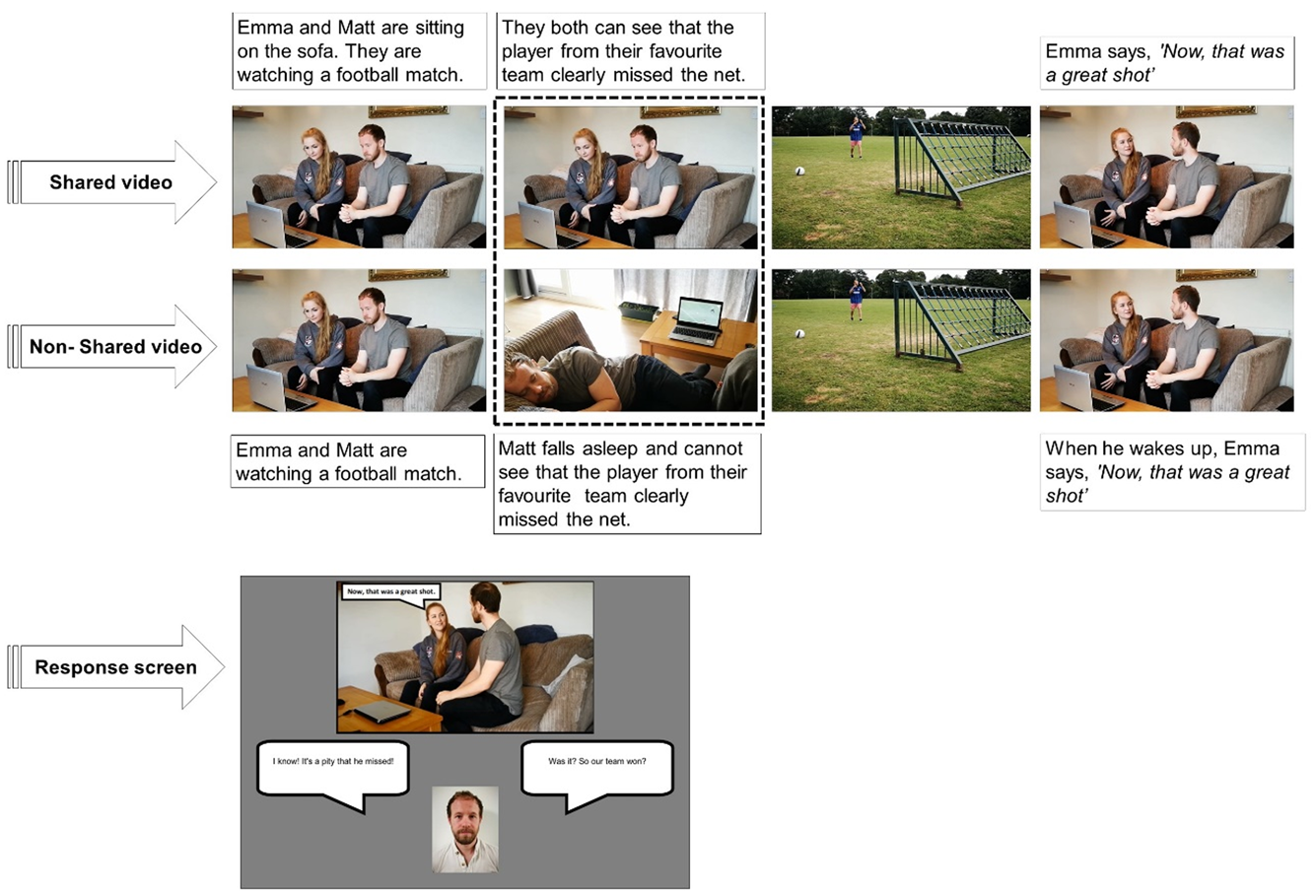
Therefore, for our main study we developed a new dependent variable, which we hoped would combine the simplicity of a binary forced choice measure with the advantages of assessing children's understanding of the type of conversational statement which can serve as an appropriate response to irony. After viewing and hearing each video-recorded vignette, children were asked how they thought the listener would respond to the ironic speaker. To manipulate the role of mentalising, we followed Nilsen et al.'s (2011) by comparing within-subjects whether the listener in a particular vignette shared the requisite knowledge to know that the speaker intended the statement to be ironic. To illustrate, for the vignette in which the speaker said ‘That was a great shot!’, in the Shared Knowledge condition, both the speaker and listener saw that the footballer had wildly missed the goal, whereas in the Non-Shared Knowledge condition, the listener had fallen asleep during that crucial moment of the football game. The novel element here concerned how children were asked to respond. That is, instead of using the aforementioned judgement task, we asked children to choose between an Irony-Consistent Response (e.g., for the missed-goal vignette “I know! It's a pity that he missed!”) versus a Literal-Consistent Response (e.g., for the missed-goal vignette “Was it? So our team won?”). We predicted that with our new dependent variable 7-year-olds would be significantly more likely to select an Irony-Consistent response in the Shared Knowledge than in the Non-Shared Knowledge condition. We also compared performance on this across three between-subjects conditions designed to manipulate the role of Set Switching. Here, we predicted that children who heard Shared Knowledge vignettes intermingled with Non-Shared Knowledge vignettes would find it harder (than children in ‘blocked’ conditions) to demonstrate their ability to take Shared Knowledge into account when interpreting irony, simply because of the increased switching load.
Pilot Study: Comparing our ‘conversational response’ DV with the traditional DV
It is of course possible that our new ‘conversational response’ dependent variable might – contrary to our predictions - be more taxing to working memory and language processing than are the meta-pragmatic judgement measures used in the literature on irony interpretation in children. That is, in our ‘conversational response’ dependent variable, the participant must track whether the speaker and listener shared visual access or not and then evaluate the speaker's statement as well as the two possible conversational responses. Therefore, in a pilot study we first compared within the same group of children (and for the same vignettes) performance on our conversational response dependent variable (‘New’ DV) against performance on a meta-pragmatic judgement measure (‘Old’ DV).
Participants
The first author tested 20 monolingual, British English-speaking children aged between 6;02 and 7;11 years individually in a quiet location. Six were tested in a separate room at their school (in Kent, UK) and the remainder were tested in the Kent Child Development Unit.
Method for ironic vignettes
The experimenter enacted five vignettes using two puppets (King and Queen) and some small props. In each vignette, both the speaker and listener (for which we counterbalanced the assignment of the King vs. the Queen) shared the knowledge (through shared visual access) required to understand that the speaker's remark was intended ironically. For example, one vignette was adapted from Nilsen et al.'s (2011) ‘football’ vignette as follows.
(1) The King and the Queen play for the same football team. They really want to win this match. The Queen kicks the ball, clearly missing the net. [Experimenter simultaneously enacts this with the two puppets, a ball and a small goal]. King: “That was a great shot”. [Note that both the speaker and the listener could see the missed goal].
At the end of each vignette each child's understanding was assessed using two types of forced-choice question. (See Appendix A for the other pilot irony vignettes). One was our new ‘conversational response’ dependent variable (New DV), which the experimenter introduced by saying “What would you then say, if you were LISTENER?”.
(A) Conversational response (Correct / Irony-Consistent): “Yeah, but you know that I'm trying my best”.
(B) Conversational response (Incorrect / Literal Consistent): “No, it wasn't actually a good shot”.
The other was a ‘meta-pragmatic judgement’ dependent variable (Old DV), as in (C) and (D), which the experimenter introduced by saying, ‘When CHARACTER says X, is s/he saying….’
(C) Old DV (Correct): The king is not happy with how the queen kicked the ball.
(D) Old DV (Incorrect): The king is happy with how the queen kicked the ball.
For each DV for each of the binary forced-choice options, the experimenter read each option aloud and also presented each option in a visual format. The two options for the ‘Old DV’ (e.g., ((C) and (D)) were read by the experimenter and accompanied by the pictures of a ‘thumbs up’ or ‘thumbs down’. For the ‘New DV’ the two options were read by the experimenter accompanied by speech bubbles containing the two options written down. For each dependent variable, the child could either point at the correct visual depiction out of the two or could answer verbally (or both). For each DV for each vignette a correct response was scored as 1 (see options (A) and (C) above), whereas the incorrect choice was scored as zero (see options (B) and (D) above). There were five vignettes in total and thus each child could obtain an overall maximum score of five correct responses for each of the dependent variables. We counterbalanced both within and between subjects whether the ‘conversational response’ (New) DV was presented first or whether the ‘old DV’ was presented first.
Pilot results
For each dependent variable we calculated (in contrast to the main study) whether the participants choose the correct versus the incorrect response (see (A) – (D) above). The mean response accuracy was numerically slightly higher for our ‘New’ conversational response DV (M = 3.05, SD = 1.32) than for the ‘Old’ DV (M = 2.8, SD= 1.77). However, this difference was not statistically significant and the effect size was very small (t(19) = −0.84, p = .41, d = 0.16). Therefore, we can assume that our new conversational response DV is at least not more challenging for six- to seven-year-old children than is the meta-pragmatic judgement method used in previous studies. Moreover, performance on the two DVs was highly inter-correlated (r(20) = .66, p = .002), indicating that they assess essentially the same construct. We therefore decided to further explore the utility of our new measure.
Method and Results for Pilot testing of literal control condition
For 13 out of our 20 pilot children, we also included the following two ‘literal interpretation = correct” vignettes, the presentation of which was interspersed between the irony vignettes.
(2) The King and the Queen have a new member of their football team. King: “What do you think of the new boy?”. Queen: “He is very kind. He gave me an apple yesterday”.
Old DV: E said “When the queen says ‘He is very king. He gave me an apple yesterday’, does she think that the new boy is very kind [shows ‘thumbs-up’ picture] or does she not think that the new boy is very nice [shows ‘thumbs-down’ picture]?”.
New DV: E said “What would you say if you were King?” Would you says “I'm going to my swimming lesson after school today” [shows speech bubble] or would you say “That was very nice of him” [show other speech bubble].
(3) [E makes the puppets speak as follows]. The King: “Would you like to go to the cinema with me this Sunday?”. The Queen: “Yes, sure. Should we go to see the new Lego Batman movie?”.
New DV: E said “What would you say if you were the King? Would you say “Yeah, I'd love to see that movie” [E showed one speech bubble] or would you say “This pizza is really good” [E showed other speech bubble].
Old DV: E said “When the Queen says “Yes sure. Should we go to see the new Lego Batman movie?”, does she really not want to go to the cinema with the King [E showed ‘thumbs-down’ picture] or does she want to go to the cinema with the King [E showed ‘thumbs-up picture].
For these two ‘literal’ vignettes, performance across the 13 children was 100% correct for the ‘new’ DV and 96% correct for the ‘old’ DV.
Main Study
Pre-study: Generation of materials from adult conversational responses
To generate our ‘conversational response’ dependent variable for the main study, the first author tested 21 adult native speakers of British English, most of whom were university students. All were naïve to the aims of the study. Participants were presented with vignettes (see examples (4) and (6) below) ending with the speaker's utterance. The participants were then asked to write down how they would respond as a listener. Ten of these participants were only presented with vignettes which would require a ‘literal-consistent’ response, as in example 4 below. None of the responses of the participants in this condition indicated that they interpreted the speaker's statement ironically (see (5) for their responses to (4)).
(4) Imagine that you and your friend really want to go for a picnic. While you are having a nap, your friend peeks through the curtains. When you open your eyes, the curtains are still closed. He says, “It's a perfect day for a picnic”. What would you say in response?
(5) Participant 1: “Let me wake up first, then we'll think about going”.
Participant 2: “I would ask him when he would like to go and where he would like to go”.
Participant 3: “I would be a bit annoyed that I got disturbed during my nap. However, since I really wanted to go on the picnic, I would probably wake up and get ready to go”.
Participant 4: “That's great! Let's go”.
Participant 5: “Shall we go out for one then and go to the park?”
Participant 6: “Great! Why don't we go out then!”
Participant 7: “Is it sunny out there?”
Participant 8: “Let me see first”.
Participant 9: “How do you know?”
Participant 10: “What's the weather like?”
The remaining eleven participants were exposed to versions of the same vignettes, where the adaptation made it clear that the speaker intended the utterance ironically (see (6) below for the ironic version of (4)). The speaker's statements were identical across these two conditions. It was never the case that the utterance was a phrase which is used ironically with very high frequency in English (e.g., ‘Well done!’).
(6) Imagine that you and your friend really want to go for a picnic. You open the curtains and you both see that it's raining. Your friend says, “It's a perfect day for a picnic”. What would you say in response?
The most frequently occurring responses were selected as the dependent variable options for our study. Thus, from the responses in (5) above, we derived the response ‘Great! Let's go then. For some conversational response options additional words were added to ensure that sentence length was equated between response options.
Method for main study
Shared Knowledge manipulation
There were ten video-recorded vignette types (e.g., ‘picnic’, ‘goal’, ‘vacuum cleaner’), each with a male and female actor, whereby for each we created both a Shared and a Non-Shared knowledge variant. Thus, there exist 20 vignettes in total (see Appendix B). Both the number of words and the length of the videos across the two conditions were matched. Importantly, for each version of a vignette type (e.g., for both the Shared and Non-Shared version of ‘picnic’) the speaker's statement and the binary-choice dependent variable options were identical. Moreover, the speaker's intonation and facial affect was also identical at this point; the actors were instructed to keep the facial and prosody slightly positive, as if the statement that they uttered were literal and this part was filmed prior to the rest of the vignette (and thus they were ignorant as to whether they were in an ironic or literal context). To ensure that the intonation was the same in the corresponding videos across conditions, we used the same audio recording of the final utterance for both videos.
The only way in which the Shared versus Non-Shared versions of each vignette type differed related to visual access to knowledge. For example, in the ‘goal’ vignette in the Shared condition, both the speaker and listener witnessed the goal whereas in the Non-Shared condition, the listener was asleep when the footballer attempted to score.
Vignettes were presented via a laptop and participants clicked on the response options. Regardless of condition, the selection of an Irony-Consistent response (e.g., “I know! It's a pity he missed” for the goal vignette) was scored by the computer as 1, whereas the selection of a Literal-Consistent response (e.g., “Was it? So our team won!”) was scored as 0. Therefore, if participants did not distinguish the Shared vs. Non-Shared conditions, there should be identical performance in both.
Each child was presented with vignettes from both the Shared and Non-Shared conditions, although never with items from the same vignette-type (e.g., s/he only saw the goal vignette in one of these conditions). Thus, each child saw five vignettes in each condition. (The specific items were counterbalanced within each between-subjects Switching group).
Practice phase
Each child participated in three practice trials, none of which included an ironic statement. These trials also differed from the test trials in two ways. First, children were asked “Which one do you think the boy/the girl would answer?”. Second, when the children were not sure which answer to choose, the content of the story was repeated and the prompt question was asked again. All of the children passed the second and the third example trials without the need for repetition.
Test trials
After each video vignette, the participant could either replay the video or move on the next section where s/he was asked to select a binary forced-choice reply on the part of the listener (i.e., Irony-Consistent vs. Literal-Consistent). Participants could both see and hear the pre-recorded response options. See figure 1 below for an example of how the response options were displayed.
Depiction of the procedure. The first row depicts the ‘Shared Knowledge’ condition. The second row depicts the ‘Non-Shared Knowledge’ condition. The boxes highlighted with the dotted lines indicate the visual distinction between the two conditions, namely whether the listener saw the key event together with the partner (or not). The third row depicts an example test trial screen, which followed each story. (This was identical across the two conditions).

Study 1
Study 1 was carried out to verify that adult native speakers of English would in fact tend to select the Irony-Consistent response in the Shared Knowledge condition, as opposed to selecting to the Literal-Consistent response.
Method
The first author tested 14 native British English-speaking adults, most of whom were university students. None of the 14 participants had participated in the Pre-Study. Each participant saw video-recorded versions of vignettes in the Shared Knowledge and Non-Shared Knowledge conditions. The Shared Knowledge vignettes were interspersed with Non-Shared Knowledge vignettes, as in the ‘Mixed’ condition in Study 2 below.
Results
Adults showed an extremely clear differentiation between the Shared Knowledge and Non-Shared Knowledge conditions; in the Shared Knowledge condition, they selected the ironic-consistent response 94% of the time, whereas in the Non-Shared Knowledge condition, they only did this 9% of the time (t(13) = 17.55, p < .001, d = 6.81). Thus, as expected, native English-speaking adults are extremely proficient at taking the listener's knowledge state into account when interpreting ironic remarks and select conversational responses accordingly.
Study 2
Shared Knowledge manipulation
The method for study was exactly the same as for Study 1. The only difference was that in addition, we also investigated the role of mental set switching by assigning participants to one of three between-subjects conditions as follows. (To ensure that the three conditions were ‘matched’, we assessed each child using standardised measures of vocabulary and non-verbal IQ).
Switching manipulation
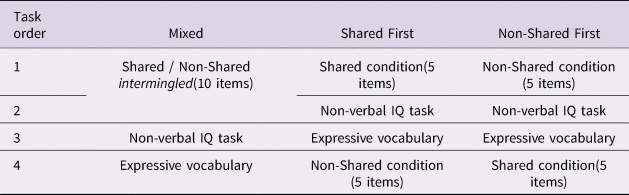
To investigate the role of switching, each child was pre-assigned to one of three Switching conditions, which only differed from one another in terms of the task order, as illustrated in Table 1 below.
Task order by Switching Condition

The position of the foil vs. target answer was counterbalanced across each of the conditions and also within each participant. Each version (Shared vs. Non-Shared) of each vignette-type was presented equally often across each of the three Switching conditions. The order of vignette-types (e.g., ‘picnic’, ‘vacuum cleaner’) within each condition in the Shared-First and Non-Shared-First conditions was randomized.
Child participants
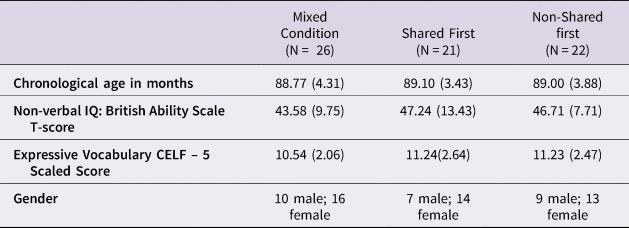
Sixty-nine typically-developing children took part in the study (M age = 88.89, range = 6;10 – 7;11), all of whom were tested by the first author. None had participated in the pilot study. Ten children in each Switching condition were recruited through and tested in the Kent Child Development Unit. The remaining participants in each Switching condition were recruited from local primary schools in Kent, UK. All participants were monolingual speakers of British English with no suspected developmental disorders. The three Switching conditions were matched on chronological age, expressive language, and non-verbal IQ (see Table 2 below - all p > .38). Expressive language was assessed with the Expressive Vocabulary sub-test of the Clinical Evaluation of Language Fundamentals® – Fifth Edition (CELF®- 5; Semel, Wiig & Secord, Reference Semel, Wiig and Secord2013). In order to assess non-verbal IQ, we carried out the Matrices subtest from the British Ability Scales (BAS; Elliot & Smith, Reference Elliot and Smith2011).
Means (SD) for the age, non-verbal IQ, expressive vocabulary plus gender ratio for the three Switching conditions.
Design
Thus, our study had a mixed two (Knowledge: Shared vs. Non-Shared) x three (Switching: Mixed, Shared-first, Non-Shared-first) design.
Main study analysis
We fitted the data with a binomial mixed-effects regression model predicting ironic interpretation responses, using the lme4 package (Bates, Maechler, Bolker & Walker, Reference Bates, Maechler, Bolker and Walker2015) in R (R Core Team, 2018). The model included fixed effects of (a) the within-subjects factor of Knowledge (Shared, Non-Shared), (b) the between-subjects Switching Condition (Mixed, Shared-First, and Non-Shared-First), and the interaction of Knowledge and Switching Condition. The Switching Condition was coded with Helmert contrasts, whereby the Mixed condition was coded as the baseline for the first contrast, following our switching hypothesis. The second contrast compared the two ‘blocked’ condition: Shared-First vs. Non-Shared-First.
Following Barr, Levy, Scheepers and Tily (Reference Barr, Levy, Scheepers and Tily2013) we included the maximal random effects structure supported by the data. The maximal model included random intercepts for participants and items, by-participants random slopes for Knowledge State, and by-items random slopes for Knowledge, Switching and their interaction. The random effects structure was reduced one term at a time beginning with the highest order term, until the model converged, resulting in a final model with only random intercepts for participants and items.Footnote 1
Main study results
Table 3 shows the proportion of responses that were consistent with the ironic interpretation by Knowledge State and by each of the three Switching Conditions (Mixed, Shared-First, Non-Shared First).
The proportion of responses consistent with an ironic interpretation by Knowledge State and Switching

We found a significant main effect of Knowledge (β = 1.65, SE = .21, p < .001), such that responses consistent with the ironic interpretation were (appropriately) more likely in the Shared than in the Non-Shared condition. There were no significant effects for the Switching Condition (contrast 1 (Mixed condition vs Blocked conditions): β = .33, SE = .24, p = .16; contrast 2 (Shared Knowledge First vs. Shared Knowledge second): β = −.15, SE = .14, p = .30). No interactions between Knowledge and Switching were significant (for contrast 1: β = .024, SE = .23, p = .92; for contrast 2: β = −.030, SE = .14, p = .84).Footnote 2
Discussion
In the current study, we developed a novel measure for irony comprehension in children. Rather than being asked to judge what a speaker thinks or means (or to verbally formulate their own response), children were instead asked to select how they thought a listener might respond. The binary forced-choice ‘conversational’ response options were developed from spontaneous responses by adults to the items. In addition, the current study is one of very few which has attempted to experimentally manipulate suspected cognitive underpinnings of the irony interpretation in children. Using our novel dependent variable, we found a role for one cognitive underpinning that we manipulated (i.e., mentalising) but not the other cognitive underpinning that we manipulated (set switching) in how seven-year-olds interpret ironic utterances.
Regarding switching, ours is the first study (whether correlational or experimental) to investigate whether this plays a role in how children interpret irony. One possibility is that our null result for this variable indicates that switching is not of particular relevance. An alternative possible explanation might be that the switching element is always implicitly present when processing ironic utterances (e.g., De Neys & Schaeken, Reference De Neys and Schaeken2007). To clarify, even if the child had a block of videos including only ironic utterances, it is possible that the literal meaning would still be activated at some level – even if only weakly. While this ‘literal-first’ view of irony interpretation is hotly contested (e.g., Gibbs, Reference Gibbs1983; Kowatch, Whalen & Pexman, Reference Kowatch, Whalen and Pexman2013), eye-tracking studies with adults certainly indicate that multiple processes are required for irony-interpretation, but that the integration of these proceeds extremely fast in real time (e.g., Barzy, Filik, Williams & Ferguson, Reference Barzy, Filik, Williams and Ferguson2020). Thus, it is certainly possible that our design was too simplistic and that online measures such as eye-tracking are necessary in order to detect the role of mental set switching in irony interpretation – at least in an experimental paradigm.
Regarding mentalising, our experimental findings fit with findings from numerous individual differences studies, which found correlations in children around this age between irony interpretation and second-order false belief understanding, which is the ability to understand that another individual can have a false belief about a third party's knowledge state (e.g., Filippova & Astington, Reference Filippova and Astington2008). However, we by no means wish to claim that second-order false belief understanding is necessary in order to successfully determine whether an utterance is intended ironically or literally. Even in situations where prosodic and other ‘likelihood’ indicators (such as speaker-listener relationship) are removed or controlled – i.e., situations where the listener is more reliant on mentalising than is always the case – we would argue that second-order false belief is nonetheless not essential to interpret irony correctly. That is, to understand in our task (and Nilsen et al.'s, 2011, task) that – for example – Emma might interpret Matt's utterance literally, a child does not need to understand that Emma might have false beliefs. Rather, the child merely has to understand that Emma does not have access to the same knowledge (e.g., the ball is flat) to which Matt has access. Thus, the requisite aspect of mentalising here is in fact knowledge-access, which is typically demonstrated by children well before they pass traditional first-order false belief tasks (e.g., Wellman & Liu, Reference Wellman and Liu2004). We follow the view that adult-like mentalising is acquired in a gradual fashion (see e.g., Tomasello, Reference Tomasello2018), where different components of mentalising are likely to correlate with one another in development.
Limitations
Our Pilot Study results indicate that our novel ‘binary forced choice conversational response’ dependent variable was not in fact easier for children than the traditional forced choice judgement tasks (e.g., “When the King said “that was a great shot!”, was he happy with how the Queen kicked the ball or not happy with how the Queen kicked the ball?”). There are several potential reasons for this. First, with our new response type, the child – as in all previous studies - must maintain the relevant event schemas in working memory. Then, as for traditional judgment tasks, the child has to simultaneously evaluate the statement as well as two possible responses. Furthermore, as in Nilsen et al.'s (2011) study, the child has to represent not only the speaker's mental state but also that of the listener in the story in order to decide how the listener might respond. Thus, as for all previous measures of irony interpretation in children, our task still burdens working memory, vocabulary – and also syntax to a degree. In addition, it is entirely plausible that the degree to which particular conversational response options are ‘acceptable’ or ‘fitting’ may vary from vignette to vignette, which is something future studies could explore. More critically, future studies are also needed to devise irony interpretation tasks for children that further minimise the burden on core language and working memory, without reducing irony interpretation to a mere binary choice between a literal versus an ironic meaning.
Conclusion
What is unambiguous in our findings is that seven-year-olds clearly take the knowledge state of the listener into account in order to determine whether an utterance is intended ironically or literally. Moreover, they are able to select an appropriate conversational response based on their assessment of this shared knowledge. Ours is the first experimental study to show that children this age use their mentalising abilities in this way to interpret irony. Such experimental evidence is essential to move the field forward.
Acknowledgments
This study was funded by a PhD scholarship to the first author. Many thanks to Frank Gasking and Dr Jonathan Prunty for technical assistance. A special ‘thank you’ to the children, to the parents who brought their children into the Kent Child Development Unit and to the staff and caregivers of local primary schools in Kent, UK.
Appendix A: Vignettes used in Pilot Study with children
1. The King and the Queen want to go for a picnic. It has just started to rain. They both look out of the window. King: “It's a perfect day for a picnic”
2. The King and the Queen are in the kitchen. The King knocks over a glass and spills the juice over the clean tablecloth. The Queen looks at the stain and says: “Well done.”
3. Queen wants to draw a beautiful picture for her friend's birthday. She is trying to draw a beautiful butterfly. While she is drawing, the Queen's crayon breaks in half. Queen: “I am so lucky today!”
4. The King and the Queen are eating cake. The Queen has some chocolate on her face but she doesn't like to be dirty. Queen: “Can you pass me a napkin?” [King moves very, very slowly] Q: “You are so fast.”
5. The King and the Queen play for the same football team. They really want to win this match. The Queen kicks the ball, clearly missing the net. King: “Great – now we're definitely going to win.”
Appendix B: Vignettes used in main study