1. Introduction
Evaluating the effects of climate threats on quality of life and the corresponding social challenges in poor and emerging countries is an underinvestigated issue of paramount importance in the current era of ecological transition and climate migration. From this point of view, the preferences of low-income individuals in small-scale island societies in the Pacific are particularly interesting, given the relatively high vulnerability to natural disasters, environmental degradation, and extreme climate events in this geographical area, along with challenges related to poor housing conditions and nutritional insecurity of its inhabitants (Briguglio, Reference Briguglio1995; Nurse et al., Reference Nurse, McLean, Agard, Briguglio, Duvat-Magnan, Pelesikoti, Tompkins and Webb2014; Scandurra et al., Reference Scandurra, Romano, Ronghi and Carfora2018).
The current study aims to contribute to this research area by evaluating the impact of climate shocks on subjectively assessed household well-being on a sample of rural farmers living in the Solomon Islands. A related research hypothesis in our empirical analysis is whether isolation, poor income and wealth status are likely to amplify the negative climate shock effect, and thus whether there is a correlation between environmental and economic concerns.
The literature on the determinants of subjectively assessed well-being has grown significantly in the social sciences for several reasons. The first important reason is that it helped to identify variables that were not usually considered before by economists, such as relational goods (Becchetti et al., Reference Becchetti, Pelloni and Rossetti2008; Bruni and Stanca, Reference Bruni and Stanca2008), expectations (Odermatt and Stutzer, Reference Odermatt and Stutzer2019) and aspirations (Ferrante, Reference Ferrante2009). A comprehensive understanding of subjectively assessed well-being therefore enables us to substantially broaden the scope of socioeconomic research since subjective well-being depends on a much wider range of factors beyond revealed preferences in observable consumption choices, such as perceived risks, procedural utility, the gap between expectations and realizations, mastery, intentionality, quality of relationships, and missed alternatives (Frey et al., Reference Frey, Benz and Stutzer2004; Frey and Stutzer, Reference Frey and Stutzer2005). In addition, the relevance of subjective well-being indicators is demonstrated by the observed correlation between observed levels of well-being and objective outcomes (Kahneman et al., Reference Kahneman, Fredrickson, Schreiber and Redelmeier1993; Frijters, Reference Frijters2000; Shiv and Huber, Reference Shiv and Huber2000; Kaiser and Oswald, Reference Kaiser and Oswald2022), (e.g., job (un)satisfaction is a good predictor of resignations, health (un)satisfaction is a leading indicator of the insurgence of diseases or mortality Becchetti et al., Reference Becchetti, Bachelet and Riccardini2018).
The validity of the subjective well-being approach has also been confirmed by several additional factors, such as (1) the positive and significant nexus between life satisfaction and/or happiness and heart responses to stress (Shedler et al., Reference Shedler, Mayman and Manis1993), smiling attitudes, and other healthy physical reactions (Pavot et al., Reference Pavot, Diener, Colvin and Sandvik1991); (2) the observed choice to discontinue activities associated with low levels of well-being (Kahneman et al., Reference Kahneman, Fredrickson, Schreiber and Redelmeier1993; Frijters, Reference Frijters2000; Shiv and Huber, Reference Shiv and Huber2000); and (3) the correlation between happiness scores provided by family and friends with the respondent's own reports (Sandvik et al., Reference Sandvik, Diener and Seidlitz1993; Diener and Lucas, Reference Diener and Lucas1999). Furthermore, self-declared life satisfaction has been shown to produce the same effect as positive feelings on physical measures of brain activity – higher alpha power in the left prefrontal cortex (Clark et al., Reference Clark, Frijters and Shields2006).
Our research on the impact of climate shocks and droughts on household well-being in small island developing countries contributes to the more general literature on environmental goods and subjectively assessed well-being. This literature has a strong tradition of research evaluating the monetary equivalent impact of non-market environmental goods on subjective well-being, with valuable contributions related to climate parameters (Van de Vliert et al., Reference Van de Vliert, Huang and Parker2004; Rehdanz and Maddison, Reference Rehdanz and Maddison2005; Maddison and Rehdanz, Reference Maddison and Rehdanz2011; Murray et al., Reference Murray, Maddison and Rehdanz2013), air pollution (Welsch, Reference Welsch2006; Luechinger, Reference Luechinger2010; Dolan and Laffan, Reference Dolan and Laffan2016; Zhang et al., Reference Zhang, Li, Zou, Wang, Jiang and Ju2017), airport noise (Van Praag and Baarsma, Reference Van Praag and Baarsma2005; Fujiwara et al., Reference Fujiwara, Lawton and MacKerron2017) and environmental quality (Van Praag and Baarsma, Reference Van Praag and Baarsma2005; Ferreira et al., Reference Ferreira, Akay, Brereton, Cuñado, Martinsson, Moro and Ningal2013), among others. By identifying further drivers of subjectively assessed household well-being, the current empirical study makes a contribution to this field of the literature measuring shadow values of non-market goods, beyond the existing conventional stated and revealed preference approaches.
Within this broader field, our research can be situated in the narrower and under-researched domain investigating the impact of climate risk and environmental disasters in poor or developing countries. In this direction, Rahman et al. (Reference Rahman, Andriatmoko, Saeri, Subagio, Malik, Triastono, Oelviani, Kilmanun, da Silva and Pesireron2022) show in a sample of Indonesians who experienced a climate disaster that rural residents are more severely affected than those living in urban areas and that low-income increases sensitivity to the shock. Alem and Colmer (Reference Alem and Colmer2022) show that higher rainfall variability (used as a proxy of income uncertainty) has a significant and negative effect on farmers well-being in rural Ethiopia and that the subjective well-being effect is larger than the negative impact of the same variable on consumption. Sapkota (Reference Sapkota2018) provides empirical evidence on the negative effects of subjective well-being of the 2015 Nepal earthquake, while Lohmann et al. (Reference Lohmann, Pondorfer and Rehdanz2019) evaluate the impact of environmental shocks on a sample of subsistence farmers living in an autonomous region of Papua New Guinea.
In a comparative perspective, similar environmental shocks in high-income countries seem to produce milder and short-lived effects, as shown for the case of hurricane Katrina (Kimball et al., Reference Kimball, Levy, Ohtake and Tsutsui2006), storm events in Germany between 2000 and 2011 (von Möllendorff and Hirschfeld, Reference von Möllendorff and Hirschfeld2016) and droughts or weather-related climate shocks in Australia (Carroll et al., Reference Carroll, Frijters and Shields2009; Gunby and Coupé, Reference Gunby and Coupé2023) (for a review of this literature see Berlemann and Eurich, Reference Berlemann and Eurich2022). This could depend on the higher capacity to transfer risk as shown by several research contributions. Luechinger and Raschky (Reference Luechinger and Raschky2009) calculate the monetary value of the negative impact caused by floods on subjective well-being in 16 European countries and show that mandatory insurance mitigates the negative impact, while Ahmadiani and Ferreira (Reference Ahmadiani and Ferreira2021) show how natural disasters have a significant and negative effect on subjective well-being of US residents with an impact that peaks after six months. They find, however, that health care access, flood insurance and government assistance programs, as well as emotional and social support, help to attenuate the negative effect.
This comparative view therefore suggests that factors amplifying negative effects on subjective well-being are likely to be low-income, lack of insurance mechanisms and scarce adaptation opportunities that increase expected present and future negative effects of climate shocks on well-being.
Based on this literature, we argue that the field of climate shocks in poor and emerging countries requires further investigation, also to provide insights for the quantitative background for the determination of loss and damage funds in environmental disasters in poor and emerging countries (recently discussed at COP27) and for a better understanding and prediction of the phenomenon of climate migration which is ongoing and expected to grow in the future. The originality of our work, beyond the contribution to an under-researched field, is in testing specifically how fragility factors (isolation, low-income, poorer dwelling and durable asset stock) can amplify the effects of climate shocks on farmers’ well-being. We further compare the effects of objectively and subjectively perceived climate shocks, and use a dependent variable where respondents are asked to evaluate household well-being and therefore called to a less self-centered evaluation of the impact of climate shocks on quality of life. We in fact expect standard self-centered life satisfaction to be much more driven by the respondent's idiosyncratic character traits, while her/his evaluation of the quality of life of household members is much less affected by them. This is the case if the respondent makes the effort to interpret their mood and if household members’ idiosyncratic traits cancel out.
To our knowledge, the only study that examines the effect of climate shocks on subjective well-being in a small-scale island society is the abovementioned research of Lohmann et al., Reference Lohmann, Pondorfer and Rehdanz2019, based on a survey of 515 subsistence farmers conducted in 2014 in Papua New Guinea. Both their study and ours focus on small-scale island societies in the Pacific, examining the impacts of climate change on the well-being of the local populations. However, there are several key differences between the two studies. First, we test our hypothesis using not only the objective but also the subjective (self-assessed exposure to climate shocks) environmental stress indicator. Second, the two studies differ with regard to geographical location, sample size and year. Third, in Lohmann et al. (Reference Lohmann, Pondorfer and Rehdanz2019), respondents’ subsistence is based on farming, pig husbandry, fishing, hunting, and foraging, and the main commercial crops are cocoa and copra, while regular cash income does not exist for the majority of the population. In our study, the focus is on a group of cocoa and coconut farmers having as a main source of income the sale of their crops but including several other income sources arising from fishing, wages, and self-employment, in addition to private or government transfers. Lastly, our paper offers novel insights into evaluating how fragility factors (such as isolation, lower income and durable assets, and poor dwellings) enhance the effects of climate shocks on well-being.
Our findings identify a significant nexus between climate shocks and subjectively assessed household well-being when using both respondents’ self-reported climate shocks and an objective proxy of droughts, such as the average number of 10-day dry spells per year in the last five years. In addition, we show that poor shelters, high altitude (proxying farmer isolation), below-median income and wealth measured in terms of durable good assets, and lack of membership in formal agricultural associations are crucial factors driving the negative nexus. The correlation between climate shocks and nutrition problems is confirmed when respondents who suffer from climate shocks report a significantly higher proportion of nutrition problems in their households in the same period.
2. Background and motivation
Small island developing states (SIDS) are a distinct group of developing countries that share common characteristics and challenges, including smallness (limited land area), remoteness (relative isolation and connectivity issues), low insularity (high sensitivity of the economy to external shocks), high risk of land area recession, and diminishing availability of freshwater for agricultural use. SIDS are constrained by structural economic, developmental, and environmental vulnerabilities, and their challenges are exacerbated by globalization and climate change.Footnote 1
The geographical area under investigation is a small-scale island society in the Pacific, particularly vulnerable to the impact of climate change. Although vivid images are often portrayed through press conferences where prime ministers stand in the water to draw public attention to rising sea levels, the environmental vulnerability in these areas encompasses various other dimensions, including high exposure to tropical cyclones and storms, droughts due to longer dry spells, ocean acidification, and saltwater inundation (CSIRO, 2020; Leal Filho et al., Reference Leal Filho, Ha'apio, Lütz and Li2020). The Solomon Islands consist of 996 islands that span a distance of 1,450 km, with a land area of approximately 28,480 square km (Coleman and Kroenke, Reference Coleman and Kroenke1981). Currently, the Solomon Islands have a population of approximately 6,86,878 inhabitants, and the nominal GDP is estimated at approximately 1.546 billion USD (2,258.40 per capita USD) (World Bank, 2020). Extreme climate events such as tropical cyclones and associated storm surges (Fritz and Kalligeris, Reference Fritz and Kalligeris2008), changing rainfall patterns, droughts, floods (Keen and McNeil, Reference Keen and McNeil2016), rising sea levels (Birk, Reference Birk, Hastrup and Fog Olwig2012), salt water inundation (Birk and Rasmussen, Reference Birk and Rasmussen2014), heat stress, and ocean acidification affect all sectors of the country's economy (Lal et al., Reference Lal, Rita and Khatri2009) and represent a major threat to the socio-economic development and well-being of the country. For these reasons, the Solomon Islands are extremely vulnerable to the adverse impacts of climate change (Barnett, Reference Barnett2011) and are highly dependent on donors in development programs. Hence, the necessity for intervention through climate change adaptation measures is broadly agreed upon by scholars and scientists around the world and is strongly sustained by the local government (Leal Filho et al., Reference Leal Filho, Ha'apio, Lütz and Li2020).
3. Research hypotheses
The increase in the stock of greenhouse gases in the atmosphere is progressively leading to a rise in global temperature, in sea levels and the generation of an increasing number of extreme climatic events such as floods, droughts and heatwaves (see the IPCC Sixth Assessment Report; Lee et al., Reference Lee, Calvin, Dasgupta, Krinner, Mukherji, Thorne, Trisos, Romero, Aldunce and Barrett2023). If economic and social effects of climate shocks are significant even in high-income countries and non tropical latitudes, we expect them to have more severe effects on poor farmers in tropical countries and the specific environment of a small tropical island such as that of the Solomon Islands described in the previous section. Based on these considerations, we assume that the direct experience of climate shocks by local farmers in the past is going to significantly and negatively affect subjectively assessed household well-being for at least two reasons. First, experienced climate shocks has negative economic consequences on income, productive capacity and wealth of the household (crop loss in the case of droughts and floods, damage to durable assets in case of floods or atmospheric events such as cyclones). Second, their direct experience is likely to reduce expected future household well-being due to the fear of new adverse climatic events and the perception that the climate threat can get progressively worse due to global warming, ultimately leading to the extreme choice of climate migration in case living conditions become economically unsustainable.
Ho1: Subjectively assessed or objectively measured climate shocks negatively and significantly affect subjectively assessed household well-being.
We also assume that factors of fragility such as poor income, poor endowment of durable assets, lack of adequate dwelling and isolation, are going to reduce the capacity to adapt and cope with the shock and therefore exposure to these factors is going to make the impact of the two measures of climate shock on household well-being worse.
Ho2: The negative impact of (subjectively assessed or objectively measured) climate shocks on subjectively assessed household well-being is more severe with exposure to fragility factors such as low-income, poor endowment of durable assets, poor dwellings, and isolation.
4. Database construction and descriptive statistics
This study used data from a sample of 1,300 farmers located in three provinces of the Solomon Islands: Guadalcanal, Makira/Ulawa, and Malaita.Footnote 2 The data was collected between 9 July 9 and 3 October 2021, as part of the International Fund for Agricultural Development's (IFAD) Impact Assessment on the project “Rural Development Programme - Phase II (RDP II)”. The IFAD database has been created for ex-post impact assessments of IFAD rural development projects. The methodology adopted to create it uses a mixed-method approach with both quantitative (statistical matching) and qualitative (stakeholder consultation) approaches employed to build the counterfactual group. The focus is on cocoa and coconut agricultural partnerships. Control villages were selected if they met the eligibility criteria and were representative of the project locations. They were identified beyond a 5 km buffer around the villages covered by cocoa and coconut agricultural partnerships that exhibited characteristics similar to those covered by them. The number of observations at the household and village level is not always balanced at the province level. This is because, given the difficulty faced in finding treatment and control villages in the same province, the research group allowed control villages to be in another province from treatment villages. However, in such cases it was verified that the treatment and control villages were statistically similar in terms of geographical attributes, distance from infrastructures and services, transportation costs, and project staff and local stakeholders were consulted to ensure their similarities based on their local knowledge and familiarity with the project locations. Note, however, that our research is not an impact evaluation analysis and we therefore merely use the database as it provides a compelling sample of poor farmers in an area particularly affected by climate shocks.
The interviews were conducted during a difficult period, and more specifically, soon after the consequences of COVID-19 in the Solomon Islands were exacerbated by the contextual tropical cyclone (TC) Harold hit the country on 2 April 2020, two weeks after the pandemic was declared on 11 March 2020. TC Harold caused severe damage to crops, food gardens, housing, buildings, and roads across Honiara, Western Province, Guadalcanal, Makira/Ulawa, Rennell, and Bellona, therefore, some provinces in the RDP II study.
A legend of the variables is provided in table 1 while descriptive statistics of the sample are presented in table 2. Education levels were extremely low: approximately one-half of the respondents reported only six years of education corresponding to elementary school attendance; 20 per cent reported no education at all; only 20 per cent reported high school education, and 10 per cent reported education above the high school level. The average number of household members in the sample was 5.4, 80 per cent of the respondents were married, and a severe gender imbalance among the respondents (only 10 per cent women) was a result of the fact that household heads were mainly men due to local culture. The average age of the respondents was 46 years old. The gross yearly household incomeFootnote 3 was 24,099.00 Solomon Islands dollar, the local currency unit (LCU) (approximately 7.49 USD per day per household at the exchange rate of July 2021 of 8.06 LCU per USD), which corresponds to an individual income of 1.51 USD per day in PPP, which is 20 per cent below the per capita 1.90 USD per day, the International Poverty Line revisited by Ravallion et al. (Reference Ravallion, Chen and Sangraula2009).Footnote 4 The average official standard of living of the Solomon Islands was estimated in 2020 as 2.62 USD per day in PPP, confirming the aim of IFAD rural development projects to target the poorest farmers. However, what should be considered is that the survey occurred during the COVID-19 pandemic, which hindered farmers’ access to the product market and consequently affected their sources of wage and self-employment income. Furthermore, the actual standard of living of the respondents is slightly higher when we assess the relevant share of cocoa, coconut, and fish at market prices that were self-consumed. After examining the farmers’ income augmented by the market value of self-consumed products (using average sale prices per kilogram in the household market village), we estimated that the value of self-consumption adds approximately 10 per cent to the household income of all sources.
Variable legend

Note: *The survey question was: During last year, did your household experience any of the following shocks? Climate shocks (droughts/floods/sea level rise).
Summary statistics

The dependent variable in this study is subjectively assessed household well-being, measured as the respondent's evaluation of the quality of life of their household. The question was asked only at the household level and formulated as follows: “Please imagine a ladder with steps numbered from 0 at the bottom to 10 at the top. Suppose we say that the top of the ladder represents the best possible life for you and your household and the bottom of the ladder represents the worst possible life for you and your household. On which step of the ladder would you say your household stands now?”. This variable is different from the standard cognitive subjective well-being indicator used to measure life satisfaction.Footnote 5 Its distribution is also different - it is not right-skewed as are almost all the observed life satisfaction sampling distributions - it is closer to a normal distribution with a mode around the central value of five.
A crucial issue in our research is whether objective or subjective data on climate shocks is used. The available subjective measure is the response to whether the household suffered a climate shock in the previous year. Although there is no explicit question about it, some of the respondents may be likely to keep in mind TC Harold when answering this question. Subjective perceptions of exposure to climate shocks are helpful in this regard, as they provide much richer information than what is related to a specific objective climate shock, as the former is a comprehensive measure that includes different climate events such as floods, droughts and rising sea levels, along with perceptions of exposure to such climate shocks considering the given household's characteristics. Beyond capturing a much richer set of unobservable objective factors affecting the impact of climate shocks on the respondent, the subjective climate shock variable is also, by definition, more likely to affect household subjective well-being.
Moreover, to ensure that our findings were not biased by perceptions of the respondents, we created an objective climate indicator. More specifically, we used information on the geographical location of each respondent (longitude, latitude, and altitude) and selected local objective climate variables among available geolocalized indicators of drought spells, temperature change, and other measures of extreme climate events. However, given the relative geographical proximity of all our sample respondents, most of these data present limited cross-sectional variation, even though their time change is extremely useful for illustrating the climate scenario of the Solomon Islands.
The variable with sufficient cross-sectional variability was the average number of 10-day dry spells per year experienced by respondents in the last five years.Footnote 6 This is a variable of the Geographic Information System (GIS) in which a dry spell is defined as the number of consecutive days with no precipitation associated with the latitude and longitude of the respondent's household. In figure 1, we show a map of the geographical areas covered in our sample: darker regions are those more severely affected by drought periods.
Dry spells in the Solomon Islands.

4.1. Econometric findings
To examine the impact of climate shocks on subjectively assessed household well-being, we estimated the following OLS specification:Footnote 7

where the dependent variable is the subjective (0–10) assessment of the i-th farmer living in province j, ward k, and village l on the well-being of her/his household and the main regressor of interest (Climate Shock) is a dummy for respondents who report having suffered a climate shock in the last year. Controls include declared exposure to non-climate shocks and standard sociodemographic variables such as household size, a (0/1) dummy for female gender, a (0/1) dummy for marital status, age, and age squared to account for the potentially nonlinear impact of the variable on subjective well-being (see Blanchflower, Reference Blanchflower2021), three education dummies that capture three of the four education levels reported in the sample (0 years, 6 years, and 13 years), with more than 13 education years being the omitted benchmark, and a (0/1) dummy that identifies respondents who are members of formal agribusiness partnerships.Footnote 8
The four variables representing economic factors are total gross income, a (0/1) dummy with unit value for households which responded that some members were unable to eat healthy and nutritious/preferred foods due to lack of money or other resources, and two proxy measures of the living conditions (absence of toilet and thatched roofs). In a further robustness check we introduce a durable good indexFootnote 9 and the total area of cultivated plantations in hectares, respectively. This broad set of flow and stock variables that measure economic conditions helps to identify the different dimensions of the economic structure, and the measurement of these indicators was assisted by the researchers administering the survey to account for the lack of numerical literacy of household respondents. This benchmark specification is progressively augmented with province, ward, and village fixed effects in columns 1–3 of table 3.
The effects of the subjective measure of climate shocks on current subjective well-being (OLS)

Notes: The dependent variable is a (0–10) categorical variable answering the question: “Please imagine a ladder with steps numbered from 0 at the bottom to 10 at the top. Suppose we say that the top of the ladder represents the best possible life for you and your household, and the bottom of the ladder represents the worst possible life for you and your household. On which step of the ladder would you say your household stands now?”. See table 1 for regressors legend.
Robust standard errors in parentheses.
The estimated findings indicate that exposure to climate shocks is negatively and significantly correlated with household well-being. The goodness of fit of the estimates improves progressively up to the last fully augmented specification, including village fixed effects (column 3, table 3), where more than one-third of the variability of the dependent variable is explained. The findings related to the other control variables suggest that economic factors are strongly significant. Specifically, gross income, poor dwellings proxied by thatched roofs, and cultivated land extensions were significantly related to subjectively assessed household well-being. In addition, membership in formal agricultural associations is positive and significant as it is likely to enable services that can help members improve market access and bargaining power, reduce risks, and absorb shocks. This finding is consistent with the role of local associations (such as the most known Kastom Gaden Association) in providing technical assistance to farmers and supporting the continuity of the Food and Agriculture Organization (FAO) and the IFAD rural development projects.
Character traits (e.g., anxiety) can lead some respondents to judge events as climate shock events that are not considered as such by other respondents. An objective measure such as dry spells avoids the problem of disagreement in subjective measures of what a climate shock is. For this purpose, we use the latitude and longitude of each respondent in the sample to obtain objective climate indicators using GIS mapping data.Footnote 10 This allows us to include measures such as dry spells, which provide a standardized and unbiased representation of climate conditions.
The most relevant climate indicator for current research is related to the yearly number of dry spells, proxying one of the three main climate change factors (rise in sea levels, droughts, and storms) identified in the climate shock question that can adversely affect the inhabitants of the Solomon Islands. A dry spell is defined as the number of consecutive days without rain precipitation. The standard variable collected by IFAD in the GIS data is the average number of 10-day periods with dry days per year. To evaluate the effect of an objective climate variable, we therefore introduce the number of 10-day dry spells per year over the last five years before the interview as an explanatory variable. As explained in our sample description, all participants in the survey were coconut or cocoa farmers and drew a dominant share of their income from these two crops. We therefore expect the impact of this variable to be significant because long dry spells generated by climate warming have severe negative effects on the production of both crops due to the reduction in soil moisture and decreased soil fertility, which can lead to cocoa seedling mortality. In addition, droughts weaken plants and reduce coconuts yield and weight.
Consistent with our expectations, the dry spell variable is negative and significant when introduced in our benchmark specification (table 4). Dry spells are less likely to be affected by endogeneity.Footnote 11 Furthermore, the subjective climate variable (perceived exposure to climate shock) remains significant after this change. This finding suggests that cumulative dry spells, as expected, do not capture the entire impact of climate shocks on household well-being, consistent with the fact that the latter includes the effect of other extreme climate events. Additionally, subjective evaluation of climate shocks on subjective well-being can also include the perception of the impact of future climate risks and the idiosyncratic effect of past climate shocks on the specific respondent situation based on the characteristics of the respondent's land area, living conditions of household members, type of crops, and breakdown of sources of income creating further endogeneity problems.
Difference between subjective and objective measures of climate shocks on current subjective well-being (OLS)

Notes: See notes for table 3.
In the estimates that follow, we examine the factors that can worsen and mitigate the impact of climate shocks on household well-being. For this purpose, we interact the climate shock variable with proxies of low housing quality (thatched roofs), unit dummies for membership in formal agricultural associations, altitude (a proxy of isolation and poorer market access), below-median values of income, and durable assets. Related findings indicate that the effect is stronger for people living at higher altitudes, with poor dwellings, income or wealth below the median, and not being members of formal agricultural associations (table 5).
Subjective measure of climate shocks and subjective well-being: interaction effects

Notes: o.b. denotes omitted benchmark. See notes for table 3.
The correlation between the disutility created by climate shocks and poorer income and/or wealth conditions confirms that environmental concerns do not arise only for high-income people. The rationale of our findings is that rural farmers have experienced climate shocks in the past and are aware of the economic consequences of climate shocks on their lives and economic activities. Therefore, they realize that if they are poor or more isolated, they have fewer opportunities to defend themselves effectively against climate risks. The rationale for the effect of poor housing quality is straightforward in that farmers’ exposure to “environmental” shocks, including events such as the recent TC Harold, is perceived as more harmful for farmers who live in dwellings with a lower probability of resisting extreme meteorological events (the omitted benchmarks of thatched roofs are wood, not burnt, or burnt bricks).
Membership in formal agricultural societies is also shown to be relevant in reducing the impact of climate shocks on subjective well-being, and this finding is consistent with the roles, activities, and strategies of these societies. The current interpretation is confirmed by estimates indicating an interaction with the objective climate variable of above median dry spells (table 6).
Objective measures of climate shocks and subjective well-being: interaction effects

Notes: o.b. denotes omitted benchmark. See notes for table 3.
To provide further evidence of the correlation between climate shocks and nutrition problems, we investigated the correlation between reported climate shocks and nutritional issues in the last year (table 7).Footnote 12 Our findings indicate that respondents exposed to climate shocks reported a significantly higher proportion (13 per cent compared to 6 per cent) of hunger for at least one member in their household, situations in which members ran out of food (13 per cent versus 9 per cent), ate less than wanted (23 per cent versus 16 per cent), or when members had to skip meals (23 per cent compared to 18 per cent).
Nutrition problem difference between groups experiencing or not climate shocks

Note: Results from t-test between the means of the two groups: those experiencing climate shocks and those not.
5. Discussion and robustness checks
In a robustness check we introduce altitude among the regressors and find that the variable has no significant effects on household well-being. Therefore, it appears that the rise in sea level does not concern respondents or is not captured by the altitude variable. On the contrary, altitude proxies remoteness and distance from product markets and, therefore, significantly increases the impact of climate shocks on household well-being.
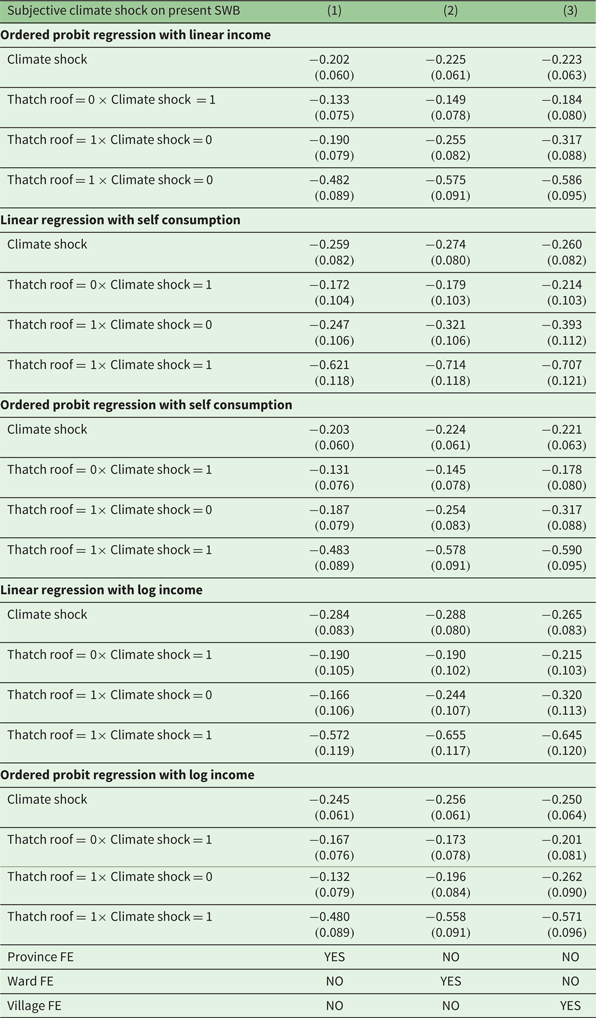
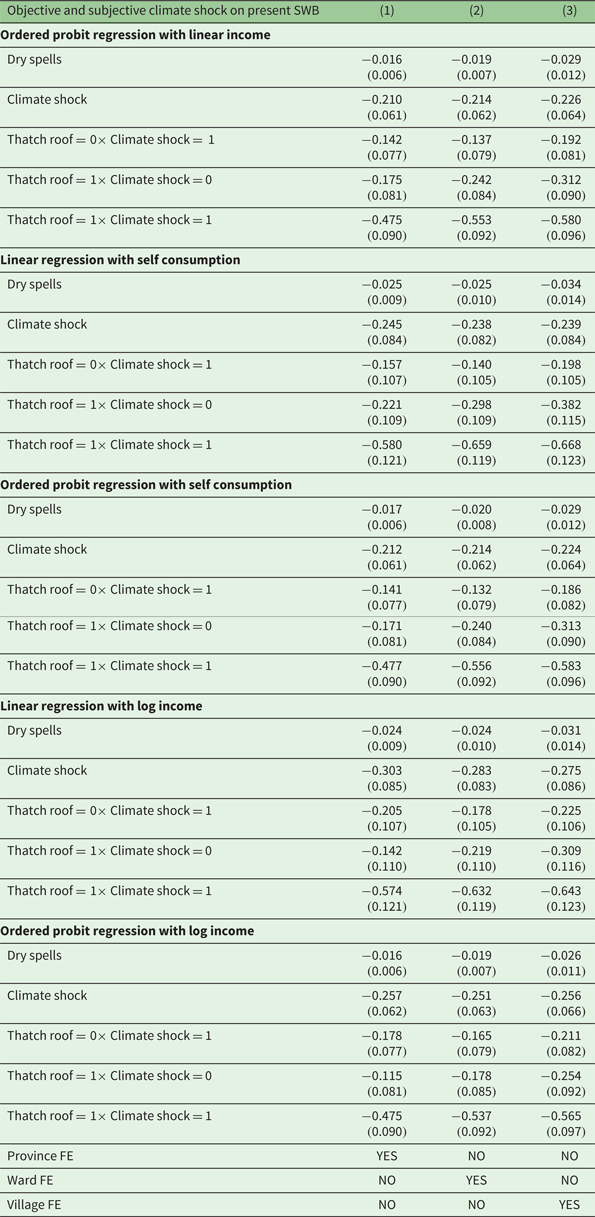
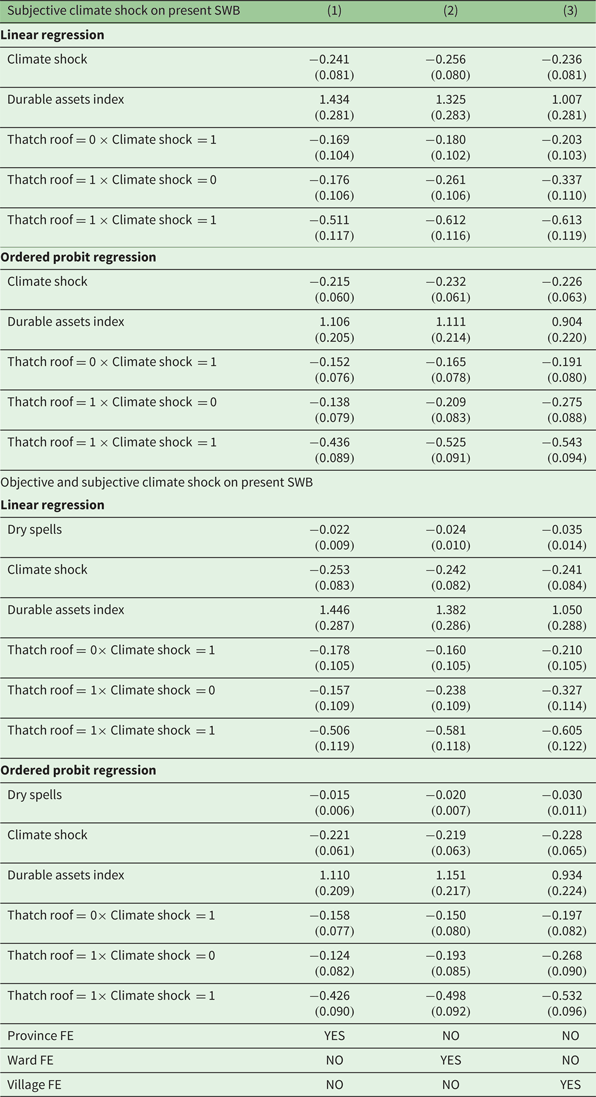
In a further robustness check, we rectify the total gross income with the market value of crops not sold but directly consumed in the household, evaluating them at the local village market price. In addition, we performed other robustness checks using log income and linear income augmented for self-consumption. Our main findings related to both the climate shock and the interaction between the thatched roof and the climate shocks are robust and do not change when using the modified specifications (tables A1 and A2 in the appendix replicate tables 3 and 4, respectively). In a final robustness check, we introduce the durable good index as a control and observe that our main findings for all the alternative specifications of tables 3 and 4 remain significant (see table A3 in the appendix).
Also note that the subjectively assessed climate shock variable captures additional effects different from those captured by dry spells. More specifically, as indicated by construction of the variable in the questionnaire, the variable can capture droughts, floods or sea level rise. As a consequence, our data unfortunately does not allow us to fully disentangle the effect of dry spells from those of the other two climate shocks in the overall climate shock variable.
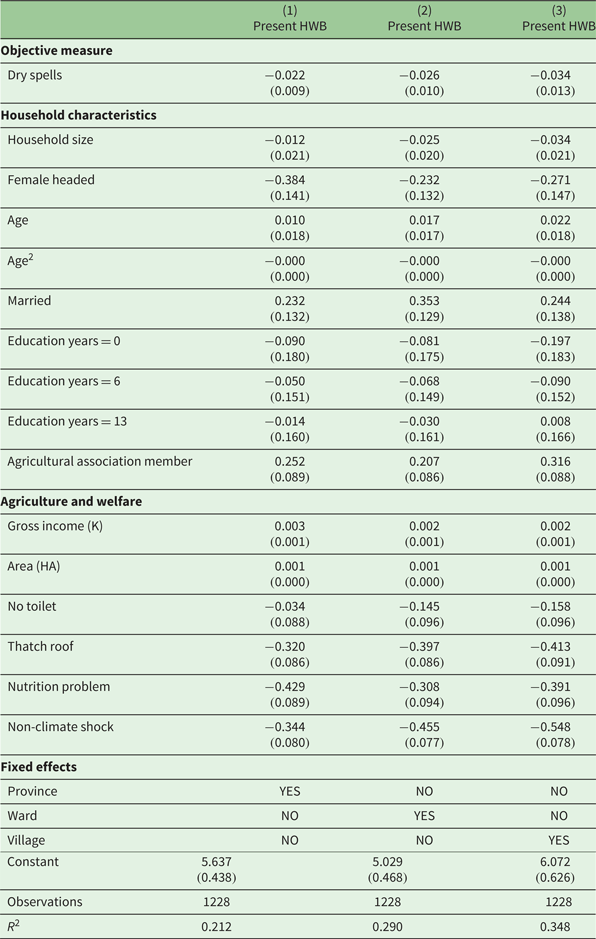
When the two variables are used together, part of the dry spell variable effect is captured by the climate shock variable. However, the significance of the climate shock variable in the estimate where both variables are present tells us that there is something more than dry spells in the negative effect of climate shocks on the dependent variable. Therefore, we have one main reason for using both variables (showing that the negative impact of climate shocks on household well-being goes beyond the effect of dry spells). In addition, if we use only the dry spell variable we have an omitted variable bias if dry spells are correlated with the climate shock variable. However, we find that correlation is small (below .05). Therefore, we perform a robustness check using only the objective climate shock variable. More specifically, we reproduce estimates of table 3 with the dry spell variable replacing the climate shock variable, as shown in table A4 in the appendix. The results of the dry spell coefficient exhibit minimal variation with respect to the results of estimates where both regressors are present (as in table 4).
6. Conclusions and direction for future research
The global economic system has entered an era of strongly correlated and interdependent environmental and social shocks affecting a relevant part of its population. An investigation of the consequences of climate shocks is therefore of the utmost importance to understand their impact and design policies that can address the problem and reduce the exposure of rural farmers to such shocks. To contribute to the existing literature, we evaluate the impact of climate shocks on a sample of low-income farmers in the small-scale island society of the Solomon Islands. The focus of our investigation on low-income individuals, particularly those exposed to climate shocks, is extremely important for measuring the correlation between environmental and socioeconomic problems.
Our findings indicate that respondents’ evaluation of their exposure to climate shocks significantly reduces their subjectively assessed well-being. Similar findings are obtained when using an objective measure (dry spells) that proxies for one of the climate shock dimensions (droughts) in the area. Additionally, we find a significant correlation between environmental shocks and economic problems since respondents with poorer homes (proxied by thatched roofs), below-median income, and fewer durable goods are more severely affected in terms of household well-being. This interaction is confirmed by the fact that those affected by climate shocks reported a significantly higher proportion of nutrition-related problems in the same period. Our findings suggest that the reported loss of household well-being finds correspondence with environmental and social problems.
One limitation of our analysis is in the impossibility of using a finer disaggregation in the comparison between the objective measure (droughts) and the subjectively assessed exposure to climate shocks including three possibilities (sea level rise, droughts, floods). We suggest on this point the development of more detailed data with disaggregation of subjective perception of climate shocks (foods, droughts, sea level rise) to understand their differential impact.
The significance of the objective climate measure used in this study, if interpreted in the sense of causality, suggests the relevance of climate adaptation policies – in particular, the adaptation of crops to drought and longer dry spells – for local farmers. The interdependence between our main findings and the role of housing, income, wealth, and membership in agricultural organizations provides additional policy suggestions related to factors of fragility that can make adaptation more difficult for local farmers. In addition, our findings on the nexus between climate shocks and subjective well-being of poor farmers provide strong evidence in favour of global policies such as the creation of loss and damage funds for vulnerable countries hit by climate disasters. On this point, it is therefore promising that the COP27 deliberated to go forward in this direction. Our findings, however, suggest in this context that we should not just dedicate financial resources to compensation for shocks that have already occurred (rehabilitation, recovery and reconstruction) but also to support for strategies of adaptation and prevention. In this respect, membership in agricultural associations can be an important direction since these associations often have forms of insurance, mutual aid and provision of various services, thus reducing farmer vulnerability to shocks. In addition, local agricultural organizations can play an important role in providing support services and acting as a bridge between FAO/IFAD rural development programs and local farmers, helping the latter to consolidate knowledge and innovation in their productive activities that reduce exposure to climate shocks.
Future research should examine whether similar effects of climate shocks on household well-being can be found for other low-income areas and populations and fill existing information gaps with the development of more detailed data. More research in this direction is urgently needed, as the literature evaluating the impact of climate shocks on subjective and household well-being is a first building block that can help to improve our knowledge on related objective outcomes such as the probability of climate migration. Future empirical research that directly reconnects evidence on disutility from climate shocks with climate migration choices (with proper data on this point thereby overcoming another limitation of this analysis) would be particularly important in this regard, in the same direction as what has been done in the literature that found clear relationships between “feelings integers and subsequent get-me-out-of-here actions” (Kaiser and Oswald, Reference Kaiser and Oswald2022), or the materialisation of objective outcomes, as in the case, among others, of the nexus between job satisfaction and quitting job, and self-assessed health and the onset of chronic diseases.
Supplementary materials
The supplementary material for this article can be found at https://doi.org/10.1017/S1355770X24000160
Competing interest
The authors declare none.