In 2012, the centenary of the death of Jules Massenet, France's most prolific and important opera composer during the last twenty years of the nineteenth century, various modest celebrations were held in Paris and in his home town of Saint-Etienne. Outside of France scant attention was paid to this centenary, and even the commemorative attempts by the French were somewhat lukewarm.Footnote 1 The mild disdain of the French for Massenet and his works today can be contrasted to his reception in France at the height of his career: although individual works were rarely outright successes in critical terms, they always elicited copious column inches, and Massenet as a ‘chef d'école’, an establishment figure and a ‘national treasure’ was highly visible. It is this ‘visibility’ that I address here: through the lens of the iconographical and, more particularly, caricatural press, I assess Massenet's ‘physical presence’ in the media during his career, drawing on theories of parody, reading and readership, memorialisation and the commodification of memory. Although the pairing of memorialisation and caricature may seem paradoxical, this article aims precisely to explain and undermine that paradox. For, although cartoons and caricatures of Massenet and his operas formed part of an increasing trend in the reception of cultural artworks via amusement or distraction,Footnote 2 their commodification and the way in which these consumer products were received gave rise to new opportunities to memorialise the composer and his works.
The impetus for commemoration is based in religious ritual, for to commemorate is to sanctify and to consecrate. Ritual tends to destabilise established forms and ‘truths’ to reintegrate and renew the sense of those things/events/processes that have been ritualised.Footnote 3 French Republican society has never had any qualms about merely laicising and adopting religious rites and ceremony, and from the earliest days of the first Republic, political commemoration has defined French political mores. The commemorative gestures of the Third Republic, the only secular republican state in Europe at the time, actively created heroes and narratives of its musical and operatic history, thus displaying the nation's attachment to particular values (although, correspondingly, these processes could also furnish an opportunity to those who wished to distance themselves from those values or to uphold others). Massenet's hard-won place as an operatic ‘hero’ of the Third Republic was clearly seen as worthy of memorialisation and commemoration during his lifetime. No statues were erected and no street names rebaptised while Massenet was alive, yet he garnered the official accolades of Republican society. Moreover, his prolificacy assured him and his works regular coverage in the French press. Although readers may well have been familiar with the critical reception of an opera from the written press, visual parodies and caricatures of his operas were created by highly skilled artists and writers in a diverse and relatively far-reaching press. The immediacy of these entertaining drawings resulted in an ever-present image of a composer memorialised.
Alexander Rehding deals with various reverential, serious-minded transformations of musical materials and ephemeral musical objects that rarely find themselves in the limelight of musicological attention, but which, when placed in dialogue with the works themselves, are often instrumental in positioning those works in the cultural space they occupy.Footnote 4 Massenet's works, in conjunction with the artefacts that they spawned, can, therefore, establish a network in which the two things mutually reinforce one another's significance. Caricatures of Massenet and parodies of his works which appeared in the press during his career carry out similar cultural work: they are very different manifestations of a similar impulsion to memorialise. Rather than embodying democratic satire, as much political caricature is seen to do, parodic drawings of this type bolster the artistic status quo and pay a form of homage to the cultural establishment.Footnote 5
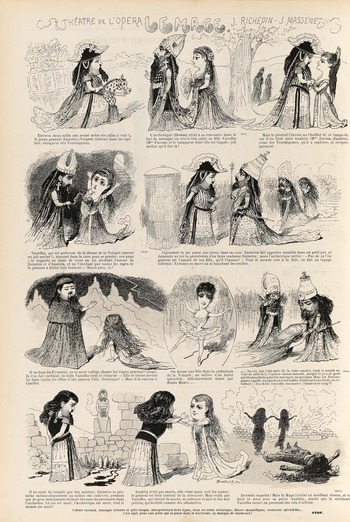
These artefacts come in various forms. The ‘portrait-charge’ brought together many diverse elements to create a compound image and message that nearly always featured a grotesque, oversized head on a small body. Functioning in a similar way to Freudian condensation in the ‘dream work’,Footnote 6 this type of image was often presented on the front cover of artistic and satirical journals, and, being non-narrative in function, it generally involved very small amounts of written text (beneath the image). Caricatures comprising one main drawing functioned in the same way, even when they did not display the grotesque heads. Cartoon parodies, on the other hand, comprised a series of drawings which were narrative in function, filling a whole page (and sometimes two). The parodies are not cartoons in the modern sense, for they do not use cinematic techniques of montage and different types of camera shot, but rather generally represent the full body of the characters and invariably some of the opera's scenery in the background (see Figs. 1 and 4). (Thus, although in the following pages, I use the terms cartoon parodies and parodies interchangeably, I avoid the term cartoon alone.) Cartoon parodies also include a certain amount of text, generally presented beneath the images, rather than in text bubbles.Footnote 7 Their comprehension is reliant on the co-presence of the verbal and the visual signs, the space beneath the image constituting ‘an access to and an ekphrasis of’ the main ‘text’ and its meaning.Footnote 8
Stop, ‘Théâtre de L'Opéra. Le Mage’, Le Journal amusant, 44e année, no. 1806, 11 April 1891, 4

Cartoon Parodies
The caricatural artistic press had a ‘special’ relationship with Massenet and his operas; this reflected the composer's prominent position in artistic society, for, indeed, no parody of one's opera was almost a sign of failure. The cartoonist Stop (pseudonym of Louis Retz) in particular and the weekly Le Journal amusant displayed a fifteen-year commitment (1884–99) to the memorialisation of the composer's works with Manon, Le Cid, Esclarmonde, Le Mage, Werther, Thaïs, Sapho and Cendrillon all appearing in cartoon format (Le Cid drawn by Henriot, pseudonym of Henri Maigrot). During the same period, the openly monarchist journal Le Triboulet (which presented an odd mix of keen artistic and social satire alongside weekly heraldic plates) frequently published reports about and drew caricatural images of Massenet and his operas. Le Charivari, a daily illustrated satirical newspaper edited by Henriot, paid tribute with full-page cartoons dedicated to Le Roi de Lahore, Le Mage and Thaïs by three different authors; and La Silhouette featured Le Cid and Thaïs on its front cover. These caricatural papers flourished at the end of the nineteenth century, as part of the boom in the French popular press which was set in motion by a release from the shackles of censorship (resulting from laws passed in 1881)Footnote 9 and by the increasingly easy and cheap reproduction of images.
Although information regarding print runs of and subscribers to the Parisian newspapers and magazines in which these caricatures abound is hard to find, the images and their accompanying texts were undoubtedly destined for an audience who possessed the ‘cultural capital’ necessary for deciphering the encoded messages within them.Footnote 10 So although knowledge of an opera that is portrayed through parodic drawing is not necessary, it certainly makes up part of the cultural capital of the authors who are, after all, writing and drawing for an initiated readership, their contemporaries and social peers. Undoubtedly therefore, a large proportion of readers of operatic parody were familiar with operatic conventions, as well as with other literary, iconographical, musical and satirical conventions born of a certain class and financial position in society. Moreover, these codes constitute common ground for the author and the reader for maximum comprehension of the parody.Footnote 11
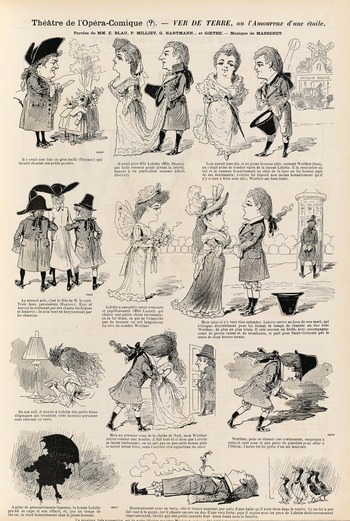
The parodies of Massenet's operas in Parisian satirical journals adapt the libretto to tell a humorous version of the original story. Authors interpolate familiar French and Parisian locations, nineteenth-century items and procedures, allusions to current affairs (both political and artistic, not to mention scandalous rumours) and contemporary figures (again, both political and/or artistic depending on the bent and readership of the paper), exterior to the story and to opera in general. For example, Stop's drawing of Le Mage (in Le Journal amusant, reproduced as Fig. 1) plunges the reader immediately into this anachronistic world. The opera, set in ancient Bactria (on the borders of modern-day Iran and Afghanistan), the cradle of Zoroastrianism, is brought closer to home: the defeated Touranians of the original story become the ‘Tourangeaux’ (the people from the Touraine region of France); thus the external exotic is transformed into the internal exotic. The first frame continues the anachronism: the text affirms that the story is set in 2000 bce, yet the battle victor enters wearing a military hat of the Napoleonic period, mounted on a dappled rocking horse and accompanied by a batallion of Napoleonic infantrymen.Footnote 12 In a similar way, Stop repatriates Charlotte and Werther from Wetzlar, Germany, to a recognisable Paris, with the Moulin Rouge and the capital's Morris columns in the background (Fig. 2,Footnote 13 top row, last frame and second row, last frame). Such temporal and geographical re-contextualisations of the opera's story highlight the immediacy of the parodic medium and the incisiveness of its intertextuality which are, indeed, the keys to the parodies' success.
Stop, ‘Théâtre de l'Opéra-Comique (?). – Ver de Terre, ou l'Amoureux d'une étoile’, Le Journal amusant, 46e année, no. 1901, 4 February 1893, 5

The cartoon can be viewed as an autonomous literary subgenre with its own structural patterns, as an original mode of communication, and as an interpretative code which the reader already shares with the author and to which the latter refers constantly in order to organise his/her message (as Umberto Eco analysed it).Footnote 14 In the early 1880s, the narrative cartoon format of operatic parody is not yet in place. For example, in G. Lafosse's drawing of Le Roi de Lahore, which appeared in Le Charivari on 6 May 1877, it is hard to follow the correct sequence of images as they are not presented in linear format; and Stop's presentation of Manon in Le Journal amusant was more just a composite image presenting the different protagonists and artists than a cartoon.Footnote 15 By 1885, however, the narrative structure of operatic parodies is provided (up to a point) by the operas' dramatic structure, and the stereotypical characters presented are often already familiar from opera librettos. The operatic genre is not completely destabilised by its parody, therefore, and the view of the characters and the stage setting presented to the reader is one with which the audience member in the opera house is familiar.Footnote 16
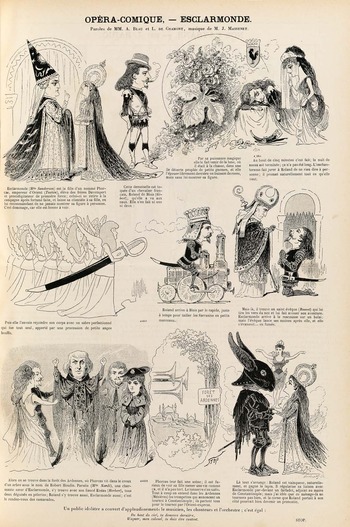
Stop's first successful cartoon parody (Fig. 3) appeared in Le Journal amusant on 1 June 1889 following the première of Esclarmonde. In this parody the audience's cultural capital is put to the test, and the level of intertextual detail renders the drawing all the more vibrant and effective. The supernatural powers of Esclarmonde's father, the Emperor Phorcas, are highlighted as he first appears with a wizard's hat and later (bottom row, first frame) is transformed into the figure of Jean Eugène Robert-Houdin (1805–71), an inventor of automata, a magician and the father of modern illusionism. The French knight Roland (top row), despite wearing medieval garb, is decidely modern, smoking a cigarette and sporting a fedora, and the libretto's constant magical travelling between distant places is replaced by that thoroughly nineteenth-century mode of transportation, the train.Footnote 17 Here the train is a miniature version which Roland easily straddles, his ‘tail’ (his magical and powerful sword) between his legs (second row, middle frame).
Stop, ‘Opéra-Comique – Esclarmonde’, Le Journal amusant, 43e année, no. 1709, 1 June 1889, 5

Details of a sexual nature were often seized upon for the enjoyment and, to some extent, the greater ‘pleasure’ of all readers. Indeed, many other illustrated and satirical journals aimed at a mid- to lower-bourgeois audience openly traded in moral satire which represented daring or even dissipated sexual behaviour, often displaying women in various states of undress and in sensual poses, for the purposes of titillation. The frequent presence of scantily clad ballet dancers and cast members and the often explicit sexual nature of the librettos banalised these sorts of images, and the opera parodies capitalised on a certain salacious humour. The étoile Rosita Mauri, for instance, appears in many cartoons,Footnote 18 often with other nubile ballerinas, while for Le Mage, Stop rather unusually steers away from explicit display of female flesh, using the visual shorthand for the corps de ballet behind Mauri by representing the dancers as brooms (brooms=balais=ballet) (Fig. 1, third row, second and third frames). For Esclarmonde, the visual substitution for the infamous orchestral interlude which shocked audiences at the premiere by its graphic musical description of the sexual act during the wedding night of Esclarmonde and Roland is also highly vivid.Footnote 19 Here, Stop draws a large rose bush (ripe for the picking), its lower half covered by a giant fig leaf, which is framed by a circle and an escutcheon showing Roland's Gallic cock crowned by Esclarmonde's imperial status. The circular form also evokes the magic-lantern slides designed by Eugène Grasset and used to represent Roland hunting in Act I.Footnote 20 This allusion to Roland's other virile quest in the opera is subtle, but the opera's aficionados could have recognised it; next to Stop's rose bush we see a spent and sleeping Roland, his ‘hunting horn’ lying indolently on the floor in front of him.Footnote 21
Stop's drawing of Jean Gaussin's night of love with Fanny Legrand from Sapho is evoked by the extinguishing of the bedside light – Fanny puts out a (phallic) candle with a conic snuffer – and the promise of what is to follow can be clearly read by Fanny's extended white arm, naked save for the short frilly cap-sleeve of her frivolous nightgown.Footnote 22 Both Stop (in Le Journal amusant) and Tézier (in Le Charivari) represent Athanaël in Thaïs as a sex-crazed hysteric and at the same time as Thaïs's therapeutic hypnotist.Footnote 23Thaïs in based on a contemporary ‘classic’ of decadent literature by Anatole France, whose heroine was both a sensual actress and a priestess of Venus. Both the opera and its press reception bathed in the fin-de-siècle notions of decadence and degeneracy, whether physical or moral, that crystallised in the theories of hysteria of the well-known and mediatised Jean-Martin Charcot.Footnote 24 Indeed, the further the opera portrayed pushes the limits of ‘common decency’ (by late nineteenth-century standards), the more sexually explicit the parodic drawings become. Thus, in Stop's cartoon parody Athanaël's headwear is ‘perverted’, a nightcap becoming a condom on the head of the sleeping yet phallic-like monk whose head is pointing directly towards the naked backside of a Thaïs who appears in his dream.Footnote 25
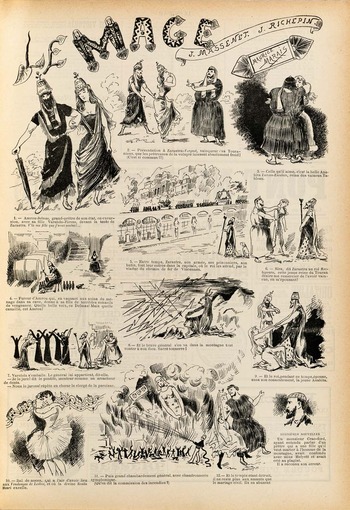
Elsewhere, artists often ally torrid love situations, or the most dramatic and impassioned scenes, to adverse weather situations as storms rage, winds blow and lightning flashes in the drawings of scenes between lovers. Such pathetic fallacy is itself parodied in the drawing by Stop (Fig. 2) that replaces the orchestral interlude linking the last two acts of Werther. This passage musically represents Charlotte's inner turmoil as much as her external travail to reach Werther through a blizzard, yet here Charlotte (portrayed in silhouette and carrying an umbrella) is battling against far more prosaic heavy rain which is represented by thick slanting lines half obscuring the image (bottom row, first frame).Footnote 26 Other cartoon parodies link expressions of extreme weather to the heavy or even overloaded nature of Massenet's score.Footnote 27 For Le Mage, Maurice Marais's cartoon for Le Charivari (Fig. 4, middle column, third frame) represents the bolts of lightning that accompany the rumbles of thunder heard in the orchestra as Zarastra retreats into the mountains, the text punning on this ‘thunder’ (‘tonnerre’) in an expression which implies ‘Hell and Damnation!’ And when representing scenes where the opera's music becomes dramatic and loaded with percussion, the allusion to kitchenware was inescapable. As the temple burns to the ground in Marais's Le Mage cartoon, the words ‘chaudronnerie symphonique’ (which loosely translates as ‘symphonic metalworking’) accompany a Parisian fireman (Fig. 4, middle column, bottom frame). Equally in Lafosse's cartoon of Le Roi de Lahore,Footnote 28 as tempers and passions flare (underpinned in the opera by heightened dramatic music), a furious Scindia thumps the bottom of a saucepan as the text affirms that he hit ‘la batterie de cuisine’ (which lamely translates as a ‘set of saucepans’ but with the connotations of percussion and military battery).
Maurice Marais, ‘Le Mage’, Le Charivari, 60e année, 28 March 1891, 3

The opera's spectacle often becomes the focus of detail in the parody, especially the elaborate costumes of exotic operas. Both Marais and Stop transform the ornate headwear of characters in Le Mage into upturned flower pots (with flowers growing out of the top, see Fig. 4, particularly left column, first frame, and Fig. 1, second and third rows), while Lafosse turns the god Indra's headdress into an elaborate and shiny cake mould in his drawing of Le Roi de Lahore. In the last, the three-tiered ‘biscuit de Savoie’ mould shines like a beacon, dotted lines emanating from it in all directions to symbolise its radiance, and the text suggests that spectators needed blue-tinted glasses to shade their eyes from the dazzling spectacle of the ‘Paradis d'Indra’. Such transformations seem to ridicule the ornate and extravagant spectacle of Orientalist operas (and ballets) which, nevertheless, held centre stage in Paris for over half a century, France's fascination for Orientalist art having been (and continuing to be) shored up by colonial interests in the Middle East and north Africa.
Thus, although irony and satire are brought to bear in all these parodies – to mock the spectacle or the sexual mores and social reactions of the characters – they are not necessarily parody's prime objective. Despite theories which read parody as a critical, subversive and pedagogical critical tool,Footnote 29 most scholars agree that parody is a self-reflexive genre, a form of inter-art discourse, a type of repetition with critical distance which mingles filial rejection with respect, an authorised subversion or transgression of recognisable forms and conventions which has the potential to challenge and destroy but also to reiterate, renovate or renew that which is parodied.Footnote 30 Thus, these parodies reinforce: they inscribe the mocked conventions (whether social, sexual, musical or dramatic) onto themselves, thereby guaranteeing their continued existence. Even for those readers unfamiliar with the original opera and its cast, the parody (and the stereotypes that it vehicles) embodies important societal or cultural values in accordance with a range of tacitly accepted formative rules, directed at the average reader's intelligence, imagination and taste.Footnote 31
Parody, therefore, is not so far removed from the ritual of commemoration described earlier, in the manner in which it destabilises established forms and ‘truths’ to reintegrate and renew the sense of the objects (material or otherwise) of ritualisation. Thus, once more, these ‘ephemeral’ cartoon parodies of Massenet's operas can be read as commemorative gestures, as agents of a memorialisation of the composer's success and of his place in Republican society rather than, as is the case with much political caricature, a democratic leveller in the name of cultural, social and aesthetic heterogeneity.Footnote 32 Moreover, in their commodification of the operatic experience, these musical ‘souvenirs’, received in the intimate surroundings and comfort of one's own home, demanded a very different kind of engagement from that of the opera house, and they provided the opportunity for an act of private commemoration.Footnote 33 For some readers, they could have been a lively and entertaining memory of the operatic performance; for others, they could have been an alternative way of evoking the specificity of the opera house experience, whether they had experienced it or not. For yet another contingent, that specificity was not key: for these readers, the cartoon parodies traded in noteworthy contemporary social, cultural and artistic trends and issues, thus becoming modern, amusing cultural artefacts in their own right. Consumption of these commodities fed into their various audiences' operatic literacy – although this was not necessarily their primary function.
The ‘Portrait-Charge’
By the mid-1880s, the ‘portrait-charge’ was a tried and tested formula. Its message and effectiveness was perhaps even more immediate than the cartoon parodies (which necessitated the reading of the text) for those readers who could easily decipher the visual messages, although necessarily the level of intertextuality was rarely as complex as in the parodies. Thus, the ‘portraits-charges’ celebrated the highest achievements of culture in ‘an immediately appreciable form, their intellectually demanding and often elitist nature notwithstanding’.Footnote 34 In this transformation from music/musical figure to musical artefact, the ‘front-page’ presentation of the subject and the high-level status such positioning conferred rendered the physical object an all the more palpable and collectable commodity.
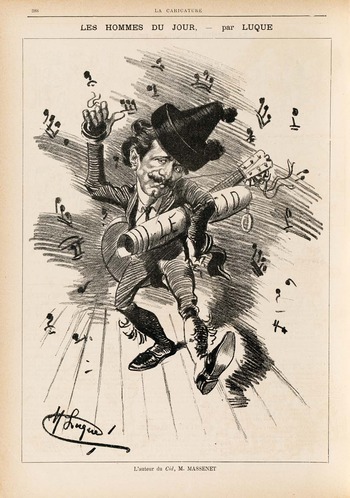
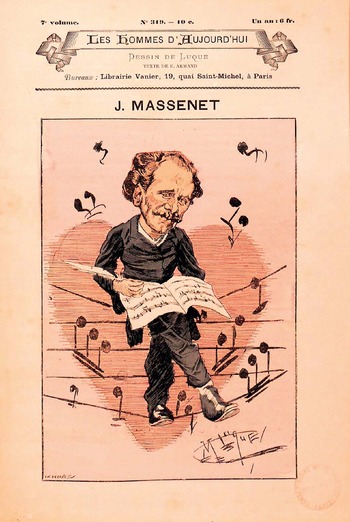
Massenet himself, in conjunction with performance of his operas, became the target of a number of these drawings.Footnote 35 Charges are most frequent from around the time of Le Cid (1885) when Massenet became the uncontested ‘chef de l'école française’. His setting of a libretto based on a classic of French literary heritage, the premiere of which was timed to coincide with the 200th anniversary of the death of Corneille, reinforced this notion. Indeed, as Annegret Fauser has pointed out, since Wagner was dead and his works had not yet reached Parisian stages (save the disastrous 1861 Tannhäuser and the 1869 Rienzi Footnote 36), and since Verdi had gone decidedly quiet (Otello and Falstaff not arriving in Paris until 1894), Massenet was not only the consecrated head of a national school but also the principal exponent of a larger European artform and the most active opera composer in Europe at the time.Footnote 37 The artist Manuel Luque twice featured Massenet: first as his ‘homme du jour’ (man of the day) in La Caricature on 5 December 1885, immediately following the première of Le Cid (Fig. 5); second as one of his ‘hommes d'aujourd'hui’ (modern men), probably in 1887, as part of a long-running series published in pamphlet format and featuring high-profile artists, writers and composers (Fig. 6).Footnote 38 In 1885 Luque drew a sombre, thin Massenet, dressed as a Spaniard with a guitar strapped to his back, dancing and clacking away on the castanets, one hand held aloft, the other behind his back. Tucked beneath his arm is a scroll, with Le Cid marked across it: resembling a huge cigar, it is a symbol of Massenet's artistic potency. As he stomps and clacks, musical notes fly off in all directions, as if Massenet's idiom is as (perceivedly) free and easy as this dance number. Luque's second charge shows a similarly melancholy and skinny Massenet sitting cross-legged on the staff lines which bend under his weight. He has a bifolio of manuscript paper on his lap and a feather quill in his hand as if he is relaxedly composing. The unrealistic notes on the staff seem to ping off the stretched lines into the air above Massenet where they are distorted to look almost like flowers or even birds. Massenet is framed by/leans back on a heart-shaped pink-shaded background. This Massenet seems to be Massenet ‘le chantre de l'amour’ (the precentor of love), the prolific and intimate painter of the ‘histoire de l'âme féminine’ (history of the female soul), as Debussy infamously remarked in 1901.Footnote 39
Manuel Luque, ‘Les Hommes du Jour. L'auteur du Cid, M. Massenet’, La Caricature, no. 310, 5 December 1885, 388

(colour online) Manuel Luque, ‘J. Massenet’, Les Hommes d'Aujourd'hui, 7e volume, no. 319, n.d. [1887?]

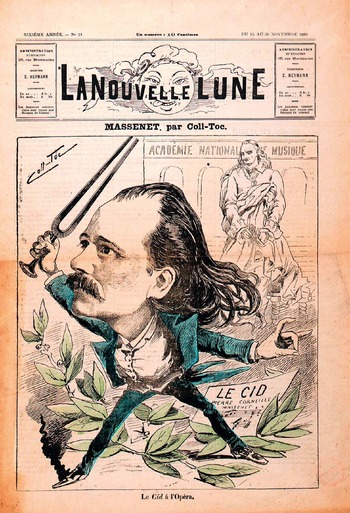
But the artistic notoreity and cultural position Le Cid afforded to Massenet was reflected in La Nouvelle Lune which gave over its title page to a composer, as it rarely did, in November 1885 with an engraving by Coll-Toc (Fig. 7). Massenet is placed in front of the Opéra and a statue of Corneille and is represented as a young, dashing conquering hero – a modern Cid – in fencing posture, brandishing not a foil but a tuning fork. He duels with his art – perhaps for the supremacy of his art over Corneille's – as he tramples the leaves of his laureate on which lies a copy of his score. Massenet's enthronement at the Opéra, that highly subsidised national theatre, conferred this public stature upon him. The simultaneous success of Manon at the Opéra-Comique contributed further to the accrued prestige of the composer,Footnote 40 but it was the work performed at the Opéra, Le Cid, which was singled out in the caricatural press to commemorate Massenet's success and status, despite the work's divided critical reception.Footnote 41 Once again, many caricaturists focussed on the dancing ‘almées’ with bare midriffs, yet simultaneously decried the great national treasure Corneille being reduced to belly-dancing.Footnote 42 Bast's cover image of Le Cid (which is somewhere between a charge and a cartoon parody) for La Silhouette echoes this sentiment, as Corneille – his weightiness in French cultural heritage represented by the ream of volumes of his works stashed under one arm – descends from heaven upon hearing that Massenet has ‘stolen’ his work.Footnote 43 Appalled by the way his Alexandrine verse has been treated in the libretto and by the musical setting, Corneille is consoled only by the sight of Rosita Mauri dancing, which makes him forget his grievances.
(colour online) Coll-Toc, ‘Le Cid à L'Opéra’, La Nouvelle Lune, 15–30 November 1885

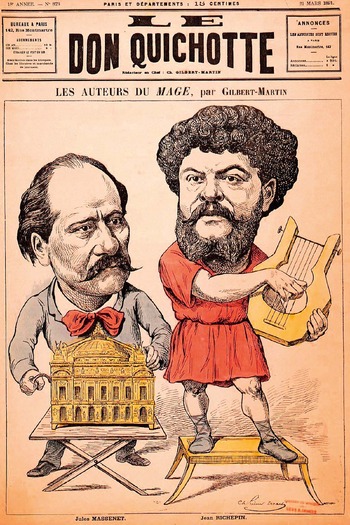
After the success of Esclarmonde at the Opéra-Comique, as the official opera of the 1889 Exposition Universelle, Massenet was again enthroned at the Opéra with Le Mage in 1891.Footnote 44 Recognition of the authors Massenet and Jean Richepin in this high-profile national house reached beyond the satirical papers which routinely ran articles and images connected with opera, to Le Don Quichotte, a radical republican and anti-clerical weekly. In the cover image (Fig. 8) by the journal's general editor Charles Gilbert-Martin, Richepin, who was yet to garner the accolades of Republican society (such as election to the Académie FrançaiseFootnote 45), is, however, foregrounded, put on a stylish pedestal and garbed in ancient attire strumming his lyre. Massenet, on the other hand, wearing (rather shabby) everyday clothes, stands a short way behind Richepin; a barrel organ in the shape of the Opéra is perched on a very basic table; and Massenet is turning its handle. Massenet is thus already seen as an accompanist to Richepin's rising star, and not an inspired one at that, but merely someone churning out street music.
(colour online) Charles Gilbert-Martin, ‘Les Auteurs du Mage’, Le Don Quichotte, 18e année, no. 873, 21 March 1891

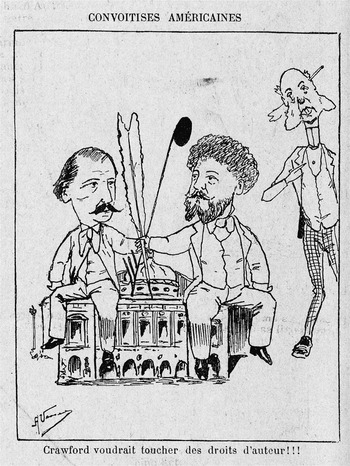
This ‘imbalance’ was, nevertheless, redressed by a parody of Gilbert-Martin's drawing, ‘Convoitises américaines’ (American Jealousy), which appeared in Le Triboulet the following day (22 March 1891, Fig. 9). A certain artistic hierarchy is re-established between Massenet and Richepin who are pictured in modern dress, each man perched upon a corner of a diminutive Opéra building. They stretch out their arms to one another; Richepin's giant feather quill and Massenet's enormous single demisemiquaver with its notehead aloft cross in a symbol of harmony, or at least of equal combat. This unity may be directed against the American novelist, playwright and librettist, Francis Marion Crawford, who is lurking in the background. In 1885 he published a two-volume, English-language novel (in London, which does not appear to have been translated into French) titled Zoroaster.Footnote 46 This image, captioned ‘Crawford would like to be paid some royalties!!!’ (Crawford voudrait toucher des droits d'auteur!!!), is unprepared anywhere else in the journal and seems guilelessly to feed the reader a snippet of background knowledge from those ‘in the know’. However, it also subtly calls into question the artistic integrity of both authors equally for a work on which a huge amount of public resources had been conferred and which had been hailed as a new manifestation of national artistic genius.
A.V., ‘Convoitises américaines’, Le Triboulet, 14e année, no. 12, 22 March 1891, 10

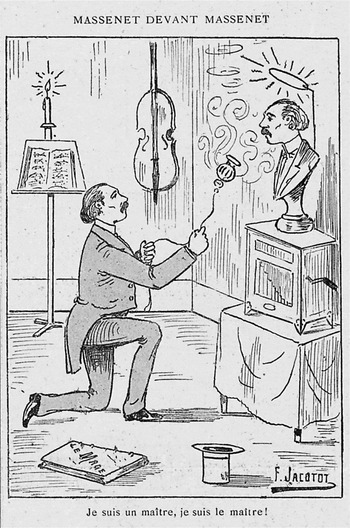
This charge is representative of Le Triboulet's habit of throwing in a drawing to be read alone, with a short caption but no extended accompanying text to contextualise the image, often to pernicious ends. A week after the publication of ‘Convoitises américaines’, Le Triboulet again featured a small drawing of Massenet (Fig. 10). ‘Massenet devant Massenet’ (Massenet before Massenet) represents the composer on bended knee before an ‘altar’ – a table, topped once again by a barrel organ – upon which is placed a bust of himself complete with a radiating halo (made of wire), with the composer swinging an incense burner towards the marble version of his head. A candlelit music stand adds to the pseudo-church imagery, and a hard-bound score of Le Mage lies on the floor. These sorts of images strike the death-knell of Massenet's uncontested popularity, and they mark the turning point in his career when critical attention tended to be just that, critical rather than eulogistic. By the time of the premiere of Thaïs in 1894, Massenet's reputation, if not his artistic position, in the French cultural landscape had changed further, and much for the worse. The opera's premiere came in the immediate wake of the controversial publication in French of Max Nordau's La Dégénérescence which systematically catalogued a range of ‘artistic perversions’ and the ‘physical degeneracy’ of contemporary artists.Footnote 47 Thus, the supposed decadence of Massenet's formal style dominated press reception of Thaïs, which comprised an unusually large number of caricatural and parodic drawings.Footnote 48 The published charges and cartoon parodies drew on this rich contextual backdrop (as well as on Massenet's personal relationship with his leading lady Sibyl Sanderson, providing a graphic window into ‘insider information’) to question the composer's position at the head of a national school which was increasingly searching, with varying levels of success, for ways to renew itself in the post-Wagnerian era.Footnote 49
F. Jacotot, ‘Massenet devant Massenet’, Le Triboulet, 14e année, no. 13, 29 March 1891, 10

Thus, the way in which charges function can be much closer to political caricature which, through the use of satire and irony to objectify, mock and ridicule, is invariably judgemental or ameliorative in intention.Footnote 50 A certain strand of the press caricatures of Massenet and his works from the 1890s, therefore, had the purposes not only to entertain but also to expose and challenge accepted standards and to promote (particularly French) aesthetic integrity. This vivid form of amusement was a powerful tool for self-analysis and auto-censorship in Parisian artistic society, in which Massenet remained a key player and resolutely popular with audiences until the early years of the twentieth century. Thus, although the critical written press increasingly called Massenet's works into question, Stop continued to draw parodies of them until the highly innovative and successful staging of Cendrillon in 1899 by Albert Carré at the Opéra-Comique.Footnote 51 Massenet, therefore, remained a physical presence in the artistic landscape, and his public successes continued to be commemorated in the caricatural press, despite a waning reputation in critical circles, with the result that readers of the light-hearted satirical press ‘received’ and ‘consumed’ his operas in this way until the turn of the century.
Entertainment and Elitism
At the height of his career, Massenet and his operatic triumphs were celebrated by Republican society, but more than that, the composer's works were sanctified and reified in the public imagination not only through their physical presence in France's most prestigious cultural institutions but also in their visual presence in periodic journals and newspapers where Massenet and his works were memorialised, commemorated and commodified, through caricatural and parodic media, as musical artefacts. Inherent in this metamorphosis of musical materials from the public to the private, from the monumental to the intimate, was a juxtaposition of distinct and often irreconcilable qualities such as convention and fashion, entertainment and edification, high culture and low culture, and mass appeal and elitism.
Parodies of opera, however, came from within the consensual world of the arts and politics, from an establishment which in no way wanted to question its own existence, even if it was capable of pointing out its own foibles. Dan Harries describes parody as ‘conservative transgression’, and in this reading of parodic cartoons of opera, it would seem that conservatism triumphed.Footnote 52 Henri Maigrot (Henriot) was a lawyer by training and a former ministerial secretary to the powerful but controversial Ernest Constans, as well as an intimate friend of the establishment composer Ernest Reyer; he received ‘la legion d'honneur’ in 1899.Footnote 53 Louis Retz (Stop), also a lawyer with formal artistic training, employed his talents not only in drawing parodies of opera but also by continuing the tradition of Cham's (pseudonym of Amédée de Noé) ‘Salons comiques’ or ‘Salons pour rire’. Cham's parodies of paintings exhibited at the annual Paris salon were published in Le Charivari during the 1860s; by reiterating the conventions of fine art and mocking the ‘out of the ordinary’, they performed similar cultural work to operatic cartoon parodies and contributed to the reinforcement of a traditional and academic aesthetic in the fine arts.Footnote 54 Like other caricaturists, Stop had also designed costumes for productions of Offenbach operettas and had even written plays and libretti.Footnote 55 Stop and Henriot, as well as many of their colleagues, were men who came from inside the system, who were part and parcel of it; and their journals, and the caricatures and parodies contained within them, were conceived by men who went to the opera, who were part of the operatic world, and who chose to trade in the art and the politics of opera. There were many other illustrated and satirical journals – such as La Chronique amusante and Le Courrier français illustré – however, that did not dare touch the high arts of the Parisian opera houses and establishment theatres such as the Comédie-Française.Footnote 56
Thus, opera parodies and caricatures can be read as memorialising gestures on the part of a cultural and cultured realm. Such gestures encourage a commemorative stance, and their reiteration indicates a devotional quality in relation to that which is commemorated.Footnote 57 Distinct from the world of political satire, parodies of Massenet's operas were an affordable and amusing consumer product in popular form for an elite, presenting an alternative but nevertheless unchallenging view of the artistic establishment which brought the singers, dancers, musicians, authors, composers and directors, as well as their trials and tribulations, directly into the fin-de-siècle home. These artefacts provided a valuable and valued window on operatic culture of this period for readers whose familiarity, particularly with the detailed cartoon parodies, fuelled their operatic literacy. Parody, as a humorous but largely respectful means of reception of opera, in commodified form, not only memorialised the composers and the works that were lampooned, but also served to bolster the genre and its conventions for future audiences, as well as for those patrons who rarely set foot in the opera house.