Implications
Finishing beef cattle in pens with floors that both improve animal welfare and reduce labour as that required for deep litter management is quite challenging. This study gives evidence of how covering the fully slatted concrete floor with rubber slats resulted in a reduced number of treatments for locomotor problems and a lower percentage of bulls with bursitis. The rubber allowed better expression of the species-specific behavioural pattern and enhanced bulls’ growth performance. The negative effects of this type and design of rubber surface on bulls’ cleanliness and hoof overgrowth might be reduced by improved drainage and abrasion.
Introduction
Pathological conditions of the locomotor system are reported to impair normal locomotion, worsening the general welfare status of cattle as well as their productive response (Barker et al., Reference Barker, Leach, Whay, Bell and Main2010). Locomotor problems are highly relevant in most cattle categories, particularly in dairy cows (Somers et al., Reference Somers, Schouten, Frankena, Noordhuinzen-Stassen and Metz2005; Barker et al., Reference Barker, Leach, Whay, Bell and Main2010) and beef cattle (Tessitore et al., Reference Tessitore, Boukha, Guzzo and Cozzi2009a and Reference Tessitore, Brscic, Boukha and Cozzi2009b).
Scientific literature gives evidence of the highest welfare potential of straw-bedded pens for the finishing of beef cattle compared with other floor types, and with the fully slatted concrete floor in particular (Schulze Westerath et al., Reference Schulze Westerath, Gygax, Mayer and Wechsler2007; Rouha-Muelleder et al., Reference Rouha-Muelleder, Absmanner, Kahrer, Zeiner, Scharl, Leisch, Stanek and Troxler2012). However, the target to combine the achievement of satisfactory welfare levels with the reduction of the costs imposed by management and renewal of the deep litter has spurred the testing of alternative flooring solutions. Several studies have investigated the effects of coating/covering the concrete slats with a rubber mat (Platz et al., Reference Platz, Ahrens, Bahrs, Nüske and Erhard2007; Graunke et al., Reference Graunke, Telezhenko, Hessle, Bergsten and Loberg2011; Rouha-Muelleder et al., Reference Rouha-Muelleder, Absmanner, Kahrer, Zeiner, Scharl, Leisch, Stanek and Troxler2012). Other studies considered the use of a fully slatted floor covered with perforated rubber mats (Lowe et al., Reference Lowe, Steen, Beattie and Moss2001) or a floor made of concrete-drilled panels coated with a hole-matching perforated rubber mat (Cozzi et al., Reference Cozzi, Tessitore, Contiero, Ricci, Gottardo and Brscic2013). A general improvement of cattle welfare was reported, although some concerns were raised either for bulls’ cleanliness or for hoof overgrowth, suggesting the need for further research supported by the use of animal-based measures. The present study aimed at comparing the effects of two fully slatted floors, one made of bare concrete slats and one on which synthetic rubber slats were placed on the concrete slats, on finishing beef cattle welfare. The assessed welfare indicators were as follows: growth performance, health status, behaviour, cleanliness and hoof growth.
Material and methods
Farms, housing, management and animals
The study was carried out from August 2012 to May 2013 on five commercial beef cattle farms located in Northeastern Italy belonging to the AZOVE Beef Producers’ Association. Basic selection criteria for farms were the availability of at least six fully slatted concrete floor pens housing a minimum of 60 bulls in total. In each farm, the floor of three fully slatted concrete pens was kept as bare concrete slatted floors (concrete slatted (CS)), with draining gaps consisting of 16.9±1.7% of the total surface (Supplementary Figure S1a). The CS floor of the remaining three pens was covered with 30-mm synthetic rubber slats (rubber slatted (RS)) (Riverstick Industries Ltd, Cork, Ireland), designed to match the gap profile of the concrete slats underneath and to allow the drainage of the manure. The RS draining gaps consisted of 11.6±1.2% of the total surface (Supplementary Figure S1b). According to the management protocol for receiving cattle adopted by the breeders’ association, in each farm, the veterinarian checked all the bulls at arrival, and visually sick/lame animals were excluded from the fattening pens and moved to the sick bay. A total of 326 finishing beef bulls (153 on CS and 173 on RS) belonging to Charolaise and Limousine breeds were included in the study as follows: 48 Charolaise bulls (three CS and three RS pens) in farm A, 48 Charolaise bulls (four CS and four RS pens) in farm B, 72 Limousine bulls (three CS and three RS pens) in farm C, 60 Charolaise bulls (three CS and three RS pens) in farm D, and 55 Charolaise bulls (three CS and three RS pens) and 43 Limousine bulls (two CS and two RS pens) in farm E. In all the farms, bulls were housed in groups of 9.1±2.0 animals/pen, balanced according to their initial BW (average initial BW per farm and per floor type: farm A: CS 469.0±2.8 kg and RS 474.5±12.8 kg; farm B: CS 396.8±30.0 kg and RS 396.8±30.2 kg; farm C: CS 382.5±17.9 kg and RS 389.0±16.3 kg; farm D: CS 467.3±11.2 kg and RS 477.7±11.5 kg; farm E: CS 396.0±11.3 kg and RS 387.0±11.3 kg), with an overall average of 414.6±52.0 kg. Average individual space allowance was 3.1±0.2 m2. The pens were equipped with two pressure water bowls for the provision of drinking water. All the farms provided the bulls with a finishing total mixed ratio based on maize silage, which was delivered once a day in the morning between 0900 and 1000 h to allow ad libitum access to the feed.
Growth performance and health status
In all the farms, bulls from each pen were weighed at the beginning and at the end of the finishing period, which lasted 7 to 9 months, in order to assess their growth performance and to calculate pen average daily gain (ADG). Daily health checks were carried out by the stockmen who recorded medical treatments for sanitary problems (respiratory, gastrointestinal and locomotor) throughout the entire finishing period, keeping track of the individual animals. Data regarding the proportion of bulls that were culled early were gathered at the end of the finishing period from farm books. Early culling considered all the bulls that did not complete the regular finishing period, either because they died or were slaughtered before their optimal finishing due to trauma, lameness or other causes. An in vivo individual bull’s health check was carried out by a trained veterinarian during the last month of the finishing. Each bull was visually assessed from the feeding alley, and the occurrence of front and rear leg problems (bursitis (swelling), alopecia (>2 cm in diameter) and lesion/wound) were recorded as binary variables (presence/absence) according to the Welfare Quality® Assessment protocol for cattle (Welfare Quality®, 2009). Hoof overgrowth was also evaluated from outside the pen by recording the number of bulls with visually evident signs of increased dorsal wall length and concavity.
Behaviour and cleanliness
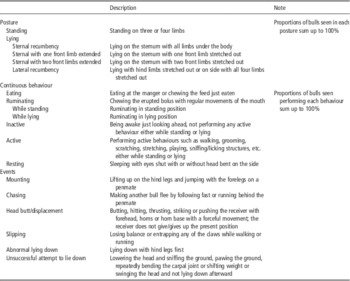
In each farm, two 8-h behavioural observation sessions were carried out by a team of five trained assessors, starting right after feed distribution was completed by the stockmen (between 0900 and 1000 h). The first observation session (OS1) was carried out 1 month after the arrival of the bulls at the experimental pens. The second session (OS2) was carried out within 2 weeks before the expected slaughter day. The assessors carried out the behavioural observations while standing in the feeding alley. Four of them were in charge of the behavioural observations: one assessor recorded the continuous behaviours and one the events in CS pens; the other two assessors recorded the continuous behaviours and the events in RS pens, respectively. Their roles were changed in a rotational manner every 2 h to reduce bias caused by observer effect. The fifth assessor was in charge of measuring durations of the lying down sequences. The ethogram used is reported in Table 1. Standing/lying postures and eating, ruminating, inactive, resting and other activities of the bulls were recorded as continuous behaviours using the scan-sampling technique with a 5-min interval between two consecutive scans (Martin and Bateson, Reference Martin and Bateson1993). The 5-min interval between two scans allowed the assessors to observe three to five pens of 6 to 12 animals each with no difficulties. At each scan (96 scans/pen), the number of bulls performing each continuous behaviour reported in Table 1 was recorded. Behavioural data gathered using the scan-sampling technique were expressed as percentage of bulls performing each behaviour with pen as the experimental unit. Mounting, chasing, head butt/displacement, slipping, abnormal lying down and unsuccessful attempts to lie down were recorded as events whenever they occurred at pen level using the behaviour-sampling technique (Martin and Bateson, Reference Martin and Bateson1993). Data related to events were expressed as number of each event performed per bull during the 8-h observation session. The time required by individual bulls to lie down and bulls’ cleanliness were assessed as measures of the comfort around resting according to the Welfare Quality® Assessment protocol for cattle (Welfare Quality®, 2009). Time needed to lie down was measured using a stopwatch that was started when the bull started bending the foreleg and stopped when the bull finished descending its hindquarters and moved the front legs slightly forward. Bulls’ cleanliness was visually evaluated from the feeding alley by the trained veterinarian who performed the in vivo health check on the same day as the second behavioural observation session.
Ethogram used for the two 8-h behavioural observations carried out 1 month after the housing and 2 weeks before the expected slaughter day of finishing bulls

Postmortem hoof inspection
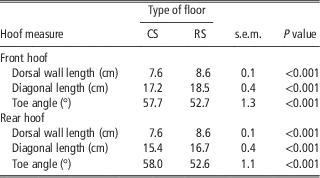
Bulls were slaughtered when a suitable finishing weight and conformation was achieved, and all farms sent their bulls to the same slaughterhouse. One slaughter day per farm was randomly chosen and a minimum of 10 bulls/type of floor were inspected postmortem by the same trained veterinarian. Front and rear hooves of each animal were inspected after the distal part of the limbs was detached from the carcass. Before inspection, the claws were rinsed in water without trimming to keep pace with the regular slaughter line. Dorsal wall length, diagonal length and toe angle of one claw per hoof were recorded in a similar manner as in the study by Platz et al. (Reference Platz, Ahrens, Bahrs, Nüske and Erhard2007). More specifically, medial claws of the right hooves and lateral claws of the left hooves were measured.
Statistical analysis
Pen was the experimental unit for bulls’ growth performance, continuous behavioural data and events. Initial and final BW and ADG were analysed using a mixed model that considered the fixed effects of type of floor, breed and their interaction and farm as random effect with the Bonferroni adjustment option. Behavioural data were statistically processed using a mixed model that considered type of floor, observation session and their interaction as fixed effects, and farm as a random effect with the observation session as repeated option and the Bonferroni adjustment option. Statistical analyses of variables expressed as proportions regarding treated and early culled bulls were performed using χ 2 tests (with the Marascuilo procedure) to verify their association with the type of floor. Variables gathered as binary regarding bulls’ cleanliness and health were expressed as percentages of bulls. The prevalence were then tested for association with the type of floor using the one-way logistic regression analysis according to the study by McCullagh and Nelder (Reference McCullagh and Nelder1983), and the odds ratio (OR) and 95% confidence intervals (CI) were calculated using CS as term of comparison. Hoof measures were analysed using a mixed model that considered the effects of type of floor as fixed and of farm as random effect, with the Bonferroni adjustment option. All data were processed using SAS/STAT (2008), and the minimum threshold for statistical significance was set at P<0.05.
Results
Growth performance and health status
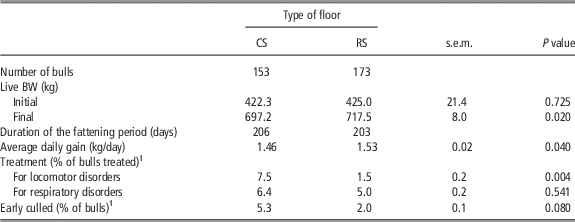
Bulls had similar initial live weights, but bulls in RS pens were heavier at the end of the finishing period and showed a higher ADG than those housed in CS pens (Table 2). There were no significant effects of either the breed (P=0.060) or the breed×floor type interaction (P=0.971) on ADG. Final BWs differed between breeds (Charolaise 754.2±11.9 kg and Limousine 613.7±11.0 kg; P=0.004) but not for the effect of the breed×floor type interaction (P=0.879).
Effect of type of floor on growth performance and percentage of treated and early culled bulls (least squares means)

CS=concrete slatted; RS=rubber slatted.
1 Data analysed by χ 2 tests with the Marascuilo procedure are reported as mean proportions.
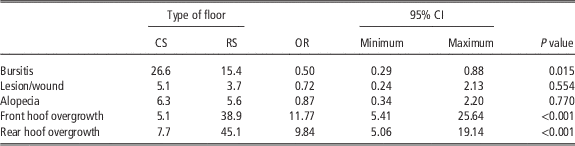
The type of floor affected the percentage of bulls treated for locomotor problems (mainly lameness treated with antibiotics, corticosteroids or nonsteroidal anti-inflammatory drugs), which were lower in the RS than in the CS pens (1.5% v. 7.5%; P=0.004). The percentages of bulls treated for respiratory problems did not vary between the types of floor (Table 2). The percentages of early culled bulls tended (P=0.080) to be lower in RS compared with CS pens. Main culling causes were locomotor and respiratory problems and trauma. RS floor resulted being a preventive solution for the occurrence of bursitis, assessed during the individual bull’s health check at end of the finishing period (Table 3). Type of floor did not affect the prevalence of bulls showing leg lesions/wounds. OR indicated an increased front and rear hoof overgrowth in bulls housed on RS compared with those on CS floors.
Effect of type of floor on the prevalence (%) of bulls showing front and rear leg problems at the in vivo health check a month before the slaughter day (145 on CS and 162 on RS); estimated odd ratios (OR) and 95% confidence intervals (CI) according to type of floor with fully slatted floor as term of comparison

CS=concrete slatted; RS=rubber slatted.
Behaviour and cleanliness
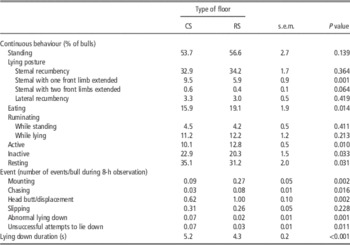
Results obtained from the behavioural assessments are reported in Table 4 according to the type of floor effect. The proportion of bulls standing was the same between the two types of floors. Regardless of the type of floor, lying in the sternal position with all the limbs underneath the body was the most frequent among lying positions. Lying with one front limb extended was less frequently observed in RS than in CS pens. Bulls on the CS floor tended to lie down more with two front limbs extended. No difference due to the type of floor was observed for the lateral recumbency. A larger proportion of bulls was seen eating in RS than in CS pens, whereas the type of floor had no effect on ruminating behaviour. Compared with CS, bulls in RS pens were observed to be less inactive and resting.
Effect of type of floor on behavioural parameters recorded 1 month after the arrival and 2 weeks before the expected slaughter day (least squares means) of finishing bulls

CS=concrete slatted; RS=rubber slatted.
The effect of the observation session was significant for standing (OS1: 52.2% v. OS2: 58.1%; P=0.018), lying on sternum (OS1: 36.9% v. OS2: 30.2%; P=0.004), lying in lateral recumbency (OS1: 3.7% v. OS2: 6.5%; P=0.004), ruminating while lying (OS1: 14.4% v. OS2: 8.9%; P=0.001), active (OS1: 8.9% v. OS2: 14.0%; P=0.001) and inactive (OS1: 20.3% v. OS2: 22.9%; P=0.046). The effect of the interaction between floor type and observation session significantly affected only lying on sternum with two front limbs extended (CS-OS1: 1.7 v. CS-OS2: 0.6 v. RS-OS1: 0.6 v. RS-OS2: 1.7; P=0.029).
Social interactions among bulls such as mounting, chasing and head butt/displacement were more frequently observed in RS pens. Slipping events did not differ between types of floor. Abnormal lying down and unsuccessful attempts to lie down were recorded with a lower frequency in RS than in CS pens. The effect of the observation session was significant for slipping (OS1: 0.35 v. OS2: 0.23 number of events/bull during 8-h observation; P=0.018) and abnormal lying down (OS1: 0.07 v. OS2: 0.03 number of events/bull during 8-h observation; P=0.019), whereas there was no significant effect of the interaction between the main effects.
The time required to lie down by a given bull differed between types of floor, and was significantly lower in the RS compared with CS pens (Table 4), with no significant effects due the observation session or due to the interaction between main effects. The percentage of bulls scored as dirty at the end of the finishing period was 53% and 31% in RS and CS pens, respectively (OR=2.5 and 95% CI=1.6 to 4.0; P<0.001).
Postmortem hoof inspection
A total of 74 bulls/type of floor were followed at the slaughterhouse for recording the postmortem hoof measures (n=592 claws measured). Dorsal wall and diagonal lengths of both front and rear hooves were longer for bulls in RS than for those in CS pens, resulting in a more acute toe angle (Table 5).
Effect of type of floor on hoof (n=592) measures (least squares means) evaluated at postmortem inspection

CS=concrete slatted; RS=rubber slatted.
Discussion
Fully slatted concrete floors have been blamed for their negative effects on bulls’ welfare (Scientific Committee on Animal Health and Animal Welfare, 2001; Cozzi et al., Reference Cozzi, Brscic and Gottardo2009; Wechsler, Reference Wechsler2011). Lameness resulted being among the main causes for culling in cattle (Refaai et al., Reference Refaai, Van Aert, Abd El-Aal, Behery and Opsomer2013), and the fully slatted concrete floors have been identified within major risk factors for locomotor problems (Tessitore et al., Reference Tessitore, Boukha, Guzzo and Cozzi2009a). In the present study, the percentage of bulls treated for locomotor problems (mainly lameness) was indeed higher on CS. This result should encourage farmers towards the implementation of alternative flooring solutions for finishing beef cattle. Further support towards the rubber covering should come from the improved growth performance observed in this study of bulls housed on RS compared with those on CS. This is in agreement with previous results by Cozzi et al. (Reference Cozzi, Tessitore, Contiero, Ricci, Gottardo and Brscic2013), who reported a higher ADG for bulls on a rubber-coated perforated floor than that of animals on concrete slats.
The use of rubber mats was demonstrated to have beneficial effects on the locomotor system, lowering the prevalence of leg lesions when compared with the concrete slats (Platz et al., Reference Platz, Ahrens, Bahrs, Nüske and Erhard2007; Schulze Westerath et al., Reference Schulze Westerath, Gygax, Mayer and Wechsler2007). Results of this study are consistent with these findings, indicating RS as a preventive measure for the occurrence of bursitis, although we cannot totally exclude that bursitis was present when animals were brought in. There is no reference associating bursitis with pain in cattle as in humans (McEvoy et al., Reference McEvoy, Lee, Blankenbaker, del Rio and Keene2013); however, bulls housed in CS pens spent more time lying with the front limbs extended likely as a strategy to get some relief in the carpal joints as suggested by Absmanner et al. (Reference Absmanner, Rouha-Mulleder, Scharl, Leisch and Troxler2009). This hypothesis is supported by observations made on dairy cows that showed an increasing trend of animals lying with extended limbs when housed in cubicles with hard floors compared with softer and more comfortable solutions (Haley et al., Reference Haley, Rushen and de Passillé2000). Moreover, the behavioural changes observed in the present study for bulls in CS pens, such as the longer inactivity and resting, the higher number of abnormal lying down and unsuccessful attempts to lie down, as well as the longer time needed to lie down, might be considered as antalgic. However, points for discussing the comfort around resting in this study are limited, considering that bulls needed a relatively short time to lie down on both floor types, although significantly different. As previously reported by the studies of Ruis-Heutinck et al. (Reference Ruis-Heutinck, Smits, Smits and Heeres2000), Platz et al. (Reference Platz, Ahrens, Bahrs, Nüske and Erhard2007) and Graunke et al. (Reference Graunke, Telezhenko, Hessle, Bergsten and Loberg2011), in the present study, it could be hypothesized that the slippery surface of CS pens is a further explanation for the modifications of species-specific postures and lying down sequences and for the inhibition of mounts, chases and head butts/displacements, although the slipping events were not significantly different between floor types.
Housing bulls on RS impaired cleanliness and negatively affected hoof overgrowth. The lower drainage of the RS pens, leading to dirtier flooring where the bulls were lying, is the principal issue explaining the higher odds for having dirty bulls. Graunke et al. (Reference Graunke, Telezhenko, Hessle, Bergsten and Loberg2011) did not find this negative effect with rubber slats with the same (20%) drainage area as the concrete slats (21%). No difference in terms of cleanliness was detected by the study of Lowe et al. (Reference Lowe, Steen, Beattie and Moss2001) as well, comparing bulls on mats v. slats, where drainage area was considerably larger. Thus, it is probably an effect of the drainage area rather than that of the material, concrete or rubber. Studies on the effect of flooring on hoof shape found that the main factor affecting its conformation was the abrasiveness of the floor (Vokey et al., Reference Vokey, Guard, Erb and Galton2001; Vanegas et al., Reference Vanegas, Overton, Berry and Sischo2006; Platz et al., Reference Platz, Ahrens, Bahrs, Nüske and Erhard2007). According to the study by Telezhenko et al. (Reference Telezhenko, Bergsten, Magnusson and Nillson2009), rubber mats were less abrasive than concrete slats, leading dairy cows to develop toe overgrowth due to poor wear. Therefore, the overgrowth observed in vivo and the change of measures recorded postmortem in bulls on RS in this study are likely associated to the less abrasive surface. Clear signs of reduced abrasion were also observed by Rouha-Muelleder et al. (Reference Rouha-Muelleder, Absmanner, Kahrer, Zeiner, Scharl, Leisch, Stanek and Troxler2012) in hooves of bulls on fully slatted floor pens covered with rubber mats. It could be speculated that a certain hoof wearing would be promoted by a rubber designed to provide adequate abrasive zones without affecting the softness of the floor, which would compromise cattle comfort and reduce the resting area. It is also questionable whether hoof overgrowth in beef bull production represents an issue, given the quite short period of finishing (7 to 9 months). Moreover, the level of pain caused by hoof overgrowth is debatable, particularly when considering results of the present study from the behavioural observations, the more satisfactory growth performance of bulls on RS and the fact that most treatments for locomotor problems were carried out on bulls in CS pens. It remains unclear, however, whether even more marked differences in the considered behavioural parameters and growth performance would have arisen between treatments if no hoof overgrowth had occurred in bulls on RS floor.
Conclusion
RS covering proved to be a valid alternative to the fully slatted concrete floor for the improvement of beef cattle welfare and growth performance. It is likely that the negative effects of this floor type on bulls’ cleanliness might be minimized by a flooring design with rubber surface with a greater drainage area. Regarding hoof overgrowth, a certain wearing could be promoted by providing an adequately abrasive surface located in a restricted part of the pen.
Acknowledgements
The authors thank AZOVE Producers’ Association (Associazione Zootecnica Veneta Soc. Coop. s.r.l.) for the logistic and financial support, Dr Lorenzo Serva for the help in data collection, and the farmers who took part in the study.
Supplementary material
For supplementary materials referred to in this article, please visit http://dx.doi.org/10.1017/S1751731115000592