Tucked among the personal papers of the late Reverend Gideon Furahani is a bundle of love letters, exchanged between Gideon and his wife-to-be Rose Limo.Footnote 1 A letter from Gideon dated New Year's Day of 1962 marks the start of their correspondence, when they were both young and still in secondary school. Typed at the dawn of Tanganyika's first full year of Independence (whether by an amanuensis or by his own hand is not clear), Gideon's inaugural letter is imbued with the same mix of excitement, expectation, anticipation, and ambivalence with which Tanganyikans throughout the new nation greeted Uhuru. Gideon opens the English-language letter by acknowledging the date not just as the beginning of ‘a year of complete Independence’ but also, with school exams, career decisions, and family responsibilities on the horizon, as the beginning of a personally consequential year in ‘which both of us can not play about’. Appealing to what he imagined to be Rose's shared sense of responsibility for shaping their personal and collective futures Gideon wrote,
I am sorry that we did not get acquainted for a long time but it is no fault of ours as our parents did not introduce us to each other … But now the door is open. We are the future leaders of the clan so we must know each other.Footnote 2
Considering the distance between their boarding schools and the limited fraternization allowed between male and female students in 1960s Tanganyika, Gideon reasoned that written correspondence was the best way to cultivate their relationship. After advising Rose to ‘put me down at [sic] your Headmistress's list as one of your correspondents’, the pair commenced a long epistolary exchange. Over the course of eight years, while Rose and Gideon attended separate boarding schools, took employment at a distance, and Gideon pursued theological training abroad, their friendship blossomed into romance. The personal and often very intimate letters – of which nearly 100 remain – became the pair's most important means of communication, constituting the main platform for their friendship, courtship, engagement, and early years of marriage.
As scholars working with intimate epistolary exchanges have shown, letters generally, and love letters in particular, are rarely ‘simple’ exchanges but hold the potential to shed light on broader concerns, such as the relationship between public and private spheres, the power and meaning of literacy, and the development of individualized selves.Footnote 3 Indeed, far from straightforward amorous exchanges, the Furahanis' love letters reveal that as lovers, as young adults, and as expectant citizens, Gideon and, even more so, Rose were deeply ambivalent about the years that lay before them. Facing adulthood at a moment of immense political and social transition, the pair used their correspondence as an opportunity to sort through these changes, to negotiate the demands of new and inherited discourses, and to imagine and experiment with new ways of being and forms of personhood. Written in the eight years immediately following Uhuru, the pair's letters were infused with much the same rhetoric of ‘modernity’, ‘progress’, and ‘civilization’ that energized political nationalists in the victorious Tanganyika African National Union (TANU). Though on the one hand, Rose and Gideon appear to have identified with the nationalist quest for these values, the discourses of community composition and nation-building with which they engaged as lovers, as clan mates, as Bondei, and as Anglican modernizers from congregations of the Universities' Mission to Central Africa (UMCA) also suffused and gave structure to their correspondence. Uniting their unfolding discussions about what defined a person – and, consequently, love, marriage, family, spiritual community, and nation – as suitably ‘Christian’, ‘civilized’, and ‘modern’ was a complex social tradition about the centrality of marriage to community-building that was deeply seated in the African past. In this, the letters reflect an inter-weaving of discourses of national and non-national community belonging, which played out in two individuals' efforts to compose their own and their communities' futures.
MARRIAGE, COMMUNITY COMPOSITION, AND NATION-BUILDING
Regarding precolonial Africa, scholars have argued that an abundance of land and a relative scarcity of people to work that land led to an investment in people as the basis of wealth. In some regions, human capital was not just valuable for working land, but individuals were also valued for their particular knowledge, personal capacities, or extended social ties. In the wealth-in-people model, leaders exercised power through building coalitions rather than conquering, and societies invested in institutions designed to secure lasting relationships of mutual obligation. Communities acquired or incorporated an individual based on her capacity to add to that community in some unique way.Footnote 4 In other words, strategic compositional processes and deliberate coalition building constituted the heart of many precolonial Africans' attempts to develop communities. The transfer of rights-in-people and other forms of wealth between lineages, communities, or other social units through marriage, then, was a widely-recognized means of tapping new social networks, of securing access to new resources, and of complementing an individual's or a community's particular capacities or knowledge. It was also fundamental to individuals' attempts to compose communities in a manner that would ensure collective prosperity and perpetuity.
As sources that have the capacity to shed light on the relationship of the public to the private sphere, Rose and Gideon's letters confirm that marriage remained central to Africans' attempts to compose communities well into the latter half of the twentieth century. At the same time, they also reveal some fundamental innovations in the nature and process of these negotiations. Both lovers saw the health, modernity, and morality of their individual selves and of their marriage as intimately tied to that of the new Tanganyikan nation, and approached the relationship as an opportunity to contribute personally to President Nyerere's nation-building project. The pair's strivings, debates, and negotiations, thus illustrate the entanglement of longer-standing discourses about the community-building function of marriage with newer ideals about Christian companionate marriage, the autonomous individual, and the identity of the ‘modern’ or ‘progressive’ nation state. I argue below that Rose and Gideon's relationship was based, in part, on the ‘modern’, ‘progressive’ Christian values of love, mutual attraction, and companionate marriage, and, in part, on the desire to cement political alliances and attend to the composition of community.
As private citizens unassociated with any formal political institutions, Rose and Gideon offer an opportunity to explore the rich and varied process of national imagination from the perspective of the intimate and the quotidian. Indeed, when Rose and Gideon began their correspondence they were still young and looking for ways to shape their personal and communal futures. Scholars' attempts to reconstruct the history of the early postcolonial period from this perspective are well underway. Within Tanzanian historiography, for example, Susan Geiger's work on TANU women effectively disrupted the standard meta-narrative of nation-building, which restricted scholars' investigations to the work of men in the victorious institutionalized bureaucracies that inherited the state. Geiger's work on the ‘illiterate, frequently self-identified as Swahili, Muslim’ women who ‘created and performed Tanganyikan nationalism's “culture of politics” ’ opened space for investigations of alternative producers and methods of national imagination.Footnote 5 Other scholars attempting to avoid what they perceived as the teleology of previous studies, which focused on the ‘winners’ of the nationalist struggle – in Tanganyika's case those associated with TANU – shifted their focus to history's ‘losers’, and to the contributions of individuals other than those involved in the largely male-dominated anti-colonial political parties.Footnote 6 Indeed, as Fredrick Cooper reminds us, focusing only on the victors and the bodies that encompassed a particular anti-imperial national consciousness elides other categories of affinities that also motivated Africans, and obscures the way in which those affinities influenced politics. By ‘looking over a longer period of time at a more varied set of political forms’ and by expanding the cast of actors one considers when investigating nation-building, Cooper argues, we can tell a story that is more nuanced than simply ‘the inevitable rise over the last two centuries of the nation-state and the national imagination’.Footnote 7 To this end, Andrew Ivaska and Kelly Askew, for example, have provided rich and compelling stories of how, in Ivaska's words, various publics contributed to the ‘unpredictable relationship between the state and cultural production’ and national identity.Footnote 8
The search for how Africans understood and engaged with politics and with the idea of the ‘nation’ in the course of their everyday lives has turned scholarly attention towards the family. This is particularly true in Tanzanian historiography, given the emphasis in the postcolonial era on national familyhood or ujamaa. Jim Giblin, for example, has argued that rather than seeing their lives as intimately tied to ‘colonialism, nationalism, or the transition from colonial to postcolonial rule’, rural Tanzanians ‘consciously situate[d] family in relationship to state authority … even while standing separate from it’. This ‘standing separate from’ the state and politics of national imagination gave ‘excluded’ citizens ‘room to formulate their own ideas of moral expectation and responsibility, and to act upon them freely’.Footnote 9 More recently, Priya Lal has pointed out the creative and highly contingent ways that rural citizens engaged with the Ujamaa-era state. In Mtwara, officials ‘could not control the actual meanings of gender and family on the ground, just as they could not determine how people interpreted and used the concepts of self-reliance and security locally’, Lal argues. Thus, rather than seeing the nuclear family as the natural and enduring institution promoted in state rhetoric, individuals in Mtwara often approached family as a ‘contingent social resource and survival strategy, and formed and dissolved marital and kinship alliances in order to achieve their own versions of self-reliance and security’.Footnote 10 Such analyses have illustrated the rich and varied ways that individuals and the family engaged with the state and how they reworked official rhetoric. Consideration of Rose and Gideon's story extends these insights in new and productive directions by illustrating that rather than ‘standing separate from’ state authority, or striving to achieve their ‘own’ versions of self-reliance and security, individuals imagined the family as an alternate site for cultivating and composing the nation.
LOVE LETTERS, LITERACY, AND MODERN PERSONHOOD
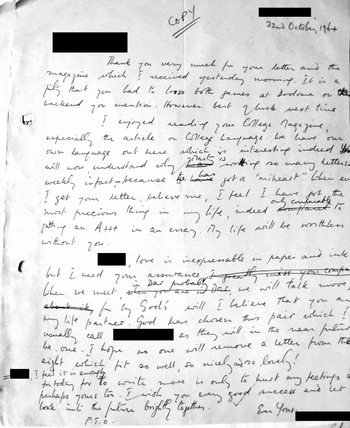
The personal papers of the late Reverend Gideon Furahani are carefully arranged in a glass-fronted cabinet in the library of a small archive outside of Dar es Salaam. The documents remain as Gideon must have left them, meticulously organized in two-ring, hard-cover binders, filed chronologically and by subject, and bound in neat packages with string. The materials that fill the binders include lined blue note cards, white typing paper, and Air Mail stationary, collected pamphlets, university theological and political science exams, lecture notes, handwritten book excerpts, religious tracts, and seemingly endless amounts of personal and professional correspondence (for example, see Fig. 1), extending from Rev. Furahani's days in secondary school in the 1960s until his emigration to the United Kingdom in the 1980s. That Gideon, a well-educated church official, wrote profusely is not surprising; that he seems to have hoarded his personal texts, carried them with him from college to university, abroad and back, assiduously cultivating an extensive private archive, is more remarkable.
Of Gideon's letters included in the archive, most were carbon copies or drafts such as the one above, dated Oct. 1964. After receipt of most of Rose's letters, Gideon added substantive marginalia, such as ‘sent’, ‘received’, and ‘replied on’ dates. LSMATC PPGF, letter from G. Furahani, New Hall, 22 Oct. 1964.

Yet, projects of personal archiving such as Gideon's, were surprisingly common in many parts of colonial Anglophone Africa. Literacy often marked status in colonial Africa and, as Karin Barber has argued, participating in cultures of literacy offered individuals the capacity ‘to enhance personal and social existence and create a particular kind of civilized and civic community’.Footnote 11 As part of this process, literates such as teachers, clerks, and rural preachers, and some migrant workers and traders – people like Gideon – seem to have been particularly fond of cultivating ‘archives’ of personal ephemera.Footnote 12 ‘Tin-trunk archives’ have proven rich sources for exploring the determined efforts of individuals to imagine new forms of personhood and new categories of self-expression. Such sources lay bare the desire of aspiring elites like Rose and Gideon to, in Barber's words, ‘assemble and investigate a personal self and to create a repository of values, the crystallized tokens and products of “civilization”, “progress”, “enlightenment”, and “modernity”’.Footnote 13 Gideon's propensity to curate, and the archive's constituent elements – drama club meeting minutes, science lecture notes, hand-copied texts of sermons – are thus evidence of his attempts to mark himself as a literate, well-educated individual armed to participate in ‘modern’ society.
Further, like their contemporaries, Rose and Gideon understood that someone – a teacher, family member, friend, or letter-carrier – might intercept and read their exchanges. As Lynn Thomas has shown for students engaged in pregnancy compensation cases in colonial Kenya, young people were well aware that ‘rather than being a confidential correspondence between two young people seeking to sort out their own personal problems, these letters were embedded in webs of peer, familial, and institutional relations and could easily be put to instrumental ends'.Footnote 14 Similar to those in Thomas's pregnancy compensation cases, the fact that Rose and Gideon's letters only ‘appeared to enable discreet communication between two people’ and instead provided a stage for personal publicity seems to have been an encouragement to write or the very purpose of producing letters in the first place.Footnote 15 When read in its entirety, then, Gideon's archive reveals as much about Rose and Gideon as individuals as about their self-positioning and aspirations.
THE LANGUAGE OF LOVE
In the first 18 months of their correspondence – from January 1962 until August 1963 – Rose and Gideon exchanged letters only periodically. This lack of urgency was likely due in part to the fact that both were busy students, neither of whom initially sought to commence an intimate epistolary love affair. By 1963, Gideon had completed his Higher School Certificate and enrolled at Makerere in Uganda, where he studied broadly in Economics, Biology, and Religious Studies, before selecting Religious Studies as the single subject for his degree.Footnote 16 Though Rose's national exam scores were not good enough to allow her to enter Form Five, she managed to matriculate in a Geography and History credential course at a Teachers' Training College in Mpwapwa.Footnote 17 Slowing the courtship further was the fact that, though she had secured permission for the correspondence from her father and the TTC headmistress, their letters were sometimes intercepted.Footnote 18
The casualness of their correspondence is evident in the tenor of their early letters. Through a light and friendly back-and-forth, in which they addressed each other as ‘cousin’ or ‘brother’/‘sister’, they slowly got to know each other by exchanging news of home, friends, and challenges and achievements in school. Rose shared with Gideon her first ‘teaching lesson practice’ and tales of an exam so hard she thought it was not in English but in ‘Double Dutch’, while Gideon engaged Rose intellectually with riddles, algebraic equations, and phrases in Latin, Greek, and Spanish, and sent her books he thought she would enjoy. He also sent photographs and newspapers from the places he traveled, such as Kampala and Nairobi. They traded news of the weather which, to Rose's chagrin, was ‘too dusty due to lack of rain’ in Mpwapwa and uncomfortable because ‘sometimes it is very gloomy and cold for three continuous days and sometimes very bright and hot’.Footnote 19 For two people who frequently insisted they had ‘not any new things to tell you’, the ten extant letters from those first 18 months somehow managed to say quite a lot.Footnote 20
Indeed by August of 1963, Rose and Gideon had built an amiable friendship in which each seemed quite invested. The letters had grown in length from a single page to several, and the pair exchanged increasingly personal details and photographs – the latter a sign, even in contemporary Tanzania, of an intimate friendship. Though there is no indication from the archive that the pair had seen each other more than once since their initial meeting, their correspondence demonstrates a building, though evidently uneven, flirtation.
Rose appears to have been the first to acknowledge this shift, when she – after what the archive records as nine months of silence – responded to what she found a discomfortingly intimate letter. She wrote,
If you at all remember writing in one of your past letters while I was still at home in the December holiday ‘I feel responsible for you …’, well this had been troubling me ever since … I have been asking myself many times to why you feel responsible for me but could not find the answer. Perhaps you can give me the correct answer.
Perhaps hoping to avert a romantic advance, Rose concluded, ‘Do write letters to me but please do not cross the boundary.’Footnote 21
Undeterred Gideon responded,
Rose: you may not know how strongly I feel about you and although I had promised to tell you nothing till we meet in December, I feel I must tell you now. I have fallen in love with you Rose, and I cannot hide this from you any longer. This may be ‘crossing the boundary’ as you said in one of your letters but I think I must tell you the truth. Since the days of my long vacation I was dreaming about you and now I can hardly spend a dose of sleep without lovely Rose coming unto me. Rose! Let us swim in the pool of love gracefully together and let there be no mud to hinder our diving into the sweet waters.
He signed the letter, ‘Gideon H. Furahani … “yours in the pool of LOVE” ’.Footnote 22
Clearly, Gideon was smitten. This deeply emotional confession was a marked departure from even the increasingly personal letters of the last few months. His honesty, intensity, and passion, and the dramatic change in the nature of their relationship startled Rose. Several more weeks elapsed before she replied in English:
Thanks very much for your letter I received not very long ago. Really I was thinking how exactly I would answer it. That's why it may be late [sic] than you expected it.
Really your letter gave me a sort of a shock. I read and reread it I don't know how many times but I don't come to a decision. To say the truth I find this situation very difficult.
In Swahili she added, ‘Je kwani wewe umesahau kuwa sisi tuko waudugu?’ (‘Have you forgotten that we are relations?’) She signed the letter, ‘Yours ever, cousin Rose.’Footnote 23
In reminding Gideon that ‘sisi tuko waudugu’ (‘we are relations’), Rose – who struggled with Swahili elsewhere – most likely meant ‘ndugu’, the plural of a Swahili word with a meaning that encompasses relationships of familiarity and/or commonality, such as relative, kin, sibling, cousin, close friend, comrade, or fellow tribesman or citizen. Though the exact nature of their relationship – blood or otherwise – is not clear from the evidence that remains, in merely suggesting a proximate blood relationship, Rose invoked marriage prohibitions which had long sought to promote communal health, well-being, fertility, prosperity, and perpetuity. In this region, families often aimed to ensure that marriages and reproduction occurred between individuals with a certain degree of consanguinity. Bondei seem to have permitted second-cousin marriage but long proscribed first-cousin marriage; the UMCA had a similar tolerance of distant consanguinity in marriage, though the nature of African families often confused the Church's attempts at enforcement.Footnote 24
Of course we cannot know for sure why Rose sought refuge in the idea of kin; indeed, at times the pair's letters seem to raise as many questions as they answer. It is possible that the pair were either too closely related to permit a ‘proper’ marriage, or their families were on opposite sides of the often-deep social and political cleavages in Bondei society. It is also possible that Rose may have invoked their kinship ties as a way to hide the fact that she was not interested in Gideon. It is perhaps just as likely, however, that Rose used the ambiguity of their kinship ties to distance herself from Gideon just enough to allow her to ‘play the field’ and entertain other suitors. As Rose herself would suggest years later when wondering whether Gideon's periodic silence while in the United States meant he might have been seeing ‘an American woman’, such was not out of the realm of possibility.Footnote 25
In the long history of courtship and marriage in East Africa, multiple and concurrent partnerships were often tolerated, expected, and sometimes even encouraged before a ‘marriage’ was complete. What Caroline Bledsoe has called ‘conjugal testing’, a process in which partners and families work ‘cautiously toward more stable unions’, often stretched over months or years, and was, thus, often a time during which individuals would try out relationships with other partners. Indeed, the occurrence of non-penetrative sexual play in many areas – such as ngweko in central Kenya or what is translated as ‘thigh sex’ elsewhere – suggests that youthful courtship had long included relations and experimentation with multiple partners.Footnote 26 The epistolary form of the love letters seems to have stretched these existing practices of courtship in new directions by allowing them to unfold over hundreds or even thousands of miles. The expanded temporal and geographic distances permitted by letters may, in fact, have made it easier for individuals to court more than one person at the same time. Correspondence also enhanced the possibilities of conveying carefully crafted selves, and obfuscating other relationships and intentions. This seems to have been the case for our young lovers: Gideon's near-obsessive letter-tracking system reveals no trace of other female correspondents, much less lovers – giving his exchange with Rose a singular and almost teleological quality. If Gideon had kept all of the personal letters he sent and received over those eight years, his archive might tell a very different story. Given all of this in addition to Rose's growing ambivalence, it would be surprising if neither had had other romantic or sexual relations over the eight years.
By choosing the language of ‘kin’ to mark the match as untenable to both herself and any potential reading public, she asserted her investment in a ‘properly sanctioned’ marriage and her aspirations in contemporary Anglican society. Rose's protestations can be read as a way to prove to herself and others, that she sought a marriage that supported local (Christian, Bondei, and emergent nationalist) attempts at communal perpetuity. Their blood relationship was all that was standing in the way of the ‘modern’ ideal – a monogamous, companionate marriage between two well-educated, upwardly mobile, autonomous Christians. In other words, Rose's protestations became a mark of her modernity, of her civility, and of her desire to participate in a strategically-composed, well-formed community. Beyond marking a fundamental shift in the pair's relationship, Rose's recourse to the idea of ‘waudugu’ and the values and institutions that it entails was a strategic choice that offered her a level of control in crafting her relationship with Gideon, and her reputation.
In many ways, Rose and Gideon's debates about marriage resembled those that prefigured the great Marriage Debate of 1970–1, public and official conversations that accompanied the first successful overhaul of colonial-era marriage law in the British Commonwealth. As Andrew Ivaska has shown, reform of the United Law of Marriage was the state's attempt to ‘at once … mark a break from the colonial by eliminating the hierarchy that privileged Christian marriage under the British code and to cast that break as one befitting Tanzania's status as a modern, progressive nation on the world stage’.Footnote 27 The cultural ferment that characterized urban Tanzania's ‘long sixties moment’, argues Ivaska, saw colonial officials and elite African nationalists alike ‘working to rearticulate notions of tradition that would be at once authentic and modern’.Footnote 28 Rose and Gideon's project, however, was less about trying to make the ‘traditional’ ‘modern’, than about trying to draw from a vast cultural repertoire – some of which was explicitly ‘traditional’ and some of which was explicitly ‘modern’ – in a way that made the most sense for their own strivings to be ‘modern’ individuals. This process of constantly reaching back into a vast repertoire of values to compose a marriage, a family, and a community that would be socially healthy and viable, replicated what their ancestors had done for generations.
Rose's abrupt and isolated switch to Swahili – particularly her recourse in Swahili to the idea of waudugu – is notable. This is in part because of its singularity – the only use of Swahili in the first two and a half years of their correspondence – and because neither Rose nor Gideon tended to switch languages ‘midstream’, even in later letters when Swahili became the ‘matrix’ language into which they embedded full Bondei and English sentences.Footnote 29 Their language of choice, English, was also the official language of the Tanganyika Territory and Zanzibar during the colonial period, and had by the 1960s come to be associated primarily with ‘progress, advancement, and social mobility’, whereas Swahili was seen as ‘a “second-class” language’.Footnote 30 English was the medium of instruction in secondary schools and higher education, and many students educated in English language schools felt that what they perceived to be the comparatively low quality of secondary school materials and teachers proved Swahili's inferiority to English.Footnote 31 Popular culture, with its glossy English-language magazines and cinemas in English and Asian languages, further increased the popular prestige of English.Footnote 32 Despite the elite connotations of English, however, there was no socioeconomic group in the 1960s, including mission-educated students like Rose and Gideon, who operated exclusively in English.Footnote 33 It is also possible to read political meaning into Rose's use of the Swahili ‘waudugu’ in her otherwise English letters. For multilinguals like Rose and Gideon, using two or more languages in a single event (such as a conversation or letter) is a common way to negotiate social identities, an instrumental choice from, as Monica Heller has argued, a ‘range of linguistic practices … use[d] to establish social goals’.Footnote 34 With English as the standard or ‘matrix’ language, Swahili became the ‘embedded’ language used to express the desire for, or the actual existence of, a social sanction against their marriage.Footnote 35
Rose's language choices seem to confirm other scholars' interpretation that Tanzanian multilinguals of the 1960s reserved Swahili and other African languages for topics that were more intimate, more personal, than those discussed in English.Footnote 36 A survey of multilanguage speakers in Dar es Salaam in the mid-1960s among people who would have been Rose and Gideon's contemporaries in education and age, suggested that for ‘younger and more detribalized speakers’ the role of Swahili and the vernacular were often blurred, and Swahili dominated in situations where older speakers might otherwise have used the vernacular, such as intimate or familiar settings.
The pair's use of language suggests much about their relationship, including the nature of Rose's ambivalence and, as the relationship progressed, their increased intimacy and expanded entanglement with the Tanzanian national project. (It may seem strange that Rose would become at once more ambivalent about the relationship but more heavily invested in it, but such relationships are complicated.) This shift is reflected in the pair's transition from English to Swahili late in 1963, on the heels of Gideon's matriculation at Makerere. Though Rose and Gideon provide no explanation, it is possible that Gideon and Rose switched to Swahili and Bondei to acknowledge both the increasing intimacy of their relationship and the increasing politicization of Swahili as the language of Tanganyikan independence and national unity. Gideon and Rose's use of Swahili as a ‘matrix’ language suggests an attempt to align themselves with the nation-building efforts of Nyerere's government.
Since before Uhuru, Swahili had been the language of TANU, making Bondeis, Zanakis, Digos, and many others into participants in the same imagined community, associating it, as Farouk Topan has written, ‘with national identity, integration and development’. As ‘the vanguard of nation-building’, Swahili challenged English as a preferred language in many circles, and between 1964 and 1970, English became ‘somewhat stigmatized … as not friendly to African socialism and the idea of nation building’.Footnote 37 Nyerere's fluency in English and preference for Swahili, neither his mother tongue, were widely considered the ‘linguistic ideal of a Tanzanian’, and may have been something that Gideon and Rose were trying to emulate.Footnote 38 The pair's insistence on Swahili was a common in the new nation as one's ability to operate in Swahili became, as Abdulaziz Mkilifi has argued, ‘a mark of national pride, even though it may not mean that one operates it any more efficiently than previously’.Footnote 39 Rose's insistence on the use of Swahili then, despite some obvious difficulties with the language, reinforces the sense that Rose and Gideon understood their projects of creating themselves and creating a national subjectivity as intimately related.
By contrast, the vernacular could act as an inter-group language of ‘ethno-cultural identification and solidarity’, as Mkilifi's study cited above suggests. This is because for individuals in increasingly urban-focused, nationally-minded, well-educated communities, the distinction between the ‘vernacular’ – in this case Bondei – and Swahili was blurred; the ‘true’ vernacular (Bondei) was often abandoned for the ‘native’ or ‘indigenous’ language (Swahili) that could provide community solidarity. Among Rose and Gideon's young, relatively well-educated, multilingual contemporaries in the 1960s, Swahili, rather than English or their ‘true’ vernacular, was often the choice for ‘affective socialization’.Footnote 40 Swahili thus represented for the pair an opportunity to express more intimate feelings in a manner that was in keeping with their attention to the construction of the nation.
The pair's ‘affective socialization’ took place against a backdrop of their increasingly cosmopolitan lives. By early 1964, Gideon was settling in at Makerere and becoming actively involved in campus life. Perhaps inspired by his 1962 participation in the All African Christian Youth Assembly in Nairobi, he was a member of the Makerere Student Christian Union and of the Guild of St. Augustine (a body of young Christians considering ordination), and found time to serve as the president of the Dramatic Society (an engagement that is perhaps not surprising given the effusiveness with which he often wrote to Rose).Footnote 41 A capable scholar, Gideon was selected in his second year to pursue an Honors Degree in Religious Studies, and even before graduation was ‘promised possibilities’, which included ordination, a lectureship in Makerere's Department of Religious Studies, and support to pursue an MA or a PhD at Cambridge or Oxford. After ‘a lot of soul searching’, Gideon decided he ‘would be better to serve as a priest’ than a lecturer and, though we have no record of why, postponed the MA/PhD option indefinitely.Footnote 42 Rose had nearly completed her teacher training course in 1963 and was doing a teaching practicum in History, Geography, and Swahili at a secondary school in northern Tanzania when the 1963–4 academic year began.Footnote 43 During this time, Rose seems to have taken opportunities to travel, visiting Dodoma, Ngorongoro, and Dar es Salaam for school, work, and pleasure, including to a neighboring school ‘to dance “country dance” and for a netball competition’.Footnote 44 Though the letters give no hint of concern, Rose's new mobility may have made Gideon suspicious about her investment in the relationship; indeed, when entering into formal marriage discussions, Rose would become defensive about this period of her life.
Perhaps it was exactly this newfound freedom and sense of independence that prompted Rose to finally articulate her ambivalence to Gideon. In so doing, Rose invoked a discourse she knew well and one that she likely knew Gideon would understand – that of Christian ethics. Publicly abdicating responsibility for her future and relying instead on God's will, Rose asked, ‘Je, unaweza kujua Mungu aliyoyapanga?’ (‘Can you know what [things, matters, troubles] God has planned?’)Footnote 45 With her often imprecise Swahili, it is possible that Rose meant to ask ‘alivyoyapanga?’ (‘how God planned them’) or even ‘alivyowapangia?’ (‘how God planned for them’). Regardless, in insisting on Swahili for what appears to be a rough translation of Jeremiah 29:11, ‘For I know the plans I have for you’, Rose employed yet another moral discourse to distance herself from a relationship with Gideon. As we will see again below, Christianity was not always a coherent ideology but something that Rose – and individuals in communities throughout Tanzania and elsewhere – struggled to interpret in their own lives. Indeed, Gideon too sought refuge in the rhetoric of Christianity, if invoking it to opposing ends. In a draft penned in October of 1964, Gideon wrote in English,
Rose, love is inexpressable [sic] in paper and ink but I need your assurance . When we meet, in Dar probably, we will talk more, for by God's will I believe that you are my life partner. God has chosen this pair which I usually call ‘ROSEGIDE’ as they will in the near future be one. I hope no one will remove a letter from the eight which fit so well, so nicely and so lovely! Rose, I feel it is enough for today for to write more is only to hurt my feelings and perhaps yours, too. I wish you every good success and let us look into the future brightly together.Footnote 46
Unfortunately, there is no record of what was but the first of many formal marriage proposals that seems to have followed.
We do know, however, that Rose refused to accept the first proposal, her response seemingly intended to buy her more time. ‘I have understood all that you have said and I sense that you are serious about your proposal’, she wrote, ‘but please don't tell the elders about it because until now I haven't decided what I want to do after this. Maybe I will let you know once I have made up my mind later on.’Footnote 47 Even after two years, at the end of 1967, Rose had not yet ‘made up her mind’. Each excuse Rose offered for not accepting Gideon's proposal seems to reinforce the possibility that she had other romantic interests, and that she was weighing an engagement to Gideon as one of several options. When Gideon pressed the issue of marriage in 1966, before his departure for a three-year course in the United States, Rose responded, ‘I don't want to be married and after two months I am left alone for three years. You wouldn't like that either if you were in my shoes.’Footnote 48 Were she committed and pursuing Gideon exclusively, being ‘alone’ during Gideon's absence might not have weighed so heavily on Rose; unengaged in his absence, however, Rose had much more freedom.
Rose also attributed her lack of willingness to marry to ill health. Towards the end of 1966, Rose reported to Gideon that she had become unwell. Her complaints took the form of general malaise and lethargy, anxiety, and other moderate ailments. At first mention, she blamed her poor health on a death in the family:
Honestly, I am writing this letter but I am not happy with life. My physical health is weak these days. Not so many days ago we had a funeral for my brother's child. The story of that child is too long, I can't write it down. I will tell you when you come back during leave; that is, if you find me alive. The death of that child really affected me and that is why I am feeling this way now. I am not doing any kitchen work – all I do is to eat food and take medication.Footnote 49
Depression and ill health continued throughout the following two years, a now chronic situation Rose argued was made even worse by the prolonged separation from Gideon. In 1967, she wrote,
You might be wondering why you are not receiving letters regularly from Rose but these days, my dear, I am very disturbed. I am not happy most of the time and, in short, I am having rather a difficult time. My laughter is sometimes pretend, for I do not want other people to notice how unhappy I am. I don't know why I am like this. Plus, the fact that you are very far away causes me to lose hope of seeing you again. I don't know what to do.Footnote 50
Rose reiterated time and again that, ‘the longer Gideon stays abroad, the more Rose suffers’.Footnote 51
Rose's ‘suffering’ was physical, not just emotional. As she wrote in a Swahili letter dated February 1968,
These days I am becoming not so perfect and I won't hide anything from you. Currently I can't even carry a bucket full of water and I haven't even practiced because tap water is available in the back. Secondly, I haven't mastered cooking a pot of food for ten people. Thirdly, I don't collect bundles of firewood anymore because firewood is for sale these days.
So my love, please think twice. If you can handle all of that, then it's all very well. If you can't handle that don't hesitate to inform me. I won't just hang on to you so that you will suffer later on.
That's how the situation is. I will be waiting for your response.Footnote 52
The prolonged illness had left her ‘mbovubovu’ (‘rotten, spoiled, unwell’), she argued, unable to perform what were then fundamental housekeeping and wifely duties. Though the couple went on to have several children, Rose may also have feared – or simply wanted Gideon to believe – that she would be unable to have children. Her health eventually got so poor that she transferred from secondary school teaching to the apparently less stressful primary school environment.Footnote 53 A medical examination, however, ‘did not reveal any abnormalities except for tachycardia’, which may have explained her general malaise. Despite this, the doctor continued, ‘I cannot convince myself that she is organically sick. On interrogation it became more and more obvious, that she is tense, has her difficulties with other teachers, and is emotionally unstable … some tranquilizing treatment would probably do her good.’Footnote 54 Though she does appear to have been physically ill, Rose's self-diagnosis of lovesickness is questionable in light of the rest of the archive.
Over time, Rose clearly wanted to convince Gideon and potential readers – and maybe even herself – that she was deeply in love. And perhaps she was. But her letters also suggest that her expressions of love did not necessarily translate into a desire for an exclusive, long-term relationship with Gideon. The tension between Rose's expressions of love and her apparent disinterest in marriage is particularly clear in 1966, when Rose employed an amanuensis. The use of amanuenses or other assistant writers, including trained secretaries, typists, scribes, and less formal personal letter writers, was common among non-literates and well-educated literati in colonial Africa. Individuals relied on skilled letter writers even when they were able to write because letter writers offered, as Catherine Burns describes regarding the South African herbalist Louisa Mvemve's attempts to maintain the image of a highly educated woman in her public correspondence, a ‘form of eloquence’ that ‘seems to have demanded the efforts of more than one individual’.Footnote 55 Gideon, for example, seems to have employed a periodic amanuensis, perhaps hoping to signal to himself and others that he was a sophisticated, well-educated man of means. Rose's one-off decision to employ an amanuensis, however, seems to stem less from aspirations to ‘modernity’ or elite standing than from a desire to convince Gideon of her affection.
Apparently too distraught to put pen to paper, Rose dictated her sentiments to a friend, who wrote in Swahili:
I was depressed when I heard that you wouldn't arrive like you had promised. So, the illness is back.
Ahh, I should wait for you for three years? How? Am I an angel? I say that because currently I am suffering a lot and partly this is because of you … I am sorry this handwriting is not mine but worry not. The person who ‘wrote’ this is me and I am the one who wrote this … NB: Still ill.Footnote 56
Rose's declaration that she is not ‘an angel’ is by far her most suggestive statement of the existence of other lovers, especially when read within the context of the pair's eventual marriage negotiations. Rather than intending to reveal other relationships to Gideon, however, it seems that Rose hoped to use the amanuensis as a witness to her intense ‘suffering’, and by virtue to her faithfulness and fidelity during their three-year separation. Making another person complicit in her lovesickness had the added benefit of providing preemptive support to Rose's claims of fidelity and mental stability in any investigative rituals that might precede marriage. And, indeed, just over a year later such an occasion arose.
INHERITED RITUALS AND ‘MODERN’ COMMUNITY COMPOSITION
In the face of Rose's protestations to marriage, Gideon remained undeterred. Immediately before his return to Tanzania from the United States, Gideon made the first recorded move to open formal marriage negotiations with Rose's family. Gideon tells Rose that he would send his brothers to her family with a ‘payment’. With the immediately surrounding letters missing, Gideon's meaning remains cryptic: whether the payment was intended as an installment of bridewealth or truly as an ugoni (a fine for committing adultery) as Gideon states is not clear. Not once did Gideon or Rose mention explicitly the existence of a fiancé or husband, or refer to the need for a divorce. Indeed, Rose's general ambivalence seems to have been the only impediment to marriage. After this first, ambiguous mention of a pre-marital payment Gideon was more explicit, indicating in August 1968 that he would send ‘wajumbe’ (‘messengers’) to Rose to perform a kuchunguliana. Remembered today as a ritual to check the virginity of a bride-to-be, the word kuchunguliana, the reciprocal form of kuchungua (to check, examine, or to look at carefully), implies mutuality to the ritual.Footnote 57 As such, a kuchunguliana was not simply an investigation of virginity, a practice common in the region, but rather was a mutual enquiry by both families for evidence of disease, madness, debt, entanglement in disputes, and other troubling circumstances.Footnote 58
In a letter to Gideon, Rose articulated her resistance to the idea of a kuchungiliana. Perhaps unsurprising given her preceding letters, Rose explained that she was not against kuchunguliana because it was an outmoded, ‘traditional’, or non-Christian practice, but because she ‘didn't know’ if she would be able to pass the examination. In response to Gideon's suggestion that the kuchunguliana would help ‘ascertain whether she had a doa or not’ (literally, a stain, spot, or blemish; more broadly, a defect, fault, flaw, short-coming, or scar), Rose distinguished between ‘mashaka yangu ya afya’ (‘her health troubles’) and another type of doa. Regarding the first, she explained that because Gideon was well-acquainted with her health problems and that they had come to ‘an understanding’ about them, there was no reason to open the matter to further questioning. Regarding the second, she wrote that ‘the way I see it I don't have a doa’:
[my chastity and faithfulness] may be hard for you to believe because you were not around for a long time, and Rose travelled to Tabora, Mpwapwa, Moshi, Arusha, Dar-es-Salaam, and Tanga alone. If you still don't believe me you can bring your messengers over, but I hate such accusations. I hope I have explained myself well enough, even though there are things that I have left out which you would find hard to believe. But only God knows my honesty.Footnote 59
Indeed, given this explanation, the couple's repeated use of doa in letters without any further elaboration reads as a euphemism for Rose's transgressions. Although it appears that Rose traveled with friends and for work or school, such independence and mobility in and of themselves seemingly raised questions about her faithfulness and chastity.Footnote 60 Likely hoping that her response would chastise Gideon into calling off the kuchunguliana, Rose begrudgingly agreed to the examination.
Rose's response to the proposed kuchunguliana highlights an important intersection between the discourse of ‘modern’, companionate marriage and longer-standing African understandings of the political capacity of marriage. Whatever their impetus, Rose's adamant declarations of love and her protestations over the potential enforcement of kuchunguliana posit Rose as a virtuous Christian woman who, as deeply in love with Gideon as she claimed to be, would neither need a ‘tribal custom’ to sanctify her union nor be expected to live up to the dictates of pre-marital celibacy. In Rose's estimation, kuchunguliana was unnecessary as their new, companionate love was enough to consecrate the marriage. While Gideon agreed that kuchunguliana was one of the ‘mambo ya kikabila’ (‘tribal things/customs’) which ‘no longer have any importance in the lives of people’, the decision was not theirs alone to make.Footnote 61
CONCLUSION
In August of 1968, Gideon returned to Rose with more news of the kuchunguliana. ‘You might be pleased to hear the following piece of news’, he wrote, which was that his family
agreed that there will be no ‘kuchunguliana’. They will agree to my judgment and they have agreed to wait for my report, which I haven't told them yet. Since you already told me, I hope that their joy will be great when I affirm it. However, before we play about with the whole process I will wait for the decision from your side, as we must make sure that we please both sides. I have no doubt this too will be done with respect and kindness without any bad feelings to either side. (I was so pleased when the decision came yesterday and I was informed of it.)Footnote 62
Rose and her family seem to have agreed with Gideon's family's decision, for the matter of kuchunguliana was dropped without another mention and the pair married in 1968.
The families’ discussions about kuchunguliana reveal some fundamental innovations in the practices and processes of marriage composition, which were permitted in part by Rose and Gideon's status as school-educated, aspiring elites. In particular, the discussion highlights the newfound authority of such youth vis-à-vis their elders. Gideon's (and presumably Rose's) family's decision to ‘to wait for my report’ suggests that young people with advanced schooling had more power to negotiate with elders than their parents or grandparents would have had. By deferring to Gideon's judgment, his family also seems to have recognized the new forms of knowledge, wealth, and status conferred by higher education and travel abroad, and the value of those achievements and experiences to composing strong families and communities.
That Rose and Gideon could ‘play about with the whole process’ of kuchunguliana by letter, rather than in person or through messengers, marks yet another innovation to practices of courtship and marriage in East Africa during the 1960s. In addition to allowing young people more autonomy in contracting marriages, the epistolary form of their courtship allowed it to unfold over a greater distance and duration. As we saw above, young people used letters to initiate relationships and romantic affairs outside the purview of families and relatives. Letters also enabled young lovers to carry out relationships at greater distances and over longer periods of time than ever before, mirroring the heightened mobility and independence generally afforded by school education. In so doing, correspondence provided young people with additional venues in which to develop and test new relationships, potentially balancing more than one lover at a time. Such machinations could all occur under an, at least, partial veil of secrecy, allowing writers greater space to craft varying public personas.
Indeed, Rose and Gideon's resistance to kuchunguliana signals a complex process of cultural and ideological continuity and change. The families’ ultimate rejection of kuchunguliana and acceptance of other innovations in the marriage process mark not what Neil Kodesh refers to as the ‘seemingly moribund fate of African tradition during the colonial period’, but rather highlight the continuity of much longer-standing ideas about community composition.Footnote 63 While the practice of kuchunguliana may have been becoming passé, it was, in fact, one element of a broader repertoire of enduring practices dedicated to ensuring that children born of marriages were ‘properly’ conceived and cared for. In African societies that valued wealth-in-people, marriages were central because of their capacity to produce, both biologically and socially, the next generation of community members.Footnote 64 While Rose and Gideon may have been resistant to the practice of kuchunguliana itself, the remainder of their archive suggests that they were anything but resistant to the idea of participating in the construction of properly ordered communities. In fact, Rose and Gideon's emphasis on love, affection, morality, civility, and Christianity suggests their desire to perpetuate communities – both spiritual and social, local and national – that were ordered by those very ideals. Rose and Gideon's discussion of kuchunguliana thus reveals that while in the late nineteenth and early twentieth centuries, the process, content, and definition of some African marriages changed, the sociopolitical function of marriage as a fulcrum around which various communities were constructed and composed remained relatively stable.
More generally, Rose and Gideon's correspondence reveals that when seen through marriage's long-standing position as the key to community composition, the family – and the very intricate and intimate process of building families – could be an alternate site of national imagination. Our young lovers understood their marriage as an explicitly political act of community-building, and cast themselves as characters in a national drama. Just as their language choices, self-presentation, and campaigns of self-documentation suggest, Gideon's first hint of a formal proposal confirms how closely they tied their own identities and futures to that of the emergent nation: responding to yet another of Rose's concerns, this about the cost of wedding bands, Gideon wrote, ‘Don't worry about anything. I think a ring made out of wood will be fine; how can we afford the expensive ones while we have decided to work for the nation?’Footnote 65 Through negotiating their twentieth-century marriage, Rose and Gideon became political innovators, selecting, producing, and testing the content and boundaries of the nation.
Further, while the written record of Rose and Gideon's love affair confirms what other scholars have established – that individuals engaged with anti-colonial nationalism in ways that were beyond the control of TANU intellectuals – it also provides evidence of the uneven, diffuse, and extremely personal ways that school-educated individuals participated in President Nyerere's nation-building project. Indeed, both Rose and Gideon sought to cultivate what they considered to be ‘modern’ identities and a ‘modern’ marriage, but realized that their personal future depended on the proper use of a variety of discourses and ideologies. What Ivaska has shown for officials’ attempts to articulate national culture – that ‘traditionalist and modernizationist imperatives often existed alongside one another and were mutually constitutive’ – is true, too, for the personal and the quotidian.Footnote 66 Our lovers moved between the scales of emotional intimacy, modern marriage, generational politics, clan solidarity, and national citizenship with ease, and without any sense of contradiction. To imagine their individual and collective futures, Rose and Gideon, like many Tazanians, drew from intellectual and moral repositories that were much broader and more varied that those privileged by victorious nationalist leaders and organizations. This intimate and yet highly political engagement with the nation-building project suggests that ‘the church’, ‘the nation’, ‘the family’, ‘the self’, or ‘the private’ are not separate or distinct realms, but are in fact blurred and overlapping. And finally, it suggests that the personal and intimate act of composing a self and a family is the very stuff of which nations are made.