INTRODUCTION
Climate change will have widespread impacts on human and natural systems on small islands, as sea levels rise and natural disasters become more frequent. The Fifth Assessment Report of the Intergovernmental Panel on Climate Change (IPCC) projected that the global mean sea level will continue to rise by 52–98 cm by the year 2100 (Church et al. Reference Church, Clark, Cazenave, Gregory, Jevrejeva, Levermann, Merrifield, Milne, Nerem, Nunn, Payne, Pfeffer, Stammer and Unnikrishnan2013). A modelling approach by Nicholls et al. (Reference Nicholls, Marinova, Lowe, Brown, Vellinga, Gusmão, Hinkel and Tol2011) estimated that a 0.5–2.0-m rise in sea level would cause displacement of 1.1–2.2 million people from the islands in the Caribbean, Indian Ocean and Pacific Ocean alone. Sea level rise (SLR) has been three- to four-times more severe in Solomon Islands compared to the global average, with rises of c. 8 mm per year since 1993 (Becker et al. Reference Becker, Meyssignac, Letetrel, Llovel, Cazenave and Delcroix2012). These projections highlight the risks faced by island communities in the Pacific, as many may become uninhabitable in the future.
Since investments of adaptation or mitigation made today only accrue benefits in the future, individuals and societies often cater to needs that are more immediate and urgent. Even if there are well-considered plans about what ought to be done in the future, people may give in to temptation and abandon the predetermined plans when the future finally arrives (Hoch & Loewenstein Reference Hoch and Loewenstein1991; O'Donoghue & Rabin Reference O'Donoghue and Rabin1999). The trade-offs an individual makes between costs and benefits at different points in time may be summarized by the concept of a discount rate. An individual's discount rate is the amount of additional future income or happiness that can compensate for the loss of one unit of income or happiness today. Discount rates are an essential concept when thinking about the conservation of common-pool resources (CPRs), since lower levels of CPR exploitation today can increase future yield. Economic theory suggests that people who value the future relatively more will exploit a CPR less. For instance, fishermen with higher discount rates exploit a CPR more intensively than fishermen with lower discount rates (Fehr & Leibbrandt Reference Fehr and Leibbrandt2011).
Traditional economics treats preferences as given and fixed for individuals – in other words, preferences are generally assumed to be exogenous to models of behaviour. With exogenous preferences, there is no persistent shift in preferences due to exposure to external shocks, institutions or cultures. On the other hand, it is likely that certain types of preferences – including discount rates – are endogenous to the behaviour of real-world actors. This would have important implications for resource conservation on small islands, as these are especially prone to SLR. Albert et al. (Reference Albert, Leon, Grinham, Church, Gibbes and Woodroffe2016) highlighted the impact of rising sea levels and wave exposure on small islands in Solomon Islands using aerial time series and satellite images from 1947 to 2014. Out of 33 studied reef islands, five were already inundated and a further six were severely eroded. There are already entire villages resettling in Solomon Islands and the Pacific.
People living on atolls who anticipate this potential scenario might realize that the resources they are conserving for the future are losing their future benefits. However, if future benefits cannot be realized – because individuals have to migrate and find a new economic occupation elsewhere – it becomes rational to stop conserving for the future and increase harvesting until resources are fully depleted. Moreover, this has important implications for migration. Migration is one of the most salient experiences of island life in Oceania, and mobility is the basis for institutionalized tribute and clan networks between islands (Malm et al. Reference Malm, Hornborg and Crumley2007). With increased resource stress, migration will continue to supplement local resources and serve as an insurance policy in times of distress. People can often rely on relatives on other islands or in the Pacific diaspora in order to receive food and material or to find temporary refuge when disaster hits (Alkire Reference Alkire1965; Peter Reference Peter2000). We turn next to a discussion of the theory of discount rates and resource exploitation, as well as a grounded example of overexploitation at work in an island setting.
The standard assumption in economics is that discount rates, as well as other preferences, are fixed attributes of individuals. There also exists a large body of research on discount rates and the ways they vary across people and contexts. For instance, laboratory evidence suggests that discounting is greater in the immediate future than in the farther future. This is illustrated in Thaler and Shefrin (Reference Thaler and Shefrin1981), where the median subject is indifferent between $15 now and $20 in 1 month (annual discount rate of 345%) and between $15 now and $100 in 10 years (annual discount rate of 19%). This time inconsistency is not explained by inflation, which devalues future benefits and opportunity costs of investments, or the inherent uncertainty of the future.
These varying annual discount rates may be a result of self-control problems, where people are tempted to do things they know are not good for them in the long run (Mischel et al. Reference Mischel, Shoda and Rodriguez1989). For instance, when individuals look into the far future, they may plan to make important and difficult changes to their behaviour, such as starting an exercise programme or stopping smoking later in time. But when “later” arrives, discounting increases and individuals may procrastinate further, rather than follow through with their plans. Recent research provides evidence on how experimental measures of discount rates can predict lifetime outcomes and individual behaviour. These include, for example, smoking, alcohol use, exercise, doing homework and managing deadlines, health behaviour, credit card borrowing or defaulting on retirement plans (Khwaja et al. Reference Khwaja, Sloan and Salm2006; Chabris et al. Reference Chabris, Laibson, Morris, Schuldt and Taubinsky2008; Meier & Sprenger Reference Meier and Sprenger2010, Reference Meier and Sprenger2013; Castillo et al. Reference Castillo, Ferraro, Jordan and Petrie2011; Sutter et al. Reference Sutter, Kocher, Glätzle-Rützler and Trautmann2013). Such behaviours have been argued to be deeply rooted in our neural system, in that payoffs in the present activate different neural systems from decisions involving only future payoffs (McClure et al. Reference McClure, Laibson, Loewenstein and Cohen2004). Some theoretical models even assume multiple personalities: a present ‘me’ and a future self. While the future self is unknown and has unknown needs, one is concerned with satisfying the needs of the present me (Fudenberg & Levine Reference Fudenberg and Levine2006).
Similarly, game theory predicts that cooperation is driven by the possibility of future interactions, which prevent or limit opportunistic behaviours. This is supported by experimental studies that compare the results from infinitely repeated games with the results from finitely repeated games to test whether cooperation depends on the shadow of the future, as theory predict (Dal Bo Reference Dal Bo2005; Blake et al. Reference Blake, Rand, Tingley and Warneken2015). Humans have evolved well-functioning institutions of property rights to allow resource users to reap the future benefits of their investments. The strength of such institutions and norms of cooperation are also shaped by society (Hofstede Reference Hofstede2001).
The idea that preferences may be endogenous questions the foundations of standard economic theory, as preferences are fundamental drivers of economic growth mediated through consumption, investment and saving behaviours. Preferences do respond systematically to economic shocks, natural disasters or conflicts (Voors et al. Reference Voors, Nillesen, Verwimp, Bulte, Lensink and Van Soest2012; Callen Reference Callen2015; Cameron & Shah Reference Cameron and Shah2015; Bauer et al. Reference Bauer, Blattman, Chytilová, Henrich, Miguel and Mitts2016) and are shaped by society, institutions and culture (Bowles Reference Bowles1998; Benjamin et al. Reference Benjamin, Choi and Strickland2010; Fehr & Hoff Reference Fehr and Hoff2011; Wang et al. Reference Wang, Rieger and Hens2016). Ultimately, if preferences change with social institutions and other events, economists would need to focus more on cultural and political context when implementing their policies. If an economic policy or an exogenous shock affects the process of preference formation, then an analysis of the policy or the shock that takes preferences as given will yield erroneous conclusions (Bar-Gill & Fershtman Reference Bar-Gill and Fershtman2005). For example, a range of empirical studies could show how incentives set by policies backfire as they change the pro-social preferences of individuals within that institutional context (Bénabou & Tirole Reference Bénabou and Tirole2003; Bowles Reference Bowles2008). Mattauch and Hepburn (Reference Mattauch and Hepburn2016) illustrate that the costs of mitigating climate change may decrease as preferences are shifted towards less carbon-intensive goods and services with policies advocating, for example, vegan food or sustainable urban transportation systems.
An illustration: the rise and fall of sea cucumber trade on Ontong Java, Solomon Islands
A grounded example from Solomon Islands helps to illustrate the importance of discounting, and how a CPR may become over-exploited due to short-sighted and egoistic profit-maximizing behaviour due to technological change and a lack of adaptive local institutions to align current and future needs (Christensen Reference Christensen2011). This case focuses on the rise and fall of sea cucumber (Actinopyga echinites; common name bêche-de-mer) trade over 40 years.
In the early 1970s, harvesting of sea cucumbers began on Ontong Java, a low-lying Polynesian outlier atoll in Solomon Islands. For over 30 years, this marine resource had been harvested in a sustainable manner. There were several reasons for this. First, the local management was strong, outlining rules that sea cucumbers could only be harvested every second year in order to sustain regeneration of the population. Second, this local management was possible because livelihood strategies were diversified, combining income from sea cucumbers with income from copra production, along with subsistence farming and fishing. Third, the technology used for harvesting sea cucumbers was based on free-diving and locally produced spears, ensuring that only select sea cucumbers were harvested. Taken together, these factors allowed for the sustainable use of this marineb CPR.
In the year 2000, a group of men on Ontong Java invented a new technology – a simple trawling net – which soon proved to be crucial for the transformation of the atoll community. This new technology made it possible to trawl the lagoon bottom for sea cucumbers, which led to immense amounts of sea cucumbers being harvested both in quantity and diversity (Christensen Reference Christensen2011). As a result, however, by 2005, the population of sea cucumbers had dramatically declined. These unsustainable practices were only stopped by government intervention, when a total ban on sea cucumber trade was imposed (Bayliss-Smith et al. Reference Bayliss-Smith, Gough, Christensen and Kristensen2010; Christensen Reference Christensen2011). This export ban caused a collapse of the atoll cash economy almost overnight. The atoll community responded immediately, adapting to this new situation. Almost a third of the atoll population migrated to the capital in search of new income opportunities, while those staying behind returned to or continued traditional practices of taro cultivation and intensive fishing (Christensen & Mertz Reference Christensen and Mertz2010; Christensen & Gough Reference Christensen and Gough2012).
This example illustrates how fast a tragedy of the commons (Hardin Reference Hardin1968) may materialize due to short-sighted and egoistic behaviour and how migration can be one option for adaptation.
The first objective of our paper is to examine these dynamics using an agent-based model of natural resource use in island communities. Developing realistic models of natural resource use is difficult, particularly because conservation outcomes are the result of the behaviours of free individuals, and even relatively simple behaviours can produce unexpected emergent outcomes at the aggregate level (Schelling Reference Schelling2006). Agent-based models provide a method for representing such complex systems and for coupled human–natural systems to be modelled given a set of assumptions about the basic drivers of human (agent) behaviour (Rai & Henry Reference Rai and Henry2016). Our second objective is to make ceteris paribus experimentation to see how a change in one variable (such as discount rates) may influence downstream factors such as future pressures on ecological systems and human well-being. Thereby, our model helps to develop a better understanding of how an endogenous change in discount rates may affect cooperation behaviour and migration in a small-island context. We next provide a detailed explanation of the theoretical agent-based model, a discussion of the results and the implications of incorporating endogenous discount rates and migration into models of natural resource use.
METHODS
Agent-based modelling of natural resource use
Collective action in the island context
We start with a simplification of island communities as a series of independent CPRs, each of which contains a collection of agents that depend upon a shared natural resource (i.e. a common fishery or taro garden) for survival, and where the existence of the resource depends on the existence of the island. As in the real world, we assume that the resource is renewable if it is not overharvested, and it is possible to both extract a renewable harvest from this resource and meet the basic needs of all community members. Also in the real world, however, agents are assumed to face a dilemma where any single agent may choose to overharvest this resource, and thereby enjoy the benefits of other agents’ sustainable harvesting behaviour without paying the costs of sustainable harvesting. The model of CPR proceeds over a series of time periods t, where the resource stock of a given CPR at time t is St . The CPR grows at some fixed rate g, such that if no resources are harvested at time t, the resource stock at time t + 1 will be St + 1 = St + (g × St ). As one looks towards future resource stocks, a sustainable harvest h without discounting would be equal to the growth rate g, such that resource stock S is stable across all time periods indefinitely. Thus, resource stock at time t + 1 will be St + 1 = St , at time t + 2 the stock will be St + 2 = St + 1 = S and generalizes to St = St – 1 .
We also assume, however, that future resource stock may be discounted by some amount. In other words, one particular resource unit today (i.e. a single sea cucumber or a single fish) is worth more to resource users than a future resource unit. Decreasing resource stocks may therefore also satisfy a sustainability criterion – provided that agents share some non-zero discount rate d for future resource stocks. In this case, the sustainability criterion requires that resource stocks in the next time period are equal to the current resource stock, less some discounted quantity. In general, at time t, the resource stock will be
 $\ {S_t} = \frac{{{S_{t - 1}}}}{{1 + d}}$
, again assuming a sustainable harvest of h = g. Therefore, this sustainability criterion implies that a single agent i may harvest at time t an amount h*i,t
where:
 $$\begin{equation}
h_{i,t}^{\rm{*}} = \left( {\frac{{{S_t}}}{{{N_t}}}} \right)\left( {1 - \frac{1}{{\left( {1 + {d_t}} \right)\left( {1 + g} \right)}}} \right)
\end{equation}$$
and Nt denotes the number of agents in the community who are also extracting from the same CPR. More details on the derivation of eqn (1) and the model setup in general are provided in Appendix S1 (available online).
Agents may choose to extract the sustainable amount – this benefits the CPR and the community as long as all other agents extract only this amount – or an agent may choose to extract some amount greater than the sustainable harvest. In the model, we limit an agent's harvest to some fixed upper bound hmax representing, for example, technological limitations in harvesting a resource (such as the absence of trawling nets for the large-scale harvest of sea cucumbers).
Following the basic decisions rules outlined in another agent-based model of collective action (Henry & Vollan Reference Henry and Vollan2011), we assume that agents make a stochastic decision either to harvest the sustainable amount h* (play the strategy cooperate) or to harvest the maximum amount hmax (play the strategy defect) with probability proportional to the marginal benefit of defection– that is, the expected benefits if one plays defect versus cooperate. It should also be noted that playing defect only means that the agent attempts to harvest hmax ; as is true in many societies that self-govern natural resources, we assume that defectors face some chance that they will be sanctioned by the community for taking more than their fair share. This yields an expected payoff for defection that is a function of technological limitations as well as community monitoring and sanctions.
RESULTS
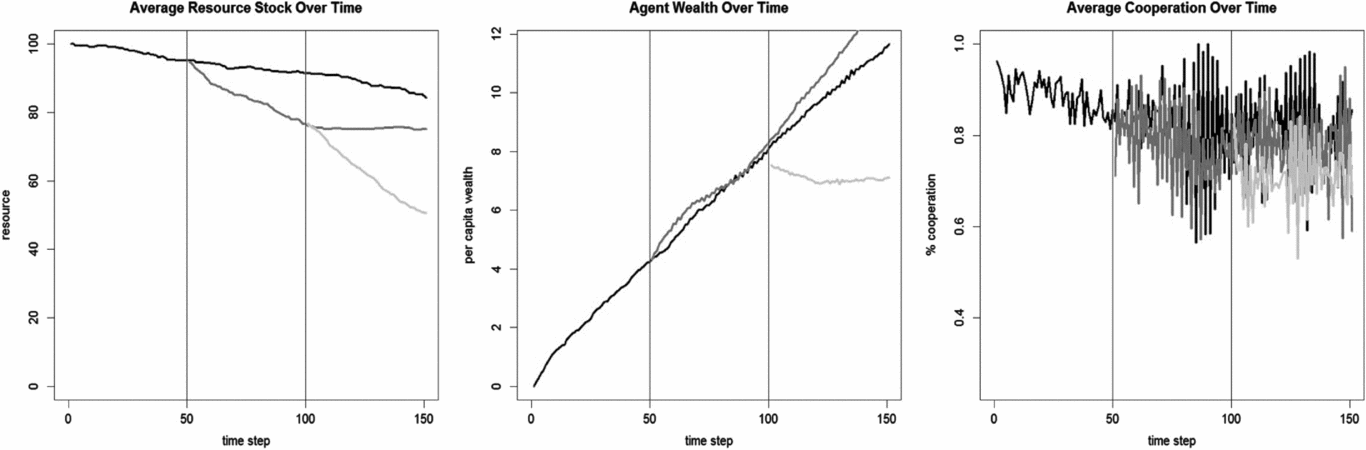
Fig. 1 illustrates the predicted dynamics of CPR use over time across a number of hypothetical CPRs. The lines track modelled changes over time in three evaluative criteria: resource stock (i.e. the average health of CPRs, left panel); average amount of resources accumulated by agents (i.e. human well-being, centre panel); and average levels of cooperation in each CPR (right panel). The black lines in Fig. 1 depict the change over time in the three evaluative criteria under two conditions: (1) agents have an exogenously determined discount rate of zero; and (2) agents are assumed to remain in their own CPR throughout the simulation. This provides a baseline scenario of resource use, against which we may compare alternative scenarios where discount rates are allowed to change and where agents are allowed to migrate to other islands.
Simulated resource stock, agent well-being and cooperation over time. Black lines indicate the baseline scenario, without discounting or migration. Dark grey lines indicate changes from the baseline in scenario 2, where discount rates increase in a single randomly chosen common-pool resource at t = 50. Light grey lines indicate changes from scenario 2 in scenario 3, where agents in the randomly selected common-pool resource have increased discount rates at t = 50 and are allowed to migrate to other common-pool resources at t = 100.

Incorporating endogenous time preferences and migration
Based on the sustainability criterion, in order for a resource to be maintained indefinitely, it is necessary for discount rates di,t to be zero. This means that resource users harvest in such a way that there is as much resource available tomorrow as there is today. Another possibility for the resource to be maintained indefinitely is a situation where the number of agents is very small compared to the size of the resource, so that a limited number of agents who are limited in their possible harvest sizes due to technology constraints (hmax ) are not able to deplete the resource, even if they have very high discount rates. While there are numerous real-world examples of sustainable CPR use, these are typically in relatively small communities where this special case may hold (Henry & Dietz Reference Henry and Dietz2012). As noted above, however, there are many reasons why agents might have non-zero discount rates such that future resources are perceived to be less valuable than current resources. Most salient to island communities, one of these possible reasons is facing a perceived risk from climate change. If island communities are threatened by climate change impacts to the extent that islands (and especially atolls) become uninhabitable, then agents truly do have a reason to devalue future resources. For this reason, it is possible that trusted information about future climate impacts might have the result of increasing an agent's discount rate d. The result would be a higher sustainable yield and a more rapid depletion of the resource.
This intuition is supported by the simulation results in Fig. 1, where dark grey lines depict outcomes over time when one CPR in the system experiences an information shock that causes the discount rate to increase for all agents on the island. This shock is introduced at a prescribed point in time (after 50 time steps) for a single, randomly selected CPR. At this time, discount rates for the affected agents are changed to 0.05, such that resources in the next time step are only valued at 95% of current resources. Afterwards, the simulation proceeds normally as described above. In the real world, this information shock might be the result of an extreme weather event that creates the belief on that island that the resource has become unstable or may disappear, or it may be the result of new information provided, such as by a governmental organization attempting to increase awareness about climate change. Whatever the cause, this increase in discount rates is likely to speed resource depletion and increase average agent well-being, at least in the short term. Indeed, that behaviour is reflected in the model, with more rapidly diminishing resource stocks when some agents increase their discount rates (dark grey lines) versus when discount rates remain fixed at zero (black lines).
A third set of simulations explore the added complexity of allowing agents to migrate away from their island after experiencing an information shock. This scenario represents a likely corollary to increasing discount rates, namely that island residents will choose to leave their island altogether or even be forced to relocate by an external authority. From the natural systems perspective, this migration can have a positive impact on the threatened CPR since there will be fewer agents harvesting this resource. However, this will increase pressures on surrounding islands as the population of agents extracting from that resource grows – note in eqn (1) that h*i,t is decreasing in Nt while hmax remains fixed, and therefore the marginal benefits and the probability of defection will increase as populations increase as a result of migration. Moreover, migrating populations may also bring with them their increased discount rates, leading to an even more rapid depletion of resources in their new homes. These dynamics are illustrated by the light grey lines in Fig. 1, where resource depletion – and overall agent well-being – decreases much more rapidly than would be expected if we did not consider the migration of affected island populations. At least two alternative models of migration may be considered: first, agents are required to pay a cost to migrate from their CPR; and second, agents do not travel with their discount rates, but rather adopt the discount rates in the CPR they migrate to. Both of these alternative models are discussed in the supplemental information. The net effect of migration cost and conformity to local discount rates is a slowing of resource depletion after migration; however, the overall patterns discussed here still hold – if migration is allowed, resources tend to deplete faster than if agents are assumed to remain in their CPR.
DISCUSSION
Global climate change models abstract from preferences of individuals and their impacts on decision making, thereby underemphasizing the actual extraction path of natural resources and the timing of potential migration flows. Estimates of the social costs of future climate impacts highly depend on the discount rate used to train the model. For example, Stern (Reference Stern2007) used a low discount rate of 1.4%, which puts a high price on future damages to motivate strong actions now, while Nordhaus (Reference Nordhaus2014) argues for a higher discount rate of between 3% and 5%, as used by most economists, which justifies only moderate actions be taken today. This is a matter of judgement as to how much weight is put on moral obligations towards future generations.
However, the anticipation of future climate change may directly and indirectly affect the pattern of resource use. As a direct effect, individuals will migrate away from the threatened environment (i.e. low-lying atolls), thereby creating environmental pressures elsewhere. The indirect effect, however, might be more severe. The anticipation of climate change may alter discount rates towards a stronger valuation of the present needs compared with future benefits from conservation. Thus, resource extraction from the atolls will increase and may even carry over to other places if people keep their newly formed discount rates. If individual discount rates systematically respond to SLR, then societal choices may be affected by this, and scenarios that inform policy making based on global climate change models will fail to account for these behavioural economic insights.
It should be noted that this theoretical model may be applied in order to understand real-world systems, though the parameterization of the model would likely be a non-trivial undertaking. A full parameterization would require detailed knowledge of the ecological conditions of islands within a particular region, as well as valid measures of agents’ discount rates, tendencies towards cooperation versus defection and local institutions in order to monitor recourses and sanction non-cooperative behaviour. Coupled with information about the spatial geography – and with it, knowledge of where agents may migrate to – it would be possible to build detailed predictive simulations of environmental stress as a result of human adaptions to climate change. At the same time, however, this model also underscores the potential value of field research for understanding these complex systems. Two relatively simple research questions may profoundly influence predications about system-level outcomes: first, whether agents adjust discount rates as a function of information or experience; and second, whether agents systematically migrate to locations that are less prone to environmental shocks. For these reasons, a better understanding is needed of how discount rates change, the circumstances under which they change and how people migrate between and beyond island communities as a result of changes in discount rates. This understanding will ultimately come from research emphasizing multi-method, interdisciplinary approaches to research (Connell Reference Connell2008, Reference Connell2010; King Reference King2009; Christensen & Gough Reference Christensen and Gough2012). While model predictions show a decrease in cooperation with increases in discounting, there is considerable evidence that Pacific Islanders’ reactions towards current environmental transformations are often less agitated than might be expected, given scientific climate change prospects (Lata & Nunn Reference Lata and Nunn2011; Farbotko & Lazrus Reference Farbotko and Lazrus2012; Rudiak-Gould Reference Rudiak-Gould2013). Changes in behaviour will ultimately lead to altered individual preferences, such as time, risk and social preferences (both pro- and anti-social). These preferences are measurable, such as by using artefactual field experiments that are conducted with a representative subject pool. Measured parameters have strong predictive power for individual behaviour and can be used to inform the model presented here. For example, risk-seeking individuals are more likely to migrate between labour markets (Jaeger et al. Reference Jaeger, Dohmen, Falk, Huffman, Sunde and Bonin2010). Additionally, survey methods could be used to train our model by collecting data on social networks, desirable migration destinations, climate change perceptions and loss of cultural identity, social norms and values. These factors that shape migration decisions could then be used to train computational models that extrapolate these observations from a sample of islanders to entire regions encompassing many islands.
Individual responses to environmental change are shaped by physical as well as socio-cultural factors, and oceanic islands are highly dynamic in their geo-physical setup. They are subject to tectonic and associated volcanic processes, to short-term and long-term climatic conditions and to anthropogenic environmental changes such as mangrove cutting, sand mining or changing coastlines due to built infrastructure (Peterson Reference Peterson2009). Mann and Westphal (Reference Mann and Westphal2014), for instance, showed that the shorelines of nine small islands on Takú atoll (Papua New Guinea) are highly dynamic and experienced large changes in the period from 1943 to 2012. Overall, a total loss of nearly 50% of beach areas has been reported, and the shorelines of these islands are volatile due to seasonal variations and tropical storms in the short term. This demonstrates that people living on small islands are accustomed to a highly dynamic environment in which beaches come and go, or in which coastlines shift within a certain range, even seasonally. Slow-onset events like SLR may therefore be masked by other events and, as a result, not given full attention.
These studies, coupled with future research, should suggest concrete recommendations for organizations in the public, private and non-profit sectors that are interested in climate change mitigation and adaptation. Providing people with information about climate change-associated risks could potentially bond people together and increase their in-group bias. It has been documented in a recent review article by Bauer et al. (Reference Bauer, Blattman, Chytilová, Henrich, Miguel and Mitts2016) for a range of post-war settings that war-affected people increase their membership in social and civic organizations, take up leadership positions and are more pro-social in experimental laboratory games. However, people might not be eager to learn about a life-changing event like relocation in advance, even though they could make better decisions, as the anticipated disutility over the years from such an event could be higher than how the actual event is turning out (Schweizer & Szech Reference Schweizer and Szech2016). Our hypothesis rests on the assumption of economic rationality where education campaigns are ‘cheap talk’ and do not change the inherent incentive structure. In reality, this might be questioned, although information campaigns in many countries tend to change problem awareness than actual behaviour (see Staats et al. Reference Staats, Wit and Midden1996).
Insights from the theoretical model presented here suggest that better information about risks of climate change might spur undesirable patterns of resource use. Nunn (Reference Nunn2013) concluded that rising sea levels for almost 200 years now will cause an end to today's Pacific Islander lifestyle. Fundamental changes to cultural identities, resettlements and society at large will be unavoidable, and the impacts can only be attenuated by efforts at the local level rather than by increased dependence on the international community. Thus, organizations should be careful in the way they craft and communicate messages about climate change. An emergent and unexpected outcome of our model is that having education about – or experience with – local climate change impacts might increase the likelihood of resource collapse.
CONCLUSION
Our model results are contrary to the common wisdom that increased environmental awareness promotes more sustainable behaviours (Stern et al. Reference Stern, Dietz and Guagnano1995; Henry & Dietz Reference Henry and Dietz2012). Indeed, presenting resource users with catastrophic, doomsday scenarios might work against resource sustainability at a larger scale and over time. This is not to say that people should not have access to better information about climate change impacts; however, it is important to also deliver positive, empowering messages that encourage continued cooperation and responsible stewardship of natural resources.
CONFLICT OF INTEREST
None.
FUNDING
Björn Vollan acknowledges financial support from the Robert Bosch foundation through the Robert Bosch Junior Professorship Sustainable Use of Renewable Natural Resources.
Supplementary material
To view supplementary material for this article, please visit https://doi.org/10.1017/S0376892917000339