Introduction
In clinical practice, the early detection of Alzheimer's disease (AD) has focused primarily on the mild cognitive impairment (MCI) phase. MCI is often seen as an intermediate stage between normal aging and dementia. In the amnestic form of MCI (aMCI), objective and subjective memory complaints are dominant. It often occurs that aMCI is a prodromal phase of AD (Dubois et al., Reference Dubois2014).
Many studies have shown that depressive symptoms are common in MCI, with depression being present in about 16% to 27% of the MCI patients (Lee et al., Reference Lee, Potter, Wagner, Welsh Bohmer and Steffens2007; Van der Mussele et al., Reference Van der Mussele2014). Research on the association between depression and AD however, has provided us with inconsistent findings regarding the temporal and directional association of both disorders. In some studies, older adults with depressive symptoms had an increased risk of developing AD (Ownby et al., Reference Ownby, Crocco, Acevedo, John and Loewenstein2006; Saczynski et al., Reference Saczynski, Beiser, Seshadri, Auerbach, Wolf and Au2010; Sacuiu et al., Reference Sacuiu2015), whereas in other research, individuals with AD had an increased risk of developing depression (Chen et al., Reference Chen, Ganguli, Mulsant and DeKosky1999; Vinkers et al., Reference Vinkers, Westendorp, van der Mast, Gussekloo and Stek2004). Some researchers even did not find any association between depression and incident dementia (Luppa et al., Reference Luppa, Luck, Ritschel, Angermeyer, Villringer and Riedel-Heller2013). So, in sum, the role of depression and depressive symptoms as an early prodromal clinical manifestation of dementia, as a risk factor and/or as a reaction to cognitive decline is still a matter of debate (Panza et al., Reference Panza2010).
The main aim of the present study was to investigate whether depressive symptoms in aMCI patients could predict conversion to dementia. More specifically, the following research questions were raised: (1) do depressive symptoms in aMCI patients allow for an accurate prediction of conversion to dementia, after 1.5, 4, and 10 years of follow-up; (2) are there significant differences in baseline depressive symptoms and scores on cognitive measures between aMCI patients with a diagnosis of dementia at follow-up (i.e. converters) and those without (i.e. non-converters)?
Methods
Participants
All patients were recruited from the Memory Clinic of Hospital Network Antwerp and were diagnosed with aMCI after a diagnostic work-up consisting of a general physical and neurological examination, blood screening, structural neuroimaging, and a neuropsychological assessment. To establish a diagnosis of aMCI, Petersen's criteria (Petersen et al., Reference Petersen, Smith, Waring, Ivnik, Tangalos and Kokmen1999) were applied. These consist of (1) a subjective memory complaint ideally corroborated by an informant, (2) an objective memory impairment for age and education, (3) essentially preserved general cognitive functions, (4) largely intact functional activities, and (5) not demented.
The inclusion criteria for our study were the following: (1) a diagnosis of aMCI at the Memory Clinic of Hospital Network Antwerp, (2) age equal to or above 64 years, (3) no history of neurological diseases or comorbid neurological disorder, and (4) no psychiatric illness. Because of a lack of an uniform definition and clinical diagnostic criteria for aMCI, all aMCI patients were diagnosed by clinicians in the same center in order to preserve homogeneity in this diagnostic group.
Materials and procedure
To avoid circular reasoning, (i.e. the same tests are used to diagnose a disease and then to predict the diagnosis), it is important to point out that the cognitive screening tests used in this study are different from the tests used in the neuropsychological assessment for the diagnosis of aMCI and dementia.
At baseline (1) the Dutch version of the Cambridge Cognitive Examination. (CAMCOG) (Roth et al., Reference Roth1986; Derix et al., Reference Derix, Teunisse and Hijdra1992), a global cognitive screening test, (2) the Mini-Mental State Examination (MMSE) (Folstein et al., Reference Folstein, Folstein and McHugh1975), a short screening instrument for cognitive functions, (3) the 30-items GDS (Yesavage, Reference Yesavage1988), a self-report questionnaire to assess depressive symptoms, (4) the Memory Impairment Screen (MIS-plus) (Dierckx et al., Reference Dierckx, Engelborghs, De Raedt, De Deyn and Ponjaert-Kristoffersen2007) (Dutch version of the original MIS) consisting of six to-be-learned words instead of the original four), and (5) the Visual Association Test (VAT) (Lindeboom and Schmand, Reference Lindeboom and Schmand2003), a visual cued recall task, were administered to all patients.
The GDS is a self-report questionnaire, specifically designed to screen for depressive symptoms in the elderly. Scores range from 0 to 30, with higher scores indicating a greater likelihood of depression. A cut-off score of 11 is generally used to distinguish between the presence and absence of significant depressive symptoms (Yesavage, Reference Yesavage1988).
The patients were subsequently divided into two groups based on their GDS scores. Patients who obtained a GDS score equaling 11 or higher were labeled as the MCI patients with depressive symptoms group, while patients with a GDS score below 11 were labeled as the MCI patients without depressive symptoms group.
After 1.5, 4, and 10 years, clinical data were used to establish a follow-up diagnosis. A diagnosis of dementia was established in the same center and by the same clinicians who initially established the diagnosis of aMCI. A dementia diagnosis was made according to DSM-IV criteria (American Psychiatric Association, 1994). Probable AD dementia was diagnosed using the National Institute of Neurological and Communicative Disorders and Stroke – Alzheimer's Disease and Related Disorders Association criteria (NINCDS-ADRDA criteria) (McKhann et al., Reference McKhann, Drachman, Folstein, Katzman, Price and Stadlan1984). In this way, a group of converters (i.e. diagnosis of dementia at follow-up) and a group of non-converters (i.e. no diagnosis of dementia at follow-up) could be distinguished.
The local ethics committees approved the study and a written informed consent was obtained from all patients.
Statistical analysis
Data were analyzed using SPSS Statistics 22 (IBM Corp., 2013) and a criterion α of 0.05 was used throughout all analyses. First, baseline scores between participants that had follow-up and that had not were compared with non-parametric Mann–Whitney U tests for each follow-up moment. Non-parametric tests were chosen because of the small sample sizes. Then aMCI patients with and without depressive symptoms at baseline were compared for baseline demographics and cognitive measures by means of Mann–Whitney U tests (age, education, and all cognitive measures) or χ 2 analysis (gender). Differences in baseline GDS, CAMCOG, MMSE, MIS-plus, and VAT scores between converters to dementia and non-converters were studied with non-parametric Mann–Whitney U tests, after both 1.5 and 4 years. Additionally, binary logistic regression analysis was performed to explore whether depressive symptoms at baseline could predict conversion to dementia in general and to AD dementia in specific in aMCI patients, both after 1.5 and 4 year of follow-up. Due to the small sample size of the non-converted group after 10 years, no further analyses were done between converters to dementia in general and non-converters. Subsequently, an “AD group” consisting of converters to AD and a “non-AD group” consisting of converters to other types of dementia was made. By means of non-parametric Mann–Whitney U tests the differences in baseline GDS, CAMCOG, MMSE, MIS-plus, and VAT scores were studied.
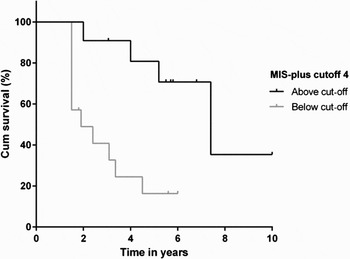
Finally, survival analyses were done. The association between aMCI at baseline and dementia was studied separately for conversion to dementia in general and for conversion to AD after ten years of follow-up. The associations were studied using Tarone-Ware χ 2tests comparing estimates of the Kaplan–Meier survival estimates of aMCI patients with depressive symptoms and those aMCI patients without depressive symptoms at baseline. Because of the promising findings with the MIS-plus to predict conversion to AD, the Kaplan–Meier analyses were reperformed to compare aMCI patients who scored below the cut-off of the MIS-plus (five or six) and those with aMCI who scored under the cut-off of the MIS-plus (four or less) at baseline. Finally, a figure was made using GraphPad Prism version 6.05 for Windows.
Results
Baseline characteristics of aMCI patients with and without follow-up (Table 1)
A total of 35 aMCI completed the baseline neuropsychological examination for this study. An even number of male (54.3%) and female participants participated with a mean age of 75.31 (5.98), ranging from 64 to 91. Mean scolarity, calculated as the mean number of years of education as from the age of six years, was 11.77 (3.26) years (range 8–18).
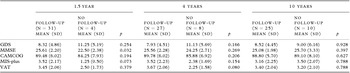
Data analysis showed that 11.43%, 22.86%, and 28.57% of the participants were not followed up after 1.5, 4, and 10 years respectively. The differences between the participants that were followed up and those that dropped out are described for each follow-up moment in Table 1. Only baseline MMSE scores differed significantly between patients who were follow-up after 1.5 year and those who were not.
Differences in baseline scores of MCI patients who received follow-up and drop outs at 1.5, 4, and 10 years follow-up

Baseline demographics and cognitive scores of aMCI patients with and without depressive symptoms (Table 2)
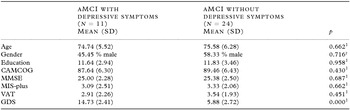
When applying the cut-off of 11 on the GDS, 31.4% of aMCI patients reported depressive symptoms at baseline. At baseline, aMCI patients with and without depressive symptoms did not significantly differ in age and years of education. None of the cognitive measures revealed a significant difference at baseline between aMCI patients with and without depressive symptoms.
Baseline demographics and cognitive functioning of aMCI patients with and without depressive symptoms

1 Mann– Whitney U tests.
2 χ 2.
Differences in baseline cognitive scores and depressive symptoms between converters and non-converters (Table 3)
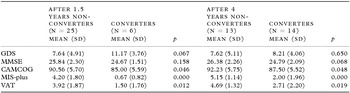
After 1.5 years, 31 out of 35 aMCI patients were reassessed and 6 fulfilled criteria for probable AD, while 25 had not (yet) converted to dementia. The conversion rate was 19.35 %. According to a binary logistic regression analysis, GDS scores at baseline were not able to predict conversion to AD (Wald χ 2 (1) = 2,397, p = 0.122).
Differences in cognitive measures and depressive symptoms at baseline in converters and non-converters after 1.5 years and 4 years

Converters scored higher on the GDS at baseline than non-converters although this difference was not statistically significant. Concerning the cognitive measures, converters performed significantly worse on the MIS-plus, the VAT, and CAMCOG (see Table 3).
A forward binary logistic regression using the GDS, CAMCOG, MMSE, MIS-plus, and VAT as predictive variables showed that the MIS-plus was the best predictor for conversion to AD dementia after 1.5 years (Wald χ 2 (1)=2,973, p = 0.085).
After 4 years, the available clinical data from 27 out of 35 aMCI patients were evaluated and 14 fulfilled criteria for dementia (12 converted to AD and 2 to non-specified dementia), while 13 had (still) not converted to dementia. The conversion rate was 51.85 %. According to a binary logistic regression analysis, GDS scores at baseline, again, could not predict conversion to dementia (Wald χ 2 (1) = 0.123, p = 0.726) or to AD dementia (Wald χ 2 (1) = 0.263, p = 0.608).
There was no significant difference in the presence of depressive symptoms at baseline between converters and non-converters. Converters again performed significantly worse on the MIS-plus, VAT, and CAMCOG. This meant that converters performed worse at baseline, mainly on cognitive measures of memory (Table 3).
Forward binary logistic regression analyses using GDS, CAMCOG, MMSE, MIS-plus, and VAT as predictive variables (first modeled all together and subsequently all separately) showed that the MIS-plus is the best predictor of conversion to dementia and to AD dementia after four years (respectively Wald χ 2 (1) = 8,880, p = 0.003 and Wald χ 2 (1) = 5.056, p = 0.025).
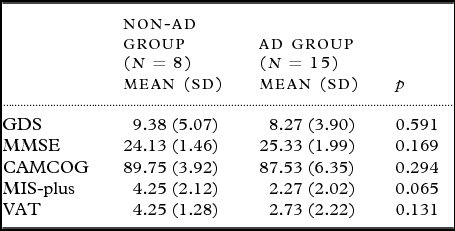
Finally after 10 years the clinical data of 25 out of 35 aMCI patients were evaluated and 23 fulfilled criteria for dementia (15 converted to AD dementia, 7 to non-specified dementia and 1 to Parkinson's disease dementia), while 2 had (still) not converted to dementia. The conversion rate was 92 %. Due to the small non-converter group no further analyses were done on conversion to dementia in general. In Table 4, the group that converted to AD is compared with the non-AD group (converters to other types of dementia). There was no significant difference in the presence of depressive symptoms at baseline between the AD group and non-AD group. The AD patients scored worse on the MIS-plus; however, this difference did not reach significance.
Comparison between non-AD and AD groups after 10 years

Survival analyses
Similar as with the binary logistic regression, the Kaplan Meier model showed that depressive symptoms were not predictive for conversion to dementia in general (Tarone ware χ 2 (1) = 0.157, p = 0.692), or for conversion to AD dementia (Tarone ware χ 2 (1) = 0.749, p = 0.387). In contrast, the model showed that the MIS-plus is a good predictor of conversion to AD over time (Tarone ware χ 2 (1) = 9.648, p = 0.002) (Figure 1).
Progression to AD dementia in aMCI patients with scores above and below the MIS-plus cut-off of 4.

Discussion
The current study aimed to explore the relationship between depressive symptoms and the risk of developing dementia in MCI patients. More specifically, this study wanted to investigate whether conversion to dementia could be predicted after 1.5, 4, and 10 years of follow-up based on the presence of depressive symptoms in aMCI patients.
Our results are in accordance with previous studies showing that depressive symptoms are common in MCI patients. While in this study 31.4% of aMCI patients reported significant depressive symptoms, other studies including population-based studies reported prevalence rates ranging between 3% and 63% with a median of 15.7% (Panza et al., Reference Panza2010). This wide variation in reported prevalence rates might be the result of differences in the use of diagnostic criteria and the operationalization of depression and depressive symptoms among studies as well as the contribution of possible selection biases (memory clinic vs. population-based studies).
After 1.5, 4, and 10 years the conversion rate from aMCI to dementia was respectively 19% (all AD), 52% (44% to AD), and 92% (60% to AD). Compared to other studies (Mitchell and Shiri-Feshki, Reference Mitchell and Shiri-Feshki2009) this is a rather high conversion rate. This might be due to a possible selection bias given the setting (memory clinic).In these settings, in most cases, the symptoms of cognitive decline are already manifest in patients and a degenerative process has been started. Besides this, it might be the case that stable or “progressed to normal” aMCI patients were represented in the missing data as they stopped coming to the clinic for follow-up.
Concerning the prediction of conversion to dementia after 1.5 years, our results show that the presence of depressive symptoms in aMCI patients is not predictive of conversion to dementia. However, the converters reported slightly more depressive symptoms than the non-converters. So it is plausible that with a larger sample size this difference would have been statistically significant. Although there was a significant difference between converters and non-converters on the cognitive tasks, these could also not predict conversion to dementia.
Regarding the prediction of conversion to dementia and AD dementia after four and ten years, our results indicate that the presence of depressive symptoms in aMCI patients is not predictive of conversion to dementia or to AD dementia. In contrast, the cognitive measures and specifically memory tasks could predict dementia and AD dementia. Our results are in contrast with a recent meta-analysis of longitudinal studies (Gao et al., Reference Gao2013) that concluded that depression is a major risk factor for incidence of dementia. However, from the four studies investigating the link between depression and AD, only two found a significant difference in the incidence of AD dementia in subjects with depression. Although most studies published to date support the assumption that there is an increased risk of dementia in people with depression, approximately 25% of published studies fail to find this association (da Silva et al., Reference da Silva, Goncalves-Pereira, Xavier and Mukaetova-Ladinska2013). A three-year and eight-year prospective study failed to show a clear significant association between depression and incident dementia and thus do not support the assumption that depressive symptoms predict cognitive decline either (Luppa et al., Reference Luppa, Luck, Ritschel, Angermeyer, Villringer and Riedel-Heller2013).
These discrepancies might be attributed to methodological differences between studies (e.g. sample size, definition and operationalization of depression, follow-up time) but might as well be explained by the impact of specific characteristics of depression influencing the association with dementia. Greater severity of depressive symptoms has been found to be an important characteristic influencing the risk of dementia (Chen et al., Reference Chen, Hu, Wei, Qin, McCracken and Copeland2008; Saczynski et al., Reference Saczynski, Beiser, Seshadri, Auerbach, Wolf and Au2010; Van der Mussele et al., Reference Van der Mussele2014). Age at onset of depression (early- and late-life depression) has also been explored. While early-life depression has consistently been found to increase the risk of developing dementia in late life (Sacuiu et al., Reference Sacuiu2015), studies investigating late-life depression have left us with contradictory findings (da Silva et al., Reference da Silva, Goncalves-Pereira, Xavier and Mukaetova-Ladinska2013).
Though, this conflicting evidence might also be due to differences in follow-up time. As proposed by different researchers (Banks et al., Reference Banks2014; Gaugler et al., Reference Gaugler, Hovater, Roth, Johnston, Kane and Sarsour2014; Van der Mussele et al., Reference Van der Mussele2014), it is reasonable that depressive symptoms form an early manifestation of the pathological process of dementia. So, it is possible that depressive symptoms in aMCI patients worsen when they are progressing to dementia with even a higher incidence at the moment of conversion to dementia. In this way, depressive symptoms are only predictive during a limited time frame. Our results indeed indicate that depressive symptoms are more predictive, however not yet significant, after 1.5 years than after 4 years of follow-up. In accordance with this hypothesis, Banks and colleagues (Reference Banks2014) found that MCI patients who progressed to dementia had increased self-reported depression.
This study also explored differences in baseline cognitive functioning between converters and non-converters, and tested whether these cognitive measures allow for a reliable prediction of conversion to dementia. There was a significant difference between converters and non-converters on memory tasks (i.e. CAMCOG, VAT, and MIS-plus), with converters performing worse. This is in accordance with research on memory performance wherein it is found that so called prodromal AD patients obtain lower scores on tests of cued recall (e.g. the VAT and MIS-plus), and free recall (e.g. the memory tests of the CAMCOG) (Dierckx et al., Reference Dierckx2009; Conde-Sala et al., Reference Conde-Sala2012).
The guidelines from IWG-2 group (Dubois et al., Reference Dubois2014) state that for typical AD pathology the clinical phenotype is recognized by an early and significant episodic memory impairment of the hippocampal type preferably measured with a free and cued recall task. Indeed, in our study the MIS-plus was a good predictor of conversion from aMCI to dementia and more specifically to AD dementia. So, our results are also in accordance with studies supporting the hypothesis that cued recall tasks, like the VAT and the MIS-plus, are better predictors of conversion to AD than other measures of memory, for instance a free recall task (Dierckx et al., Reference Dierckx2009). Moreover, impairment on cued recall seems strongly associated with AD biomarkers in cerebrospinal fluid (Wagner et al., Reference Wagner2012) which might be promising for the development of screening instruments to capture the clinical phenotype of AD in an early stage.
Some study limitations merit mentioning. First, this study has a small sample size (N = 35) in combination with a rather high dropout rate (28%) over ten years. This might leave the study underpowered. Indeed, in a recent study with a much larger sample size (N = 183) of MCI patients at baseline, the presence of significant depressive symptoms was associated with progression to AD (Van der Mussele et al., Reference Van der Mussele2014). Second, the lack of an uniform operationalization of depression or depressive symptoms in MCI patients limits the comparability of our study with other studies. Third, this study did not take into account the psychiatric history of the patients. As a consequence, we cannot estimate the impact of early-life depressive symptoms or duration of the depressive symptoms on conversion, while studies have shown that the onset and duration of depression are important factors in determining the risk of developing dementia (da Silva et al., Reference da Silva, Goncalves-Pereira, Xavier and Mukaetova-Ladinska2013). Besides this, only depression was assessed in this study. However, it has been shown that also other psychiatric symptoms and conditions like for example apathy, which shares a lot of characteristics with depression, might be a risk factor for the conversion to AD (Robert et al., Reference Robert2006). Future research should take into account the psychiatric history of the patient and as well as duration of depressive symptoms or apathy as independent variables. In conclusion, this study showed that (1) depressive symptoms were common in this sample of aMCI patients, and that (2) the presence of depressive symptoms at baseline, as measured by means of the GDS, is not predictive of conversion to dementia or to AD dementia and that (3) especially the verbal cued recall task (MIS-plus) was able to predict conversion to dementia, specifically AD dementia in aMCI patients. However, future prospective, longitudinal studies with larger sample sizes of MCI patients should be used. Although depressive symptoms are one of the most prevalent neuropsychiatric symptoms in MCI and AD patients, other neuropsychiatric symptoms, e.g. apathy, should be studied in light of an early diagnosis of AD.
Conflict of interest
None.
Description of author's roles
E. De Roeck conducted analyses, and wrote portions of the paper. I. Ponjaert-Kristoffersen supervised the execution of the study and contributed to the study's design. M. Bosmans wrote portions of the paper. P. P. De Deyn supervised the execution of the study. S. Engelborghs supervised the analysis, and interpretation of data and writing of this article. E. Dierckx designed the study, collected data, and supervised the analysis, and interpretation of data and writing of this article.
Acknowledgments
This research was funded in part by the University of Antwerp Research Fund; the Alzheimer Research Foundation (SAO-FRA, http://alzh.org); the Institute Born-Bunge; the Belgian Science Policy Office Interuniversity Attraction Poles (IAP) program (BELSPO, www.belspo.be); the Flemish Government initiated Methusalem excellence grant (EWI, www.ewi-vlaanderen.be); the Flanders Impulse Program on Networks for Dementia Research (VIND); the Agency for Innovation by Science and Technology (IWT, www.iwt.be); and the Research Foundation Flanders (FWO, www.fwo.be).