Implications
Despite the fact that Nguni cattle are less responsive to pre-slaughter stress compared with established beef breeds, limited protein supply in the dry season predisposes them to pre-slaughter stress, which in turn impacts negatively on their beef yield and quality. In this study, concentrations of catecholamines and their relationship to beef quality in Nguni steers supplemented with Acacia karroo leaf-meal, a locally available protein source, were determined. Favourable findings will be of importance in formulating low-cost diets that minimise stress-mediated losses in the yield and quality of beef from breeds such as Nguni that are suitable for challenging socio-economic and pedo-climatic conditions in Southern Africa.
Introduction
Beef cattle experience several physical and/or psychological stressors during pre-slaughter periods (Gregory, Reference Gregory2008; Terlouw et al., Reference Terlouw, Arnould, Auperin, Berri, Le Bihan-Duval, Deiss, Lefèvre, Lensink and Mounier2008). The consequences of these stressors range from weight loss and death to impaired carcass and meat quality (Foury et al., Reference Foury, Devillers, Sanchez, Griffon, Le Roy and Mormè de2005; Nanni Costa, Reference Nanni Costa2009). The magnitude of any negative effect is a function of the type, duration and intensity of the individual stressors, production system and susceptibility of each individual animal to stress (Ferguson and Warner, Reference Ferguson and Warner2008; Terlouw et al., Reference Terlouw, Arnould, Auperin, Berri, Le Bihan-Duval, Deiss, Lefèvre, Lensink and Mounier2008). The susceptibility of the individual animal to stress is, in particular, influenced by genetics (Ndlovu et al., Reference Ndlovu, Chimonyo, Okoh and Muchenje2008; Muchenje et al., Reference Muchenje, Dzama, Chimonyo, Strydom and Raats2009; O’ Neill et al., Reference O’ Neill, Webb, Frylinck and Strydom2009) and nutrition (Schaefer et al., Reference Schaefer, Dubeski, Aalhus and Tong2001; Lowe et al., Reference Lowe, Peachey and Devine2002). If losses in beef yield and quality due to ante-mortem stress are to be minimised, it is necessary to understand the effects of these contributory factors and their interaction.
In South Africa, the indigenous Nguni breed is being promoted for beef production under communal rangeland conditions. The Nguni breed has been shown to be resistant to nematodes (Xhomfulana et al., Reference Xhomfulana, Mapiye, Chimonyo and Marufu2009), ticks (Muchenje et al., Reference Muchenje, Dzama, Chimonyo, Raats and Strydom2008a) and tick-borne diseases (Marufu et al., Reference Marufu, Chimonyo, Dzama and Mapiye2010), tolerant to pre-slaughter stress (Ndlovu et al., Reference Ndlovu, Chimonyo, Okoh and Muchenje2008; Muchenje et al., Reference Muchenje, Dzama, Chimonyo, Strydom and Raats2009) and produce meat of comparable quality to established beef breeds under rangeland conditions (Muchenje et al., Reference Muchenje, Dzama, Chimonyo, Raats and Strydom2008b). Although rangeland energy and mineral supplies in the dry seasons are sufficient to meet the production requirements of Nguni cattle (Mapiye et al., Reference Mapiye, Chimonyo, Dzama and Marufu2010a), they lose body condition and weight in the same season as a consequence of limited protein supply (Mapiye et al., Reference Mapiye, Chimonyo, Dzama and Marufu2010b). Cattle in poor condition are more susceptible to pre-slaughter stressors than well-fed animals (Lowe et al., Reference Lowe, Peachey and Devine2002; Gregory, Reference Gregory2008). Use of stress-tolerant cattle genotypes in tandem with dietary nutrient supplementation might therefore reduce ante-mortem stress-related losses in meat yield and quality.
Recently, Acacia karroo leaf-meal (AK) has been reported to be a low-cost protein supplement that reduces worm burdens, improves protein status, growth performance, carcass characteristics and some meat quality attributes, and that increases the proportion of desirable fatty acids in beef from Nguni steers raised on rangeland (Mapiye et al., Reference Mapiye, Chimonyo, Marufu and Dzama2011). Evaluating ante-mortem stress response and its relationship to beef quality attributes in cattle fed on such a supplement could be invaluable for the development of appropriate nutritional management strategies that lower ante-mortem stress and subsequently improve animal welfare, beef yield and quality.
Determination of urinary catecholamines post mortem has been shown to be a valid method for evaluating ante-mortem stress in animals (Lowe et al., Reference Lowe, Peachey and Devine2002; Ndlovu et al., Reference Ndlovu, Chimonyo, Okoh and Muchenje2008). Muchenje et al. (Reference Muchenje, Dzama, Chimonyo, Strydom and Raats2009) obtained low concentrations of catecholamines in urine collected post mortem from Nguni steers compared with the Bonsmara and the Angus breeds. In similar studies, such genotype dissimilarities in behavioural response were attributed to the fact that different animals react differently to the same stressor (O’ Neill et al., Reference O’ Neill, Webb, Frylinck and Strydom2009). It is, however, not clear from such studies whether these variations emanate from differences in basal secretion or in the intensity of the response to ante-mortem stress or their combination. A comparison of catecholamine concentrations in urine collected ante-mortem on-farm and post mortem is thus essential. The objective of this study was to determine concentrations of catecholamines and their relationship to beef quality in Nguni steers supplemented with A. karroo leaves.
Material and methods
Research site description
The trial was conducted at the University of Fort Hare farm, Alice, South Africa. The farm lies along longitude 32°78′E and latitude 26°85′S at an altitude of 450 to 500 m above the sea level. It is situated in the False Thornveld of the Eastern Cape Province characterised by a mean annual rainfall of 480 mm and mean annual temperature of 18.7°C, respectively. Cattle graze on rangelands comprised the Aristida congesta, Cympopogon plurinodis, Cynodon dactylon, Digitaria eriantha, Themeda triandra and Sporobolus grass species. Rangelands are dominated by the A. karroo, Scutia myrtina and Maytenus polyacantha tree species.
Feeding management and animal handling
A total of 30 19-month-old Nguni steers, which had a mean weight of 241.5 ± 14.62 kg, were randomly assigned to three dietary treatments: AK, sunflower cake (SF) and the control diet with no supplement (CN), from April 2008 to June 2008. Each treatment included 10 steers. Apart from crude protein (CP) obtained from rangeland grazing, steers on the AK diet received 1500 g of A. karroo leaves to supply an additional 150 g of CP/day. AK was prepared according to Mapiye et al. (Reference Mapiye, Chimonyo, Dzama, Muchenje and Strydom2010c). Before feeding, 1500 g of A. karroo leaves were mixed with rangeland hay (300 g) to improve palatability. The hay was harvested in the same paddocks where the steers were grazing. In addition to CP received from rangeland grazing, steers on the SF diet were offered 650 g of sunflower cake to provide 150 g CP/day. Steers on the CN diet relied entirely on rangeland grazing without any feed supplement. The targeted rangeland forage allowance for each steer on supplementary and CN diets was 6.0 and 7.5 kg/day, respectively.
All the steers were ear-tagged for easy identification. Steers on the same treatment were kept in one paddock. Those on the supplementary diets were allowed 21 days to adapt to their respective diets before the 60-day feeding trial. Each steer on the supplementary diet was fed individually. The feed supplements were offered daily at 0830 h. All the steers were released daily for grazing at 1000 h and penned at 1730 h throughout the trial period. The three treatment groups were continuously rotated on three paddocks (2 ha each) every 7 days. This was done to avoid variations in the quality and quantity of forage consumed that is attributable to the differences in plant growth or micro-environmental condition of the paddocks. Clean tap water was freely accessible to the experimental animals. All steers were neither dewormed nor dipped throughout the trial. Animal care was taken in compliance with the guidelines on the ethics for medical research: use of animals in research and training (South African Medical Research Council, 2004).
Chemical composition and digestibility of feed ingredients
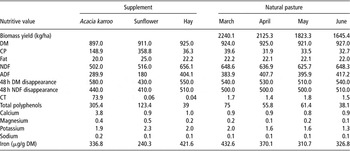
During the trial, biomass yield of forages in the paddocks was estimated using a disc meter. SF, AK, rangeland hay and fresh herbage were assessed for dry matter (DM), CP, fat, calcium, magnesium, potassium, sodium and iron using the Association of Official Analytical Chemists (AOAC, 2003) procedures. Neutral detergent fibre (NDF) and acid-detergent fibre (ADF) were determined according to Van Soest et al. (Reference Van Soest, Robertson and Lewis1991). Total phenolics were assayed calorimetrically according to Price and Butler (Reference Price and Butler1977). Condensed tannins (CT) assays were performed calorimetrically with the butanol–HCl method (Bate-Smith, Reference Bate-Smith1981) using purified CT from Desmodium intortum as the reference standard. The in vitro DM and NDF disappearance after 48 h were determined in accordance with the ANKOM DaisyII system (ANKOM Technology Corporation, Fairport, New York, USA; Van Soest and Robertson, Reference Van Soest and Robertson1985). The biomass yield of the natural pasture and nutritive value of the feed ingredients are shown in Table 1.
Biomass yield of the natural pasture and nutritive value of the dietary components in g/kg DM (unless stated)

DM = dry matter; CT = condensed tannins.
Collection of urine and meat samples
At 2 h before loading and transportation, each steer was stimulated to urinate by gently massaging the preputial area using a dry and clean cloth and the urine sample was collected in sample vessels. Steers were then weighed and trucked to the slaughtering plant at the East London Abattoir (120 km from the University of Fort Hare). The mean slaughter weight was 294.5 ± 3.65, 280.1 ± 3.65 and 259.4 ± 3.65 kg for steers on the SF, AK and CN diets, respectively. The growth rates for steers that received the SF, AK and CN diets were 380.0 ± 33.09, 305.4 ± 33.09 and 270.3 ± 33.09 g/day, in that order.
At the abattoir, the steers were deprived of feed overnight, but water was available at all times. Cattle slaughter and dressing were carried out humanely, following the standard commercial procedures at the East London Abattoir. The steers from each treatment group were randomly moved from the pens to the knocking box. The captive bolt method was used to stun the steers. Carcasses were electrically stimulated (300 V, 50 Hz and 5 A) over a period of 40 to 45 s at 12 pulse/s to minimise the likelihood of cold shortening due to the rapid chilling regime used. Urine samples were also collected from the bladder of each animal with a syringe and needle into sample vessels soon after evisceration about 12 min post mortem. Pre- and post-slaughter urine sample vessels contained 6 M HCl to preserve the catecholamines. All urine samples were stored at room temperature <2 h until return to the laboratory where they were stored at −80°C until analysis.
Carcasses were split and weighed 1 h after evisceration and then chilled at 3°C before being processed the following day after slaughter. The cold carcass weight for steers that received the SF, AK and CN diets was 165.8 ± 4.02, 149.3 ± 4.02 and 129.5 ± 4.0 kg, respectively. The Musculus longissimus thoracis et lumborum (LTL) of the left side was sampled for meat analysis, a day after slaughter, from the 10th rib in the direction of the rump in the following order:
(i) A 100 mm thick steak for 2-day aged Warner–Bratzler shear force (WBSF2) tests and cooking loss (CL2) determination.
(ii) A 100 mm thick steak for 21 days aged WBSF21 tests and CL21 determination.
(iii) A 15 mm steak for drip loss and water holding capacity (WHC) in duplicate.
(iv) A 20 mm steak for Commission International de I'Eclairage (CIE) Lab colour measurement.
(v) A 100 mm steak for fat content determination.
All samples for WBSF and CL tests were frozen at −20°C after the respective ageing periods, whereas tests for drip loss, WHC, colour lightness (L*) and fat were carried out on fresh samples.
Determination of catecholamine concentrations
The urine samples were first hydrolysed before the determination of catecholamines as described by Odink et al. (Reference Odink, Sandman and Schreurs1986). Urine samples were then loaded on cationic columns and the catecholamines were eluted with boric acid. The eluates were then assayed using high performance liquid chromatography (HPLC) with electrochemical detection with an oxidising potential of +65 V following procedures of Gouarne et al. (Reference Gouarne, Foury and Duclos2004). The catecholamines were then quantified against a calibration curve (Gouarne et al., Reference Gouarne, Foury and Duclos2004). The inter- and intra-assay coefficients of variation for epinephrine and norepinephrine analyses were 8.0% and 10.0% and 10.6% and 12.0%, respectively. Urine creatinine was determined by HPLC using the method of Thienpont et al. (Reference Thienpont, Van Landuyt, Stöckl, Saeyens, De Keukeleire and De Leenheer1995), and the urinary catecholamines were expressed as ratios to creatinine concentrations (ng/μmol creatinine).
Determination of pH, L*, drip loss, WHC and fat content
The pH value of the LTL was measured with a digital hand-held meat pH meter (Sentron, Model 1001, Sentron Technologies, Roden, The Netherlands) at 24 h after slaughter. The meat L* values were measured with a Minolta meter (Model CR200, Osaka, Japan) on fresh unaged samples (2 days post mortem) according to the CIE (1976) procedure. For drip loss measurement, two blocks of meat measuring 15 × 15 × 30 mm were sliced from the LTL steak so that the fibres ran across the longer axis of the sample. The samples were suspended on metal hooks in plastic sample bottles (200 ml) so that the sample did not touch the side of the bottle. The suspended samples were stored in a cold room at 2°C for 72 h. Drip loss was calculated as the difference between the initial and final weight of the sample, expressed as a percentage.
The WHC of the meat was measured as the amount of water expressed from a fresh meat sample (1 g) held under pressure (60 kg pressure) using the filter-paper press method developed by Grau and Hamm (Reference Grau and Hamm1957). WHC was calculated using the equation: WHC = 100%−[(outer circle area−inner circle area)/outer circle area] × 100%. A 50 g finely ground sample of the LTL was used for the determination of fat content (AOAC, 2003).
Determination of WBSF and CL
The sampled LTL used for WBSF resistance and CL was vacuum-packed and either frozen directly (for those aged for 2 days) or aged at 2°C for 21 days and frozen. At 2 days before preparation, three steaks measuring 30 mm thick were cut with a band saw, vacuum-packed and thawed over 24 h between 0°C and 4°C. The steaks were prepared according to an oven-broiling (Mielé, model H217, Mielé and Cie, Gütersloh, Germany) method using direct radiant heat (American Meat Science Association, 1995). An electric oven was set on ‘broil’ 10 min before preparation at 260°C. Steaks were placed initially in an oven pan on a rack to allow the meat juices to drain during cooking and later in the pre-heated oven 90 mm below the heat source. The steaks were cooked to an internal temperature of 35°C recorded by a direct probe, then turned and finished to 70°C. Raw and cooked weight was recorded.
After cooking, the steaks were cooled at room temperature for 5 h before shear force determination. A total of eight sub-samples measuring 12.5 mm in core diameter were cored parallel to the grain of the meat and sheared perpendicular to the fibre direction using a Warner–Bratzler shear device mounted on a Universal Instron apparatus (Model 4301, Instron Ltd, Buckinghamshire, UK; cross head speed = 400 mm/min, one shear in the centre of each core). The mean maximum load recorded for the eight cores represented the average of the peak force in Newtons (N) of each sample. Percentage CL was calculated as [(weight of steak after thawing−weight of cooked steak)/weight of raw steak after thawing] × 100. It was made up of evaporation and dripping loss during cooking.
Statistical analyses
Data on catecholamine concentrations were subjected to repeated measures using the PROC MIXED procedure of SAS Institute (2003). Assuming first-order autoregressive correlation, the model fitted incorporated the fixed effects of diet, time of urine collection, their interaction and the repeated effect of urine collection with a steer within a diet as the subject. Data on some selected meat quality attributes were analysed for the effects of diet using the GLM procedure of SAS Institute (2003). Pair-wise comparisons of the least square means were performed using the PDIFF option (SAS Institute, 2003) when the F-test was significant at P < 0.05. The relationships between catecholamines and selected meat quality attributes across diets were determined using the linear regression model (PROC REG) procedure of SAS Institute (2003) with a BY diet statement.
Results
Urinary catecholamine concentrations
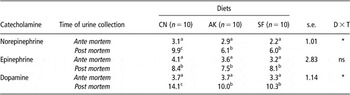
As shown in Table 2, diet had no effect on ante-mortem concentrations of urinary catecholamines in Nguni steers. Generally, post-mortem concentrations of urinary catecholamines were higher (P < 0.05) than ante-mortem concentrations (Table 2). Nguni steers that subsisted on rangelands alone had higher (P < 0.05) concentrations of post-mortem urinary norepinephrine and dopamine hormones compared with those that received the AK and SF diets (Table 2). Post-mortem concentrations of epinephrine were not influenced by diet.
Least square means and s.e. of ante- and post-mortem urinary catecholamine levels (ng/μmol creatinine) in Nguni steers fed three supplementary diets

CN = control diet; AK = Acacia karroo; SF = sunflower cake; D × T = diet by time of urine collection interaction.
a,b,cMeans with different superscripts for a particular catecholamine are different at P < 0.05.
*P < 0.05.
Selected meat quality attributes
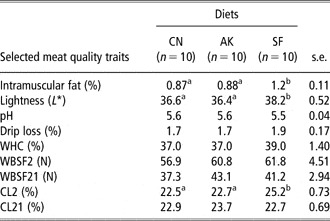
Table 3 shows the least square means ± s.e. of selected meat quality traits of Nguni steers fed on the three different diets. Steers that received the SF diet had higher (P < 0.05) values for intramuscular fat, L* and CL2 compared with those on the AK and CN diets. Meat pH, drip loss, WHC, WBSF2 and WBSF21 days and CL21 were similar across dietary treatments.
Least square means and s.e. of meat quality traits of Nguni steers fed three supplementary diets
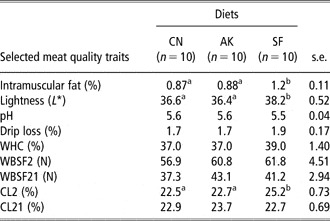
CN = control diet; AK = Acacia karroo; SF = sunflower cake; WHC = water holding capacity; WBSF2 = Warner–Bratzler shear force value of meat aged for 2 days; WBSF21 = WBSF value of meat aged for 21 days; CL2 = cooking loss of meat aged for 2 days; CL21 = CL of meat aged for 21 days.
a,bMeans within a row with similar superscripts are not significantly different (P < 0.05).
Relationships between catecholamine concentrations and selected beef quality traits
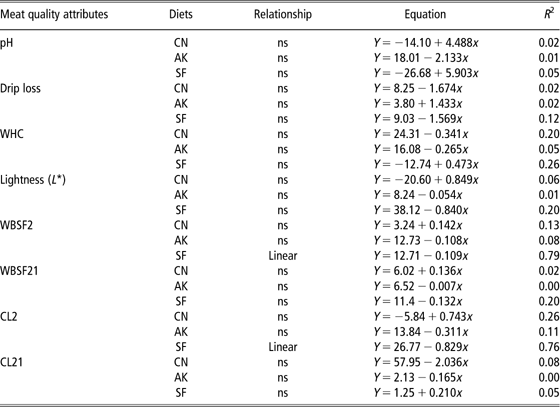
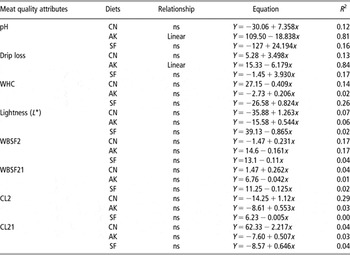
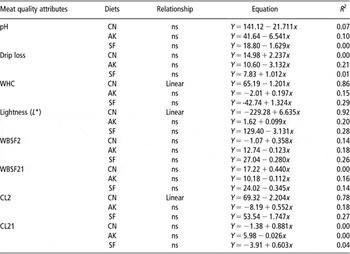
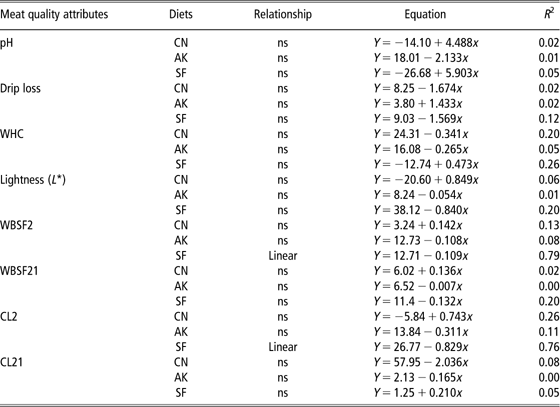
Negative linear trends (P < 0.05) were observed between norepinephrine and WBSF2, and CL2 for steers that were supplemented with SF (Table 4). Norepinephrine levels for both supplemented and unsupplemented steers were not related to meat pH, drip loss, WHC, L*, WBSF21 and CL21 (Table 4). Ultimate pH and drip loss values decreased linearly (P < 0.05) with increasing epinephrine concentration in steers that were supplemented with AK (Table 5). For all the diets, relationships of epinephrine with WHC, L*, WBSF2, WBSF21, CL2 and CL21 were not significant (Table 5). Dopamine concentration was negatively linearly related (P < 0.05) to WHC and CL2 for steers on the CN diet (Table 6). There was a positive linear relationship (P < 0.05) between dopamine concentration and meat lightness for steers that entirely subsisted on rangeland (Table 6). Relationships of dopamine with pH, drip loss, WBSF2, WBSF21 and CL21 were not significant for all the tested diets (Table 6).
Relationship between norepinephrine and meat quality attributes in Nguni steers fed three supplementary diets
CN = control diet; AK = Acacia karroo; SF = sunflower cake; WHC = water holding capacity; WBSF2 = Warner–Bratzler shear force value of meat aged for 2 days; WBSF21 = WBSF value of meat aged for 21 days; CL2 = cooking loss of meat aged for 2 days; CL21 = CL of meat aged for 21 days.
ns (P > 0.05).
Relationship between epinephrine and meat quality attributes in Nguni steers fed three supplementary diets
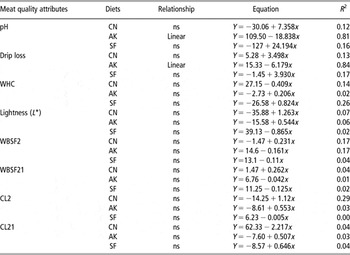
CN = control diet; AK = Acacia karroo; SF = sunflower cake; WHC = water holding capacity; WBSF2 = Warner–Bratzler shear force value of meat aged for 2 days; WBSF21 = WBSF value of meat aged for 21 days; CL2 = cooking loss of meat aged for 2 days; CL21 = CL of meat aged for 21 days.
ns (P > 0.05).
Relationship between dopamine and meat quality attributes in Nguni steers fed three supplementary diets

CN = control diet; AK = Acacia karroo; SF = sunflower cake; WHC = water holding capacity; WBSF2 = Warner–Bratzler shear force value of meat aged for 2 days; WBSF21 = WBSF value of meat aged for 21 days; CL2 = cooking loss of meat aged for 2 days; CL2 = CL of meat aged 21 days.
ns (P > 0.05).
Discussion
The observed differences in catecholamines in urine collected on-farm and after slaughter could be a consequence of ante mortem physical stressors such as hunger, thirst, fatigue, noise (Micera et al., Reference Micera, Dimatteo, Grimaldi, Marsico and Zarrilli2007; Ferguson and Warner, Reference Ferguson and Warner2008) and/or psychological stressors during transportation and at slaughter, which include restraint, manipulation, sudden change of environment and social disturbances (Gregory, Reference Gregory2008; Nanni Costa, Reference Nanni Costa2009). To efficiently reduce ante-mortem stress, it could be important to measure its sources (e.g. handling on-farm, transport, abattoir environment and handling, and slaughtering processes) separately.
The observed concentrations of post-mortem catecholamines in steers that relied on natural pasture alone were higher than those that were reported by Ndlovu et al. (Reference Ndlovu, Chimonyo, Okoh and Muchenje2008) and Muchenje et al. (Reference Muchenje, Dzama, Chimonyo, Strydom and Raats2009). The variation could be due to the differences in age-related responses to pre-slaughter stress (Knowles et al., Reference Knowles, Warriss, Brown, Edwards, Watkins and Phillips1997). Nguni steers in this study were 3 months older at slaughter compared with those used by Ndlovu et al. (Reference Ndlovu, Chimonyo, Okoh and Muchenje2008) and Muchenje et al. (Reference Muchenje, Dzama, Chimonyo, Strydom and Raats2009).
Given that steers on the AK and SF diets received more protein than those on the CN diet, the low concentrations of post-mortem urinary norepinephrine and dopamine hormones observed in the former diets were expected. Agharanya and Wurtman (Reference Agharanya and Wurtman1985) reported that there is an inverse relationship between dietary protein concentration and catecholamine turnover in several sympathetically innervated organs, when energy intake is constant. Protein intake may affect sympathetic activity indirectly by altering energy intake and growth (Agharanya and Wurtman, Reference Agharanya and Wurtman1985; Johnston and Balachandran, Reference Johnston and Balachandran1987). Alternatively, it has been proposed that increasing the protein intake may directly reduce peripheral sympathetic activity (Johnston and Balachandran, Reference Johnston and Balachandran1987), thereby reducing the synthesis and secretion of catecholamines.
The lower levels of norepinephrine and dopamine observed in steers that received extra protein could also be linked to the effect of dietary amino acids on concentration and balance of neurotransmitters (O’ Neill et al., Reference O’ Neill, Webb, Frylinck and Strydom2009). The amino acids that are important precursors of neurotransmitters are tyrosine, tryptophan and phenylalanine (Schaefer et al., Reference Schaefer, Dubeski, Aalhus and Tong2001). It is speculated that if dietary tryptophan is increased, tyrosine and phenylalanine are not able to cross the same blood brain barrier that tryptophan occupies and their products, namely dopamine, epinephrine and norepinephrine, are not synthesised in high amounts (Lee and Britton, Reference Lee and Britton1982). Thus, this response may have the potential to minimise the stress response by not allowing catecholamines to be released in large quantities (Schaefer et al., Reference Schaefer, Dubeski, Aalhus and Tong2001).
Another way in which tryptophan may reduce pre-slaughter stress response is through its ability to increase serotonin production (Guzik et al., Reference Guzik, Matthews, Kerr, Bidner and Southern2006). Increased serotoninergic activity in the brain has been proposed to play a key role in the aetiology of pre-slaughter stress reduction in animals (Kuha et al., Reference Kuha, Toemsombatthaworn and Changkleungdee2009). The concentrations of serotonin and of dietary amino acids such as tryptophan, which are precursors of neurotransmitters, were, however, not evaluated in this study. Overall, A. karroo leaves and sunflower seed cake contain fairly high concentrations of tryptophan averaging 2.3 (Halimani, Reference Halimani2002) and 2.5 g/kg DM (Mupeta et al., Reference Mupeta, Wiesbieeg, Hvelplund and Madsen1997), respectively. It is important to measure the concentration of such amino acids in A. karroo leaves and determine their effect on neurotransmitter concentrations that regulate pre-slaughter stress response.
The elevated levels of magnesium concentrations in supplementary diets could partially explain the lower concentrations of catecholamines observed in steers given the SF and AK diets. Magnesium may affect an animal's response and resistance to stress by antagonising the calcium required for neurotransmitter release and reducing the secretion of neurotransmitters by motor-nerve impulses, which in turn reduce neuromuscular stimulation (Schaefer et al., Reference Schaefer, Dubeski, Aalhus and Tong2001; Dunshea et al., Reference Dunshea, D'Souza, Pethick, Harper and Warner2005). Magnesium and dietary amino acids, which are precursors of neurotransmitters involved in the stress response, may offer a practical means of reducing ante-mortem stress and improving animal welfare and meat quality.
The additional interaction between the steers and humans during provision of supplements in the AK and SF treatments could be partly responsible for the lower levels of catecholamines observed in these treatments. According to Fordyce et al. (Reference Fordyce, Goddard, Tyler, Williams and Toleman1985), cattle accustomed to human contact have a calmer temperament compared with non-acclimated ones. The fact that the response to stress in steers fed the AK diet can be explained by several mechanisms further confirms that determination of pre-slaughter stress and its causes is a conundrum. Additional research to determine the actual mechanism responsible for eliciting a reduction in catecholamine levels in steers fed the AK diet is therefore essential.
The higher values of L* and CL2 in steers supplemented with SF compared with other diets could be explained by the high intramuscular fat content reported for the former diet. The lack of dietary influence on ultimate pH, WHC, drip loss, WBSF2 and WBSF21, and CL21 could mean that the observed differences in norepinephrine and dopamine concentration across diets were not high enough to trigger significant changes in these meat quality attributes. Although pre-slaughter stress is arguably the most important factor influencing the aforementioned meat attributes (Nanni Costa, Reference Nanni Costa2009), stress-independent factors such as age, genetics, metabolic characteristics of the muscle fibres, biochemical and physiological processes (Huff-Lonergan and Lonergan, Reference Huff-Lonergan and Lonergan2005; Muchenje et al., Reference Muchenje, Dzama, Chimonyo, Raats and Strydom2008b) are also important. These factors were probably the same across the dietary treatments.
A decline in WBSF2 with increasing norepinephrine observed in Nguni steers fed SF could be linked to the combined effects of high-energy diet and norepinephrine on meat tenderness. High-energy diets increase the tenderness of meat through an increase in the intramuscular fat content (Shi-Zheng and Su-Mei, Reference Shi-Zheng and Su-Mei2009) and rate of protein synthesis and degradation, which may accelerate post-mortem proteolysis (Tarrant, Reference Tarrant1989). The observed variability in meat tenderness might have partly arisen as a result of norepinephrine-elicited activation or suppression of key proteolytic enzymes involved in myofibrillar protein turnover (Dransfield, Reference Dransfield1994; Sensky et al., Reference Sensky, Parr, Bardsley and Buttery1996). The potential interaction between adrenergic stimulation and the calcium-activated proteolytic system in skeletal muscle may be an important mechanism by which this variability in post-mortem proteolysis arises (Sensky et al., Reference Sensky, Parr, Bardsley and Buttery1996; Dunshea et al., Reference Dunshea, D'Souza, Pethick, Harper and Warner2005).
The inverse relationships observed between norepinephrine and dopamine with CL2 in steers supplemented with SF and CN diets are difficult to explain. It has been suggested that a rise in endogenous secretion of catecholamines results in a concomitant increase in intramuscular glycogen utilisation (Lowe et al., Reference Lowe, Peachey and Devine2002; Foury et al., Reference Foury, Devillers, Sanchez, Griffon, Le Roy and Mormè de2005). A direct action of catecholamines in these processes could therefore completely exhaust the fat reserves of the muscle (Schaefer et al., Reference Schaefer, Dubeski, Aalhus and Tong2001; Lowe et al., Reference Lowe, Devine, Wells and Lynch2004) and consequently reduce meat CL.
The observation that pH and drip loss values were inversely related to epinephrine concentration in steers that were fed the AK diet may be associated with A. karroo’s amino acid and/or mineral composition. For example, magnesium, which was higher in the AK diet than in the CN diet, has been shown to improve pH and reduce drip loss in meat by manipulating the secretion of catecholamines (Dunshea et al., Reference Dunshea, D'Souza, Pethick, Harper and Warner2005). Generally, when an animal is stressed in the pre-slaughter environment, there is a rapid release of catecholamines, which results in glycogen depletion and consequently meat acidification and reduced drip loss (Foury et al., Reference Foury, Devillers, Sanchez, Griffon, Le Roy and Mormè de2005).
Given that CN muscle had low fat content, the relationship between dopamine and WHC in steers that entirely subsisted on rangeland could be explained by the effect of catecholamines on glycogen reserves. Animals slaughtered with low-energy reserves in their muscles as a result of stress have final pH values higher than the isoelectric point of proteins, which result in expansion of the protein network, and which capture water and increase the WHC of meat (Huff-Lonergan and Lonergan, Reference Huff-Lonergan and Lonergan2005). Given that diet had no influence on pHu in this study, other post-slaughter factors such as the rate of temperature and pH decline, ionic strength, proteolysis and protein oxidation might have influenced the WHC of meat (Huff-Lonergan and Lonergan, Reference Huff-Lonergan and Lonergan2005; Cheng and Sun, Reference Cheng and Sun2008).
A positive linear relationship between dopamine and L* in steers that relied on rangeland alone was not expected and is complicated to comprehend. As steers on the control treatment had low dietary fat, it was anticipated that a rise in catecholamines ante mortem would result in the rapid utilisation of muscle glycogen post mortem, which leads to reduced lactic acid production and consequently high pHu and darker and tougher meat (Vestergaard et al., Reference Vestergaard, Oksbjerg and Henckel2000). These results could therefore imply that the relationship observed between dopamine and L* could be a consequence of other unknown biochemical and physiological factors that are independent of the glycogen depletion pathway. Overall, the interpretation of the relationships between stress responsiveness and meat quality attributes is highly complex.
Conclusions
Nguni steers that received protein supplements had lower levels of catecholamines than those that solely subsisted on rangeland. There were several interesting relationships among the urinary levels of stress hormones and certain beef quality traits across dietary treatments. It was concluded that stress responsiveness and its relationship to certain beef quality attributes could be cost-effectively modified by provision of the AK diet. To further reduce stress responsiveness in Nguni steers, the use of locally available feeds that are rich in minerals and amino acids that influence the release or synthesis of stress hormones could be worth exploring.
Acknowledgements
The authors are indebted to the Kellogg Foundation (Nguni Cattle Project) and the National Research Foundation of South Africa for funding this research. Catecholamines in urine samples were analysed at Ampath Laboratories in East London, South Africa. The Agricultural Research Council Meat Industry Centre at Irene in Pretoria, South Africa is acknowledged for meat samples analyses.