Introduction
Loneliness is a significant concern among the elderly, particularly in societies with rapid growth of aging populations. Loneliness is a complex concept described as a subjectively experienced, aversive emotional state resulting from the perception of unfulfilled personal and social needs, and may result from changing lifestyle with aging, declining health, death of loved ones with decreasing social networks, and worries over institutionalization and financial status (Peplau and Perlman, Reference Peplau and Perlman1982). Weiss (Reference Weiss1973) further theorizes that the experience of loneliness involves both social and emotional facets. Emotional loneliness typically refers to the absence of attachment to a special or beloved person, whereas social loneliness refers to the lack of connectedness or satisfaction with social networks and the absence of a meaningful relationship in one's life.
Preliminary evidence indicates that loneliness is associated with cognitive decline (Cacioppo and Hawkley, Reference Cacioppo and Hawkley2009). Cognitive decline, in turn, affects the ability to perform activities of daily living and function independently, including understanding medication instructions, handling finances, arranging transportation, and preparing food. Cognitive decline may progress to dementia or Alzheimer's disease and is not a normal consequence of aging. The aging brain is capable of neurogenesis and neuroplasticity (Salthouse, Reference Salthouse2011; Struble and Sullivan, Reference Struble and Sullivan2011), and better understanding of relevant psychosocial and biological factors that may detrimentally influence cognitive function is important to prevent a decrease in quality of life and improve overall health status in the older adult (Cacioppo and Hawkley, Reference Cacioppo and Hawkley2009; Salthouse, Reference Salthouse2011).
Currently the potential mechanisms underlying the association of loneliness and cognitive function are poorly understood. Evidence suggests that potential biological mechanisms include prolonged activation of the hypothalamus–pituitary–adrenal (HPA) axis and inflammation. Prolonged activation of the HPA axis with hypercortisolism has been documented with chronic psychological stress and loneliness (Dallman et al., Reference Dallman, La Fleur, Pecoraro, Gomez, Houshyar and Akana2004; Steptoe et al., Reference Steptoe, Owen, Kunz-Ebrecht and Brydon2004; Adam et al., Reference Adam, Hawkley, Kudielka and Cacioppo2006), and the elderly are particularly prone to experience these psychosocial conditions due to changing personal and social lifestyles with aging (Nies and McEwen, Reference Nies and McEwen2011). Lonely elderly people report experiencing a great number of chronic stressors (Hawkley and Cacioppo, Reference Hawkley and Cacioppo2007) and are more likely to perceive daily events as stressful (Turner, Reference Turner1989; Cacioppo, Reference Cacioppo1994). Lonely elderly people are more likely to experience negative thoughts and less positive expectations and persistent negative thoughts and emotions promote stress, further worsening the sense of loneliness (Krause, Reference Krause1991; Mann, Reference Mann1997).
Although not universal, loneliness typically has shown significant and negative correlations with cortisol level in college students (Cacioppo et al., Reference Cacioppo2000; Doane and Adam, Reference Doane and Adam2010) as well as in middle-aged and older adults (Steptoe et al., Reference Steptoe, Owen, Kunz-Ebrecht and Brydon2004; Adam et al., Reference Adam, Hawkley, Kudielka and Cacioppo2006). Prolonged hypercortisolism may cause cellular damage in the brain that is associated with altered cognitive function, including dementia or Alzheimer's disease (Epel, Reference Epel2009). Elevated morning and day salivary cortisol levels have been associated with poor performance in various domains of cognitive function including executive function, episodic memory, and visuo-spatial memory (Fiocco et al., Reference Fiocco, Wan, Weekes, Pim and Lupien2006; Peavy et al., Reference Peavy2009; Beluche et al., Reference Beluche, Carriere, Ritchie and Ancelin2010). Prolonged hypercortisolism also is directly related to reduced dendritic branching, abnormal synapse formation, and neuronal death in the hippocampus and frontal cortex, the areas known for their role in memory and executive function (Steptoe et al., Reference Steptoe, Owen, Kunz-Ebrecht and Brydon2004; Adam et al., Reference Adam, Hawkley, Kudielka and Cacioppo2006).
Furthermore, prolonged hypercortisolism disrupts the anabolic/catabolic (A/C) hormonal balance, characterized by lower levels of anabolic hormones (insulin-like growth factor-1, growth hormone, dehydroepiandrosterone, and testosterone) and a high-level of cortisol. The A/C hormonal imbalance leaves the detrimental effects of cortisol unopposed, resulting in negative cellular changes in stress-responsive structures of the brain (Strack et al., Reference Strack, Sebastian, Schwartz and Dallman1995; Dallman et al., Reference Dallman, La Fleur, Pecoraro, Gomez, Houshyar and Akana2004).
Inflammation is another biological mechanism through which stress and loneliness may impact cognitive function. Lonely individuals are highly reactive to stress, and prolonged and greater activation of glucocorticoids may dysregulate inflammatory responses (Rotenberg et al., Reference Rotenberg, Grunman and Ariganello2002; Glaser and Kiecolt-Glaser, Reference Glaser and Kiecolt-Glaser2005). Normally glucocorticoids downregulate inflammatory responses, but prolonged glucocorticoid exposure loses normal regulatory responses and allows higher levels of inflammation to be persistent in lonely individuals (Irwin, Reference Irwin2008; Piazza et al., Reference Piazza, Almeida, Dmitrieva and Klein2010). Because inflammation has been implicated in pathological processes involved in Alzheimer's disease and dementia (Gorelick, Reference Gorelick2010), increased inflammation in lonely individuals may serve as a pathway for impaired cognitive function. Findings of epidemiological studies indicate preliminary correlations between inflammation and cognitive impairment (Gorelick, Reference Gorelick2010). Noble et al., (Reference Noble2010) reported that those with higher C-reactive protein levels had higher adjusted odds of impaired memory in the elderly. In addition, elderly who developed Alzheimer's disease at the five-year follow-up showed increased free radical damage from baseline when compared with those who did not (Sonnen et al., Reference Sonnen2009). These preliminary findings suggest the need for further research on stress, loneliness, inflammation, and cognitive function.
Although loneliness has been associated with cognitive decline, most of the literature focuses on the association between social networks and cognitive function (Fratiglioni et al., Reference Fratiglioni, Wang, Ericsson, Maytan and Winblad2000; Bennett et al., Reference Bennett, Schneider, Tang, Arnold and Wilson2006; Stoykova et al., Reference Stoykova, Matharan, Dartigues and Amieva2011). Because loneliness is a subjective feeling related to unfulfilled personal and social needs, simple reliance on the objective measure of social network alone may not adequately represent the concept of loneliness. In fact, a person who is socially isolated may not necessarily feel lonely (Ye et al., Reference Ye, Hawkley, Waite and Cacioppo2012), whereas a person surrounded by social network may feel lonely. Thus, emotional loneliness may affect health via biological mechanisms, independent of the size of social network (Steptoe et al., Reference Steptoe, Shankar, Demakakos and Wardell2013). For this reason, loneliness assessment should include both emotional and social facets. A previous review was focused only on the nature of loneliness within contextual frameworks and general clinical health significance of loneliness across the lifespan (Heinrich and Gullone, Reference Heinrich and Gullone2006). Differing from the previous focus, the purpose of this systematic review was to synthesize current findings on the correlations of loneliness and cognitive function in older adults ≥60 years.
Methods
The literature was searched using PubMed, Medline (Ovid), and Pscycinfo electronic databases. The search keywords included “loneliness,” “social isolation,” “alienation,” “cognition,” “elderly,” “older adult,’ “aging,” “geriatric,” “cognitive impairment,” “cognitive ability,” “cognitive decline,” “cognitive processes,” “cognitive function,” “cognition,” “comprehension,” and “memory,” in various combinations. Although social isolation is a distinctively different concept from loneliness, it was included as a search term to determine if a measure of loneliness was used in the study. Criteria for inclusion were original quantitative or qualitative research, report written in English, study on human participants with a mean age ≥60 years, and report published from January 2000 through July 2013. Review or opinion papers were excluded.
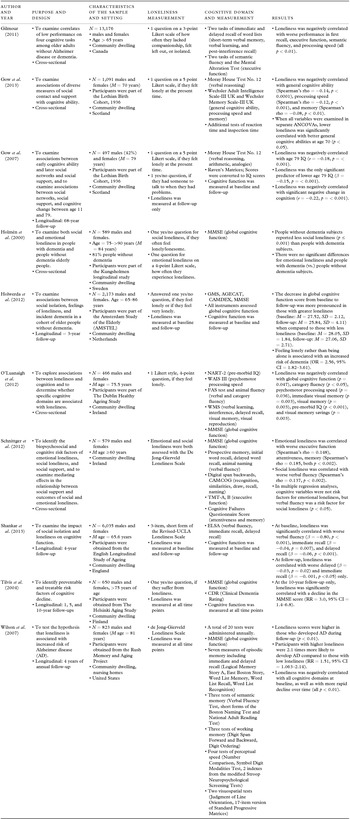
Initially, 832 articles were identified in PubMed, 795 in Medline (Ovid), and 432 in Pscycinfo. After duplicates were removed and abstracts screened, the total number of studies was reduced to 15. The remaining 15 studies were retrieved for potential use and evaluated on information contained in the full-text version of the study. Upon review, studies not meeting inclusion criteria were eliminated, leaving eight studies. An additional manual search of references yielded another two studies. The total number of studies included in this systematic review was ten (see Table 1).
Association of loneliness and cognitive function in older adults.

Note: MMSE = Mini-Mental State Examination; GMS = Geriatric Mental State; AGECAT = Automated Geriatric Examination for Computer Assisted Taxonomy; CAMDEX = Cambridge Mental Disorders of the Elderly Examination; NART-2 = National Adult Reading Test; WAIS III = Wechsler Adult Intelligence Scale III; WMS = Wechsler Memory Scale; CAMCOG = Cambridge Cognitive Examination; TMT-A = Trail Making Test-A; TMT-B = Trail Making Test-B; ELSA = English Longitudinal Study of Ageing.
Results
Description of studies
Design
Out of the ten studies, five were cross-sectional (Holmén et al., Reference Holmén, Ericsson and Winblad2000; Gilmour, Reference Gilmour2011; O’Luanaigh et al., Reference O’Luanaigh2012; Schnittger et al., Reference Schnittger, Wherton, Prendergast and Lawlor2012; Gow et al., Reference Gow, Corley, Starr and Deary2013) and five were longitudinal (Tilvis et al., Reference Tilvis, Kähönen-Väre, Jolkkonen, Valvanne, Pitkala and Strandberg2004; Gow et al., Reference Gow, Pattie, Whiteman, Whalley and Deary2007; Wilson et al., Reference Wilson2007; Holwerda et al., Reference Holwerda2012; Shankar et al., Reference Shankar, Hamer, McMunn and Steptoe2013) with a follow-up period ranging from one year (Tilvis et al., Reference Tilvis, Kähönen-Väre, Jolkkonen, Valvanne, Pitkala and Strandberg2004) to 68 years (Gow et al., Reference Gow, Pattie, Whiteman, Whalley and Deary2007). Eight studies reported findings from participants enrolled in large, population-based studies (Holmén et al., Reference Holmén, Ericsson and Winblad2000; Tilvis et al., Reference Tilvis, Kähönen-Väre, Jolkkonen, Valvanne, Pitkala and Strandberg2004; Gow et al., Reference Gow, Pattie, Whiteman, Whalley and Deary2007; Wilson et al., Reference Wilson2007; Holwerda et al., Reference Holwerda2012; O’Luanaigh et al., Reference O’Luanaigh2012; Gow et al., Reference Gow, Corley, Starr and Deary2013; Shankar et al., Reference Shankar, Hamer, McMunn and Steptoe2013), such as the Amsterdam Study of the Elderly (Holwerda et al., Reference Holwerda2012) and The Helsinki Aging Study (Tilvis et al., Reference Tilvis, Kähönen-Väre, Jolkkonen, Valvanne, Pitkala and Strandberg2004). Two studies by Gow and colleagues (Gow et al., Reference Gow, Pattie, Whiteman, Whalley and Deary2007; Reference Gow, Corley, Starr and Deary2013) were from the same cohort of participants, The Lothian Birth Cohort, 1921, although approaches and analysis of the data differed with different research questions. There were no qualitative studies that met criteria for inclusion in this review.
Sample
Eight out of ten studies were conducted in Europe, including Ireland (O’Luanaigh et al., Reference O’Luanaigh2012; Schnittger et al., Reference Schnittger, Wherton, Prendergast and Lawlor2012), Scotland (Gow et al., Reference Gow, Pattie, Whiteman, Whalley and Deary2007; Reference Gow, Corley, Starr and Deary2013), England (Shankar et al., Reference Shankar, Hamer, McMunn and Steptoe2013), Finland (Tilvis et al., Reference Tilvis, Kähönen-Väre, Jolkkonen, Valvanne, Pitkala and Strandberg2004), Sweden (Holmén, et al., Reference Holmén, Ericsson and Winblad2000), and the Netherlands (Holwerda et al., Reference Holwerda2012). The remaining two studies were conducted in Canada (Gilmour, Reference Gilmour2011) and the United States (Wilson et al., Reference Wilson2007). The number of participants per study ranged from 466 (O’Luanaigh et al., Reference O’Luanaigh2012) to 13,176 (Gilmour, Reference Gilmour2011) for a total of 26,079 participants across all studies. All authors provided a description of sampling methods and sample size, although specific details varied among studies. Samples included both genders in all studies, and most participants were community dwelling and independently living older adults. One study included participants in nursing homes, but this accounted for only 4% of their sample (Wilson et al., Reference Wilson2007), and 19% of participants in another study were people with dementia (Holmén et al., Reference Holmén, Ericsson and Winblad2000). The overall health status varied among participants, but most were described as generally healthy with few chronic diseases, such as osteoarthritis, hypertension, coronary artery disease, and hypothyroidism.
Theoretical basis
None of the studies addressed specific theoretical basis for research. However, all authors proposed that certain psychosocial factors, including loneliness, were thought to influence cognitive function in the older adult and this was the implied theoretical basis for research. In addition to loneliness influencing cognitive function, authors of two studies (Tilvis et al., Reference Tilvis, Kähönen-Väre, Jolkkonen, Valvanne, Pitkala and Strandberg2004; Holwerda et al., Reference Holwerda2012) proposed that psychosocial and biological factors, such as prolonged activation of the HPA axis or inflammation, might interact to detrimentally influence cognitive function. Despite slight variations in theoretical basis, specific aims and hypotheses were consistent to examine the association between loneliness and cognitive function.
Covariates
The most common covariates were factors related to age, gender, educational status, depressive symptoms/depression, and social network factors, such as marital or cohabitation status, significant others, household composition, and social isolation.
Measurement of loneliness
Measurement of loneliness varied among studies, but most researchers utilized one or two Likert-style or yes/no format question(s) to measure loneliness (Holmén et al., Reference Holmén, Ericsson and Winblad2000; Tilvis et al., Reference Tilvis, Kähönen-Väre, Jolkkonen, Valvanne, Pitkala and Strandberg2004; Gow et al., Reference Gow, Pattie, Whiteman, Whalley and Deary2007; Gilmour, Reference Gilmour2011; Holwerda et al., Reference Holwerda2012; O’Luanaigh et al., Reference O’Luanaigh2012; Gow et al., Reference Gow, Corley, Starr and Deary2013). Most common questions were, “Do you feel lonely at the present time?” and “How often do you experience loneliness?”
In one study, loneliness was measured with the three-item short version of the Revised-University of California at Los Angeles Loneliness scale (R-UCLA Loneliness scale) (Shankar et al., Reference Shankar, Hamer, McMunn and Steptoe2013). The R-UCLA Loneliness scale was designed to measure general feelings of social isolation and dissatisfaction with one's social interactions (Russell et al., Reference Russell, Peplau and Cutrona1980). The three-item, Likert style questionnaire contains three positively worded items and higher total scores indicate greater levels of loneliness. The instrument is considered reliable across various populations with Cronbach's α ranging from 0.89–0.94 (Russell et al., Reference Russell, Peplau and Cutrona1980) and 0.78 (Shankar et al., Reference Shankar, Hamer, McMunn and Steptoe2013).
In the remaining two studies, authors measured loneliness with the De Jong Gierveld Scale for Loneliness (Wilson et al., Reference Wilson2007; Schnittger et al., Reference Schnittger, Wherton, Prendergast and Lawlor2012), which was designed to measure overall, emotional, and social loneliness (De Jong Gierveld and van Tilburg, Reference De Jong Gierveld and van Tilburg2006). The six-item, Likert style questionnaire includes three negatively worded items and three positively worded items. Negatively worded items are reverse scored and sum of the scores ranges from 0–24. Higher scores indicate greater levels of loneliness. The instrument is considered reliable in the adult population, with Cronbach's α ranging from 0.70–0.76 (De Jong Gierveld and van Tilburg, Reference De Jong Gierveld and van Tilburg2006) and 0.78 (Wilson et al., Reference Wilson2007), but it was not reported by Schnittger et al. (Reference Schnittger, Wherton, Prendergast and Lawlor2012).
Measurements of cognitive function
Various domains of cognitive function were measured including global cognitive function, executive function, verbal reasoning, processing speed, immediate and delayed recall, episodic memory, semantic memory, and working memory. The most common instruments used were the Mini-Mental State Examination (MMSE) and Wechsler Adult Intelligence scale-III (WAIS-III). The Moray House Test Number 12 (MHT No. 12) was utilized in two studies.
The MMSE was used to measure global cognitive function in six studies (Holmén et al., Reference Holmén, Ericsson and Winblad2000; Tilvis et al., Reference Tilvis, Kähönen-Väre, Jolkkonen, Valvanne, Pitkala and Strandberg2004; Wilson et al., Reference Wilson2007; Holwerda et al., Reference Holwerda2012; O’Luanaigh et al., Reference O’Luanaigh2012; Schnittger et al., Reference Schnittger, Wherton, Prendergast and Lawlor2012). The MMSE includes simple tests and problems in the domains of orientation, registration, attention and calculation, recall, and language (Folstein et al., Reference Folstein, Folstein and McHugh1975). Scores ≥24 are considered normal cognition, and those ≤23 correlate closely with dementia. The MMSE is a reliable instrument for the aging population with test–retest reliability of 0.82–0.98 (Folstein et al., Reference Folstein, Folstein and McHugh1975). Measures of reliability were not reported for studies included in this review.
The WAIS-III was used in two studies to measure general cognitive ability (O’Luanaigh et al., Reference O’Luanaigh2012; Gow et al., Reference Gow, Corley, Starr and Deary2013). The WAIS-III was designed to measure intelligence in adults and older adolescents (Wechsler, Reference Wechsler1997). It provides scores for verbal IQ, performance IQ, and full scale IQ, as well as four secondary indices (verbal comprehension, working memory, perceptual organization, and processing speed). The test is composed of 14 subtests that begin with easy questions and become progressively harder based on the person's performance. All items are summed and transformed into standard scores that represent aggregate abilities (Wechsler, Reference Wechsler1997). Administration time for the full test takes approximately 75–110 min. Cronbach's α for individual subtests across all age groups ranges from 0.70–0.93 (Silva, Reference Silva2008). Cronbach's α for studies included in this review were not reported.
The Moray House Test No. 12 was used in two studies with participants of the same birth cohort to measure intelligence (Gow et al., Reference Gow, Pattie, Whiteman, Whalley and Deary2007; Reference Gow, Corley, Starr and Deary2013). The MHT No. 12 assesses reasoning, arithmetic, following directions, and analogies. In both studies, the test was provided to participants at the age between 11 and 79 years and raw scores were converted into IQ scores, corrected for age. The MHT No. 12 has demonstrated validity with correlations of 0.81 in boys and 0.79 in girls from the Stanford Revision of the Binet scale in 1,000 children of age 11 years (Scottish Council for Research in Education, 1949) and 0.71 with Raven's Matrices among 541 older adults with mean age 79 years (Deary et al., Reference Deary, Whiteman, Starr, Whalley and Fox2004). Measures of reliability were not reported in these studies.
Loneliness and global cognitive function/general cognitive ability
Authors of five studies reported both significant and non-significant associations between loneliness and global cognitive function or general cognitive ability. Mostly, the findings indicated a significant and negative association between the two variables (Holmén, et al., Reference Holmén, Ericsson and Winblad2000; Tilvis et al., Reference Tilvis, Kähönen-Väre, Jolkkonen, Valvanne, Pitkala and Strandberg2004; O’Luanaigh et al., Reference O’Luanaigh2012; Gow et al., Reference Gow, Corley, Starr and Deary2013), but authors of one study reported a non-significant association (Schnittger et al., Reference Schnittger, Wherton, Prendergast and Lawlor2012).
In two cross-sectional studies, O’Luanaigh et al. (Reference O’Luanaigh2012) and Gow et al. (Reference Gow, Corley, Starr and Deary2013) analyzed data from large, population-based studies and reported similar findings. Loneliness was significantly and negatively associated with global cognitive function after controlling for depression and social network status (O’Luanaigh et al., Reference O’Luanaigh2012). In addition, loneliness was significantly and negatively associated with general cognitive ability, however, when depression symptoms were controlled for the association, it was no longer significant (Gow et al., Reference Gow, Corley, Starr and Deary2013). In two other cross-sectional studies, authors measured global cognitive function in relation to two specific domains of loneliness, emotional and social loneliness (Holmén, et al., Reference Holmén, Ericsson and Winblad2000; Schnittger et al., Reference Schnittger, Wherton, Prendergast and Lawlor2012). Holmén et al. (Reference Holmén, Ericsson and Winblad2000) compared the association of loneliness with global cognitive function between people without dementia (81% of sample) and people with dementia participants and found that social loneliness was significantly more common in people with dementia participants (p ≤ 0.001), but non-significant findings were reported for emotional loneliness in both people with dementia and people without dementia participants. Schnittger et al. (Reference Schnittger, Wherton, Prendergast and Lawlor2012), on the other hand, included people without dementia participants only and did not find a significant association between social or emotional loneliness and global cognitive function. In one longitudinal study, Tilvis et al. (Reference Tilvis, Kähönen-Väre, Jolkkonen, Valvanne, Pitkala and Strandberg2004) assessed loneliness and global cognitive function at baseline, 1, 5, and 10 years. At the ten-year time point only, after controlling for age, greater baseline loneliness was a significant predictor of cognitive decline in regression analysis (RR = 3.0, 95% CI = 1.4–6.8).
Loneliness and dementia/Alzheimer's disease
In two longitudinal studies over with 3–4 year follow-up times (Wilson et al., Reference Wilson2007; Holwerda et al., Reference Holwerda2012), authors found similar significant associations between loneliness and dementia (Holwerda et al., Reference Holwerda2012), and between loneliness and Alzheimer's disease (Wilson et al., Reference Wilson2007). Authors of both studies examined if the baseline association of loneliness predicted dementia or Alzheimer's disease at 3 and 4-year follow-up time points (Wilson et al., Reference Wilson2007; Holwerda et al., Reference Holwerda2012). In both studies, authors found greater loneliness significantly predicted the increased risk for dementia and Alzheimer's disease at follow-up (OR = 2.56, 95% CI = 1.82–3.61 (Holwerda et al., Reference Holwerda2012); RR = 1.51, 95% CI = 1.063– 2.14 (Wilson et al., Reference Wilson2007)). The association between loneliness and dementia persisted even after controlling for demographic, somatic, and psychiatric risk factors (Holwerda et al., Reference Holwerda2012). Additionally, the association between loneliness and Alzheimer's disease also persisted after controlling for objective measures of social isolation, such as social support and solitary living (Wilson et al., Reference Wilson2007).
Loneliness and memory
Authors of six studies reported both significant and non-significant associations between loneliness and various domains of memory that included immediate and delayed recall, visual and general memory, and episodic, semantic and working memory (Wilson et al., Reference Wilson2007; Gilmour, Reference Gilmour2011; O’Luanaigh et al., Reference O’Luanaigh2012; Schnittger et al., Reference Schnittger, Wherton, Prendergast and Lawlor2012; Gow et al., Reference Gow, Corley, Starr and Deary2013; Shankar et al., Reference Shankar, Hamer, McMunn and Steptoe2013).
In three cross-sectional population-based studies, immediate recall and delayed recall were examined (Gilmour, Reference Gilmour2011; O’Luanaigh et al., Reference O’Luanaigh2012; Schnittger et al., Reference Schnittger, Wherton, Prendergast and Lawlor2012). Gilmour (Reference Gilmour2011) and Schnittger et al. (Reference Schnittger, Wherton, Prendergast and Lawlor2012) measured immediate recall and delayed recall, while O’Luanaigh et al. (Reference O’Luanaigh2012) measured delayed recall only. Gilmour (Reference Gilmour2011) found significant and negative correlations of loneliness with immediate recall only (p < 0.01), whereas O’Luanaigh et al. (Reference O’Luanaigh2012) reported greater loneliness was associated with worse performance on delayed recall (p < 0.05). In contrast, Schnittger et al. (Reference Schnittger, Wherton, Prendergast and Lawlor2012) found non-significant associations of loneliness with immediate recall and delayed recall.
Similar findings were reported in two longitudinal studies over a four-year follow-up period (Wilson et al., Reference Wilson2007; Shankar et al., Reference Shankar, Hamer, McMunn and Steptoe2013). Shankar et al. (Reference Shankar, Hamer, McMunn and Steptoe2013) measured immediate and delayed recall and reported significant and negative associations with loneliness at both baseline and 4-year follow-up (all p < 0.05). For delayed recall, higher levels of isolation and loneliness were associated with poorer recall in individuals with lower levels of education only. Wilson et al. (Reference Wilson2007) measured episodic, semantic, and working memory, and reported significant and negative associations with loneliness at baseline, but only semantic memory remained significant at the fourth year follow-up (p = 0.01) when controlling for age, gender, and level of education.
When other domains of memory, such as visual memory and general memory were measured, O’Luanaigh et al. (Reference O’Luanaigh2012), Schnittger et al. (Reference Schnittger, Wherton, Prendergast and Lawlor2012), and Gow et al. (Reference Gow, Corley, Starr and Deary2013) found that loneliness was associated with memory in initial bivariate models. However, only O’Luanaigh et al. (Reference O’Luanaigh2012) found that increased loneliness was significantly associated with reduced visual memory (p < 0.05) in both bivariate and multivariate models when controlling for depression and a wide range of demographic, social network factors. Similarly, in initial bivariate correlations, Schnittger et al. (Reference Schnittger, Wherton, Prendergast and Lawlor2012) found that emotional loneliness was significantly and negatively associated with memory (p < 0.01), however, memory was not a significant risk factor for emotional loneliness in final multiple linear regression models. Additionally, Gow et al. (Reference Gow, Corley, Starr and Deary2013) found that loneliness was significantly and negatively associated with memory in bivariate correlations (p < 0.01), but loneliness was not significantly associated with memory, independent of age, gender, childhood IQ, and social class in final ANCOVA models.
Loneliness and executive function
For executive function, authors of two population-based cross-sectional studies reported similar significant associations between loneliness and executive function (Gilmour, Reference Gilmour2011; Schnittger et al., Reference Schnittger, Wherton, Prendergast and Lawlor2012). In the study with the largest sample size (N = 13, 176), Gilmour (Reference Gilmour2011) reported a significant and negative association between loneliness and executive function (p < 0.01); however, when social interaction was included in multivariate models, the negative association between loneliness and executive function no longer persisted (Gilmour, Reference Gilmour2011). Similarly, Schnittger et al. (Reference Schnittger, Wherton, Prendergast and Lawlor2012) found a significant negative correlation between emotional loneliness and executive function (p < 0.05), but executive function was not a significant risk factor for emotional loneliness independent of psychosocial (depression, neuroticism, and perceived stress) and social network factors (solitary living, accommodation status) in final multiple linear regression models.
Loneliness and intellect
Authors of two population-based studies measured cognitive domains related to intellect and reported similar findings (Gow et al., Reference Gow, Pattie, Whiteman, Whalley and Deary2007; O’Luanaigh et al., Reference O’Luanaigh2012). Gow et al. (Reference Gow, Pattie, Whiteman, Whalley and Deary2007) used an exceptionally long follow-up of 68 years in the Lothian Birth Cohort, 1921 to determine the association between early cognitive ability and loneliness in late life. Cognitive function was assessed at the age between 11 and 79 years, and loneliness was assessed at the age of 79 years only. Findings indicated that greater loneliness at the age of 79 years was significantly and negatively correlated with IQ at this age (p < 0.001). Additionally, loneliness at the age of 79 years was the only significant predictor (p < 0.001) of cognitive ability in old age, and demographic and social network factors did not significantly add to this prediction. These findings may indicate that participants who showed more cognitive change over their lifespan were lonelier in late life (Gow et al., Reference Gow, Pattie, Whiteman, Whalley and Deary2007). O’Luanaigh et al. (Reference O’Luanaigh2012) used a cross-sectional approach with participants in The Dublin Healthy Ageing Study and measured loneliness with IQ at one time point. Findings revealed that greater loneliness was significantly correlated with worse pre-morbid IQ (p < 0.05).
Loneliness and verbal fluency
Authors of three studies analyzed loneliness and verbal fluency and reported mixed findings (O’Luanaigh et al., Reference O’Luanaigh2012; Schnittger et al., Reference Schnittger, Wherton, Prendergast and Lawlor2012; Shankar et al., Reference Shankar, Hamer, McMunn and Steptoe2013). Schnittger et al. (Reference Schnittger, Wherton, Prendergast and Lawlor2012) reported that verbal fluency was a significant risk factor of social loneliness (p < 0.05). However, O’Luanaigh et al. (Reference O’Luanaigh2012) reported no significant associations between verbal fluency and loneliness when controlling for depression, social networks, and a range of demographic factors. In a longitudinal study with a four-year follow-up, greater loneliness was significantly associated with low levels of verbal fluency at baseline (p < 0.001), but not at follow-up (Shankar et al., Reference Shankar, Hamer, McMunn and Steptoe2013).
Loneliness and processing speed
In three cross-sectional studies, similar significant correlations were reported between loneliness and processing speed (Gilmour, Reference Gilmour2011; O’Luanaigh et al., Reference O’Luanaigh2012; Gow et al. Reference Gow, Corley, Starr and Deary2013). Although authors used similar research designs, the sample size varied widely from N = 466 (O’Luanaigh et al., Reference O’Luanaigh2012) to N = 13,176 (Gilmour, Reference Gilmour2011). Despite a large difference in sample size, all three groups of authors found significant and negative associations of loneliness and processing speed (all p < 0.05). These significant and negative associations persisted after controlling for or including factors such as depression, social network, and a wide range of cognitive and demographic factors.
Discussion
The purpose of this systematic review was to examine associations of loneliness and cognitive function in the aging population. Overall findings from the ten studies largely indicate that loneliness is negatively associated with cognitive function. Main findings were significant and negative correlations of loneliness with global cognitive function or general cognitive ability (Holmén et al., Reference Holmén, Ericsson and Winblad2000; Tilvis et al., Reference Tilvis, Kähönen-Väre, Jolkkonen, Valvanne, Pitkala and Strandberg2004; Wilson et al., Reference Wilson2007; Holwerda et al., Reference Holwerda2012; O’Luanaigh et al., Reference O’Luanaigh2012; Gow et al., Reference Gow, Corley, Starr and Deary2013), IQ (Gow et al., Reference Gow, Pattie, Whiteman, Whalley and Deary2007; O’Luanaigh et al., Reference O’Luanaigh2012), processing speed (Gilmour, Reference Gilmour2011; O’Luanaigh et al., Reference O’Luanaigh2012; Gow et al., Reference Gow, Corley, Starr and Deary2013), immediate recall (Gilmour, Reference Gilmour2011; Shankar et al., Reference Shankar, Hamer, McMunn and Steptoe2013), and delayed recall (O’Luanaigh et al., Reference O’Luanaigh2012; Shankar et al., Reference Shankar, Hamer, McMunn and Steptoe2013). When loneliness was examined as two different dimensions, social and emotional loneliness, similar significant negative correlations persisted between loneliness and various cognitive domains including verbal fluency (Schnittger et al., Reference Schnittger, Wherton, Prendergast and Lawlor2012) but social loneliness seemed to have a stronger correlation with global cognitive function than did emotional loneliness (Holmén et al., Reference Holmén, Ericsson and Winblad2000). On the contrary, some initial correlations of loneliness and cognitive function were not significant after controlling for a wide range of demographic and psychosocial risk factors thought to influence loneliness (Wilson et al., Reference Wilson2007; Gilmour, Reference Gilmour2011; O’Luanaigh et al., Reference O’Luanaigh2012; Schnittger et al., Reference Schnittger, Wherton, Prendergast and Lawlor2012; Gow et al., Reference Gow, Corley, Starr and Deary2013; Shankar et al., Reference Shankar, Hamer, McMunn and Steptoe2013).
The findings of the ten studies were surprisingly consistent, despite the use of different methodologies to assess loneliness. A majority of the authors used only one or two direct questions in the form of yes/no or Likert style, while three authors used a psychometric instrument with more items. Although the measure with one or two direct questions is minimally burdensome and practical in large cohort studies, this approach implies that loneliness is a one-dimensional concept differing only in the intensity of the experience (Fees et al., Reference Fees, Martin and Poon1999). This simplistic approach may not allow for cultural differences or interpretations (Fees et al., Reference Fees, Martin and Poon1999). In addition, loneliness might have been thought to be stigmatizing to older people and study participants might have down-scored their loneliness levels when direct questions were used (Victor et al., Reference Victor, Grenade and Boldy2005).
Another common method of measuring loneliness was using a psychometric instrument comprised of a series of Likert-style items exploring personal perception of loneliness. The two loneliness instruments used in the studies, the De Jong Gierveld Scale for Loneliness and the R-UCLA Loneliness scale, treat loneliness as a multidimensional concept and include both positive and negative dimensions of loneliness (Victor et al., Reference Victor, Grenade and Boldy2005). The De Jong Gierveld Scale for Loneliness, for example, includes questions relating to three distinct dimensions of loneliness: deprivation relating to loss of intimate attachment, temporal perspective examining the extent of change in loneliness over time, and range of emotional components of loneliness such as sadness, guilt, frustration, and desperation (Victor et al., Reference Victor, Grenade and Boldy2005). This multi-dimensional approach may represent a true response more comprehensively. A disadvantage is that the multi-item tool may increase the burden on aging participants who may already have health issues.
Confounding variables such as demographic, depressive symptoms/depression, and social network did not influence the relationship between loneliness and cognitive function. For example, despite controlling for demographic risk factors, the association between greater loneliness and worse cognitive function persisted in domains of global cognitive function, dementia, Alzheimer's disease, semantic memory, and visual memory (Tilvis et al., Reference Tilvis, Kähönen-Väre, Jolkkonen, Valvanne, Pitkala and Strandberg2004; Wilson et al., Reference Wilson2007; Gilmour, Reference Gilmour2011; Holwerda et al., Reference Holwerda2012; O’Luanaigh et al., Reference O’Luanaigh2012). In addition, despite controlling for depression/depressive symptoms, the association between greater loneliness and worse visual memory and global cognitive function persisted (O’Luanaigh et al., Reference O’Luanaigh2012; Schnittger et al., Reference Schnittger, Wherton, Prendergast and Lawlor2012). Lastly, when controlling for social network, the association between greater loneliness and worse global cognitive function and Alzheimer's disease (Wilson et al., Reference Wilson2007; O’Luanaigh et al., Reference O’Luanaigh2012) did not significantly add to loneliness predicting cognitive function (Gow et al., Reference Gow, Pattie, Whiteman, Whalley and Deary2007).
The current literature does not clarify the cause-and-effect relationship between loneliness and cognitive function. Loneliness may lead to cognitive decline, perhaps from limited social interactions and intellectual stimuli, but it is also possible that cognitive deficits may lead to decreased social interactions and greater loneliness subsequently. Schnittger et al. (Reference Schnittger, Wherton, Prendergast and Lawlor2012) found that decreased verbal fluency was a significant predictor of social loneliness supporting the latter case. Poor communication skills associated with worse verbal fluency may discourage conversation, hinder the development and maintenance of meaningful relationships, and thus increase loneliness. On the other hand, Shankar et al. (Reference Shankar, Hamer, McMunn and Steptoe2013) found that greater loneliness predicted worse cognitive function, and this finding was more pronounced in participants who had lower educational levels. Lack of resources may increase vulnerability for negative consequences of loneliness on cognitive function and more readily activate biological responses. Loneliness may trigger prolonged activation of the HPA axis to decrease neural reserve through decreased dendritic arborization in the hippocampus and prefrontal cortex, leading to decreased memory and learning (Holwerda et al., Reference Holwerda2012). The causal relationship between loneliness and cognitive function should be further investigated using rigorous designs with longitudinal data collection. Equally critical would be better determination for biological mechanisms underlying the causality of loneliness on cognitive function. In that line, persistent hypercortisolism and inflammation are two likely pathways along with discovery of new biomarkers.
Future directions
Most studies have been conducted in Western European countries. Because of different cultural and social environment, findings from one region may not be applicable to populations in other regions. More studies should be done in diverse settings with multiple populations across diverse cultures and locations, including the United States (Theeke, Reference Theeke2009; De Jong Gierveld and Tesch-Römer, Reference De Jong Gierveld and Tesch-Römer2012). Future studies should be conducted to elucidate the causality of loneliness on cognitive function using a controlled rigorous prospective design. Biomarkers of hypercortisolism and inflammation along with new biomarkers need to be incorporated in the design. Findings of these studies should serve as a foundation for developing culturally appropriate interventions to decrease loneliness and improve cognitive function in the elderly.
Conclusion
Overall, greater loneliness is associated with lower cognitive function, in which increased cortisol and inflammation may play an important role. Although the preliminary evidence is promising, additional studies are necessary to determine the causality and biological mechanisms underlying the relationship between loneliness and cognitive function. Findings should be verified in culturally diverse populations in different ages and settings.
Conflict of interest
None.
Description of authors’ contributions
L. Boss designed the systematic review, performed the literature search, and wrote most of the manuscript. D.H. Kang guided the conception for the review and the process of performing the literature search, assisted with writing the manuscript, and edited the manuscript. S. Branson assisted with writing the manuscript.