INTRODUCTION
Modern China is undergoing a profound transition in administrative institutions, and changes have been underway for the past 20 years to improve the government’s human resource systems (Lu & Guy, Reference Lu and Guy2014). However, in recent years, a number of government employees have chosen to leave the profession. In a study on 414 government employees in Guangxi, China, 17% of participants had high turnover intention (Wan, Feng, Xu, Huang, Xu, & Yang, Reference Wan, Feng, Xu, Huang, Xu and Yang2016), and a study on 1,265 government employees in Taiwan found that 42% of participants had turnover intention (Chen, Reference Chen2012). Although turnover is normal and even considered important for the viability of an organization in the long run (Dalton & Todor, Reference Dalton and Todor1979), in recent years, researchers have found that turnover lead to costs related to the loss of employees’ performance and expertise (Moynihan, Reference Moynihan2008; Eric, Nancy, Shannon, & Oko, Reference Eric, Nancy, Shannon and Oko2009; Grissom, Nicholsoncrotty, & Keiser, Reference Grissom, Nicholsoncrotty and Keiser2012). Thus, addressing government employees’ turnover intention has become an important topic in human resource management.
In recent literature (Pitts, Marvel, & Fernandez, Reference Pitts, Marvel and Fernandez2011), turnover intention has been conceptualized as the result of organizational factors and individual factors, such as good social relationships with coworkers and supervisors, promotion opportunities, professional development opportunities, participatory management strategies, and human resource management practices (Ellickson & Logsdon, Reference Ellickson and Logsdon2002; Kim & Moen, Reference Kim and Moen2002; Wright & Davis, Reference Wright and Cropanzano2003; Kim & Hatfield, Reference Kim and Hatfield2004; Borzaga & Tortia, Reference Borzaga and Tortia2006; Watty-Benjamin & Udechukwu, Reference Wayne, Shore and Liden2014). However, the research does not explain why, in the same environment, one individual thrives and another has turnover intention. Although some research looks at how the propensity to quit is explained by individual differences, such as race and gender, which are frequently used as demographic variables (Lazear, Reference Lazear1999; Barak, Nissly, & Levin, Reference Barak, Nissly and Levin2001; Iverson & Douglas, Reference Iverson and Douglas2003), it cannot explain changes in turnover intention. In line with researchers in the field of turnover intention, we believe that we must look at individual work-related attitudes in order to answer this question.
At the end of the 20th century, psychology research was led by ‘positive’ thinking, which focused on how to make human life more meaningful (Nakamura & Csikszentmihalyi, Reference Nakamura and Csikszentmihalyi2014). Positive organizational behavior thus emerged. The focuses of research on the positive organizational behavior perspective are human resource advantages and psychology abilities that are positively oriented, can be measured, developed, and effectively managed, and can improve well-being and performance (Luthans, Reference Luthans2002). High reward is not equal to high subjective well-being (Hulbert, Reference Hulbert2004), but passion in work is crucial for increasing the level of well-being (Lara, Reference Lara2012). Passion is a strong inclination or desire toward an activity (e.g., one’s job) that one likes (or even loves) and finds important and in which one invests time and energy (Vallerand et al., Reference Vallerand, Paquet, Philippe and Charest2003). Goleman, Boyatzis, and McKee (Reference Goleman, Boyatzis and Mckee2002) state that it is time for people to reawaken their work passion when they feel trapped or bored or feel that they are not who they want to be.
In reviewing the literature on the impact of passion on turnover intention, three theoretical gaps are identified that need to be filled. First, there is a paucity of work on how different types of passion can promote or reduce turnover intention. Organizational researchers have focused on concepts that appear to be related to passion, such as work engagement (Schaufeli & Bakker, Reference Schaufeli and Bakker2004) and vigor (Shirom, Reference Shi2003). Work engagement and vigor are considered the opposite of turnover intention (Shirom, Reference Shi2003; Schaufeli & Bakker, Reference Schaufeli and Bakker2004). Based on the Conceptual Model of Employee Work Passion (Zigarmi, Nimon, Houson, Witt, & Diehl, Reference Zikic and Klehe2009), passion is a type of work engagement and involvement that should trigger psychological processes that lead to turnover intention (or not). Furthermore, both types of engagement (and vigor) do not distinguish between two types of engagement, as is proposed by the Dualistic Model of Passion (DMP, i.e., harmonious and obsessive passion) (Vallerand et al., Reference Vallerand, Paquet, Philippe and Charest2003). Vallerand et al. (Reference Vallerand, Paquet, Philippe and Charest2003) draw on the idea of internalization of external motivation in self-determination theory (SDT) and put forward the DMP. People want to satisfy their basic psychological needs and develop a sense of self and identity. People will develop a passion for enjoyable activities that are internalized in their identity. Harmonious passion results from an autonomous internalization, which can be defined as a motivational force that leads an individual to choose to engage in an activity. In contrast, obsessive passion results from a controlled internalization and is characterized by an internal pressure to practice an activity (Vallerand et al., Reference Vallerand, Paquet, Philippe and Charest2003). Although researchers have alluded to the different roles passion can play in affecting turnover (Vallerand et al., Reference Vallerand, Paquet, Philippe and Charest2003), tests of this role are rare.
Second, little research has acknowledged how different types of passion reduce or promote turnover intention. Harmonious passion leads individuals to view their job as important and meaningful (Vallerand et al., Reference Vallerand, Paquet, Philippe and Charest2003) and reduces turnover intention (Vallerand, Paquet, Philippe, & Charest, Reference Vallerand and Ratelle2010). Obsessive passion makes individuals fulfill the tasks of their job because doing so can fulfill external needs (Vallerand, Rousseau, Grouzet, Dumais, Grenier, & Blanchard, Reference Vancouver, Tamanini and Yoder2006; Mageau & Vallerand, Reference Mageau and Vallerand2007; Rousseau & Vallerand, Reference Rousseau and Vallerand2008). If the job cannot fulfill extrinsic needs, turnover intention will arise (Ryan & Deci, Reference Ryan and Deci2000). The term ‘need’ refers to what is essential or necessary for well-being. Research has shown that harmonious passion is associated with general positive affect and subjective well-being, whereas obsessive passion is associated with general negative affect and is either unrelated or negatively related to subjective well-being (Rousseau, Vallerand, Ratelle, Mageau, & Provencher, Reference Rousseau, Vallerand, Ratelle, Mageau and Provencher2002; Vallerand et al., Reference Vallerand, Paquet, Philippe and Charest2003; Miquelon & Vallerand, Reference Miquelon and Vallerand2006; Mageau & Vallerand, Reference Mageau and Vallerand2007; Rousseau & Vallerand, Reference Rousseau and Vallerand2008). Because subjective well-being plays a vital role in influencing turnover intention (Jung et al., Reference Jung, Kim, Kim, Cho, Yoon, Mun and Choi2014), it is an important mediator in the relationship between passion and turnover intention.
Finally, an inherent assumption in the passion literature is that harmonious passion promotes performance and well-being, but obsessive passion does not. That is, little research to date has considered boundary conditions, such as career adaptability, that could change the relationship between passion and outcomes. This research was grounded in Basic Psychological Needs Theory (BPNT), one of the six mini-theories of SDT. BPNT posits the existence of three basic psychological needs: autonomy, relatedness, and competence. The satisfaction of these psychological needs is important for human thriving. When these needs are not met, maladjustment and even psychopathology are said to result. Among people whose passion cannot satisfy their basic needs and for whom well-being is low, career adaptability is more critical for need satisfaction (Savickas, Reference Savickas1997; Zikic & Klehe, Reference Taber and Timpone2006) and loyalty (Sverke & Hellgren, Reference Sverke and Goslinga2002; Sverke & Goslinga, Reference Soresi, Nota and Ferrari2003). Passion enables people to show their career adaptability, while career adaptability enables people to show their passion. Therefore, reawaking passion requires enough career adaptability to show the effect of internalization of an activity on one’s identity (Vallerand & Ratelle, Reference Vallerand, Rousseau, Grouzet, Dumais, Grenier and Blanchard2002), given that the effects of passion may not affect the subjective well-being for all government employees. Staff career adaptability could reduce subjective well-being, which is likely to be induced by factors for turnover intention (Klehe, Zikic, Vianen, & Pater, Reference Klehe, Zikic, Vianen and Pater2011). Therefore, we test for the interaction effect of passion and career adaptability on subjective well-being.
By reporting the mediating role of subjective well-being and the moderating role of career adaptability in the relationship between harmonious/obsessive passion and turnover intention, the purpose of the present paper is to propose a resolution to reduce turnover intention using the DMP.
THEORY AND HYPOTHESES
Passion and turnover intention
Passion for one’s work is found to be related to positive outcomes (Goleman, Boyatzis, & Mckee, Reference Goleman, Boyatzis and Mckee2002; Gubman, Reference Gubman2004), such as well-being (Burke & Fiksenbaum, Reference Burke and Fiksenbaum2009) and entrepreneurial success (Cardon, Reference Cardon2008; Cardon, Wincent, Singh, & Drnovsek, Reference Cardon, Wincent, Singh and Drnovsek2009). However, it is also found to be negatively related to innovative behavior (Shi, Reference Shepherd and Cardon2012) and burnout (Carbonneau, Vallerand, Fernet, & Guay, Reference Carbonneau, Vallerand, Fernet and Guay2008). Researchers must focus not only on whether individuals have passion but also what types of passion individuals have. Vallerand et al. (Reference Vallerand, Paquet, Philippe and Charest2003) proposed the DMP, where passion is classified into two different types: harmonious passion and obsessive passion. Harmonious passion can be defined as a motivational force leading an individual to choose to engage an activity. In contrast, obsessive passion is characterized by an internal pressure to practice an activity. Studies have demonstrated that the DMP has applicability in the Chinese context (Shi, Reference Shepherd and Cardon2012; Luo, Bai, Min, Tang, & Fang, Reference Luo, Bai, Min, Tang and Fang2014).
The two forms of passion result from the different bases of internalization (voluntary vs. pressured). Different bases of internalization allow for the possibility that one form of passion may lead to positive outcomes while another may not. In the work context, harmonious passion results from an autonomous or voluntary internalization (Ryan & Deci, Reference Ryan and Deci2000) of a job, meaning that individuals freely and voluntarily view their job as important because of characteristics of the job itself. Individuals who are harmoniously passionate about their job do it because they choose to, not because of any pressures or outcomes (e.g., feelings of social approval or recognition) deriving from the job. As such, harmonious passion leads individuals to view their job as important and significant (Vallerand et al., Reference Vallerand, Paquet, Philippe and Charest2003) and reduces turnover intention (Vallerand et al., Reference Vallerand and Ratelle2010).
In contrast, obsessive passion results from a pressured internalization of a job, meaning that individuals do their job due to certain pressures or outcomes attached to their job (Vallerand et al., Reference Vallerand, Paquet, Philippe and Charest2003; Shepherd & Cardon, Reference Shepherd and Cardon2009). For example, such pressures could come from feelings of superiority over others or social acceptance deriving from the job, which in turn compels the individual to do the job (Amiot, Terry, Jimmieson, & Callan, Reference Amiot, Terry, Jimmieson and Callan2006), but it is questionable that individuals who are obsessively passionate about their job do the job continuously. Obsessive passion makes individuals fulfill the tasks of their job because the tasks can fulfill external needs, such as money and social approval, but not because of the value and meaning of the job (Vallerand et al., Reference Vancouver, Tamanini and Yoder2006; Mageau & Vallerand, Reference Mageau and Vallerand2007; Rousseau & Vallerand, Reference Rousseau and Vallerand2008). If the job cannot fulfill extrinsic needs or another job can give them more money and/or high social approval, turnover intention will arise (Ryan & Deci, Reference Ryan and Deci2000). Considering the above arguments, we assume the following:
Hypothesis 1: Harmonious passion is negatively related to turnover intention.
Hypothesis 2: Obsessive passion is positively related to turnover intention.
Passion and subjective well-being
Subjective well-being refers to how people experience the quality of their life, and it is composed of life satisfaction and affect (comprising positive and negative affect) (Diener, Suh, Lucas, & Smith, Reference Diener, Suh, Lucas and Smith1999). Earlier research on the DMP (Vallerand et al., Reference Vallerand, Paquet, Philippe and Charest2003) supports the relationship between passion and subjective well-being. Harmonious passion is in balance with other areas of life. An individual freely devotes time and energy to an activity while remaining in control of his or her engagement. Harmonious passion creates a sense of volition and personal endorsement about pursuing an activity (Vallerand et al., Reference Vallerand, Paquet, Philippe and Charest2003). It is positively associated with psychological well-being, including positive affect, life satisfaction, meaning and vitality, and negatively related to anxiety and depression (Vallerand et al., Reference Vallerand, Paquet, Philippe and Charest2003; Mageau & Vallerand, Reference Mageau and Vallerand2007; Rousseau & Vallerand, Reference Rousseau and Vallerand2008; Philippe, Vallerand, Nathalie, Lavigne, & Donahue, Reference Philippe, Vallerand, Nathalie, Lavigne and Donahue2010).
In contrast, obsessive passion creates rigid persistence in an activity; although individuals may enjoy an activity, they feel compelled to engage in it because of these internal contingencies that control them. They cannot help but to engage in the passionate activity. Obsessive passion must run its course as it controls a person. Because activity engagement is out of the person’s control, it eventually takes disproportionate space in the person’s identity and causes conflict with other activities in the person’s life (Rip, Fortin, & Vallerand, Reference Rip, Fortin and Vallerand2006). Obsessive passion is negatively related to life satisfaction, self-realization (Mageau & Vallerand, Reference Mageau and Vallerand2007; Philippe et al., Reference Philippe, Vallerand, Nathalie, Lavigne and Donahue2010), and subjective well-being (Rousseau & Vallerand, Reference Rousseau and Vallerand2008). Obsessive passion has been shown to lead to less adaptive outcomes, such as well-being (Mageau & Vallerand, Reference Mageau and Vallerand2007). This is because obsessive passion cannot facilitate control of an activity, and it cannot contribute to the experience of positive affect and task satisfaction or minimize the experience of negative affect after task engagement. The more people experience obsessive passion, the more they experience a decrease in positive affect (Mageau & Vallerand, Reference Mageau and Vallerand2007). Considering the above arguments, we offer the following assumption:
Hypothesis 3: Harmonious passion is positively related to subjective well-being.
Hypothesis 4: Obsessive passion is negatively related to subjective well-being.
The mediating effect of subjective well-being
Subjective well-being is ‘a broad category of phenomena that includes people’s emotional responses, domain satisfactions, and global judgments of life satisfaction’ (Diener et al., Reference Diener, Suh, Lucas and Smith1999). Subjective well-being is related to the awareness of pleasure, satisfaction, and happiness (Burns & Machin, Reference Burns and Machin2009). Generally speaking, subjective well-being refers to individuals’ self-evaluations of their lives both as a whole and in specific domains, such as work (Salanova, Cifre, & Martin, Reference Salanova, Cifre and Martin2004). Some researchers have identified a link between well-being and job outcomes such as commitment (Wright & Cropanzano, Reference Zhang and Feng2000), whereas others have found that well-being predicted organizational commitment and turnover intentions for police officers (Brunetto, Teo, Shacklock, & Farr-Wharton, Reference Brunetto, Teo, Shacklock and Farr-Wharton2012). Because passion is related to subjective well-being and subjective well-being plays a vital role in influencing turnover intention (Jung et al., Reference Jung, Kim, Kim, Cho, Yoon, Mun and Choi2014), subjective well-being is an important mediator in the relation between passion and turnover intention. Based on these arguments, we suppose the following:
Hypothesis 5: Subjective well-being mediates the relationship between harmonious passion and turnover intention.
Hypothesis 6: Subjective well-being mediates the relationship between obsessive passion and turnover intention.
The moderating effect of career adaptability
Career adaptability is defined by Savickas as ‘the readiness to cope with the predictable tasks of preparing for and participating in the work role and with the unpredictable adjustments prompted by changes in work and working conditions’ (Reference Savickas1997: 254). Career adaptability consists of four factors: career concern, career control, career curiosity, and career confidence. A four-dimensional scale of career adaptability has been developed, and its structural validity has been supported by empirical studies conducted in 13 countries (Savickas & Porfeli, Reference Savickas and Porfeli2012).
Some studies have shown that career adaptability is related to subjective well-being. For example, career adaptability positively predicts employees’ breadth of interests, orientations to happiness, general and professional well-being, and quality of life, and it negatively predicts perceived career barriers and work stress (Soresi, Nota, & Ferrari, Reference Shirom2012; Johnston et al., Reference Johnston, Broonen, Stauffer, Hamtiaux, Pouyaud, Zecca, Houssemand and Rossier2013; Maggiori, Johnston, Krings, Massoudi, & Rossier, Reference Maggiori, Johnston, Krings, Massoudi and Rossier2013). Koen, Klehe, Vianen, Zikic, and Nauta (Reference Koen, Klehe, Vianen, Zikic and Nauta2010) found that career adaptability predicted the quality of re-employment, work satisfaction, and low turnover intentions.
Different levels of career adaptability may influence the mediating effect of subjective well-being in the relationship between passion and turnover intention. SDT reveals the effective path of how external interferences influence individual motivation, and it means that the goal proposed is matched to intrinsic interests and values (Ryan & Deci, Reference Ryan and Deci2000). According to SDT, behavior can be chosen freely because of internal or external controls. Thus, individuals’ reasons for acting range on a continuum from complete control to full integration and internalization. There are four types of reasons for engaging in achievement behaviors: ‘external’ (avoid punishment), ‘introjected’ (garner others’ approval), ‘identified’ (achieve a self-valued or personally important goal), and ‘intrinsic’ (experience fun or enjoyment). Satisfaction of basic psychological needs provides the nutriments for intrinsic motivation and internalization. Vallerand et al. (Reference Vallerand, Paquet, Philippe and Charest2003) proposed a conceptual model of passion toward activities. In line with SDT (Ryan & Deci, Reference Ryan and Deci2000), the passion model posits that people experience the need to grow psychologically and develop a sense of self and identity (Ryan & Deci, Reference Ryan and Deci2003). Harmonious passion can predict satisfaction of psychological needs, while obsessive passion cannot (Pitts, Marvel, & Fernandez, Reference Pitts, Marvel and Fernandez2011). Career adaptability also plays a vital role in the satisfaction of psychological needs (Johnston et al., Reference Johnston, Broonen, Stauffer, Hamtiaux, Pouyaud, Zecca, Houssemand and Rossier2013; Maggiori et al., Reference Maggiori, Johnston, Krings, Massoudi and Rossier2013). Harmonious passion can satisfy psychological needs when career adaptability is low; in contrast, when career adaptability is high, the distinctions between different harmonious passions are not significant. Obsessive passion demands that individuals with low career adaptability find a path to their identity from controlled internalization. Although their needs in this condition are not satisfied, they will not feel imbalanced, in contrast with those whose career adaptability is high. In addition, satisfaction of psychological needs is similar to subjective well-being (Forest, Mageau, Sarrazin, & Morin, Reference Forest, Mageau, Sarrazin and Morin2011). Based on these arguments, we suppose the following:
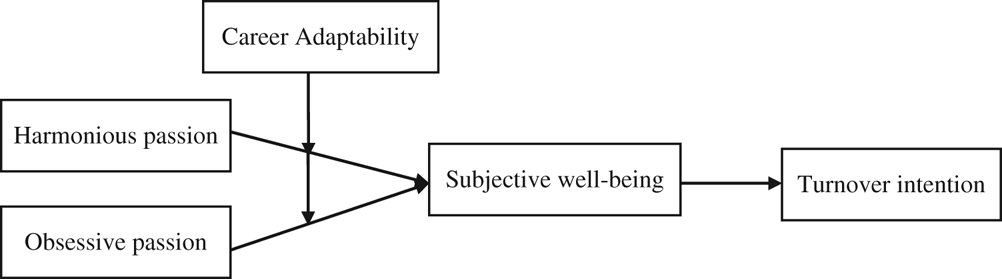
Hypothesis 7: Career adaptability moderates the relationship between harmonious passion and subjective well-being; the positive relationship between harmonious passion and subjective well-being will be stronger when career adaptability is low and weaker when career adaptability is high.
Hypothesis 8: Career adaptability moderates the relationship between obsessive passion and subjective well-being; the negative relationship between obsessive passion and subjective well-being will be stronger when career adaptability is low and weaker when career adaptability is high (Figure 1).
Final path model with standerdized path coefficients

METHOD
Participants and procedures
The sample comprises government employees in Shandong Province, China. Every year, all government employees receive several trainings at a municipal school of administration, and the training courses include administrative management, law, human resource management, document writing, etc. In this study, participants were instructed to complete the questionnaire at three time points. Survey 1 included work passion, career adaptability, and demographic measures and was administered at the end of January 2015. Of the 873 government employees who participated in the study, 798 gave valid responses. The government employees did not need to fill in their names; rather, they wrote the last eight numbers on their ID card. This number is treated as corresponding standard for every participant at three time points. Survey 2 assessed subjective well-being and was administered in March 2015. Of the 786 government employees who participated in the study, 676 provided valid responses. Survey 3 measured turnover intention and was administered in mid-June 2015. Of the 510 government employees who participated in the study, 489 provided valid responses. Ultimately, 472 participants provided valid responses at all three time points.
Most participants in the valid sample were engaged in administrative work at the municipal, district, or lower levels. The next largest proportion was from the public utilities sector, and the rest were from public enterprises. The valid sample was 62.92% male and 37.08% female. Regarding age, 13.5% of participants were under 25 years old, 32.8% were between 26 and 30 years old, and 22.7% were between 31 and 35 years old. Among the four levels of tenure, each group contained ~25% of the test subjects, with the seniority levels evenly distributed. Among the three educational levels, 8.9% had completed high school, technical secondary school, or below, 43.7% had a junior college education, and 47.4% had obtained a bachelor’s degree or above.
Instruments
The measurement items used in the present study were primarily developed in English; thus, to ensure cross-linguistic equivalence, we translated all scale items into Chinese and then back-translated them into English by means of two bilingual (English–Chinese) professional translators (Brislin, Reference Brislin1980).
Passion
The Chinese version of the Passion for Work Scale (Vallerand & Houlfort, Reference Vallerand and Houlfort2003) has two 7-item subscales: harmonious passion, with a Cronbach’s α of 0.89 in the current study (sample item: ‘The new things that I discover with my work allow me to appreciate it even more’), and obsessive passion, with an alpha of 0.88 (sample item: ‘I have difficulty controlling my need to do my work’). The Cronbach’s α of the whole scale in this study was 0.95.
Career Adapt-Abilities Scale (CAAS)
Participants were asked to complete the Chinese version of the CAAS (Hou, Leung, Li, Li, & Xu, Reference Hou, Leung, Li, Li and Xu2012). It consists of 24 items that are divided equally into four subscales measuring the adaptive resources of concern, control, curiosity, and confidence. Participants responded to each item on a scale from 1=‘not strong’ to 5=‘strongest’. The Cronbach’s α of the CAAS in this study was 0.94.
Subjective well-being
In line with past research (Diener & Larsen, Reference Diener and Larsen1984; Diener, Reference Diener1994), subjective well-being was conceptualized as the presence of life satisfaction and positive affect combined with the absence of negative affect. The Satisfaction with Life Scale (Larsen, Diener, & Emmons, Reference Larsen, Diener and Emmons1985; Blais, Vallerand, Pelletier, & Brière, Reference Blais, Vallerand, Pelletier and Brière1989) was used to evaluate participants’ life satisfaction. This scale includes five items questions and has been aptly used in the Chinese context (Liu, Zhang, Wu, Liu, & Li, Reference Liu, Zhang, Wu, Liu and Li2017). It assesses participants’ level of satisfaction with their life in general using a 7-point Likert-type response scale ranging from 1=‘not at all in agreement’ to 7=‘very strongly in agreement’. A sample item is ‘The conditions of my life are excellent.’ The Cronbach’s α of the whole scale in this study was 0.96.
Turnover intention
We used five items taken from a questionnaire written by Wayne, Shore, and Liden (Reference Wright and Davis1997). A sample item is ‘As soon as I can find a better job, I’ll leave’. Respondents answered on a scale ranging from 1=‘strongly disagree’ to 6=‘strongly agree’. The Cronbach’s α of whole scale was 0.92.
Control variables
To reduce the impact of demographic variables’ imbalance on the results, we included gender, age, job tenure, and education level as demographic control variables.
RESULTS
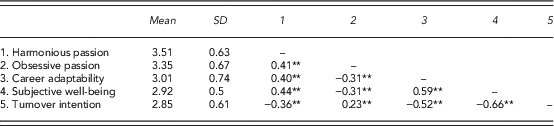
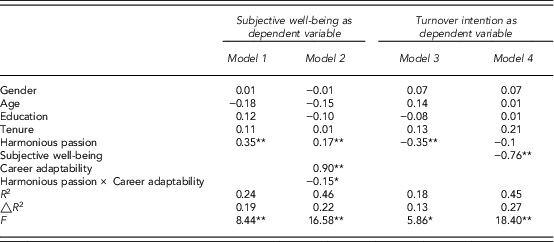
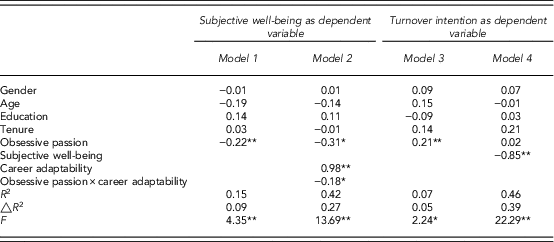
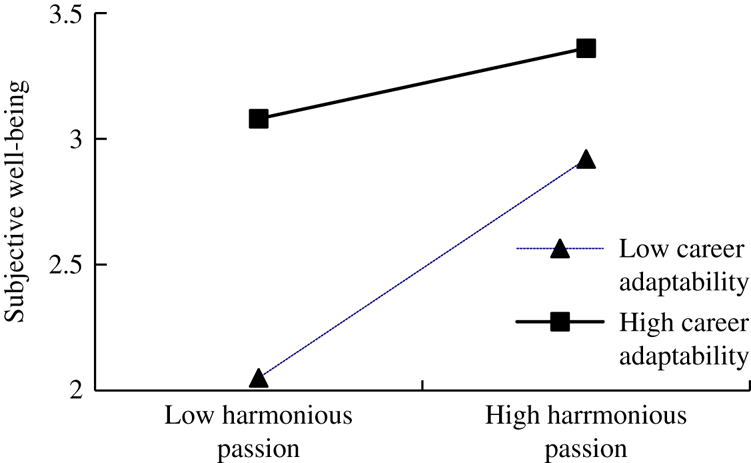
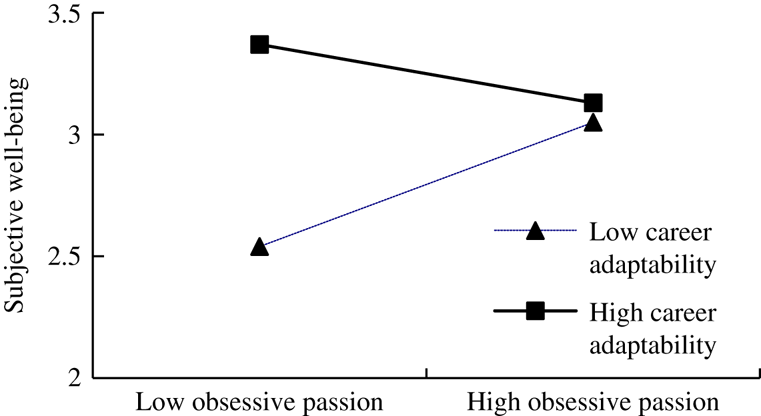
Table 1 presents the means, standard deviations and correlations among the study variables. Further analyses were conducted to better estimate the overall contribution of harmonious passion and obsessive passion in predicting turnover intention as well as the mediating role of subjective well-being. Table 2 presents the fit indices and statistics for the a priori, structural, and modified structural models. As our hypotheses involve mediation effects, we applied a path modeling method in estimating our proposed model. We standardized all variables for the analyses. We conducted a mediation path analysis to test the hypotheses using Mplus 7.0. To alleviate concerns of common method bias, we tested an alternative measurement model in which all indicators were loaded on a single method factor. We assessed overall model fit by goodness-of-fit indices including the comparative fit index (CFI), Tucker-Lewis index (TLI), root mean square error of approximation (RMSEA), and standardized root mean square residual (SRMR). This alternative model fit the data very poorly, χ2=315.67, df=118, p<.01; CFI=0.86; TLI=0.83; RMSEA=0.11; SRMR=0.25. The hypothesized structural model was a mediated model consisting of paths among passion, subjective well-being and turnover intention, where subjective well-being was proposed to fully mediate the effect of passion on turnover intention. The addition of this path resulted in a substantially better model fit based on the following set of fit indices: χ2=213.11, df=119, p<.01; CFI=0.96; TLI=0.94; RMSEA=0.08; SRMR=0.06. A χ2 difference test indicated that the fully mediated model provided a better fit to the data. We then tested a revised model in which a direct path from passion to turnover intention was added. This model fit the data poorly, χ2=236.78, df=117, p<.01; CFI=0.88; TLI=0.87; RMSEA=0.08; SRMR=0.08. Tables 3 and 4 shows that the interaction term for harmonious/obsessive passion with feedback orientation was significant in predicting subjective well-being. To further understand the moderating effect, we plotted the interaction effect using one standard deviation above and below the mean of career adaptability. Figures 2 and 3 shows the interaction patterns as expected in that the relationship between harmonious/obsessive passion and subjective well-being is stronger for low career adaptability than high career adaptability.
Means, standard deviations, and correlations of all measures

Note. n=472.
**p<.01.
Fit indices and statistics for the a priori, structural, and modified structural models

CFI=comparative fit index; RMSEA=root mean square error of approximation; SRMR=standardized root mean square residual; TLI=Tucker-Lewis index.
Hierarchical regressions for the impact of harmonious passion and subjective well-being on turnover intention

Note. n=437.
*p<.05, **p<.01.
Hierarchical regressions for the impact of obsessive passion and subjective well-being on turnover intention

Note. n=437.
*p<.05, **p<.01.
Simple slopes of harmonious passion predicting subject well-being at low (1 SD below M) and high (1 SD above M) levels of career adaptability

Simple slopes of obsessive passion predicting subject well-being at low (1 SD below M) and high (1 SD above M) levels of career adaptability

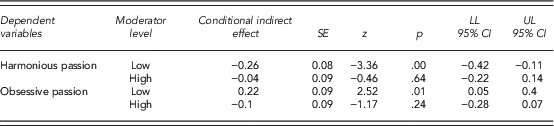
Results in Table 5 show that, the conditional indirect effect of harmonious passion was stronger and significant in the low career adaptability, but was stronger and not significant in the low career adaptability. The conditional indirect effect of obsessive passion was stronger and significant in the low career adaptability, but was not significant in the high career adaptability.
Results for conditional indirect effect of harmonious/obsessive passion on turnover intention via subject well-being across levels of career adaptability

Note. n=437.
DISCUSSION
The results show that the more harmonious passion people experience, the more they tend to experience subjective well-being in their passionate activity, which in turn is negatively associated with turnover. Obsessive passion negatively relates to subjective well-being, which in turn is negatively associated with turnover. The present research replicates past findings (Vallerand et al., Reference Vallerand, Paquet, Philippe and Charest2003; Mageau & Vallerand, Reference Mageau and Vallerand2007; Rousseau & Vallerand, Reference Rousseau and Vallerand2008; Philippe et al., Reference Philippe, Vallerand, Nathalie, Lavigne and Donahue2010) by using subjective well-being instead of psychological well-being. These results suggest that having harmonious passion may constitute one avenue toward a more fulfilling life, whereas the more obsessive passion people have, the less subjective well-being they experience. Moreover, these findings are in line with research by Carbonneau et al. (Reference Carbonneau, Vallerand, Fernet and Guay2008), who showed that whereas obsessive passion is positively related to burnout, harmonious passion prevents burnout; some research has shown that burnout is positively related to turnover intention (Zhang & Feng, Reference Zigarmi, Nimon, Houson, Witt and Diehl2011). Furthermore, the present findings are aligned with past research on passion that has shown that harmonious passion typically predicts adaptive outcomes, whereas obsessive passion typically leads to less adaptive outcomes and at times clearly maladaptive ones (Vallerand et al., Reference Vallerand, Paquet, Philippe and Charest2003, Reference Vallerand, Ntoumanis, Philippe, Lavigne, Carbonneau, Bonneville, Lagacé-Labonté and Maliha2008; Ratelle, Vallerand, Mageau, Rousseau, & Provencher, Reference Ratelle, Vallerand, Mageau, Rousseau and Provencher2004).
Moreover, career adaptability moderates the relationship between harmonious and obsessive passion, and subjective well-being will be stronger when career adaptability is low and weaker when career adaptability is high. Several recent studies have shown that career adaptability is related to important career-related skills (Guzman & Choi, Reference Guzman and Choi2013), job search self-efficacy (Guan et al., Reference Guan, Deng, Sun, Wang, Cai, Ye, Fu, Wang, Zhang and Li2013), the outcomes of career satisfaction (Tolentino, Garcia, Restubog, Bordia, & Tang, Reference Vallerand, Blanchard, Mageau, Koestner, Ratelle, Leonard, Gagne and Marsolais2013), orientations toward happiness, general and professional well-being, and quality of life (Soresi, Nota, & Ferrari, Reference Shirom2012; Johnston et al., Reference Johnston, Broonen, Stauffer, Hamtiaux, Pouyaud, Zecca, Houssemand and Rossier2013; Maggiori et al., Reference Maggiori, Johnston, Krings, Massoudi and Rossier2013). Research has demonstrated that career adaptability positively predicts career commitment making, career identification, and career exploration (in-depth and in-breadth) and negatively predicts career commitment self-doubt (Savickas & Porfeli, Reference Savickas and Porfeli2012). Career adaptability plays an important role in turnover. If a person has low career adaptability, he or she will experience more feelings of failure and low self-identification (Maggiori et al., Reference Maggiori, Johnston, Krings, Massoudi and Rossier2013). Vallerand et al. (Reference Vallerand, Paquet, Philippe and Charest2003) suggest that people will develop a passion toward enjoyable activities that are internalized in their identity. Harmonious passion, by contrast, results from an autonomous internalization (Ryan & Deci, Reference Ryan and Deci2000) of an activity into a person’s identity. Harmonious passion generally predicts adaptive outcomes, whereas obsessive passion typically leads to less adaptive outcomes and at times clearly maladaptive ones (Vallerand et al., Reference Vallerand, Paquet, Philippe and Charest2003, 2008; Ratelle et al., Reference Ratelle, Vallerand, Mageau, Rousseau and Provencher2004).
For people with low career adaptability, harmonious passion can lead to psychological need satisfaction, but obsessive passion cannot. For people with high career adaptability, the positive effect of different types of passion is similar; it is possible that different types of passion focus on different points. In line with research on the relationship between passion and performance, not only harmonious passion but also obsessive passion is positively related to performance (Mageau & Vallerand, Reference Mageau and Vallerand2007). Employees with high harmonious passion will be more advantaged in interpersonal communication, and they will enjoy work that requires continuous acquisition of new knowledge and skills; in contrast, employees with high obsessive passion may be hardworking in order to be able to defeat others in work or avoid failure.
Theoretical implication
First, the proposal that explores the impact of passion using the DMP (i.e., harmonious and obsessive passion) on turnover intention can solve the problems of prior research. Prior research has focused on individual factors such as personality traits and demographic factors, which are more stable, distal, and general constructs. Thus, these traits should be less flexible than passion in terms of allowing people to manage career challenges. Although passion is considered a type of work engagement and involvement that should trigger psychological processes, based on the Conceptual Model of Employee Work Passion (Zigarmi et al., Reference Zikic and Klehe2009), passion is a type of work engagement and involvement that should trigger psychological processes that lead to turnover intention (or not). Furthermore, both types of engagement (and vigor) do not distinguish between two types of engagement, as is proposed by the DMP (i.e., harmonious and obsessive passion) (Vallerand et al., Reference Vallerand, Paquet, Philippe and Charest2003). Harmonious passion results from autonomous internalization; in contrast, obsessive passion results from controlled internalization. The results of the present research show that the more harmonious passion people have, the more they tend to experience subjective well-being in their passionate activity; this in turn is negatively associated with turnover. Obsessive passion is negatively related to subjective well-being, which in turn is negatively associated with turnover.
Second, the present research also offers insight into the processes responsible for the diametrical consequences of the two types of passion. Our results add to the passion literature by identifying subjective well-being as a mediating mechanism between work passion and turnover intention. Although researchers have focused on the relationships among passion, work engagement (Schaufeli & Bakker, Reference Schaufeli and Bakker2004), and vigor (Shirom, Reference Shi2003), the mechanism in their relationship remains unclear. Prior research on the DMP (Vallerand et al., Reference Vallerand, Paquet, Philippe and Charest2003) supports the relationship between passion and subjective well-being. Harmonious passion makes individuals view their job as meaningful (Vallerand et al., Reference Vallerand, Paquet, Philippe and Charest2003) and reduces turnover intention (Vallerand et al., Reference Vallerand and Ratelle2010). If their job cannot fulfill extrinsic needs, turnover intentions will arise for people with obsessive passion (Vallerand et al., Reference Vancouver, Tamanini and Yoder2006; Mageau & Vallerand, Reference Mageau and Vallerand2007; Rousseau & Vallerand, Reference Rousseau and Vallerand2008). The term ‘need’ refers to what is necessary for well-being. This research builds upon previous work that has focused only on the relationship between passion and well-being (Vallerand et al., Reference Vallerand, Paquet, Philippe and Charest2003; Rousseau & Vallerand, Reference Rousseau and Vallerand2008) or the relationship between well-being and turnover (Jung et al., Reference Jung, Kim, Kim, Cho, Yoon, Mun and Choi2014).
Third, our results speak to scholars who seek to understand passion in a more comprehensive manner by demonstrating that if managers want to reduce subordinates’ turnover intention, they must focus on their passion. One must also consider the role of career adaptability. The present research extends prior research by considering boundary conditions, such as career adaptability, that could change the relationship between passion and outcomes because an inherent assumption in the passion literature is that harmonious passion improves performance and well-being, but obsessive passion does not (Rousseau et al., Reference Rousseau, Vallerand, Ratelle, Mageau and Provencher2002). According to BPNT, one of the six mini-theories of SDT, there are three basic psychological needs: autonomy, relatedness, and competence. The satisfaction of these psychological needs is important for human thriving. Among those for whom passion cannot satisfy basic needs and well-being is low, career adaptability is more critical for need satisfaction (Savickas, Reference Savickas1997; Zikic & Klehe, Reference Taber and Timpone2006) and loyalty (Sverke & Hellgren, Reference Sverke and Goslinga2002; Sverke & Goslinga, Reference Soresi, Nota and Ferrari2003). The results also make a contribution to the DMP, which posits that two distinct types of passion – obsessive and harmonious – develop as a result of the type of internalization processes that takes place. Obsessive passion may interfere with the experience of positive affect and task satisfaction and even facilitate negative affect during task engagement (Vallerand et al., Reference Vallerand, Paquet, Philippe and Charest2003; Rousseau & Vallerand, Reference Rousseau and Vallerand2008). In the career development literature, different types of career adaptability are correlated with different needs. Individuals with low career adaptability need more information to improve their adaptability, and obsessive passion can put them in the position of experiencing an internal uncontrollable urge to engage in a passionate activity (Savickas & Porfeli, Reference Savickas and Porfeli2012). Obsessive passion can fulfill needs and improve subjective well-being. Among low-adaptability employees, the higher their obsessive passion, the higher their subjective well-being.
Practical implications
Based on our findings, we propose the following recommendations for the management of Chinese government employees. The first is to satisfy the psychological needs of autonomy, relatedness, and competence to promote harmonious passion and hinder obsessive passion among employees with low career adaptability. Offering strong support and a caring working atmosphere and improving their career adaptability requires concern, control, curiosity, and confidence. Leaders can focus on improving the organization and work environment through, for example, work autonomy, work meaning, task diversity, workload balancing, a feedback environment, and cooperative relationships. Through education, training and informal feedback, leaders can improve feedback credibility, have support staff actively seeking feedback behavior, improve the quality of their feedback and offer feedback by taking more consideration of employees’ psychological experiences, etc. Thus, they can improve the levels of goal self-concordance and the internalization of external motivation.
Second, for employees with high career adaptability, reawaking their harmonious and obsessive passion can promote their subjective well-being and reduce their turnover intention. People with high levels of obsessive passion should be aim at reducing the encroachment of passionate activities on other life areas and at helping other people find more efficient ways to control their engagement in passionate activities. For example, different strategies could be taught to bring work into perspective with other life domains and enhance work-life balance (Matjasko & Feldman, Reference Matjasko and Feldman2006).
Third, for employees with low work passion, improving their career adaptability can reduce their turnover intention. Employees need to have a proactive and exploratory spirit to manage the stress and challenges of career transformation. For enterprise internal positions or post-adjustment, employees should actively adapt to the new work environment, work tasks and work specifications, thus shaping their professional competence. The strategies employees can use to improve themselves include self-motivation, consulting with experienced workplace seniors, enhancing their professional knowledge and skills to build up professional competitiveness, and so on.
Fourth, improving civil servants’ promotion, salary fairness and work meaning is vital. The government should shape an environment where pay, benefits, resources, and workload are fair, balanced, and equitable, where people treat each other with respect, and leaders act in an ethical manner (Zigarmi et al., Reference Zikic and Klehe2009). Organizations should make government employees perceive the organization’s larger purpose, consider their work to be worthwhile, and be proud of their individual actions and contributions.
Limitations and future research
Although our findings have made some contribution to answering several recent questions in the passion and turnover literature, this study have several limitations. One limitation lies in the method of data collection, as all constructs were measured via self-report. Therefore, these results could be biased by common method variance, although procedural and statistical actions were taken to address these concerns, thereby alleviating some of this threat. In the future, research should find a new measurement of objective turnover intention to reflect real turnover or consider what biases might exert an influence.
Moreover, although we used a time-lag design to examine the role of passion in the turnover process, our results concern the short-term turnover outcomes across 6 months. Future research should address this limitation by corroborating the current findings by examining the long-term effects of passion on turnover intention and turnover behavior. It may be that if employees have turnover intentions (for other reasons), their well-being and passion may decline. Indeed, 15% of recently published studies in top-tier industrial/organizational and management journals are longitudinal (Austin, Scherbaum, & Mahlman, Reference Austin, Scherbaum and Mahlman2003). Unfortunately, the level of internal validity in longitudinal designs may be less than believed (Vancouver, Tamanini, &Yoder, Reference Wan, Feng, Xu, Huang, Xu and Yang2010). Dynamic computational theory refers to the mathematical specification of a theoretical account of how key variables (or constructs) influence each other over time (Taber & Timpone, Reference Tolentino, Garcia, Restubog, Bordia and Tang1996). Such theories can be simulated to examine how variables in a system change from a given set of starting values (Vancouver, Tamanini, &Yoder, Reference Wan, Feng, Xu, Huang, Xu and Yang2010). In the future, research should find causal relationships by using the System Dynamic Method.
Another limitation of this study was our use of a government employee sample only from Shandong Province, China, which limits the results’ generalizability. While the current study involved a large heterogeneous sample in China, it was conducted in a specific Eastern setting. Future studies should use different samples to make the results more specific and representative. To improve the generalizability of our results, future research should replicate our model employing multi-organization and cross-national samples. In addition, there is some within-country variation in cultural values and orientations, and career adaptability is bounded by the social, institutional, and cultural contexts in which it is acquired and has influence (Savickas & Porfeli, Reference Savickas and Porfeli2012). However, this study was not concerned with cultural factors. Future research should add more diverse control variables for a deeper understanding of relevant issues, increase the confidence regarding the conclusions and investigate the career adaptability effects of cultural characteristics on the relationships between passion and turnover intention.
ACKNOWLEDGEMENTS
This research was supported by Shandong Social Science Planning Fund Program (18DGLJ02) and Research Fund for the Doctoral Program of Liaocheng University.
About the Authors
Zhenxing Gong is a lecture in the School of Business, Liaocheng University. His research focuses on the organizational behavior and human resource management, with a special focus on work passion and turnover intention.
Ying Zhang is a student in the School of Business, Liaocheng University. Her research focuses on the organizational behavior and psychology, with a special focus on feedback and emotion.
Jinfeng Ma is a student in the School of Business, Liaocheng University. Her research focuses on the organizational behavior and human resource management, especially the leadership of public official and citizens, social capital, subjective well-being, and mentor network.
Yao Liu is a student in the School of Business, Liaocheng University. Her research focuses on the organizational behavior and human resource management, with a special focus on work passion.
Yujia Zhao is a master in the Donglinks School of Economics and Management, University of Science and Technology Beijing. Her research focuses on the organizational behavior and psychology, with a special focus on complex network and motivation.