Introduction
In sub-Saharan Africa, horticulture is a promising driver of economic growth, as it is a vital source of income for resource-poor growers in rural and peri-urban areas (Moustier, Reference Moustier2007; van Veenhuizen and Danso, Reference van Veenhuizen and Danso2007; Labaste, Reference Labaste2007). Furthermore, fruit and vegetable crops can contribute to food security and nutritional balance for most vulnerable populations (FAO, 2012). In Senegal, the field-grown tomato is one of the most important crops of the horticultural value chain. Tomato production increased from 40,000 to 190,000 tons between 2000 and 2013 to meet growing urban demand for fresh market tomato and processing (FAO, 2015). However, the continuous yield and quality of tomato production is threatened by significant biotic constraints, including serious diseases, such as bacterial wilt caused by Ralstonia solanacearum (Smith) (N'Guessan et al., Reference N'Guessan, Abo, Fondio, Chiroleu, Lebeau, Poussier, Wicker and Koné2012), nematodes (Netscher, Reference Netscher1970; Diop et al., Reference Diop, Ndiaye, Mounport and Mateille2000), mites (Huat, Reference Huat2006) and insect pests causing direct damage or transmitting diseases (James et al., Reference James, Atcha-Ahowé, Godonou, Baimey, Georgen, Sikirou and Toko2010). Principal economic losses are due to insect pests, such as the fruitworm Helicoverpa armigera Hübner (Lepidoptera: Noctuidae) (Collingwood and Bourdouxhe, Reference Collingwood and Bourdouxhe1980), leafminer flies, particularly Liriomyza trifolii Burgess (Diptera: Agromyzidae) (Neuenschwander et al., Reference Neuenschwander, Murphy and Coly1987) and the whitefly Bemisia tabaci Gennadius (Hemiptera: Aleyrodidae) that can transmit Tomato yellow leaf curl virus (TYLCV) (D'Hondt and Russo, Reference D'Hondt and Russo1985; Camara et al., Reference Camara, Mbaye, Noba, Samb, Diao and Cilas2013). The recent introduction of the invasive South American tomato leafminer Tuta absoluta Meyrick (Lepidoptera: Gelechiidae) is a new challenge that farmers are facing (Pfeiffer et al., Reference Pfeiffer, Muniappan, Sall, Diatta, Diongue and Dieng2013). Tuta absoluta that is also known as the South American tomato pinworm can attack tomato plants at any developmental stage. Tuta absoluta larvae mine on leaves and bore holes on stems and fruits, negatively affecting crop yield and fruit quality. The threat to agricultural production due to T. absoluta invasion may include other significant crops from the family Solanaceae, such as potato (Desneux et al., Reference Desneux, Luna, Guillemaud and Urbaneja2011; Tropea Garzia et al., Reference Tropea Garzia, Siscaro, Biondi and Zappalà2012). Previous results showed that T. absoluta populations were established across the central vegetable-producing area of Senegal, the Niayes, which is located along the northern coast, where growers abandoned fields as a result of crop damage during 2012/13 season (Brévault et al., Reference Brévault, Sylla, Diatte, Bernadas and Diarra2014).
In less developed countries, losses caused by crop pests along the value chain of agricultural production remain high, and threats are set to increase with climate change (Maxmen, Reference Maxmen2013). Most farmers lack suitable alternatives to broad-spectrum chemicals to effectively control insect pests (Sam et al., Reference Sam, Osekre, Mochiah and Kwoseh2014). Intensive use of the same class of insecticides often leads to the evolution of insect resistance (Martin et al., Reference Martin, Ochou, Djihinto, Traoré, Togola, Vassal, Vaissayre and Fournier2005; Brévault et al., Reference Brévault, Achaleke, Sougnabé and Vaissayre2008; Djihinto et al., Reference Djihinto, Katary, Prudent, Vassal and Vaissayre2009; Houndété et al., Reference Houndété, Ketoh, Hema, Brévault, Glitho and Martin2010), and to severe hazards for the ecosystem and human health (Barzman et al., Reference Barzman, Bàrberi, Birch, Boonekamp, Dachbrodt-Saaydeh, Graf, Hommel, Jensen, Kiss, Kudsk, Lamichhane, Messéan, Moonen, Ratnadass, Ricci, Sarah and Sattin2015). Besides, detrimental effects on biodiversity can result in pest outbreaks due to the alteration of ecosystem services, such as natural pest regulation provided by natural enemies (Desneux et al., Reference Desneux, Decourtye and Delpuech2007; Power, Reference Power2010; Biondi et al., Reference Biondi, Mommaerts, Smagghe, Viñuela, Zappalà and Desneux2012; Grzywacz et al., Reference Grzywacz, Stevenson, Mushobozi, Belmain and Wilson2014). Development of new pest management strategies is needed to minimize the use of pesticides and preserve natural resources (De Bon et al., Reference De Bon, Huat, Parrot, Sinzogan, Martin, Malézieux and Vayssières2014). New pest management strategies require better science-based knowledge on the identity and life system of key pests, including spatial distribution and seasonal occurrence.
The current study aimed to: (i) update key pest records of field-grown tomato in the central vegetable-producing area in Senegal, the Niayes; (ii) map their spatial and temporal incidence and (iii) characterize insecticides used by growers to control key pests. Field surveys were conducted from 2012 to 2014 on a set of 98 tomato fields. Our results are useful for developing essential guidelines for improving pest management strategies, from local to regional practices, in the framework of sustainable vegetable production systems.
Materials and methods
Field sites
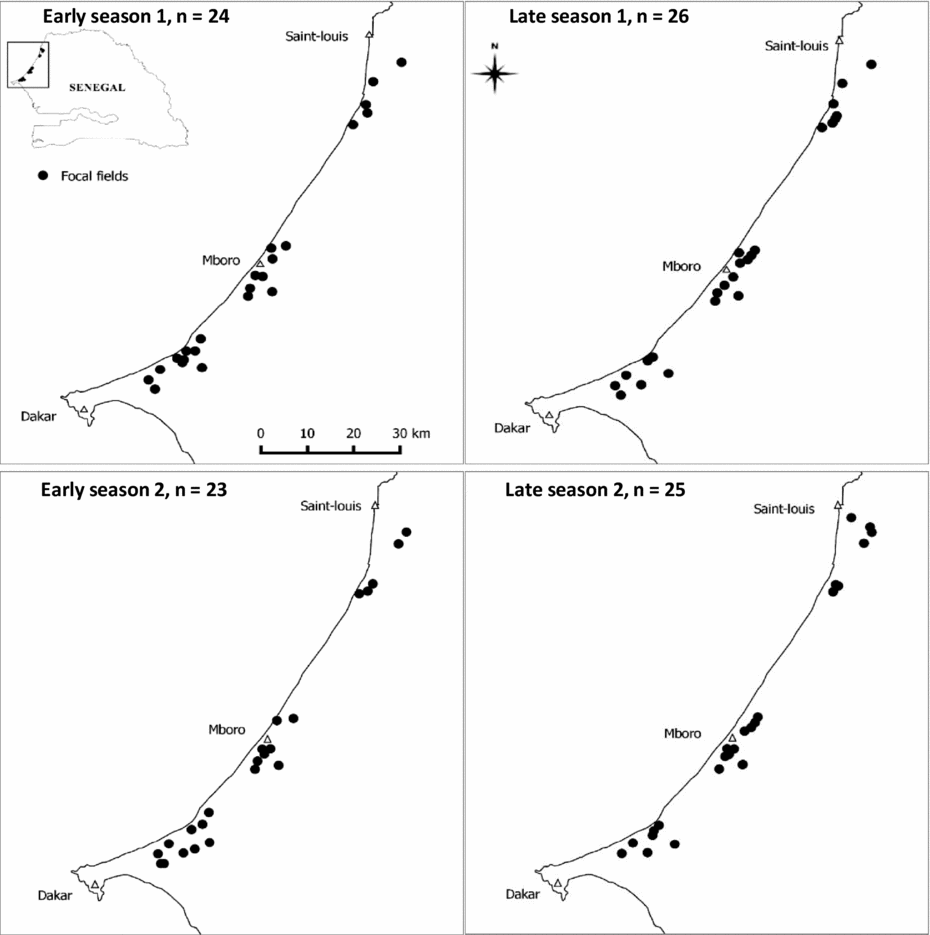
A survey was carried out in the Niayes ecoregion in Senegal (Fig. 1). The Niayes area is located along the northern coast on a 180 km coastal strip 10–30 km wide. Dunes and depressions that are often flooded characterize the environment and the alternation of a short wet season (July–September) and a long dry season (October–June) during which most vegetable crops are grown under irrigation. This horticultural area provides about 80% of domestic vegetable production.
Spatial distribution of sampled tomato fields in the Niayes area over two dry seasons (season 1 [2012/2013] and season 2 [2013/2014]) and two crop cycles (early and late dry season) per season.

A set of 98 fields was selected in 3 zones of the Niayes area along a north–south transect from Dakar to Saint-Louis (Fig. 1). Surveys were carried out over two dry seasons and two consecutive crop cycles per season, from October 2012 to May 2014 (Fig. 1). For each crop cycle, sampled fields were separated by at least 2 km from each other. Temperature was recorded for each zone using data loggers (Hobo, Prosensor) placed throughout the crop cycle in two sampled fields.
Pest monitoring
Sampling of arthropod pests in sampled tomato fields was carried out every three weeks from transplanting to harvest. For each field, 24 tomato plants were randomly selected and classified according to their phenological stage (vegetative, flowering, fruiting and maturity). The entire plant was observed in the field by eye for symptoms of nematodes (symptomatic plants checked for galls on roots), diseases, especially TYLCV (CABI, 2013), and fruit damage. Three leaves per plant (from lower, intermediate and upper canopy) were inspected for the presence of arthropod pests or associated damage. Insect specimens were collected and conserved in 70% ethanol for further identification in the laboratory with the help of fact sheets and taxonomic keys for arthropod identification (Delvare and Aberlenc, Reference Delvare and Aberlenc1989; Bordat and Arvanitakis, Reference Bordat and Arvanitakis2004; James et al., Reference James, Atcha-Ahowé, Godonou, Baimey, Georgen, Sikirou and Toko2010) and insect taxonomists (G. Delvare and D. Bordat, CIRAD, France) when necessary. ‘Occurrence’ refers here to proportion of infested fields. ‘Incidence’ indicates proportion of infested plants (or leaves). A set of fields of potential host crops adjacent to the sampled fields were inspected once for presence of H. armigera larvae on 24 randomly selected plants. These included Solanaceae: sweet pepper Capsicum frutescens L., eggplant Solanum melongena L., potato S. tuberosum L., Ethiopian eggplant S. aethiopicum L. and pepper Capsicum annuum L.; Brassicaceae: cabbage Brassica oleracea L. var. capitata and turnip Brassica rapa L.; Cucurbitaceae: squash Cucurbita maxima L. and zucchini Cucurbita pepo L.; Asteraceae: lettuce Lactuca sativa L.; and Alliaceae: onion Allium cepa L. A farmers’ survey of insecticide applications (date, trade mark, active ingredient) was conducted for each sampled field during the entire crop cycle.
Statistical analyses
The effect of zone (south, centre, north), season (2012/2013, 2013/2014), crop cycle (1–4) and crop phenology on the incidence (proportion of infested plants) of arthropod pests was assessed using logistic regression assuming a binomial distribution of the data (GLM logit function). The effect of the explanatory variables was assessed using a type II analysis with the criterion of maximum likelihood ratio. Mean comparisons were done using Tukey pair-wise comparisons. Graphical representations of data as box plots were done to give information on the central tendency values (mean and median), their variability, symmetry of distribution and the presence of atypical values. Non-parametric Kruskal–Wallis tests were carried out to assess the effect of zone and ‘insecticide use’ groups on the number of insecticide applications and the effect of ‘insecticide use’ groups on the incidence of H. armigera and T. absoluta in sampled fields. An analysis of variance (ANOVA) was used to test the effect of season, time of season and zone on temperature. Analyses were performed with XLSTAT Version 2015.1.01 (Addinsoft).
Results
Temperature across zones
Mean temperatures during field monitoring were 24.3, 22.4, 22.7 and 21.7 °C for crop cycles 1, 2, 3 and 4, respectively. Season 1 was warmer (+1.1 °C) than season 2 (F = 7.9, df = 1, P<0.01). The first part of the dry season was warmer (+1.3 °C) than late part of the dry season (F = 14.0, df = 1, P<0.001). No significant temperature difference was recorded among zones (F = 0.8, df = 2, P = 0.431). No effect of zone or time of season on minimum temperature was observed (F = 0.0, df = 2, P = 0.994 and F = 0.6, df = 1, P = 0.447, respectively). Maximum temperature was higher in the north zone than in the south (+2.9 °C) and centre (+3.9 °C) zones (F = 11.0, df = 2, P<0.001), and higher (+1.5 °C) during the first part of the dry season (F = 4.7, df = 1, P = 0.032).
Incidence of key insect pests
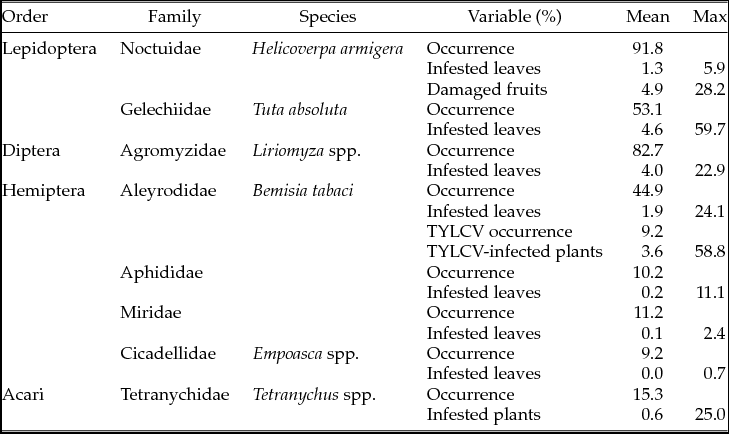
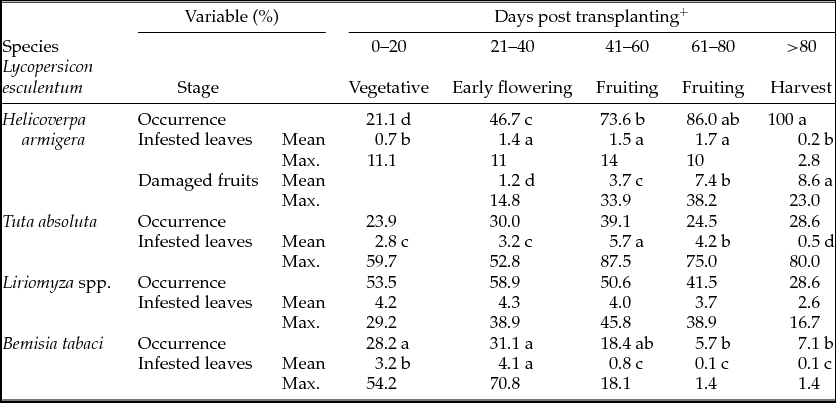
The tomato fruit worm H. armigera was the major pest with an occurrence of 91.8% in sampled fields and up to 38.2% damaged fruits at the time of sampling (Tables 1 and 2). Helicoverpa armigera larvae were observed on tomato leaves before the flowering stage (before 21 days post planting) and their abundance slightly increased at early flowering (χ² = 27.7, df = 4, P<0.001). Fruit damage started as soon as early fruiting and significantly increased during the fruiting stage (χ² = 185.1, df = 3, P<0.001). An average of 8.6% damaged fruits with a maximum of 23.0% damaged fruits in one field were observed at harvest time.
Incidence of arthropod pests observed on tomato fields (N = 98) in the Niayes area over two cropping seasons, from October 2012 to May 2014

Occurrence: proportion of infested fields.
Incidence of key insect pests in tomato fields as a function of crop phenology

Occurrence: percentage of infested fields. Data with different letters in the same row are not significantly different according to Tukey's test (P>0.05).
+ Tomato plants were usually transplanted after four weeks in the nursery.
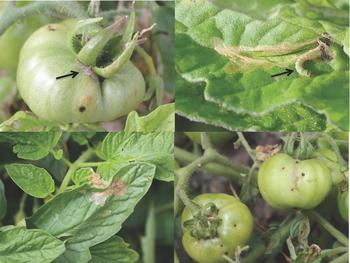
Typical leaf damage caused by the tomato leafminer T. absoluta (Wyckhuys et al., Reference Wyckhuys, Bordat, Desneux and Fuentes Quintero2012) was observed in 53.1% of the sampled fields, with an average of 4.6% infested leaves, and a maximum of 59.7% in one sampled field (Table 1, Fig. 2). The tomato leafminer T. absoluta colonized tomato plants at the vegetative stage, before reaching a maximum at the early fruiting stage (χ² = 99.9, df = 4, P<0.001). A maximum of 87.5% mined leaves were observed in one field (Table 2).
Tuta absoluta adult (top, left) and larva (top, right), and damage caused by larvae on tomato leaves (bottom, left) and fruits (bottom, right).

Damage due to leafminer flies Liriomyza spp. was also observed in sampled fields (82.7%). However, mean proportion of infested leaves was only 4.0%, with a maximum of 22.9% in one field. Mines were observed on plant seedlings, resulting in significant incidence in some fields from the vegetative to early fruiting stage (29.2–45.8% infested leaves). Whiteflies B. tabaci were observed on less than half of the sampled fields (44.9%) at low densities (on average 1.9% infested leaves). Outbreaks of TYLCV were recorded in some fields (8/98), with up to 100% of plants infected during field monitoring. Incidence of B. tabaci was greater during the vegetative and early flowering stages (χ² = 167.5, df = 4, P<0.001) of tomato plants, with a maximum of 70.8% infested leaves in one field. We found a low incidence of aphids, mirids, leafhoppers and mites (Table 1).
Spatio-temporal incidence of the tomato fruitworm
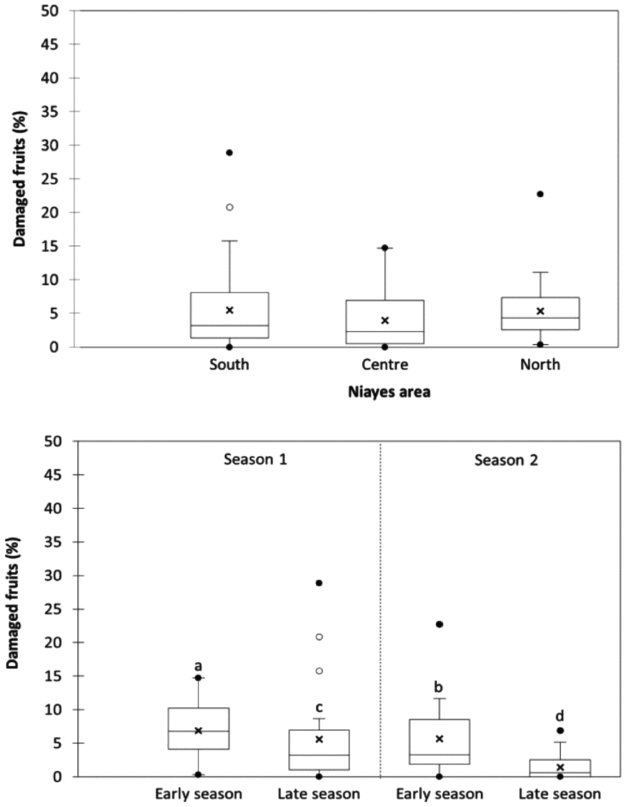
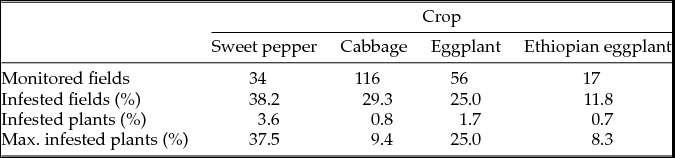
Incidence of the tomato fruitworm H. armigera in terms of fruit damage did not significantly vary among monitored zones (χ² = 5.8, df = 2, P = 0.410) (Fig. 3A). Fruit damage due to the tomato fruit worm was greater during the early dry season compared to the late dry season (χ² = 179.1, df = 1, P<0.001) (Fig. 3B). Fruit damage was greater in season 1 than in season 2 (χ² = 86.8, df = 1, P<0.001). Significant damage caused by H. armigera larvae was observed on other vegetable crops, such as sweet pepper, eggplant and Ethiopian eggplant fruit, and cabbage head (Table 3). Helicoverpa armigera larvae were occasionally detected on leaves or flowers of other crops such as potato, pepper, turnip, squash, zucchini, lettuce and onion (Table 3).
Incidence of the tomato fruitworm Helicoverpa armigera for (A) the zone in the Niayes area (2012/2013 and 2013/2014 seasons) and (B) season (2012/2013 and 2013/2014 seasons) and time of season (early [October to January] vs. late dry season [February to May]). Lower edge of the box represents the first quartile (Q1). Median is represented by the central line and mean by ‘x’. The third quartile (Q3) corresponds to the upper edge of the box. Two gaps are defined on either side of the first and third quartiles: IQ1 = [Q1 − 1.5 × (Q3 − Q1) Q1] and IQ3 = [Q3, Q3 + 1.5 × (Q3 − Q1)]. Closed circles (●) represent the minimum and maximum values, while the open circles (○) represent extreme values above IQ1 and IQ3.

Incidence of Helicoverpa armigera on other vegetable crops in the Niayes area

Spatio-temporal incidence of the tomato leafminer
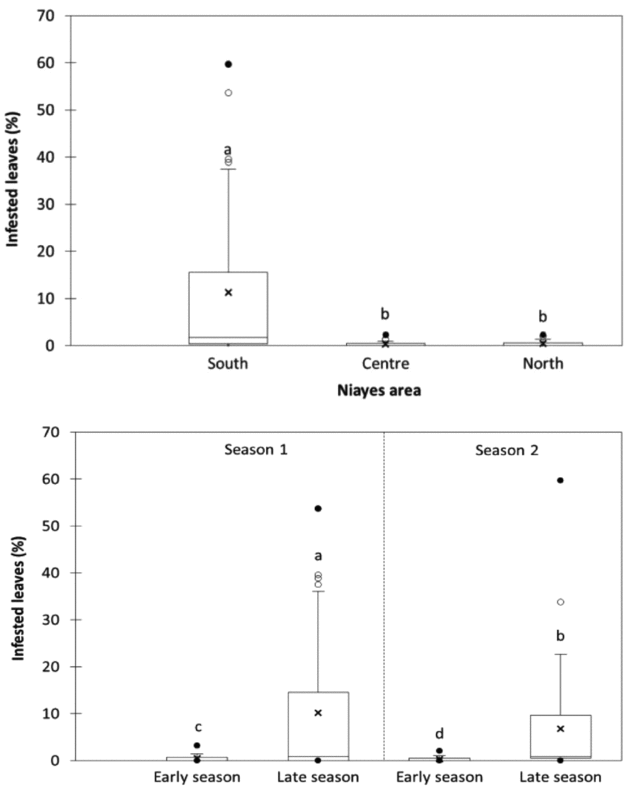
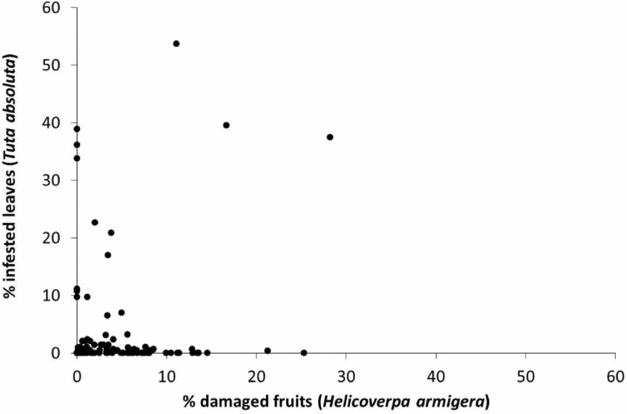
The incidence of the tomato leafminer T. absoluta was greater in the south zone of the Niayes area, with 0–60% mined leaves (χ² = 645.5, df = 2, P<0.001) (Fig. 4A). The proportion of mined leaves was greater in season 1 than in season 2 (χ² = 62.8, df = 1, P<0.001), and during the late dry season compared to the early dry season (χ² = 558.9, df = 1, P<0.001) (Fig. 4B). No significant relationship was observed between incidence of H. armigera and that of T. absoluta in sampled fields (r² = 0.02, P = 0.160) (Fig. 5).
Incidence of the tomato leafminer Tuta absoluta for (A) the zone in the Niayes area (2012/2013 and 2013/2014 seasons) and (B) the season (2012/2013 and 2013/2014 seasons) and time of season (early dry season [October to January] vs. late dry season [February to May]).

Relationship between proportion of fruits damaged by Helicoverpa armigera and the number of leaves mined by Tuta absoluta in sampled tomato fields (N = 98).

Insecticide use
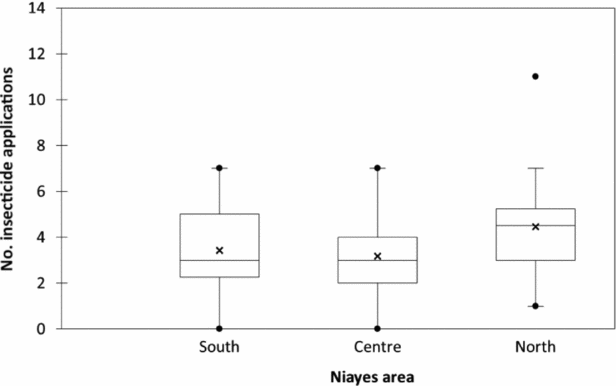
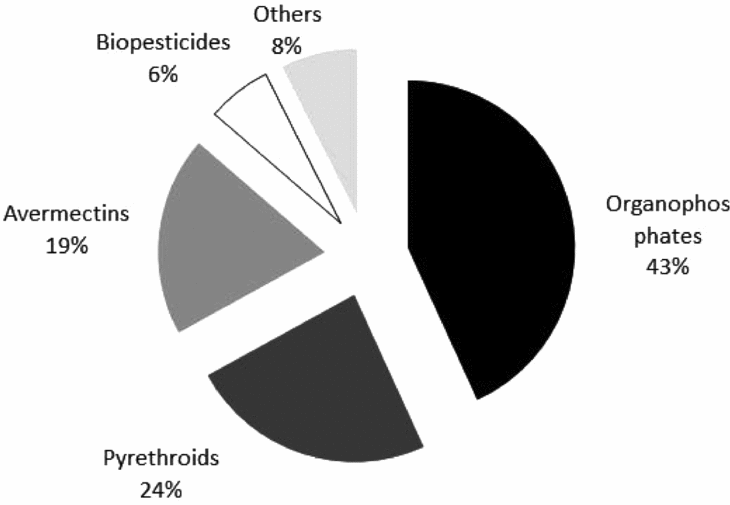
The mean number of insecticide applications was 3.4, 3.2 and 4.5 over the crop cycle in the south, centre and north zones of the Niayes area, respectively. No significant difference between zones was observed (K = 5.9, df = 2, P = 0.054) (Fig. 6). The number of insecticide applications was significantly correlated to the proportion (log transformed) of fruit damage due to H. armigera (r = 0.24, P = 0.019) but not to the proportion of plants infested by T. absoluta (r = −0.07, P = 0.508). Most applications were made with broad-spectrum insecticides, including organophosphates, pyrethroid-based formulations (>60% of pyrethroid applications were binary or ternary formulations, including neonicotinoids or organophosphates) or avermectins (abamectin) (Fig. 7). A low proportion of insecticide applications (6%) was with biopesticides, including Bacillus thuringiensis or neem oil commercial formulations. Other insecticides included indoxacarb (oxadiazine), methomyl (carbamate), imidacloprid (neonicotinoid) and dicofol (organochlorine).
Number of insecticide applications over a tomato crop cycle in the south, central and north zones in the Niayes area (2012/2013 and 2013/2014 seasons).

Insecticide use by growers to manage insect pests in tomato sampled fields (relative to total number of insecticide applications, N = 403).

Discussion
Insect pests are a significant constraint to field-grown tomato production in Senegal (Collingwood and Bourdouxhe, Reference Collingwood and Bourdouxhe1980; Huat, Reference Huat2006). The tomato fruitworm H. armigera remains the most widespread pest, as we detected larvae or associated damage in almost all sampled fields (90/98). Larvae were observed on leaves from the vegetative stage, and mostly from early flowering. Fruit damage started at the onset of the fruiting stage and significantly increased during fruiting. An average of 4.9% damaged fruits, with a maximum of 38.2%, was observed during crop growth. An average of 8.6% damaged fruits, with a maximum of 23.0%, was seen at harvest time. Incidence at harvest time does not include most fruits that were attacked at an early stage and rotted a few days later. The species was already reported to cause up to 85% fruit damage (Collingwood and Bourdouxhe, Reference Collingwood and Bourdouxhe1980). In field monitoring conducted in Nigeria in 2011/2012, Mailafiya et al. (Reference Mailafiya, Degri, Maina, Gadzama and Galadima2014) showed that H. armigera was the primary pest of tomato crops. In Spain, 3% damage during crop growth (seasonal damage) was proposed as an economic threshold in Integrated Pest Management (IPM) programmes to control H. armigera in processing tomato crops (Torres-Vila et al., Reference Torres-Vila, Rodriguez-Molina and Lacasa-Plasencia2003).
Incidence of the tomato fruitworm did not differ among zones in the Niayes area. Fruit damage was greater in the early season, on the first crop cycle after the rainy season. Moths that colonize tomato crops could come from rainfed crops, including pearl millet, corn and cotton. Reverse migration could also occur from vegetable host crops to rainfed crops at the beginning of the rainy season (Brévault et al., Reference Brévault, Achaleke, Sougnabé and Vaissayre2008; Reference Brévault, Nibouche, Achaleke and Carrière2012). Higher temperature in season 1 compared to season 2 could partially explain the greater incidence of H. armigera in season 1.
Significant damage of H. armigera larvae was observed on other vegetable crops, such as sweet pepper, eggplant, Ethiopian eggplant and cabbage. The presence of larvae was occasionally detected on leaves or flowers of vegetable crops, such as potato, pepper, turnip, squash, zucchini, lettuce and onion. These observations confirm the high degree of polyphagy in H. armigera (CABI, 2016) and typical traits of an invasive species by its ability to adapt to changing environment, e.g. by broadening its ecological niche, by migrating or locally diapausing when resources are scarce or by evolving resistance when insecticide pressure is high (Cunningham and Zalucki, Reference Cunningham and Zalucki2014). Helicoverpa armigera was recorded for the first time in Brazil in 2013 (Czepak et al., Reference Czepak, Albernaz, Vivan, Guimarães and Carvalhais2013), where significant damage was observed on cotton and soybean crops, and also in Argentina in 2013 (Gabriela Murúa et al., Reference Gabriela Murúa, Scalora, Navarro, Cazado, Casmuz, Villagrán, Lobos and Gastaminza2014). Helicoverpa armigera has a growing importance in Europe with crop damage and insecticide resistance (Mironidis et al., Reference Mironidis, Kapantaidaki, Bentila, Morou, Savopoulou-Soultani and Vontas2013). A better understanding of genetic and demographic flows among agricultural production basins in Senegal, and more broadly in West Africa, is necessary for the development of area-wide pest management strategies (Brévault and Bouyer, Reference Brévault and Bouyer2014).
The invasive tomato leafminer T. absoluta was detected in more than half of sampled fields (52/98), mainly in the south zone of the Niayes area during the late dry season. As no significant difference in temperatures was observed among zones, it is probable that populations decrease during the rainy season, due to low resource availability (few solanaceous crops, particularly in the north and centre of Niayes) and rainfall (de Medeiros et al., Reference de Medeiros, Sujii and de Morais2011). Tuta absoluta populations may start to grow at the early dry season, with larger populations southward in relation to the importance of solanaceous crops, and subsequent recolonization of the central and north zones by long-distance dispersal. A maximum of 87.5% mined leaves was observed in one field at fruiting. In some cases, growers were forced to abandon their fields due to uncontrollable outbreaks, as reported by Brévault et al. (Reference Brévault, Sylla, Diatte, Bernadas and Diarra2014). Colonization of tomato plants started at the vegetative stage just after transplanting, to reach a maximum during the flowering–fruiting stage, but infestations were also observed in nurseries (S. Sylla, unpublished data).
Incidence of H. armigera and T. absoluta populations was variable among sampled fields within the same zone. This suggests the important effect of crop management, particularly insecticide use, but possibly also in the landscape context, e.g. semi-natural habitats, which would favour biocontrol by natural enemies (Maalouly et al., Reference Maalouly, Franck, Bouvier, Toubon and Lavigne2013; Morandin et al., Reference Morandin, Long and Kremen2014), or diversity and abundance of host crops, which would affect their dynamics (Carrière et al., Reference Carrière, Goodell, Ellers-Kirk, Larocque, Dutilleul, Naranjo and Ellsworth2012; Lu and Baker, Reference Lu and Baker2013). In a previous study, Brévault et al. (Reference Brévault, Sylla, Diatte, Bernadas and Diarra2014) detected the presence of T. absoluta on other vegetable crops, such as eggplant and Ethiopian eggplant. No relationship was observed between the incidence of H. armigera and that of T. absoluta in sampled fields. This could suggest no competition for resources, though direct competition was expected between moths for oviposition on leaves, or between larvae (particulary early instars) for food, knowing the territorial behaviour of H. armigera larvae (Sigsgaard et al., Reference Sigsgaard, Greenstone and Duffield2002; Kakimoto et al., Reference Kakimoto, Fujisaki and Miyatake2003). Relative low density of H. armigera larvae in tomato fields, location of larvae on leaves (abaxial vs. adaxial surface of the leaf), dissimilar effect of insecticide applications on the two species, or asynchronism of infestation (early vs. late season) could explain the lack of observed competition. Studies should be conducted at the plant level to better estimate interactions among species.
The occurrence of Liriomyza spp. was high but the proportion of infested leaves was low. Coly et al. (Reference Coly, Bordat and Letourmy1993) reported significant crop losses of up to 41% and an average density of 111 larvae per plant. Whiteflies B. tabaci (Gennadius) were observed on less than half of sampled fields. Their presence, even at low densities, can however, cause significant losses due to transmission of viruses (up to 100% of plants infected with TYLCV). In Africa, whiteflies are often considered as the key insect pest of tomato crops (Umeh et al., Reference Umeh, Kuku, Nwanguma, Adebayo and Manga2002; Gnankiné et al., Reference Gnankiné, Ketoh and Martin2013). Aphids, mirids, leafhoppers or mites can be considered as secondary pests of field-grown tomato crops in the Niayes area.
Spraying of synthetic insecticides was the only method deployed by growers to control tomato pests. If the mean cumulative number of insecticide applications was moderate, with 3–4 treatments on average over the crop cycle, more than 5 insecticide applications were, however, carried out in 14 of 98 fields. Most growers use broad-spectrum insecticides, such as organophosphates, and to a lesser extent, pyrethroids (often in the form of binary or ternary products with neonicotinoids and organophosphates) and avermectins (abamectin). The repeated use of those insecticides, particularly organophosphates, is incompatible with the conservation of natural enemies and beneficial insects (Gentz et al., Reference Gnankiné, Ketoh and Martin2010; Biondi et al., Reference Biondi, Zappalà, Stark and Desneux2013). Less than 5% of growers used biopesticides (B. thuringiensis and neem oil commercial formulations). The significant positive correlation (or the absence of significant correlation) observed between the number of insecticide applications and the incidence of H. armigera (or T. absoluta) indicates that insecticide strategies were not effective. Effective control of T. absoluta is generally difficult to achieve due to the endophytic behaviour of larvae (Lietti et al., Reference Lietti, Botto and Alzogaray2005; Desneux et al., Reference Desneux, Wajnberg, Wyckhuys, Burgio, Arpaia, Narváez-Vasquez, González-Cabrera, Ruescas, Tabone, Frandon, Pizzol, Poncet, Cabello and Urbaneja2010), while populations of H. armigera have probably evolved resistance to some insecticides (Moreira et al., Reference Moreira, Schiffers and Haubruge2002).
Conclusion
From this two-year field survey, we identified key insect pests of field-grown tomato in the main vegetable-producing area in Senegal, the Niayes. We also identified a new ‘assemblage’, which refers to a taxonomically related group (here, insect pests) of species (here, the highly polyphagous species H. armigera and the invasive species T. absoluta) that occur together in space and time according to the definition that Stroud et al. (Reference Stroud, Bush, Ladd, Nowicki, Shantz and Sweatman2015) proposed. Because of their ability to adapt to changing environments (instability of resources, insecticide pressure, etc.), these two phytophagous lepidopterans are a major issue for crop protection. More research is needed to improve our knowledge on the life system of these two pests and drivers of their population dynamics. Crop losses due to these two key pests could result in the substantial increase of broad-spectrum insecticide use with economic and detrimental impact on the health of living organisms and ecosystems, in addition to the disruption of ongoing IPM initiatives. Capacity building of stakeholders to use selective insecticides, low doses, targeted applications (temporal or spatial), but also provision of bio-rational cost-effective insecticides (such as insect growth regulators [IGR] and biopesticides), should be also encouraged, to enhance biological control by indigenous natural enemies (Zappalà et al., Reference Zappalà, Biondi, Alma, Al-Jboory, Arnò, Bayram, Chailleux, El-Arnaouty, Gerling, Guenaoui, Shaltiel-Harpaz, Siscaro, Stavrinides, Tavella, Vercher Aznar, Urbaneja and Desneux2013). The results from this study could help develop guidelines for improving pest management strategies, from local to regional practices, in the framework of sustainable vegetable production systems. Coordinated efforts amongst stakeholders, research specialists and extension officers are needed to improve monitoring systems and to design area-wide management strategies.
Acknowledgements
We express our sincere gratitude to Institut de Recherche pour le Développement (IRD) under Programme d'Excellence pour l'Enseignement et la Recherche Scientifique (PEERS) and West Africa Agricultural Productivity Program (WAAPP) for financial support. We acknowledge the technical assistance of O. Ndoye and S. Gueye (Fédération des Producteurs Maraîchers de la zone des Niayes [FPMN]), A. Dabo and A. Dia (Master students, Université Cheikh Anta Diop de Dakar). We thank E. V. Coly (DPV Direction de la Protection des Végétaux, Senegal) for supporting our work and we are grateful to anonymous reviewers for their comments and helpful suggestions.