Introduction
Depression in the elderly is associated with increasing morbidity and mortality (Simon et al., Reference Simon, Goldberg, Tiemens and Ustun1999). Despite its high prevalence and poor outcome, geriatric depression goes largely under-diagnosed and under-treated (Alexopoulos et al., Reference Alexopoulos2002). Primary care is a logical environment for depression recognition and treatment. The majority of older adults are diagnosed and treated for depression by primary care providers (Harman et al., Reference Harman, Crystal, Walkup and Olfson2003). There is evidence that depression screening improves the detection and outcomes for older adults in primary care services when followed by appropriate treatment and care management (Scogin and Shah, Reference Scogin and Shah2006).
Thus, a number of screening instruments have been developed for use in everyday clinical practice to identify depression. One such instrument is the Geriatric Depression Scale (GDS), which has been validated in a number of countries and at different levels of health assistance (Montorio and Izal, Reference Montorio and Izal1996; Wancata et al., Reference Wancata, Alexandrowicz, Marquart, Weiss and Friedrich2006). The original version of the GDS has 30 different items (Yesavage et al., Reference Yesavage1982), but shortened versions of the GDS have been developed and shown to be valid and less time-consuming (Sheikh and Yesavage, Reference Sheikh and Yesavage1986; van Marwijk et al., Reference van Marwijk, Wallace, de Bock, Hermans, Kaptein and Mulder1995; Hoyl et al., Reference Hoyl1999; Rinaldi et al., Reference Rinaldi2003).
The GDS has been translated into Portuguese and validated among elderly individuals at specialized (Almeida and Almeida, Reference Almeida and Almeida1999a; Reference Almeida and Almeida1999b) and secondary (Paradela et al., Reference Paradela, Lourenco and Veras2005) health care services in Brazil, a country with a growing elderly population. However, the original and short versions of the GDS have not yet been validated in primary care units, particularly in those affiliated with the Brazilian Family Health Program (BFHP). The BFHP is an initiative of the Ministry of Health and is the initial contact for subjects, families and communities with the national health system. BFHP deals with patients at a much lower socioeconomic level in comparison with those seen at the secondary and specialized health services, a factor with potential implications on the performance of screening tools. Thus, the objective of this study was to determine the diagnostic properties of the Brazilian version of the GDS with 30, 15, 10, 4 and 1 items, as well as to calculate the optimum cut-off points of the GDS scores for identifying depression among elderly primary care patients.
Methods
The sample of the present study was composed of patients aged 60 years and over treated for a one-year period at four primary care centers of Region 3 in the city of Fortaleza, Ceará, Brazil. Region 3 covers some 378,000 inhabitants (34,000 aged). A total of 220 consecutive patients were selected. This sample size was estimated based on an expected sensitivity of 0.85 (with a minimal acceptable confidence interval of 0.65) assuming an approximate 20% prevalence of geriatric depression in primary care (Flahault et al., Reference Flahault, Cadilhac and Thomas2005). Patients who were unable to communicate or to answer the formulated questions were excluded.
The selected patients were asked by a previously trained medical student to answer the GDS items (Almeida and Almeida, Reference Almeida and Almeida1999b). The medical student read the questions orally, elicited answers from the patients and recorded the responses. Self-reported medical conditions (obtained from a semi-structured instrument developed by the research team), sociodemographic data and the performance in activities of daily living (ADLs), as measured by the Brazilian version of the Katz scale for independence in activities of daily living (Lino et al., Reference Lino, Pereira, Camacho, Ribeiro Filho and Buksman2008) were obtained for all the participants. All patients were then assessed by a psychiatrist who was unaware of the GDS scores. The clinical interview was the “gold standard” in diagnosing the absence or presence of major depressive episodes, using the Portuguese version of the Structuralized Clinical Interview for Axis I disorders from the Diagnostic and Statistical Manual of Mental Disorders DSM-IV (SCID-I) (First et al., Reference First, Spitzer, Gibbon and Williams1995).
This study was previously approved by the Ethics Committee in Research of the Federal University of Ceará, Brazil. Written informed consent was obtained from all participants after explaining the nature of the study.
Sensitivity, specificity, positive predictive value and negative predictive value were calculated for different cut-off scores in identifying depression (criterion validity). Receiver operating characteristic (ROC) analysis was also carried out for each version of the scale. Internal consistency validity of the various versions of the GDS was measured using Cronbach's α coefficients. The GDS was evaluated in the versions with 30, 15, 10, 4 and 1 items. The scores of the GDS-15, GDS-10, GDS-4 and GDS-1 were estimated in accordance with Almeida and Almeida (Reference Almeida and Almeida1999a).
Results
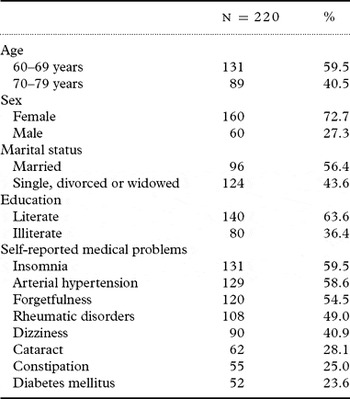
A total of 220 subjects were interviewed from November 2002 to November 2003. Major depressive episodes were present in 14% of the sample (according to the SCID-I). Sociodemographic and general medical variables are summarized in Table 1. As expected, the sample had numerous medical problems and complaints. Of importance, the vast majority of the sample (98.6%) was independent regarding the performance of ADLs.
Sociodemographic characteristics of the 220 elderly subjects included in the study

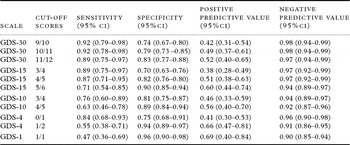
The sensitivity, specificity, PPV and NPV of various cut-off scores of the GDS-30, GDS-10, GDS-15, GDS-4 and GDS-1 are summarized in Table 2.
Performance of the different versions of the Geriatric Depression Scale (GDS) at different cutoff points for the detection of a major depressive episode according to DSM-IV.

The optimum cut-off point for major depression was 10/11 for the GDS-30, as determined by the coordinates of the receiver operating characteristic curve. At this cut-off point, sensitivity was 92.1% (95% CI: 77.5–97.9); specificity was 79.7% (95% CI: 72.9–85.1); PPV was 48.6% (95% CI: 36.8–60.3); and NPV was 98.0% (95% CI: 93.7–99.5). The area under the ROC curve was 0.93 (P-value < 0.001; 95% CI: 0.89–0.97). Cronbach's α coefficient value demonstrated good internal consistency reliability for the GDS-30 (0.88; 95% CI: 0.86–0.90).
The optimum cut-off point for the GDS-15 was 4/5, at which point sensitivity was 86.8% (95% CI: 71.1–95.1); specificity was 82.4% (95% CI: 75.9–87.5%); PPV was 50.8% (95% CI = 38.2 to 63.3%); and NPV was 96.8% (95% CI = 92.2 to 98.8%). The area under the ROC curve was 0.91 (P-value < 0.001; 95% CI = 0.86–0.96). Cronbach's α coefficient value for the GDS-15 was 0.81 (95% CI = 0.78–0.85).
The cut-off of 3/4 for the GDS-10 produced sensitivity, specificity, PPV and NPV of: 76% (95% CI = 60 to 89%), 81% (95% CI = 76 to 80%), 46% (95% CI = 33–59) and 94% (95% CI: 89–97), respectively. The area under the ROC curve for the GDS-10 was 0.86 (P-value < 0.001; 95% CI: 0.83–0.94). Cronbach's α coefficient value for the GDS-10 was 0.77 (95% CI: 0.71–0.81).
The optimum cut-off point for GDS-4 was 0/1, where sensitivity was 84.2% (95% CI: 68.1–93.4); specificity was 74.7% (95% CI: 67.7–80.7); PPV was 41% (95% CI: 30.2–52.7) and NPV was 95.8% (95% CI: 90.6–98.3), respectively. The area under the ROC curve for the GDS-4 was 0.85 (P-value < 0.001; 95% CI: 0.77–0.92). Cronbach's α coefficient value for the GDS-4 was 0.74 (95% CI: 0.60–0.69)
For GDS-1, sensitivity was 47.5% (CI 95%: 36.0–68.7); specificity was 95.6% (CI 95%: 90.5–97.6); positive predictive value was 69% (CI 95%: 49.0–84.0); and negative predictive value was 90.6% (95% CI: 85.3–94.2). The area under the ROC curve for the GDS-1 was 0.74 (P-value < 0.001; 95% CI: 0.64–0.84).
Discussion
Although the present work was not designed to be a prevalence study, we found that 14% of the sample had a diagnosis of a major depressive episode. This figure is within the prevalence range of major depression in aged persons in primary care: 37% in London (Evans and Katona, Reference Evans and Katona1993), 13.7% in the Netherlands (Licht-Strunk et al., Reference Licht-Strunk2005), 13% in Sweden (Gottfries et al., Reference Gottfries, Noltorp and Norgaard1997), 18% and 9% in American women and men, respectively (Barry et al., Reference Barry, Fleming, Manwell, Copeland and Appel1998).
The detection of depression in elderly primary care patients can be facilitated through the use of screening tools. The choice of instrument should be based on its capacity to detect cases as well as evaluate the severity of symptoms and the time consumed in the application of the instrument. Cultural factors should have no impact on the performance of an instrument used for such a purpose.
The present study demonstrated that the GDS-30, GDS-15, GDS-10 and GDS-4 have robust sensitivities, specificities and NPVs. The PPVs were relatively lower, around or even below 50%. However, given that the GDS would be used by the general practitioner as a screening tool, it is important that the instrument had high sensitivity and NPV in order to detect the majority of cases, albeit at the cost of labeling as ill those patients who are not in reality. Those aged primary care patients with positive results who therefore have a higher probability for depression should be evaluated in depth by the general physician before initiating any treatment.
The ideal cut-off score for the GDS-30 in this study was 10/11 (non-case/case). This cut-off score was similar to those obtained in other studies involving primary care patients worldwide. This score is consistent with various studies involving the use of the GDS-30 as a screening instrument, as systematically reviewed by Wancata et al. (Reference Wancata, Alexandrowicz, Marquart, Weiss and Friedrich2006). The high sensitivity and NPV of the GDS-30 support its routine use for the screening of geriatric depression in primary care services in Brazil.
The cut-off score of 4/5 for the GDS-15 is in agreement with other reports from the literature (Almeida and Almeida, Reference Almeida and Almeida1999a; Wancata et al., Reference Wancata, Alexandrowicz, Marquart, Weiss and Friedrich2006). An ideal cut-off of 7/8 was reported for the Arabic GDS-15 version, in a study performed in Lebanon with a sample that included individuals recruited from primary care services (Chaaya et al., Reference Chaaya2008), whereas a much lower cut-off of 2/3 was obtained from a primary care study performed by van Marwijk et al. (Reference van Marwijk, Wallace, de Bock, Hermans, Kaptein and Mulder1995). Variations in cut-off scores might reflect differences in methodologies across the studies. For example, Chaaya et al. (Reference Chaaya2008) did not use a structured or semi-structured instrument as a “gold-standard” for depression, whereas van Marwijk et al. (Reference van Marwijk, Wallace, de Bock, Hermans, Kaptein and Mulder1995) used the diagnostic interview schedule as their “gold standard” for the diagnosis of depression. However, the psychometrics of the GDS-15 obtained in the present study suggests that its use may add the correct identification of geriatric depression among Brazilian primary care patients.
The cut-off score of 3/4 for the GDS-10 and 0/1 for the GDS-4 also produced robust results. The effective use of the GDS-10 as a screening tool for geriatric depression has been suggested by other studies (D'Ath et al., Reference D'Ath, Katona, Mullan, Evans and Katona1994; van Marwijk et al., Reference van Marwijk, Wallace, de Bock, Hermans, Kaptein and Mulder1995; Almeida and Almeida, Reference Almeida and Almeida1999a). The 4-item GDS has been investigated by several studies with encouraging results (D'Ath et al., Reference D'Ath, Katona, Mullan, Evans and Katona1994; Almeida and Almeida, Reference Almeida and Almeida1999a; Clément et al., Reference Clément, Nassif, Leger and Marchan1997).
The GDS-1 failed to exhibit adequate sensitivity in the present study. However, as it demonstrated high specificity and NPV, the negative answer to the item “are you generally satisfied with life?” may effectively rule out a major depressive episode. As this item is included in all versions, it is important to pay particular attention to the response to this question.
The present study also demonstrated that the GDS-30, GDS-15, GDS-10 and GDS-4 have high internal consistency reliability (Cronbach's α coefficients of each version were all above 0.7).
In conclusion, the 30-, 15-, 10- and 4-item versions of the geriatric depression scale had adequate criterion validity and internal consistency reliability. The satisfactory performance of the shortened versions renders them particularly appealing for use in primary care clinical practice, where the majority of elderly individuals with depression are attended.
Conflict of interest
None.
Description of author's roles
M. S. Castelo contributed to the design and implementation of the study. J. M. Coelho-Filho contributed to the conceptualization of the study and helped write the paper. A. F. Carvalho contributed to data analysis and helped write the paper. J. W. O. Lima contributed to data analysis. J. C. S. Noleto collected the data and helped organize the data banks. K. G. Ribeiro collected the data. J. I. Siqueira-Neto contributed to the conceptualization of the project and writing of the paper.
Acknowledgment
The present work was supported by the Ministry of Health / DECIT / SESA, Ceara, Brazil.