




No CrossRef data available.
Article contents
From Somerset to Samaná: Preverbal did in the voyage of English
Published online by Cambridge University Press: 01 July 2004
Abstract
This article aims to contribute new data on periphrastic did by systematically examining its behavior in two varieties of English: Somerset English (SMT), a variety spoken in Southwest England, and Samaná English (SAM), a variety spoken in the Samaná peninsula of the Dominican Republic. We hope to contribute a broader historical and cross-dialectal perspective for understanding the origin and function of periphrastic did in nonstandard varieties of English. We focus on the linguistic contexts of its occurrence from the diachronic and synchronic literature. The results show that periphrastic did is conditioned by a number of constraints, which can be traced throughout the history of the English language, as well as some constraints from English-based creoles. Interpreting these results reveals that the similarities between the two varieties are the result of linguistic diffusion.We gratefully acknowledge the generous support of the Economic and Social Research Council (ESRC) of Great Britain for a DPhil studentship to Jones (R42200034220), as well as the support of the Social Sciences and Humanities Research Council of Canada for Tagliamonte's doctoral fellowship. We would like to acknowledge the University of Ottawa's Sociolinguistics Laboratory, under the direction of Shana Poplack, where the research for the Samaná English corpus was originally carried out for Tagliamonte's PhD dissertation. We would also like to thank Anthony Warner for important comments and suggestions on earlier versions of this analysis and our reviewers who provided invaluable input. We dedicate this article to the speakers of the new Somerset English corpus, who contributed the data on which this study is based.
Information
- Type
- Research Article
- Information
- Copyright
- © 2004 Cambridge University Press
The research program exploring underlying grammatical relationships between dialects, particularly those between British and American English, is now nearly a century old. This research began with standard dialectological methods (Kurath, 1928, 1939, 1949, 1964; McDavid, 1985); in recent years, however, standards for comparison in this enterprise have received increasing attention as researchers have renewed efforts to establish trans-Atlantic linguistic links (e.g., Clarke, 1997b; Harris, 1986; Rickford, 1986b). The methodology of the historical comparative enterprise has formed the foundations of this research program. More recently, the quantitative techniques and tenets of variationist sociolinguistics, including Labov's (1972:72) principle of accountability, have added yet another dimension (see e.g., Montgomery, 1989; Rickford, 1986a). To date, however, very few studies have provided this type of analysis, nor have they fulfilled the standards of evidence for the establishment of historical links explicitly laid out in the literature. Ideally, as Schneider (2004) observed, in order to establish trans-Atlantic connections we should aim for: “evidence of historical connections, functional identities, or similar effects … it is only parallels of such a subtle nature or the joint weight of several sets of data that should allow us to assume direct transmission in select instances.”
In the absence of suitable corpora, principled data collection, enunciation and operationalization of hypotheses, and accountable statistical analyses, most studies have been, at most, suggestive.
Some standards for comparison are explicitly laid out in Montgomery (1989:240), outlined in Figure 1. To this this we add, following Poplack and Tagliamonte (2001), the three lines of evidence used in standard variationist methodology—statistical significance, constraint hierarchies, and the relative strength of factors, as well as the details of comparative methodology laid out in Poplack and Tagliamonte (2004).1
Note that the comparative analysis of verbal -s in Samaná and Devon in Poplack & Tagliamonte (2004) predates the present analysis by several years despite the publication date.

Standards for comparison (adapted from Montgomery, 1989:240).
Most important of these are that: (1) the grammatical features should be as closely limited to the varieties concerned as possible, and (2) there are demonstrable historical connections between the groups speaking those varieties. Constructing a research project in which all these standards of comparison are appropriately met is difficult. However, as we will outline, a project that specifically addresses as many of the external criteria as possible and that fully complies with methodological considerations, can contribute strong empirically-based observations. These, in turn, can be used to inform future work.
Of all the varieties that have been used to establish connections between new and old world varieties, one of the most controversial is African American Vernacular English. This is because its origins and development are widely disputed, putting it at the center of such investigations (see e.g., Mufwene, 1996; Mufwene et al., 1998; Poplack, 2000; Rickford, 1998, 1999; Winford, 1997, 1998). The main site of the controversy derives from the following question: Given that there are two major geographic locales that figured in early American population movements—Britain and West Africa—do the features of American varieties whose speakers have African ancestry derive from African roots? Or have they developed from an earlier stage in the evolution of English dialects? Further, if these varieties have restructured certain linguistic features, did they do so from one source, or the other, or both?
By necessity, much of the linguistic evidence brought to bear on this issue has focused on features that are both frequent and widely-attested in African American Vernacular English and not part of mainstream American English. Some notable contributions have included verbal -s (e.g., Clarke, 1997a; Montgomery & Fuller, 1996; Montgomery et al., 1993; Poplack & Tagliamonte, 1991), was/were variation (Wolfram & Thomas, 2002), zero copula (Rickford, 1996, 1998), and relative pronouns (e.g., Tottie & Harvie, 2000). The problem is that this necessarily provides a number of features, which, because they appear in so many varieties, could very well be subject to universal constraints. This becomes a self-defeating circle. For example, in the numerous studies on verbal -s, the recurrence of the Type of Subject constraint, which is also present in British dialects (e.g., Godfrey & Tagliamonte, 1999), has led some researchers (Poplack & Tagliamonte, 2001, 2004) to the hypothesis that varieties that share this constraint can be traced back to British roots. However, if the constraint is, in fact, universal, because it is so widespread, then verbal -s is not a good test for trans-Atlantic connections. Thus, one of the most important methodological problems in this endeavor is finding the right diagnostic (Wolfram, 2000:47).
In the pantheon of linguistic features that have been considered in this research endeavor, nonstandard habitual forms and their associated functions present a particularly good case. The aspectual meaning of “habitual” is said to be grammaticalized across all the putative sources for Atlantic contact vernaculars—Irish English, British Dialects, and West African languages (e.g., Harris, 1986; Hopkins, 1994; Rickford, 1986b). However, most, if not all of the research that discusses these features is based on present temporal reference forms, whether do be, do + V, verbal -s, do + V +ing, do + be + V + ing, or various combinations thereof. The distribution patterns of these features, as well as their diachronic and synchronic development, is discussed extensively in the literature. However, the criss-crossing of origins (Northern vs. Southern Ireland vs. Southwest British) and subsequent dialect contact in the United States leaves little room for unambiguous interpretations of the dialect contact situation (see McDavid, 1985:19–20; Montgomery, 2001). Indeed, even in the rare case when sociohistorical links can be firmly traced back in time, as in the case of Vernacular Newfoundland English (Clarke, 1997b), the sheer lack of the feature in question in the transported variety presents the ultimate paradox for the comparative endeavor.
However, both the linguistic and sociohistorical quandary associated with the do habitual forms, in particular, can be addressed in the study of a closely associated feature—affirmative periphrastic did, which provides an entirely different type of diagnostic. First, it is rarely attested. Second, it is currently localized to a particular region in Britain (the West Country), and within that region, to a limited range of source dialects.2
As pointed out by a reviewer of this manuscript, historical research carried out on affirmative periphrastic do in Early Modern English is based on the general written sources of the time, not specifically on West Country data. Indeed, until recently, there has been next to no dialect research on the period between 1500 and 1700. However, during this time period, the spelling of the English language was standardized to a point where texts became nonlocalizable on the basis of orthography.
Fortuitously, the use of did in affirmative periphrastic constructions persists in two varieties of English critical to the issue of American/British historical connections—one on either side of the Atlantic: Somerset English (SMT), a variety spoken in Southwest England, as in (1), and Samaná English (SAM), a variety spoken in the Samaná peninsula of the Dominican Republic, as in (2):3
Codes in parentheses identify the community (Somerset = SMT, Samana = SAM), single character speaker code, and coordinates of the token in the transcription of the data.

Although the same form occurs in Ireland, its characteristics in Samaná and Somerset are essentially different on three counts. (1) In Ireland, periphrastic do often occurs with be, for example, does be or do be, whereas in Somerset (Jones, 2000) and Samaná (Walker, 2000) it does not. (2) When periphrastic do occurs with a verb other than be it is inflected, for example, does tell.4
In most analyses, do/did variation is inflectional. Here, what is significant is the absence of 3rd singular present marking.
DO + lexical verb occurs in both locales. In Somerset, constructions of this type form 10% of present tense affirmative declarative contexts (Jones, 2000:48). Conversely, Walker (2000) reported 1% DO in these same contexts in Samaná English.
Thus, periphrastic did in these varieties provides an unprecedented diagnostic for tracking the diffusion of linguistic features from Britain to the Americas. First, as far as we are aware, these are the only two contemporary varieties in which periphrastic did exists within the highly circumscribed function described previously. Consequently, this provides a showcase for the requirement proposed by Montgomery (1989:240), that comparative features be as closely limited to the varieties concerned as possible.
However, are there demonstrable historical connections between these two varieties? Generalized variability of periphrastic DO6
Our use of upper case DO encompasses both present and past temporal reference uses, as is typical for discussions of this feature in the historical literature.
Such sociohistorical links can be corroborated by the fact that, although periphrastic did is rarely attested anywhere outside of Southwest England, where it is found, it is attested with similar distributional restrictions and in varieties of African American English. For example, in the Ex-Slave Recordings (Tagliamonte, 1991), the Ex Slave Narratives (Schneider, 1989:138–9), and Gullah (Pargman, 2000), there is no did + be.7
Pargman (2000:7–8) reported that, in modern Irish English, periphrastic DO is used differently from Gullah duh in three fundamental ways. (1) Gullah duh generally does not occur with the verb be. (2) Gullah duh is an invariant form and is not inflected with 3rd singular subjects. (3) Gullah duh can convey progressive meaning, as could early Southwest British dialects, and almost certainly present-day Southwest dialects. There is, however, a separate does form which may or may not be related to Irish English.
Yet, even when the right feature with the right historical connections is found, “there is no substitute for the rigorous application of the principles of traditional historical and comparative linguistics” (Harris, 1986:192). It is to this type of analysis that we now turn. In the next section, we provide a description of the grammatical feature from diachronic and synchronic perspectives, discussing the constraints reported for this feature in English dialects and English-based creoles. In the third section, we detail the data and analytic method through which we operationalize these constraints in our data. In the fourth section, we present a distributional and multivariate analysis of the contribution of these factors. In the fifth section, we compare the results across varieties and synthesize our observations.
PREVIOUS ANALYSES OF DO
Periphrastic DO in general,8
We note that historical research on DO is not confined to the habitual use of affirmative do in general or to habitual did in particular.

The reasons for this development, however, are much debated in the historical literature. A number of different hypotheses have been put forward, all of which come from analyses of texts dating from the Old English period (see e.g., Denison, 1985, 1993; Ellegård, 1953; Visser, 1963–1973). Denison (1993:274–287) outlined a number of possible explanations:
- Periphrastic DO arose as a consequence of a semantic change affecting an extant Old English construction (Ellegård, 1953; Engblom, 1938).
- The construction developed as a result of a syntactic change (different in each account) involving reanalysis of an extant Old English construction (Denison, 1985; Klemola, 1996; Kroch, 1989; Roberts, 1985; Visser, 1963–1973:§1412–14a).
- Periphrastic DO was calqued on the common Old Welsh gwnuethur ‘DO’ + verbal noun construction (Preusler, 1938:1939–40, cited in Ellegård, 1953:119–20).
- Periphrastic DO arose in colloquial Old English through Saxon-Celtic contact in the west and may have derived from substratal influence of the Celtic tense/aspect system (Poussa, 1990; Tristam, 1997, 2000; Vennemann, 2001).
Whatever the underlying mechanism that produced the periphrastic DO construction, it is generally accepted that it spread outward from the Southwestern regions of Britain. It was adopted in London quite early, eventually being incorporated in Standard English as a compulsory element for negated and inverted sentences. The feature gradually spread northward, simultaneously varying with both inflected present, (4a), and past-tense, (4b), verbs (James White, 1761, cited in Visser, 1963–1973:1508). In northern varieties, the feature remained infrequent (Ellegård, 1953; Klemola, 1996; Meurman-Solin, 1993; Mustanoja, 1960). Indeed, Klemola noted that there is evidence that the use of the periphrastic auxiliary DO was a relatively late introduction in northern dialects, which came about as a change from above (see e.g., Labov, 1966/1982, 1994) under the influence of the emerging London Standard.

It is important to note that periphrastic auxiliary DO has a long history of differentiation according to context. It developed rapidly in negative constructions (questions, declaratives) and affirmative questions, going to near completion between 1400–1700.9
For a full description of the history and development of periphrastic DO, see Denison, 1985, 1993; Ellegård, 1953; Engblom, 1938; Kroch, 1989; Kroch & Taylor, 1997; Ogura, 1993; Poussa, 1990; Roberts, 1985; Visser, 1963–1973.

Percentage frequency of DO in affirmative declarative contexts (Ellegård, 1953:162).
It is important to note that affirmative declarative DO never exceeded 10%, even at the most frequent point of its development (Fig. 2). Despite this low frequency, however, in the western and southwestern regions of England it endured. Wright noted that “the periphrastic form I do love &c. for I love &c. is in gen.[sic] use in the Southwestern dialects” (1898–1905:297). Throughout the 19th century there are several attestations in the dialect literature for the Southwest (e.g., Barnes, 1886; Elworthy, 1877). Dialect grammars and surveys (based on Ellis, 1869–1889, see also Klemola, 1996), provide evidence that the construction, while largely absent in Devon and Cornwall, was retained in Somerset, Dorset, Wiltshire, and the western parts of Hampshire, and further north in Gloucestershire, South Wales, and southern Hereford and Worcestershire. According to the Survey of English Dialects (Orton, 1962), the form continues to exist in most of the same localities where it was attested in the 19th century (Ellis, 1869–1889), and it is reported consistently in Somerset in more contemporary writings (Ihalainen, 1976; Klemola, 1996; Wakelin, 1977, 1986; Weltens, 1983).
Constraints in the historical record
During the period of expansion of affirmative declarative DO (hereafter, simply DO), a series of internal constraints were in operation. Extrapolating from a number of studies based on historical corpora, we have identified a number of internal factors. These studies include Ellegård's (1953) study of texts written between the 14th and 18th centuries, Rissanen's (1985, 1991) research on Early Modern British English (1500–1710) and American English (1620–1720) in the Helsinki Corpus, Nevalainen's (1991) work on Early Modern English Liturgical Prose, and work on the Corpus of Early English Correspondence (Nurmi, 1998a, 1998b, 1999a, 1999b, 2000).
Type of clause
Periphrastic DO is said to occur more frequently in certain types of clauses. Stein (1990) suggested that DO is a main-clause phenomenon, which marks the pivotal points in the message. Samuels (1972), on the other hand, claimed that it was used in the lengthy complex sentences of Elizabethan writers to indicate a return to the main clause, particularly after the interruption of a subordinate clause. Nevalainen (1991:310–311) found that, in the Early Modern English period, DO served as a subordinate clause marker, with 86% of cases of DO occurring in subordinate clauses. A high frequency of DO is also reported in relative clauses. Rissanen, in a corpus representing early American spoken English, concurs that DO-periphrasis is used particularly in subordinate clauses beginning with as or with a relative pronoun. He also reported a tendency for DO in coordinated verbs (1985:173). Denison (1993:283) observed that periphrastic DO occurred in these coordinated structures to avoid the repetition of tense marking. This suggests that certain types of clauses are implicated in the distribution of DO, but without quantitative evidence it is difficult to assess which observation is the most appropriate or accurate account for DO.
Aspect
Use of DO has long been associated with different aspectual readings of the verb. For some researchers, this came about because “by virtue of mere availability it had been differentiated and realigned to an aspectual function” (Samuels, 1972:176). However, the specific aspectual function attributed to DO varies.10
Several different semantic functions have been attributed to periphrastic DO in the Early Modern English period. Traugott (1972:139) has suggested that, in connection with the collapse of the subjunctive system in the Middle English period, DO was used as an indicative mood marker to assert the truth of a statement. Traugott's hypothesis applies to only a limited number of cases, however, and there are many counterexamples. Thus, it has been largely rejected by scholars.
In checking the 13th- and 14th-century examples of “DO + infinitive,” Denison (1985:54) observed that “the vast majority” of examples were “telic”: that is, that they denoted accomplishments. A smaller set represented achievements or “punctual” verbs. Fewer than ten examples encoded states. Denison argued that this evidence, taken with the development during the 11th to the 13th centuries of various new aspect- and aktionsart-marking devices, suggests that at this time DO fulfilled the function of an aktionsart marker for nonstative infinitives.
From the earliest dialectological observations, in particular with respect to southwestern dialects (e.g., Barnes, 1886; Elworthy, 1877), periphrastic do and did have been associated with habitual aspect, as in (5), (Edwards & Weltens, 1985:112–13; Harris, 1986; Trudgill, 1986:70–71).
(5) A boy said to me, in speaking of some days of very hard frost, “They did break the ice at night, and did vind it avroze ageän nex' mornèn.” That is they broke and found several times. If they had broken and found only once, he would have said: “They broke the ice at night, an' vound it,” etc. (Barnes, 1886:23)
Nevertheless, Klemola (1996:92) argued that these observations were misinterpreted and that periphrastic DO was never a habitual marker. However, this observation is made without accountable evidence for the extent to which did marks habitual contexts, out of all the habitual contexts that occur, and similarly, punctual events out of all the possible punctual contexts. We return to this issue in the subsection “Circumscribing the variable context.”
Adverb position
Periphrastic DO has long been connected with the use of adverbs (see Ellegård, 1953; Engblom, 1938; Nevalainen, 1991; Rissanen, 1985, 1991). This tendency was first noted by Grainger: “Some adverbs must stand next to the verb and yet will make an awkward sentence if placed between either subject and verb or verb and object. In such a case the verb is split in two by introducing a form of do. The adverb is placed between the do-form and the verb proper” (Grainger, 1907:22).
Engblom (1938:89) distinguished three types of adverb placement, as in (6).

In the first type (6a), it was argued that DO would be added because the verb needed more weight when separated from its subject (Engblom, 1938:89,115). However, this construction was a short-lived stylistic device which never “gained a firm foothold in the spoken language” (Ellegård, 1953:181). Type (6b)—referred to by Ellegård as a ‘sdav’ sentence—that is, (subject + DO + adverb + verb) was more frequent and survived much longer. In Ellegård's material, these constructions increase over time, he observed that: “the instances where an adverb occurs between the auxiliary and the infinitive make up an increasing proportion of the total number of affirmative declarative DO-instances” (Ellegård, 1953:181). Indeed, by the 17th century the ‘sdav’ contexts made up some 30% of all instances of periphrastic DO in affirmative sentences (Ellegård, 1953:182).12
Once again, however, without the proportion of other verb forms, this is not very revealing.
Although the number of instances of preverbal adverbials without do-support is not given.
Type of verb
In the historical literature, the particular lexical verb used with DO has often been cited as a factor conditioning its use (Ellegård, 1953; Engblom, 1938; Ihalainen, 1976; Nurmi, 2000; Ogura, 1993; Rissanen, 1985; Tieken-Boon van Ostade, 1987; Traugott, 1972; Visser, 1963–1973). This has been described in terms of lexical collocation patterns, morphological class, and transitivity. We discuss each in turn.
Lexical collocation patterns. Strong emotional content verbs have a tendency to occur with periphrastic DO. Ellegård (1953:172), for example, noted the tendency for DO to cooccur with verbs such as beseech, believe, confess (see also, Nevalainen, 1991:306; Rissanen, 1985:168–72). Other authors, however, have noted that the occurrence of DO is not confined to these verbs (Nurmi, 2000:92; Rissanen, 1985:164ff, 1991:326ff). Ellegård noted that 216 out of 370 DO-instances in Machyn's diaries involve the verb preach (1953:166). Further, “verbs […] singled out for preferential treatment are not always the same with different writers” (1953:167). A related explanation is that there was a tendency for DO to occur with latinate verbs and neologisms that had not been fully assimilated into the grammatical system (Samuels, 1972:174). The observations, outlined previously, suggest that verb collocations with DO are highly idiosyncratic. Thus, any analysis of this feature must take lexical patterning into account.
Morphological class. A second tendency relating to lexical verb, but one more suitable for quantitative testing, is morphological class. Irregular verbs are said to be more likely to occur with DO. The reasons for this are varied. Krüger claimed that “the do-form was resorted to because speakers would not go to the trouble of finding the ‘correct’ form of a strong verb” (cited in Engblom, 1938:106). On the other hand, Ellegård (1953:180) reported that some authors in his study show a preference for DO with verbs in which the present and past are identical, for example, put, cut, set (see also Jespersen, 1909/1949; Rissanen, 1985:165).14
In fact, Ellegård (1953) found that regular verbs were propitious to periphrastic DO; however, because of the massive shifts from strong to weak verb classes in the 16th century, this distinction is impossible to test on contemporary data.
Transitive effect. A third tendency relating to verb type may be discovered in the historical dialect literature for Somerset in which transitive and intransitive verbs are said to behave differently with respect to DO. Elworthy (1877:50) observed that transitive verbs may have two different forms. When they are used without an object, they take DO as well the suffix ‘ee’,15
The spellings here are retained from the original sources. The -ee suffix that appears on this main verb was once commonly used in Southwest dialects for verbs not followed by a direct object and derives from the suffix -ian of the Old English second class of weak verbs (Gachelin, 1991:224). This suffix is largely obsolescent in the Southwest today.

Although these observations of Elworthy's are part of the received wisdom about DO in Southwestern British dialects (see Ihalainen, 1976:612; Klemola, 1996:87), this distinction has never been investigated quantitatively.
Reports in the contemporary literature
Aside from the historical literature and Southwest England, preverbal DO more generally is attested in Welsh English (e.g., Thomas, 1985), (8a), Irish English (e.g., Harris, 1986; Kallen, 1985, 1989), (8b), and Newfoundland Vernacular English (Clarke, 1997c), as in (8c). There are also many reports of similar forms in Caribbean English-based creoles. These include Trinidadian (e.g., Winer, 1993), Barbadian (e.g., Burrowes, 1983), Guyanese (e.g., Bickerton, 1975), Limón Creole English (e.g., Herzfeld, 1983), and Jamaican Creole (e.g., Patrick, 1999), as in (8d). It is also reported in Gullah (Pargman, 2000), as in (8e), and there are a few examples in the Ex-Slave Recordings (Tagliamonte, 1991), as in (8f).

As mentioned earlier, all the varieties in which DO is reported may be distinguished with respect to one main factor. In Southwest England DO never occurs with the verb ‘be’.16
The only examples of cooccurrence of do and be in Britain are found in Wright (1900), as in (i.a–d).

All these examples are taken from locations on the periphery of the DO-area described in the historical literature (Ellis, 1869–1889). Klemola argued that the reliability of these examples is “somewhat questionable” (1996:68).
Aside from the divide between varieties which employ periphrastic DO with ‘be’ and those that do not, a number of internal factors have been identified in contemporary studies. We now turn to a discussion of these factors.
Habitual aspect
Ihalainen (1976) analyzed the use of affirmative periphrastic did in eight speakers in the dialect of East Somerset in the early 1970's.17
The speakers chosen for Ihalainen's (1976) study fulfilled the characteristics of norm speakers. The term norm—Nonmobile, Older, Rural, Male—coined by Chambers and Trudgill (1980:33–35), refers to the characteristics of the informants used in dialect surveys, such as the SED (Orton & Halliday, 1963). Such speakers were selected to tap into traditional dialects. Orton (1962:14) described the rationale behind such a method of informant selection as:
The kind of dialect chosen for this study was that normally spoken by elderly speakers of sixty years of age or over belonging to the same social class in rural communities, and in particular by those who were, or had formerly been, employed in farming, for it is amongst the rural populations that the traditional types of vernacular English are best preserved today.
The study is not conducted quantitatively. However, Ihalainen illustrated the frequencies of did, used to, and would/'d in four of the interviews. The results are as follows:

Unfortunately, Ihalainen does not take into account the fact that habitual or generic events can also be expressed by the preterit form of the verb (Quirk & Greenbaum, 1972:43). Consequently, these results cannot be directly compared with those of this study. Moreover, no overall frequency can be inferred.
(9) We did come back then and we did have a glass or two of cider, and then we did go and have a bit of breakfast, come out again and then we did have another drink before we did start off. (Ihalainen, 1976:615)
This led Ihalainen to conclude that periphrastic did is a grammaticalized habitual aspect marker in the dialect of East Somerset. However, additional fieldwork revealed that did simply showed a tendency to be used in habitual contexts (Ihalainen, 1981:27). Consistent with this, Weltens (1983) reported that there is no convincing evidence to support a conclusion that periphrastic DO would occur only in habitual contexts.19
In the localities investigated in South Wales, however, there was clear evidence for an aspectual distinction, because these informants accepted only the habitual examples of periphrastic DO, rejecting all sentences referring to a punctual event (Weltens, 1983:61).
Stativity/Anteriority
The association of preverbal did with past and/or anterior tense has received considerable attention in the Creolist literature (see Patrick, 1999:203). These effects are associated with the mesolect or higher lects in the creole continuum. According to Bickerton (1975:70), did is “simply slotted into place in [the] creole structures” of Guyanese: “the mesolectal Guyanese speaker has […] did for [+anterior] past actions and states” (Bickerton, 1975:103). The weakest version of the Creolist hypothesis states that when past-reference is indicated by preverbal markers, such as did, it is not equally marked in stative and nonstative clauses, or anterior and nonanterior ones. Statives, in general, should occur with did. In addition, did should also mark “past before past” clauses, which invert the iconic chronological order of events, regardless of stativity. Unfortunately, examples of periphrastic did illustrating these effects are difficult to find. Patrick provided only a single exemplar of periphrastic did, as in (10), which illustrates the use of did in a [–stative, +anterior] context.20
An exhaustive search of published works on this subject uncovered not a single example of periphrastic did in a [+stative; +anterior] context.
(10) /wen ai did meik di haplikieshan ai sieted a intelijent

“When I did make the application I stated ‘an intelligent person’”
(Patrick, 1999:219)
Patrick (1999:214) is perhaps the only researcher who has subjected periphrastic did in a creole variety to an accountable statistical analysis. In his study of Urban Jamaican Creole, he found that stative verbs strongly favored past-marking with did, as well as another preverbal marker neva (28%), and tended to disfavor verb inflection. Punctual verbs, on the other hand, rarely occurred with these markers (7%). Anterior clauses also showed a strong preference for preverbal did and neva marking (20%) as opposed to sequenced clauses (7%), following the predictions of Bickerton's hypotheses (Patrick, 1999:218). Thus, we would hypothesize that a creole-like system would be identifiable by a strong association of periphrastic did with stative and anterior verbs.
Parallel processing
Another factor that has been reported to constrain the use of do and did is parallel processing, an effect in which “marking leads to further marking and lack of marking leads to further lack of marking” (Poplack, 1979, 1980; Scherre & Naro, 1991). In the literature on DO, this effect has been referred to as “clusters of do” (Rissanen, 1985:168), as exemplified in (11).
(11) It is trew yow did in privat declare yowr grevance to me abowt the greate Iniurie that was done to yow, and yow did tell me yow wear very jeliows of such a combination. Therfor I did exhort and advice yow to be very carefull how yow did use any such speeches or how yow did entertayne such jelowsies of Bretheren except yow be able suffitiently to prove it, and I thought yow would be advised by me, but yow wear not, but in an unsatisfied way did goe from one to another and inqwier of this and that men. (Rissanen 1985:168).
Klemola (1996:137–139) reported that in his data there is a significantly greater probability for the periphrastic construction to occur if the preceding construction is also periphrastic DO + VERB, than if it is any other form. This predicts that periphrastic DO is subject to parallel processing.
Our discussion, up to this point, has demonstrated that, despite the infrequent and highly circumscribed diffusion of affirmative periphrastic did, quite a number of internal constraints may be salvaged from the historical literature. Moreover, at least one effect can be extrapolated that dictates how the form might be expected to operate in a creole-like grammar. In the remainder of this article, we explore quantitatively the behavior of did, testing specifically for these constraints, paying particular attention to their statistical significance, constraint hierarchy, and relative strength.
Interpreting these results from a historical and comparative perspective will provide evidence for whether the variation observed in these corpora can be explained as diffusion, restructuring, or independent development. If the data suggest diffusion, then we will take this evidence to posit trans-Atlantic connections between Somerset and Samaná.
DATA AND METHOD
The communities
The data on which this report is based come from two communities, which can be differentiated by two major criteria: (1) their geographical location and (2) the ethnic background of the speakers. Samaná is an English-speaking community located on the Samaná peninsula of the Dominican Republic, made up of fourth-generation descendants of African-Americans who colonized the area in 1824. Somerset, on the other hand, is located in the Southwest of Great Britain. The vast majority of the residents trace their family lines back for centuries. Aside from these extreme and obvious differences, the two communities are, in fact, quite similar according to broad cultural characteristics.
Somerset, Great Britain
Somerset is located on the Southwestern peninsula of Great Britain, approximately 120 miles from London. It is bordered mostly by coastline, hill ranges, and moorland, all of which form natural barriers that have contributed to its geographical isolation even to the present day. Somerset is a predominantly rural agricultural county with minimal development; just 5% of the land is occupied by villages or towns.
The data were collected in and around Wincanton, a small town with a population of 4600, by Jones, an in-group member. The fieldwork for this study was conducted in 2000 and involved sociolinguistic interviews with the oldest members of the community, most of whom were (or had been) involved in agriculture and had left school by the age of 14.21
This was the minimum age for leaving school at the time.
Samaná, Dominican Republic
Samaná is located on the Northeastern peninsula of the Dominican Republic in the Caribbean Sea. The community was settled in 1824 by African American ex-slaves or their descendants who emigrated there from the United States. As detailed extensively elsewhere (e.g., Poplack & Sankoff, 1987; Poplack & Tagliamonte, 1989, 2001) this variety of English can be linked to that spoken by African Americans in the early 1820's. As in Somerset, the speakers are the oldest members of the community, many of whom worked in small-scale agriculture, and had minimal education. Although these materials were not collected by in-group community members, consistent comparison with other off-shoot varieties of African American Vernacular English that were settled contemporaneously have demonstrated notable parallelism, suggesting that the observer's paradox was sufficiently mitigated (Poplack & Tagliamonte, 2001).
Thus, both of these corpora are highly informal and, as far as possible, represent the typical discourse found in each community. On the basis of measures of geographic remoteness, social networks, employment, and education vis-à-vis the supra-local community, these two varieties can be characterized as highly conservative. Indeed, they exhibit many of the characteristics of “peripheral” areas, which in historical linguistics are widely known to provide choice evidence about earlier stages of a language (Anttila, 1989; Hock, 1986).
Features in common in Somerset and Samaná
Even cursory examination of the data corroborates a hypothesis for the extreme conservatism of linguistic features, that are also shared between the two communities. Both retain features recorded in the history of English that have since become obsolescent or moribund. These include perfective be, as in (12),22
The pattern with I'm got is limited in these varieties; however, a number of examples occur in each corpus. The apparent use of the be-perfect with transitive verbs is noted in Denison (1993:363–64). Further discussion of these forms in the Samaná corpus can be found in Tagliamonte (1996, 1997).

Many of these can be traced back to at least the Early Modern English period, with some having arisen in Old English and early Middle English.
However, it is the steadfast survival of affirmative periphrastic did in these two varieties that is most intriguing, especially considering that the construction never became very frequent in the standard language (Figure 1), and that it was lost in most varieties of English some centuries ago. In the varieties at hand, language shift from English to Spanish in Samaná and the loss of periphrastic DO amongst the youngest generation in Somerset mean that this feature is finally dying out. Thus, this study is likely to be the last opportunity to discover the grammar of this feature, not only in a new-world variety, but also in comparison with a British dialect in which it has existed since the 13th century.
Analysis
As we discussed previously, one of the most widely held views on the function of periphrastic did is that it encodes habitual aspect. Unfortunately, none of the research conducted on this feature has been able to establish this accountably. There are at least two reasons for this: (1) most analyses simply tabulate the number of periphrastic DO tokens and combine both present and past temporal reference contexts (Ellegård, 1953; Nurmi 2000:79) and (2) the claim that DO encodes habitual aspect (or not) is typically based simply on the number of DO tokens that have habitual meaning (Ihalainen, 1976; Klemola, 1996; Nevalainen, 1991). However, the contexts with habitual meaning in which DO did not occur are never considered, nor are any of the other aspectual contexts, in order to make the appropriate comparison. This is problematic, because the propensity for a form to mark any one aspectual reading cannot be established without information on the complete set of those contexts, and further, whether or not the form also occurs in other aspectual readings.
Thus, our first challenge was to circumscribe the variable context.
Circumscribing the variable context
Consistent with reports from the historical and dialectological literature, initial examination of periphrastic did in both our data sets revealed that it overwhelmingly encoded habitual aspect. However, in keeping with our goal to attend carefully to the form and function of the feature and to specify the linguistic environments in which it occurs (Rickford, 1986a:39–40), we needed to situate the form not only in the contexts where it appears, but also in the contexts in which it could have appeared, but did not (Labov, 1972:72).
In the case of the Samaná materials, our data is drawn from a much larger study in which the entire past temporal reference system was investigated, totalling over 8000 tokens (Tagliamonte, 1991). Of these, only 1% of past temporal reference contexts were marked by periphrastic did. Similarly, Walker (2000) examined the present temporal reference system in the same data and reported 1% periphrastic DO. However, this small proportion is misleading in the case of did.
Periphrastic did is nearly categorically circumscribed in this data set to real-world situations conveying habitual or generic past meaning (e.g., Ihalainen, 1976; Tagliamonte, 1991), as in (19).
(19) Well alright, at that time I always did try, if when it was coming to the time that they should had their road papers, I had the money. (SAM/S)
habitual past contexts represent 16% of the dataset. When they are treated separately, and the proportion of periphrastic did is recalculated, we discover that it is 7% of all the habitual past contexts—a seven-fold increase. The same highly circumscribed situation is visible in the Somerset materials, as in (20), where periphrastic did virtually always encodes habitual past function.
(20) Yes, we had the evacuees. Barking. Barking. They – you couldn't understand them. What amused us the first year was, always remember they did say when if you ate an apple, they would say “Give us the kuwa [sic. ‘core’].” And they'd want the core. They wouldn't, you know, they wouldn't want the apple because they wouldn't – couldn't – didn't know what a blinkin' apple were. And they did ask for the ‘kuwa’. After the first year when they were here, they knew what an apple were. 'Cos they could go and pinch 'em theirselves like we used to. (SMT/a/93)
Thus, to approach this form/function anomaly accountably in both datasets, we first tabulated every instance of periphrastic did, regardless of its aspectual meaning. The incidence of nonhabitual did tokens was extremely rare. There were only two in the Samaná data (out of approximately 165,000 words), as in (21), and eight in the Somerset data (out of approximately 220,000 words), as in (22).

Because of the fact that these nonhabitual tokens represent such an infinitesimal proportion of the data, we do not treat them quantitatively. Instead, we restrict the variable context for periphrastic did to contexts that encode the habitual past.
Therefore, the data represented in this analysis comprise every token in which a verb encoded habitual past meaning, regardless of its surface morphology in Samaná and Somerset.23
This decision is supported by dialectological studies of Somerset in which use of periphrastic did in nonhabitual contexts was nonexistent, not reported, or rare. Our estimate of the proportion that the eight existing examples represents of the total number of verbs with past temporal reference in the materials, is less than .01%.
A situation which is characteristic of an extended period of time, so extended in fact that the situation referred to is viewed not as an incidental property of the moment but, precisely, as a characteristic feature of the whole period.
A number of exceptional contexts were excluded. These include all tokens involving the verb to be, because did does not occur with to be in these varieties (see the first section). As did does not occur with structures containing modal verbs other than USED TO, these were excluded. All negative and interrogative constructions, emphatic clauses, and imperatives were excluded, as well. These contexts never have a nonemphatic affirmative declarative do. In most varieties of English, they often require do-support and cannot be combined with the former type of do.
Ambiguous tokens, as in (23a), in which it is not clear whether you'd refers to a habitual event, or whether it expresses irrealis modality, were excluded. Similarly, tokens like those italicized in (23b), where the verb follows an overt habitual marker, in this case used to, and is not inflected, were also excluded. False starts (23c), fixed expressions, discourse markers, and structures containing reported speech that may have been imitated or learned by rote, were all excluded from the analysis, as were examples of ellipsis24
For the purposes of this study, ellipsis was defined as a construction in which some material required for semantic interpretation, and which could have been overtly present, is absent, but immediately recoverable from the linguistic context.

A total of 4431 tokens were retained for analysis, 1043 in Samaná and 3388 in Somerset. From this we can tabulate the overall frequency of periphrastic did in its context of use. Each verb was then coded for the internal grammatical factors reported to have an effect on the use of did, all of which were extrapolated from historical and synchronic research. These included: parallel processing, adverb position, clause type, verb class, transitivity of the verb, stativity, and anteriority. From this information we can statistically model the simultaneous contribution of all these factors on the choice of periphrastic did. The software package employed is goldvarb 2.0 (Rand & Sankoff, 1990), a logistic regression package for the Macintosh computer.
RESULTS
Distribution of do in habitual past reference
Comparison of the overall rates of did in Samaná English and Somerset English (Figure 3) reveal noteworthy similarities. In both varieties, did occurs along with the standard habitual past constructions used to, would/'d, and the preterit, as in (24a–b). Moreover, the proportions of each of these forms across corpora are quite similar. In addition, Samaná has 'll, as in (24c).


Overall distribution of verb forms in Somerset and Samaná.
Nearly half of all habitual past contexts, both in Somerset and Samaná English, are encoded with preterit morphology.25
This corroborates recent findings for the habitual past in York (UK) English, where the preterit was used in 70% of cases (Lawrence, 2001:73; Tagliamonte & Lawrence, 2000:330), despite the impression given in the literature in which used to and/or would are cited as the English habitual past markers (e.g., Kruisinga & Erades, 1960:631).
Although periphrastic did accounts for just 7% of contexts in both locales, it must be kept in mind that even Ellegård (1953:162) found that periphrastic DO accounted for no more than 10% of affirmative statements at its peak in the 1570's (see Figure 2). Ellegård's results are not entirely comparable, because he considered both present and past forms in calculating this figure (1953:162), however the small proportion in both cases is notable.
The only difference between the varieties is the higher rate for variants of would ('d and 'll) in Samaná. This may be a case of stylistic variance. The uses of both will and would, in a habitual sense, date from the earliest documented stages of Old English (Bybee et al., 1994:157). The additional form 'll may well be related to this earlier use of will. The variant is not found in Somerset; however, Winford (1992:336) reported it in Trinidadian Creole. He also found it occurs in “general reminiscences of the past” and, following Bybee (1988:374), Winford described this “future” marker as having “a secondary function of marking characteristic behaviour.” Indeed, this seems to be its function in Samaná English.
As our goal is to evaluate whether the varieties share the same grammar with respect to the use and function of did, we now turn to an analysis that can assess the factors contributing to the use of did in these varieties, as revealed by the results of multivariate analysis.
Multivariate analysis
Table 1 shows the results of two independent variable rule analyses of the main linguistic constraints reported to condition the use of DO in the history of English and in creoles, in Samaná English and Somerset English.
Variable rule analysis of internal factors contributing to the probability of did in past habitual contexts in Somerset and Samaná

Table 1 shows the results for factors that were selected as statistically significant, as well as those that were not (indicated in square brackets). In the case of the latter, we provide the results of the iteration of the step-down analysis, in which all factors are included in the regression. We also include the percentages and the number of tokens per cell.
From these results we will consider four lines of evidence: (1) Which of the factors is statistically significant? (2) What is the relative contribution of the linguistic features selected? Is it strong or weak? (3) What is the constraint ranking of the categories within each factor? (4) Finally, does this order reflect the direction reported in the literature?
The contribution of each of these lines of evidence will enable us to assess the similarities and differences in the variable grammar of periphrastic did in these varieties. Where we find parallels, this will be evidence that periphrastic did is operating with the same systemic organization. When such parallels multiply across factors, it suggests that the grammatical function marked by did is the same in both. We will then use such correspondences to infer that they have inherited these from a common source. If the evidence is not parallel, however, this will provoke us to seek other explanations.
Parallel processing
We begin with a constraint found to be relevant for historical data on periphrastic DO and which is also attested in many guises for surface marking in discourse—forms tend to appear in clusters. This effect can be observed in both Somerset and Samaná, as in (25).27
Conjoined verbs, as in ‘He did write (a letter) and introduce himself’, are not included.

Table 1 shows that this constraint is statistically significant in both varieties. The range here is relatively large in both corpora. Of course, surface-level processing constraints cannot necessarily be construed as language-specific, because they may well reflect general constraints on language use. Indeed, this type of constraint has been found to operate at statistically significant levels on other verb phrase patterns in Samaná (Tagliamonte & Poplack, 1993:198). The same result here adds further support to Scherre and Naro's (1991) suggestion that parallel processing is a universal. It is important to note, however, that separate analyses (not shown) with the ‘primed’ tokens entirely removed, did not affect the significance nor the constraint ranking of the grammatical constraints. This confirms that whether or not parallel processing constraints operate, the internal factors remain constant.
Position of adverb
Perhaps the best known constraint from the historical record is the propensity for DO to appear with a preverbal adverb. Table 1 shows that periphrastic did is highly favored in constructions where the adverb occurs before the verb, as in (26). Thus, this historical constraint is fully operative in both Samaná and Somerset English, with results that are parallel in constraint ranking and strength.

Clause type
The historical record records that subordinate clauses favored DO. The same effect can be observed in Table 1. The effect of clause type is the weakest constraint, but statistically significant in both Samaná and Somerset English. Moreover, in both, subordinate clauses, as in (27), favor periphrastic did.28
Separate consideration (not shown) of relative clauses revealed no significant difference from other subordinates. Similarly, separate consideration of main, conjoined, and coordinate clauses revealed no significant difference among them.

Verb class
Another factor known to have influenced the use of DO at earlier times is the morphological class of the verb. However, as outlined earlier, the reports in the literature can be separated into two distinct claims. (1) Ambiguous verbs of the type put/put/put are said to show a preference for DO, as in (28a), and (2) irregular verbs, in general, are said to favor DO, as in (28b). We tested both in the same factor group, hypothesizing that nonregular verbs generally should favor DO over regular verbs, as in (28c–d).

Note that verb class is not statistically significant in Somerset English. However, the constraint ranking shows that the use of did is favored with ambiguous verbs, at .66, and with strong verbs, less so at .51, revealing a tendency consistent with reports in the historical record. In Samaná English, the factor is statistically significant, exerts one of the strongest effects and has a contrastive pattern. Here, only regular verbs favor the use of did, at .66. Moreover, the low probability of did with ambiguous verbs, at .21, contrasts with the favoring tendency observable in Somerset. Why would this be so?
We know from previous analyses that regular verbs with past temporal reference with habitual readings tend to surface as bare stems in Samaná (Poplack & Tagliamonte, 2001). This means that many of these verbs in this analysis feature no mark, even without did, despite their unambiguous past temporal reference. Thus, the tendency for regular verbs to occur with periphrastic did may be the result of a functional effect in which a mark is inserted where there is no other indication of temporal reference on the verb. Indeed, this result also jibes very well with Ellegård's (1953) original analysis, which shows that regular verbs were more likely to occur with periphrastic DO. This result, however, is likely to result from the fact that the regular/irregular verb dichotomy was in tremendous flux at the time. Thus, for example, Samuels (1972) argued that use of periphrastic DO was the result of instability within the verb system.
Taken together, these observations suggest that the use of periphrastic DO in earlier stages of English (when it was favored on regular verbs), in Samaná (where it is favored on regular, largely unmarked, verbs), and in Somerset (where it is favored on ambiguous, unmarked, verbs) is strongly linked to the categorial organization of the verb system and the type of inflection on the main verb.
Transitive effect
Our attempt to test the “transitive effect” discussed by Elworthy (1877) required us to categorize verbs according to whether they were transitive, as in (29a), intransitive, as in (29b), or both, as in (29c), and whether a direct object was present, as in (29d).29
In rare cases, nonstandard use of certain verbs required us to diverge from their prescriptive categorization. For example, the verb account, in (ii), has transitive meaning, even though it is typically regarded as a nontransitive verb. In our coding schema it was coded as transitive.
(ii) Yes, she did account us plenty history, you-hear. (SAM/S/1780)

Extrapolating from this observation, we hypothesize that, despite the obsolescence of the Old English suffix in both locales, the remnants of this effect might still be observable if periphrastic did showed a tendency to be used more with transitive verbs without a following object.30
The lack of surface object was undoubtedly a result of independent processes, such as movement, elision, ellipsis, or gapping.
This effect is not statistically significant in either variety. Nevertheless, the constraint ranking reveals that transitive verbs (.52, .64) and verbs that can be transitive or intransitive (.57, .56) are more favorable to periphrastic did, whereas intransitive verbs are less favorable (.48, .54). The favoring effect of transitive verbs is consistent with the historical record where certain transitive verbs in particular were known to take do. It is remarkable that despite the fact that the Old English inflection—the original cause for this effect—is moribund in Somerset, the results we observe here mirror Elworthy's description. More astounding, however, is that the same constraint is visible in Samaná. Unlike parallel processing, this effect is unlikely to be a universal. As far as we are aware, it is not reported for any other variety for any other verb phrase feature.
Stativity/anteriority
The last of the factors we consider is the effect of stativity/anteriority, a combined factor group that tests one of the most important influences on the use of preverbal did in contemporary creoles. According to the Creolist hypothesis, when past-reference is indicated by preverbal markers, stative and nonstative verbs, and anterior and nonanterior clauses are not treated equally. In Bickerton's (1975) characterization of the prototypical creole past-temporal marking system, aspect is inextricably linked with temporal relationship: [–anterior] statives and [+ anterior] punctuals should feature an overt past mark, whether it be marking on the verb or some kind of periphrastic verbal marker, whereas [–anterior] punctuals should surface with zero. In a thorough accountability test of this system, Patrick (1999) found a statistically significant correlation of these distinctions on the use of did in Mesolectal Jamaican Creole.
Of course, the variable context analyzed in these studies is not entirely comparable to our own. This is because, in creoles, did occurs in all past temporal reference contexts, not simply in habitual past. In contrast, in our data, as we outlined earlier, did is virtually confined to habitual past contexts. We return to this point later. However, with regard to the hypothesis tested in Table 1, even in habitual past contexts, the full range of relevant creole categories occur, that is, [+/– stative] and [+/– anterior] contexts.31
However, because of the fact that one of the four possible concatenations, [+stative, +anterior] contexts, occurred so rarely in Samaná (N = 21), and did was even rarer in them, we did not subject these to quantitative analysis.

Table 1 shows that stativity/anteriority figures amongst the strongest constraints for both varieties, particularly Samaná. Yet here, once again, observe that the constraint ranking is parallel. Both Somerset and Samaná English highly favor did in [–stative, +anterior] contexts, at .72 and .90, respectively. They each also favor did in [–stative, –anterior] contexts, at .55 and .54, respectively. However, neither shows a favoring effect for did in [+stative, –anterior] contexts. Although the pattern is consistent with one aspect of the creole pattern—the favoring effect of [+anterior]—the other, the stativity effect, is antithetic. More interesting, perhaps, is the fact that the predictions for the stativity effect clearly separate English dialects and creoles. Whereas creoles favor preverbal did with stative verbs (Patrick, 1999); English dialects favor did with nonstatives (Jones, 2000). This effect is reported in the historical record (Denison, 1985), as well as in other dialectological work (Klemola, 1996). Such a dichotomy provides evidence that the stativity effect is not universal, as well as uncovers the specific points where varieties differ and where they are the same. This highlights the caliber of these cross-variety parallels. These results are summarized in Table 2.
Comparison of similarities and differences in internal linguistic features in Samaná and Somerset

Of the five constraints reported in the historical record on English dialects, Samaná and Somerset share not only the constraint ranking, but also statistical significance for three of them—parallel processing, adverb position, and clause type (indicated by

in Table 2). One historical constraint—the transitive effect—is not significant (as indicated by n/s), however, both varieties share the constraint ranking. Somerset and Samaná also share the direction of effect and statistical significance of the anteriority effect reported for creoles, but not their stativity effect (indicated by

in Table 2). The one factor on which the two varieties differ, and for which an explanation is more difficult, is verb class. Somerset follows the pattern reported by Samuels (1972) in the historical record, but it is not statistically significant. In contrast, Samaná follows the pattern reported by Ellegård (1953), and it is statistically significant and strong. Thus, both varieties exhibit distinct tendencies with respect to verb class, but neither one is incompatible with the historical record.
How can these results be interpreted? The similarities observed between Somerset and Samaná prompt several plausible explanations with regard to periphrastic did. (1) It arose independently, (2) it is related to the Somerset construction through diffusion, (3) it was inherited from another source, or (4) some combination of these.
DISCUSSION
First, these data have provided an unprecedented opportunity to analyze a feature that is moribund virtually everywhere in the world. Two of the exceptions are the Somerset and Samaná materials we have considered here. In conjunction with the findings of an increasing number of studies on conservative varieties more generally (Jones, 2000; Montgomery, 1989; Poplack, 2000; Poplack & Tagliamonte, 2001, 2004; Smith, 2000; Wolfram & Thomas, 2002), we suggest that the peripherality of these locales is critical for the long-term maintenance of these features. In such contexts, older features, like affirmative periphrastic DO, endure.
The presence of periphrastic did, in particular, with its idiosyncratic distributional character, presented an excellent diagnostic for making historical connections. Extensive study of this feature in earlier stages of English, as well as in English-based creoles, enabled us to test a series of constraints for its use from two diverse strands of linguistics—historical dialectology and pidgin and creole linguistics. A consistent comparative quantitative investigation of these internal constraints in the two data sets revealed a number of extraordinary similarities. The frequency of periphrastic did in both Samaná and Somerset, circumscribed identically across corpora, was the same (Figure 3, 7% and 7%). Moreover, its occurrence was systematically influenced by the position of the adverb, the clause type, verb-class parallel processing, and a combination of stativity and anteriority of the verb. Four of the significant effects are attested in connection with DO throughout the diachronic and dialectological literature on the development of DO. One of the most significant effects in both varieties is one repeatedly attested for creoles. Most striking, however, are the clear correspondences between Samaná and Somerset in the ranking of constraints for each of the factors tested.
Did these systematic patterns in the use of periphrastic did arise independently? The detailed set of correspondences for four different constraints, as revealed in Table 1, suggest otherwise. Instead, the subtle nature of the parallels, in terms of distributional frequency, ranking of constraints, and relative strength of factors, all converge in showing that the two varieties have the same grammar for affirmative periphrastic did.
Could they be universal? Such preverbal tense, mood, and aspect markers may be indicative of universal and/or prototypical features of human language (e.g., Bickerton, 1981). If so, then it may be that the parallels we observe here reflect such pervasive mechanisms. We consider this to be highly unlikely. To our knowledge, there is no documentation of the effects of adverb position, clause type, and transitivity observed here, except in earlier varieties of English. Barring further evidence, we can only conclude that these are dialect-specific. However, two factors do qualify for universal status—the parallel processing constraint and the functional effect observable for verb class. With respect to the former, the two varieties are congruent. The fact that the same effects are reported, both for many other varieties and for other linguistic features, does support a universals explanation. As far as verb class is concerned, at face value, the two varieties appear to be divergent. Yet, when the English past-temporal reference verb system, more generally, is taken into account and put in context with its longitudinal reorganization, we discover that the observed patterns may well be the fallout of historical developments, though they manifest differently. In Somerset, did is favored when the main verb holds no other mark, which in this variety, is with ambiguous verbs (put/cut/hit/set, etc.). In Samaná, did is also favored when the main verb holds no other surface mark; however, in this variety, this is with regular verbs (Poplack & Tagliamonte, 2001:134, Table 6.3).32
Of course, this would predict that the same verb class would favor did in Samaná English, but it does not. Note that these verbs highly disfavor did, at .21. This may simply be the result of small Ns (N = 14) and a very restricted lexical set (e.g., put, cut). Analysis of the use of did with the same lexical set in other corpora of Samaná English would prove most fruitful for solving this puzzle.
Another possible factor for universal status is the creole stativity/anteriority constraint. We found that Samaná and Somerset did not pattern in the same way as English-based creoles with respect to the effect of stativity.33
The discrepancy between Urban Jamaican Creole (e.g., Patrick, 1999), Samaná, and Somerset, with respect to the use of did on stative verbs, may be an epiphenomenon of the methodology employed in each study. In the creole study, did is not just a marker of habitual aspect, but also of tense, therefore all past-temporal reference contexts were considered. However, in our study, only habitual past contexts were treated, for reasons detailed previously. If it is true that stative verbs in habitual contexts do not require an additional marker to encode habitual meaning (Comrie, 1976:28), this may explain the Samaná and Somerset result in which did is disfavored with statives. However, the available evidence does not enable us to compare this directly with creoles. It would be informative to know what the result might have been had Patrick's data been isolated to habitual past contexts.
There is no evidence in the analyses we have performed that there is extensive restructuring of original forms or patterns. Moreover, because periphrastic did is not reported outside the British Isles, neither do we have any evidence to suggest that it was inherited from some other source. Although it is true that the Samaná speakers might have acquired this feature from the surrounding Caribbean creoles, none of the evidence unambiguously points in this direction either. Supportive to this is the fact that earlier research on other tense/aspect features in Samaná English has consistently demonstrated patterns distinct from creoles (e.g., Poplack, 2000; Poplack & Tagliamonte, 2001). Of course, such evidence alone is insufficient to discount diffusion from creoles for the anteriority effect. However, the key fact which obviates this is the unexpected correspondence with Somerset. Even if the Samanese speakers had acquired this from English-based creoles, the fact that the same patterns are found in Somerset makes a strictly creole connection implausible. In sum, all of the evidence points to the observation that the use of periphrastic did in Somerset and Samaná is the result of historical continuity and could only have arisen through diffusion.
Taken together, these results also highlight that, although the ranking of constraints may sometimes be universal (Wolfram, 2000), linguistic features such as periphrastic did, which involve different levels of grammar, are complex enough to have embedded within them the tracks of dialect-specific tendencies, as well. Only attention to the multiplex of factors and the details of their operation can disentangle which ones are which. We suggest, therefore, that Poplack and Tagliamonte's (1989) “strong hypothesis” is not so strong at all. In fact, this study permits us to join Poplack and Tagliamonte (2001) in advocating rigorous standards for cross-variety comparison.
Harris (1986:193) once asked why a saliently nonstandard British feature should have become so widely established in Atlantic contact vernaculars, yet no other particular features from the same dialect areas have? However, as we have seen, not only do Somerset and Samaná share the same circumscribed behavior with respect to periphrastic did, they also share numerous other nonstandard conservative features. As Poplack and Tagliamonte (2001) argued, it is the shared retention of features that is critical for establishing common ancestry. Only where linguistic data exists, can appropriate linguistic analysis be performed that can determine the character of the “diagnostic” forms and functions. We would add, however, that whereas the sociohistorical record is often fraught with ambiguous interpretations, making it nearly impossible to disentangle population mixes, proportions of different dialect speakers, and the myriad of different social influences, the linguistic evidence is critical.
The lines of evidence presented here converge in demonstrating both the steadfast retention and systemic nature of periphrastic did in Somerset and Samaná. We have also provided evidence to show that even linguistic features on the verge of extinction, and especially relic forms, will continue to retain diachronic patterns in systematic linguistic conditioning. Indeed, this dialect feature has remained intact (see also, Campbell & Muntzel, 1989). This contradicts suggestions that variables at the end point of change in language display unusual or “unnatural” patterning (e.g., Labov, 1994). In fact, this study poses a direct challenge to the claim that, during the process of obsolescence, there may be upheaval in the “natural ordering of constraint effects” (Wolfram & Schilling-Estes, 1995:711). In Somerset, as well as in Samaná, obsolescing periphrastic did continues to maintain a complex set of constraints and patterns of constraints that can be traced in the history of English. To use the words of one of the Samanese speakers describing the dispersal of migrants to Samaná, “a vessel what did steal them out”; periphrastic did, like the ancient timbers of that vessel, lies shipwrecked in Samaná.
References
REFERENCES
Anttila, R.
(1989).
An introduction to historical and comparative linguistics.
Amsterdam:
Benjamins.CrossRef
Bailyn, B.
(1986).
The peopling of British North America: An introduction.
New York:
Knopf.
Bailyn, B., &
DeWolfe, B.
(1986).
Voyagers to the west: A passage in the peopling of America on the
eve of the revolution.
New York:
Knopf (distributed by Random House).
Barber, C. L.
(1976).
Early modern English.
London:
André Deutsch.
Barnes, W.
(1886).
A glossary of the Dorset dialect with a grammar of its word
shapening and wording.
London:
Trübner.
Bickerton, D.
(1975).
Dynamics of a creole system.
New York:
Cambridge University Press.
Bickerton, D.
(1981).
Roots of language.
Ann Arbor, MI:
Karoma.
Bliss, A. J.
(1979).
Spoken English in Ireland 1600–1740.
Dublin:
The Dolmen Press & Atlantic Highlands, NJ: Humanities Press.
Burrowes, A. E. w. R. Allsop.
(1983).
Barbadian creole: A note on its social history and structure. In
L. Carrington,
D. Craig, &
R. T. Dandaré (eds.),
Studies in Caribbean language.
St. Augustine, Trinidad:
Society for Caribbean Linguistics.
Bybee, J.
(1988).
The diachronic dimension in explanation. In
J. A. Hawkins (ed.),
Explaining language universals.
Oxford:
Blackwell.
350–379.
Bybee, J. L.,
Perkins, R. D., &
Pagliuca, W.
(1994).
The evolution of grammar: Tense, aspect, and modality in the
languages of the world.
Chicago:
University of Chicago Press.
Campbell, L., &
Muntzel, M. C.
(1989).
The structural consequences of language death. In
N. C. Dorian (ed.),
Investigating obsolesence: Studies in language contraction and
death.
Cambridge:
Cambridge University Press.
181–196.
Chambers, J., &
Trudgill, P.
(1980).
Dialectology.
Cambridge:
Cambridge University Press.
Clarke, S.
(1997a).
English verbal -s revisited: The evidence from
Newfoundland.
American Speech
72(3):227–259.Google Scholar
Clarke, S.
(1997b).
On establishing historical relationships between New World and Old
World varieties: Habitual aspect and Newfoundland Vernacular
English. In
E. W. Schneider (ed.),
Englishes around the world I.
Amsterdam:
Benjamins.
277–293.
Clarke, S.
(1997c).
The search for origins: Habitual aspect and Newfoundland Vernacular
English.
Journal of English Linguistics
27(4):328–340.Google Scholar
Comrie, B.
(1976).
Aspect: An introduction to the study of verbal aspect and related
problems.
Cambridge:
Cambridge University Press.
Denison, D.
(1985).
The origins of periphrastic DO: Ellegård and Visser
reconsidered. In
R. Eaton,
O. Fischer,
W. Koopman, &
F. van der Leek (eds.),
Papers from the 4th International Conference on English Historical
Linguistics: Amsterdam 10–13 April 1985.
Amsterdam:
Benjamins.
45–60.
Denison, D.
(1993).
English historical syntax.
Harlow, Essex:
Longman.
Edwards, V., &
Weltens, B.
(1985).
Research on non-standard dialects of British English: Progress and
prospects. In
W. Viereck (ed.),
Focus on: England and Wales.
Amsterdam:
Benjamins.
97–139.
Ellegård, A.
(1953).
The auxiliary do: The establishment and regulation of its
use in English.
Stockholm:
Almqvist and Wiksell.
Ellis, A. J.
(1869–1889).
On early English pronunciation: With special reference to
Shakespeare and Chaucer.
Vols. 1–5.
New York:
Greenwood.
Elworthy, F. T.
(1877).
An outline of the grammar of the Dialect of West Somerset.
London:
Trübner.
Engblom, V.
(1938).
Origin and early development of the auxiliary do.
Lund:
Berlingska Brktryckeriet.
Fischer, D. H.
(1989).
Albion's seed: Four British folkways in America.
New York:
Oxford University Press.
Gachelin, J.-M.
(1991).
Transitivity and intransitivity in the dialects of south-west
England. In
P. Trudgill &
J. Chambers (eds.),
Dialects of English: Studies in grammatical variation.
London:
Longman.
218–228.
Godfrey, E., &
Tagliamonte, S.
(1999).
Another piece for the verbal -s story: Evidence from Devon
in Southwest England.
Language Variation and Change
11(1):87–121.Google Scholar
Grainger, J. M.
(1907).
The syntax of the King James version of the Bible.
Studies in Philology.
2:5–60.Google Scholar
Harris, J.
(1986).
Expanding the superstrate: Habitual aspect markers in Atlantic
Englishes.
English World Wide
7(2):171–199.Google Scholar
Herzfeld, A.
(1983).
The creoles of Costa Rica and Panama. In
J. A. Holm (ed.),
Central American English.
Amsterdam:
Benjamins.
131–156.
Hock, H. H.
(1986).
Principles of historical linguistics.
Amsterdam:
Mouton de Gruyter.
Hopkins, T.
(1994).
Variation in the use of the auxiliary verb da in
contemporary Gullah. In
M. Montgomery (ed.),
The crucible of Carolina.
Athens, GA:
University of Georgia Press.
60–86.
Ihalainen, O.
(1976).
Periphrastic ‘do’ in affirmative sentences in the
dialect of East Somerset.
Neuphilologische Mitteilungen
77(4):608–622.Google Scholar
Ihalainen, O.
(1981).
A note on eliciting data in dialectology: The case of periphrastic
‘do’.
Neuphilologische Mitteilungen
82(1):25–27.Google Scholar
Ihalainen, O.
(1982).
On the notion of “possible grammatical change”: A look
at a perfectly good change that did not quite make it.
Studia Anglica Posnaniensia
15(3–11):284–285.Google Scholar
Jespersen, O. H.
(1909/1949).
A modern English grammar on historical principles. Part VI:
Morphology.
London:
Allen & Unwin.
Jones, M.
(2000).
“They had these things what did go up across the
sky”—Non-standard periphrastic do in the dialect of
South-east Somerset.
MA dissertation,
University of York.
Joos, M.
(1964).
The English verb: Form and meaning.
Madison, WI:
University of Wisconsin Press.
Kallen, J. L.
(1985).
The co-occurrence of do and be in
Hiberno-English. In
J. Harris,
D. Little, &
D. Singleton (eds.),
Proceedings of the first symposium on Hiberno-English.
Trinity College Dublin: Centre for Language and Communication
Studies.
133–147.
Kallen, J. L.
(1989).
Tense and aspect categories in Irish English.
English World Wide
10:1–39.Google Scholar
Klemola, K. J.
(1996).
Non-standard periphrastic do: A study of variation and
change.
Doctoral dissertation,
University of Essex.
Kroch, A. S.
(1989).
Function and grammar in the history of English: Periphrastic
do. In
R. Fasold &
D. Schiffrin (eds.),
Language, change and variation.
Washington, DC:
Georgetown University Press.
133–172.
Kroch, A., &
Taylor, A.
(1997).
Verb movement in Old and Middle English: Dialect variation and
language contact. In
A. van Kemenade &
N. Vincent (eds.),
Parameters of morphosyntactic change.
Cambridge:
Cambridge University Press.
297–325.
Kruisinga, E., &
Erades, P. A.
(1960).
English grammar: Accidence of syntax.
Groningen:
Noordhoff M.V.
Kurath, H.
(1928).
The origin of the dialectal differences in spoken American English.
Modern Philology
25:385–395.Google Scholar
Kurath, H.
(1939).
Handbook of the linguistic geography of New England.
Providence, RI:
Brown University Press.
Kurath, H.
(1949).
A word geography of the Eastern United States.
Ann Arbor, MI:
University of Michigan Press.
Kurath, H.
(1964).
British sources of selected features of American pronunciation:
Problems and methods. In
D. Abercrombie,
D. B. Fry,
P. A. D. MacCarthy,
N. C. Scott, &
J. L. M. Trim (eds.),
In honour of Daniel Jones: Papers contributed on the occasion of
his eightieth birthday 12 September 1961.
London:
Longman.
146–155.
Labov, W.
(1966/1982).
The social stratification of English in New York City.
Washington, DC:
Center for Applied Linguistics.
Labov, W.
(1972).
Sociolinguistic patterns.
Philadelphia:
University of Pennsylvania Press.
Labov, W.
(1994).
Principles of linguistic change: Internal factors.
Cambridge:
Blackwell.
Lawrence, H.
(2001).
Aspects of English: An examination of aspect within past temporal
reference in northern British English.
Doctoral dissertation,
University of York.
Le Page, R. B., &
Tabouret-Keller, A.
(1985).
Acts of identity: Creole-based approaches to language and ethnicity.
Cambridge:
Cambridge University Press.
McDavid, R. I.
(1985).
Dialect areas of the Atlantic seaboard. In
P. Benes (ed.),
American speech: 1600 to the present.
Boston:
Boston University Press.
15–26.
Meurman-Solin, A.
(1993).
Variation and change in Early Scottish prose.
Helsinki:
Suomalainen Tiedeakatemia.
Montgomery, M. B.
(1989).
Exploring the roots of Appalachian English.
English World Wide.
10(2):227–278.Google Scholar
Montgomery, M. B.
(2001).
British and Irish antecedents. In
J. Algeo (ed.),
The Cambridge history of the English language: Volume VI: English
in North America.
Cambridge:
Cambridge University Press.
86–151.
Montgomery, M. B., &
Fuller, J. M.
(1996).
What was verbal -s in 19th-century African American
English? In
E. W. Schneider (ed.),
Focus on the USA.
Amsterdam:
Benjamins.
211–230.
Montgomery, M. B.,
Fuller, J. M., &
DeMarse, S.
(1993).
“The black men has wives and sweet harts [and third
person plural -s] jest like the white men”:
Evidence for verbal -s from written documents on 19th-century
African American speech.
Language Variation and Change
5(3):335–357.Google Scholar
Mufwene, S. S.
(1996).
The founder principle in creole genesis.
Diachronica
13(1):83–134.Google Scholar
Mufwene, S. S.,
Rickford, J. R.,
Bailey, G., &
Baugh, J. (eds.).
(1998).
African-American English: Structure, history and use.
London:
Routledge.
Mustanoja, T. F.
(1960).
A Middle English syntax.
Helsinki:
Société Néophilologique.
Nevalainen, T.
(1991).
Motivated archaism: The use of affirmative periphrastic
do in Early Modern English liturgical prose. In
D. Kastovsky (ed.),
Historical English syntax.
Berlin:
Mouton de Gruyter.
303–320.
Nurmi, A.
(1998a).
The language of social aspirers and the rise of periphrastic DO in
affirmative statements: Evidence from the corpus of Early English
correspondance. In
A. Renouf (ed.),
Explorations in corpus linguistics.
Amsterdam:
Rodopi.
159–167.
Nurmi, A.
(1998b).
The rise and fall of periphrastic DO in Early Modern English, or
“Howe the Scots will declare themselv's”. In
R. Bermudez-Otero,
D. Denison,
R. M. Hogg, &
C. B. McCully (eds.),
Generative theory and corpus studies: A dialogue from 10 ICEHL.
Berlin:
Mouton de Gruyter.
373–394.
Nurmi, A.
(1999a).
Auxiliary DO in fifteenth-century English: Dialectical variation
and formulaic use. In
I. Taavitsainen,
G. Melchers, &
P. Pahta (eds.),
Dimensions of writing in non-standard English.
Amsterdam:
Benjamins.
225–242.
Nurmi, A.
(1999b)
A Social History of Periphrastic DO. (Mémoires de la
Société Néophilolgique de Helsinki: 56).
Helsinki:
Société Neophilologique.
Nurmi, A.
(2000).
The rise and regulation of periphrastic DO in negative declarative
sentences: A sociolinguistic study. In
D. Kastovsky &
A. Mettinger (eds.),
The history of English in social context.
Berlin:
Mouton de Gruyter.
339–362.
Ogura, M.
(1993).
The development of periphrastic do in English: A case of
lexical diffusion in syntax.
Diachronica
10(1):51–85.Google Scholar
Orton, H.
(1962).
Survey of English dialects: Introduction.
Leeds:
E. J. Arnold.
Orton, H., &
Halliday, W. J.
(1963).
Survey of English dialects.
Leeds:
E. J. Arnold.
Pargman, S.
(2000).
Gullah duh and periphrastic do in English dialects:
Another look at the evidence.
Paper presented at Gullah: A Linguistic Legacy of Africans in
America—A Conference on the 50th Anniversary of Africanisms in the
Gullah Dialect.
Howard University,
Washington, DC.
Patrick, P. L.
(1999).
Urban Jamaican Creole: Variation in the mesolect.
Amsterdam:
Benjamins.CrossRef
Poplack, S.
(1979).
Function and process in a variable phonology.
Doctoral dissertation,
University of Pennsylvania.
Poplack, S.
(1980).
The notion of the plural in Puerto Rican Spanish: Competing
constraints on (s) deletion. In
W. Labov (ed.),
Locating language in time and space.
New York:
Academic.
55–67.
Poplack, S. (ed.).
(2000).
The English history of African American English.
Malden:
Blackwell.
Poplack, S., &
Sankoff, D.
(1987).
The Philadelphia story in the Spanish Caribbean.
American Speech
62(4):291–314.Google Scholar
Poplack, S., &
Tagliamonte, S.
(1989).
There's no tense like the present: Verbal -s
inflection in Early Black English.
Language Variation and Change
1(1):47–84.Google Scholar
Poplack, S., &
Tagliamonte, S.
(1991).
There's no tense like the present: Verbal -s
inflection in early Black English. In
G. Bailey,
N. Maynor, &
P. Cukor-Avila (eds.),
The emergence of Black English: Text and commentary.
Amsterdam:
Benjamins.
275–324.
Poplack, S., &
Tagliamonte, S.
(2001).
African American English in the diaspora: Tense and aspect.
Malden:
Blackwell.
Poplack, S., &
Tagliamonte, S.
(2004).
Back to the present: Verbal -s in the (Africn American) diaspora.
In
R. Hickey (ed.),
Transported Dialects: Legacies of Colonial English.
Cambridge:
Cambridge University Press.
Poussa, P.
(1990).
A contact-universals origin for periphrastic do with
special consideration of OE-Celtic contact. In
S. Adamson,
V. A. Law,
N. Vincent, &
S. Wright (eds.),
Papers from the fifth international conference on English Historical
Linguistics, 6–9 April 1987.
Amsterdam:
Benjamins.
407–434.
Quirk, R., &
Greenbaum, S.
(1972).
A university grammar of English.
London:
Longman.
Rand, D., &
Sankoff, D.
(1990).
GoldVarb: A variable rule application for the Macintosh.
Montreal, Canada:
Centre de Recherches Mathématiques, Université de
Montréal. Version 2.
Rickford, J.
(1986a).
Some principles for the study of Black and White speech in the
south. In
M. B. Montgomery &
G. Bailey (eds.),
Language variety in the South.
Tuscaloosa, AL:
University of Alabama Press.
38–62.
Rickford, J.
(1986b).
Social contact and linguistic diffusion: Hiberno-English and new
world Black English.
Language
62(2):245–289.Google Scholar
Rickford, J.
(1996).
Copula variability in Jamaican Creole and African American
Vernacular English: A reanalysis of DeCamp's texts. In
J. Baugh,
C. Faegin,
G. Guy, &
D. Schiffrin (eds.),
A festchrift for William Labov.
Amsterdam:
Benjamins.
357–372.
Rickford, J.
(1998).
The creole origins of African-American Vernacular English:
Evidence from copula absence. In
S. Mufwene,
J. R. Rickford,
G. Bailey, &
J. Baugh (eds.),
African-American English: Structure, history and use.
London:
Routledge.
154–200.
Rickford, J.
(1999).
African American Vernacular English.
Malden/Oxford:
Blackwell.
Rissanen, M.
(1985).
Periphrastic do in affirmative statements in Early
American English.
Journal of English Linguistics
18(2):163–183.Google Scholar
Rissanen, M.
(1991).
Spoken language and the history of do-periphrasis. In
D. Kastovsky (ed.),
Historical English syntax.
Berlin:
Mouton de Gruyter.
321–342.
Roberts, I.
(1985).
Agreement parameters and the development of the English modal
auxiliaries.
Natural Language and Linguistic Theory
3(1):21–58.Google Scholar
Samuels, M. L.
(1972).
Linguistic evolution, with special reference to English.
Vol. 5. Cambridge:
Cambridge University Press.CrossRef
Scherre, M., &
Naro, A.
(1991).
Marking in discourse: “Birds of a feather”.
Language Variation and Change
3(1):23–32.Google Scholar
Schneider, E. W.
(1989).
American Earlier Black English.
Tuscaloosa, AL:
The University of Alabama Press.
Schneider, E. W.
(2004).
The English dialect heritage of the southern United States. In
R. Hickey (ed.),
Legacies of Colonial English: Studies in transported dialects.
Cambridge:
Cambridge University Press.
Smith, J.
(2000).
Synchrony and diachrony in the evolution of English: Evidence from
Scotland.
Doctoral dissertation,
University of York.
Stein, D.
(1990).
The semantics of syntactic change: Aspects of the evolution of
‘do’ in English.
Berlin:
Mouton de Gruyter.CrossRef
Tagliamonte, S. A.
(1991).
A matter of time: Past temporal reference verbal structures in
Samaná English and the Ex-slave Recordings.
Doctoral dissertation,
University of Ottawa.
Tagliamonte, S. A.
(1996).
Has it ever been PERFECT? Uncovering the grammar of early Black
English.
York Papers in Linguistics
17:351–396.Google Scholar
Tagliamonte, S. A.
(1997).
Obsolescence in the English Perfect? Evidence from Samaná
English.
American Speech
72(1):33–68.Google Scholar
Tagliamonte, S. A., &
Lawrence, H.
(2000).
“‘I used to dance, but I don't dance now’:
The HABITUAL PAST in contemporary English.”
Journal of English Linguistics
28(4):324–353.Google Scholar
Tagliamonte, S. A., &
Poplack, S.
(1993).
The zero-marked verb: Testing the creole hypothesis.
Journal of Pidgin and Creole Languages
8(2):171–206.Google Scholar
Thomas, A. R.
(1985).
Welsh English: A grammatical conspectus. In
W. Viereck (ed.),
Focus on England and Wales.
Amsterdam:
Benjamins.
213–221.
Tieken-Boon van Ostade, I.
(1987).
The auxiliary ‘do’ in eighteenth-century English: A
sociohistorical-linguistic approach.
Dordrecht:
Foris.
Tottie, G., &
Harvie, D.
(2000).
It's all relative: Relativization strategies in early African
American English. In
S. Poplack (ed.),
The English history of African American English.
Oxford & Malden:
Blackwell.
198–230.
Traugott, E. C.
(1972).
A history of English syntax; A transformational approach to the
history of English sentence structures.
New York:
Holt, Rinehart & Winston.
Tristam, H. L. C. (ed.).
(1997).
The Celtic Englishes.
Heidelberg:
Winter.
Tristam, H. L. C.
(2000).
The Celtic Englishes II.
Heidelberg:
Winter.
Trudgill, P.
(1986).
Dialects in contact.
Oxford:
Blackwell.
Vennemann, T.
(2001).
Atlantic Semitica: Structural contact features in Celtic and
English. In
L. J. Brinton (ed.),
Historical Linguistics 1999: Selected papers from the 14th
international conference on Historical Linguistics.
Amsterdam:
Benjamins.
351–369.
Visser, F. T.
(1963–1973).
An historical syntax of the English language.
Leiden:
E. J. Brill.
Wakelin, M. F.
(1977).
English dialects: An introduction.
London:
Athlone.
Walker, J. A.
(2000).
Present accounted for: Prosody and aspect in Early African American
English.
Doctoral dissertation,
University of Ottawa.
Weltens, B.
(1983).
Non-standard periphrastic do in the dialects of south west
Britain.
Lore and Language
3(8):56–64.Google Scholar
Winford, D.
(1992).
Back to the past: The BEV/Creole connection revisited.
Language Variation and Change
4:311–357.Google Scholar
Winford, D.
(1997).
On the origins of African American Vernacular English—A
creolist perspective, Part 1: The sociohistorical background.
Diachronica XIV:2,
305–344,
Fall 1997.Google Scholar
Winford, D.
(1998).
On the origins of African American Vernacular English—A
creolist perspective, Part 2: Linguistic features.
Diachronica XV:1,
Spring 1998.Google Scholar
Wolfram, W.
(2000).
Issues in reconstructing earlier African-American English.
World Englishes
19(1):39–58.Google Scholar
Wolfram, W., &
Schilling-Estes, N.
(1995).
Moribund dialects and the endangerment canon: The case of the
Ocracoke Brogue.
Language
71(4):696–721.Google Scholar
Wolfram, W., &
Thomas, E.
(2002).
The development of African American English: Evidence from an
isolated community.
Malden:
Blackwell.CrossRef
Wright, J.
(1898–1905).
The English dialect grammar.
Oxford:
Clarendon.
Wright, J.
(1900).
English dialect dictionary.
London:
Henry Frowde.
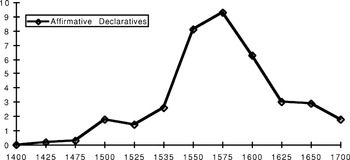
Percentage frequency of DO in affirmative declarative contexts (Ellegård, 1953:162).
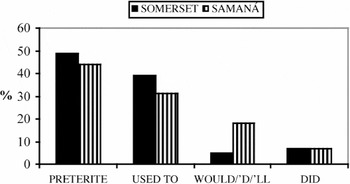
Overall distribution of verb forms in Somerset and Samaná.
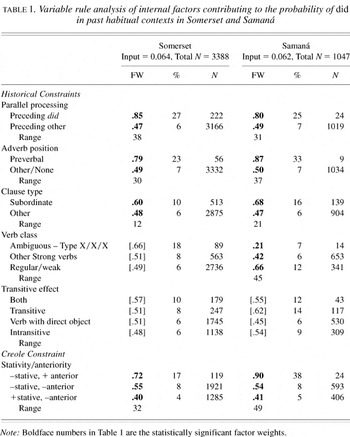
Variable rule analysis of internal factors contributing to the probability of did in past habitual contexts in Somerset and Samaná
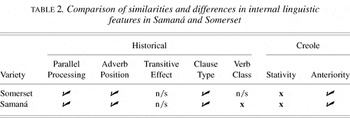
Comparison of similarities and differences in internal linguistic features in Samaná and Somerset
 You have
Access
- 18
- Cited by