Introduction
The use of Arabic source texts to recount the ancient history of North Africa has often been criticized and contested. Contestations relate to the dates of the Arab conquest of North Africa, as well as to the history of antiquity in the region.Footnote 1 Reservations notwithstanding, I believe both these aspects deserve a new and thorough examination of Arabic texts, supported by a rigorous methodology. Not only would this enable a better understanding of how the history of the region was written, it would also provide new insight into the content of the texts themselves.
The present study adopts this approach. While tracing the ancient history of North Africa is currently difficult, because it requires bringing together a variety of thematic elements, primarily from Arabic source texts, I have chosen to focus on the relationship between Arab writers and ancient African ruins. This is a way of responding to criticisms I have noted concerning Arabic texts. It is also a way of calling attention to testimonies which are extremely original for the region and which provide important information about North African history, art, culture and mentalities prior to the arrival of Islam. These texts are not completely unbiased. When the authors see a monument, they inevitably have a set of assumptions in relation to that monument. Nevertheless, certain observations may be considered to be objective.
To avoid embarking on an endless quest for all references to the antique world (history and monuments)Footnote 2 in Arabic texts, a restricted number of ancient monuments were selected for study. By approaching these monuments with textual data, the aim was to better understand the presence of antique civilizations on African soil and to determine how this knowledge might contribute to archaeological field studies. The study is structured around three key research questions:
• How reliable are the accounts provided in Arab-Muslim stories?
• To what extent do Arabic source texts provide supplementary data?
• What is the most efficient method of using Islamic historiography and its associated data?
Before going any further, it should be noted that studies of Arabic source texts need to be performed with exceptional care as they may be deformed and/or fictional. Texts may therefore reflect everything and anything their authors potentially saw, believed, wished for or reconstructed. However, before attempting to respond to the questions outlined above, we need to consider the Arab source material used in this study, as well as the choice of monuments.
The legacy of antiquity in Arabic source texts
The Islamic conquests of the early seventh century marked the beginning of an exceptional period of cultural synthesis. In different areas of writing, from history to geography to genealogy to biography, the Arab language was developing a new and original vocabulary in order to describe the new reality writers were encountering. While the information used in the context of this study emanates essentially from geographers, this in no way diminishes contributions from other Arabic sources.
The choice of monuments in this study determined the selection of texts. Through these testimonies the ruins become the bearers of historical memory that the texts attempt to restore. While it is necessary to differentiate the stories of travellers from those of merchants or pilgrims in these geographical writings, the most important question remains whether or not the authors actually visited North Africa. Undoubtedly, some of them did.
This is the case of Ibn ḪurradāḏbihFootnote 3 (d. 300/911), author of The Book of Roads and Kingdoms (Masālik waʾl- mamālik), and of Al-YaʿqūbīFootnote 4 (d. 284/897), author of Book of the Countries (al-Buldān), both of whom visited North Africa. On the other hand, we do not know if Al-IṣṭaḫrīFootnote 5 (d. 346/957) ever visited the Maghreb. Certainly, his book, al-Masālik waʾl-Mamālik is unclear on this point.
For his part, Ibn ḤawqalFootnote 6 (d. after 362/973), in his The Face of the Earth (Kitāb Ṣūrat al-arḍ), provides guidance on humans and their various activities. Given the context of this study, it is regrettable that Yāqūt al-ḤamawīFootnote 7 (d. 627/1229), in his Dictionary of Countries (Muʿǧam al-buldān), who generally provides a wealth of detail, rarely mentions the ancient past in his descriptions, and never includes information on towns.
Fortunately, certain local actors provide extremely valuable information on this topic. A good example of this is Al-BakrīFootnote 8 (d. 487/1094), a geographer and historian and author of Kitāb al-Masālik wa-al-Mamālik, written in 1068. In this text the author, following on in the tradition of Ibn Ḫurradāḏbih, bases his texts on the travel writings of merchants and sailors who lived prior to or at the same time as the author.
The Kitāb al-Istibṣār fī ʿaǧāʾib al-amṣār, the work of an anonymous author living in the town of Marrakech, is also full of precious information.Footnote 9 However, the only biographical information we have pertaining to its author is that he died in the second half of the twelfth century VIe H. In the section of the book dedicated to a description of North Africa and Bilād al-Sudan, we find historical information, including details of the conquest of different regions, mixed in with the geography.
Al-ʿAbdarīFootnote 10 (d. after 687/1289) too had the opportunity to visit widely during his journey to Mecca. The author began his voyage on 11 December 1289 AD in the land of the Ḥāḥā near Mogador, where he lived. Al-TiǧānīFootnote 11 (d. 717/1318), the author of a publication entitled Riḥla al-Tiǧānī, left Tunis to perform the Haǧ in December 1306, 706 H, accompanied by one of the Hafsidic princes, but was obliged to stop in Tripoli because of illness. The interest of this publication lies in the important information it provides concerning the regions through which they passed, from Tunis to Tripoli, and in particular details concerning the geography, ethnography and history of the region.
Finally, Al-ḤimyarīFootnote 12 (d. in 14th) is the author of the important Arabic geographical dictionary entitled Kitāb al-Rawḍ al-miʿṭār fī ḫabar al-aqṭār. His principal sources are three Arabic geographical textsFootnote 13 which were important from the fifth/eleventh century and the sixth/twelfth century. Among the different references to antiquity contained in these texts, three monuments were chosen for further study. This selection was determined by the presence of a sufficiently large quantity of usable information in terms of texts and archaeology.
The monuments: Between display and functionality
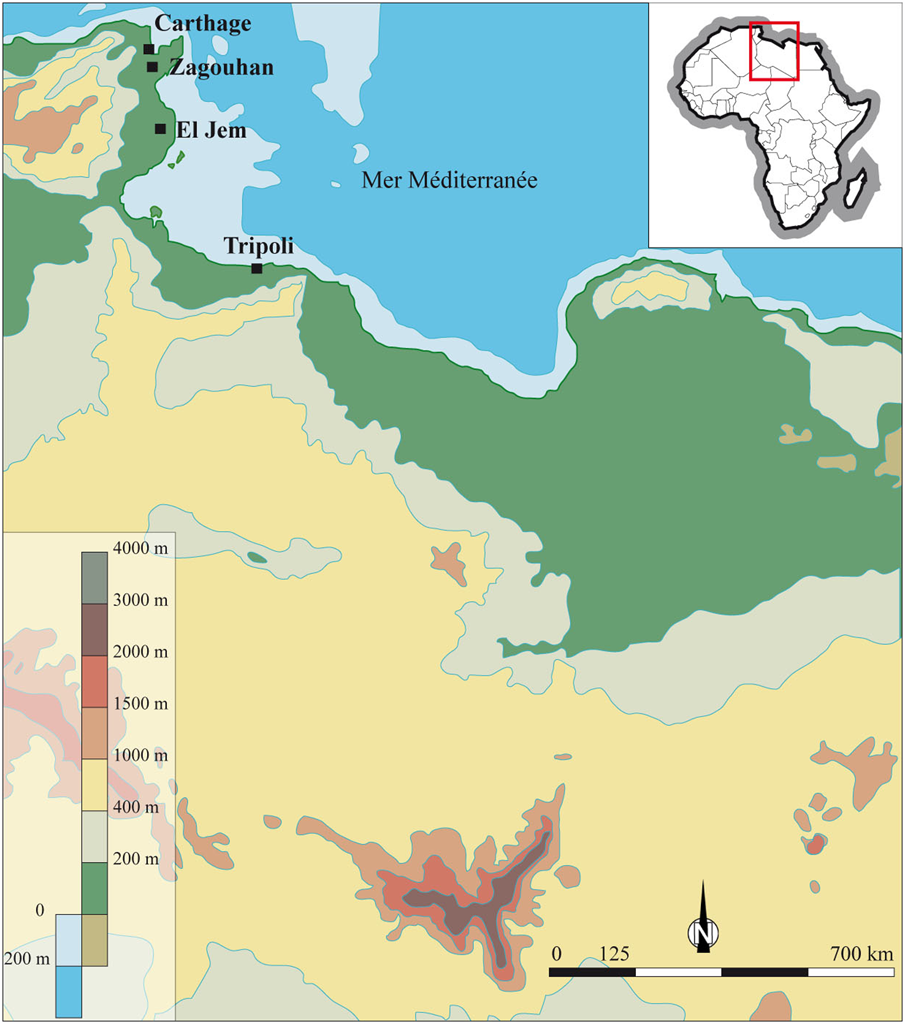
The integration of ancient monuments into the North African urban fabric is the consequence of a variety of factors ranging from human will, to climatic conditions, to economic considerations. These monuments constitute the undeniable proof of the antique past of the region and of the grandeur of the different civilizations that inhabited it, notably the Roman civilization which was responsible for the construction of the three monuments examined in this study (Figure 1, map of the sites studied). In choosing monumental urban constructions, Roman authorities perpetuated a well-established tradition which began in Italy. This involved pursuing the dual objectives of ‘Romanizing’ the territory, while simultaneously offering local inhabitants buildings that were useful for their everyday activities. The diverse roles of these monuments were accentuated by their decoration with scenes laden with political or religious symbolism in the form of inscriptions and bas reliefs. Consequently, these open-air repositories are a rich source of historical, social and religious information.
Location of the monuments discussed in this article.

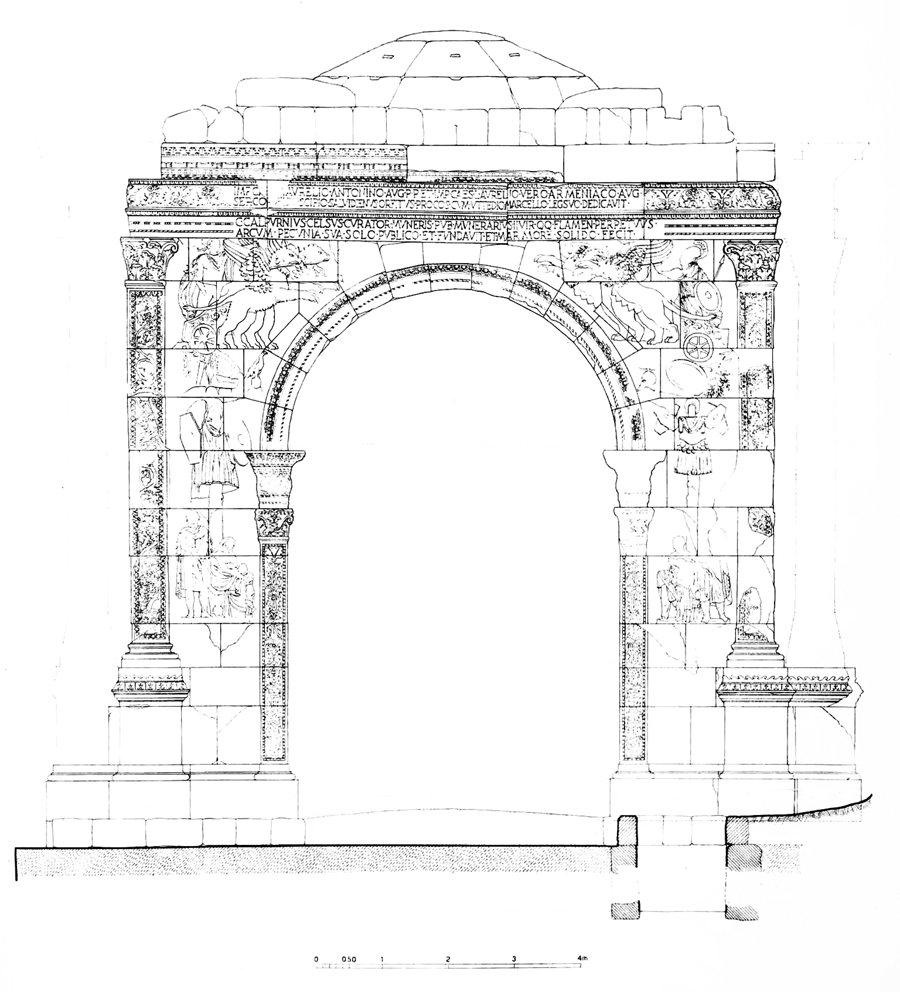
The first monument I chose to study was the arch of Marcus Aurelius (Figure 2), a Roman triumphal arch, located in Tripoli in Libya. Modern-day Tripoli is built on top of the ancient city of Oea, in the province of Tripolitania. The triumphal arch (arch of Marcus Aurelius) was built at the crossing of two main, perpendicular streets in Oea: the Cardo Maximus, which began at the port, and the Decumanus Summus, which linked the ancient Roman city with Leptis Magna and Sabratha and, further on, with Carthage and Alexandria. The inauguration of this monument took place in 163–64 AD.Footnote 14 In 643–44, after a month-long siege, the town was conquered by ʿAmr b.al-ʿĀṣ. Subsequently an Islamic medina was created, covering over the totality of the ancient monument.
Northern front of Marcus Aurelius’ triumph arch according to I Monumenti Italiani rilievi raccolti, a cura della Reale Accademia d'Italia Fascicolo XIII L'Arco di Marco Aurelio e di Lucio Vero in Tripoli. Testo di Salvatore Aurigemma, Roma, 1938, Tav. IX.

The only two Arabic writers to make mention of this monument are al-ʿAbdarīFootnote 15 and al-Tiǧānī.Footnote 16
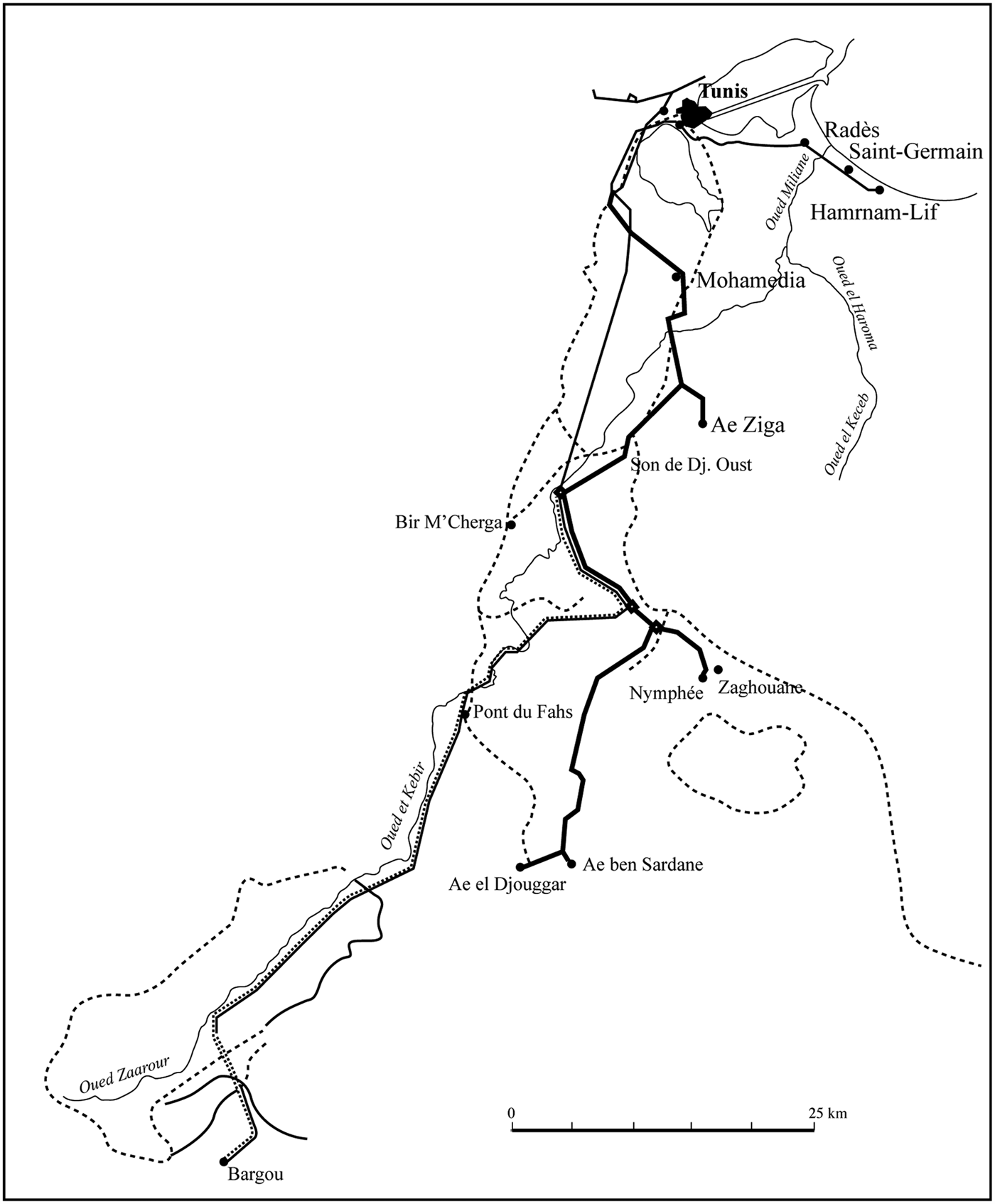
I next examined the Zaghouan aqueduct (Figure 3), an ancient Roman aqueduct situated in the antique region of Africa Proconsularis, which corresponds to present-day Tunisia. This aqueduct supplied the city of Carthage with water. Its starting point lies not far from the town of Zaghouan, about 70 km south of Carthage. Construction of the Zaghouan aqueduct was launched during the reign of the Emperor Hadrien, who decided to collect water in the mountainous areas of Djebel Zaghouan Aïn Jouggar and convey it to the water cisterns of La Malga by way of an aqueduct. Zaghouan was probably captured by Ḥassān b. al-NuʿmānFootnote 17 on the way to Carthage, before the city fell. Although the Archaeological Atlas of Tunisia states that ruins of the ancient town of Zaghouan have been covered over by the modern town, we can still see a triumphal gate at its southern-most point. This was the starting point of the water intake which supplied the grand aqueduct of Carthage. Arabic sources including al-Bakrī,Footnote 18 Yāqūt,Footnote 19 Kitāb al-Istibṣār,Footnote 20 al-ʿAbdarīFootnote 21 and Ibn Ḫaldūn (d. 784/1382)Footnote 22 provide an overview of the monument. Other noteworthy contributions, particularly in the modern period, have been provided by Ibn Abī Dīnār al-QayrawānīFootnote 23 (d. approx 1698).
Water supply plan for the city of Tunis, dating from 1928, including the aqueduct route, according to H. Baklouti, ‘Les installations hydrauliques antiques de Tunisie dans les sources arabes. Étude historiographique’, Africa, 24, pp. 39–67, Fig. 6.

The third and final monument examined was the Roman amphitheatre of Thysdrus, located in El-Djem in Tunisia. This monument lies 70 km to the south-east of Kairouan, 42 km to the south-west of Mahdia, 64 km to the north of Sfax and 63 km to the south of Sousse. As in Tripoli, ancient ruins of the amphitheatre have been partly covered over by modern construction – in this case, the village of El-Djem.Footnote 24
Although this monument has often been studied and photographed, there is some controversy surrounding its date of construction. Some experts consider that construction took place between 230 and 250, a period of military anarchy, while other studies place construction under the reign of the Antonines, or even at the end of the Empire.
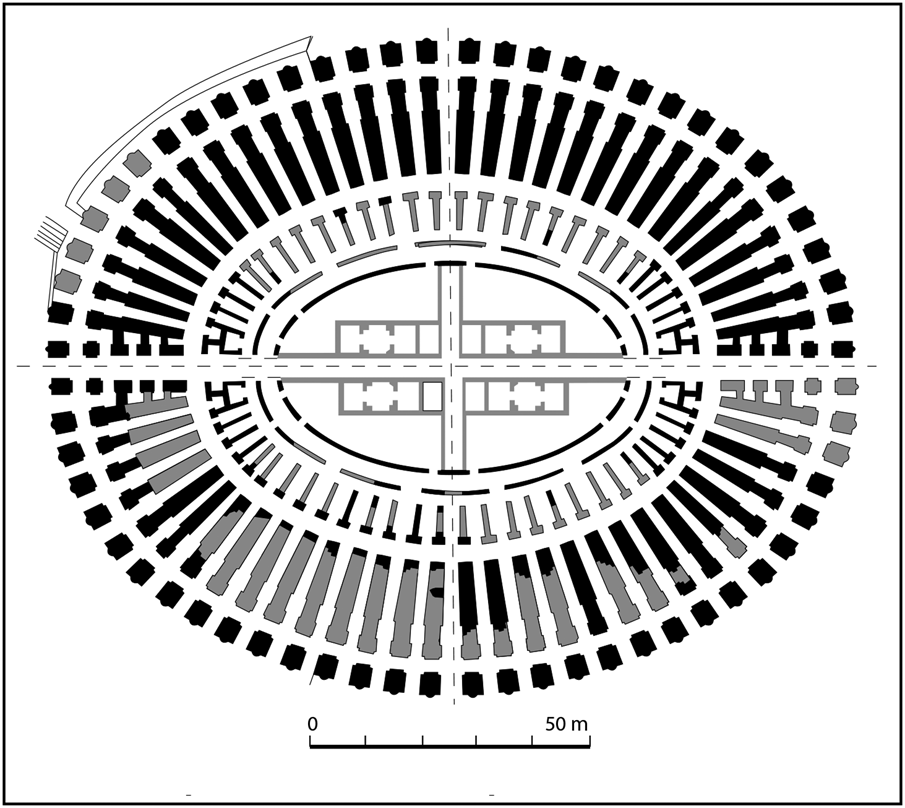
The amphitheatre of El-Djem measures 150 metres by 130 metres (Figure 4). The height of the facade minus the attic is 26 metres. The structure is composed of 68 galleries. In certain areas, the three levels of the structure are still decorated with engaged columns: Corinthian columns at the top and bottom levels, composite columns at the middle level. This monument is notably referred to by both an anonymous author of al-Bakrī,Footnote 25 al-Istibṣār,Footnote 26 al-TiǧānīFootnote 27 and al-Ḥimyarī.Footnote 28
Plan of the amphitheatre of El-Djem, from P.-L. Cadrat, A l'amphithéâtre d'El Jem, Bulletin de Société Archéologique de Sousse, 1909, pp. 103–104.

Using Arabic texts to confirm archaeological hypotheses
Before reflecting on how this information might be useful for archaeological studies, we need to consider how the Arabic texts connect with antiquity. Essentially, these texts translate the perceptions that their authors had concerning the monuments. In addition to providing a description of their physical state, the texts make an attempt at iconography, at times assisted by historical knowledge. We also need to be aware of the profiles of the authors of these texts. For the main part, we are dealing with collectors of subjective experience and not compilers of factual information from other sources. In other words, these stories translate what their authors saw with their own eyes.
Sometimes this tendency changes and objective facts are integrated into what is, strictly speaking, a personal narrative. This mix of fact and fiction is not the same for each of the different monuments studied. For example, the degree of fiction in relation to the arch of Marcus Aurelius is higher than that for the Zaghouan aqueduct or the amphitheatre of El-Djem. Interestingly, although both Al-ʿAbdarī and Al-Tiǧānī were eye-witnesses to the arch of Marcus Aurelius, neither provides us with any information concerning the size of the ruin or its function. On the other hand, the anonymous Moroccan writer/traveller distinguishes himself by his description of the scene. With the amphitheatre and the aqueduct, things change.
There is the existence of a real function (water transfer) or a potential function (the transformation of the amphitheatre into a fortification during the Byzantine era). In addition to identifying the purpose of the building, the Arabic texts also take a particular interest in the monument's architecture and its condition at the time of writing. However, are these references sufficiently significant to make a meaningful contribution to an archaeological study? We now arrive at the complex issue of the contribution of the texts chosen, and their reliability when confronted with material culture.
The first case for consideration is that of the arch of Marcus Aurelius in Tripoli. Archaeologists who have explored the monument have analysed its different phases of existence, especially its different phases of transformation and the fate of its materials. This is illustrated in the text of Al-Tiǧānī.Footnote 29 However, study findings suggest that the eye-witness accounts of the two Arab authors can enrich this archaeological diagnosis.Footnote 30
By focusing on the monument's spoliation, the Arabic texts inform us that there was an attempt to recover the stones of the monument, but that the solidity of the building's construction enabled it to resist the attack and withstand the tests of time. This may also explain the state in which the monument was discovered. It can therefore be considered that the Arabic texts have situated the monument in space and time.
The texts do not, however, provide answers to all of our questions. For example, neither author manages to identify the nature of the structure. Worse still, when one of the two authors, al-ʿAbdarī, launches into an exercise of iconographic reading, he does not have the necessary knowledge to correctly interpret the words and subjects represented.Footnote 31
In contrast, the texts relating to the Zaghouan aqueduct are explicit concerning the monument's structure. The building's function is also clearly identified and certain architectural concepts appear in the testimonies.Footnote 32 It could even be said that Al-Bakrī's text proposes a form of Ancient History lesson. This native of Al-Andalus informs us that the hydraulic structure was built by a certain Ardmīn, son of Lāwdīn, son of Namrūd. According to Al-Bakrī, the aqueduct's construction phase lasted 40 years. The author of al-Masālik also distinguishes himself by the fact that he is the only person, as far as we know, to provide precise information concerning the aqueduct's water sources in Delāla and Aïn Jouggar. Three extracts dating from between the 10th and 14th centuries, by three different authors, reflect this change in approach to the monument.Footnote 33
However, the texts are even more specific. In addition to identifying the water sources supplying the aqueduct, they provide clarification concerning the route of the aqueduct to its destination in Carthage. More specifically, they indicate that the structure bypassed the town of Tunis to the west before arriving in Carthage.Footnote 34 All of these references have enabled a better understanding of the monument's structure, with terminology (especially geographical place names) contributing to the success, either of archaeological surveys or studies of the monument.
Perhaps the most important contribution of the Arabic texts in relation to the aqueduct relates to links between its condition during the antique period and its fate during medieval and modern eras. The texts reveal a monument undergoing intense change – a structure beginning to perfectly integrate into its new historical context. References to the recovery of materials for recycling purposes, spoliation of parts of the structure, and more specifically, the addition of offshoots to the initial structure, offer archaeologists a real research opportunity.Footnote 35 If these changes had an impact on the structure of the monument, surely they also impacted the areas surrounding the monument. Consequently, all archaeological field studies should take into account the descriptions provided in the Arabic testimonies.Footnote 36
With the amphitheatre of El-Djem, we have the opportunity to review all three key research questions. A careful study of the Arabic texts reveals that the writers, inspired by the ancient condition of the monument, not only focus on its architecture but also on its function. Interestingly, they do not cite its original role, as a place of entertainment, but rather that of a place of refuge and protection.Footnote 37
Setting aside the presence and use of the amphitheatre by Kahina,Footnote 38 the broader context would seem to confirm this use of the monument. In times of war and confronted with an enemy who moves rapidly in the region, the first priority for local inhabitants is to find suitable shelter. Given the thickness of its walls and the height of the arcades, the amphitheatre would have provided optimal protection. This information is extremely important, as it fits perfectly with the urban transformation which took place in Byzantine Africa. Indeed, if certain buildings fell into ruin or were abandoned, others took on a fortified appearance completely consistent with possible threats.
Study findings suggest that archaeologists may be able to refine their diagnostics of a given monument by taking into account data concerning that building's change in use. Another possible avenue for archaeologists to pursue would be to search modern urban structures for sections that have been plundered from ancient monuments.
Conclusion
In this article, I have attempted to show how a methodical study of Islamic historiography might reinforce our knowledge of the passage from antiquity to that of Arab rule of North Africa. More specifically, I have examined the contribution of Arabic texts to archaeological studies in relation to three main monuments:
• The arch of Marcus Aurelius
• The Zaghouan aqueduct
• The amphitheatre of El-Djem
Generally speaking, it is difficult to either prove or reject the validity of Islamic historical texts, as fiction is a common characteristic of all Islamic historiography and there are no concrete criteria to separate fact from fiction. However, as this study shows, a careful examination of Arabic texts enables us to read between the lines, so by confronting Arabic texts with other sources we may indeed be able to prove or refute their reliability.
Furthermore, this study suggests that Islamic history books are able to provide us with supplementary data to that provided by material culture. This supplementary data is essentially subjective and ideological and therefore probably inaccessible through materials. Consequently, the use of Islamic texts in future studies could potentially extend our knowledge of the cultural and intellectual history of the region.
As has been suggested in historic archaeology, it is possible to prove or disprove credibility by confronting different pieces of evidence. Historic Islamic sources are no exception to the rule. By examining three monuments, we have shown that it is possible to prove archaeological hypotheses with the help of Islamic historic texts. No doubt, the contrary is equally true: that material culture could be used to check the historical hypotheses raised by textual sources.
This study has also shown that data retrieved from Islamic historiography could be considered to be archaeological evidence, and consequently used in archaeological studies of the region, in particular those concerning the fate of ancient monuments. Nevertheless, as is the case for all written source material, certain considerations need to be taken into account when reading an Islamic history book and information retrieval from these sources needs to be conducted with extreme care. Moreover, Arabic source texts and archaeological studies should ideally be analysed simultaneously, thereby bringing a new dimension to the research.
Although the use of Islamic historiography is recommended for future archaeological and historical studies of late antiquity and the medieval period, if we wish to improve prospects for the use of Islamic texts, we urgently require further in-depth studies into the texts themselves. These studies should focus on increasing our knowledge of the structure of the texts, as well as developing our understanding of the exact methods used by Muslim historians to collect historical information.