1 Introduction
This paper examines the vowel system of Santiago Mexquititlán Otomi (Hñäñho), an Oto-Manguean language variety spoken in central Mexico. Hñäñho is spoken as a first language (L1) or second language (L2) almost exclusively by Otomi indigenous people from the rural community of Santiago Mexquititlán in the state of Querétaro (Mexico). Previous impressionistic phonological studies have described a Hñäñho vowel system that comprises nine oral vowels (/i ɨ u e ɘ o ɛ ɔ a/) and one nasal vowel (/ã/) (Hekking et al. Reference Hekking2010, Reference Hekking, de Jesús, de Santiago Quintanar, Núñez López and de Keyser2014; Guerrero Galván Reference Guerrero and Esther Herrera2015). However, little is known about the acoustic realization of the Hñäñho vowels since they have not been analyzed instrumentally. Because of the lack of an instrumental acoustic-phonetic analysis, it is difficult to predict cross-linguistic effects in native, heritage, and L2 speakers of Hñäñho in a context of extensive language contact with Spanish. The goal of this paper is to provide an acoustic description of Hñäñho oral and nasal vowels. Moreover, this study carries out a detailed analysis of Hñäñho vowels produced by a group of relatively balanced Hñäñho–Spanish bilinguals in order to shed light on language contact phenomena, such as whether these vowels are still produced as different phonemes or whether any of them have merged due to extended contact with Spanish. These speakers’ Hñäñho vowels are also compared to their production of Spanish vowels. Similarly, it provides insights on specific phonetic features of the Hñäñho vowel system in comparison to Spanish and other Otomi varieties.
1.1 Santiago Mexquititlán Otomi (Hñäñho)
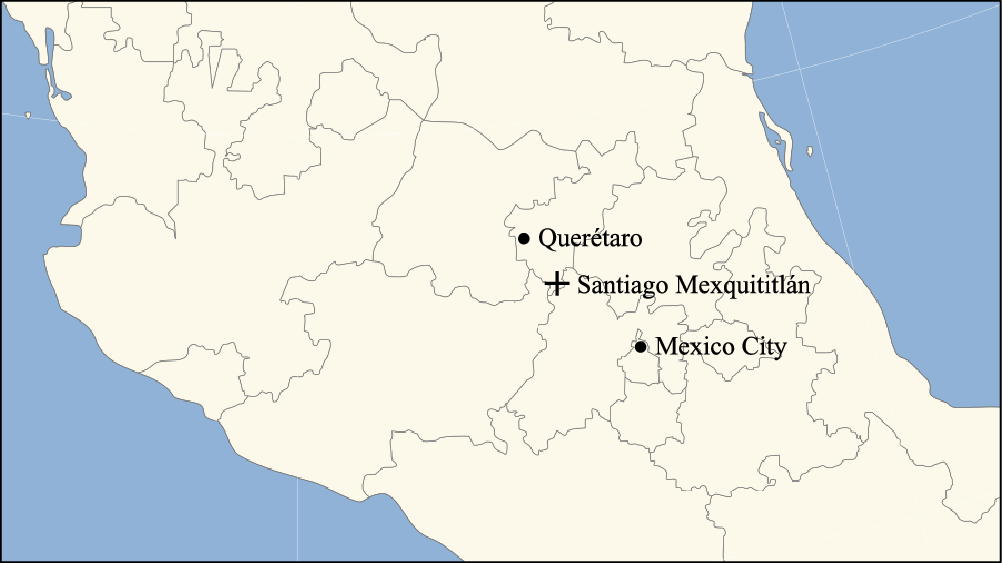
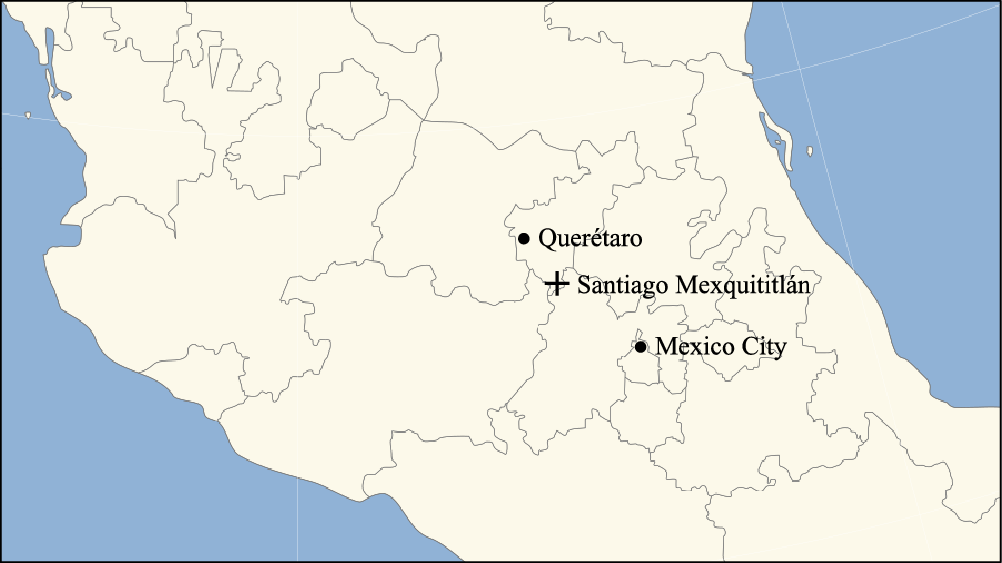
Otomi, spoken in central Mexico, belongs to the Otomian branch of the Oto-Pamean subdivision of the Oto-Manguean language family (Lastra Reference Lastra2006). Due to widespread dialectal variation and mutual unintelligibility, Otomi is further divided into several regional varieties, ranging from four (Palancar Reference Palancar, Samia and Jean-Léo2013) to nine (INALI 2008, Simons & Fennig Reference Simons and Fennig2018). Santiago Mexquititlán Otomi, called Hñäñho by its speakers (that is, the Ñäñho peoples), belongs to the Querétaro Otomi variety (Glottocode: quer1236; ISO 639-3: otq) (Simons & Fennig Reference Simons and Fennig2018), also classified as Low Northwestern Otomi (INALI 2008). Hñäñho is almost exclusively spoken by native speakers born in Santiago Mexquititlán, where the first Ñäñhos settled at the beginning of the Mexican colonial era (Hekking Reference Hekking1995). In terms of the degree of language endangerment, Hñäñho is considered vulnerable (Moseley Reference Moseley2010). While it may not be spoken by all Ñäñho generations, most children use the language in certain domains, such as at home (Moseley Reference Moseley2010). Figure 1 shows a map of central Mexico with state boundaries. Hñäñho is spoken in Santiago Mexquititlán in the Amealco de Bonfil Municipality in the south of the Mexican state of Querétaro de Arteaga.
Santiago Mexquititlán Otomi and its speakers have received attention in the field over the past several decades, with documentation of Hñäñho in a series of publications, including dictionaries (Hekking & Andrés de Jesús Reference Hekking and Severiano1989, Hekking et al. Reference Hekking2010), Hñäñho grammar descriptions and language contact studies (Hekking & Andrés de Jesús Reference Hekking and Severiano1984, Hekking & Bakker Reference Hekking, Bakker, Yaron and Jeanette2007, Bakker & Hekking Reference Bakker and Hekking2012), language displacement and preservation studies (Hekking Reference Hekking1995, Reference Hekking2002), and a trilingual English-Spanish-Hñäñho course (Hekking et al. Reference Hekking, de Jesús, de Santiago Quintanar, Núñez López and de Keyser2014). Recent work on this variety of Otomi also includes a study on the vitality of Hñäñho in Santiago Mexquititlán (Bermeo Reference Bermeo, Roland and Laura García2011), a sociolinguistic diagnosis of Ñäñhos living in an urban community in Santiago de Querétaro (Rico García Reference Rico and Karola2014), a psycholinguistic profile of Hñäñho-Spanish bilinguals living in Santiago de Querétaro (Mulík et al. Reference Mulík, Corona-Dzul, Amengual and Carrasco-Ortíz2021), and a description of a way Ñäñhos living in the city of Santiago de Querétaro use their language in order to reconstitute their community (Vázquez Estrada & Rico García Reference Vázquez Estrada and Rico García2016).
Like other Oto-Manguean languages, Santiago Mexquititlán Otomi (Hñäñho) features a rich inventory of consonant and vowel phonemes; however, at this time, there is a lack of instrumental analyses of the segmental inventory of Hñäñho, including the phonetic-acoustic characteristics of Hñäñho phonemes and their relationship with the Spanish sound system.
1.2 Vowel phonemes of Hñäñho
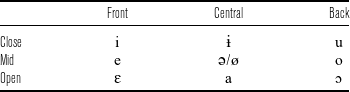
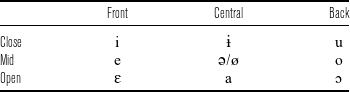
Early descriptive work on the phonology of the various regional varieties of the Otomi language (Andrews Reference Andrews1949, Jenkins Reference Jenkins1958, Bernard Reference Bernard1967, Bartholomew Reference Bartholomew1968, Wallis Reference Wallis1968, Blight & Pike Reference Blight and Pike1976) list nine oral vowel phonemes that can be stylized into a highly symmetrical phonological system (see Table 1), and a smaller set of nasal vowel phonemes that can differ in number depending on the Otomi variety, ranging from one to five (Guerrero Galván Reference Guerrero and Esther Herrera2015). Acoustic studies describing the vowel systems of other Otomi varieties are extremely scarce, but see Skibsted Volhardt (Reference Skibsted and Daniel2013) and Pharao Hansen et al. (Reference Pharao Hansen, Hernández-Green, Turnbull, Thomsen, Gabriela Pérez, Chris and Jorge Emilio Rosés2016) for two studies including Acazulco Otomi vowels.
Oral vowel phonemes of the Otomi language (Andrews Reference Andrews1949, Jenkins Reference Jenkins1958, Bernard Reference Bernard1967, Bartholomew Reference Bartholomew1968, Wallis Reference Wallis1968, Blight & Pike Reference Blight and Pike1976).
Map of central Mexico. Grey lines indicate state boundaries. The cross marks the location of Santiago Mexquititlán in the southern part of Querétaro de Arteaga state.
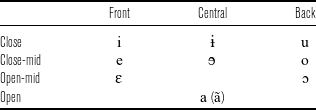
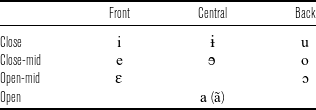
As for Querétaro Otomi, and specifically concerning the Santiago Mexquititlán Otomi variety (Hñäñho), phonological descriptions of the vowel system based on minimal pairs present a vowel system that comprises nine oral Hñäñho vowels and one nasal vowel /ã/, as presented in Table 2 (Hekking & Andrés de Jesús Reference Hekking and Severiano1984; Hekking Reference Hekking1995; Hekking et al. Reference Hekking2010, Reference Hekking, de Jesús, de Santiago Quintanar, Núñez López and de Keyser2014).
Since these descriptions of the vowel system are based on impressionistic analysis, more specific phonetic detail is unknown. However, Hekking and collaborators assert that /a/, /e/, /i/, /o/, and /u/ are pronounced exactly like in Mexican Spanish; phonemes /ɘ/ and /ɨ/ are articulated as close-mid and close central unrounded vowels, respectively; /ɛ/ is pronounced as an open-mid front unrounded vowel, whereas /ɔ/ is not pronounced like the open-mid back rounded vowel [ɔ] but more like the open back rounded vowel [ɒ], since its pronunciation is similar to that of the open central vowel /a/ but with slightly rounded lips; and the nasal open central vowel /ã/ is pronounced as [ã] by older Hñäñho speakers but as its allophone [õ] by younger ones (Hekking & Andrés de Jesús Reference Hekking and Severiano1984; Hekking Reference Hekking1995; Hekking et al. Reference Hekking2010, Reference Hekking, de Jesús, de Santiago Quintanar, Núñez López and de Keyser2014).
Otomi is a tonal language with three distinctive tones (Sinclair & Pike Reference Sinclair and Pike1948, Leon & Swadesh Reference Leon and Morris1949, Wallis Reference Wallis1968; but see Turnbull Reference Turnbull2017 for an alternative view). Since the Hñäñho variety is no exception to this, the vowels described in Table 2 can bear either high, low, or rising tone; the words that contain the same vowel but a different tone differ in meaning (Hekking & Andrés de Jesús Reference Hekking and Severiano1984; Hekking Reference Hekking1995; Hekking et al. Reference Hekking2010, Reference Hekking, de Jesús, de Santiago Quintanar, Núñez López and de Keyser2014). Despite the lack of consensus on the interaction of the tonal and accentual phenomena in Otomi, disyllabic words seem to mostly be stressed on the first syllable, regardless of the tone (Guerrero Galván Reference Guerrero and Esther Herrera2015).
Hñäñho vowels; the nasal vowel in parenthesis (Hekking & Andrés de Jesús Reference Hekking and Severiano1984; Hekking Reference Hekking1995; Hekking et al. Reference Hekking2010, Reference Hekking, de Jesús, de Santiago Quintanar, Núñez López and de Keyser2014).
1.3 The community: Hñäñho–Spanish bilinguals
According to Mexico’s National Census conducted in 2010, as many as 92.8% of Otomi speakers are Otomi-Spanish bilinguals (INEGI 2011). This is a result of the fact that Spanish is Mexico’s dominant language, and even in Santiago Mexquititlán, where most inhabitants are native speakers of Hñäñho, the indigenous language is a minority language and Spanish is the majority language (Hekking Reference Hekking2002). For instance, in a survey carried out on a sample of 330 inhabitants of Santiago Mexquititlán, 11% reported they did not speak or understand Hñäñho, whereas only 1% reported this for Spanish (Bermeo Reference Bermeo, Roland and Laura García2011). The imbalance between Hñäñho and Spanish accentuates the increase in the use of Spanish and a decrease in the use of Hñäñho, and contact-induced changes in the linguistic systems of both languages due to this context of extensive language contact (Thomason & Kaufman Reference Thomason and Kaufman1992, Hekking Reference Hekking2002). The process of native language attrition is even more evident in Hñäñho speakers who leave the rural community in Santiago Mexquititlán and migrate to Spanish-dominant urban areas, such as those living in Santiago de Querétaro, where their use of Hñäñho is usually limited to their nuclear family (Rico García Reference Rico and Karola2014, Mulík et al. Reference Mulík, Corona-Dzul, Amengual and Carrasco-Ortíz2021).
According to Hekking (Reference Hekking1995), an increased influence from Spanish on Hñäñho started in the late 1940s. Specifically, after an extensive and widespread loss of livestock in Santiago Mexquititlán in 1947 there was an increment in the contact between members of the community and the outside world, facilitated by the construction of roads connecting Santiago Mexquititlán and Amealco, which resulted in the expansion of trade between Ñäñhos and non-indigenous Mexicans. Furthermore, schools were built where classes were taught in Spanish, and the arrival of the radio, telephone, and television to Santiago Mexquititlán increased the exposure of its inhabitants to Spanish. This period also marked the beginning of the constant and intensive cyclical migration to Spanish-speaking Mexican cities, such as Mexico City or Santiago de Querétaro. In these urban environments, it is typical for speakers of indigenous languages to shift from their native (minority) language to the majority language (Spanish) in as few as three generations (Canuto Castillo Reference Canuto Castillo2015). There are several possible reasons for this, including the higher relative prestige of Spanish over indigenous languages in Mexico and the socio-political context of the country. The latter is related to the Mexican government’s hispanicization policy of the 20th century, which effectively sought to eradicate indigenous languages, and to the processes by which economic incentives strongly favor speaking Spanish and devalue Hñäñho and other indigenous languages (Heath Reference Heath1972). Due to these circumstances, contact-induced changes to the Hñäñho vowel system would not be completely unexpected if they were to be found in Hñäñho–Spanish bilinguals’ vowel production. On the other hand, Hñäñho–Spanish bilinguals might also maintain all phonemic contrasts of Hñäñho vowels in their production, especially because of their continuous use of Hñäñho on a daily basis and despite the extensive language contact with Spanish.
1.4 The present study
The main goal of the present study is to acoustically describe the Hñäñho oral and nasal vowels, as produced by Hñäñho native speakers who are relatively balanced Hñäñho–Spanish bilinguals. Moreover, we seek to determine whether phonemic contrasts between the Hñäñho vowels, as previously described impressionistically (Hekking et al. Reference Hekking2010, Reference Hekking, de Jesús, de Santiago Quintanar, Núñez López and de Keyser2014; Guerrero Galván Reference Guerrero and Esther Herrera2015), are maintained in the speech production of such native speakers or if Hñäñho phonemic categories are merging due to the influence of Spanish. To this end, we recorded the oral production of six Hñäñho native speakers and analyzed the acoustic realization of their Hñäñho and Spanish vowels, thus exploring two possible scenarios: (i) a potential loss of Hñäñho-specific vowel contrasts in the production of Hñäñho–Spanish bilingual speakers who have migrated to densely populated Mexican cities, and (ii) that the Hñäñho vowel system of the bilingual speakers remains intact. The maintenance of the Hñäñho vowel contrasts may be motivated by the speakers’ ongoing usage of the Hñäñho language, even in a Spanish-dominant urban environment.
In addition to acoustically describing the Hñäñho vowel system for the first time, this study also examines the acoustic realization of each bilingual individual as part of a group of six relatively balanced Hñäñho–Spanish bilinguals by carrying out individual analyses of adjacent vowel contrasts and determining the extent of vowel pair distinction/degree of merger. Finally, a comparison is made of these bilinguals’ Hñäñho and Spanish vowel systems in order to shed light on the production of vowel segments in each language that may be prone to phonetic cross-linguistic influence.
2 Method
2.1 Participants
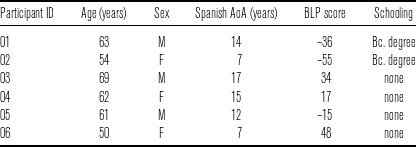
Six Hñäñho–Spanish bilinguals (three men and three women) participated in the study. All participants were recruited from a Hñäñho-speaking neighborhood of Santiago de Querétaro, they reported normal speech and hearing and normal or corrected-to-normal vision, and they received monetary compensation for their participation. Their ages ranged from 50 to 69 years (M = 59.8 years, SD = 6.8). All were native speakers of Hñäñho and reported that it was their only mother tongue; however, all of them were also highly proficient Spanish speakers. They were born and raised by Hñäñho-speaking parents in Santiago Mexquititlán and started learning Spanish at the age of 7–17 years old (M = 12.0 years, SD = 4.2), when they left their rural home community for work. In their younger years, they mostly lived in between bigger cities in central Mexico, such as Mexico City, and their home community of Santiago Mexquititlán, before finally moving to Santiago de Querétaro, where they have been living for several decades now. At the time of recording, they had been speaking Spanish for 43–52 years (M = 47.8 years, SD = 3.0) but had never stopped speaking Hñäñho, especially with family members of a similar age or older. Two of the participants attended Spanish-speaking schools, but none of the six had ever received formal education in Hñäñho. All participants reported normal speech and hearing, signed an informed consent form, and received monetary compensation for taking part in the study. Table 3 summarizes each participant’s characteristics.
Participants’ characteristics.
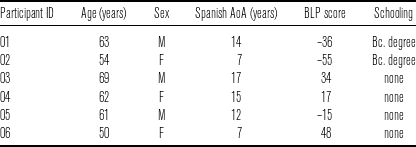
AoA = Age of acquisition, Bc. = Bachelor’s, BLP = Bilingual Language Profile, M = male, F = female
In order to measure participants’ language dominance, each participant completed the Bilingual Language Profile (BLP) questionnaire (Birdsong, Gertken & Amengual Reference Birdsong, Gertken and Amengual2012). The BLP is an instrument for assessing language dominance through self-reports. It produces a continuous dominance score and a general bilingual profile, considering multiple dimensions: language history, language use, language proficiency, and language attitudes. For more information on the BLP, see Gertken, Amengual & Birdsong (Reference Gertken, Mark, David, Pascale, Amanda and Heather2014). The responses to the questionnaire generated a language score for each module and a global score for each language, calculated by giving equal weights to all four modules. The point system was converted to a dominance scale score with the Spanish score subtracted from the Hñäñho score, thus representing both languages by a single dominance value. The possible minimum and maximum dominance values were –218 (a Spanish-dominant bilingual) and 218 (a Hñäñho-dominant bilingual). Participants’ dominance scores ranged from –55 to 48; therefore, they can all be considered relatively balanced bilinguals. The overall sample score mean was also close to zero (M = –1.1, SD = 40.7), pointing to balanced bilingualism of the participant group as a whole.
2.2 Materials
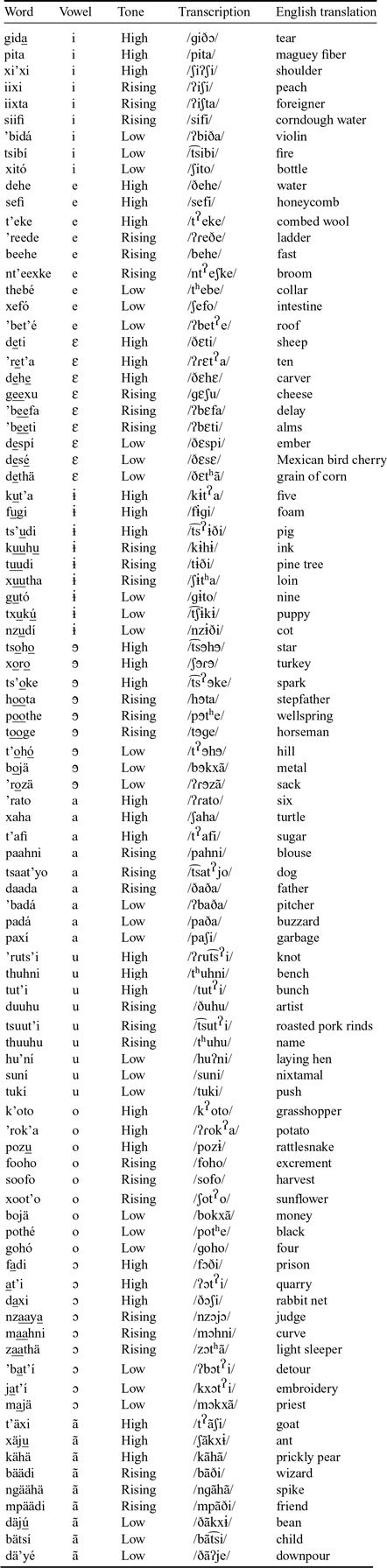
A list of 90 common disyllabic Hñäñho nouns was extracted from a Hñäñho–Spanish dictionary (Hekking et al. Reference Hekking2010) and appears in Appendix A below. The list was carefully designed to contain three different nouns for each one of the 30 possible vowel–tone combinations (10 vowels × 3 tones × 3 nouns = 90). Each vowel in the experimental items was represented by an equal number of words with high, low, and rising tone, thus balancing out any effects of this variable on the production of Hñäñho vowels. Before being selected as target items in the production task, all nouns on the list were corroborated by a native Hñäñho speaker to make sure that they were recognized, frequently used, and that they were pronounced with the intended target vowel–tone combination. The list was randomized and split into two counterbalanced blocks of 45 words. The target vowel in each experimental item appeared in a stressed position, forming the nucleus of the first syllable. The syllabic structure of all words was (C)CV–(C)CV (target vowel in bold), typical of disyllabic Otomi lexical items (Palancar Reference Palancar2009, Guerrero Galván Reference Guerrero and Esther Herrera2015, Turnbull Reference Turnbull2017). Consonant sounds directly preceding and following the target vowel included plosives, fricatives, and affricates. Words with nasal and lateral consonants were avoided since they can complicate vowel formant measurements (Johnson Reference Johnson2003). In order to enable the comparison of the Hñäñho vowels with the Spanish vowels, a list of five Spanish words was used: papa, pepa, pipa, popa, and pupa.Footnote 1
2.3 Recording procedure
Oral production recordings were conducted individually in a sound-attenuated booth with participants comfortably seated next to the experimenter. The production of the target Hñäñho vowels was elicited by a Spanish–Hñäñho translation task. Participants were asked to provide Hñäñho translations of Spanish words by embedding them in a Hñäñho carrier phrase, Dí mää ar targetword gatho ya pa ‘I say the targetword every day’, which did not change the tonal pattern of the target word. The production of the target Spanish vowels was elicited directly by embedding the corresponding Spanish words in a Spanish carrier phrase, Digo targetword cada día ‘I say targetword every day’.
The speech samples were recorded using a head-mounted microphone (Shure SM10A) and a solid-state digital recorder (Marantz PMD660), digitized (44 kHz, 16-bit quantization), and computer-edited for subsequent acoustic analysis. Three repetitions of the 90 Hñäñho words embedded in the carrier phrase yielded 270 target vowel tokens per participant. One-hundred and thirteen tokens (7%) were excluded from the analysis due to mispronunciations or recording errors, resulting in a total of 1507 tokens of Hñäñho vowels. Similarly, three repetitions of the five Spanish words embedded in the carrier phrase yielded 15 target vowel tokens per participant, none of which were excluded from the analysis. This resulted in a total of 90 tokens of the Spanish vowels.
2.4 Acoustic analysis
In order to describe bilinguals’ vowel systems, both Hñäñho and Spanish vowels were segmented using synchronized waveform and spectrographic displays in Praat (Boersma & Weenink Reference Boersma and Weenink2018). Formant trajectories, as well as intensity displays, were taken as indicators of vowel onsets and offsets. Vowel formant (F1, F2) and fundamental frequency (f0) estimates were automatically extracted at the center of the vowel steady-state period. Formant values were calculated with the Burg algorithm as implemented in the Praat program. The effective window length for the calculation was set at 25 ms and was maintained across tokens and speakers. The maximum number of formants to be located by the formant tracker was always five, and the ceiling was set at 5.0 kHz for men and 5.5 kHz for women. These gender-specific formant ceilings reflect the different average vocal tract lengths of men versus women and were deemed appropriate after visual inspection of the sound files.
In order to minimize physiological inter-speaker variation to permit accurate cross-speaker comparisons of formant data, a vowel-intrinsic bark distance normalization procedure was applied, where b0, B1, and B2 represented f0, F1 and F2, respectively, in Bark; B1 – b0 represented vowel height, and B2 – B1 the degree of vowel frontness/backness (Syrdal & Gopal Reference Syrdal and Gopal1986, Baker & Trofimovich Reference Baker and Trofimovich2005, Tsukada et al. Reference Tsukada, Birdsong and Bialystok2005). Therefore, formant values were extracted in Hertz (Hz) and converted to Bark (Traunmüller Reference Traunmüller1990) – see the following equation:
 \begin{equation*}Bark=\frac{26.81\times\ f(Hz)}{1960+f(Hz)}-0.53\end{equation*}
The bark scale is a logarithmic psychoacoustic scale that ranges from 1 to 24 and is a measure of frequency based on the critical bandwidths of hearing believed to reflect human perception (Zwicker Reference Zwicker1961, Traunmüller Reference Traunmüller1990).
2.5 Statistical analysis
For Hñäñho vowels only, linear mixed-effects models were constructed in R using the lme4 package (Bates et al. Reference Bates, Mächler, Bolker and Walker2015) to predict vowel height (B1 – b0) and vowel frontness/backness (B2 – B1). Vowel (10 Hñäñho vowels) was considered as a predictor, Participant (the ID code for each participant) and Item (each Hñäñho word) were considered as potential random effects. As a control variable, we considered Tone (high, low, and rising), which, due to the f0 value included in its formula, would always cause the B1 – b0 metric to make high-toned vowels seem higher than vowels with lower tones. Multiple comparisons of the means with Tukey contrasts were carried out for significant predictors from the models. Individual variation in the production patterns of these participants were also analyzed by calculating their Pillai score, which is a measure for the degree of merger (Hay, Warren & Drager Reference Hay, Warren and Drager2006, Hall-Lew Reference Hall-Lew2010, Sloos Reference Sloos2013, Amengual & Chamorro Reference Amengual and Chamorro2015).
3 Results
3.1 The acoustic description of Hñäñho vowels
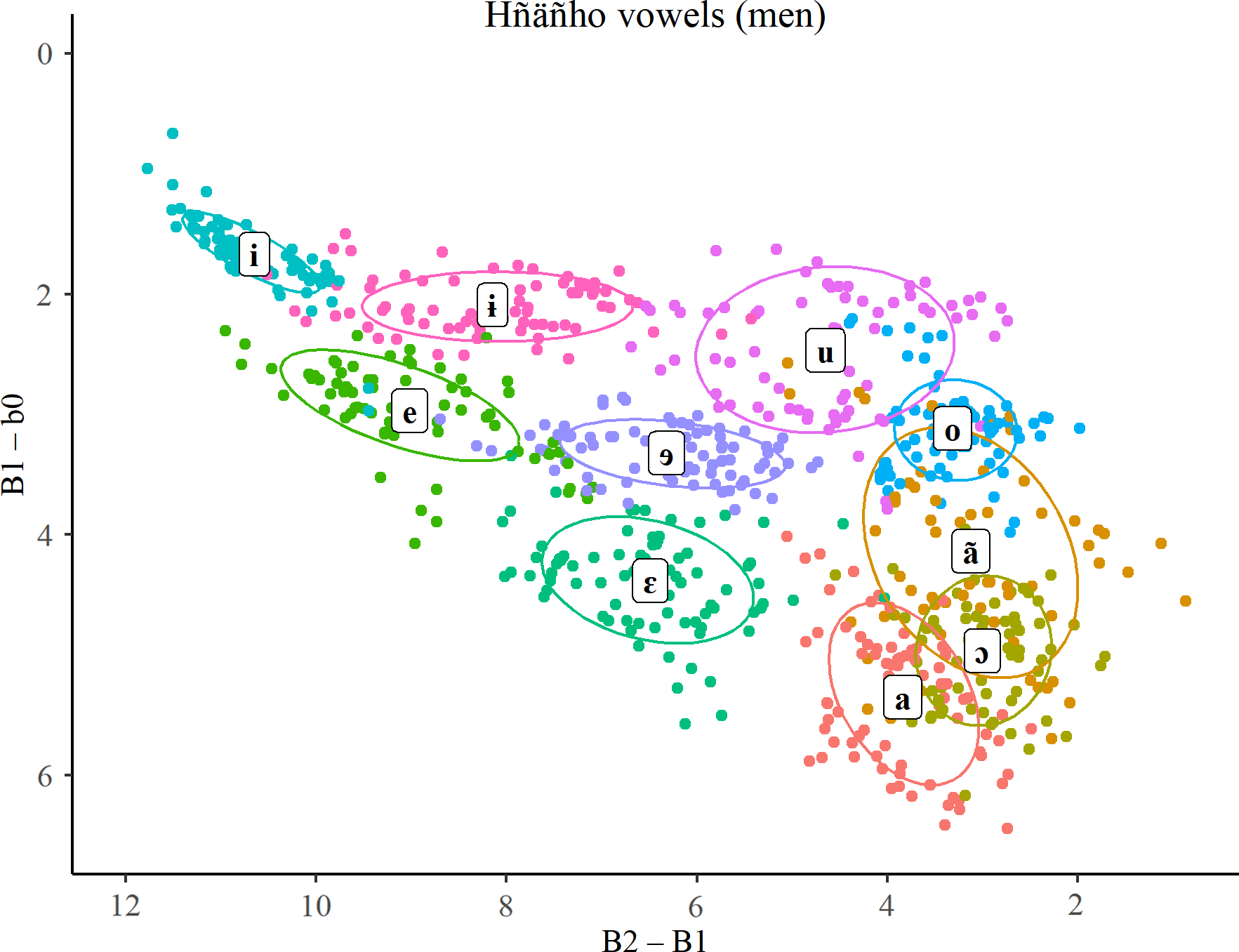
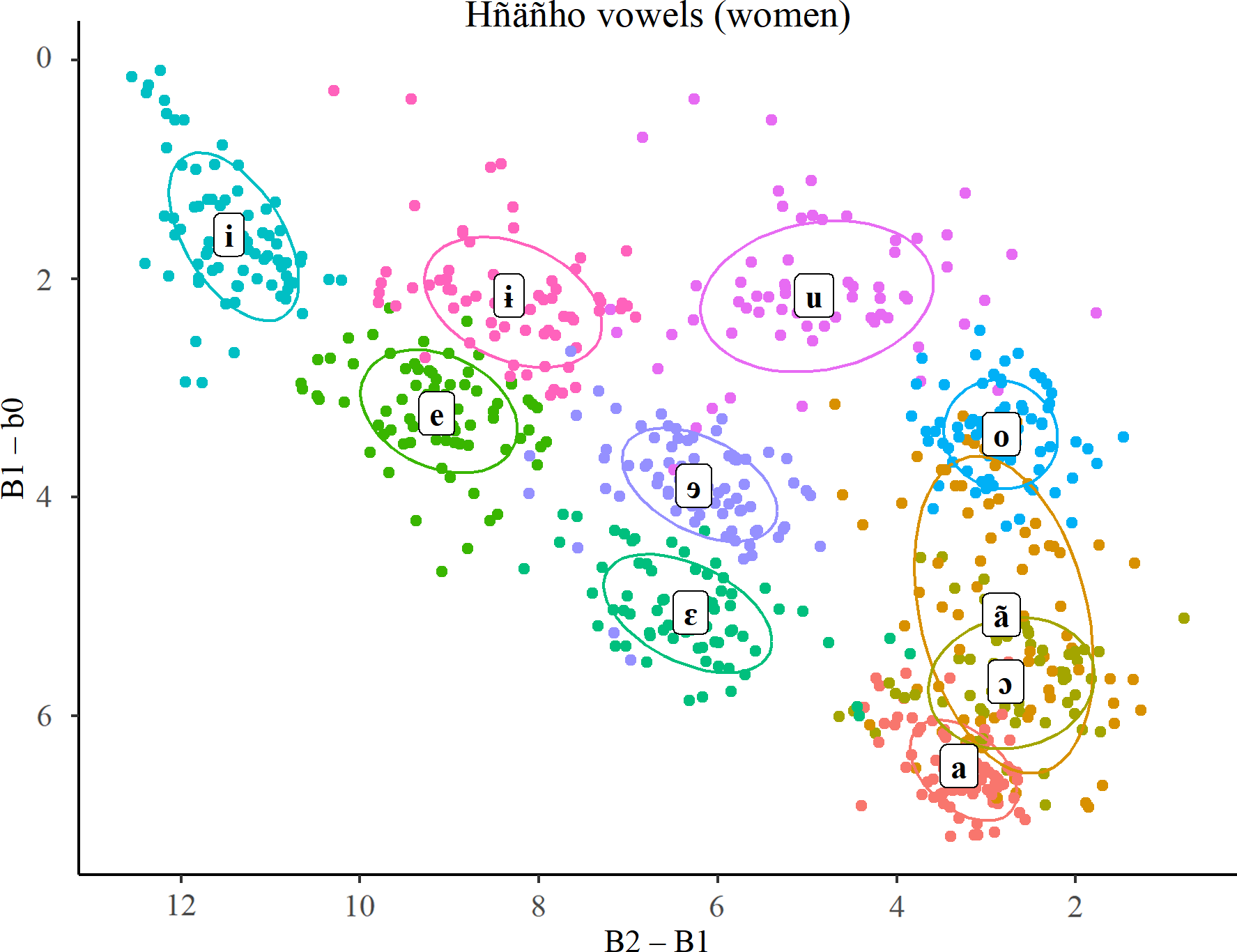
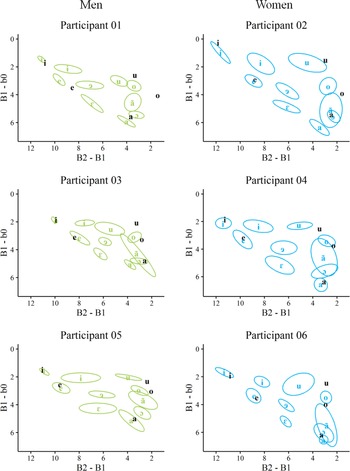
The vowel charts presented in Figure 2 (male Hñäñho speakers) and Figure 3 (female Hñäñho speakers) illustrate vowel height (B1 – b0) and vowel frontness/backness (B2 – B1) for each token, as well as the mean values and data ellipses (using the stat_ellipse() function in the ggplot2 package in R for the calculation and plotting of the ellipses) with a 67% confidence interval that roughly correspond to direction-specific one standard deviation (SD) for each of the 10 Hñäñho vowels, as produced by three male and three female Hñäñho speakers, respectively. For data visualization, we used the ggplot2 package (Wickham Reference Wickham2016) in R (R Core Team 2017).
Hñäñho oral and nasal vowels plotted by Bark-converted vowel height (B1 – b0) and vowel frontness/backness (B2 – B1) as produced by three male Hñäñho speakers. The ellipses represent 1SD distance from the mean, marked with the vowel label.

Hñäñho oral and nasal vowels plotted by Bark-converted vowel height (B1 – b0) and vowel frontness/backness (B2 – B1) as produced by three female Hñäñho speakers. The ellipses represent 1SD distance from the mean, marked with the vowel label.

Visual inspection of the vowel charts plotted in Figure 2 and 3 hints towards two specific phonetic features of Hñäñho vowels: a fronted realization of /u/ and a lowered realization of /ɔ/, especially in relation to the highly symmetrical phonological system of Hñäñho (Table 2). Crucially, the data plotted in Figures 2 and 3 suggest that proficient Hñäñho speakers maintain all vowel contrasts in their production, since there is a notable absence of substantial ellipse overlap among the oral vowels.Footnote 2 In order to confirm the vowel differences in terms of vowel quality (namely height and frontness/backness), statistical analyses were conducted which are discussed next for each vowel dimension separately.
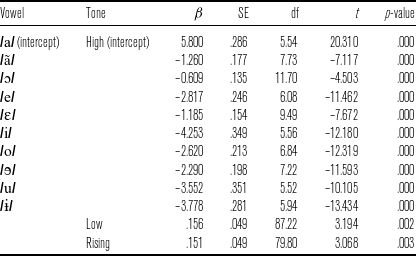
In the linear mixed-effects model used to predict vowel height, we used Vowel as a fixed-effects variable and Tone and its interaction with Vowel as fixed-effects control variables. The maximal random-effects structure was specified with random intercepts for Item and Participant and random slopes for the within-subject variable of Vowel per Participant (see Barr et al. Reference Barr, Levy, Scheepers and Tily2013). Backward selection was used first to specify the random effects (using REML estimation), then we narrowed down the fixed-effects structure (using ML estimation), and then we computed the final model using REML again (see Zuur et al. Reference Zuur, Ieno and Walker2009). Model comparison was performed using chi-squared log-likelihood ratio tests with maximum likelihood. The model with random slope for Participant was significantly better than the model with random intercepts only (χ2(54) = 570.22, p < .001). The fixed-effects structure was maximally specified with simple fixed effects only and no interaction: there was a fixed effect of Vowel (χ2(9) = 339.75, p < .001) and a fixed effect of the control variable Tone (χ2(2) = 13.26, p = .001). The variance inflation factor value was 1.0, indicating no collinearity. The syntax for the final model was the following: vowel height ~ Vowel + Tone + (1 + Vowel | Participant) + (1 | Item). The reference value for Vowel and for Tone was /a/ and high tone, respectively. Using the MuMIn package (Bartoń Reference Bartoń2020) in R, we calculated the marginal and conditional coefficients of determination for the model. The Marginal R2 represents the variance explained by fixed factors (R2m = .829), whereas the Conditional R2 represents the variance explained by both fixed and random factors for the entire model (R2c = .929). See Table 4 for a statistical summary of this model.
Summary of the significant simple effects of vowel and tone on vowel height.
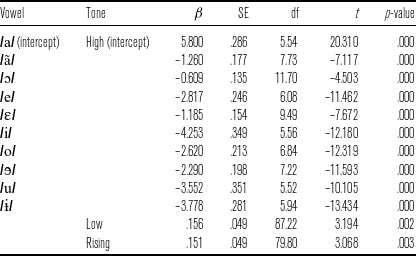
Multiple comparisons of the means (Tukey contrasts) showed that, in terms of vowel height, all vowel contrasts were significant (all ps < .05), except for 4 non-significant contrasts: /e – o/, /ɘ – o/, /ɨ – u/, and /ɛ – ã/ (all ps = n.s.). As for tone, no difference was found between the height of vowels with low and rising tone (p = n.s.), but these were produced significantly (both ps < .05) lower than vowels bearing high tone, as expected because of the artifact in the B1 – b0 formula mentioned above.
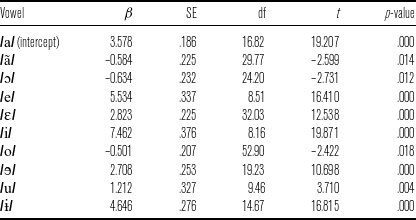
In the linear mixed-effects model used to predict vowel frontness/backness, we used the same procedure and variables as in the model for vowel height. The model with random slope for Participant was significantly better than the model with random intercepts only (χ2(54) = 380.27, p < .001). The fixed-effects structure was maximally specified with a simple fixed effect of Vowel (χ2(9) = 802.06, p < .001). The syntax for the final model was the following: vowel frontness/backness ~ Vowel + (1 + Vowel | Participant) + (1 | Item). The reference value for Vowel was /a/. The Marginal R2 representing the variance explained by fixed factors was R2m = .919, whereas the Conditional R2 representing the variance explained by both fixed and random factors for the entire model was R2c = .961. See Table 5 for a statistical summary of this model.
Summary of the significant simple effect of vowel on vowel frontness/backness.
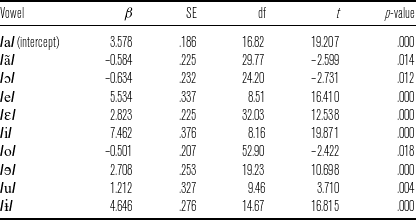
Multiple comparisons of the means (Tukey contrasts) showed that, in terms of vowel frontness/backness, all vowel contrasts were significant (all ps < .05), except for 7 non-significant contrasts, namely /a – o/, /a – ɔ/, /a – ã/, /ã – ɔ/, /o – ɔ/, /o – ã/, and /ɛ – ɘ/ (all ps = n.s.).
Taken together, the linear mixed-effects models successfully predicted both vowel height and vowel frontness/backness as a function of Hñäñho vowel category and lexical tone. The results of the models suggest that these proficient Hñäñho speakers maintain all vowel contrasts distinctively in their productions and that there is no evidence that any of these vowel pairs are merging. Regarding the effects of lexical tone on vowel quality, the results of the models suggest that Hñäñho vowel height, but not vowel frontness/backness, can be influenced by lexical tone. Specifically, Hñäñho vowels bearing high tone appear to be slightly higher than those bearing low or rising tone. This is a generalized effect that does not depend on a particular vowel (no interaction between vowel and tone) and, as mentioned above, it is a logical consequence of the formula for the vowel height estimate (B1 – b0) involving the acoustic correlate of lexical tone (f0).
3.2 Individual differences in Hñäñho vowel production
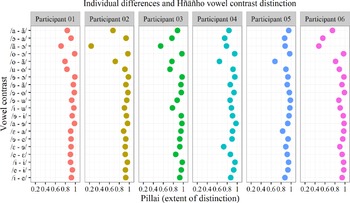
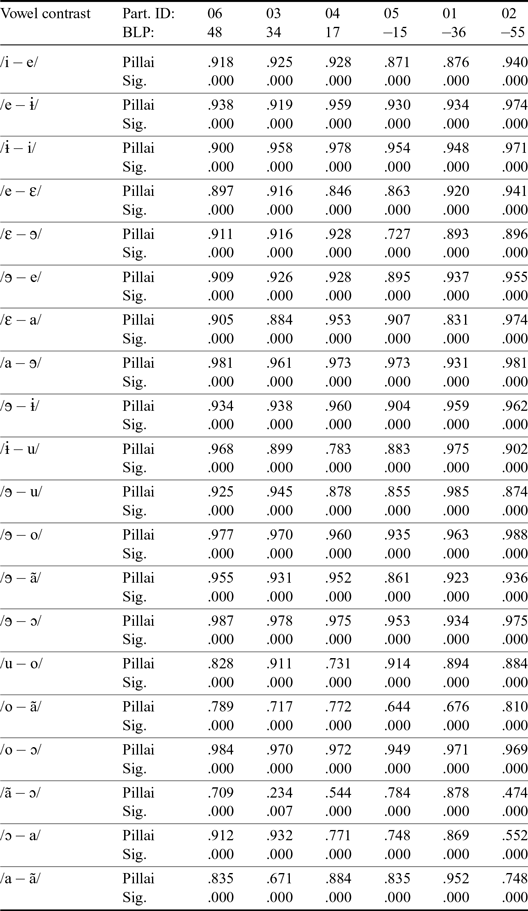
Because the analysis of group means may obscure distinct patterns of between-speaker variation, we conducted further analyses to examine the extent to which these vowel contrasts are realized for each individual speaker. In order to explore possible individual differences in vowel contrast maintenance, we selected 20 vowel contrasts of adjacent Hñäñho vowels and calculated their degree of overlap for each participant separately, taking into account the variability between different tokens. The extent of distinction (the inverse of the degree of overlap) for a vowel pair can be expressed by means of a Pillai score (Hay et al. Reference Hay, Warren and Drager2006, Hall-Lew Reference Hall-Lew2010, Sloos Reference Sloos2013, Amengual & Chamorro Reference Amengual and Chamorro2015). Pillai score is obtained from the output of a multivariate analysis of variance (MANOVA) that considers not only the distribution of the vowel cluster for each token in the vowel pair, but also the phonological environment in which the vowel was produced. Therefore, the consonants preceding the critical vowels were included in the MANOVA in order to account for possible coarticulation effects. The higher the Pillai score, the lower the degree of overlap and greater the distinction between the two vowel clusters (see Appendix B below). The results of this analysis are plotted in Figure 4, which illustrates Hñäñho vowel pair distinction for each participant separately.
Influence of individual differences between participants on the extent of Hñäñho vowel contrast distinction (Pillai score; 0 = overlap, 1 = distinction) for 20 selected vowel contrasts of adjacent Hñäñho vowels.
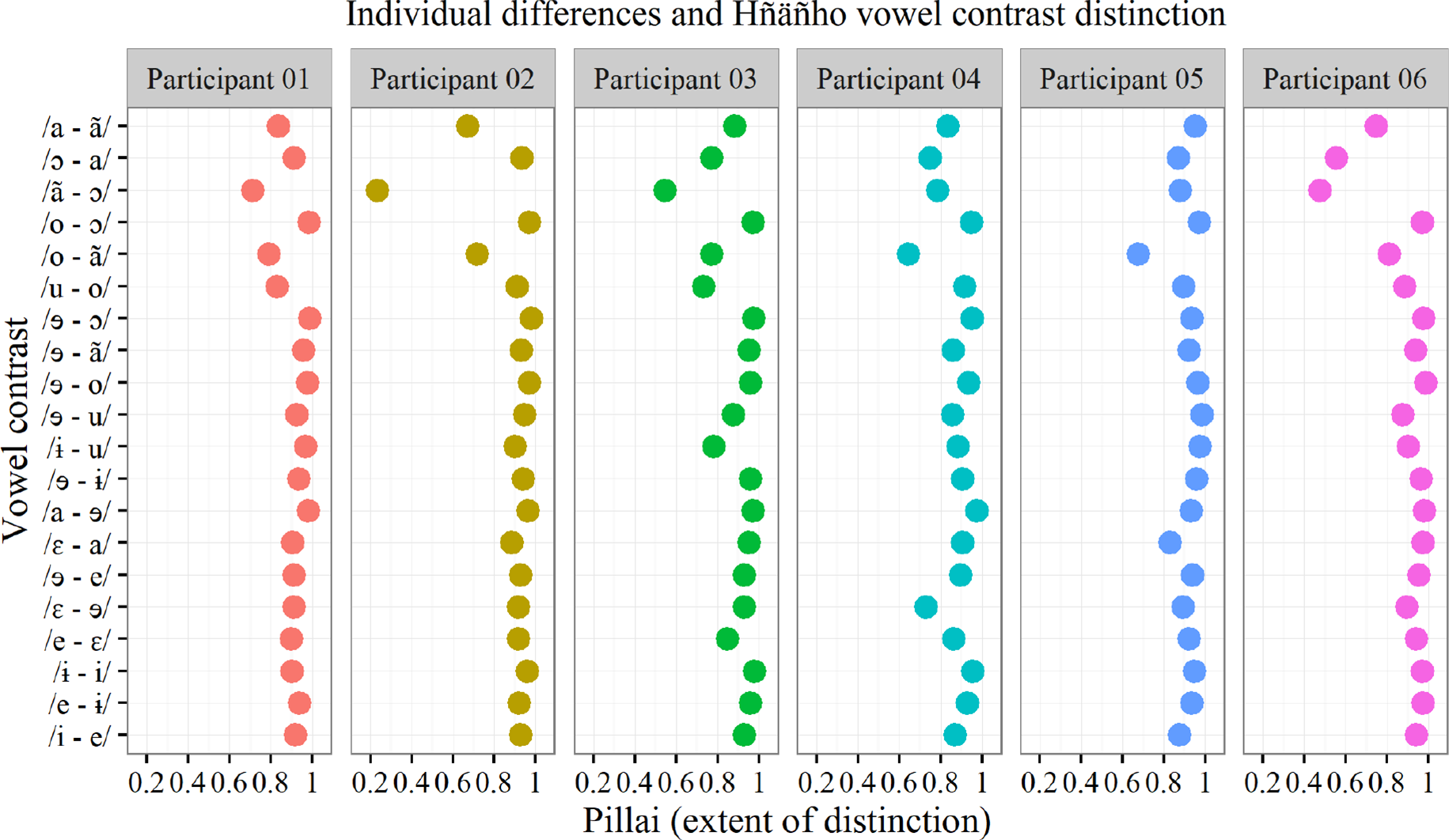
Importantly, all 20 Hñäñho vowel pairs obtained a significant p-value (p < .05) for each participant (see Appendix B) and can therefore be treated as consisting of distinct vowels without neutralization (Sloos Reference Sloos2013). In other words, this means that every individual Hñäñho speaker maintained all vowel contrasts in their production of Hñäñho vowels. The extent of distinction is generally slightly greater for anterior and central vowel pairs in comparison to posterior vowel pairs, especially for those vowel contrasts involving the nasal vowel /ã/. It is important to mention that our analysis cannot capture other factors that distinguish nasality, and nasality also tends to create erratic F1 measurements because nasal formants and antiformants interfere with the acoustic expression of the oral F1, causing it to cover a greater range of F1 values. As for the posterior vowel contrasts including oral vowels, the vowel pairs /a – ɔ/ and /o – u/ exhibit lower Pillai scores than /o – ɔ/. Despite these trends, no neutralization of vowel contrasts has taken place in any of the Hñäñho speakers who participated in this study.
3.3 The comparison of the Spanish and Hñäñho vowel systems
Figure 5 shows the Spanish and Hñäñho vowel chart for each of the 6 participants, with mean vowel height (B1 – b0) and mean vowel frontness/backness (B2 – B1) for each vowel and 1SD for each of the 10 Hñäñho vowels.
Spanish vowels (in black) and Hñäñho vowels (in green and blue) plotted by vowel height (B1 – b0) and vowel frontness/backness (B2 – B1) as produced by six Hñäñho speakers. The ellipses around Hñäñho vowels represent 1SD distance from the mean, marked with the vowel label.

Each participant’s production of the five Spanish vowels, plotted in black, can be compared with the production of their Hñäñho counterparts (Figure 5). According to Hekking et al. (Reference Hekking2010, Reference Hekking, de Jesús, de Santiago Quintanar, Núñez López and de Keyser2014), Hñäñho vowels /a/, /e/, /i/, /o/, and /u/ are pronounced similarly to Spanish vowels /a/, /e/, /i/, /o/, and /u/. In our acoustic data, this claim mostly holds true for the anterior vowels /i/ and /e/; however, several systematic differences between Hñäñho and Spanish can be observed for /a/, /o/, and /u/. What stands out most is the difference that all speakers make in their production of the vowel /u/, with a more fronted Hñäñho [u̟] in comparison to Spanish [u]. Secondly, Spanish /a/ is produced similarly to Hñäñho /a/ only by some bilinguals, whereas most bilinguals produce their Spanish /a/ more like their Hñäñho /ɔ/. Some bilinguals also appear to produce more posterior /o/ in Spanish than in Hñäñho. Finally, one bilingual produces Spanish /e/ halfway between Hñäñho /e/ and /ɛ/.
4 Discussion and conclusions
In this study, we acoustically described the vowel system of Hñäñho, an understudied and endangered indigenous language variety spoken in central Mexico. By recording the oral production of six balanced Hñäñho–Spanish bilinguals who pronounced a total of 1507 Hñäñho and 90 Spanish word tokens embedded in carrier phrases, we were able to corroborate the previously reported impressionistic measures of Hñäñho vowels. Importantly, these recordings provide novel phonetic and acoustic detail that enable us to evaluate the extent of distinction of all 10 Hñäñho vowels in native Hñäñho speakers who are also proficient in Spanish. Moreover, this production study provides a direct comparison between the speakers’ production of Hñäñho and Spanish vowels and explores the influence of speakers’ individual differences on their two vowel systems.
Until now, little was known about the acoustic realization of the Hñäñho vowels since they have not been analyzed instrumentally. Previous phonological descriptions have reported a Hñäñho vowel system that can be stylized into a highly symmetrical phonological system (see Table 2), containing nine oral vowels (/i ɨ u e ɘ o ɛ ɔ a/) and one nasal vowel (/ã/) (Hekking et al. Reference Hekking2010, Reference Hekking, de Jesús, de Santiago Quintanar, Núñez López and de Keyser2014; Guerrero Galván Reference Guerrero and Esther Herrera2015). Our acoustic data on Hñäñho vowel height and frontness/backness shed some light on the organization of this vowel system. Regarding the back open-mid rounded vowel /ɔ/, our analysis showed that while vowel pairs such as the close /ɨ – u/ and close-mid /e – o/ and /ɘ – o/ are indeed produced at the same vowel height, the expected open–mid pair /ɛ – ɔ/ is not, with /ɔ/ pronounced significantly lower than /ɛ/. In terms of vowel frontness/backness, /ɔ/ is pronounced as posteriorly as /o/ but, at the same time, as anteriorly as /a/. In terms of vowel contrast distinction (Pillai score), the contrast /ɔ – o/ is more robust than the contrast /ɔ – a/ for all six Hñäñho speakers. These results are in line with the claim that the phonetic realization of the Hñäñho phoneme /ɔ/ is similar to that of the open central vowel /a/ but with slightly rounded lips (Hekking & Andrés de Jesús Reference Hekking and Severiano1984; Hekking Reference Hekking1995; Hekking et al. Reference Hekking2010, Reference Hekking, de Jesús, de Santiago Quintanar, Núñez López and de Keyser2014), so that it is actually pronounced more like the open back rounded vowel [ɒ] instead of the theoretically more plausible open-mid back rounded vowel [ɔ]. A similar phenomenon of the phonetic realization of /ɔ/ produced as [ɒ] was noted for another Querétaro Otomi variety, namely San Ildefonso Tultepec Otomi, called Hñöñhö (Palancar Reference Palancar2009). These two Otomi varieties are spoken in communities that lie about 20 km apart and whose members often coexist in urban contexts. This could be a common characteristic of Querétaro Otomi varieties, pointing to a possible future phonemic merger /ɔ/–/a/, already observed in some Otomi varieties (Butragueño Reference Butragueño2004).
Regarding Hñäñho nasal vowels, only the nasal vowel /ã/ from the four original nasal vowels of Proto-Oto-Pamean (*ĩ, *ẽ, *ã, and *õ), proposed by Bartholomew (Reference Bartholomew1965), seems to remain relevant as a phoneme in Hñäñho. However, a large cognate set for different Otomi varieties would be necessary in order to determine whether the original nasal vowels merged with their oral counterparts or whether the other nasal vowels actually merged into /ã/. As for the acoustic realization of the nasal phoneme /ã/, if this vowel were to be considered the nasal counterpart of the open central oral vowel /a/, our data show that their acoustic realization is not qualitatively similar. The vowel /ã/ is produced significantly higher and more posteriorly than the vowel /a/. In fact, these group of Hñäñho speakers pronounced /ã/ at the same vowel height as /ɛ/ and equally posteriorly as /o/ and /ɔ/, therefore as [õ] or even [ɔ˜]. This is in line with the claim that the nasal open central vowel /ã/ is pronounced as [ã] by older Hñäñho speakers but as its allophone [õ] by younger ones (Hekking & Andrés de Jesús Reference Hekking and Severiano1984; Hekking Reference Hekking1995; Hekking et al. Reference Hekking2010, Reference Hekking, de Jesús, de Santiago Quintanar, Núñez López and de Keyser2014). This was first reported more than three decades ago; thus, our six participants belong to what Hekking and colleagues then referred to as the younger generation of Hñäñho speakers. Finally, the fronted realization of the Hñäñho vowel /u/ as [u̟]Footnote 3 can be compared with an opposite phenomenon reported for Hñöñhö, where /u/ in tonic syllables becomes not fronted but retracted [u] (Palancar Reference Palancar2009).
The differences between prior phonological descriptions of the Hñäñho vowel system and the data obtained in this study may be explained in terms of a chain reaction. This change might have been motivated by the gradual loss of a larger set of nasal vowels (between two and five nasal vowels in other Otomi varieties; Guerrero Galván Reference Guerrero and Esther Herrera2015), characteristic of Otomi languages, and by the possible influence of Hñöñhö, which employs the nasal vowel /õ/ where Hñäñho would use /ã/ (Palancar Reference Palancar2009). We hypothesize that, initially, the gradual loss of phonemic nasality in other vowels might have made it necessary for the nasal vowel /ã/ to be distinctive in terms of vowel quality. Subsequently, the vowel space occupied by [o] and [õ] might have lowered the phonetic realization of /ɔ/ to [ɒ]. Another possibility is that the vowel /ɔ/ first lowered to [ɒ] and then the nasal vowel /ã/ occupied the free spot in the vowel space as [ɔ˜]. This does not happen in Hñöñhö, which maintains five nasal vowels, and where /o/ can be lowered into the empty vowel space left behind after the lowering of /ɔ/ to [ɒ] (Palancar Reference Palancar2009). It is important to point out, however, that in order to count on firmer hypotheses regarding /õ/ or /ã/ pronunciation and the related processes of lowering and raising, the aforementioned cognate set from multiple varieties of Otomi would have to be analyzed and the conservative pronunciation of these vowels determined.
The individual measures of vowel contrast distinction (Pillai score) for each vowel and for each individual Hñäñho speaker separately confirmed the notion that the phonemic distinctions between all ten Hñäñho vowels are robust and maintained in the vowel system of these balanced Hñäñho–Spanish bilingual speakers. We analyzed all possible Hñäñho contrasts consisting of adjacent vowels but found no evidence for mergers in the Hñäñho speakers’ production due to their extensive contact with Spanish (all six speakers have been bilingual in Hñäñho and Spanish for about five decades – see Table 3). Two out of the six speakers received formal education in Spanish, but this has not had an apparent effect on their production of Hñäñho vowels either. This could be due to the fact that they were all born and raised in Santiago Mexquititlán, which they left after several decades, but have maintained their language use and contact with their speech community. We expect that changes in the Hñäñho vowel system due to language contact with Spanish might be more likely in the acoustic realization of the next generation of Hñäñho speakers, already born in the Spanish-dominant urban environment and highly proficient in Spanish, thus considered heritage speakers of Hñäñho.
The Spanish and Hñäñho vowel systems of balanced Hñäñho-Spanish bilinguals seem to consist of five phonemes used for both Spanish and Hñäñho vowel production (/a e i o u/) and five extra phonemes used for Hnäñho vowel production only (/ɔ ɛ ɨ ɘ ã/). Even though this scenario corresponds with Hekking et al. (Reference Hekking2010, Reference Hekking, de Jesús, de Santiago Quintanar, Núñez López and de Keyser2014), more data is necessary for the bilinguals’ production of Spanish vowels in order to confirm these findings. However, it is worth noting that in this study the BLP score of language dominance ranged only from BLP = –55 for the slightly Spanish-dominant Participant 02 to BLP = 48 for the slightly Hñäñho-dominant Participant 06, but all participants were relatively balanced bilinguals since all BLP scores were fairly close to zero (0 = balanced bilingual). Future studies will benefit from including dominant Hñäñho–Spanish bilinguals across a wider range of language dominance, in order to more accurately and thoroughly examine the effects of language dominance on the bilingual individual’s vowel systems.
In conclusion, being bilingual per se does not indicate that there has to be an adverse effect on the maintenance of phonemic contrasts in the native language of highly proficient and relatively balanced Hñäñho–Spanish bilinguals. The results of the present study indicate that this older generation of bilingual speakers maintain all vowel contrasts in their Hñäñho vowel production, despite their intense contact with Spanish. These findings underline the importance of early and sustained exposure to Hñäñho–Spanish bilinguals’ native language, and the positive effects it has on the maintenance of language-specific phonological categories in the acoustic realization of their native speech.
Acknowledgements
This work was supported by the CONACyT (Consejo Nacional de Ciencia y Tecnología de México) National Grant 2017 awarded to Stanislav Mulík [grant number 473389]. The authors would like to thank the reviewers of this paper for their helpful comments and suggestions, as well as to Dorotea Soriano Fernández, Zacarías Pedro Rafael, Remedios Cleofas Gabino, Tomás Severiano Eduardo, and other native speakers of Hñäñho who made this study possible. ¡Xí dí jamädi gatho!
A very early version of this study was presented at the 19th International Congress of Phonetic Sciences in Melbourne, Australia (Mulík, Amengual, Avecilla-Ramírez & Carrasco-Ortíz Reference Mulík, Amengual, Avecilla-Ramírez and Carrasco-Ortíz2019).
Appendix A. The list of recorded Hñäñho words

Appendix B. Pillai scores and their significance value for each speaker and selected vowel contrast
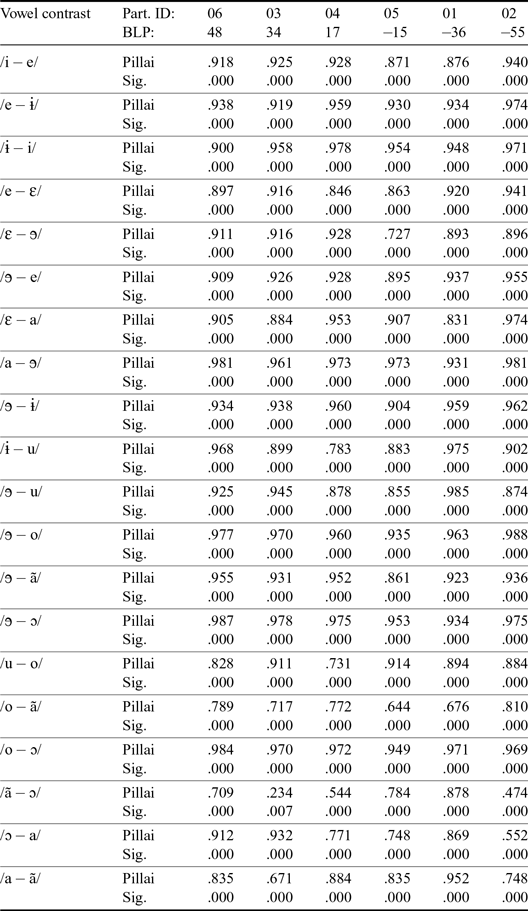
Part. ID = participant identifier; BLP = Bilingual Language Profile; Sig. = significance p-value