In literature, rumination has been widely studied in the domain of cognitive vulnerability styles for depression. According to Nolen-Hoeksema (Reference Nolen-Hoeksema1991) rumination is a relatively stable maladaptive coping strategy that consists of ‘‘repetitively focusing on the symptoms of depression and on the causes, meanings, and consequences of those symptoms’’ (p. 569). The Response Styles Theory (RST; Nolen-Hoeksema, Reference Nolen-Hoeksema1991, Reference Nolen-Hoeksema2000) has strong empirical support, showing evidence that ruminative response style prolongs sad or dysphoric mood and has a negative impact on the engagement in pleasant or distracting activities and on effective problem solving in face of distress circumstances (Nolen-Hoeksema, Wisco, & Lyubomirsky, Reference Nolen-Hoeksema, Wisco and Lyubomirsky2008). A large body of empirical research shows that rumination predicts the onset, severity and maintenance of depression (Nolen-Hoeksema, Reference Nolen-Hoeksema1991, Reference Nolen-Hoeksema2000; Nolen-Hoeksema, Stice, Wade, & Bohon, Reference Nolen-Hoeksema, Stice, Wade and Bohon2007; Nolen-Hoeksema et al., Reference Nolen-Hoeksema, Wisco and Lyubomirsky2008).
Based on the RST (Nolen-Hoeksema, Reference Nolen-Hoeksema1991), Nolen-Hoeksema and Morrow (2001) develop the “Ruminative Responses Scale”, the most commonly self-report instrument used to assess individual differences in the tendency to engage in ruminative thoughts and behaviors. This scale was initially composed by 22 items, but 12 items on the scale seem to overlap with the item content on scales measuring depressive symptoms, and consequently, were removed (Treynor, Gonzalez, & Nolen-Hoeksema, Reference Treynor, Gonzalez and Nolen-Hoeksema2003). As a result, Treynor et al. (Reference Treynor, Gonzalez and Nolen-Hoeksema2003) found ten candidate items to tap ruminative response style. They performed a Principal Component Analysis that revealed two–factor solution, reflection (5 items) and brooding (5 items), which accounted for 50.5% of the total variance. The reflection factor includes items that tap an active and “a purposeful turning inward to engage in cognitive problem solving to alleviate one’s depressive symptoms” (Treynor et al., Reference Treynor, Gonzalez and Nolen-Hoeksema2003, p. 256). The brooding factor reflects “a passive comparison of one’s current situation with some unachieved standard” (Treynor et al., Reference Treynor, Gonzalez and Nolen-Hoeksema2003, p. 256). Regarding reliability analysis, both components revealed adequate internal consistency (with α of .72 for reflection and α of .77 for brooding) and satisfactory temporal stability (r = .60 for reflection and r = .62 for brooding) (Treynor et al., Reference Treynor, Gonzalez and Nolen-Hoeksema2003). The authors (Treynor et al., Reference Treynor, Gonzalez and Nolen-Hoeksema2003) found a differential association between these two factors and depressive symptoms. That is, the reflection factor was correlated with more current depressive symptoms and with lower levels of depressive symptoms over time. On the contrary, the brooding factor of rumination not only showed a strong correlation with currently depressive symptoms but was also associated with increasing depressive symptoms one year later.
Additionally, gender differences were found in both dimensions, with women scoring higher than men on both the reflection and brooding factors; but it is only when rumination style takes the form of brooding is it linked to greater levels of depression concurrently and longitudinally in women compared to men. For these reasons, brooding has been considered the maladaptive component of rumination (Treynor et al., Reference Treynor, Gonzalez and Nolen-Hoeksema2003).
However, there is no consensus among authors with regard to the construct validity of brooding and reflection dimensions. While some studies found significant correlations between reflection component and psychopathology, others do not (Joormann, Dkane, & Gotlib, Reference Joormann, Dkane and Gotlib2006; Rude, Maestas, & Neff, Reference Rude, Little Maestas and Neff2007). For instance, Whitmer and Gotlib (Reference Whitmer and Gotlib2011) demonstrate a distinction between brooding and reflection in two groups of currently non-depressed individuals, but not in a clinical depressed group.
Moreover, the content of RRS’s items does not help to clarify the differences between the two rumination dimensions. Not only items from brooding subscale but also some items from reflection subscale involve self-focus attention centered on negative evaluations of the situation or emotional reactions (Rude et al., Reference Rude, Little Maestas and Neff2007). Specifically for reflection component, Whitmer and Gotlib (Reference Whitmer and Gotlib2011) conducted an exploratory factor analysis (EFA) and suggested that the item “write down what you are thinking and analyze it” (item 5) should be removed or replaced, because it had a small initial communality in three adult samples (i.e., currently depressed, formerly depressed and never depressed individuals) and did not load on either factor (in clinically depressed individuals), which means that it does not measure the same latent variable as the other items. Similarly, the psychometric study of the Portuguese version of RRS (Dinis, Pinto-Gouveia, Duarte, & Castro, Reference Dinis, Gouveia, Duarte and Castro2011), conducted in a sample of 893 non-clinical adult sample (undergraduate students and general population), showed adequate internal consistency for both dimensions (.75 for reflection and .76 for brooding) and a low communality in item 5, which also suggests its elimination. On the contrary, in a community sample of adolescents, Burwell and Shirk (Reference Burwell and Shirk2007) conducted an EFA of the 22-item RRS and results showed a two factor-structure and an adequate factor loading of item “write down what you are thinking and analyze it” (.43) on the reflection factor. Clearly, these studies found mixed results and future research confirming the factor structure of the RRS appears warranted.
In line with adult research on rumination, results from cross-sectional and prospective studies in adolescents support the role of rumination in the onset, maintenance and exacerbation of depressive symptoms (Abela & Hankin, Reference Abela and Hankin2011; Abela, Vanderbilt, & Rochon, Reference Abela, Vanderbilt and Rochon2004; Burwell & Shirk, Reference Burwell and Shirk2007; Nolen-Hoeksema et al., Reference Nolen-Hoeksema, Stice, Wade and Bohon2007; Rood, Roelofs, Bogels, Nolen-Hoeksema, & Schouten, Reference Rood, Roelofs, Bögels, Nolen-Hoeksema and Schouten2009). For instance, Muris, Roelofs, Meesters, and Boomsma (Reference Muris, Roelofs, Meesters and Boomsma2004) examined the contribution of rumination, worry and negative attributional style to the prediction of depressive and anxiety symptoms in a large sample of non-clinical adolescents, and found significant associations between rumination (measured by the Children’s Response Style Scale) and depression (r = .34) and anxiety (r = .46). Papadakis, Prince, Jones, and Strauman (Reference Papadakis, Prince, Jones and Strauman2006) analyzed the influence of the two rumination components (i.e., brooding and reflection measured by the Response Styles Questionnaire developed by Nolen-Hoeksema & Morrow, Reference Nolen-Hoeksema and Morrow1991) on depressive symptoms among adolescent girls from middle and high schools and found that both brooding and reflection correlated significantly with depressive symptoms (r = .51 and r = .20, respectively). In turn, Burwell and Shirk (Reference Burwell and Shirk2007) conducted a short-term longitudinal study in a community sample of adolescents and found that both brooding and reflection were associated concurrently with depressive symptoms (r = .69, r = .17, respectively), but only brooding predicted the development of depressive symptoms over time, particularly for girls. Moreover, brooding (but not reflection) seems to play a moderator role in the relationship between stress (interpersonal stress) and depressive symptoms (Cox, Funasaki, Smith, & Mezulis, Reference Cox, Funasaki, Smith and Mezulis2012), specially for girls with high levels of co-rumination (Bastin, Mezulis, Ahles, Raes, & Bijttebier, 2014). Although rumination is consistently considered in relation to depression, several studies have demonstrated associations between rumination and various internalizing symptoms, such as anxiety, worry, trauma-related symptoms and levels of stress (Nolen-Hoeksema et al., Reference Nolen-Hoeksema, Wisco and Lyubomirsky2008). As a result, rumination is generally conceptualized as a maladaptive thought process with impact on several aspects of both mental and physical health (Smith & Alloy, Reference Smith and Alloy2009).
Overall, research in adults, adolescents and children support that rumination is a multifaceted or multidimensional construct, with brooding and reflection as distinct components (Burwell & Shirk, Reference Burwell and Shirk2007; Cox et al., Reference Cox, Funasaki, Smith and Mezulis2012; Lopez, Driscoll, & Kistner, Reference Lopez, Driscoll and Kistner2009; Smith & Alloy, Reference Smith and Alloy2009; Verstraeten, Vasey, Raes, & Bijtterbier, Reference Verstraeten, Vasey, Raes and Bijttebier2010). Furthermore, brooding has been consistently associated with depressive symptoms, whereas the impact of reflection component in relation to depressive symptoms is not clear (Cox et al., Reference Cox, Funasaki, Smith and Mezulis2012; Verstraeten et al., Reference Verstraeten, Vasey, Raes and Bijttebier2010).
Nolen-Hoeksema and Girgus (Reference Nolen-Hoeksema and Girgus1994), based on RST, stated that the emergence of gender differences in depression during the transition from pre-adolescence to adolescence might be partially explained by ruminative tendencies in dealing with external stressors or stressful life events. Child and adolescent literature found mixed results (Rood et al., Reference Rood, Roelofs, Bögels, Nolen-Hoeksema and Schouten2009). While the majority of studies have found that girls ruminate more than boys (Bastin et al., 2014; Lopez et al., Reference Lopez, Driscoll and Kistner2009; Muris et al., Reference Muris, Roelofs, Meesters and Boomsma2004; Ziegert & Kistner, Reference Ziegert and Kistner2002), some studies reported that girls scored higher on reflection dimension than boys (Burwell & Shirk, Reference Burwell and Shirk2007; Mezulis, Simonson, McCauley, & Stoep, Reference Mezulis, Simonson, McCauley and Stoep2011; Verstraeten et al., Reference Verstraeten, Vasey, Raes and Bijttebier2010), and other studies shown no gender differences (Abela & Hankin, Reference Abela and Hankin2011; Abela et al., Reference Abela, Vanderbilt and Rochon2004). Although multiple studies have examined mean levels differences in rumination between genders, there is no study, as far as we know, that has analyzed the invariance of the factor structure of the RRS across gender. The analysis of the factor structure invariance is a much needed statistical procedure in order to assure that the same construct is being assessed in each group and to use accurately RRS in different groups or samples (Chen, Souza, & West, Reference Chen, Sousa and West2005; Meredith, Reference Meredith1993).
Taken together, these findings emphasize the key value of rumination in the aetiology and maintenance of a range of psychological difficulties. The 10-item Ruminative Responses Scale (Treynor et al., Reference Treynor, Gonzalez and Nolen-Hoeksema2003), as a brief and economical measure, has been widely used in both adult and adolescent populations, as well as adapted and validated in other countries, such as Turkey (Erdur-Baker & Bugay, Reference Erdur-Baker and Bugay2010) or Spain (Extremera & Fernández-Berrocal, Reference Extremera and Fernández-Berrocal2006). This scale was validated for the Portuguese adult population (Dinis et al., Reference Dinis, Gouveia, Duarte and Castro2011) and also adapted to adolescents (Cunha et al., Reference Cunha, Amado, Xavier, Couto, Galhardo and Massano-Cardoso2015). In the Portuguese study of the RRS for adolescents, an Exploratory Factor Analysis was conducted and results revealed a two-factor solution accounting for 51% of the total variance. Likewise studies in adult population (Dinis et al., Reference Dinis, Gouveia, Duarte and Castro2011; Whitmer & Gotlib, Reference Whitmer and Gotlib2011), this preliminary study among adolescents showed that the item 5 had a low communality and factor loading. Overall, the Portuguese version in adolescents demonstrated adequate internal reliability (α = .71 and α = .73 for brooding and reflection, respectively; Cunha et al., Reference Cunha, Amado, Xavier, Couto, Galhardo and Massano-Cardoso2015). Thus, RRS seems to be a promising tool to facilitate the assessment of rumination among adolescents.
Although the large evidence of the relevance of rumination for several mental health difficulties, as well as the widespread use of the RRS for its assessment, there are few studies going beyond the RRS’s exploratory and mean level differences analyses. Furthermore, the prior research on rumination has mainly been conducted among adult populations in the USA, suggesting the importance of gaining insight into components of rumination in other countries and populations. Some past studies have found good psychometric properties for the two-factor structure of the RRS (e.g., Burwell & Shirk, Reference Burwell and Shirk2007), while others suggested the elimination of item 5 from reflection factor (e.g., Whitmer & Gotlib, Reference Whitmer and Gotlib2011). Thus, it seems important to test how item 5 fared in other populations, to confirm the factorial structure of the RRS and to analyze the factor structure invariance across gender.
Therefore, using a Confirmatory Factor Analysis approach, the present paper aims to test the factor structure of the Ruminative Responses Scale (10-item version; Treynor et al., Reference Treynor, Gonzalez and Nolen-Hoeksema2003) and the gender-based measurement invariance of the model, in a sample of adolescents. This study also aims to examine the psychometric properties of the RRS, specifically item’s analysis, internal consistency and convergent validity, by comparing the RRS with measures of depression, anxiety and stress symptoms. Finally, the last goal is to analyze the distinctive contribution of brooding and reflection to explain emotional negative states among adolescents.
Method
Participants
The sample consists of 542 adolescents, with 255 males (47%) and 287 females (53%). This adolescents aged between 12 and 18 years old (M = 14.90, SD = 1.75) and attended between 7th and 12th grade (M = 9.46, SD = 1.60) from middle and secondary schools from Portugal. No gender differences were found regarding age, t(540) = 0.543, p = .587, and years of education, t(540) = 1.818, p = .070.
Instruments
The Ruminative Responses Scale – short version (RRS; Treynor et al., Reference Treynor, Gonzalez and Nolen-Hoeksema2003; Portuguese version for adolescents by Amado, Reference Amado2014) is a 10-item scale that measures the individuals’ tendency to ruminate when in a sad or depressed mood. This scale comprises two subscales: brooding (5 items) and reflection (5 items). To the statement “what you generally do, not what you think you should do when feel down, sad or depressed” respondents rated each item on a 4 point scale (1 = “almost never” to 4 = “almost always”). Thus, scores may range between 10 and 40, with higher scores indicating higher levels of ruminative responses styles.
The Depression Anxiety and Stress Scales (DASS-21; Lovibond & Lovibond, Reference Lovibond and Lovibond1995; Portuguese version by Pais-Ribeiro, Honrado, & Leal, Reference Pais-Ribeiro, Honrado and Leal2004) is a self-report measure composed of 21 items and designed to assess three affective states of depression, anxiety and stress. The items indicate negative emotional symptoms and are rated on a 4-point scale (0–3). On the original version, Lovibond and Lovibond (Reference Lovibond and Lovibond1995) found the subscales to have high internal consistency (Depression subscale α = .91; Anxiety subscale α = .84; Stress subscale α = .90). The concurrent validity was confirmed with two other measures of depression and anxiety (Beck Depression and Anxiety Inventories), ranging between moderate and high magnitude correlations. All three scales evidenced favourable temporal stability across some studies (ranging between r = .71 and r = .81). In the Portuguese version (Pais-Ribeiro et al., Reference Pais-Ribeiro, Honrado and Leal2004), the subscales have Cronbach’s alphas of .85 for depression, .74 for anxiety, and .81 for stress. In this study, the Cronbach’s alpha for subscales were .91 for depression, .85 for anxiety and .88 for stress.
Procedures
This adolescents’ sample was collected from five public schools in the district of Coimbra, Portugal. These schools were selected in accordance with convenience and accessibility of researchers. Previous to the administration of the questionnaires, ethical approvals were obtained by the Ministry of Education and the National Commission for Data Protection from Portugal. Then, the head teacher of the schools and parents were informed about the goals of the research and gave their consent. Adolescents were informed about the purpose of the study, aspects of confidentiality and consent. They voluntary participated and filled out the questionnaires in the classroom. The teacher and researcher were present to provide clarification if necessary and to ensure confidential and independent responding.
Data Analysis
Statistical analyses were carried out using PASW Software (Predictive Analytics Software, version 18, SPSS, Chicago, IL, USA) and Amos Software (Analysis of Moment Structures, version 18, Amos Development Corporation, Crawfordville, FL, USA). Descriptive statistics were computed to explore demographic variables and independent sample t tests were performed when conducting between-group analyses (Field, Reference Field2013). In the reliability analysis the Cronbach’s alpha with a cut-off of .70 was considered suitable and the item-total correlations equal or above .42 was considered appropriate (Field, Reference Field2013). We also assessed the Composite Reliability that estimates the internal reliability of each construct and indicates the degree to which the individual indicators are all consistent with their common latent construct. Composite Reliability’ values equal or higher than .70 are considered acceptable reliability (Hair, Anderson, Tatham, & Black, Reference Hair, Anderson, Tatham and Black1998). Another measure of reliability is the Variance Extracted Measure (VEM), which reflects the overall amount of variance in the indicators accounted for by the latent construct. The VEM values should be equal or higher than .50 (Hair et al., Reference Hair, Anderson, Tatham and Black1998). Pearson product-moment correlation coefficients were performed to analyze the relationship between RRS and their subscales and depression, anxiety and stress symptoms (measured by DASS-21).
A Confirmatory Factorial Analysis (CFA) was performed in order to test the factor structure of the RRS. This CFA method from Structural Equation Modeling (SEM) family aims to analyze the relationship between observed indicators and latent factors (Kline, Reference Kline2005). Since CFA has a theory-driven nature and empirical studies support the two-factor structure of the RRS, we chose the CFA approach to test the factorial validity of the RRS among Portuguese adolescents. A Maximum Likelihood (ML) parameter estimation was chosen over other estimation methods because ML has been found to be relatively robust and efficient if the sample size is sufficiently large (Kline, Reference Kline2005; Schermelleh-Engel, Moosbrugger, & Müller, Reference Schermelleh-Engel, Moosbrugger and Müller2003) and because it is one of most frequently used estimation methods in this statistical procedure (Kline, Reference Kline2005).
In the evaluation of the model, we used the chi-square goodness-of-fit, which measures the discrepancy between the predicted model and the data (Kline, Reference Kline2005) and which smaller values were required. However, since this index is very sensitive to sample size (Schermelleh-Engel et al., Reference Schermelleh-Engel, Moosbrugger and Müller2003), we used simultaneously other global fit indices. The following goodness-of-fit indices and recommended cut-points were used to evaluate overall model fit: Goodness of Fit Index (GFI ≥ .90, good, and ≥ .95, desirable; Hu & Bentler, Reference Hu and Bentler1998), Comparative Fit Index (CFI ≥ .90, acceptable, and ≥ .95, desirable; Hu & Bentler, Reference Hu and Bentler1998), Tucker-Lewis Index (TLI ≥ .90, acceptable, and ≥ .95, desirable; Hu & Bentler, Reference Hu and Bentler1998), Root Mean Square Error of Approximation (RMSEA ≤ .05, good fit; ≤ .08, acceptable fit; ≥ .10, poor fit; Hu & Bentler, Reference Hu and Bentler1998), Standardized Root Mean Square Residual (SRMR ≤ .08, good fit; = 0, perfect fit; Hu & Bentler, Reference Hu and Bentler1998).
Chi-square difference test was used to compare both models (original model versus parsimony or simplified model) and statistically significant difference (χ2 0.95) indicates better models. Additionally, some indexes were used to compare alternative models (Schermelleh-Engel et al., Reference Schermelleh-Engel, Moosbrugger and Müller2003), such as Akaike Information Criterion (AIC) and Expected Cross-Validation Index (ECVI), with smaller AIC and ECVI values indicating superior models and more stable model for population under study (Kline, Reference Kline2005).
In regard to local adjustment of the model, the adequacy of any model can also be judge by investigating the factor loadings. Therefore, we analyzed items’ factor loadings (λ) of the observed variables, which represent the strength of the association between the latent variable and the observed variable. All factor loadings should be significant (p < .05) and the standardized factor loadings for each item should present values of λ ≥ 0.50. We also considered the Squared Multiple Correlations of the factor loadings (R 2 ≥ 0.25), which provides the amount of variance in the observed variable that the underlying construct is able to explain (Hair et al., Reference Hair, Anderson, Tatham and Black1998).
Furthermore, measurement invariance across gender was assessed through a multiple-group CFA approach using Amos software. The statistically significance was assessed by chi-square difference test (Meredith, Reference Meredith1993).
Finally, a Multiple Regression Analysis through Structural Equation Modeling (SEM) approach was performed in order to estimate the presumed causal relations among latent constructs and test theoretical relationships on the basis of covariation and correlations among variables (Kline, Reference Kline2005). A ML method was used to evaluate the regression coefficients significance. Effects with p < .05 were considered statistically significant. The invariance of the structural model for genders was tested through the chi-square difference test and the critical ratios for differences among all parameter estimates (Byrne, Reference Byrne2010).
Preliminary Data Analyses
The assumptions of univariate and multivariate normality were examined and all items showed acceptable values of asymmetry and kurtosis (Sk < ǀ3ǀ and Ku < ǀ8ǀ–ǀ10ǀ; Kline, Reference Kline2005). The presence of multivariate outliers were screened for all variables by using Mahalanobis Distance statistic (D 2) (Kline, Reference Kline2005). Although, some cases presented D 2 values indicating possible outliers, these were retained since their elimination did not alter the results and excluding those cases would decrease factor’s variability. The presence of multicollinearity was screened through the Variance Inflation Factor (VIF > 5.0) and no variable violated this assumption (Kline, Reference Kline2005). Missing data completely at random were minimal (less than 5% of cases) and a single imputation method through mean substitution was used. The mean substitution is a most common approach and involved the replacement of a missing value with the overall sample average (Tabachnick & Fidell, Reference Tabachnick and Fidell2007). All analyses were performed with the completed data from the participants.
Results
Confirmatory Factor Analysis
Based on theoretical framework (Treynor et al., Reference Treynor, Gonzalez and Nolen-Hoeksema2003) and preliminary results in adolescents (Cunha et al., Reference Cunha, Amado, Xavier, Couto, Galhardo and Massano-Cardoso2015), in this study we tested two CFA models: (i) Model 1: two-factor oblique (i.e. allows the intercorrelation among factors), composed by brooding dimension (5 items) and reflection dimension (5 items); (ii) Model 2: two-factor oblique, composed by brooding dimension (5 items) and reflection dimension without item 5 (“write down what you are thinking and analyze it”).
As can be seen in Table 1, in Model 1 the overall goodness of fit indicates a poor fit to the data. In addition, results from local adjustment showed that the item 5 (“write down what you are thinking and analyze it”) has the lowest standardized regression weight or factor loading (λ = .323) and the lowest squared multiple correlation (R2 = .104) and therefore, acting as an item without the essential qualities for being kept in the scale structure of the Portuguese version of RRS for adolescents. Then, we conducted a CFA model without this item (“write down what you are thinking and analyze it”) and the overall goodness of fit in Model 2 showed a slightly increase in cut-off indexes in comparison with Model 1 (cf. Table 1). The elimination of item 5 allowed a reduction to some extent on the Chi-square value, although it remains statistically significant. As noted earlier, the Chi-Square is highly sensitive to sample sizes. Although some relative fit indices (TLI; RMSEA) are marginally closed to the recommended cut points, others fit indices are satisfactory, including GFI = .93, CFI = .90 and SRMR = .05, which give some support to the adequacy of the model to the data. Additionally, this respecified model was statistically superior to the original model in our sample (chi-square difference test: χ2 dif = 22.808 > χ2 0.95; (8) = 15.507) and has smaller values of comparison indexes (AIC and ECVI; cf. Table 1) than the original model. This model 2 (without item 5) is reinforced by previous data analysis that showed that item 5 was poor in terms of psychometric properties (e.g., internal consistency). Furthermore, other empirical studies (Cunha et al., Reference Cunha, Amado, Xavier, Couto, Galhardo and Massano-Cardoso2015; Dinis et al., Reference Dinis, Gouveia, Duarte and Castro2011; Whitmer & Gotlib, Reference Whitmer and Gotlib2011) also found this pattern.
Goodness-of-fit statistics for comparative models of the Ruminative Responses Scale for adolescents (N = 542)

Note: ***p < .001. df = degrees of freedom; GFI = Goodness-of-fit index; CFI = Comparative Fit Index; TLI = Tucker-Lewis Index; RMSEA = Root Mean Error of Approximation; C.I. = Confidence Interval; AIC = Akaike Information Criterion; ECVI = Expected Cross-Validation Index; SRMR = Standardized Root Mean Square Residual.
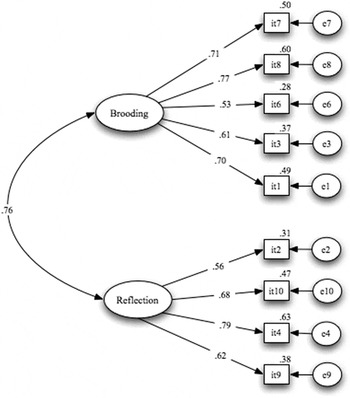
Moreover, in local adjustment, the standardized factor loadings ranged from .532 (item 6) to .793 (item 4) and all factor loadings were statistically significant (p ≤ .001). Additionally, all items showed Squared Multiple Correlations ranging between .283 (item 6) and .629 (item 4) (Figure 1). On the whole, the respecified model showed a good local adjustment. The correlation between brooding dimension and reflection dimension was r = .76. Given the high correlation between both types of ruminative responses styles, the similarity in the content of items and the empirical inconsistency of the results regarding the distinction between both components, we also tested a one-factor structure of the RRS through CFA and the results showed a quite weak fit to the data (χ2 (35) = 308.723, p < .001, GFI = .894, CFI = .841, TLI = .796, RMSEA = .120, CI 95% [.118 to .133], p < .001, AIC = 348.723, ECVI = .645). In conclusion, the model 2 is considered a favorable model because it satisfies in terms of overall goodness of fit and strength of parameter estimates.
Confirmatory Factor Analysis of the two-factor of the RRS for adolescents (N = 542). Standardized coefficients are shown; all paths are statistically significant (p < .001).

Multiple-Group Analysis for gender invariance
Since gender may influence the psychometric properties of psychological trait or affect-related measures and empirical evidence shows the role of gender in tendencies for engage in rumination, it seems important to assess whether the underlying factor structure of the RRS is equivalent for gender (Meredith, Reference Meredith1993). A measure is invariant when its measurement properties are structurally equivalent in all groups of interest (Meredith, Reference Meredith1993).
In this study a multiple-group CFA for gender invariance of the RRS (model without item 5) was assessed through the comparison between the unconstrained model (i.e., less restrictive model where parameters were freely estimated across groups) and the constrained model, by constraining various parameters across both groups. The first step is to test for configural invariance, that is, to fit a baseline model for each group separately (Meredith, Reference Meredith1993). The factorial model presented a reasonable fit to the data for both males and females adolescents: GFI = .911, CFI = .889, TLI = .846, RMSEA = .079, C.I. 90% [0.069 to 0.090], p < .001. The second step involves metric invariance, meaning that equal factor loadings across groups are required to ensure equivalent relationships between latent factor and its indicators (items) in the factorial model (Meredith, Reference Meredith1993). Results confirm the invariance of measurement across gender for measurement weights (i.e., equal factor loadings) (χ2 dif (7) = 3.720, p = .811 < χ2 0.95;(7) = 14.067).
Descriptive Statistics and Reliability Analysis
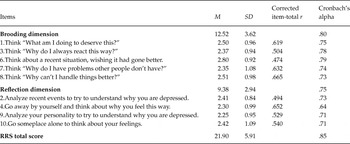
Table 2 displays means, standard deviations, corrected item-total correlation, Cronbach’s alpha if item deleted and Cronbach’s alpha for total score (9 items) and subscales of the Ruminative Responses Scale in adolescents’ sample. Results showed high item-total correlations, ranging between .47 (item 6) and .67 (item 8), which confirm the adequacy of the items to the measure and its internal consistency (Tabachnick & Fidell, Reference Tabachnick and Fidell2007). The Cronbach’s alpha obtained for the total score of the RRS was very good (α = .85) and for its components was adequate, with α = .80 for brooding and α = .75 for reflection (Table 2). Additionally, all items positively contributed to the internal consistency of the Portuguese version of the RRS for adolescents, since the reliability would not improve if any item was deleted (Table 2).
Means (M), standard deviations (SD), corrected item-total correlations, Cronbach’s alpha and Cronbach’s alpha if item deleted for Ruminative Responses Scale (RRS) and its dimensions in adolescents’ sample (N = 542)

The Composite Reliability obtained for brooding dimension was .87 and for reflection dimension was .84. The variance extracted measure value for brooding and reflection dimensions was .57, respectively, suggesting that individual indicators are truly representative of the latent construct.
Descriptive data for sex, age and grade in school
To evaluate the influence of demographic variables in RRS, we performed Pearson product-moment correlations for age and years of education. In this sample, there were no correlations between RRS and its dimensions and age and years of education. Regarding sex, the means, standard deviations and t-test differences for the total score of RRS and for the two dimensions are presented in Table 3. The total and subscale scores are computed by calculating the mean of item responses. Results showed that females reported higher levels of brooding, reflection and rumination (total score) than males (Table 3). According with Cohen’s guidelines (1988 cited in Tabachnick & Fidell, Reference Tabachnick and Fidell2007), the magnitude of the differences in the means presented a moderate effect (Table 3).
Means (M), standard deviations (SD), t-test differences and eta-squared for effect size by sex for Ruminative Responses Scale (RRS) and their dimensions in adolescents’ sample (N = 542)

Convergent Validity
To evaluate convergent validity of the overall score of RRS and their dimensions, Pearson product-moment correlations were computed between RRS (total and subscales) and depression, anxiety and stress symptoms (measured by DASS-21). Results showed that RRS total score was significantly and positively correlated with depression (r = .56, p < .001), anxiety (r = .51, p < .001) and stress symptoms (r = .60, p < .001). There were positive and moderate correlations between brooding dimension and depression (r = .57, p < .001), anxiety (r = .49, p < .001) and stress symptoms (r = .58, p < .001). There were positive and moderate correlations between reflection dimension and depression (r = .43, p < .001), anxiety (r = .43, p < .001) and stress symptoms (r = .50, p < .001).
The contribution of brooding and reflection to explain depressive, anxiety and stress symptoms
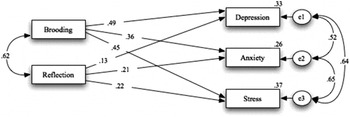
In this study we conducted a Multiple Regression Analysis through SEM approach in order to analyze the significance of each path analysis of the predictor variables (with multiple dependent variables) and the variance explained of the model (i.e., observed correlations or covariances) (Kline, Reference Kline2005). In the theoretical model, brooding and reflection dimensions are exogenous variables and depression, anxiety and stress are endogenous variables. This is a saturated or just-identified model (i.e., with zero degrees of freedom), resulting in a perfect fit to the data: GFI = 1.000, CFI = 1.000, TLI = 1.000, SRMR = 0.000, RMSEA = .523 [.501, .546]. Figure 2 displays the multiple regression analysis through SEM with the standardized path coefficients, the squared multiple correlations (R 2 ) and the measurement error correlations among dependent variables. Results show that all paths are statistically significant (p < .001). Both brooding and reflection accounted for 37% of stress, 33% of depression and 26% of anxiety total variances. The paths from brooding to depression had a medium effect (b = 3.400, SE b = .314, Z = 10.843, p < .001, β = .49), to anxiety had a medium effect (b = 2.196, SE b = .287, Z = 7.648, p < .001, β = .36), and to stress had a medium effect (b = 2.997, SE b = .293, Z = 10.232, p < .001, β = .45). The paths from reflection to depression had a small effect (b = .918, SE b = .309, Z = 2.973, p = .003, β = .13), to anxiety had a small effect (b = 1.256, SE b = .283, Z = 4.444, p < .001, β = .21), and to stress had a small effect (b = 1.465, SE b = .288, Z = 5.081, p < .001, β = .22). The correlations between exogenous variables and between dependent variables are statistically significant (Figure 2).
Multiple Regression Analysis Model (SEM) with brooding and reflection (exogenous variables) to predict depressive, anxiety and stress symptoms (endogenous variables) in an adolescents’ sample (N = 542). Standardized coefficients are presented; all paths are statistically significant (p < .001).

Then, this model was tested by a multi-group approach to analyse gender differences in the relationships among rumination factors and depression, anxiety and stress. This multiple group analysis will allow us to test whether path coefficients in the model are equal or invariant for groups (i.e., males vs. females) (Byrne, Reference Byrne2010). The comparison between the unconstrained model (i.e., with free structural parameter coefficients) and the equality constrained model (i.e., where the parameters are constrained equal across groups) was analyzed (Byrne, Reference Byrne2010). Results from the Chi-square difference test showed the invariance of the model for both genders, χ2 dif(6) = 7.903, p = .245. Finally, the critical ratio difference method provided by Amos software was calculated to test for differences between male and female adolescents among all parameter estimates and critical ratio values larger than 1.96 indicated a significant difference between genders on the corresponding parameter (Byrne, Reference Byrne2010). Results indicated no significant differences on parameters coefficients in all paths (Z values < 1.96).
Discussion
The main purpose of this paper was to examine the factor structure of the 10-item version of the Ruminative Responses Scale (RRS; Treynor et al., Reference Treynor, Gonzalez and Nolen-Hoeksema2003) in an adolescents’ sample. Two alternative models were tested using a CFA approach, as suggested by previous studies concerning the structure of RRS in adults (Dinis et al., Reference Dinis, Gouveia, Duarte and Castro2011; Treynor et al., Reference Treynor, Gonzalez and Nolen-Hoeksema2003; Whitmer & Gotlib, Reference Whitmer and Gotlib2011) and in adolescents (Cunha et al., Reference Cunha, Amado, Xavier, Couto, Galhardo and Massano-Cardoso2015). In accordance to these previous studies, results showed that item 5 (“write down what you are thinking and analyze it”) was not able to explain the variance of the underlying latent factor (reflection) as it presented low factor loading and squared multiple correlation (Kline, Reference Kline2005). Thus, the item 5 was removed. Results showed that the two-factor structure of the RRS composed by brooding and reflection dimensions had a significantly better fit to the data and an adequate local adjustment than the model 1. These results support the distinction between brooding and reflection in adolescents, which is in accordance with previous studies in this age group (Burwell & Shirk, Reference Burwell and Shirk2007; Cunha et al., Reference Cunha, Amado, Xavier, Couto, Galhardo and Massano-Cardoso2015; Erdur-Baker & Bugay, Reference Erdur-Baker and Bugay2010). Moreover, the two-factor structure of RRS in adolescents’ sample revealed equivalent for both males and females, supporting the invariance of measurement across gender.
Regarding internal reliability of the RRS in this adolescents’ sample, results revealed a good internal consistency for the overall score of the RRS and an adequate internal consistency for both dimensions of rumination. These findings are very similar to those obtained among adult (Dinis et al., Reference Dinis, Gouveia, Duarte and Castro2011; Treynor et al., Reference Treynor, Gonzalez and Nolen-Hoeksema2003) and adolescent populations (Burwell & Shirk, Reference Burwell and Shirk2007; Cox et al., Reference Cox, Funasaki, Smith and Mezulis2012; Cunha et al., Reference Cunha, Amado, Xavier, Couto, Galhardo and Massano-Cardoso2015).
Concerning sex differences, the data revealed that girls tend to ruminate more than boys, reporting higher levels of both brooding and reflection dimensions. This finding is in line with previous research on adolescents, demonstrating that girls are more likely than boys to engage in ruminative responses style (Bastin et al., 2014; Burwell & Shirk, Reference Burwell and Shirk2007; Lopez et al., Reference Lopez, Driscoll and Kistner2009; Mezulis et al., Reference Mezulis, Simonson, McCauley and Stoep2011; Muris et al., Reference Muris, Roelofs, Meesters and Boomsma2004; Rood et al., Reference Rood, Roelofs, Bögels, Nolen-Hoeksema and Schouten2009; Verstraeten et al., Reference Verstraeten, Vasey, Raes and Bijttebier2010; Ziegert & Kistner, Reference Ziegert and Kistner2002).
The present results also suggest that the brooding factor demonstrated significant and moderate relationships with depression, anxiety and stress symptoms whereas reflection factor had low associations. This differential association pattern between the two dimensions and internalizing symptoms was also found in several empirical studies (Cox et al., Reference Cox, Funasaki, Smith and Mezulis2012; Verstraeten et al., Reference Verstraeten, Vasey, Raes and Bijttebier2010). Moreover, results from multiple regression analysis through SEM demonstrate that brooding dimension is strongly linked to depressive, anxiety and stress symptoms than reflection dimension. Although reflection dimension had a significant and independent effect on these symptoms, its effect was of small magnitude. To sum up, these findings indicate that adolescents who brood about their own depressive or dysphoric emotions tend to present higher levels of depressive, anxiety and stress symptoms. These results are in accordance with empirical research in adolescent and adult populations. Indeed, it has been suggested that brooding is the most maladaptive and toxic component of rumination (Dinis et al., Reference Dinis, Gouveia, Duarte and Castro2011; Nolen-Hoeksema et al., Reference Nolen-Hoeksema, Wisco and Lyubomirsky2008; Smith & Alloy, Reference Smith and Alloy2009; Treynor et al., Reference Treynor, Gonzalez and Nolen-Hoeksema2003; Whitmer & Gotlib, Reference Whitmer and Gotlib2011). In adolescence, studies have also shown that brooding consistently predicts increased levels of depression (Bastin et al., 2014; Burwell & Shirk, Reference Burwell and Shirk2007; Cox et al., Reference Cox, Funasaki, Smith and Mezulis2012).
On the contrary to theoretical framework, reflection dimension is still significantly associated with psychopathology. Moreover, our results from CFA showed a high correlation between both dimensions (r = .76) but the one-factor structure had a poor fit to the data. There are two possible explanations for these results. Firstly, the semantic construction of the items (“Think” and “Analyze or Go away”) may lead to obtaining two factors and not one. Secondly, the content of the items are similar because it tends to centre on negative evaluations of the situation or emotional reactions to it, which may result in high correlation between both components. Thus, these two dimensions are not so different which can, at least partially, explain the significant association between reflection and psychopathology. As some studies have noted, when reflection is used in the context of perceived failure in problem solving it may trigger judgmental evaluations about one’s feelings and reactions, which, in turn, might lead to self-perpetuating cycles of negative cognition and negative affect (Joormann et al., Reference Joormann, Dkane and Gotlib2006; Rude et al., Reference Rude, Little Maestas and Neff2007).
Some limitations should be considered when interpreting our findings. Firstly, the use of cross-sectional design precludes the establishment of causal directions. In the future, longitudinal studies should carry out to improve the understanding on the causal relationships between variables. Secondly, although other studies have already suggested that item 5 (“write down what you are thinking and analyze it”) should be removed or replaced because of its low factor loading (Cunha et al., Reference Cunha, Amado, Xavier, Couto, Galhardo and Massano-Cardoso2015; Dinis et al., Reference Dinis, Gouveia, Duarte and Castro2011; Whitmer & Gotlib, Reference Whitmer and Gotlib2011), this issue might be due to cultural or language differences as well as other differences in the population (e.g., community versus clinical samples). Therefore, future studies should seek to confirm the factor structure and the relevance of removing or replacing or retaining this item in other samples. Thirdly, the nature of the sample used constrains the generalizability of our results to a clinical adolescent’s sample. Additionally, the non-clinical sample, limits the study of the RRS sensitivity to discriminate between respondents from general population and those with psychopathology where rumination is thought to constitute a central and transdiagnostic feature. Moreover, the convenience nature of the sample constrains the generalization of the data. Lastly, our data are constrained by the limitations linked to the exclusive use of self-report measures and therefore other assessment methodologies (e.g., face-to-face interviews, ecological momentary assessment) are required in future research.
Despite of the aforementioned methodological constraints, our findings support that rumination is a multidimensional construct, composed by two distinct dimensions, namely brooding and reflection. As in adult populations, among adolescents brooding is consistently linked to depressive symptoms, whereas reflection shows a low association with depression. In addition, this study demonstrates that brooding had a highly contribution to explain depressive, anxiety and stress symptoms, than reflection. Overall, the present study supports that the RRS allows for a brief, time-efficient and reliable assessment of rumination among adolescents.
The key contribution of this study relies on the understanding of subtypes of rumination measured by the Ruminative Responses Scale in a Portuguese sample of adolescents, whereas much of the prior research on rumination has been conducted among adults in USA. Additionally, the current study offers relevant data on gender invariance in RRS’s factor structure that goes beyond examination of mean level differences reported in previous studies.