Introduction
The unprecedented increase of the older population in Europe has prompted the search for new formulas to manage the demands arising from demographic change. Among the new policy pathways, ‘ageing in place’Footnote 1 appears as the mainstream guideline for housing and care measures that seek to preserve and extend as long as possible the autonomy that allows older individuals to remain in their own home as an alternative to institutionalisation (Davey et al. Reference Davey, Nana, De Joux and Arcus2004; Houben Reference Houben2001; Sixsmith and Sixsmith Reference Sixsmith and Sixsmith2008). A recurrent statement to back up the implementation of ageing-in-place policies is that older people want to stay in their own home (De Jong et al. Reference De Jong, Rouwendal, Hattum and Brouwer2012), a preference supported by studies that reveal low rates of residential mobility between private homes (Angelini and Laferrère Reference Angelini and Laferrère2011; Tatsiramos Reference Tatsiramos2006) and into residential care (Laferrère et al. Reference Laferrère, Van den Hende, Van den Bosch, Geerts, Börsch-Supan, Brandt, Litwin and Weber2013). Additionally, the generalised decrease in the proportion of multigenerational households in Europe – currently ranging between 17 and 24 per cent in Italy, Spain and Greece, to less than 4 per cent in Sweden, Denmark and the Netherlands (Ogg and Renaut Reference Ogg and Renault2006) – has also supported the hypothesis that older people widely prefer to remain in their own home.
Nevertheless, whereas much empirical evidence validates that ageing in one's own home is the most extended living pattern among older adults de facto, little is known about their primary wishes in this respect. Surprisingly, despite a number of studies showing that to remain in an unwanted place, even if it is one's own home, may entail negative outcomes for wellbeing such as isolation, loneliness or a sense of confinement (Braubach and Power Reference Braubach and Power2011; Oldman Reference Oldman2003; Oldman and Quilgars Reference Oldman and Quilgars1999), the desirability to stay at home can be questioned when the domestic environment has deteriorated over time (Heywood, Oldman and Means Reference Heywood, Oldman and Means2002), its facilities and location are perceived as inadequate by older dwellers (Clough et al. Reference Clough, Leamy, Miller, Bright and Brooks2005; Oswald et al. Reference Oswald, Jopp, Rott and Wahl2010), or there is a lack of real alternatives in terms of preferred living and care arrangements (Hillcoat-Nallétamby and Ogg Reference Hillcoat-Nallétamby and Ogg2013). Although the attitudes of older people have been identified as an essential determinant to achieve a larger involvement of the older population in their own care (Bastiaens et al. Reference Bastiaens, Van Royen, Pavlic, Raposo and Baker2007), the ideal dimension of residential and care choices has been rarely explored.
Even less attention has been drawn to residential choices in the context of macro-structural factors such as culture and welfare state organisation, which have been identified as the major determinants of elder-care arrangements in Europe (Lowenstein, Katz and Gur-Yaish Reference Lowenstein, Katz, Gur-Yaish, Szinovacz and Davey2009; Motel-Klingebiel, Tesch-Roemer and von Kondratowitz Reference Motel-Klingebiel, Tesch-Roemer and von Kondratowitz2005; Suanet, van Groenou and van Tilburg Reference Suanet, van Groenou and van Tilburg2012). If, as stated by the Second World Assembly on Ageing, to accomplish a successful promotion of independent living it is indispensable to pay special attention to individual preferences and create affordable residential options according with these preferences (United Nations 2002), it is essential to achieve a more realistic overview which integrates older people's perceptions, regardless of the residential situation they actually experience. Questioning the universality of ‘ageing in place’ as a desire is a first step in this direction.
Thus, the main objective of this study is to shed light on the preferred residential and care arrangements in later life by means of a case study of the older Spanish population (65+), exploring the willingness for each one of the alternatives considered: one's own home, the relative's home and institutions. The research aims to bring some innovative features to this field: (a) to distinguish the ideal preferences of older adults facing different health status: the preferred option in the case of healthy ageing and in the case of frailty; and (b) to explore the profiles associated with the selection of each one of the residential alternatives in the case of frailty. In addition, the focus on Spain allows the specificities under which residential and care choices in old age are made in Southern Europe to be approached. These specificities are a familiaristic conceptualisation of care and an insufficient supply of public housing and care services for people in need of social care, elements that seem to be forgotten at times in the creation of the European common policy guidelines (Genet et al. Reference Genet, Boerma, Kroneman, Hutchinson and Saltman2012).
Background
The study of residential choices in old age
Research on residential choices has a long tradition of investigating the factors of housing consumption from an economic point of view (Dieleman Reference Dieleman2001). The assumption underlying these studies, which have treated individuals as consumers and dwellings as products, is that individuals configure their choices by valuating the housing attributes, location, facilities, price, etc., in terms of part-worth utility (Molin, Oppewal and Timmermans Reference Molin, Oppewal and Timmermans1996). Recently, motivational determinants have been assessed as explaining factors of choice, recognising the influence that personal attitudes and values display on the housing selection (Coolen and Hoekstra Reference Coolen and Hoekstra2001; Sirgy, Grzeskowiak and Su Reference Sirgy, Grzeskowiak and Su2005). The perspectives used to explore housing choices can be summarised in two main branches: the revealed preferences approach, which interprets the observed behaviours of individuals and households in the real market and the follow-on dynamics, i.e. move or stay in the same accommodation, ownership or tenure, etc., as an expression of preferences in terms of utility-maximising and functionality (Clark and Dieleman Reference Clark and Dieleman1996; Timmermans, Molin and van Noortwijk Reference Timmermans, Molin and van Noortwijk1994); and the stated preferences approach, which is focused on the ideal choices that individuals and households would make to face hypothetical situations: the place where they would like to grow old, with whom they would like to live in five years, etc. (Timmermans, Molin and van Noortwijk Reference Timmermans, Molin and van Noortwijk1994). From this perspective, the choices are not observational and do not imply an authentic decision, but they are informative opinions about expectations, aspirations or goals not necessarily materialised at any time. It is this second notion of preference from which the subsequent analysis departs.
Concerning the research on ageing, the majority of studies exploring the residential choices by older people have adopted, directly or indirectly, the revealed preferences approach by focusing on factual behaviours. In this sense, residential mobility has been a leading subject of investigation, covering a wide range of topics: the characteristics of older movers (González-Puga Reference González-Puga2004; Smits, Van Gaalen and Mulder Reference Smits, Van Gaalen and Mulder.2010), the reasons that triggered the residential movements (Sabia Reference Sabia2008; Sergeant and Ekerdt Reference Sergeant and Ekerdt2008; Van der Hart Reference Van der Hart1998) or the associated life transitions of widowhood or retirement (Bonvalet and Ogg Reference Bonvalet and Ogg2008; Kulu and Milewski Reference Kulu and Milewski2007). The empirical evidence provided by these studies has confirmed the tendency of older people to age in their own home, varying in intensity depending on the country.Footnote 2
Studies on ideal residential choices are much more limited, although the preference for one's own dwelling is perceptible in the opinions of older adults and their families, who declare that a private home would be a more suitable environment than institutionalisation (Burnholt and Windle Reference Burnholt and Windle2001), even in the case of dependency (Davey Reference Davey2006). In addition, co-residence in a relative's home is rejected as the prime residential-care arrangement when older adults construe that multigenerational households limit both their own and their children's independence (Olsberg and Winters Reference Olsberg and Winters2005). The exception is when it is seen as place for palliative care. A combination of moral and practical factors explain the rejection of co-residence: people not wanting to be a burden to family or friends; doubts about the quality of care in relation to technologies and health care; or the presence of ‘strangers' as professional care-givers in such an intimate setting make older people prefer to live their final days in hospitals or nursing homes (Gott et al. Reference Gott, Seymour, Bellamy, Clark and Ahmedzai2004).
What the cited studies have in common is that they are case studies of countries pertaining to the so-called weak-family societies (United Kingdom (UK), Australia, United States of America (USA), etc.), characterised by weak family ties and more individualistic social norms (Reher Reference Reher1998), revealing a gap of knowledge regarding the contexts of countries with family-oriented values. The research carried out by Costa-Font, Elvira and Miró (Reference Costa-Font, Elvira and Miró2009) is one of the few attempts aiming to examine the residential preferences in familiaristic societies from the stated preferences approach and focusing on the Spanish population aged 65 and over. This pioneer study concluded that, compared with institutions or relative's homes, one's own home was the most desired setting among older people (78%), observing a slight shift in the willingness for supportive environments as age increases. Furthermore, gender disparities were found in relation to the preferred supportive environment, with men being more inclined towards collective homes and women opting for kin living arrangements. Those older Spanish people preferring nursing homes were already showing serious impairments at the moment of the survey but, moreover, they had a fairly comfortable economic situation, relatively high income and owned high-price dwellings, which would allow them to afford an eventual transition to residential care.
Another study using the stated preferences approach has shown that the preferred informal care-giver is conditioned by the reason that activates the support demand: when the need is related to domestic tasks, older Spanish people select the partner first, but also friends are preferred, and children or siblings would be chosen as a main option in the case of financial problems (Fernández Alonso Reference Fernández Alonso2012). Also studies approaching the issue of residential preferences in the Spanish context have put the focus on the ideal measures of formal care, showing that the preferences are conditioned by the pathologies that the older disabled population present: depressive symptoms increase the probability of preferring domiciliary assistance and physical limitations increase the willingness towards nursing care, day-care centres, tele-assistance, and information and communications technology (ICT) (Vilaplana Prieto Reference Vilaplana Prieto2009).
Understanding residential and care arrangements for older adults in Spain: the influence of contextual conditions
Residential choices in later life are inevitably linked to new physical and cognitive needs. A large part of the possibilities of covering these age-related demands comes from a combination of resources provided by family, State and market. In Southern Europe, these demands are clearly met mostly by the family, with a residual partaking of the State and the private sector. Notwithstanding the fact of regional and country differences (Dykstra and Fokkema Reference Dysktra and Fokkema2010; Glaser, Tomassini and Grundy Reference Glaser, Tomassini and Grundy2004), a hierarchical compensatory model of care predominates in Southern countries, in which informal care usually replaces formal. In Spain, Italy, Portugal or Greece, time-consuming support is principally assumed by kin, contrasting with the patterns in Scandinavian countries or the Netherlands, where it is mainly provided by care professionals (Brandt, Haberkern and Szydlik Reference Brandt, Haberkern and Szydlik2009; Kalmijn and Saraceno Reference Kalmijn and Saraceno2008). In the specific case of Spain, it is estimated that 88 per cent of home-based care received by older people comes from their social network (Durán Reference Durán2002). The archetypical profile of informal care-givers is a female relative, aged around 55 years old, married with children and without paid employment (Tobío et al. Reference Tobío, Agulló, Gómez and Martín-Palomo2010). Occasionally, formal and informal support combine in Southern countries when the support demanded by the older person requires a high level of specialisation, e.g. nursing care (Bolin, Lindgran and Lundborg Reference Bolin, Lindgran and Lundborg2007; Haberkern and Szydlik Reference Haberkern and Szydlik2010). Recent studies focusing on Spain have identified a mixed pattern that combines the prevalence of the hierarchical compensatory model – a partner or adult children assuming the main role as care-giver, with the complementary model – the probability of receiving public care services combined with informal increases as capabilities deteriorate (Rogero-García Reference Rogero-García2009; Rogero-García, Prieto-Flores and Rosenberg Reference Rodríguez-Martín, Martínez-Andrés, Cervera-Monteagudo, Notario-Pacheco and Martínez-Vizcaíno2008).
Culture together with welfare state organisation have been identified as the most determinant explanatory factors of the cross-European divergences in the models of care (Geerts and van der Bosch 2012; Suanet, van Groenou and van Tilburg Reference Suanet, van Groenou and van Tilburg2012). In the case of Spain, the pre-eminence of informal support is rooted in a family system characterised by a high proportion of multigenerational households, strong relationships, frequent contacts between members of the kin network and cultural norms that point to relatives as foremost care-givers of those in need. Traditional values linked to the high level of normative solidarity result in individual goals that are largely dependent on family expectations (Lowenstein and Daatland Reference Lowenstein and Daatland2006). Thus, intergenerational solidarity becomes more of a social duty than an option, above all in cases of functional limitations or illness. An upward flow of support between relatives is expected by all generations, grounded in the idea of reciprocity; the support provided from parents to their children during early life stages is viewed to some extent as an investment for their future security, which adult children also assume as part of their obligation towards their older parents (Tobío Reference Tobío2008). Currently, this familiaristic conceptualisation of care responsibilities has been notably relaxed, although not eliminated. Both filial obligations and parental expectations in relation to care are now combined with the rising importance of individual aspirations and choices. The growing preference for formal assistance coming from the State and private providers reflects the fact that norms in familiaristic societies are turning into a mixed mode (Daatland and Herlofson Reference Daatland and Herlofson2003; Meil Reference Meil2011).
In addition to socio-cultural values, the hierarchical compensatory model of care that characterises the Spanish context results from the historically deficient and auxiliary protection of the State for dependent persons. The connotation of care as a private activity has led to tightly rationing age-related costs, chiefly pension schemes and health services which are mostly orientated to individuals who cannot depend on their own resources or relatives to assist them (Comas-Herrera, Wittenberg and Pickard Reference Comas-Herrera, Wittenberg, Pickard, Comas-Herrera and Wittenberg2003). According to Eurostat (2014), while the average public expenditure on long-term care in the EU15 countries was 2 per cent of gross domestic product in 2008 – considering allowance, accommodation and assistance in carrying out daily tasks – the Spanish public expenditure was situated among the lowest at 0.45 per cent.
A recent attempt to alleviate this deficiency was taken in 2006 by implementing the Ley de Promoción de la Autonomía Personal y Atención a las Personas en Situación de Dependencia y a las Familias de España (Law for the Promotion of Personal Autonomy and Attention to People in Situations of Dependency and the Families of Spain). The regulation, presented as the pillar for the future National System of Attention to Dependence, was strongly criticised since its implementation did not co-ordinate new services with those actually provided. In addition, the reform gave prominence to cash transfers over benefits in kind, which perpetuated the role of the family as active care provider (López-Cumbre Reference López-Cumbre2006). The cutbacks on social expenditure due to the economic crisis have resulted in an abrupt halt to the regulation, maintaining the deficient role of Spanish authorities in the social care supply.
Co-residence: between choice and a lack of alternatives
To remain at home in later life is the preferred living arrangement in Western countries, as confirmed by the very low rate of institutionalised older people (approximately 5% in Organisation for Economic Co-operation and Development (OECD) countries (OECD 2005) and 3% in the EU27 (Peeters, Debels and Verpoorten Reference Peeters, Debels and Verpoorten2013). According to Spanish census data, during the period 1991–2011 the percentage of the population aged 65+ living in private accommodation remained relatively stable, exceeding 96 per cent every year, with a slight overall decrease between 1991 (97.1%) and 2011 (96.5%). However, what characterises the Spanish context is the exceptionally high rates of older adults living in private homes over the age 85 (89%), a time when the likelihood of institutionalisation increases (Laferrère et al. Reference Laferrère, Van den Hende, Van den Bosch, Geerts, Börsch-Supan, Brandt, Litwin and Weber2013). The percentage of older people living in the private domain remains particularly high compared to other European counties such as the Netherlands, Sweden or the UK, where the proportion of the population living in private homes at age 85 barely exceeds 80 per cent (Fernández-Carro Reference Fernández-Carro2013).
This picture should be interpreted with caution, because to reside in a private setting during old age in Spain is not necessarily associated with independent living in the same way as it could be considered in the Northern or Western part of Europe. Despite the decrease of multigenerational households in Europe (Festy and Rychtarikova Reference Festy, Rychtarikova, Gaymu, Festy, Poulain and Beets2008; Kohli, Künemund and Lüdicke Reference Kohli, Künemund, Lüdicke, Börsch-Supan, Brugiavini, Jürges, Kapteyn, Mackenbach, Siegrist and Weber2005), co-residence does not necessarily imply a relationship of dependence between the older and younger member(s) of the household. Relocating to a relative's home is a solution when physical and/or mental conditions impede an older adult living independently, especially in Southern Europe (Grundy and Tomassini Reference Grundy and Tomassini2003). In fact, the need for care and support has been identified as one of the most relevant triggering factors of parent–child residential movement (Malmberg and Pettersson Reference Malmberg and Pettersson2007; Smits Reference Smits2010).
In Spain, it is estimated that 40 per cent of the disabled population aged 65 and over are living in multigenerational households, out of which more than a half – 22 per cent – moved to their relative's home on a permanent basis, namely the adult children's home (Abellán, Esparza and Pérez-Díaz Reference Abellán, Esparza and Pérez-Díaz2011). The proportion of older adults co-residing is even higher among older adults who were previously living alone; whether widowed, separated or never married (Pérez-Ortíz Reference Pérez-Ortíz2006). The contextual factors aforementioned – family-oriented values underpinning the care supply together with a limited range of housing and care alternatives resulting in the scant development of the Spanish welfare state – condition the available options for selecting a living environment that covers care demands. Thus, as Isengard and Szydlik (Reference Isengard and Szydlik2012) note, co-residence with support aims is not only the outcome of traditions and habits, but also a reaction to socio-political and economic adverse circumstances.
Collective homes: the last resort
The trend of older people conserving good physical and cognitive health for longer periods, together with the family providing the bulk of care, has resulted in older Spanish people being kept inside the boundaries of the domestic sphere.Footnote 3 As a result, cases where Spanish older people move to institutions are unusual and normally prompted by the incapability of the older individual and their relatives facing a serious health decline or by the lack of relatives who assume a caring role. The strong negative connotations of institutionalisation as a personal, family or social failure mean that transitions to residential care are not usually a proactive choice, but the outcome of the lack of alternatives. One of the first qualitative studies focusing on the older Spanish population living in collective homes showed that the decision of institutionalisation was fundamentally taken because there was no other possibility (Bazo Reference Bazo1991). Almost 25 years later, the picture is rather similar for older adults, but also for their relatives, who see institutionalisation as the only chance when cognitive impairments make home-based care insufficient to assure wellbeing (Rodríguez-Martín et al. Reference Rodríguez-Martín, Martínez-Andrés, Cervera-Monteagudo, Notario-Pacheco and Martínez-Vizcaíno2014). Also Lázaro-Ruíz and Gil-López (Reference Lázaro-Ruíz and Gil-López2005) found similar results among the non-institutionalised older population: 20 per cent declared that the main reason for considering institutionalisation would be the absence of alternatives.
Familiaristic values, together with severe limitations impeding older people to choose on their own, have meant that younger members of the family, mainly adult children, but also adult grandchildren, daughters-in-law, sons-in-law, brothers or sisters if they are alive, participate actively in selecting the timing, type, location and facilities of the nursing home, leading to an implicit compliance of older people in family choices. In a survey carried out by the Instituto de Mayores y Servicios Sociales (Institute of Older People and Social Services; IMSERSO) in 2004, institutionalised people aged 65 and over were asked who was the person that took the final decision to move into a collective setting. Although the majority of respondents declared that it was decided only by themselves (64 per cent, out of which 8 per cent also declared not to have any relatives), it is noticeable that 17 per cent admitted that the decision was taken exclusively by their family, 12 per cent declared that it was a mutual agreement and 5 per cent affirmed that the choice was made by social services. This means that 34 per cent of institutionalised older people admitted that someone else took part in the final decision about their moving to a collective home.
Guilt about the loss of competence is a shared feeling of those residing in care institutions of their own free will. The data of the aforementioned survey reveal that 9 per cent of the older respondents declared that the reason for moving was that they did not want to be a burden for their families, increasing to 14 per cent in older generations (80+). In the case of older adults still living at home, the proportion is even higher (35 per cent) (Lázaro-Ruíz and Gil-López Reference Lázaro-Ruíz and Gil-López2005). The relatives of nursing care residents expressed ambivalent feelings, ranging from guilt for not being able to assume the care duties to relief for thinking that collective homes are a proper environment to cover elder-care demands (Rodríguez-Martín et al. Reference Rodríguez-Martín, Martínez-Andrés, Cervera-Monteagudo, Notario-Pacheco and Martínez-Vizcaíno2014).
Methods
The analysis of elderly peoples' residential preferences was undertaken using the data from the cross-sectional survey Encuesta de Mayores 2010 (Older People Survey 2010), implemented by the Instituto de Mayores y Servicios Sociales de España in 2010 (Institute of Older People and Social Services of Spain; IMSERSO), which collected information on several dimensions of older adults' lives: socio-demographic characteristics, health status, living arrangements, residential situation, social participation, and opinions and attitudes about old age.
Sample and data collection
The survey was a representative sample at the national level, comprising 2,535 individuals aged 65 and over who were living in private households. The respondents were selected using a simple random sampling based on the National Telephone Directory, where the private home units are listed counting on a fixed telephone line. The eligibility criteria consisted of selecting those households with at least one permanent member aged 65 and older as a potential respondent. To avoid non-response, if no one in the household presented these characteristics or did not want to answer the questionnaire, the household was removed from the sample and replaced by another with the same characteristics. The interviews were carried out by telephone and conducted by a structured questionnaire with close-ended questions, which was previously evaluated by means of a pilot pre-test applied to a sample of 201 respondents.
A common criticism of the sampling methods based on telephonic directories lies in the possible bias resulting from the population excluded, such as subscribers who do not have a fixed telephone line, who asked specifically not to be listed in the directory or who have recently moved (Leuthold and Scheele Reference Leuthold and Scheele1971). Despite these limitations, the validity of this procedure for the Spanish context is supported by the high number of private households with a fixed telephone line. Another limitation of this type of sampling is the increasing substitution of fixed lines by mobile phones, although this does concern older households as much as younger households (Garcia-Continente et al. Reference Garcia-Continente, Pérez-Giménez, López and Nebo2014; Pasadas del Amo, Uribe-Echevarría and Soria-Zambrano Reference Pasadas del Amo, Zarco Uribe-Echevarría and Soria-Zambrano2004). In sum, studies carried out in Spain comparing different methods sampling have not found significant differences between telephone and other samples (Díaz de Rada Reference Díaz de Rada2010; Díaz de Rada and Andreu-Abela Reference Díaz de Rada and Andreu-Abela2004).
Data analysis
The analysis of the characteristics correlated with the ideal living preferences in the case of frailty was undertaken using a Discrete Choice approach by means of a multinomial logit model. The convenience of this strategy was extensively shown by Louviere, Hensher and Swait (Reference Louviere, Hensher and Swait2000), in economics and business research, and Costa-Font, Elvira and Miró (Reference Costa-Font, Elvira and Miró2009) and Vilaplana Prieto (Reference Vilaplana Prieto2009) have applied it to housing preferences in old age. According to multinomial logit premises, the probability of preferring each one of the residential alternatives (y i), which are mutually exclusive, takes the value of 0 for the preference of living in one's own home, 1 for the preference of living in a relative's home and 2 for living in an institutional setting. The probability of choosing a given residential mode is expressed by the function:
 $$\Pr (y = j) = \displaystyle{{{\rm exp}({\rm \beta} _j x_k )} \over {1 + \sum _{\,j = 1} ^2 {\rm exp}({\rm \beta} _j x_k )}}$$
where x i represents a vector of the explanatory variables and β is a vector of the parameters of the preference j. This analysis adopts the conventional normalisation in which β0 = 0, which means that to opt for an ‘ageing in place’ mode is established as the reference category of the dependent variable. Marginal effects have been used to calculate the coefficients of the model, which summarises how the change in an independent variable is related to the change in a covariate. The results of the multinomial logit model expressed as marginal effects could be read in terms of probability of change.
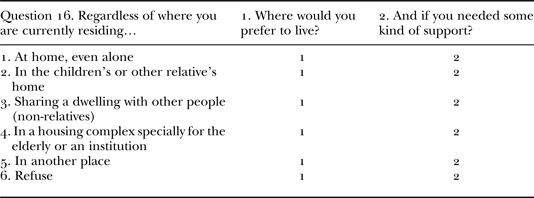
To construct the dependent variable, the question about the preferred place to live during old age regardless of the current residential and care arrangement of the older respondent has been used. The question sets out two hypothetical situations: situation I: what would be the preferred setting in the case of not needing any kind of support/care, and situation II: what would be this setting in the case of suffering any disability which may impede the normal development of daily routines. As a response, the survey considers five categories: ‘the same in both situations', and the respondent may select only one: ‘in their own home’, ‘in the relative's home’, ‘in a home shared with other people’ (non-relatives), ‘in an institution or housing complex’ and ‘other places' (Table 1).
Choice set included in the questionnaire
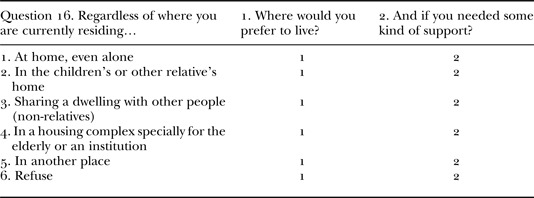
Source: Encuesta de Mayores 2010 (IMSERSO).
For methodological reasons, the five categories have been reduced given the low rate of response to the categories ‘living in a shared accommodation with no relatives' and ‘other places'. As a result, the dependent variable comprises three alternative options labelled as ‘at home’, ‘co-residing with relatives' and ‘institutionalisation’. The first category at home alludes to residing in one's own home, including living alone, managing and organising the activities of everyday life. The option co-residence refers to residing in a relative's home, mainly adult children. The third category is institutionalisation, which refers to institutions or housing complexes specially designed for older people.Footnote 4 The fact that the questionnaire presents both settings merged in the same response category, corresponding to images of housing solutions with care facilities as the traditional vision of collective homes, exemplifies the very limited range of supportive housing alternatives apart from residential care in Spain. The impossibility of separating both options requires that the study assumes that this category basically refers to collective homes.
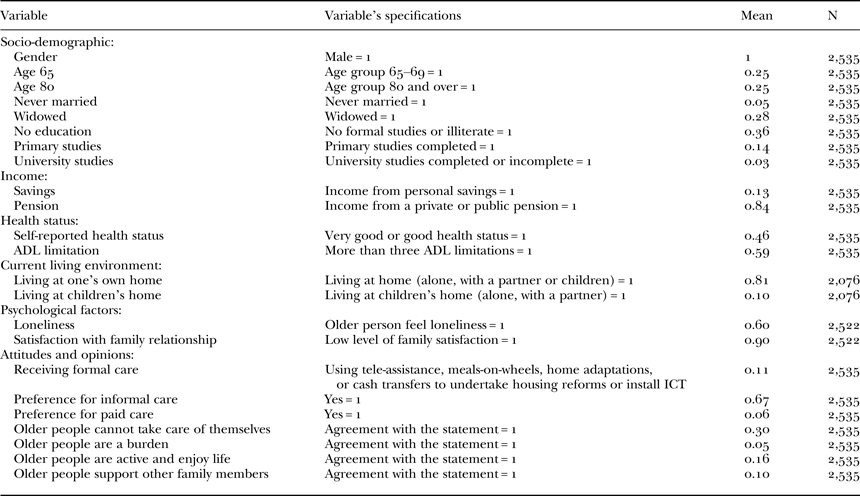
The explanatory variables of residential-care preferences are sorted in clusters of characteristics: socio-demographic, income, health status, current living environment, psychological and attitudinal factors (Table 2).
Description of the variables included in multinomial logit regression model

Notes: All variables are dummies. ICT: information and communications technology. ADL: activities of daily living.
The inclusion of these explanatory variables relates to the connection between ideal residential choices in old age with the real conditions that older people are experiencing. The different circumstances of individuals in later life shape residential and care demands. Individual features such as age or health status are important determinants of the evaluation that older people make about the characteristics that a living environment must have to ensure their wellbeing and comfort (Davey Reference Davey2006). The availability of social networks as a primary source of informal care is a key aspect. The possibility of receiving informal support, which does not necessarily mean care, but help with cleaning tasks or paperwork, a source of additional income or simply the psychological benefit of ‘being there’, also influences the perceived adequacy of a given residential environment. In this sense, the economic resources of the household are determinant: higher income would facilitate the purchase of home-based assistance, allow a change of dwelling or a move towards residential care (Costa-Font, Elvira and Miró Reference Costa-Font, Elvira and Miró2009), to adapt the housing facilities to the individual's needs. As a proxy of financial situation, the analysis adds two variables regarding the respondent's current source of income: strictly private, which includes savings and assets, and mostly public, which is income of his/her own pension or from the partner.
In addition, the influence of psychological factors such as loneliness or isolation is observed when older people perceive residential care more positively, suggesting that this solution would facilitate social integration. In this sense, the images that society constructs about ageing and older people also influence aspirations regarding living environments. Older people who refuse to admit their own ageing are more likely to transform their opinions so as to distinguish themselves from old-age stereotypes, which vary across cultures and generations (Minichiello, Browne and Kendig Reference Minichiello, Browne and Kendig2000). For this reason, the last cluster of explaining factors adds the attitudes and opinions of older adults about the ageing population to the model.
Results
The starting point: frailty as a conditioning factor of the preferred living environments in old age
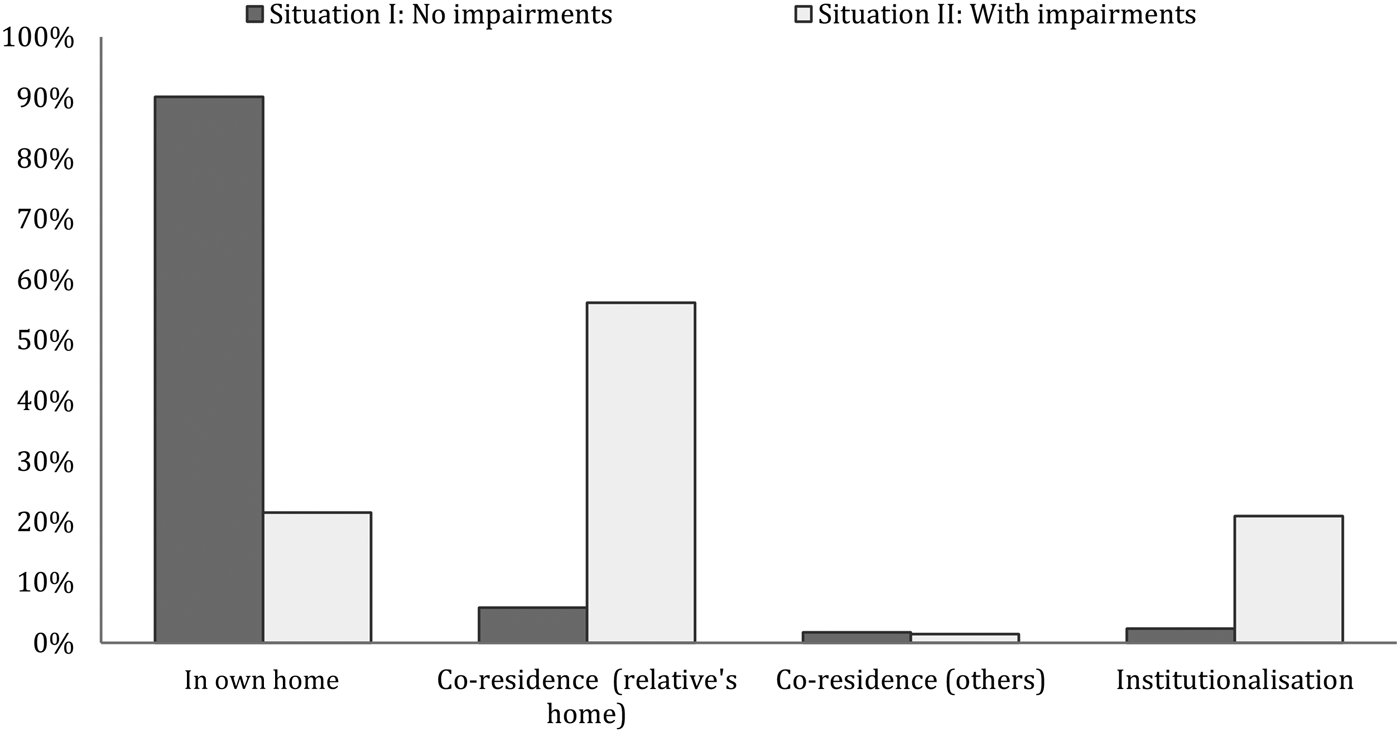
In the case of a good health status, to stay in one's own home is by far the preferred living situation for older Spanish persons, not only in reality but also as an ideal choice. About 90 per cent of respondents declared that they would prefer to live in their own home as long as they retain good physical and cognitive functioning, even if during this time they live alone (Figure 1).
Preferred residential solution in old age in the case of presence/absence of impairments, 65+ population, Spain, 2010.
When good health permits, opting for supportive environments is fairly unlikely: to move to a relative's home represents the main choice for only 6 per cent of the sample, and to live with non-relatives and relocate to a collective home is the main choice for 2 per cent. However, when older adults are asked about their preference should impairment arise, the order of preferences radically changes, and the share of preferred residential arrangements becomes more equally distributed, increasing in those categories with supportive environments (co-residence and institutions). It is noticeable that more than half of older respondents (56%) would prefer to move into the home of a relative in the case of frailty, confirming the weight older adults confer to co-residence as a mechanism to receive assistance. It is also noticeable that institutions as a preference in the case of frailty increase (21%). Overall, almost 80 per cent of the respondents ideally opt for supportive settings, private or collective, viewing them as the most suitable solution to receive support instead of ageing at home if their health status deteriorates. In addition, the low proportion of older Spanish people that would opt for a shared home with non-relatives reflects the preference for kin living arrangements in both situations.
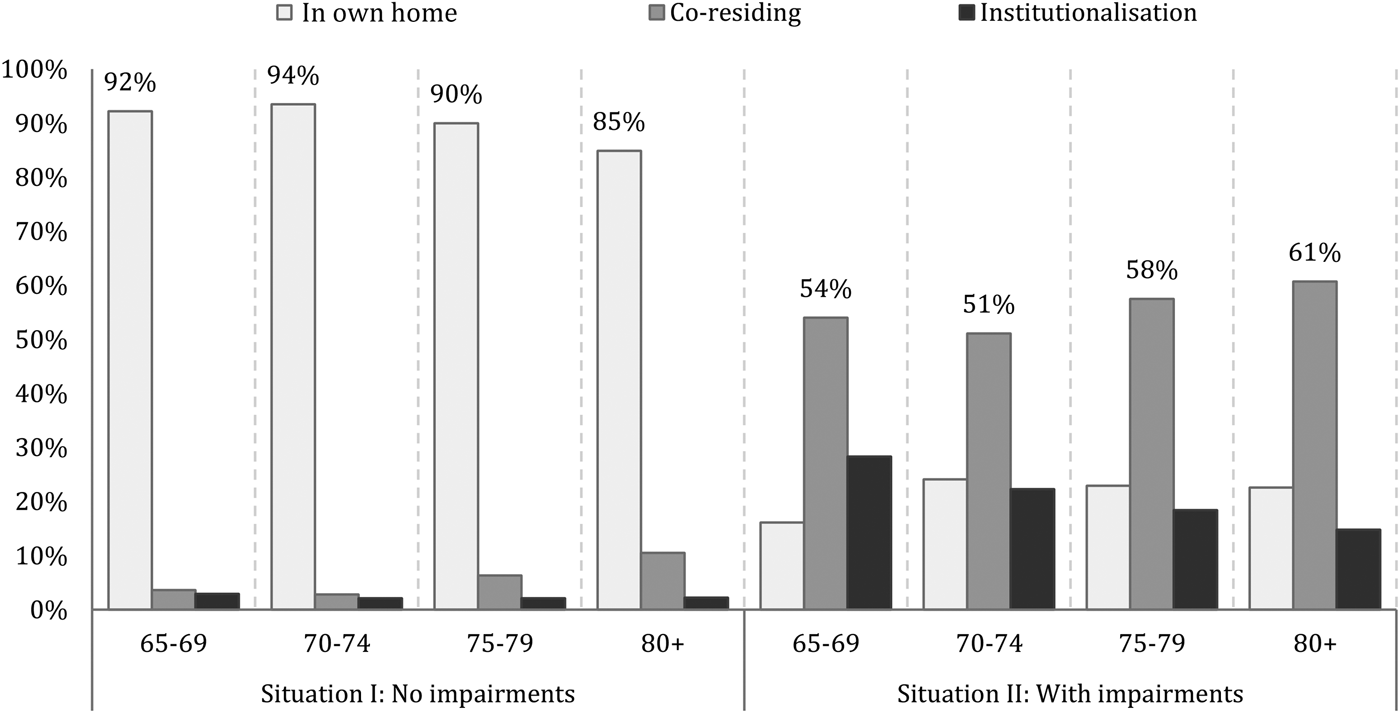
Disaggregating these data by age, in a situation without impairment, living at home as a clear preference is present in all age groups (Figure 2). Even so, a slightly higher percentage of respondents aged 80 and above who prefer to co-reside with relatives even with a fair health status is observed. Looking at the preferences in the case of impairments, there is a change in the second preferred option among the younger elderly cohorts, who prefer institutionalisation to living in their own home: 28 per cent of older respondents aged 65–69 in contrast to 15 per cent for those aged 80 and over. Given the larger difference between the factual behaviour and preferences of older people regarding each one of the alternatives in situation II (with impairments), the following section explores the profiles associated with the preference of supportive environments – co-residence and institutionalisation – compared to the preference of remaining in one's own home.
Preferred residential situation in old age by age group, 65+ population, Spain, 2010. Question: ‘Regardless of your current living environment, where would you prefer to reside in the case of no impairments/impairments in old age?’
Profiles associated with the ideal living environments in the case of frailty
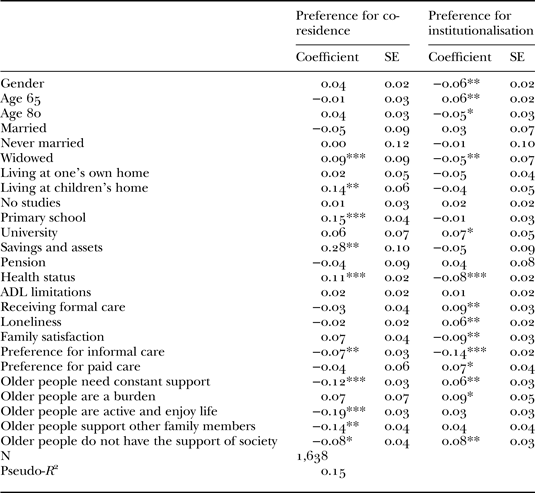
Table 3 shows the probability of choosing each of the alternatives regarding supportive environments (co-residence and institutions) compared to the willingness to reside in one's own home. The goodness of fit shown in the model is acceptable despite the low value of the McFadden's pseudo-R 2. According to Bateman, Carson and Hanemann (Reference Bateman, Carson and Hanemann2002), the adjustment of a discrete choice model applied to the study of stated preferences is satisfactory when this indicator surpasses 0.1.
Multinomial logit regression model of Spanish elderly home-residential/care preferences in the case of frailty (marginal effects)
Notes: SE: standard error. ADL: activities of daily living.
Significance levels: ***p < 0.01, **p < 0.05, *p < 0.1.
Profiles associated with the preference for co-residence
The aspects significantly related to the choice of co-residence are current living arrangements, socio-economic characteristics and opinions about ageing. To be widowed increases the probability of selecting co-residence as a better option in the case of impairments compared with staying at home. When older Spanish people lose the protective effect of a partner they tend to prefer an adult child's or other relative's home.
Another factor associated with co-residence as a preferred setting is a low educational and financial profile. If the older person has only completed primary studies, the probability of choosing co-residence increases by 15 per cent. The same occurs with older Spanish people who receive their income from a private source, i.e. savings or assets. In this case, the likelihood of preferring co-residence increases by 28 per cent. Probably, the less stable nature of these kinds of financial resources affects the willingness towards residential environments which do not imply a regular outlay as do paid home-care or private collective homes.
Concerning physical and cognitive capabilities, older adults reporting a bad or very bad health status are more inclined towards co-residence than those reporting a very good/good health status (11%). In this case, the prospective aspect of their preferences is evident as the need for care is a reality at the moment of the survey. Likewise, older people who are already living in a relative's home are more prone to identifying this arrangement as the preferred one. Older Spaniards who do not prefer to receive informal care in their own home are those more likely to choose co-residence as well. In this respect, the representation that older people in Spain have of old age in terms of independence and activity also shows a significant association with their living preferences. In the case of co-residence, individuals who do not agree with positive statements about old age where older people are active and support their families show higher probabilities towards co-residence.
Profiles associated with the preference for institutionalisation
Regarding institutionalisation as the preferred choice in the case of impairment, demographic characteristics, health status and psychological factors are those more significantly associated. Results support the gender and age pattern found by Cost-Font, Elvira and Miró (Reference Costa-Font, Elvira and Miró2009), with women 6 per cent less prone to preferring relocation in a collective home than men. The choice of collectives homes is also associated with age both negatively and positively for the ‘younger’ respondents (65–69) – the likelihood of choosing institutionalisation compared to residing in their own home is 5 per cent higher, whereas for those aged 80 and over the inverse relationship is observed: to select a nursing home is 5 per cent less probable. This means that among those age groups which are more prone to suffer some impairment, the desire to stay in their own home is higher compared to the desire to relocate to residential care. In this respect, to be widowed (a circumstance highly linked with increasing age) decreases the probability of preferring institutionalisation compared to remaining at home. The results for the younger elderly cohorts could be interpreted as a reflection of the incipient shift in the traditional vision towards institutional care. This generational effect is also visible in the educational profile associated with those older adults who prefer institutionalisation. As the level of education increases, and the younger cohorts of older people are those more skilled, the willingness to choose nursing homes as an ideal setting also increases; for those older adults who attended college, the probability of nursing homes as an ideal setting is 6 per cent higher.
In the health domain, those older adults who report a bad or very bad health status are more inclined to choose institutionalisation compared to staying in their own home. Also those older Spanish people who are using, or used in the recent past, some kind of formal assistance for a loss of independence (tele-assistance, meals-on-wheels, home adaptations, or cash transfers to undertake housing reforms or install ICT), also prefer collective homes as an ideal setting. The effect of family satisfaction over elderly preferences is fairly intuitive. Older adults who report a satisfactory relationship with their kin are less likely to opt for a nursing home compared with the ‘ageing in place’ mode. The other psychological indicator introduced in the model, loneliness, indicates that those older people who consider being alone are 6 per cent more likely to choose institutionalisation. The combination of both factors, low satisfaction with family relationships and loneliness, reduces the size of social networks and restricts the real options of informal care-givers, which as observed, negatively affect the choice for ‘ageing in place’.
The preferred type of care at home is also linked with the choice for institutionalisation: older adults who prefer to receive informal care also are less likely to choose institutionalisation, while those who prefer paid support at home are more willing to select collective homes. This association shows coherence between preferences: older adults who value nursing professionals over informal care-givers are inclined to prefer collective homes. Regarding attitudinal factors, older Spanish people who show a pessimistic opinion about the role that older people play in society are more inclined to choose institutionalisation as their preferred residential option. To think that older people are constantly needing support, that they are a burden to their families or that they are not socially supported are the assertions that increase the probability of opting for this type of setting compared to independent living.
Conclusion
The hypothesis that staying at home is the almost-universal desire of older people has been used to advocate ageing-in-place policies undertaken in Europe. However, whereas research on the manifest residential choices of the older population has been profuse (Bonvalet and Ogg Reference Bonvalet and Ogg2008; Kulu and Milewski Reference Kulu and Milewski2007; Sabia Reference Sabia2008; Sergeant and Ekerdt Reference Sergeant and Ekerdt2008; Smits, Van Gaalen and Mulder Reference Smits, Van Gaalen and Mulder.2010), little empirical evidence supports this assumption in relation to ideal preferences. To contribute to filling this gap, the goal of this research has been to examine the validity of the desirability hypothesis of ageing at home in the Spanish context, examining the willingness of the older population towards three living environments, their own home, a relative's home or institutions, and in two different scenarios, in healthy old age and in frailty. By doing so, a range of personal features, socio-demographic characteristics, health status, current living arrangements and attitudes towards old age were assessed using survey-based data to outline the profiles associated with each preference in the case of frailty.
Two major conclusions can be drawn from the research. Firstly, the perceptions about the most suitable living environment in later life vary depending on the circumstances that older people expect to undergo, confirming findings of previous studies that show how the preferred type of formal care varies depending on the pathologies presented by older adults (Vilaplana Prieto Reference Vilaplana Prieto2009). On the one hand, the study revealed that the vast majority of older Spanish people – 90 per cent – prefer ageing in their own home if such a situation would imply a sufficient level of autonomy. This result confirms the findings of the study by Costa-Font, Elvira and Miró (Reference Costa-Font, Elvira and Miró2009) (the only that has so far focused on Spain), as well as similar studies carried out in other national contexts such as Australia or the USA (Davey Reference Davey2006; Olsberg and Winters Reference Olsberg and Winters2005). On the other hand, when Spanish older people were asked about their preferences should they suffer from some physical or cognitive limitation, more than half – 56 per cent – identified co-residence with a relative, principally the adult children's home, as the ideal living environment. In this case, the influence of the hierarchical compensatory model of care entrenched in Spain, in which informal support substitutes formal (Brandt, Haberkern and Szydlik Reference Brandt, Haberkern and Szydlik2009; Rogero-García, Prieto-Flores and Rosenberg Reference Rogero-García, Prieto-Flores and Rosenberg2008), also becomes visible in the preferences of older people, reinforcing the familiaristic conceptualisation of care responsibilities in which relatives are viewed as the most secure source of support. According to these findings, it is possible to question the generalisation of ageing at home as a universal desire, since this option is only prioritised when older people do not anticipate any care-related demand. At the moment, the reality is that older people in Spain do not perceive that the options to remain in their own home, public or private, are suitable alternatives to ensure their wellbeing in situations of frailty. The most plausible explanations of the limited choice for ageing at home are the structural constraints of a high level of normative solidarity between family members that imbues the Spanish care model (Rogero-García Reference Rogero-García2009), in combination with the deficit of home-based measures to facilitate older people to stay at home despite impairments (Genet et al. Reference Genet, Boerma, Kroneman, Hutchinson and Saltman2012).
The second conclusion is that a preference for each type of supportive environment in the case of frailty – co-residence or institutionalisation – depends on the potential vulnerability displayed by the older person's profile and the degree of attachment to socio-cultural familiaristic norms. In short, this could be explained by a combination of age and generational effects. The model showed that disadvantaged older adults were more inclined to prefer co-residence: widowers, persons with a low educational and financial status, and those who present a bad self-reported health status. When the hypothetical situation of frailty is not so far from their reality, older people prefer to turn to their kin networks for their ideal living arrangement. In turn, the willingness for institutionalisation follows a different pattern, being stronger among younger-old people and those more educated, which precisely coincides with those aged between 65 and 69. As observed by Meil (Reference Meil2011), the changes that Spanish society is undergoing away from a traditional vision of normative solidarity and filial obligations link with increasing personal autonomy and the possibility of choice, permeating above all to the opinions of younger elderly cohorts about how, where and with whom they prefer to live. At the same time, the higher inclination towards institutionalisation of younger-old people is driven by an understanding of the personal investment that taking care of others means, the so-called sandwich generation, interpreting that institutional settings and housing complexes with care facilities do not jeopardise adult children's personal projects in the case of co-residence. Other factors associated with the choice of institutions converge with previous studies that observed that psychological aspects such as loneliness also increased the willingness towards selecting nursing homes as ideal places to age, viewing this housing solution as an opportunity to achieve a more satisfactory social integration (Oldman Reference Oldman2003; Rodríguez-Martín et al. Reference Rodríguez-Martín, Martínez-Andrés, Cervera-Monteagudo, Notario-Pacheco and Martínez-Vizcaíno2014).
The study presents some limitations related to the data characteristics that should be mentioned. Firstly, the cross-sectional design of the survey does not allow an investigation of the factors that motivate the shift of preferences as individuals grow older. At the same time, qualitative data are essential to achieve a deeper understanding of the role that ideal preferences play in the decision-making process about care arrangements in old age. Secondly, the present data-set does not provide detailed information about the attributes displayed by each residential environment, e.g. facilities or location, which would allow a more rigorous analysis. The fuzzy categorisation of some response options included in the questionnaire, e.g. the merging of the housing complexes with care facilities in collective homes, the non-specification of the option of remaining at home with adaptation of the domestic space, restricts a deeper analysis of ideal choices. Thirdly, the effect of the social desirability bias should not be underestimated given the existence of cultural stereotypes, which tend to favour kin living arrangements and penalise the preference for institutionalisation due to their image as an individual, family and societal failure.
At this point, it is difficult to discern whether formal support at home could be supplied in a more efficient way, when preferences are in favour of staying in one's own home. What this study can confirm is that the preference for ageing at home is not generalised when structural conditions do not ensure a sufficient level of assistance. This aspect should be taken into account to avoid over-simplifications when elaborating ageing-in-place policies. The usual formulation of the housing dilemma for older Europeans that contrasts ageing at (their own) home versus institutionalisation is not so straightforward in Southern Europe at the present time, because it neglects the third important option for older people and their families that co-residence still represents. Consequently, to design effective measures that actually contribute to the enhancement of later life wellbeing is crucial to distinguish the preferences not only between life situations, but also among national contexts, respecting the population's priorities. This means integrating socio-cultural norms and practices, and their changes over the time, into a fundamental axis of policy implementations, not only in terms of the importance that families have in the care provision in the older person's home, but also the relevance of the social networks when they turn their own dwelling into a space of care.
Acknowledgements
I am especially grateful to Dr Athina Vlachantoni for her comments and suggestions during the preparation of the final version of the manuscript. This study has been carried out as part of the R&D&I Project ‘Demographic Analysis of Housing Needs in Spain, 2005–2015’ funded by the Ministry of Science and Innovation of Spain (SEJ2007-60119). This study has also been funded by the 2013 call of the Centro de Investigaciones Sociológicas Research Programme ‘Ayudas a la Investigación’. There is no conflict of interest in submitting this work for publication.