Learning a second language (L2) in adulthood is a formidable task, not only because it involves learning a novel syntax, semantics, and phonology, but also because knowledge of the first language (L1) interferes with L2 acquisition. Nevertheless, many people are able to acquire functional usage of L2s in adulthood. In this study, we examined how English speakers learn to assign thematic roles (or theta roles) in Spanish. To track the course of this learning, we examined learners varying in L1 and L2 dominance. Our objective was to describe how learners' underlying representations change during the process of L2 acquisition and how they interface with processing mechanisms. Our framework for this analysis is the Competition Model (MacWhinney, Reference MacWhinney, Gass and Mackey2011; MacWhinney & Bates, Reference MacWhinney and Bates1989), a functionalist processing model of L1 and L2 learning.
There are two broadly different types of theories that have been used to describe learners' underlying representations during L2 acquisition. Generative theories (Flynn, Reference Flynn, Ritchie and Bhatia1996; White, Reference White2003) hold that language processing is specialized and is controlled by a universal grammar that can no longer be accessed during adult L2 learning. According to these accounts, L2 acquisition is characterized by slow, effortful and fragmented processing. Functionalist theories, such as the Competition Model, on the other hand, maintain that language processing is governed by general cognitive mechanisms, and that difficulties in L2 acquisition are due to the risk factors of entrenchment, negative transfer, and social isolation. The model holds that L2 learning succeeds when these risk factors are balanced through the protective factors of social participation, resonant training, and internalization of L2 (MacWhinney, Reference MacWhinney, Gass and Mackey2011). Within the Competition Model framework, researchers are particularly interested in understanding interactions between L1 and L2 and how they relate to variations in the validity and processibility of particular linguistic structures.
The Competition Model
The Competition Model characterizes sentence processing in terms of a series of competitions between alternative theta role assignments (MacDonald, Pearlmutter & Seidenberg, Reference MacDonald, Pearlmutter and Seidenberg1994), phrase attachments (Taraban & McClelland, Reference Taraban, McClelland, Balota, Flores and Rayner1990), and coreference assignments (McDonald & MacWhinney, Reference McDonald and MacWhinney1995). To resolve these competitions, the processor makes use of a variety of surface structure features known as cues that can be syntactic, morphological, phonological, or lexical in form. Cues vary across four important dimensions: availability, reliability, cost, and strength. If a cue is nearly always present for making a given relevant decision, then it is high in availability. If, in addition, it points in the correct direction when one uses it, then it is also high in reliability. Cues also vary in terms of the load or cost they place on the processor, as well as the strength they display when they are in competition with each other. The central claim of the model is that cue strength is determined by cue reliability, such that cues with the highest internal processing weight are the most reliable in the input to the language learner. However, this tight linkage of strength to reliability is only expected for adult learners, because L1 and L2 learners rely more on availability than reliability during the earliest stages of learning. These predictions of the model have received support in over 143 published empirical studies.Footnote 1
In computerized Competition Model studies examining online thematic role assignment, participants listen to sentence-like word strings consisting of two nouns and a verb. Their task is to choose “who did it” by selecting the picture that represents the referent of one of the subject nouns. In a sentence with two nouns, the one that wins the competition for the role of object cannot also win the competition for the role of subject. This follows from the theta criterion, as formulated in Chomsky (Reference Chomsky1981). Therefore, cues that favor the choice of a noun as the object serve indirectly as cues against the choice of the other noun as subject (McDonald, Reference McDonald, MacWhinney and Bates1989) and vice versa.
In order to measure relative cue strength, Competition Model experiments place cues into orthogonal combinations. As a result, some word strings may fail to form grammatical sentences, particularly in a strict word order language, such as English. Although Gibson (Reference Gibson1992) suggested that the processing of ungrammatical sentences might be discontinuous from that of grammatical sentences, specific tests of this claim in Hungarian (MacWhinney, Pléh & Bates, Reference MacWhinney, Pléh and Bates1985), Croatian (Mimica, Sullivan & Smith, Reference Mimica, Sullivan and Smith1994), and Japanese (Sasaki & MacWhinney, Reference Sasaki, MacWhinney and Shirai2005) have shown that no such discontinuities exist. More importantly, the consistent demonstration of the linkage of cue strength to cue reliability across studies in 19 languages argues for the validity of methods that place cues into competition to measure their relative strength.
In the current study, we focus on English speakers’ learning of cues to thematic role assignment in Spanish. Both corpus and experimental psycholinguistic studies have shown that English principally conveys thematic roles using word order (MacWhinney, Bates & Kliegl, Reference MacWhinney, Bates and Kliegl1984; Yoshimura & MacWhinney, Reference Yoshimura and MacWhinney2010), whereas Spanish conveys thematic roles mainly through subject–verb agreement and animacy (Hernandez, Bates & Avila, Reference Hernandez, Bates and Avila1994; Kail & Charvillat, Reference Kail and Charvillat1988). In English, the most reliable cue for subject assignment is preverbal positioning of the noun, yielding the subject–verb (SV) word order pattern. The second most reliable cue is the postverbal positioning of the object, yielding the verb–object (VO) pattern. Together, these two patterns produce SVO word order. For example, in the ungrammatical sentence *The balls hits the bear, English speakers rely on word order and choose the balls as the subject, despite the fact that both animacy and agreement favor the bear. In addition to the two basic word order cues, English also makes use of the cues of subject–verb agreement and pronominal case. However, of these two weak cues, only the second plays a major role in thematic role assignment (Yoshimura & MacWhinney, Reference Yoshimura and MacWhinney2010).
In contrast, Spanish is much more flexible in its word order, allowing SOV, VSO, and OVS configurations in addition to the canonical SVO order. There are two major factors producing this greater flexibility. First, Spanish verbs have clear markings for person and number of the subject. As a result, it is often easy to retrieve the identity of the subject even when it is omitted through the process of pro-drop (Hyams & Wexler, Reference Hyams and Wexler1993). Second, Spanish consistently places object pronouns in clitic position directly before the verb. Thus, unlike English, Spanish uses the preverbal position to mark the object when it is a pronoun. Using this OV pattern, Spanish can then license SOV and OVS orders, in which it is still easy to retrieve the identity of the subject and the object. For example, in the sentence La pelota les pega “The ball hits them”, Spanish speakers rely upon subject–verb agreement and clitic placement to determine that la pelota “the ball” is the subject, even though it is inanimate and not in preverbal position.
In addition, Spanish marks some direct objects using the preposition a, particularly when the patients are people or animals who would be plausible subjects. This is an example of the operation of the principle of DOM or differential object marking (Malchukov, Reference Malchukov2008) for animacy. An example of this can be seen in the sentence La mujer fusila al hombre “The woman shoots the man”, where both mujer “woman” and hombre “man” are plausible subjects. The Competition Model posits that English speakers must decrease their dependence upon word order and increase their dependence upon subject–verb agreement, clitic placement, and case marking in order to utilize the cues with the greatest reliability in Spanish (Hernandez et al., Reference Hernandez, Bates and Avila1994).
Sentence processing in L2 learners and bilinguals
Studies of sentence processing by L2 learners and bilinguals have demonstrated a number of mutually consistent empirical patterns. One such pattern, forward transfer, refers to learners' interpretation of L2 sentences using L1 strategies. Bates and MacWhinney (Reference Bates, MacWhinney and Winitz1981) and Kilborn (Reference Kilborn1989) demonstrated that even highly advanced bilinguals can maintain an L1 processing “accent” for L2. Forward transfer has also been detected using ERP studies (Tokowicz & MacWhinney, Reference Tokowicz and MacWhinney2005; Tolentino & Tokowicz, Reference Tolentino and Tokowicz2011) and self-paced reading (Frenck-Mestre, Reference Frenck-Mestre, Kroll and Groot2005). The Shallow Structure Hypothesis (SSH) of Clahsen and Felser (Reference Clahsen and Felser2006) presents a very different picture of these relations. According to the SSH, learners do not transfer cues from L1 to L2. More specifically, the ability to deeply process syntax that was acquired during native L1 acquisition cannot transfer to L2. Moreover, acquisition of this deep processing ability in L2 may be impossible for some learners.
The Competition Model view is that learners will attempt cue transfer wherever they can perceive cross-language similarity in the mapping between an L1 structure and an L2 structure. For example, we predict initial transfer of the English preverbal positioning cue to Spanish and initial transfer of the Spanish agreement cue and pro-drop pattern to English. However, over time, learners will acquire cues in L2 in correspondence to their relative validities in the new language (McDonald, Reference McDonald, MacWhinney and Bates1989). As Ellis and Sagarra (Reference Ellis and Sagarra2010) note, transfer is particularly effective for forms that are salient, such as temporal adverbs, because they match so closely across both languages. Several empirical studies have shown evidence of the effects of cross-language similarity on transfer, demonstrating that L2 learners are more sensitive to morphosyntactic violations that are similar to L1 structure than to those that are unique to L2 structure (Tokowicz & MacWhinney, Reference Tokowicz and MacWhinney2005; Tokowicz & Warren, Reference Tokowicz and Warren2010). Systems such as declension, conjugation, or grammatical gender are unaffected by transfer (Sabourin & Stowe, Reference Sabourin and Stowe2008), presumably because no clear mapping can be made between the often arbitrary assignments in these systems. Taken together, these results provide evidence supporting the Competition Model, which highlights the role of processing strategy transfer between L1 and L2.
A third pattern frequently observed in L2 learners and bilinguals is gradual and incremental L2 differentiation. McDonald (Reference McDonald1987) showed that the longer L2 learners are exposed to a second language, the more they learn to rely upon comprehension strategies used by native speakers. For example, McDonald showed that the percentage of variance contributed by case inflection – which native Dutch speakers rely upon heavily – increased from less than 10% in English–Dutch bilinguals exposed to Dutch for an average of 2.8 years to 45% in bilinguals exposed to Dutch for 18.2 years. Conversely, the percentage of variance contributed by word order increased from just above 30% in Dutch–English bilinguals exposed to English for one year to 90% in bilinguals exposed to English for 11 years. These results are inconsistent with the SSH, which posits that L1 and L2 should be differentiated from the beginning. Nevertheless, they support the Competition Model's predictions regarding L1–L2 transfer.
In addition to these patterns of L2 differentiation and forward transfer based on cross-language similarity, several studies have documented patterns of backward transfer, in which L2 learning impacts L1 sentence interpretation. This effect has been demonstrated by showing that the L1 sentence interpretation strategies of bilinguals and L2 learners take on certain characteristics of L2 processing, such as reliance on word order for L2 English learners (Cook, Iarossi, Stellakis & Tokumaru, Reference Cook, Iarossi, Stellakis, Tokumaru and Cook2003; Hernandez, et al., Reference Hernandez, Bates and Avila1994; Liu, Bates & Li, Reference Liu, Bates and Li1992). In addition to being replicated in studies of relative clause attachment (Dussias & Sagarra, Reference Dussias and Sagarra2007), influence of L2 on L1 processing has been found for word-level semantic association (Linck, Kroll & Sunderman, Reference Linck, Kroll and Sunderman2009), as well as for narrative level gesture production (Brown & Gullberg, Reference Brown and Gullberg2008). Like the other patterns of L1–L2 influence, these results support the Competition Model's predictions about transfer and fail to support the predictions of the SSH.
In the most extreme cases, the combined effects of forward and backward transfer can lead to a pattern of amalgamation or merger in which bilingual sentence processing tends toward a strategy that lies between the two monolingual patterns. This type of processing was found in some of the Spanish–English bilinguals studied by Hernandez et al. (Reference Hernandez, Bates and Avila1994), who weighted word order and agreement similarly in both Spanish and English. Similarly, Dussias (Reference Dussias and Nicol2001) found that Spanish–English bilinguals tended to adopt a general approach to relative clause attachment that was in accord with both languages. Once again, these results are consistent with the Competition Model's emphasis on interaction between languages, but not with the SSH's emphasis on strict modular separation between languages.
The present study
Here, we are interested in extending previous Competition Model studies of L2 learning in three ways. First, we want to examine a population of learners that is less advanced than the fully proficient bilinguals involved in previous studies. It is unclear whether learners at this early stage will demonstrate the patterns of forward transfer, backward transfer, and merger found in full bilinguals. Second, to measure cue strength more accurately across languages, we would like to examine the processing of sentences that have exactly parallel structures in the two languages, as well as sentences that are not parallel across the two languages. To this end, we contrast the use of cues that are shared between the two languages with the use of cues that are language specific. Earlier Competition Model studies of bilinguals used sentences with identical cues in each language. This approach permits a direct comparison across the languages. However, it excludes the examination of language-specific cues in the two languages and it may therefore underestimate the extent of differentiation between the two languages. Third, we are interested in refining the online measurement of thematic role assignment using a mouse-tracking method developed by Spivey and Dale (Reference Spivey and Dale2006). Unlike reaction time measures, mouse tracking is sensitive to minute motor movements reflecting real-time decision making processes (Farmer, Cargill, Hindy, Dale & Spivey, Reference Spivey2007; Spivey & Dale, Reference Spivey and Dale2006). As such, mouse tracking provides a measure that is particularly sensitive to the nuances of online language processing, which is necessary to detect the incremental changes in cue use predicted by the Competition Model in both L1 and L2 processing (McDonald & MacWhinney, Reference McDonald and MacWhinney1995).
For sentences containing cues present in both languages, the following hypotheses were investigated:
(i) Less advanced learners will rely heavily upon word order when interpreting Spanish sentences, whereas more advanced learners will rely more on additional cues.
(ii) Less advanced learners will rely upon word order to a greater degree than more advanced learners when interpreting English sentences.
(iii) Both beginning and advanced learners will rely upon animacy when interpreting Spanish sentences.
For sentences containing prepositional case marking, which is used to designate object status in nouns in Spanish but not in English, it was hypothesized that advanced learners would rely upon this cue to a greater degree than beginning level learners, given the need to adjust interpretation strategies to accommodate a novel cue type. Also, of our three dependent variables, we predict that mouse tracking should be particularly sensitive to the moment-to-moment demands of online sentence interpretation (Farmer et al., Reference Farmer, Cargill, Hindy, Dale and Spivey2007; Spivey & Dale, Reference Spivey and Dale2006).
Method
Participants
There were 15 participants in this study. Participants were undergraduate students at a medium-sized research university on the US west coast, and were compensated for their participation with partial course credit. All participants were native speakers of English who varied in their English–Spanish dominance. The number of males and females was roughly equal, and their ages ranged from 18 years to 32 years.
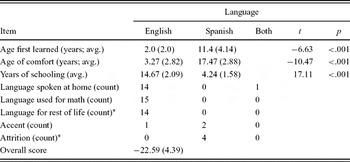
As can be seen from Table 1, all participants first learned and felt comfortable speaking English at an earlier age than Spanish, and also had more years of schooling in English than in Spanish. Language dominance was measured using the questionnaire and norms provided by Dunn and Fox Tree (Reference Dunn and Fox Tree2009), which provides the only quantitative measure of language dominance appropriate for bilinguals and second language learners. No psycholinguistic measures of proficiency were used, because it was expected that the experimental task itself would serve as a measure of first and second language processing. The questionnaire includes some questions focusing on objective aspects of respondents’ experience with each language (age first learned, years of schooling, language spoken at home, and language used for math), as well as some questions eliciting subjective ratings of proficiency in each language (age of comfort, language used for rest of life, accent presence, and attrition). Overall scores of language dominance ranged from –13 to –29, indicating that all participants were English-dominant. For the purposes of this study, proficiency was operationalized as language dominance, as measured by the Bilingual Dominance Scale.
Participants' responses to quantitative items of the Bilingual Dominance Scale.

* One participant answered with another language (Arabic).
Additionally, participants also listed their language(s) spoken at home, language(s) used when solving mathematical problems, language(s) in which they have an accent, language(s) that they would like to use for the rest of their lives, and language(s) in which they have lost fluency. As can be seen from Table 1, all participants except for one spoke English at home, and all participants used English to solve math problems and chose English as the language they would prefer to speak for the rest of their lives. Moreover, four participants experienced attrition in Spanish, whereas no participants experienced attrition in English or in both languages.
Participants were divided into high- and low-proficiency groups on the basis of their overall language-dominance scores via a median split. The high-proficiency group consisted of seven participants, and the low-proficiency group consisted of eight participants. The average language-dominance scores of the high- and low-proficiency groups were 17.8 and 25.6, respectively. Three of the four participants who experienced attrition were assigned into the low-proficiency group, and one was assigned into the high-proficiency group.
Materials
Experimental stimuli consisted of a total of 108 English and 108 Spanish sentences generated within E-Prime (MacWhinney, St. James, Schunn, Li & Schneider, Reference MacWhinney, James, Schunn, Li and Schneider2001) by inserting words of a given class (animate nouns, inanimate nouns, or verbs) into a template that produced simple transitive sentence-like strings composed of two nouns or pronouns (representing a subject and an object), a verb, and determiners. Consistent with past research conducted within the Competition Model paradigm, some of these strings were grammatical and some were ungrammatical in each language. Words comprising the strings were selected randomly without replacement from a pool of 12 animate (A) English nouns (Ns; zebra, pig, cow, bear, horse, elephant, cat, bunny, bird, goal, dog, duck), seven inanimate (I) English nouns (pencil, rock, block, ball, fork, cup, chair), and 15 transitive English action verbs (Vs; eat, pat, kiss, lick, bite, hit, push, grab, scratch, case, bump, touch, pet, pinch, pull) and their Spanish equivalents. All verbs were presented in the present progressive tense in order to facilitate comparison with past Competition Model studies. The stimuli varied three cues, each with three levels, in a within-participants design, yielding 27 unique string types per cue-based task. Two examples of each string type were presented in each cue-based task in order to counterbalance the side on which subject and object images were presented and to provide enough exemplars in each cell to allow for treatment of choice as a continuous variable.
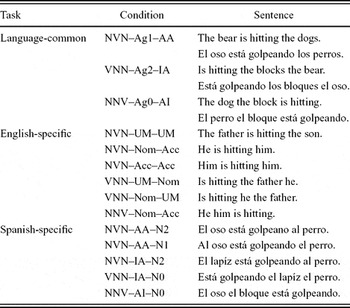
The experiment included two different types of cue-based tasks in each language: one in which the cues were held constant across languages (language-common cue task), and one in which the cues were specific to each language (language-specific cue task). In the language-common cue task, the cues in both languages were word order (NNV, NVN, VNN), noun–verb agreement (first noun, second noun, neither), and animacy (AA, AI, IA). In the English-specific task, the cues were word order (NNV, NVN, VNN), nominal case of first noun (unmarked noun; nominative pronoun; accusative pronoun), and nominal case of second noun (unmarked noun; nominative pronoun; accusative pronoun). In the Spanish-specific task, the cues were word order (NNV, NVN, VNN), animacy (AA, AI, IA), and prepositional case marking with personal a (first noun, second noun, neither). Table 2 provides examples of the sentences in the three task types.
Sample sentences for the three cue task types.

The experiment also included two different types of response-based tasks in each language: a keypress task and a mouse-tracking task. Each of these response types was administered across the three stimulus types (common, English-specific, and Spanish-specific). Participants were presented with strings of a given type twice in each response-based task, yielding a total of four presentations. For the keypress task, the dependent variables were choice of the agent noun and reaction time. For the mouse-tracking task, in addition to agent choice and latency, x, y coordinates were collected continuously from trial initiation to termination, and were later analyzed to calculate the dependent variables of maximum deviation and area under the curve (see Results section for details). These data were collected using Mouse Tracker, a freely available application designed specifically for the design, collection, and analysis of mouse-tracking experiments (Freeman & Ambady, Reference Freeman and Ambady2010).
An English–Spanish bilingual with a minimal accent in each language recorded the instructions and stimulus words digitally for later playback from the experimental control program. The images used to represent the common nouns were downloaded from the International Picture Naming Project Database of the Center for Research in Language at UCSD (Szekely et al., Reference Szekely, Jacobsen, D'Amico, Devescovi, Andonova, Herron, Lu, Pechmann, Pleh, Wicha, Federmeier, Gerdjikova, Gutierrez, Hung, Hsu, Iyer, Kohnert, Mehotcheva, Orozco-Figueroa, Tzeng, Tzeng, Arevalo, Vargha, Butler, Buffington and Bates2004). The images of people were free-use photos obtained from Google Images.
Procedure
All participants attended a single session that lasted about 90 minutes, and completed the task individually in an enclosed room located in a research laboratory. The order of the key-press and mouse-click tasks was counterbalanced across subjects. Each of these response-based tasks was divided into four blocks according to cue-based task type: English-common, English-specific, Spanish-common, and Spanish-specific, and presentation order was counterbalanced across participants. Each of the English and Spanish blocks consisted of two sub-sections, practice and test, which were completed sequentially. Participants were allowed a brief (maximum 5 min.) rest period between the English and Spanish blocks. Instructions were presented as simultaneous text and speech in each language at the beginning of the first section, and in the language in which the stimuli would be presented in each block for both the practice and test sub-sections.
Both the key-press and mouse-click tasks were identical in structure. At the beginning of the first experimental block, participants completed a practice section that consisted of 6 trials (sentences) in the language of the block in order to acclimate them to the structure of experimental trials. Once participants had completed the practice sub-section, they moved on to the test section of a given block, which comprised 54 trials (see above). In both the practice and test sections, participants were first presented with pictures and labels representing two randomly selected nouns one-by-one, and then heard a sentence-like word string that included the two nouns generated according to the procedure described above. In accordance with other Competition Model studies, participants were instructed to indicate “the thing that is doing the action” as quickly as possible either by pressing a specified key corresponding to the side of the screen on which the image representing the agent was presented in the key press task, or by clicking on the image in the mouse-click task.
Results
For clarity, the results are organized by task (common, English-specific, Spanish-specific) and by dependent variable (noun choice, reaction time, and mouse trajectories). The results are presented and discussed in terms of the cues tested in each task. All of the analyses used multivariate analysis of covariance (MANCOVA). Each analysis consisted of three within-participants factors (the three cues tested in each task; see below for listings of the cues tested in each task) plus participants' scores on the Bilingual Dominance Scale as a covariate.
Prior to analysis, the data were screened for outliers. All trials for which choice latencies reached or exceeded 3 standard deviations above the mean were excluded from analyses based on agent choice and latency. Similarly, for the mouse-tracking task, all trajectories for which the maximum deviation from the target exceeded three standard deviations were discarded. In both cases, these screening measures resulted in the exclusion of less than 5% of the data.
For the mouse-tracking task, trajectory curvature was examined by computing the difference between the observed trajectory and an ideal trajectory consisting of a straight line between the starting point and the target. From this calculation, we obtained two dependent variables: maximum deviation, defined as the largest difference between the ideal and observed trajectories, and area under the curve, defined as the total area between the ideal and observed trajectories. Although these variables are closely related, both are reported below in the interest of comprehensiveness.
In order to examine whether the four participants who suffered attrition in Spanish affected the results, a second set of analyses was run with these participants excluded. In terms of statistical significance, the results of all of these analyses remained the same, except for latency on the English-specific task, which dropped below .05. Thus, due to their similarity to the primary analyses, the results of these additional analyses are not reported below, except for in this one case.
Language-common task
In this task, the three cues examined were word order, subject–verb agreement, and animacy – three cues common to both English and Spanish. In order to facilitate comparison between cue use in English and Spanish, language was entered into the analysis as an additional within-participants variable in addition to these cues.
Choice
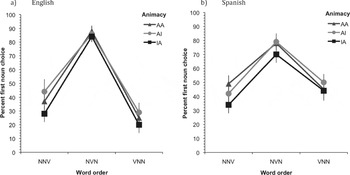
The first dependent variable was percentage choice of the first noun as agent. Here, all three within-participant main effects were significant (word order: F(2,14) = 25.32, p < .001, ηp2 = .71; animacy: F(2,14) = 13.26, p = .001, ηp2 = .69; agreement: F(2,14) = 4.86, p = .03, ηp2 = .45). Post-hoc analyses revealed that participants were more likely to choose the first noun as the actor in both languages when word order was canonical (NVN) than when it was non-canonical (NNV: p = .03; VNN: p = .01). Participants were also most likely to choose the first noun as the agent when it was animate and the second noun was inanimate (ps < .01). For the agreement cue, however, post-hoc analyses indicated no significant differences between levels.
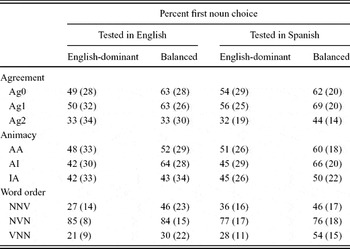
Looking at the interactions of the within-participant factors with language, the analysis revealed that participants were more likely to select the first noun as the agent in Spanish than in English given sentences with VNN order, F(2,14) = 5.67, p = .02, ηp2 = .49 in accord with the licensing of VSO order in Spanish. Finally, L2 self-rated proficiency affected interpretation strategies in both English and Spanish sentences. In particular, participants who were more balanced in their language dominance were more likely to choose the agent of Spanish sentences based on animacy than participants who were more English-dominant, F(2,14) = 3.19, p = .02, ηp2 = .81 (see Table 3). This finding indicates that as participants gain more exposure to Spanish, they rely more on animacy to determine noun agency, incorporating cues other than word order into their sentence interpretation strategies. No other interactions approached significance.
Average proportion first noun choice for main effects in English-dominant and balanced L2 learners in language-common cue task (standard deviation in parentheses).

Note: Language-dominance group defined via a median split of Bilingual Dominance Scale scores: English-dominant = –29 – –24; Balanced = –24 – –13.
Latency
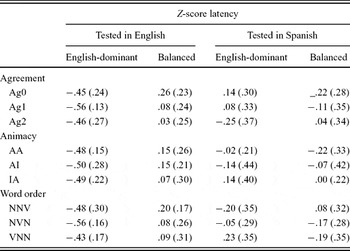
Based on the findings of Hernandez et al. (Reference Hernandez, Bates and Avila1994) and the observation that the Spanish words and sentences used in this study were longer in duration than English sentences, a paired-samples t-test was performed to determine whether agent choice latency differed according to language. In accordance with past findings, participants required a significantly greater amount of time to choose the agent of Spanish sentences than English sentences, t(14) = 7.96, p < .001. In order to control for the difference in latency due to language, all reaction times for this dataset were transformed into standardized scores (z-scores) before they were analyzed.
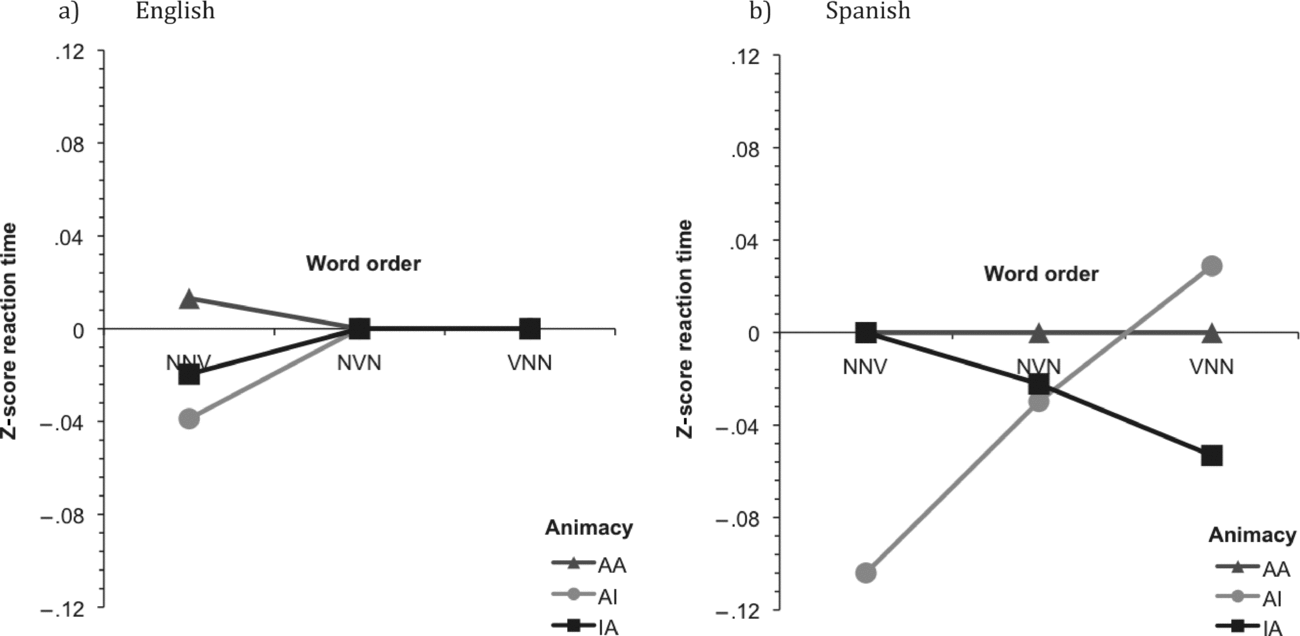
Analysis of choice latency revealed that animacy affected L2 learners' sentence interpretation in both English and Spanish, F(2,14) = 7.86, p < .01, ηp2 = .61. Post-hoc analyses revealed that participants were marginally quicker to choose the agent of sentences when the first noun was animate and the second noun was inanimate (AI) than when both nouns were animate (AA) (p = .07). Analyses of higher-order effects showed a three-way interaction between language, animacy, and word order, F(2,14) = 2.77, p = .06, ηp2 = .36. Specifically, this interaction showed that participants' response times were only affected by animacy for English sentences with the NNV word order, whereas their response times were affected by word order except when both the subject and the object were animate (see Figure 2). This variation in latency as a function of cue contingencies was noticeably greater for Spanish sentences than for English sentences.
Animacy by word order interaction for percent first noun choice in English and Spanish sentences in the language-common task.
AA = sentence with two animate nouns, AI = sentence with animate noun followed by inanimate noun, IA = sentence with inanimate noun followed by animate noun; NNV = Noun Noun Verb word order, NVN = Noun Verb Noun word order, VNN = Verb Noun Noun word order.

Animacy by word order interaction for z-score reaction time in English and Spanish sentences in the language-common task.
AA = sentence with two animate nouns, AI = sentence with animate noun followed by inanimate noun, IA = sentence with inanimate noun followed by animate noun; NNV = Noun Noun Verb word order, NVN = Noun Verb Noun word order, VNN = Verb Noun Noun word order
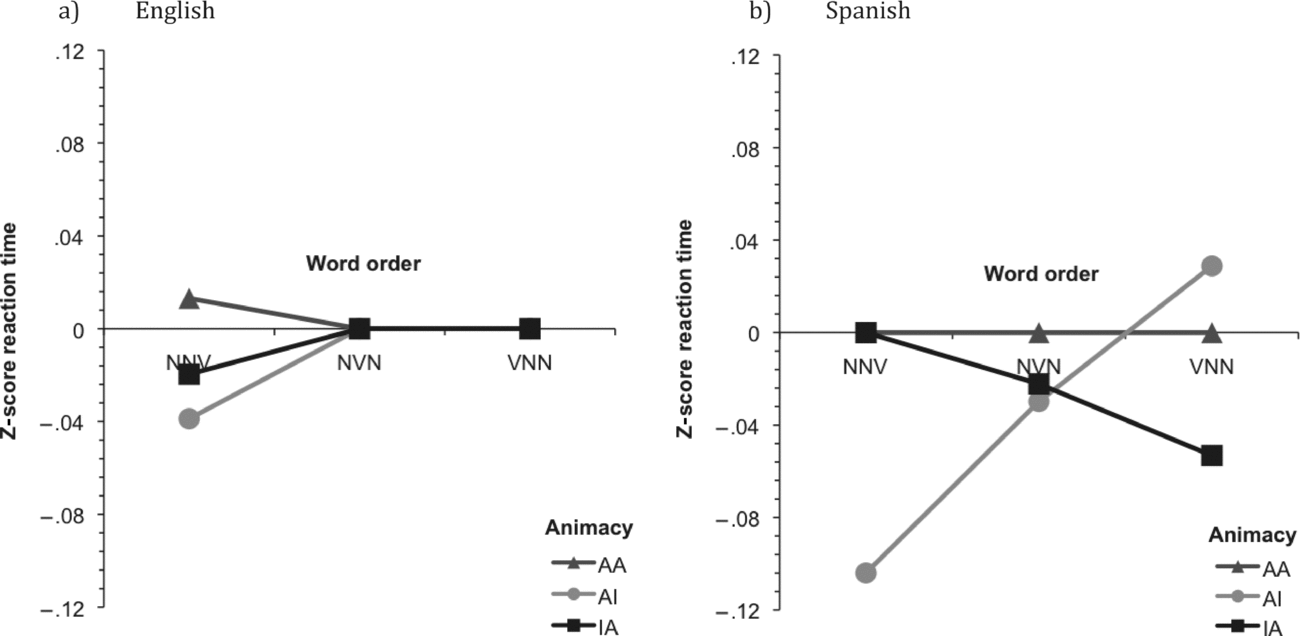
Participants' response times for Spanish sentences also varied marginally as a function of Bilingual Dominance Scale score, F(2,14) = 4.10, p = .07, ηp2 = .80, whereas no such variation was observed for reaction times to English sentences (see Table 4). Taken together, these results provide evidence that, in accordance with the predictions of the Competition Model, exposure to Spanish encourages participants to base their sentence interpretation strategies on a combination of cues, leading to a slight processing delay.
Average standardized latencies for main effects in English-dominant and balanced L2 learners in language-common cue task (standard deviation in parentheses).

Note: Language-dominance group defined via a median split of Bilingual Dominance Scale scores: English-dominant = −29 – –24; Balanced = −24 – –13.
Trajectory
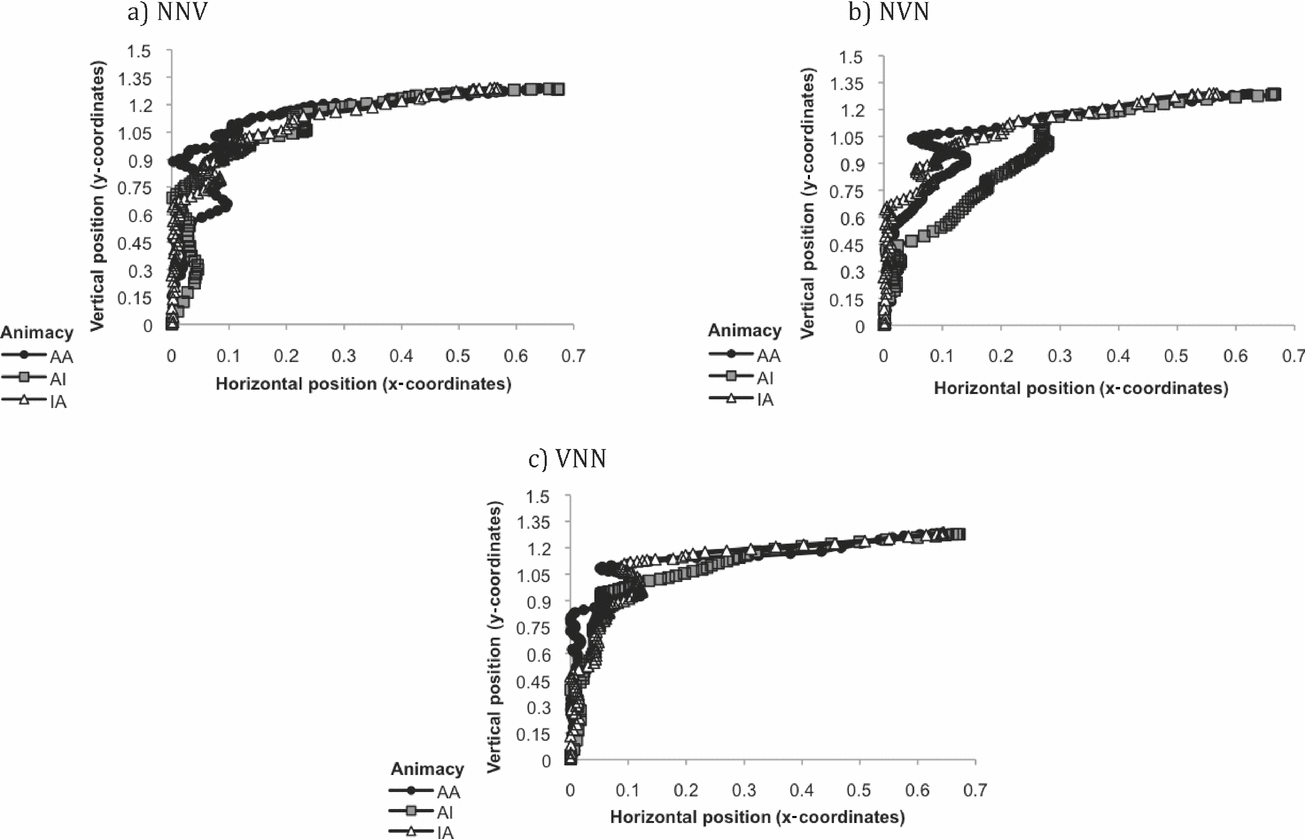
Analysis of participants' mouse trajectories in the mouse-tracking task produced two related outcome variables, maximum deviation (MD) and area under the curve (AUC) of trajectory, both of which are expressed as standardized scores. Both of these variables reveal the extent to which mouse trajectories deviated from the choice of the first noun as agent, in accordance with the arbitrary convention used in Competition Model analyses. To compute these two variables, mouse trajectories were normalized into 101 equal time steps via linear interpolation, and were rescaled into an x, y coordinate space with upper left and right endpoints of –1, 1.5 and 1, 1.5, respectively.
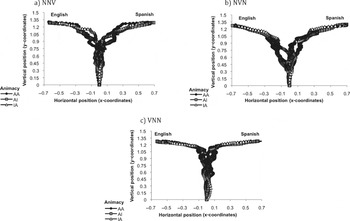
The results of analyses revealed that, for both English and Spanish sentences, participants' mouse trajectories were affected by word order, F MD(4,14) = 15.60, p < .01, ηp2 = .84; F AUC(4,14) = 13.96, p < .01, ηp2 = .82, but not by animacy. Post-hoc analyses revealed that participants' mouse trajectories showed greater attraction to the first noun for sentences with canonical word order (NVN) than non-canonical word order (NNV: p = .02, VNN: p = .08; see Figure 3). Analyses also revealed an interaction between language and agreement, such that participants' mouse trajectories showed greater deviance for Spanish sentences in which the verb agreed with both nouns than when it agreed with either the first or the second noun than they did for English sentences, F MD(4,14) = 5.36, p = .05, ηp2 = .64; F AUC(4,14) = 4.50, p = .06, ηp2 = .60.
Animacy by word order interaction for mean maximum deviations of mouse trajectories in English and Spanish sentences in the language-common task.
AA = sentence with two animate nouns, AI = sentence with animate noun followed by inanimate noun, IA = sentence with inanimate noun followed by animate noun; NNV = Noun Noun Verb word order, NVN = Noun Verb Noun word order, VNN = Verb Noun Noun word order

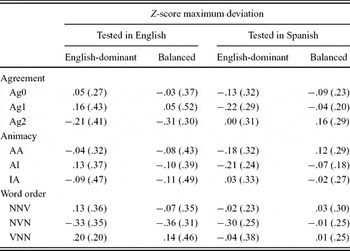
The results also revealed that the mouse trajectories of participants varied as a function of language dominance, F MD(4,14) = 5.65, p = .09, ηp2 = .64; F AUC(4,14) = 9.61, p = .05, ηp2 = .96 (see Table 5). Moreover, the effect of word order on mouse trajectories was mediated by language dominance, such that, when English and Spanish sentences were structured according to the canonical NVN word order pattern, the English-dominant participants showed marginally greater attraction to the first noun than did the more balanced participants, F AUC(4,14) = 3.29, p = .07, ηp2 = .90; F MD(4,14) = 1.79, p = ns. Finally, a three-way interaction between language, animacy, and word order was mediated by bilingual dominance score, indicating that, for sentences in both English and Spanish, the mouse trajectories of participants more fluent in Spanish deviated more when cues were in competition than the mouse trajectories of less fluent participants, F MD(4,14) = 2.58 p = .04, ηp2 = .87; F AUC(4,14) = 2.00, p = ns. No other interactions approached significance. These results are consistent with the Competition Model in that they indicate that a more balanced pattern of language dominance is associated with a greater tendency to rely on multiple cues when processing sentences in both English and Spanish.
Average standardized maximum deviation for mouse-tracking task in English-dominant and balanced L2 learners in language-common cue task (standard deviation in parentheses).

Note: Language-dominance group defined via a median split of Bilingual Dominance Scale scores: English dominant = −29 – –24; Balanced = −24 – –13.
English-specific task
Choice
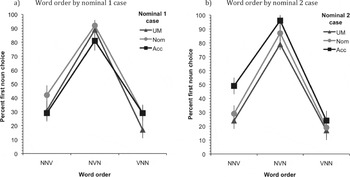
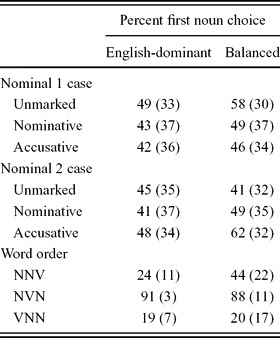
In this task, the three cues examined were word order, first nominal case, and second nominal case. The nominals in these sentences could be either nouns, which are not marked for case, or pronouns, which are marked as either nominative or accusative. For agent choice, the results revealed that participants rely on all three cues (word order and case of both nominal 1 and nominal 2) to interpret English sentences regardless of bilingual dominance pattern (word order: F(2,14) = 45.84, p < .001, ηp2 = .88; nominal 1 case: F(2,14) = 6.50, p = .01, ηp2 = .52; nominal 2 case: F(2,14) = 6.47, p = .01, ηp2 = .52). Post-hoc analyses revealed that participants were more likely to choose the first nominal as the agent when it was a nominative pronoun than when it was unmarked noun (p = .001) or accusative pronoun (p = .03). They were also more likely to choose the first nominal as agent when the second nominal was an accusative pronoun than when it was an unmarked noun (p < .01) or a nominative pronoun (p = .04). Likewise, post-hoc analyses revealed that participants were more likely to choose the first nominal as the agent when sentences were structured according to a canonical (NVN) than a non-canonical word order (NNV: p = .001; VNN < .001). The effect of word order was mediated by bilingual dominance, such that participants less fluent in Spanish were marginally more likely to choose the first nominal as the agent of sentences with a canonical (NVN) word order than were more fluent participants, F(2,14) = 2.44, p = .06, ηp2 = .77 (see Figure 4).
Word order by nominal case interaction for percent first noun choice in the English-specific task.
UM = unmarked noun; Nom = nominative pronoun; Acc = accusative pronoun; NNV = Noun Noun Verb word order, NVN = Noun Verb Noun word order, VNN = Verb Noun Noun word order

Analyses also revealed that participants were more likely to rely on the case of the second nominal to determine agency given sentences with NNV word order than sentences with NVN or VNN word order, F(2,14) = 45.84, p < .001, ηp2 = .88. Moreover, the results revealed an interaction between nominal 1 case and nominal 2 case, such that participants were more likely to choose the first nominal as the agent when it was an unmarked noun or a nominative pronoun and the second nominal was an accusative pronoun than when the first nominal was accusative and the second noun was unmarked or nominative, F(4,14) = 4.47, p < .01, ηp2 = .43. This effect was mediated by language dominance, such that participants who were more balanced in their language dominance showed this effect more strongly than participants who were more English-dominant, F(4,14) = 1.79, p = .07, ηp2 = .71 (see Table 6). No other interactions approached significance. These results suggest that as English-speaking L2 learners' language-dominance shifts to become more balanced, they are more likely to take cues other than word order into account when interpreting sentences of their native language, even if those cues are unique to English. In this regard, we should note that the NNV pattern aligns with Spanish SOV in the case that the object is a clitic pronoun.
Average proportion first noun choice for main effects in English-dominant and balanced L2 learners in English-specific cue task (standard deviation in parentheses).

Note: Language-dominance group defined via a median split of Bilingual Dominance Scale scores: English dominant = −29 – –24; Balanced = −24 – –13.
Latency
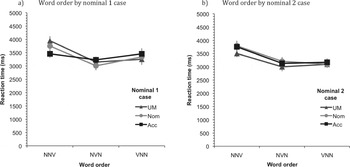
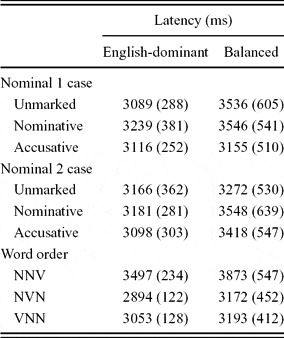
Analysis of the choice latency data revealed that word order affects how quickly participants choose the agent of English sentences, F(2,14) = 32.06, p < .001, ηp2 = .89, whereas nominal 1 and nominal 2 case do not affect latency. Post-hoc analyses revealed that participants were quicker to choose an agent for sentences with NVN or VNN word order than for sentences with NNV word order (ps < .01; see Figure 5). Bilingual dominance score also affected choice latency, such that English-dominant participants were quicker to choose the agent of sentences than balanced participants, F(2,14) = 6.47, p = .05, ηp2 = .89.
Word order by nominal case interaction for reaction time in the English-specific task.
UM = unmarked noun; Nom = nominative pronoun; Acc = accusative pronoun; NNV = Noun Noun Verb word order, NVN = Noun Verb Noun word order, VNN = Verb Noun Noun word order

Additionally, the results revealed that participants were marginally quicker to determine agency when the cases of nominal 1 and nominal 2 complemented one another (e.g., nominal 1: unmarked noun or accusative pronoun; nominal 2: nominative pronoun) than when their cases were the same, F(2,14) = 2.74, p = .07, ηp2 = .41. This effect was mediated by word order, such that participants were quicker to decide on the agent of a sentence with NVN or NNV word order in which the cases of nominal 1 and nominal 2 were complementary than on sentences with VNN word order, F(2,14) = 3.52, p < .01, ηp2 = .47. This effect, in turn, was mediated by bilingual dominance score, such that participants who were more fluent in Spanish were slower to choose the agent of sentences based on nominal 1 and nominal 2 case in combination with word order than participants who were less fluent, F(2,14) = 1.80, p = .05, ηp2 = .69 (see Table 7). This result lost significance, but still trended in the same direction, when the four participants with attrition were excluded from the sample, F(2, 10) = 1.48, p = .07, ηp2 = .52. This .02 increase of the alpha level was likely caused by slightly decreased power due to the smaller number of observations with these participants excluded. Nevertheless, the non-significant trend towards the three-way interaction of nominal 1 case, nominal 2 case, and word order demonstrates that participants with some attrition of Spanish were behaving essentially like other participants with comparable language-dominance levels, indicating that attrition at this level did not dramatically affect participants' interpretation of English sentences. In general, the results of this task corroborate the results derived from agent selection, indicating that exposure to Spanish encourages L2 learners to rely on cues other than word order when interpreting English sentences, even if those cues are exclusive to English.
Average latencies for main effects in English-dominant and balanced L2 learners in English-specific cue task (standard deviation in parentheses).

Note: Language-dominance group defined via a median split of Bilingual Dominance Scale scores: English dominant = −29 – –24; Balanced = −24 – –13.
Trajectory
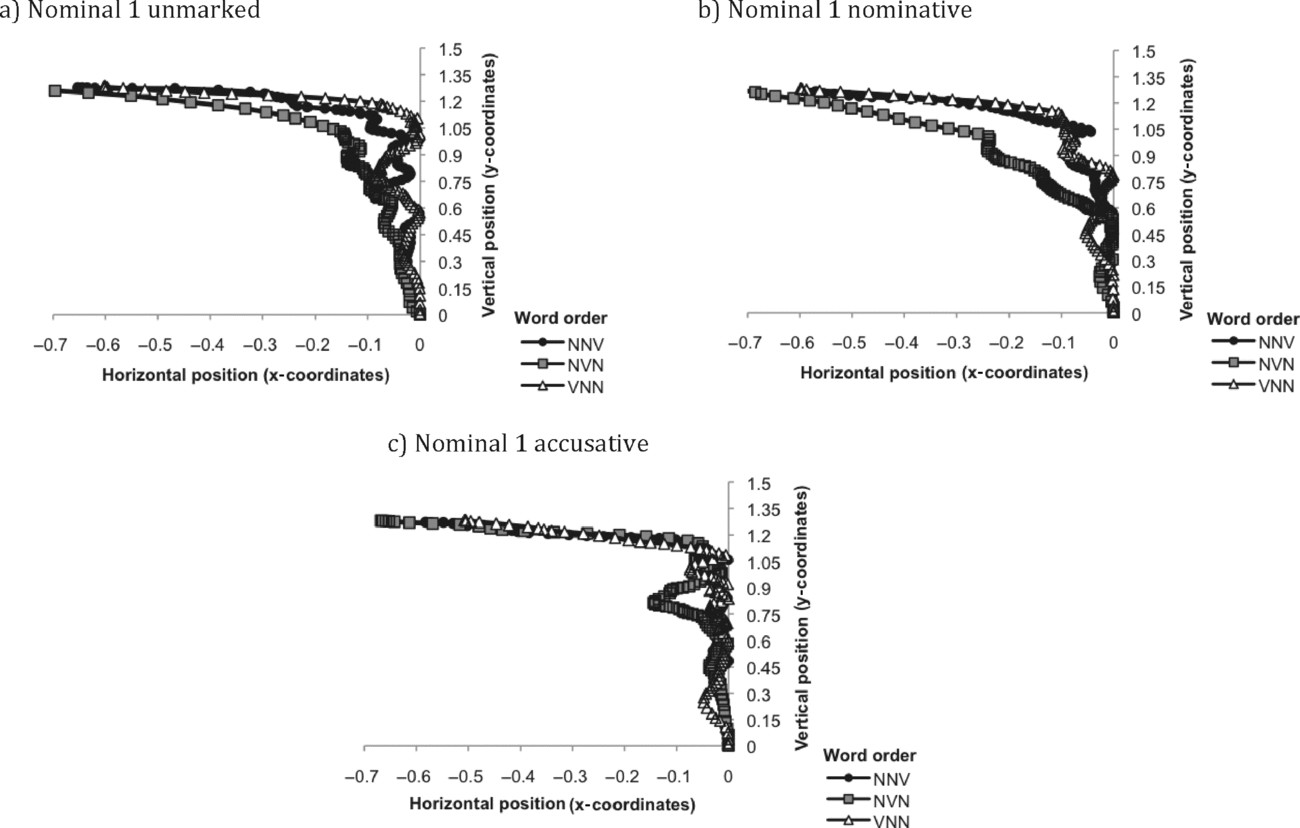
Analyses revealed that word order significantly affected the maximum deviation of participants' mouse trajectories, F(2,14) = 3.52, p < .01, ηp2 = .47; however, nominal 1 and nominal 2 case did not significantly affect trajectories. Post-hoc analyses revealed that trajectories showed marginally greater attraction to the first nominal given sentences with NVN word order than VNN word order (p = .09); no other contrasts approached significance. The maximum deviations of participants' mouse trajectories showed marginally greater attraction to the first nominal given sentences with NNV word order in which the second nominal was unmarked or nominative rather than accusative, F(2,14) = 2.41, p = .08, ηp2 = .33 (see Figure 6).
Nominal 1 case by word order interaction for mean maximum deviations of mouse trajectories in the English-specific task. Trajectory markers vary by word order.
NNV = Noun Noun Verb word order, NVN = Noun Verb Noun word order, VNN = Verb Noun Noun word order
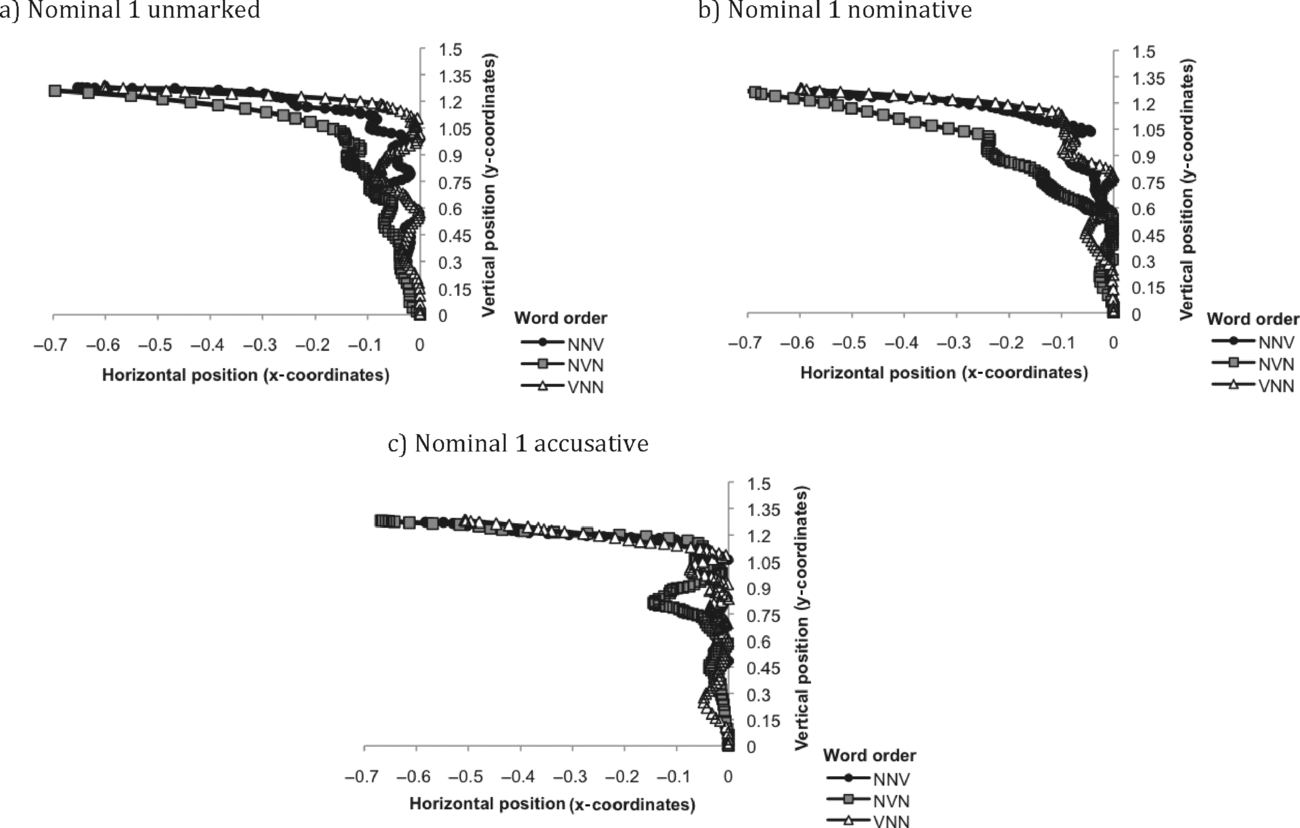
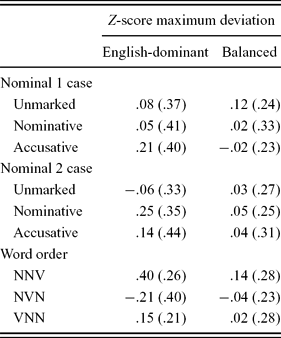
The maximum deviations of the mouse trajectories of participants who are more English-dominant showed marginally greater deviation from the first nominal when it was an accusative pronoun than those of more balanced participants, F(2,14) = 1.96, p = .06, ηp2 = .76 (see Table 8). This result remained even when the four participants with attrition were excluded from the sample, F(2,10) = 1.69, p = .08, ηp2 = .66. This suggests that less advanced L2 learners' online sentence processing strategies may also be influenced subtly by cues other than word order. No other interactions approached significance, and no effects approached significance for the area under the curve.
Average standardized maximum deviation values for mouse-tracking task in English-dominant and balanced L2 learners in English-specific cue task (standard deviation in parentheses).
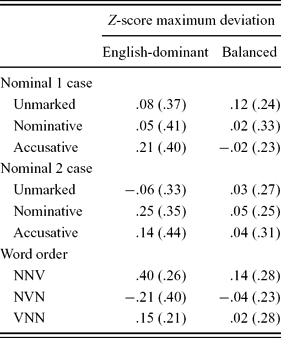
Note: Language-dominance group defined via a median split of Bilingual Dominance Scale scores: English dominant = −29 – –24; Balanced = −24 – –13.
Spanish-specific task
Choice
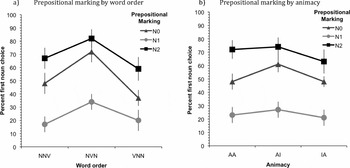
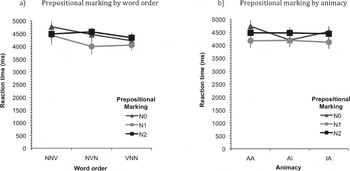
In this task, the cues examined were word order, animacy, and prepositional marking of nouns with personal a. For agent choice, the results revealed that all three cues – word order, animacy, and prepositional case marking – affect participants' likelihood of choosing the first nominal as the agent of sentences (word order: F(2,14) = 4.61, p = .03, ηp2 = .43; animacy: F(2,14) = 10.86, p < .01, ηp2 = .64; prepositional case marking: F(2,14) = 8.35, p < .01, ηp2 = .58). Post-hoc analyses revealed that participants were more likely to choose the first noun as the agent of sentences with NVN word order than with VNN word order (p < .01), when the second noun was inanimate (AI) than when it was animate (AA: p = .02; IA: p = .04), or when the second noun was marked by the personal a than when the first noun was marked by the personal a (p = .06; see Figure 7).
Prepositional case marking by word order and animacy interaction for percent first noun choice in the Spanish-specific task.
N0 = neither noun marked with a, N1 = first noun marked with a, N2 = second noun marked with a; NNV = Noun Noun Verb word order, NVN = Noun Verb Noun word order, VNN = Verb Noun Noun word order; AA = sentence with two animate nouns, AI = sentence with animate noun followed by inanimate noun, IA = sentence with inanimate noun followed by animate noun

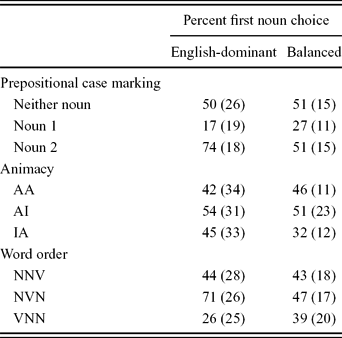
Bilingual dominance score also marginally predicted likelihood of noun choice, such that participants less fluent in Spanish were more likely to select the first noun as the agent of Spanish sentences than more fluent participants, F(2,14) = 3.70, p = .06, ηp2 = .83. Moreover, participants who were less fluent in Spanish were more likely than participants who were more fluent in Spanish to choose the first noun of the sentence as the agent if it was animate (IA), F(2,14) = 3.04, p = .03, ηp2 = .80 (see Table 9). Finally, the interaction between prepositional case marking and animacy was mediated by the bilingual dominance score, indicating that participants who were more balanced in their language dominance were marginally more likely than participants who were more English-dominant to choose the first noun as the agent of Spanish sentences in which both nouns were animate when the second noun was marked by the personal a, F(2,14) = 1.89, p = .06, ηp2 = .72. No other interactions approached significance. Taken together, these results provide evidence that as L2 learners' language-dominance shifts to become more balanced, they are more likely to rely on cues such as animacy and prepositional case marking when interpreting Spanish sentences, confirming the predictions of the Competition Model.
Average proportion first noun choice for main effects in English-dominant and balanced L2 learners in Spanish-specific cue task (standard deviation in parentheses).
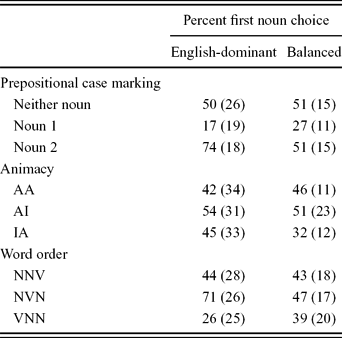
Note: Language-dominance group defined via a median split of Bilingual Dominance Scale scores: English dominant = −29 – –24; Balanced = −24 – –13.
Latency
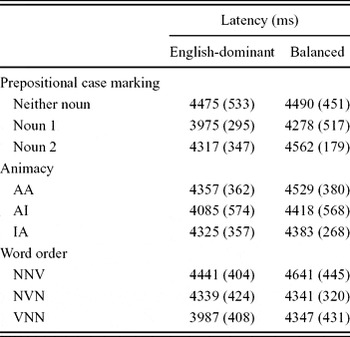
The results of the latency data revealed that word order, animacy, and prepositional case marking did not affect how quickly participants selected the agent of Spanish sentences (see Figure 8). However, the results demonstrated that participants less fluent in Spanish were marginally quicker than more fluent participants to choose the agent of Spanish sentences when first noun was animate (AA; AI), as compared to sentences in which the first noun was inanimate (IA), F(2,14) = 2.43, p = .06, ηp2 = .76 (see Table 10). This result suggests that English-dominant L2 learners may rely more on animacy when interpreting Spanish sentences than more balanced learners. No other interactions approached significance.
Prepositional case marking by word order and animacy interaction for reaction time in the Spanish-specific task.
N0 = neither noun marked with a, N1 = first noun marked with a, N2 = second noun marked with a; NNV = Noun Noun Verb word order, NVN = Noun Verb Noun word order, VNN = Verb Noun Noun word order; AA = sentence with two animate nouns, AI = sentence with animate noun followed by inanimate noun, IA = sentence with inanimate noun followed by animate noun

Average latencies for main effects in English-dominant and balanced L2 learners in Spanish-specific cue task (standard deviation in parentheses).

Note: Language-dominance group defined via a median split of Bilingual Dominance Scale scores: English dominant = −29 – –24; Balanced = −24 – –13.
Trajectory
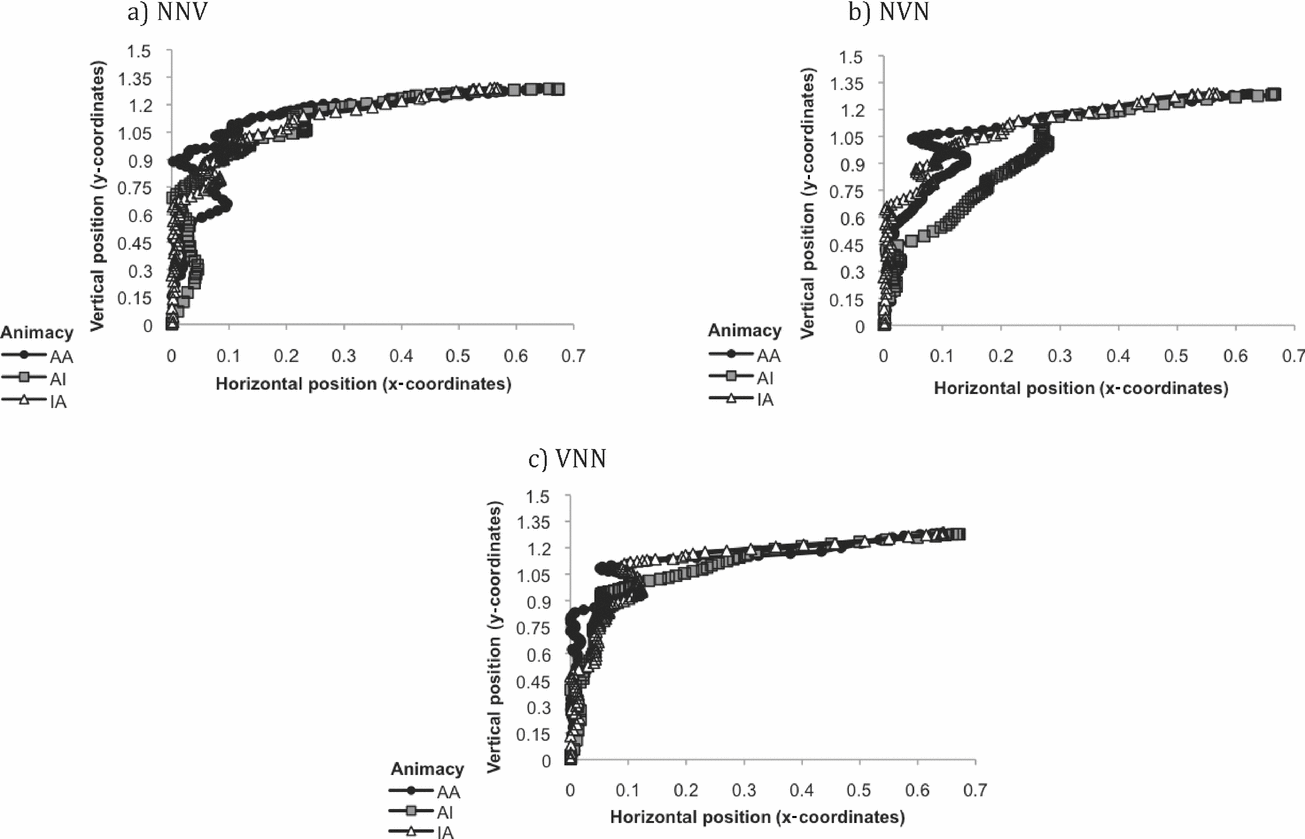
Analyses revealed that maximum deviations of participants' mouse trajectories varied significantly as a function of word order, F(2,14) = 43.89, p < .001, ηp2 = .90. In particular, post-hoc analyses revealed that mouse trajectories showed greater attraction to the first noun given sentences with canonical word order (NVN) than given sentences with non-canonical word order (NNV: p < .001; VNN: p < .01; see Figure 9). No other effects or interactions, including bilingual dominance score, approached significance for this measure.
Word order by animacy interaction for mean maximum deviations of mouse trajectories in the Spanish-specific task.
AA = sentence with two animate nouns, AI = sentence with animate noun followed by inanimate noun, IA = sentence with inanimate noun followed by animate noun; NNV = Noun Noun Verb word order, NVN = Noun Verb Noun word order, VNN = Verb Noun Noun word order
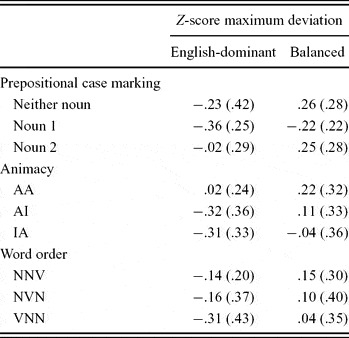
The mouse trajectories indicated greater attraction to the target noun for Spanish sentences with canonical word order (NVN) in which the first or second noun was marked by the preposition a, F(2,14) = 3.58, p = .02, ηp2 = .42. No other effects or interactions, including bilingual dominance score, approached significance for this measure (see Table 11).
Average standardized maximum deviation values for mouse-tracking task in English-dominant and balanced L2 learners in Spanish-specific cue task (standard deviation in parentheses).

Note: Language-dominance group defined via a median split of Bilingual Dominance Scale scores: English-dominant = −29 – –24; Balanced = −24 – –13.
General discussion
This study provided support for a number of core predictions of the Competition Model, and failed to support the predictions of the SSH. For English, the results demonstrated the strength of the preverbal positioning cue and its dominance over all other cues in the language, thereby replicating the results from studies such as MacWhinney et al. (Reference MacWhinney, Bates and Kliegl1984). As in previous Competition Model studies, the two-way and three-way cue interactions involved coalitions and competitions between secondary cues in cells where primary cues are neutralized. Specifically, the interactions for English arose in the non-canonical NNV and VNN word orders when the strong combination word order cues of NVN word order are weakened or missing. The results for the English-specific sentences with pronoun case-marking replicated the findings of Yoshimura and MacWhinney (Reference Yoshimura and MacWhinney2010), which showed that the strength of the pronominal case-marking cues only become evident in non-canonical word orders, when the strong preverbal positioning and postverbal positioning cues of NVN word order are weakened or missing.
The results also demonstrated the ability of English-dominant bilinguals to acquire three specific aspects of the Spanish cue hierarchy. First, the more advanced learners showed a higher level of reliance on animacy than the less advanced learners. At first blush, this finding goes against the notion developed in Gass (Reference Gass1987) that learners tend to rely on the animacy cue as a general initial default when learning a second language. However, the data reported by Gass came from a population of beginning learners for whom the animacy cue provides a first-pass solution to the case role assignment problem. Both the less advanced and more advanced participants in the current study are more advanced than the learners in the Gass study. For these English-dominant bilinguals, the increased reliance on animacy in Spanish is not an across-the-board effect, but one that occurs when other stronger cues such as NVN order or prepositional case marking are not present. Second, the more advanced participants in the current study showed evidence of increased use of the VS, or subject-second, order of Spanish. Use of this cue leads the less English-dominant participants to interpret VNN sentences as VSO. Third, all participants showed heavy reliance on Spanish prepositional case marking as a cue to patient marking. However, advanced participants placed still greater reliance on the cue of prepositional case marking. Together, these results show that the advanced participants were moving closer to a native-like application of Spanish-specific cues.
In general, the results show that as language dominance becomes more balanced, learners rely on cues with greater validity in L2 than in L1 when interpreting L2 sentences. The results of the language-common tasks provide evidence that less advanced Spanish learners apply English interpretation strategies directly to Spanish, whereas more advanced L2 learners and bilinguals are more likely to rely on cues with high reliability in Spanish. This can be seen in the longer latencies of more balanced participants for non-NVN word order sentences, which reflect greater use of agreement and animacy information. Because the SVO word order is canonical in both English and Spanish, it is not surprising that all learners, regardless of proficiency, are able to apply this cue effectively to Spanish. Similar research has shown that English-speaking L2 learners of Japanese, which has an SOV word order and uses extensive case marking, frequently misinterpret Japanese sentences due to over-reliance on word order in general, and on the preverbal positioning cue of English in particular (Sasaki, Reference Sasaki1991). Overall, these findings confirm the Competition Model's prediction that L2 learners initially use L1 strategies to process L2 sentences, but that they adopt L2-appropriate comprehension strategies with increased L2 exposure. By the same token, these findings fail to confirm the SSH's prediction that L2 learners cannot create accurate representations of L2 grammatical structure, and that L1 and L2 structure representations are autonomous and impervious to transfer.
The results for pronominal case processing in the English-specific sentences provide evidence for the type of backwards transfer observed in Liu et al. (Reference Liu, Bates and Li1992). It appears that the additional attention to case marking needed to process the more variable word order of Spanish has the secondary effect of sharpening attention to case marking in English. Interactions of this type are in accord with the Competition Model emphasis on interactions between languages and between cue types within languages, but are inconsistent with the SSH's claim that L1 and L2 structures are distinct and do not interact.
The absolute levels of cue use of English-speaking L2 Spanish learners, as observed in this study, contrast with the levels of cue use of English and Spanish monolinguals, as documented in Hernandez et al. (Reference Hernandez, Bates and Avila1994). In that study, word order accounted for 82% of the variance in agent choice of English-speaking monolinguals, whereas agreement and animacy only accounted for 14% and 1% of agent choice variance, respectively. Also, agreement accounted for 67% of the variance in the agent choice of Spanish monolinguals, whereas animacy and word order accounted for only 28% and 1% of agent choice variance, respectively. In the current study, word order accounted for 49% of the variance in agent choice in both English and Spanish sentences, but was qualified by an interaction with language, which accounted for 15% of the variance in agent choice. These results provide evidence that these English-dominant bilinguals are in between monolingual extremes in their cue reliance, but that they tend to apply L1 interpretation strategies to L2 sentences.
This is the first study to use mouse tracking within the Competition Model paradigm, providing data that both corroborates and supplements choice and latency data. The mouse-tracking data are important because they provide an even finer-grained measure of the temporal dynamics of cue application during sentence processing, as evidenced by minute motor movements. These results show that, during sentence processing, strong cues such as animacy and word order are used immediately to promote the candidacy of the relevant nouns for the agent role. Moreover, the level of L2 learning influences the details of this processing. The mouse movements of the more advanced learners showed a decreased reliance on the English word order cue. This decrease, in conjunction with the overall slowdown in latencies for the less English-dominant group, reflects their increased attention to a multiplicity of cues present in their two languages.
In summary, the results of this study demonstrate that English-dominant second language learners are “in between” monolinguals and balanced bilinguals in regard to their L2 sentence interpretation strategies, in accordance with the Competition Model's predictions and in contrast to the SSH's predictions. The results also indicate that cue strength shifts from L1 to L2 values gradually in accordance with L2 exposure, without providing any evidence for the operation of abrupt shifts or sudden parameter setting. The results demonstrate forward transfer of L1 interpretation strategies to L2 sentence comprehension in learners varying in language dominance. This forward transfer benefits learners by allowing them to rely on familiar cues to interpret L2 sentences, but also hinders them by making it difficult for them to rely initially on cues with high L2 validity. However, within the less English-dominant learners, acquisition of Spanish-specific cues begins to approach native-like levels. In addition to this basic process of forward transfer, there is also evidence of somewhat weaker backward transfer for case marking. While the results of the current study should be confirmed using a larger and more heterogeneous sample of second language learners, they nevertheless provide initial evidence confirming the predictions of the Competition Model. Overall, the results of this study show that functionalist models such as the Competition Model characterize L2 acquisition accurately, explaining how learners' comprehension strategies shift to adjust to the details of L2 structure during the advanced stages of second language learning.