INTRODUCTION
The Kumamoto oyster Crassostrea sikamea (Amemiya, Reference Amemiya1928) is widely distributed in China, Korea and Japan. Several studies have investigated the taxonomic status of the oyster (Imai & Sakai, Reference Imai and Sakai1961; Numachi, Reference Numachi and Imai1971; Ahmed, Reference Ahmed1975; Robinson, Reference Robinson1992; Banks et al., 1993; Hedgecock et al., 1993); and many researchers acknowledge that C. sikamea is a sympatric species of C. gigas.
Artificial seed production and aquaculture trials have recently been conducted in Kumamoto prefecture (Nakano, Reference Nakano2007; Sou, Reference Sou2008) for commercial production. The Kumamoto oyster C. sikamea was introduced from Japan into the USA (Woelke, Reference Woelke1955), where it has become a commercially important oyster species. In the early 1990s, the US oyster-culture industry attempted several field surveys to import C. sikamea breeding stock from the Ariake and Yatsushiro Seas. However, this oyster is closely related to the Pacific oyster Crassostrea gigas and it can be difficult to distinguish between the 2 species on the basis of their morphological features in field surveys (Hedgecock et al., 1999; Camara et al., 2008).
In recent years, several polymerase chain reaction (PCR)-based molecular diagnostic techniques have been developed for use in oyster field surveys. Banks et al. (Reference Banks, Waters and Hedgecock1993) analysed the nucleotide sequences of the mitochondrial large subunit of ribosomal DNA (LSrDNA) using PCR-based restricted fragment length polymorphism (PCR-RFLP) and species-specific PCR for the Kumamoto oyster. However, a one-way gametic incompatibility barrier between C. gigas and C. sikamea reported by several authors (Numachi, Reference Numachi and Imai1971; Banks et al., Reference Banks, McGoldrick, Borgeson and Hedgecock1994; Camara et al., Reference Camara, Davis, Sekino, Hedgecock, Li, Langdon and Evans2008) indicates that C. gigas sperm are capable of fertilizing C. sikamea eggs under laboratory conditions, leading to the hypothesis that cross breeding occurs in these oysters' shared natural environment.
Hedgecock et al. (Reference Hedgecock, Li, Banks and Kain1999) conducted advanced field surveys in the Ariake and Yatsushiro Seas, the native habitat of C. sikamea, and reported that this oyster was widely distributed in the Ariake Sea based on both mitochondrial DNA (Banks et al., Reference Banks, McGoldrick, Borgeson and Hedgecock1994) and nuclear ribosomal internally transcribed spacer-1 (ITS-1) examination results. Usuki (Reference Usuki2002) used the molecular markers reported by Banks et al. (Reference Banks, Waters and Hedgecock1993) to survey the Kumamoto oyster in the Ariake Sea and subsequently artificially cross bred the Kumamoto oyster and the Pacific oyster. Several researchers (Aranishi & Iidzuka, Reference Aranishi and Iidzuka2007; Camara et al., 2008; Wang & Guo, Reference Wang and Guo2008) developed a multiplex PCR-based method to identify C. sikamea. Using this method, Aranishi & Iidzuka (Reference Aranishi and Iidzuka2007) determined that the oyster species had been re-established in the Yatsushiro Sea, and Wang & Guo (Reference Wang and Guo2008) discovered C. sikamea in China.
In recent years, molecular markers have identified new Kumamoto oyster habitats outside of the Ariake and Yatsushiro Seas, in Japan, China and Korea (Wu et al., Reference Wu, Xu, Yu, Wei and Xia2010; Liu et al., Reference Liu, Li, Kong, Yu and Zheng2011; Hong et al., unpublished). Recently, the oyster was discovered in Nakaumi, a large estuary lake located inland from the Japan Sea, during a field survey conducted by Iidzuka et al. (unpublished) using novel molecular markers.
The Seto Inland Sea separates the Japanese islands of Honshu, Kyushu and Shikoku. The Suo-nada is to the west of the Seto Inland Sea and is a semi-enclosed rectangular basin with an area of 3100 km2 and average depth of 23.7 m. Numerous rivers run off the basin, and the area exemplifies a topographic setting of what Simpson (Reference Simpson1997) termed as ‘the region of freshwater influence.' The ebb and flow of the tide is large, and there are numerous tidal flats along its coast. The Nakatsu tidal flat is located in the Suo-nada at eastern Kyushu and is the second largest natural tidal flat in Japan, following the Ariake Sea. The fauna in the tidal flat is very similar to the Ariake Sea, and many threatened species from the ancient East China Sea (ECS) have been observed in this area. Thus, the tidal flat is a very important wetland for the conservation of various blackish and marine species.
We started a long-term project for monitoring species diversity at the Nakatsu tidal flat in 2004. In 2011, oysters were collected as part of this monitoring effort in the estuary of the Nakatsu River in the Nakatsu tidal flat and analysed using the molecular markers reported by Banks et al. (Reference Banks, Waters and Hedgecock1993). We discovered a Kumamoto-like oyster with this method and subsequently employed a more accurate means of identifying the species using nucleotide sequences for mitochondrial LSrDNA, cytochrome c oxidase subunit 1 (COI) and ITS-1. The nucleotide sequences produced with these makers are identical to those previously deposited in the GenBank database of the US National Center for Biotechnology Information for the Kumamoto oyster, thereby positively identifying the oyster collected in the Nakatsu tidal flat as the Kumamoto oyster. This is the first record of the Kumamoto oyster in the Seto Inland Sea of Japan.
MATERIALS AND METHODS
Samples and DNA preparation
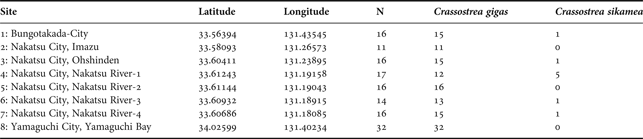
Oysters with the morphological features of Crassostrea sikamea (<40-mm shell height, deep-cupped, winkled left valves and smooth right valves) were collected on 3 separate days (4 July, 14 July and 2 August 2011) from 8 localities in and around the Suo-nada, the western part of the Japanese Seto Inland Sea (Figure 1). A total of 138 oysters were collected and transported alive to our laboratory in Hiroshima prefecture, Japan. The adductor muscle was collected from the oysters, and genomic DNA was extracted using a DNeasy Blood & Tissue Kit (Qiagen, Valencia, CA, USA) following the manufacturer's instructions.
Sampling sites of genus Crassostrea oysters in this study.

Species identification by PCR-RFLP
We identified C. sikamea on a preliminary basis using the PCR-RFLP method described by Banks et al. (Reference Banks, Waters and Hedgecock1993) and Hedgecock et al. (Reference Hedgecock, Li, Banks and Kain1999). A portion of the LSrDNA region was amplified with primers designed by Banks et al. (Reference Banks, Waters and Hedgecock1993). PCR amplification was conducted in a total volume of 20 µL containing 5 U of Takara Ex TaqTM (5 units/μL, TaKaRa, Otsu, Shiga, Japan), 1× Ex TaqTM Buffer, 2.5 mM of each dNTP, 0.5–1.0 µM of each primer, and 50 ng of template. The PCR conditions were 35 cycles of denaturation (94°C, 30 seconds), annealing (55°C, 30 seconds), and extension (72°C, 45 seconds) on a My CyclerTM thermocycler (Bio-Rad; Hercules, CA, USA). A partial fragment of ITS-1 was amplified using the PCR primers ITS-A and ITS-B published by Hedgecock et al. (Reference Hedgecock, Li, Banks and Kain1999). PCR amplification was conducted in a total volume of 20 µL containing 5 U of Takara Ex TaqTM (5 units/μL, TaKaRa), 1× Ex TaqTM Buffer, 2.5 mM of each dNTP, 0.5–1.0 µM of each primer, and 50 ng of template. The reaction was performed with an initial denaturation of 1 minute at 94°C, followed by 35 cycles of denaturing (94°C, 30 seconds), annealing (55°C, 30 seconds), and extension (72°C, 1 minute), with a final extension of 10 minutes at 72°C; the reaction mixture was then maintained at 4°C. The 319-base pairs (bp) amplicon of mitochondrial LSrDNA generated by the PCR reaction was cut with DraI restriction endonuclease at 25°C for 1 hour, and the approximately 550 bp amplicon of nuclear ITS-1 was cut with TaqI restriction endonuclease at 65°C for 3 hours. A 5-μL aliquot of each DraI- and 5
TaqI-digested PCR amplicons were loaded onto a 3.0% agarose gel (Agarose 21; NIPPON GENE, Tokyo, Japan) and run at 15 V/cm for 40 minutes and visualized with 0.5 µg/mL ethidium bromide. The gel images are shown in Figures 2 and 3 taken by the image analyser AE-6962 System (ATTO, Osaka, Japan).
(A) Restriction endonuclease (DraI) digest patterns of mitochondrial large subunit of ribosomal DNA (LSrDNA) in specimens of Crassostrea sikamea from the Nakatsu tidal flat (Lanes 1 and 2), Crassostrea gigas from the Nakastsu tidal flat (Lanes 3 and 4), C. sikamea from the Ariake Sea (Lane 5) and C. gigas from the Ariake Sea. Lane M is a standard DNA 100-base-pair ladder; (B) restriction endonuclease (TaqI) digest patterns of internally transcribed spacer-1 (ITS-1) in specimens of C. sikamea from the Nakatsu tidal flat (Lanes 1 and 2), C. gigas from the Nakastsu tidal flat (Lanes 3 and 4), C. sikamea from the Ariake Sea (Lane 5) and C. gigas from the Ariake Sea. Lane M is a standard DNA 100-base-pair ladder.

Crassostrea sikamea in the Nakatsu River.

Species identification by nucleotide sequencing
A portion of the COI region was amplified with primers designed by Folmer et al. (Reference Folmer, Black, Hoeh, Lutz and Vrijenhoek1994). PCR amplification followed the protocol as described for LSrDNA. The amplification products were checked by loading 4 µL on a 1% agarose gel (Agarose S; NIPPON GENE, Tokyo, Japan) with 0.5 µg/mL ethidium bromide. The remaining product was purified using ExoSAP-IT (USB, Cleveland, OH, USA) and sequenced using the ABI PRISM BigDye Terminator Cycle Sequencing Ready Reaction Kit ver. 3.1 (Applied Biosystems, Carlsbad, CA, USA) with a Genetic Analyzer 3100 automated DNA sequencer (Applied Biosystems, Carlsbad, CA, USA). A partial fragment of ITS-1 was amplified using the PCR primers ITS-A and ITS-B published by Hedgecock et al. (Reference Hedgecock, Li, Banks and Kain1999). PCR amplification was as previously described for ITS-1. The PCR product was sub-cloned using the TOPO TA cloning vector pCR-4-TOPO (Invitrogen, Carlsbad, CA, USA) and chemically transformed into One Shot TOP 10 Escherichia coli per the manufacturer's instructions. The cloned PCR products were screened by colony-directed PCR, and DNA from the PCR-positive plasmids was isolated using a QIAprep Mini Kit (Qiagen, Valencia, CA, USA). PCR products were cleaned up and sequences were generated as for the COI products. All final sequences were obtained from both strands for verification, and all newly obtained sequences were deposited at the DNA Data Bank of Japan.
Phylogenetic analysis
We examined the taxonomic separation among samples by constructing a Bayesian tree using the COI sequences (579 bp) of 12 nominal Crassostrea species available in the DDBJ/EMBL/GenBank DNA databases: C. gigas (accession number AF177226), C. sikamea (EU672833), C. angulata (EU815966), C. ariakensis (EU672835), C. nippona (HM015198), C. hongkongensis (FJ593173), C. iredalei (HQ661023), C. belcheri (AY160755), C. virginica (AY905542), C. brasiliana (FJ717651), C. gasar (FJ717611) and C. rhizophorae (FJ717639). Saccostrea mordax (HQ661029) was used as an outgroup to construct a rooted tree. The obtained sequences were aligned with Clustal X2 (Larkin et al., Reference Larkin, Blackshields, Brown, Chenna, McGettigan, McWilliam, Valentin, Wallace, Wilm, Lopez, Thompson, Gibson and Higgins2007) and then subjected to Bayesian analyses performed using MrBayes 3.1.2 (Huelsenbeck & Ronquist, Reference Huelsenbeck and Ronquist2001; Ronquist & Huelsenbeck, Reference Ronquist and Huelsenbeck2003) under a HKY + I + G best-fit substitution model determined by Akaike information criteria as implemented in Kakusan 4 (Tanabe, Reference Tanabe2011). Random starting trees were used, and analyses were performed by running a Markov chain Monte Carlo (MCMC) algorithm for 900,000 generations, sampling every 100 generations. The initial 30% of generations were discarded for tree-building, and the convergence of MCMC runs was confirmed by MrBayes. The posterior probabilities of the phylogeny were determined by constructing a 50% majority-rule consensus tree after a burn-in period of 3000 trees.
RESULTS
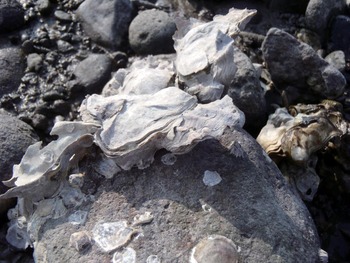
Species identification by mitochondrial LSrDNA and nuclear ITS-1 segments digested by DraI and TaqI, respectively (Figure 2), were concordant for the 138 individuals scored for both molecular makers. PCR products were obtained for all specimens, and each individual had a restriction enzyme digest pattern consistent with either C. gigas (129/138 individuals) or Crassostrea sikamea (9/138 individuals) (Table 1). Heterozygous loci for the ITS-1 marker were not detected in all C. sikamea specimens collected from the Nakatsu tidal flat. Along with the molecular data, the morphological features of all PCR-RFLP-positive oysters showed a shell height below 40-mm, thin-cupped, no-winkled left valves and smooth right valves (Figure 3).
Results of polymerase chain reaction–restriction fragment length polymorphism diagnosis of the oysters collected in and around Nakatsu tidal-flat.

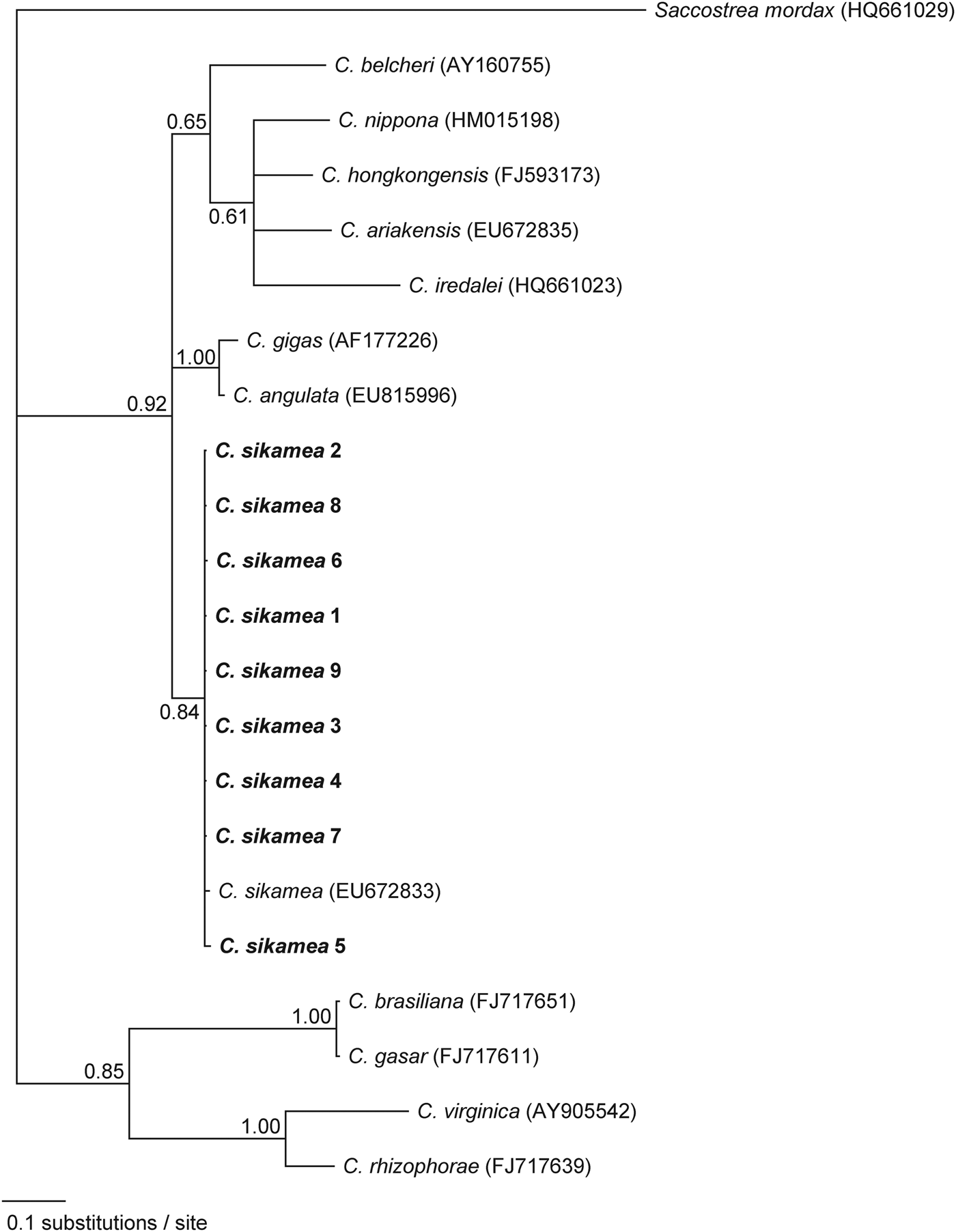
The nucleotide sequences generated for COI and ITS-1 were identical with previously generated C. sikamea sequences from the Ariake Sea. The nucleotide sequences of C. sikamea COI have been deposited in GenBank (accession numbers AB675947–AB675955). Phylogenetic analysis of COI is shown in Figure 4. All C. sikamea specimens collected in the Nakatsu tidal flat were clearly distinguished from other Asian Crassostrea species and only shared a cluster with the C. sikamea sequence deposited in GenBank (accession number EU672833).
Bayesian tree for 12 species of Crassostrea based on mtDNA COI sequence data. The consensus tree was constructed with Bayesian inference based on the HKY + I + G model. Saccostrea mordax was used as an outgroup. Nodal support values (Bayesian posterior probability) higher than 0.5 are indicated around the branches. Accession numbers of the DDBJ/EMBL/GenBank database are provided in parentheses, and newly obtained Crassostrea sikamea (1–9) are indicated in bold font.

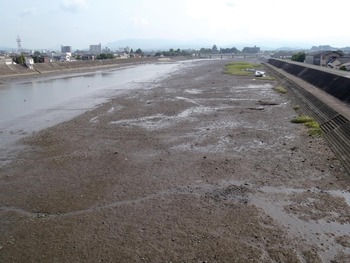
Crassostrea sikamea dots the estuaries from the Nakatsu tidal flat to Bungotakada city (Figure 1). Site 4, which is located in the upper Nakatsu tidal flat and is at the mouth of the Nakatsu River (Figure 5), had the highest numbers of C. sikamea.
Habitat of Crassostrea sikamea in Nakatsu tidal-flat.

DISCUSSION
Crassostrea gigas and C. sikamea are closely related species; therefore, their morphological and taxonomic diagnostic features are very similar. In the Ariake Sea, both of these species and that of a third species, C. ariakensis, inhabit the same ecosystem and have established sympatric speciation with each other (Torigoe, Reference Torigoe1981; Hedgecock et al., Reference Hedgecock, Li, Banks and Kain1999). Molecular identification methods were eventually developed to resolve the taxonomic confusion between the oyster species (Reece et al., Reference Reece, Cordes, Stubbs, Hudson and Francis2008; Sekino, Reference Sekino2009; Ren et al., Reference Ren, Liu, Zhang, Guo and Liu2010; Liu et al., 2011). New habitats of C. sikamea have been discovered through molecular identifications in oyster populations in China, Korea and Japan.
In vitro experiments indicated that C. sikamea ova could be fertilized with C. gigas sperm under laboratory conditions, indicating that cross-species propagation was highly likely. The C. gigas habitat overlaps the C. sikamea habitat by 90% in the Nakatsu tidal flat; hence, identifying pure C. sikamea, particularly in non-native habitat, requires genetic information from both mitochondrial and nuclear DNA.
In this study, we analysed the mitochondrial LSrDNA and COI genes and the nuclear ribosomal ITS-1 region for identification of C. sikamea-like oysters collected in the Nakatsu tidal flat. As a result, 9 C. sikamea-like oysters were initially identified as C. sikamea by PCR-RFLP analysis of both mitochondrial LSrDNA and nuclear ITS-1. Subsequently, the nucleotide sequences of the COI gene of 9 C. sikamea-like oysters were found to be identical to C. sikamea collected in the Ariake Sea. These results positively identify the C. sikamea-like oysters collected in the Nakatsu tidal flat as C. sikamea, providing the first evidence of C. sikamea in the Seto Inland Sea.
In the Ariake Sea, many species inhabited the seashores of ancient land masses of the ECS during the last glacial age. The Nakatsu tidal flat is the next largest area after the Ariake Sea, which is part of the margin of the ancient ECS. The fauna in the tidal flat is very similar to that in the Ariake Sea and many threatened species in Japanese waters have been observed in the Nakatsu tidal flat. Therefore, finding C. sikamea in the Nakatsu tidal flat indicates that the oysters could be an indigenous species and may have inhabited the area since the last glacial age.
There could also be the possibility that C. sikamea was anthropogenically introduced from other habitats. The naturally occurring oyster seed collected in the Hiroshima and Miyagi prefectures were widely used for aquaculture from Amami-Oshima Island to Hokkaido Island in Japan. Oyster cultures near the Nakatsu tidal flat gradually introduced the oyster seed from Hiroshima and Miyagi prefecture. However, to date, C. sikamea has not been found in Hiroshima and Miyagi prefectures; therefore, it is unlikely that the species was introduced to the Nakatsu tidal flats from this area.
The Nakatsu tidal flat is one of the largest areas for cultivating the Asari clam Ruditpes philippinarum, artificially introduced by clam seed harvested in the Ariake Sea as well as brought in from the Korean Peninsula and China. Crassostrea sikamea is found in all the 3 abovementioned areas, and Okoshi (Reference Okoshi2004) reported many mollusc species, including those of the genus Crassostrea, in the Asari clam seed. Therefore, C. sikamea in the Nakatsu tidal flat could have been introduced along with the Asari clam seeds. Given the likely high level of crossbreeding between C. sikamea and C. gigas in the Nakatsu tidal flat, a high-resolution molecular diagnostic method (e.g. microsatellite markers) will be needed to be able to identify indigenous C. sikamea oysters in the region.
ACKNOWLEDGEMENT
This research was supported by ‘A project for development of biodiversity index in fishing ground and its environment' from the Fisheries Agency.