Introduction
Chronic rhinosinusitis is defined by persistent inflammation of the nose and paranasal sinuses, and is characterised by two or more symptoms.Reference Aukema and Fokkens1, Reference Daines and Orlandi2 One of these symptoms must be nasal congestion or nasal discharge. Other symptoms may include headache, facial pain or pressure, aural pain or fullness, anosmia, halitosis, dental pain, cough, and fatigue.Reference Goldenberg and Goldstein3 The symptoms of chronic rhinosinusitis persist for 12 weeks or longer.Reference Fokkens, Lund, Mullol, Bachert, Alobid and Baroody4, Reference Meltzer and Hamilos5 Chronic rhinosinusitis is further subdivided based on the absence or presence of nasal polyps.Reference Lee and Lane6
Chronic rhinosinusitis is difficult to treat and disabling for patients who are affected.Reference van Agthoven, Fokkens, van de Merwe, Marijke van Bolhuis, Uyl-de Groot and Busschbach7 To date, there is a lack of consistently effective treatments available for chronic rhinosinusitis, and refractory and recurrent disease remains a challenge.Reference Daines and Orlandi2 Based on the Australian National Health Survey, 9.2 per cent of the population had chronic rhinosinusitis from 2004 to 2005, making it one of the most commonly reported health conditions.8 The Australian National Health Survey also showed that during this period, the direct health expenditure allocated to chronic respiratory diseases including chronic rhinosinusitis was $3.3 billion. Chronic rhinosinusitis is associated with significant health expenditure because of direct costs arising from physician visits and medical treatment, as well as indirect costs arising from absence from work and decreased quality of life.
Despite its prevalence and significant health impact, the pathophysiology of chronic rhinosinusitis remains incompletely understood.Reference Lee and Lane6 Although chronic rhinosinusitis has been attributed to several factors such as allergy, superantigens and microbials, none of these have been confirmed so far.Reference Zhang, Wang, Han, Sy, Huang and Sun9–Reference Bachert, Watelet, Gevaert and Van Cauwenberge12 Most clinicians also tend to classify chronic rhinosinusitis by clinically relevant phenotypes.Reference Akdis, Bachert, Cingi, Dykewicz, Hellings and Naclerio13 Phenotypes are defined as an observable characteristic or trait such as the absence or presence of nasal polyps. However, broad phenotypes do not provide an understanding of the underlying cellular and molecular mechanisms of chronic rhinosinusitis.
Chronic rhinosinusitis is a heterogeneous condition and multiple pathophysiological mechanisms are likely to exist.Reference Eloy, Poirrier, De Dorlodot, Van Zele, Watelet and Bertrand14 Therefore, chronic rhinosinusitis should be classified as consisting of multiple endotypes.Reference Akdis, Bachert, Cingi, Dykewicz, Hellings and Naclerio13 Endotypes are defined as distinct pathophysiological mechanisms that may be identified by corresponding biomarkers such as specific immunoglobulin E and blood eosinophils.
Given that chronic rhinosinusitis is characterised by persistent inflammation of the sinonasal mucosa, research in the field has attempted to elucidate the factors driving this inflammation. Previous research has focused predominantly on T-helper type cytokines to highlight the inflammatory mechanisms. However, proteins such as nuclear factor kappa B and transforming growth factor beta are increasingly recognised to have important roles in sinonasal inflammation and tissue remodelling.
This review article aimed to explore the roles of T-helper type cytokines, nuclear factor kappa B and transforming growth factor beta in the pathophysiological mechanisms of chronic rhinosinusitis, and discuss them in light of the recent literature. An understanding of these mechanisms will allow for better identification and classification of chronic rhinosinusitis endotypes, and, ultimately, improved therapeutic strategies.
T-helper type cytokines
Inflammation of the sinonasal mucosa is accompanied by characteristic profiles of increased cytokine expression.Reference Daines and Orlandi15 Cytokines are chemical messengers that direct the immune response by facilitating communication between diverse cell populations. They are proteins produced by structural and infiltrating immune cells, and they interact with specific cell-surface receptors. Cytokines are involved in the stimulation and regulation of the immune system, and have a wide variety of functions, ranging from cellular proliferation to chemotaxis.
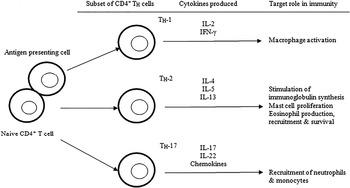
Cytokines are divided into groups depending on the type of cluster of differentiation 4+ T-helper cell that produces them.Reference Daines and Orlandi15–Reference Derycke, Eyerich, Van Crombruggen, Perez-Novo, Holtappels and Deruyck17 The best defined subsets of cluster of differentiation 4+ T-helper cells are the T-helper 1, 2 and 17 subsets (Figure 1). T-helper 1 cells produce interleukin (IL)-2 and interferon gamma. These cytokines activate macrophages and are predominantly involved with cellular immune response. T-helper 2 cells produce IL-4, IL-5 and IL-13. These cytokines target B cells and are involved with humoral immunity, stimulation of immunoglobulin synthesis, mast cell proliferation, and eosinophil production, recruitment and survival. T-helper 17 cells produce IL-17, IL-22 and chemokines. These cytokines recruit neutrophils and monocytes, and promote inflammation. T-helper 1, 2 and 17 cytokines can stimulate their own production through an autocrine mechanism, enhance their own effects and stimulate production of other cytokines. They can also inhibit other subsets of cells in the vicinity to produce polarisation of the immune response.
Subsets of cluster of differentiation 4+ T-helper cells and their target roles in immunity. CD = cluster of differentiation; TH = T-helper; IL = interleukin; IFN = interferon

Cytokines are readily detectable in sinonasal secretions. Molecular-based studies such as real-time quantitative polymerase chain reaction and DNA microassay analysis have revealed a characteristic profile for chronic rhinosinusitis. This profile includes tumour necrosis factor alpha, IL-3, granulocyte macrophage colony stimulating factor, IL-1 beta, IL-5, IL-8 and IL-13.Reference Ramanathan and Lane18
A study by Riechelmann et al. examined the expression of 15 cytokines from the T-helper 1, 2 and 17 subsets in the sinonasal secretions of patients with acute rhinosinusitis, chronic rhinosinusitis without nasal polyps, and chronic rhinosinusitis with nasal polyps.Reference Riechelmann, Deutschle, Rozsasi, Keck, Polzehl and Burner19 Results from that study showed that compared with controls, all 15 cytokines examined were significantly higher in expression in patients with chronic rhinosinusitis, irrespective of the clinical type.Reference Riechelmann, Deutschle, Rozsasi, Keck, Polzehl and Burner19 Interleukin 5 levels were also found to be significantly higher in patients with chronic rhinosinusitis with nasal polyps, compared with patients with acute rhinosinusitis and chronic rhinosinusitis without nasal polyps.Reference Ramanathan and Lane18 The most common type of inflammatory cell present in nasal polyps is eosinophils, and therefore these findings support the role of IL-5 in the activation and prolonged survival of eosinophils.Reference Aukema and Fokkens1, Reference Akdis, Bachert, Cingi, Dykewicz, Hellings and Naclerio13, Reference Riechelmann, Deutschle, Rozsasi, Keck, Polzehl and Burner19, Reference Bachert, Wagenmann, Hauser and Rudack20 These studies highlight the important role of cytokines in chronic rhinosinusitis, and the variation in cytokine expression between chronic rhinosinusitis patients with and without nasal polyps.
Nuclear factor kappa B activation
Chronic inflammation in chronic rhinosinusitis is induced and maintained by a complex interaction of various cytokines. This process is activated by several transcription factors, one of which is nuclear factor kappa B.Reference Lawrence21 Nuclear factor kappa B is considered to be a prototypical component of the proinflammatory signalling pathway, and has an important role in the modulation of pro- and anti-inflammatory cytokines at the gene expression level.
Most of the knowledge of signalling in inflammation has been obtained by studying members of the interleukin (IL)-1 and tumour necrosis factor (TNF)-alpha receptor families, and the toll-like microbial pattern recognition receptors, which belong to the IL-1 receptor family.Reference Lawrence21 Interleukin 1 and TNF-alpha are archetypal proinflammatory cytokines that are rapidly released upon tissue injury or infection.Reference Bachert, Wagenmann, Hauser and Rudack20 Toll-like receptors are part of a germline-encoded non-self-recognition system that is programmed to trigger inflammation.Reference Akira, Uematsu and Takeuchi22 These receptors, albeit structurally unrelated, use similar signal transduction mechanisms, such as the activation of IκB kinase and nuclear factor kappa B.Reference Ghosh and Karin23 IκB kinase is an enzyme involved in the propagation of cellular responses to inflammation and forms part of the upstream nuclear factor kappa B signal transduction cascade.Reference Lawrence21
There are two main pathways for nuclear factor kappa B activation.Reference Lawrence21, Reference Strnad and Burke24 The canonical pathway is triggered by microbial products and proinflammatory cytokines such as TNF-alpha and IL-1, and leads to the activation of nuclear factor kappa B proteins, and RelA- or cRel-containing complexes.Reference Karin and Ben-Neriah25 The non-canonical pathway is triggered by TNF-family cytokines such as lymphotoxin beta, cluster of differentiation 40 ligand, B cell activating factor and receptor activator of nuclear factor kappa B ligand, and leads to the activation of RelB/p52 complexes.Reference Senftleben, Cao, Xiao, Greten, Krahn and Bonizzi26–Reference Novack, Yin, Hagen-Stapleton, Schreiber, Goeddel and Ross28 These two pathways are differentiated by their requirement for the IκB kinase subunits. The IκB kinase complex consists of two kinase subunits, IκB kinase alpha and IκB kinase beta, and a regulatory subunit IκB kinase gamma. IκB kinase beta regulates activation of the canonical pathway through phosphorylation of IκB, and requires the IκB kinase gamma subunit but not IκB kinase alpha.Reference Zandi, Rothwarf, Delhase, Hayakawa and Karin29 IκB kinase alpha regulates activation of the non-canonical pathway through phosphorylation and processing of p100, the precursor for p52.Reference Lawrence21, Reference Ghosh and Karin23, Reference Senftleben, Cao, Xiao, Greten, Krahn and Bonizzi26 IκB kinase alpha is independent of both IκB kinase beta and IκB kinase gamma.Reference Lawrence21, Reference Ghosh and Karin23, Reference Senftleben, Cao, Xiao, Greten, Krahn and Bonizzi26
Inflammation is a process of innate immunity in response to physical, physiological or oxidative stress, and is associated with activation of the canonical pathway.Reference Hoesel and Schmid30 The canonical pathway primarily responds to TNF-alpha and IL-1 signalling, and prototypical proinflammatory cytokines, and therefore has an important role in the pathogenesis of chronic inflammatory diseases.Reference Lawrence21
In the canonical pathway, the inactive form of nuclear factor kappa B lies in the cytoplasm, and is constituted by a heteromeric complex of p50, p65 and an inhibitor of the nuclear factor kappa B family of proteins (IκB alpha).Reference Strnad and Burke24, Reference Fraczek, Rostkowska-Nadolska, Kapral, Szota, Krecicki and Mazurek31 In response to a variety of proinflammatory signals, mediated through toll-like receptors, IL-1 receptors, TNF receptors and antigen receptors, the activation of nuclear factor kappa B leads to the phosphorylation and degradation of IκB alpha. The released p50/p65 heterodimer consequently translocates to the nucleus, where it binds to specific consensus sequences within the promoters of the nuclear factor kappa B target genes to enhance gene expression.
Chronic inflammatory conditions such as chronic rhinosinusitis are influenced by nuclear factor kappa B modulation in diseased tissue. A study by Takeno et al. examined the relationship between the degree of nuclear factor kappa B activation and the levels of local cytokine gene expression in nasal polyp epithelium.Reference Takeno, Hirakawa, Ueda, Furukido, Osada and Yajin32 The results from that study showed a significant correlation between the degree of epithelial nuclear factor kappa B activation and the levels of IL-8, IL-16 and eotaxin messenger RNA (mRNA) expression. This highlights the important role of nuclear factor kappa B in the inflammatory process in chronic rhinosinusitis with nasal polyps. A study by Yang et al. has also shown that nuclear factor kappa B may act as anti-apoptotic molecules in eosinophils and are responsible for the recruitment-enhanced survival of inflammatory cells.Reference Yang, Cohn, Zhang, Homer, Ray and Ray33
Previous studies have described the expression and localisation of cyclo-oxygenase 2 in chronic rhinosinusitis mucosa, and have shown that nuclear factor kappa B pathways are involved in the up-regulation of cyclo-oxygenase 2 expression.Reference Wang, Zhang, Li, Li, Zhang and Li34–Reference Zhou, Shin, Guo, Youn, Bae and Kang38 Cyclo-oxygenase is an enzyme that converts arachidonic acid to prostaglandins and thromboxane. As an inducible isoform, cyclo-oxygenase 2 has been shown to be induced by various inflammatory stimuli, such as cytokines and lipopolysaccharide, in cells in vitro and in inflamed sites in vivo.
Transforming growth factor beta and tissue remodelling
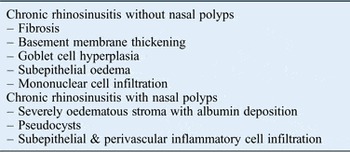
Chronic inflammation in chronic rhinosinusitis results in structural changes referred to as remodelling.Reference Akdis, Bachert, Cingi, Dykewicz, Hellings and Naclerio13 The remodelling pattern is not consistent in chronic rhinosinusitis, and there are different types of mucosal remodelling in chronic rhinosinusitis patients without nasal polyps and those with nasal polyps (Table I).Reference Tomassen, Van Zele, Zhang, Perez-Novo, Van Bruaene and Gevaert39–Reference Spinozzi, de Benedictis and de Benedictis43 Chronic rhinosinusitis without nasal polyps is characterised by fibrosis, basement membrane thickening, goblet cell hyperplasia, subepithelial oedema and mononuclear cell infiltration. In contrast, chronic rhinosinusitis with nasal polyps is characterised by severely oedematous stroma with albumin deposition, pseudocysts, and subepithelial and perivascular inflammatory cell infiltration.
Mucosal remodelling patterns in chronic rhinosinusitis with and without nasal polyps

The remodelling process aims to balance extracellular matrix production and degradation, and is regulated by several mediators, of which transforming growth factor beta has the main role. Transforming growth factor beta is involved in the attraction and induction of fibroblast proliferation, with an integral role in wound repair.Reference Leask and Abraham44
In patients with chronic rhinosinusitis without nasal polyps, previous studies have shown that transforming growth factor beta 1 and 2 protein concentrations, and transforming growth factor beta receptor type I and III mRNA expressions, were significantly higher compared with controls.Reference Van Crombruggen, Zhang, Gevaert, Tomassen and Bachert40–Reference Yang, Zhang, Van Crombruggen, Hu, Hong and Bachert42 In patients with chronic rhinosinusitis with nasal polyps, transforming growth factor beta 1 protein concentration, and transforming growth factor beta receptor type II and III mRNA expressions, were significantly lower compared with controls. In patients with chronic rhinosinusitis without nasal polyps, the up-regulation of the transforming growth factor beta signalling pathway results in excessive collagen deposition with fibrosis. In patients with chronic rhinosinusitis with nasal polyps, the down-regulation of the transforming growth factor beta signalling pathway results in oedema formation and lack of collagen production.
Potential therapeutic strategies
Most clinicians tend to classify chronic rhinosinusitis by clinically relevant phenotypes, such as the absence or presence of nasal polyps, severity, disease recurrence, and response to therapy.Reference Akdis, Bachert, Cingi, Dykewicz, Hellings and Naclerio13 However, there is increasing evidence to suggest that chronic rhinosinusitis should also be classified by endotypes. The presence of different inflammatory and remodelling patterns between chronic rhinosinusitis patients without nasal polyps and those with nasal polyps, as highlighted in this review article, reflects the different pathophysiological mechanisms involved, and these are associated with different responses to treatment.Reference Gevaert, Van Bruaene, Cattaert, Van Steen, Van Zele and Acke45, Reference Van Bruaene and Bachert46 Classifying chronic rhinosinusitis by endotypes therefore allows for targeted therapeutics, with improved effectiveness and better patient outcomes.
A study by Gevaert et al. investigated the therapeutic potential of inhibiting interleukin (IL)-5 with a humanised monoclonal antibody, mepolizumab, as a treatment option for chronic rhinosinusitis with nasal polyps.Reference Gevaert, Van Bruaene, Cattaert, Van Steen, Van Zele and Acke45 This was a randomised, double-blind, placebo-controlled study, where patients with chronic rhinosinusitis with nasal polyps received two single intravenous injections of mepolizumab. The results from that study showed that mepolizumab significantly reduced the size of nasal polyps, based on endoscopic scoring and computed tomography scans. Further long-term studies are required at this stage to further assess the full effects of mepolizumab.
Interestingly, recent strategies have also included the use of anti-sense oligonucleotides, such as TPI ASM8, to target IL-5 receptors.Reference Amini-Vaughan, Martinez-Moczygemba and Huston47 TPI ASM8 modulates the expression of the common beta chain of IL-5 receptors to inhibit T-helper 2 type cytokines. Initially developed for asthma, studies have shown that inhaled TPI ASM8, with increasing doses over 4 days, results in a 60 per cent and 68 per cent reduction in sputum eosinophils after 7 and 24 hours respectively. It is hoped that the broader therapeutic potential for anti-sense oligonucleotides will be demonstrated for other subsets of hypereosinophilic syndromes such as chronic rhinosinusitis in the future.
The inhibition of nuclear factor kappa B has also been explored as a novel target for therapeutics in chronic rhinosinusitis. A study by Valera et al. investigated dehydroxymethylepoxyquinomicin (‘DHMEQ’) as a potential nuclear factor kappa B inhibitor for the treatment of chronic rhinosinusitis with nasal polyps.Reference Valera, Umezawa, Brassesco, Castro-Gamero, Queiroz and Scrideli48 Dehydroxymethylepoxyquinomicin is derived from the antibiotic epoxyquinomicin. In that study, dehydroxymethylepoxyquinomicin was shown to directly inhibit the nuclear translocation and transcription of nuclear factor kappa B in vitro. Further studies are required at this stage to determine the ideal doses and schedules of dehydroxymethylepoxyquinomicin, and its efficacy in controlled clinical trials.
Given its regulatory function in both inflammation and remodelling processes, transforming growth factor beta also represents a novel therapeutic target.Reference Yang, Zhang, Van Crombruggen, Hu, Hong and Bachert42 Corticosteroids are currently the first-line therapy for chronic rhinosinusitis with nasal polyps, as recommended by the European position paper on rhinosinusitis and nasal polyps and by American guidelines.Reference Fokkens, Lund, Mullol, Bachert, Alobid and Baroody4, Reference Kou, Hu, Yao, Wang, Shen and Kang49, Reference Meltzer, Hamilos, Hadley, Lanza, Marple and Nicklas50In vitro corticosteroids have been shown to suppress transforming growth factor beta 1 induced fibroblast proliferation and differentiation in nasal polyps.Reference Serpero, Petecchia, Sabatini, Giuliani, Silvestri and Di Blasi51
Long-term, low-dose macrolide antibiotic therapy (e.g. clarithromycin) is effective in the treatment of chronic rhinosinusitis through anti-inflammatory effects.Reference Kou, Hu, Yao, Wang, Shen and Kang49, Reference Wallwork, Coman, Mackay-Sim and Cervin52 A study by Wallwork et al. showed that when applied in vitro, clarithromycin significantly reduced the expression of transforming growth factor beta in cultured nasal mucosal specimens from chronic rhinosinusitis patients.Reference Wallwork, Coman, Mackay-Sim and Cervin52 However, when clarithromycin was given therapeutically to chronic rhinosinusitis patients for three months, nasal biopsies taken before and after treatment showed no differences in the cellular expression of transforming growth factor beta.
Conclusion
Chronic rhinosinusitis is a heterogeneous condition and multiple pathophysiological mechanisms are likely to exist. In this review article, we explore the roles of T-helper type cytokines, nuclear factor kappa B and transforming growth factor beta in the pathophysiological mechanisms of chronic rhinosinusitis. An understanding of these mechanisms will allow for better identification and classification of chronic rhinosinusitis endotypes, and, ultimately, improved therapeutic strategies.