Introduction
The potential link between use of benzodiazepines and fall-related injuries in the elderly (e.g. Ray et al., Reference Ray, Grin and Downey1989; Reference Ray, Thapa and Gideon2002; Cumming et al., Reference Cumming1991; Herings et al., Reference Herings, Stricker, de Boer, Bakker and Sturmans1995; Neutel et al., Reference Neutel, Hirdes, Maxwell and Patten1996; Isacson, Reference Isacson1997; Passaro et al., Reference Passaro, Volpato, Romagnoni, Manzoli, Zuliani and Fellin2000; Sgadari et al., Reference Sgadari, Lapane, Mor, Landi, Bernabei and Gambassi2000; Pierfitte et al., Reference Pierfitte2001; Tamblyn et al., Reference Tamblyn, Abrahamowicz, du Berger, McLeod and Bartlett2005; Abrahamowicz et al., Reference Abrahamowicz, Bartlett, Tamblyn and du Berger2006) is of particular concern. In the elderly, the annual prevalence of benzodiazepine use varies from 10% to 25% (van Hulten et al., Reference van Hulten, Leufkens and Bakker1998; Tu et al., Reference Tu, Mamdani, Hux and Tu2001), and it often involves repeated use and longer exposure periods than recommended (Isacson, Reference Isacson1997; Bartlett et al., Reference Bartlett, Abrahamowicz, Tamblyn, Grad, Čapek and du Berger2004).
However, it is still uncertain what particular patterns of benzodiazepine use are associated with high risk of falls and injuries. Indeed, it remains unclear whether the risk is common to all benzodiazepines (Herings et al., Reference Herings, Stricker, de Boer, Bakker and Sturmans1995; Neutel et al., Reference Neutel, Hirdes, Maxwell and Patten1996; Pierfitte et al., Reference Pierfitte2001; Tamblyn et al., Reference Tamblyn, Abrahamowicz, du Berger, McLeod and Bartlett2005) and whether it varies systematically between products with short versus long half-lives (Ray et al. Reference Ray, Grin and Downey1989; Cumming et al., Reference Cumming1991; Passaro et al., Reference Passaro, Volpato, Romagnoni, Manzoli, Zuliani and Fellin2000). In addition, while some studies have assessed the impact of the current benzodiazepine dose (Herings et al., Reference Herings, Stricker, de Boer, Bakker and Sturmans1995; Sgadari et al., Reference Sgadari, Lapane, Mor, Landi, Bernabei and Gambassi2000), others have focused only on the duration or timing of the exposure (Neutel et al. Reference Neutel, Hirdes, Maxwell and Patten1996; Ray et al., Reference Ray, Thapa and Gideon2002). Thus, there is a need for further benzodiazepine-specific analyses, which should account simultaneously for both the dose and the timing of exposure.
The information about duration, dose and timing of past exposures can be efficiently combined into a weighted cumulative exposure (WCE) metric (Vacek, 1977). The time-varying WCE metric is calculated by (i) multiplying each dose taken in the past by a weight that represents the relative importance of that dose for the current risk, and (ii) summing the weighted past doses up to the current time (Vacek, Reference Vacek1997). Such cumulative effects of past benzodiazepines use can occur because their effective concentrations may persist in the blood for some time after the intake, especially in the elderly, where drug elimination may be slower (Catterson et al., Reference Catterson, Preskorn and Martin1997).
Previous preliminary analyses of three benzodiazepines by Abrahamowicz et al. (Reference Abrahamowicz, Bartlett, Tamblyn and du Berger2006) suggested some cumulative effects of recent doses on the risk of fall, and suggested associations that conventional modeling of current use or current dose only could not capture (Abrahamowicz et al., Reference Abrahamowicz, Bartlett, Tamblyn and du Berger2006). However, these authors recognized that their analyses were limited by the a priori selection of a specific “weight function” that assigns weights to past doses (Abrahamowicz et al., Reference Abrahamowicz, Bartlett, Tamblyn and du Berger2006) In fact, the relative importance of benzodiazepine doses taken at different times in the past is unknown (Abrahamowicz et al., Reference Abrahamowicz, Bartlett, Tamblyn and du Berger2006) and an incorrectly specified weight function may lead to biased estimation, decreased statistical power and/or incorrect etiologic conclusions (Vacek, Reference Vacek1997).
To address this challenge, we have recently proposed and validated a flexible WCE model that estimates the weight function directly from the data, without the need for arbitrary a priori assumptions regarding its analytical form (Sylvestre and Abrahamowicz, Reference Sylvestre and Abrahamowicz2009). In addition to improving the power to detect associations, an accurate estimation of the weight function may also help identify the mechanisms linking medication use with adverse outcomes (Csajka and Verotta, Reference Csajka and Verotta2006).
In the current study, we employed the new flexible WCE method to re-assess the associations between the use of seven benzodiazepines and the risk of fall-related injuries.
Methods
Data source
The data were previously assembled by Tamblyn et al., (Reference Tamblyn, Abrahamowicz, du Berger, McLeod and Bartlett2005) from the province of Québec, Canada, where all residents aged 65 years and older have public insurance coverage for prescription drugs, and hospital and medical care. Four administrative databases of RAMQ (Régie de l'assurance-maladie du Québec) were linked with encrypted individual identifiers. The physician claims dataset provided the dates, diagnosis and medical services supplied at each medical visit, while the hospitalization database provided admission and discharge dates and diagnostic causes (International Classification of Diseases, 9th revision (ICD-9)) for each admission. The prescription database provided information on the drugs prescribed, the dose, the duration, and the date when each prescription was filled. Finally, the beneficiary database included individual information on sex, age and the date of death if it had occurred during the time of follow-up. The use of these administrative databases for pharmacoepidemiological studies has been validated elsewhere (e.g. Tamblyn et al., Reference Tamblyn, Lavoie, Petrella and Monette1995).
Study population
The initial cohort consisted of a random sample of 517,450 community-dwelling elderly people, aged 65 years or older on 1 January 1989 (Tamblyn et al., Reference Tamblyn, Abrahamowicz, du Berger, McLeod and Bartlett2005). The prescription, hospitalization and medical services records were retrieved for the following five years, until 31 December 1994. From this cohort, Tamblyn et al. selected 78,367 new elderly benzodiazepine users, who were prescribed at least one benzodiazepine in 1990–1994, but not prescribed any benzodiazepine in 1989 (Tamblyn et al., Reference Tamblyn, Abrahamowicz, du Berger, McLeod and Bartlett2005). Elderly people who were institutionalized for the complete follow-up period were excluded.
For the present study, we formed seven mutually exclusive subcohorts, each including only users of a particular benzodiazepine (alprazolam, bromazepam, chlordiazepoxide, clonazepam, flurazepam, lorazepam, and temazepam), identified based on their first benzodiazepine prescribed during follow-up. Subjects who later switched to another benzodiazepine or added different benzodiazepine(s) were censored at that time.
Fall-related injuries
The outcome was defined as the first fall-related injury, which included fractures of the hip, upper or lower extremity, pelvis, skull and thorax, or soft tissue injuries, during the follow-up (Tamblyn et al., Reference Tamblyn, Abrahamowicz, du Berger, McLeod and Bartlett2005).
Benzodiazepine use
Individual history of benzodiazepine exposure was reconstructed from the drug type, date, dosage, number of pills, and duration of consecutive benzodiazepine prescriptions. Whenever two prescriptions of the same drug overlapped by less than five days, the second prescription was considered an early refill, and was assumed to start at the end of the first prescription (Tamblyn et al., Reference Tamblyn, Abrahamowicz, du Berger, McLeod and Bartlett2005).
Daily dosage was computed by dividing the number of pills in a prescription by its duration, and multiplying the result by the dose of a single pill (Tamblyn et al., Reference Tamblyn, Abrahamowicz, du Berger, McLeod and Bartlett2005). A standardized daily dose was then calculated by dividing the daily dosage by the World Health Organization recommended daily adult dose for that benzodiazepine (WHO Collaborating Centre for Drug Statistics Methodology, 2000).
Statistical analysis
We used the Cox proportional hazards model with time-dependent covariates to assess the effect of benzodiazepine exposure on the risk of fall-related injuries (Cox, Reference Cox1972). Time zero corresponded to 1 January 1990 but, to avoid “immortal time bias” (Sylvestre et al., Reference Sylvestre, Huszti and Hanley2006), subjects entered the risk set only when they started their first benzodiazepine prescription. The event of interest was the first fall-related injury. Individuals who died, moved out of the province, or were institutionalized before their first fall-related injury, were censored at that time.
Because of the uncertainty about the potential mechanisms linking the benzodiazepine exposure with fall-related injuries, for each product we estimated seven alternative Cox models, each representing benzodiazepine exposure differently. All seven models were adjusted for sex, age at baseline and the occurrence of an injury in 1989.
The first four models used conventional time-dependent variables to represent benzodiazepine exposure. Model 1 included a binary indicator of current use (1 for periods of use vs. 0 for non-use). Model 2 used the current daily dose. Model 3 included the duration of past use within the last 90 days. Finally, Model 4 used an (unweighted) cumulative dose variable, calculated as the sum of all past daily doses in the last 90 days. For each model, we used a likelihood ratio test to test for an association between the corresponding exposure measure and the hazard of fall-related injury, at α = 0.05.
Weighted cumulative exposure models
The three last models relied on weighted cumulative exposure metrics (WCE) (Vacek, Reference Vacek1997; Hauptmann et al., Reference Hauptmann, Wellmann, Lubin, Rosenberg and Kreienbrock2000; Abrahamowicz et al., Reference Abrahamowicz, Bartlett, Tamblyn and du Berger2006; Sylvestre and Abrahamowicz, Reference Sylvestre and Abrahamowicz2009). Model 5 represented the exposure by the weighted cumulative dose (WCEDose(u)), i.e. the weighted sum of the past doses, with weights reflecting the relative importance of doses taken at different times. The weights were assigned to different times in the past through the “weight function”, estimated using flexible cubic spline functions (Hauptmann et al., Reference Hauptmann, Wellmann, Lubin, Rosenberg and Kreienbrock2000, Sylvestre and Abrahamowicz, Reference Sylvestre and Abrahamowicz2009). The weight function was estimated over a pre-specified “etiologically relevant exposure window”, the length of which varied from 60 to 90 and 180 days. For example, the 90-day window implies that doses taken three or more months ago could not affect the current risk of falls. For each exposure window, we estimated weight functions of increasing flexibility and complexity, corresponding to 4 to 6 degrees of freedom (Sylvestre and Abrahamowicz, Reference Sylvestre and Abrahamowicz2009). The best-fitting WCE model for a given benzodiazepine was selected, among models with different degrees of freedom and different exposure windows, based on the minimum Bayesian information criterion (BIC) (Volinsky et al., Reference Volinsky and Raftery2000).
Model 6 represented the time-dependent exposure metric by the weighted cumulative duration of treatment: WCDur(u). WCDur(u) was similar to the weighted cumulative dose of Model 5, except that daily doses X(t) were replaced by a binary indicator of current benzodiazepine use, with the value of 1 indicating days of use (X(t)>0) and 0 indicating days of non-use.
Finally, in Model 7 benzodiazepine exposure was represented by two time-dependent variables: the current dose X(u) and the weighted cumulative treatment duration WCDur(u).
The pointwise confidence bands for the weight functions w(u-t) were obtained using non-parametric bootstrap re-sampling technique (Efron and Tibshirani, Reference Efron and Tibshirani1993) which accounted for a posteriori BIC-based model selection (Abrahamowicz et al., Reference Abrahamowicz, MacKenzie and Esdaile1996). In each WCE model, we tested the association between the corresponding WCE and fall-related injury using the likelihood ratio test with the appropriate degrees of freedom (Abrahamowicz et al., Reference Abrahamowicz, MacKenzie and Esdaile1996). For Model 7, we also estimated and tested separate effects of current dose and weighted cumulative duration.
Results
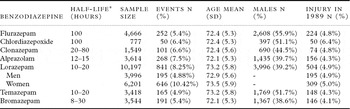
The baseline characteristics of the users of particular benzodiazepines are summarized in Table 1. The chlordiazepoxide cohort had the smallest number of fall-related injuries (50 events, 6.4%), while the lorazepam cohort had the largest (841 events, 8.25%). In fact, since the cohort for lorazepam had both a large sample size and the highest number of events, we stratified the analysis of its effects by sex. Across cohorts, the mean age in 1989 varied between 72 and 73 years (SD around 5 years), the proportion of males ranged between 38.6% and 55.9%, and the proportion of subjects who had an injury in 1989 varied from 4.1% to 6.4%.
Selected characteristics of the new users of seven benzodiazepines

* Including active metabolites when applicable
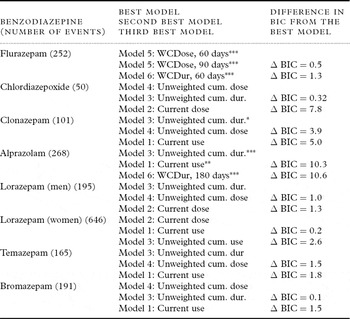
We analyzed each cohort with both the conventional and the weighted cumulative exposure (WCE) models, and compared the fit of the alternative models using BIC, with lower BIC indicating better fit. For each benzodiazepine, Table 2 shows the three best-fitting models. For the second and third best models, we show the difference in BIC (Δ BIC) relative to the minimum BIC model, with Δ BIC> 4.0 considered a clinically important difference. Asterisks indicate models for which the variable(s) representing the benzodiazepine exposure had a statistically significant association, at α = 0.05, with the fall-related injuries.
Three best-fitting models for each of the seven benzodiazepines

* Statistically significant likelihood ratio tests at α = 0.05 for the effect of the variables representing exposure to benzodiazepines.
** Statistically significant likelihood ratio tests at α = 0.01 for the effect of the variables representing exposure to benzodiazepines.
*** Statistically significant likelihood ratio tests at α = 0.001 for the effect of the variables representing exposure to benzodiazepines.
cum. = cumulative; dur. = duration
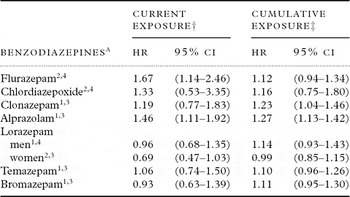
Table 3 shows the estimated hazard ratios (HR) obtained from the conventional models (Models 1–4) representing current or cumulative measures of exposure or dose. The weight functions estimated with the best-fitting WCE models for alprazolam, flurazepam, and temazepam are shown in Figure 1. Finally, to illustrate the clinical implications of the estimated WCE models, for selected benzodiazepines, Table 4 shows the estimated relative risks (adjusted HR) for five arbitrarily selected comparisons. Each comparison contrasts two different, clinically relevant, patterns of past benzodiazepine exposure.
Conventional estimates of the association between benzodiazepines use and fall related injuries (based on best-fitting parametric models)

a The first superscript beside the name of the benzodiazepine represents the model used for the current exposure; the second superscript represents the model used for the cumulative exposure.
† HR associated with a 1-day exposure to benzodiazepine at the standard dose compared to a day of non-use, as estimated by the lowest BIC model between the model with current use Model 1 and the model with current dose Model 2.
‡ HR associated with a 30-day exposure to benzodiazepine at the standard dose compared to a 30-day period of non-use as estimated by the lowest BIC model between the model with unweighted cumulative duration (Model 3) and the model with unweighted cumulative dose (Model 4).
Results of best-fitting weighted cumulative exposure (WCE) models: hazard ratio estimates for the associations between four specific patterns of the past use of selected benzodiazepines and fall related injuries (95% CI)

5 Estimates from the weighted cumulative dose model (Model 5).
6 Estimates from the weighted cumulative duration of treatment model (Model 6).
7 Estimates from the current dose + weighted cumulative duration of treatment model (Model 7).
(i) compares a current user at the recommended dose who has used the benzodiazepine for 1 day and a non-user.
(ii) compares a current user at the recommended dose who has used the benzodiazepine for 7 days and a non-user.
(iii) compares a current user at the recommended dose who has used the benzodiazepine for 30 days and a non-user.
(iv) compares a current user at the recommended dose who has used the benzodiazepine for 7 days and a past user who has used the benzodiazepine for a week, between 14 and 7 days ago, at the recommended dose.
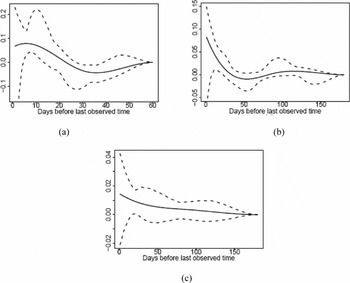
Estimated weight function and 95% pointwise bootstrap confidence intervals (dotted curves); (a) flurazepam, with weight function estimated from a weighted cumulative dose model, 60 days; (b) temazepam, with weight function estimated from a weighted cumulative duration and current dose model, 180 days; (c) alprazolam, with weight function estimated from a weighted cumulative duration model, 60 days.

For flurazepam, the best-fitting models were those that represented exposure using the WCE metric, and the corresponding associations with increased risk of fall-related injuries were statistically very significant (Table 2). The best model was Model 5, which represented exposure using the weighted cumulative dose over the past 60 days. The estimated weight function shown, together with 95% pointwise confidence band in Panel (a) of Figure 1, is relatively flat in the first 10 days but decreases thereafter. This shape suggests cumulative effects of flurazepam doses taken during the past 10 days. On the other hand, doses taken more than 20 days ago do not seem to affect the current risk (Figure 1a).
Hazards ratios obtained from the conventional models, shown in Table 3, indicate that while the higher current dose of flurazepam is associated with an increased risk of fall-related injuries (Model 2: HR = 1.67, 95% CI 1.14–2.46), the unweighted total past dose over the last 30 days is not (Model 4: HR = 1.12 95% CI 0.94–1.34). This pattern of findings is consistent with the estimated weight function for flurazepam, which suggests that the effects of flurazepam cumulate only during the past 20 days of use, with higher weights assigned to doses taken in the last 10 days, (Figure 1a). For this reason, the conventional Model 4, which represents flurazepam exposure by the unweighted cumulative dose over the past 90 days – i.e. sums the doses taken mostly too long ago to contribute to the current risk of falls – fails to detect an association (Table 3).
The first row of Table 4 shows the adjusted HR, estimated from the best-fitting weighted cumulative dose model (Model 5), for comparing the risks associated with specific patterns of flurazepam use. An elderly person who has been taking the recommended daily dose for the past 7 days has about a 70% higher risk of fall-related injuries than another elderly person, of the same age and sex, who did not use flurazepam in the past 90 days (adjusted HR = 1.68; 95% CI 0.68–3.05), even if the 95% pointwise confidence interval is wide. Furthermore, the continuous use, at the same recommended dose, over the past 30 days is associated with an almost three-fold, statistically very significant, risk increase (adjusted HR = 2.83; 95% CI 1.45–4.34).
For alprazolam, the best-fitting model is the conventional model that represents exposure by its unweighted cumulative duration of past use (Table 2). In this model, subjects who took alprazolam over the previous 30 days have 27% higher risks of fall-related injuries than non-users (HR = 1.27; 95%CI 1.13–1.42 in Table 3). Interestingly, Model 6, which represented exposure using the weighted cumulative duration of treatment over the past 180 days, was selected as the third best-fitting model by the BIC, and also detected a statistically significant association between alprazolam and fall-related injury (Table 2). The estimated weight function for alprazolam is shown in Panel (c) of Figure 1. Compared to the other weight functions shown in Figure 1, the weight function for alprazolam was relatively flat with weights decreasing very slowly with increasing time since exposure. Thus, the WCE estimate is consistent with the best-fitting unweighted cumulative duration model, which corresponds to using the WCE metric with a constant weight function, which assigns the same weight to all exposures in the past.
Similarly, the best-fitting model for clonazepam was the unweighted cumulative duration of treatment (Table 2). Uninterrupted use of clonazepam for the past 30 days is associated with about a 20% increase in the risk of fall-related injuries (HR = 1.23; 95% CI 1.01–1.46, in Table 3). None of the WCE models was selected among the three best-fitting models for clonazepam (Table 2).
On the other hand, even the BIC-optimal models failed to detect a statistically significant association with fall-related injuries for the other three benzodiazepines: chlordiazepoxide, lorazepam, and bromazepam (Table 2).
Finally, for temazepam, the three best-fitting models did not include any of the WCE models (Table 2). However, the previous study that used the parametric WCE model had found that it accurately described the association between temazepam and fall-related injuries (Abrahamowicz et al. Reference Abrahamowicz, Bartlett, Tamblyn and du Berger2006). Therefore, we investigated further the results of WCE models for temazepam. The best-fitting WCE model for temazepam was Model 7 with the exposure time window of 180 days (data not shown). Like the best-fitting model in our previous study (Abrahamowicz et al. Reference Abrahamowicz, Bartlett, Tamblyn and du Berger2006), our Model 7 included both the current dose of temazepam and the weighted cumulative duration of its use, and their joint effects on the risk of fall-related injuries were statistically significant (p = 0.017).
The estimated weight function for temazepam, shown in Figure 1 (d), gradually decreases with increasing time since exposure, but the weights (vertical axis) are positive. This weight function suggests the risk of falls increases with increasing cumulative duration of recent temazepam use. In contrast, when adjusted for the weighted cumulative duration of past use, in Model 7 the effect of the current dose of temazepam was protective (HR = 0.38). This would suggest that, among the elderly who had the same history of past temazepam exposure, the risk is actually lower for current users (current dose > 0) than for subjects who do not take temazepam on a given day (dose = 0), This combination of (i) harmful effect of longer cumulative duration and (ii) protective effect of current dose, indicates that the highest risk group consists of the elderly who (i) have long history of previous temazepam use (i.e. high cumulative duration of use) but (ii) have recently stopped the treatment. This pattern of results may, in turn, suggest that the risk of fall-related injuries among temazepam users is mostly driven by a withdrawal effect, which may be the strongest among the elderly who have been exposed for relatively long time. Table 4 illustrates the implications of the dual effects of (i) cumulative duration of past use versus (ii) Current dose/exposure status on the relative risks (HR) associated with different patterns of past temazepam use. The leftmost column (i) of Table 4 shows that a subject who has been exposed to temazepam for just one day has significantly lower risk than a non-user (HR = 0.42; 95% CI 0.16–0.97). However, as cumulative duration of past use increases to 7 and 30 days, the relative risks gradually increase to, respectively, HR = 0.63 (95% CI 0.29–1.15), and HR = 1.17 (95% CI 0.66–2.01) (Table 4).
Discussion
We reassessed the associations between the use of selected benzodiazepines and fall-related injuries using both conventional parametric models (current exposure, unweighted sum of past exposures) and the novel, flexible weighted cumulative exposure (WCE) models. In the WCE models, past exposures are weighted according to a function that assesses their contributions to the current risk, depending on the time elapsed since exposure. Then, the current WCE value is calculated as the weighted sum of past exposures and represented by a time-dependent covariate (Abrahamowicz et al. Reference Abrahamowicz, Bartlett, Tamblyn and du Berger2006, Sylvestre and Abrahamowicz, Reference Sylvestre and Abrahamowicz2009). Our flexible WCE model (Sylvestre and Abrahamowicz, Reference Sylvestre and Abrahamowicz2009) allowed us to estimate the weight function directly from the data without imposing a priori assumptions about the shape of this function. Although the WCE models provided new insights regarding the associations between exposure to selected benzodiazepines and the risk of falls, they produced slightly wider 95% confidence intervals than the conventional models. This is common to more complex models, where additional coefficients help increasing the accuracy of the estimated association, at the cost of increased variance (Abrahamowicz et al., Reference Abrahamowicz, MacKenzie and Esdaile1996).
Our results highlight the importance of recognizing that the effects of some benzodiazepines may cumulate over time. Indeed, while previous studies did not detect any association between fall-related injuries and the current use of alprazolam (Pierfitte et al., Reference Pierfitte2001; Tamblyn et al., Reference Tamblyn, Abrahamowicz, du Berger, McLeod and Bartlett2005; Abrahamowicz et al., Reference Abrahamowicz, Bartlett, Tamblyn and du Berger2006), our results suggest a statistically significant and clinically important effect of its cumulative duration of its use, in the last 30 days. In addition, the WCE model offered new insights regarding the previously established association between flurazepam use and the risk of falls (Neutel et al., Reference Neutel, Hirdes, Maxwell and Patten1996; Tamblyn et al., Reference Tamblyn, Abrahamowicz, du Berger, McLeod and Bartlett2005; Abrahamowicz et al., Reference Abrahamowicz, Bartlett, Tamblyn and du Berger2006), by suggesting that the etiologically relevant exposure for flurazepam is limited to approximately the two previous weeks. Furthermore, the WCE models fitted the flurazepam data better than any of the conventional models and, as such, yielded much higher estimates of relative risks associated with high cumulative dose in the recent weeks.
All but one (Pierfitte et al., Reference Pierfitte2001) of the previous studies that investigated the effect of temazepam on fall-related injuries detected a statistically significant association (Herings et al., Reference Herings, Stricker, de Boer, Bakker and Sturmans1995; Tamblyn et al., Reference Tamblyn, Abrahamowicz, du Berger, McLeod and Bartlett2005; Abrahamowicz et al., Reference Abrahamowicz, Bartlett, Tamblyn and du Berger2006). Yet, consistent with previous analyses of cumulative effects of temazepam use (Abrahamowicz et al., Reference Abrahamowicz, Bartlett, Tamblyn and du Berger2006), we find that its use has a statistically significant association with the risk of fall-related injuries only when the effects of both (i) the cumulative use and (ii) current dose are jointly taken into account. Interestingly, the opposite effects of these two components of exposure history suggest that the possibly increased risk of fall-related injuries associated with cumulative use of temazepam may be driven mostly by a withdrawal effect, especially among elderly who have been using it over a prolonged period. This conjecture needs, of course, to be corroborated by future studies.
Our finding of no association between bromazepam use and falls is consistent with previous reports (Pierfitte et al., Reference Pierfitte2001; Tamblyn et al., Reference Tamblyn, Abrahamowicz, du Berger, McLeod and Bartlett2005). Whereas current use of chlorazepoxide was associated with increased risk of fall-related injury in one study (HR = 1.83 (1.04–3.22)) (Tamblyn et al., Reference Tamblyn, Abrahamowicz, du Berger, McLeod and Bartlett2005), our non-significant results for chlordiazepoxide could reflect low statistical power, due to only 50 events in the corresponding subcohort. Finally, in spite of having a large cohort of lorazepam users, we did not replicate previous findings of its statistically significant association with fall-related injuries (Herings et al. Reference Herings, Stricker, de Boer, Bakker and Sturmans1995; Neutel et al., Reference Neutel, Hirdes, Maxwell and Patten1996; Pierfitte et al., Reference Pierfitte2001, Tamblyn et al., Reference Tamblyn, Abrahamowicz, du Berger, McLeod and Bartlett2005). The latter findings may be partly due to the increased trend toward switching higher-risk users of other benzodiazepines to lorazepam (Bartlett et al., Reference Bartlett, Abrahamowicz, Tamblyn, Grad, Čapek and du Berger2004).
It was suggested that the risk increases with increased benzodiazepine half-life, which implies a longer drug presence in the body (Catterson et al., Reference Catterson, Preskorn and Martin1997). Yet, similar to two previous studies (Ray et al., Reference Ray, Grin and Downey1989; Cumming et al., Reference Cumming1991), our results do not support this hypothesis as, in our analyses, the most important risks were associated with both long- acting (flurazepam) and short-acting (alprazolam) products. The mechanisms linking benzodiazepine use with falls seem to differ across products. While recent cumulative dose is an important risk factor for flurazepam, for alprazolam and clonazepam the duration of past treatment seems to be more important.
Development of pharmacodynamic tolerance, i.e. decreasing responsiveness to the drug with increasing duration of exposure, due to adaptive changes in the brain, is a prominent feature of benzodiazepines. Undoubtedly, many benzodiazepine users in our study developed some degree of tolerance, but its strength likely varied depending on the drug, dose and, more especially, on the duration of exposure. Obviously, our database did not provide any information that would allow us to measure tolerance. Yet, in general, one may expect that tolerance and the resulting potential non-adherence will result in some under-estimation of the cumulative effects of long-term benzodiazepine exposure, based on the filled prescriptions. From this perspective, these phenomena are unlikely to affect the robustness of our findings for those benzodiazepines for which the cumulative WCE model was found to predict fall-related injuries better than any of the conventional models. On the other hand, it is likely that tolerance, and possibly also drug dependence, could also affect the physicians' prescribing decisions and/or patients' adherence to the prescribed treatment. For these reasons, future pharmaco-epidemiological and clinical studies should attempt to assess how the tolerance (i) depends on the exposure patterns and (ii) affects, in turn, the risk of fall-related injuries.
Interpretation of our results should take into account the typical limitations of administrative database pharmacoepidemiological studies (Schneeweiss and Avorn, Reference Schneeweiss and Avorn2005; Abrahamowicz and Tamblyn, Reference Abrahamowicz, Tamblyn and Colton2005). First, exposure was based on filled prescriptions of benzodiazepines and not on their actual use (West et al., Reference West, Strom, Poole and Strom2002). Given that benzodiazepines are often prescribed on pro re nata (PRN) basis, this could induce exposure misclassification (Tamblyn et al., Reference Tamblyn, Abrahamowicz, du Berger, McLeod and Bartlett2005). Yet, users of PRN and non-PRN benzodiazepines were reported to have similar risks of falls (Sgadari et al., Reference Sgadari, Lapane, Mor, Landi, Bernabei and Gambassi2000), implying non-differential exposure misclassification, which would result in an under-estimation of the actual strength of the association (Schneeweiss et al., Reference Schneeweiss and Avorn2005, Tamblyn et al., Reference Tamblyn, Abrahamowicz, du Berger, McLeod and Bartlett2005). Thus, it is rather unlikely that the possible inaccuracy in exposure ascertainment could have induced spurious associations, implying that those of our results that indicate statistically significant associations between use of particular benzodiazepines and risk of fall-related injuries may be considered to be robust with respect to exposure misclassification. Furthermore, the resulting regression dilution bias will affect the results of all models of exposure-risk association and, thus, should not have a material impact on the comparison of the goodness of fit of the alternative models.
Any observational study of potential adverse effects of medication should include a careful assessment of potential for confounding bias and, in particular, for confounding by indication (Walker, Reference Walker1996). Indeed, users of different benzodiazepines likely present systematically different clinical profiles that need to be taken into account in the analysis in order to obtain unbiased relative risk estimates. In contrast, each of our analyses is limited to the cohort of new users of a specific benzodiazepine who start their follow-up at the time of their first prescription. This implies that cohort members are likely to share similar characteristics related to indication for the specific benzodiazepine they are prescribed, i.e. to have similar risk profiles. In addition, because the primary interest is the weighted cumulative exposure, simplistic comparisons of users vs. non-users are replaced by comparisons of risks of injury between users of the same benzodiazepine who have different longitudinal patterns of use. Hence, in our study, potential confounders include risk factors for fall-related injuries that are also likely to be associated with the patterns of benzodiazepine use. Based on these considerations, all our models adjust for three a priori selected potential confounders: (i) previous injury, which acts as a proxy for frailty, and is likely to affect the probability and pattern of benzodiazepine exposure, as well as (ii) sex and (iii) age, which were both identified as the only characteristics systematically associated with differences in such clinically important aspects of longitudinal patterns of benzodiazepine use as changes in dose over time (Bartlett et al., Reference Bartlett, Abrahamowicz, Tamblyn, Grad, Čapek and du Berger2004). On the other hand, we recognize that, ideally, our analyses would have been adjusted for variables such as cognitive impairment or self-reported health status but these variables are typically not collected in administrative databases.
Our data likely underestimate the incidence of fall-related injuries, which we identify based on the diagnoses at discharge from the hospital. Accordingly, we miss the (presumably less severe) injuries, including soft-tissue injuries that had not resulted in hospitalization, as well as those where the diagnostic codes failed to indicate a fall-related injury. On the other hand, such misclassification of the outcomes is likely to be non-differential, i.e. not associated with particular patterns of benzodiazepine use and, thus, should not affect the comparison of alternative models and of the risks associated with different patterns of benzodiazepine use. On a related note, future research should also investigate if and how the occurrence of the injury affects the future use of benzodiazepine(s). For example, it is possible that many of the frequent switches from one to another benzodiazepine (Bartlett et al., Reference Bartlett, Abrahamowicz, Tamblyn, Grad, Čapek and du Berger2004) may be triggered by a recent fall and/or injury, including those not serious enough to result in a hospital admission, and some clinical or subclinical symptoms indicating the patient's cognitive function may be affected by his/her current benzodiazepine therapy.
In conclusion, our study highlights the importance of considering potential cumulative effects of past use of some benzodiazepines on fall-related injuries. It also indicates that mechanisms affecting the risk of falls differ across benzodiazepines. Thus, benzodiazepine-specific analyses, which consider both the dose and the timing of the exposure, should be preferred over simpler analyses that assume the effects are similar for all benzodiazepines, or within categories of half-life, and limit exposure to current use or current dose. These methodological recommendations apply as well to studies of the potential adverse effects of other medications, where the patterns of use and dose vary over time.
Conflict of interest
None.
Description of authors' roles
M-P. Sylvestre and M. Abrahamowicz were responsible for the methodological design of the study. M-P. Sylvestre performed the statistical analyses of the data and wrote the initial draft of the paper. M. Abrahamowicz edited the paper. R. Capek contributed his pharmacology expertise to the interpretation and discussion of the results. R. Tamblyn designed the initial study and assembled the data, in addition to providing several comments on the paper.
Acknowledgments
M. Abrahamowicz is a James McGill Professor at McGill University. This research was supported by a grant from the Canadian Institutes for Health Research (\#MOP-81275 PI: M. Abrahamowicz). The initial study was funded by the Fonds de recherche en santé du Québec and approved by the McGill University Faculty of Medicine Institutional Review Board, the Quebec Access to Information Commission, and the Régie de l'assurance maladie du Québec (PI: R. Tamblyn).