INTRODUCTION
The introduction of species into new areas is one of the leading causes that determine changes in the composition of ecological communities (Ricciardi, Reference Ricciardi2006). The transfer of species across regions breaks down bio-geographical barriers and causes the homogenization of ecosystems (Olden et al. Reference Olden, Poff, Douglas, Douglas and Fausch2004). This reshuffling of species is more important than normally perceived, also because introduced species may carry parasites into the new habitats (Altizer et al. Reference Altizer, Harvell and Friedle2003). On the other hand, introduced species have to adapt to a new environment and to a potentially new complex of parasite species. Therefore, among the possible outcomes of the introduction of a species into an ecosystem there is the introduction of new parasites and, conversely, the acquisition of parasites from resident hosts by the introduced species (Barton, Reference Barton1997). These phenomena may change the processes that regulate the structure and organization of the parasite community and the host-parasite interactions (Esch et al. Reference Esch, Bush and Ano1990).
Whether communities are just random assemblages of species or the result of interspecific competition and environmental filters is generally considered a fundamental question, one that would allow for a better understanding of parasite community structure and parasite-host relationships. Recent studies on the organization of parasite communities revealed that most patterns of species co-occurrence do not differ from those predicted by null models, while departures from random species assembly are the exception rather than the norm (Guégan and Hugueny, Reference Guégan and Hugueny1994; Poulin, Reference Poulin1996; Gotelli and Rohde, Reference Gotelli and Rohde2002). However, most of these studies were conducted using ectoparasites or helminths as models, while similar research on microparasites is still needed.
The Eastern cottontail (Sylvilagus floridanus Allen, 1890) is a lagomorph native to North and Central America that was introduced for hunting purposes to other areas of the United States (Chapman et al. Reference Chapman, Hockman, Magaly and Ojeda1980) and to some European countries (Mitchell-Jones et al. Reference Mitchell-Jones, Amori, Bogdanowicz, Kryštufek, Reijnders, Spitzenberger, Stubbe, Thissen, Vohralík and Zima1999). In Europe, wild populations have apparently survived only in Italy, where the cottontail is distributed over a large area in the north west of the country and, with smaller populations, in north eastern and central regions (Angelici and Spagnesi, Reference Angelici, Spagnesi, Amori, Contoli and Nappi2008). The cottontail may be a carrier of pseudo-tuberculosis, transmissible to the native brown hare (Lepus europaeus). Moreover, it is resistant to myxomatosis while being a carrier of the disease that is fatal to the European rabbit (Oryctolagus cuniculus). Also endoparasites of cottontails may constitute a threat to European lagomorphs. Among them, eimeriid coccidia (Apicomplexa: Eimeriidae) are of special interest, as they represent a ubiquitous and diversified assemblage of intestinal protistan parasites. So far, the only study on coccidia of cottontails in Europe is by Tizzani et al. (Reference Tizzani, Lavazza, Capucci and Meneguz2002), who reported a list of 6 Eimeria species: E. honessi, E. paulistana, E. environ, E. magna, E. leporis, E. andrewsi. However, no study ever fully investigated host-parasite interactions between introduced cottontails and coccidian species, nor took into consideration the origin of the coccidia and the predictors of infection.
During the period 2003–2005, one of us (S.B.) conducted a study on the population dynamics and life-history parameters of the cottontail in an area of northern Italy where the brown hare was also present. This study enabled us to monitor the coccidian community of the introduced species and to investigate the possible host-parasite interactions. In particular, we examined the pattern of species richness and prevalence, the probable origin of the species found, and the host-parasite interactions. Accordingly, we addressed the following questions. (1) Which parasites did the cottontail introduce to Italy and what is the range of parasites that may have adapted to the cottontail from the native fauna? (2) Which host parameters (e.g. sex, age, body condition) are important predictors of infection? (3) Is there any evidence that clearly proves a community of parasite species to be structured and to differ from a random assembly?
MATERIALS AND METHODS
Study area
The study area was located on the right bank of the Orba River (province of Alessandria, northwestern Italy, 44°49′N, 8°40′E), partly within a natural reserve and partly within the adjacent game reserve, where hunting was prohibited. Moving away from the river, the landscape was composed of a narrow shore, a small woodland (3 ha) and a shrubby area, then uncultivated fields and a mosaic of meadows, field crops, and a few poplar plantations. The shore was partially covered by shrubs and low trees, mainly willows (Salix spp.) and poplars (Populus spp.). The woodland was mainly composed of black locust (Robinia pseudoacacia) and common oak (Quercus robur), with a rich undergrowth of hawthorn (Crataegus monogyna), black elderberry (Sambucus nigra), and common buckthorn (Rhamnus cathartica). The shrubby area was a thick strip of Rubus spp. and Rosa spp. with few trees. Crop fields were cultivated with wheat, maize, sunflower and beet according to a rotation system.
Trapping
Cottontails were captured every other month, from December 2004 to October 2005. Cage traps (single catch, double entry, spring door traps, 100×40×40 cm Gibis, France) were set in the field and checked twice a day for 7 days: at sunset and after dawn. Each trapped cottontail was individually marked with ear-tags (a Monel No 3, National Band and Tag Co., USA and a rabbit coloured tag with number), sexed, weighed, and its hind-foot length was measured. After the release of trapped animals, faeces were collected from the traps and placed in vials containing 2·5% (w/v) of aqueous potassium dichromate (K2Cr2O7).
Coccidia identification
In the laboratory, faecal samples were examined for the presence of parasites using a centrifugation-flotation method in modified Sheather's sugar solution (sp. gr. 1·3). Coccidian oocysts were examined, measured and photographed using an Olympus Provis AX 70 microscope, equipped for Nomarski interference-contrast microscopy. Coccidia were identified according to generally valid criteria for species separation, based on morphological and biological characteristics (Levine and Ivens, Reference Levine and Ivens1965; Duszynski and Wilber, Reference Duszynski and Wilber1997). The morphological examination includes measurement and shape identification (shape index) of oocysts and sporocysts, an examination of the absence or presence (appearance) of micropyle cap, micropyle, polar granule, oocyst residuum, Stieda body, sporocyst residuum, and appearance of oocyst wall and sporozoites (Levine and Ivens, Reference Levine and Ivens1965; Duszynski and Marquardt, Reference Duszynski and Marquardt1969; Duszynski and Wilber, Reference Duszynski and Wilber1997; Samuel et al. Reference Samuel, Pybus and Kocan2001). All the eimeriid species that affect members of the genera Sylvilagus, Lepus and Oryctolagus were included in the differential diagnosis (e.g. Duszynski and Marquardt, Reference Duszynski and Marquardt1969; Pellérdy, Reference Pellérdy1974; Wiggins and Rothenbacher, Reference Wiggins and Rothenbacher1979; Duszynski et al. Reference Duszynski, Upton and Couch2001).
Data analysis
Two series of analyses were performed which included parasite occurrence data and predictors: the former investigated an individual parasite's response to the parameters measured in individual cottontails; the latter investigated the structure and composition of the parasite community. For these analyses we considered 1 faecal sample for each animal (i.e. that collected during first capture), thus avoiding autocorrelation problems eventually caused by repeated sampling.
The relationships between parasite occurrence, species richness, and host parameters were analysed using Generalized Linear Models (GLM). The independent variables were: sex (male or female), age (juvenile or adult), body condition, and population density index (number of cottontails trapped in each period). An index of body condition was derived as the ratio of body mass and hindfoot length, and taken to be a measure of structural body size (Krebs and Singleton, Reference Krebs and Singleton1993). We evaluated numerical species richness as the number of eimeriid species found in each cottontail (Magurran, Reference Magurran2004). The error structure associated with the occurrence models was assumed to be binomial with a logit link function, and Poisson when modelling species richness. For statistical inference we used Bayesian model averaging (BMA) (Raftery, Reference Raftery1996; Wintle et al. Reference Wintle, McCarthy, Volinsky and Kavanagh2003; Ellison, Reference Ellison2004). BMA incorporates uncertainty in the model selection and avoids parameter selection and estimation biases associated with stepwise selection methods (e.g. Whittingham et al. Reference Whittingham, Stephens, Bradbury and Freckleton2006). Unlike traditional stepwise methods, this approach does not entail the selection of one ‘best’ model (Whittingham et al. Reference Whittingham, Stephens, Bradbury and Freckleton2006); instead, more than one model is typically used to describe the relationship between the response and predictor variables. All models in the model space, M, are evaluated, where M is the set of all possible combinations of response and predictors. Posterior model probabilities (i.e. the probability of a model given the data), are calculated for each model in M and Pr(Mi | data), where Mi is the ith model in M. In other words, M represents the probability that a model is the ‘true’ one given the data. Predictor importance and influence were assessed in 2 ways. First, we examined the predictors' posterior effect probabilities which indicated evidence as to whether their coefficients were not equal to zero (i.e. Pr[bi≠0|data]). The posterior effect probability is essentially the percentage of occurrence of each predictor among the set of models selected for each parasite species and can be regarded as a measure of the relative importance of an explanatory variable. Second, the average mean of each regression coefficient was calculated by weighted averaging of coefficients under each separate model, with weights given by the posterior model probabilities. All the Bayesian model-averaging analyses were carried out using the BMA package (Hoeting et al. Reference Hoeting, Madigan, Raftery and Volinsky1999) for R (Ihaka and Gentleman, Reference Ihaka and Gentleman1996).
Similarities between Eimeria species occurrence were estimated with hierarchical cluster analysis, using Jaccard similarity index and the Ward linkage rule (Legendre and Legendre, Reference Legendre and Legendre1998). A powerful way to investigate community structure is the use of null models (Gotelli, Reference Gotelli2000; Gotelli and Entsminger, Reference Gotelli and Entsminger2009). These are statistical tools based on the randomization data that allow comparison between observed patterns and those expected under a particular null hypothesis (Gotelli and Graves, Reference Gotelli and Graves1996). The input matrix was the presence (1) or absence (0) of parasite species in individual hosts. From this empirical matrix, a single co-occurrence index, the C-score, is extracted, representing the degree of occurrence of species throughout the communities. This index quantifies the average number for each species pair of checkerboard units (cu), a 2×2 submatrice with the form 01/10 or 10/01, in a matrix of occurrence. Subsequently, the checkerboard units are reshuffled in the matrix to generate 5000 new matrices on which simulated C-scores are calculated. This process yields a distribution of the index under the null hypothesis of independence among occurrences. The C-score measures the tendency of species not to occur together: the larger the C-score, the less the average co-occurrence of species pairs. In a community structured according to competitive interactions, the number of checkerboard units between similar species tends to be higher than expected by chance (high segregation of parasite species among hosts) and the C-score is higher than in randomized communities. Conversely, when species are more aggregated and the community not so strongly structured according to competitive interactions, relatively few checkerboard units and a lower C-score are usually reported. The randomization process was conducted using Ecosim software v7.0 (Gotelli and Entsminger, Reference Gotelli and Entsminger2009), maintaining fixed sums for row and column constraints; that is, each generated matrix had the same row and column totals as the original matrix (Connor and Simberloff, Reference Connor and Simberloff1979).
RESULTS
Prevalence of infections
Out of the 123 samples collected from 113 animals, 119 (96·7%) were found to be infected with coccidian species. Only 4 animals (3·5%) were not infected with Eimeria, while 20 animals (17·7%) were infected with 1 Eimeria species only. However, in most animals co-infections of 2–5 Eimeria species were detected (2 species: 37·3%; 3: 21·2%; 4: 15·9%; 5: 4·4%). Eight Eimeria species were determined (prevalence min.-max.) (Table 1, see Fig. 1 for microphotographs of the species): E. poudrei (10·7–71·4%), E. honessi (20·0–71·4%), E. environ (42·9–89·3%), E. maior (21·4–42·9%), E. neoirresidua (28·6–85·7%), E. neoleporis (6·3–42·9%), E. minima (0–21·4), E. leporis (0–6·3).
Sporulated oocysts of the Eimeria species found in Sylvilagus floridanus introduced to Italy.

Prevalence (%) of Eimeria species infecting Sylvilagus floridanus in Italy from December 2004 to October 2005 (N=113)

The cluster trees of the similarity of occurrence between Eimeria species produced 2 groupings, the former corresponding to E. poudrei and E. honessi, the latter corresponding to E. leporis, E. neoleporis, and E. minima (Fig. 2). The other species were clustered outside these two groups, with E. maior and E. environ being closer to the latter group, and E. neoirresidua being far away from all the other species.
Cluster tree of Eimeria species occurrence in Sylvilagus floridanus estimated using the Jaccard similarity index.

Effects of host phenotype
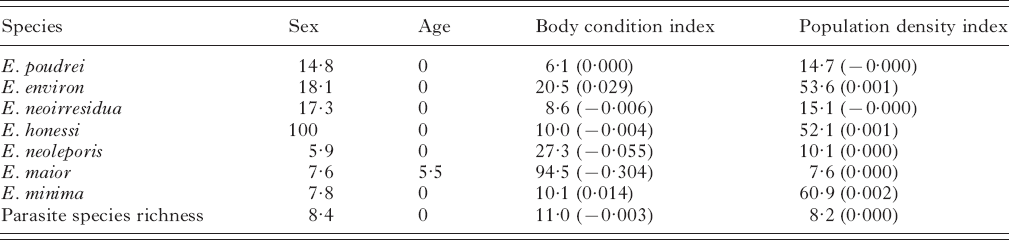
The results of Bayesian model averaging seem to support a strong association between sex and the occurrence of E. honessi, and a relatively weaker association between sex and the occurrence of E. poudrei, E. environ and E. neoirresidua (Table 2). In all these cases the prevalence was higher in females. Age did not seem to have any support from any of the models, with the exception of E. maior, for which prevalence was higher in adults than juveniles, though support was very low. The posterior effect of probability (i.e. the variable importance) for the body condition index varied from 6·1 (E. poudrei) to 94·5 (E. maior). The analysis showed that the probability of infection with E. maior increases when the animals were in poor body condition. However, most model-averaged coefficients for the body condition index were very low. In a similar fashion, population density was shown to have a relatively high posterior effect of probability on 3 species (E. environ, E. honessi, E. minima), but the model-averaged coefficients were close to zero. Eimeria leporis was excluded from this analysis on account of its low prevalence.
The analyses of the parasite species richness indicated very limited support for the effects of each of the 4 variables used as predictors (Table 2). These were ranked as follows: body condition index, sex, population density, and age.
Results of Bayesian model averaging assessing the effects of four predictor variables on parasite occurrence and on parasite species richness in Sylvilagus floridanus
(For each predictor variable the posterior effect of probability and the average estimated regression coefficients (in parentheses) are shown. For factors (i.e. sex and age) only the posterior effect probability is shown.)

Community structure
The observed C-score for the parasite matrix was 361·29, while the average of the simulated matrices was 353·33. In fact, only 41 of them had a C-score larger than the observed score (Fig. 3). Therefore, when compared to the simulated universe of random matrices with identical row and column sums, there was much less co-occurrence in the parasite matrix than expected by chance (P<0·01).
Results of null model analyses and position of the empirical C-score (arrow) in a frequency distribution of values generated randomly from the matrix with Eimeria species occurrence using the fixed sums for row and column constraints algorithm.

Inspection of cu values for each species pair showed that an unusually high C-score resulted from the pairing of E. environ and E. neoirresidua with E. poudrei, E. honessi, E. maior (mean cu values=855·17±86·35; mean cu values of the other pairs=226·59±37·94). After removing E. environ and E. neoirresidua from the matrix, the co-occurrence analysis gave different results. The observed C-score was 223·93 while the average C-score generated in the simulation was 225·23, without any significant difference between observed and expected values (P>0·05).
DISCUSSION
The assemblage of Eimeria species reported in our study is consistent with previous studies on Sylvilagus floridanus (Wiggins and Rothenbacher, Reference Wiggins and Rothenbacher1979; Wiggins et al. Reference Wiggins, Cosgrove and Rothenbacher1980). Until today, 12 species of Eimeria have been reported to belong to S. floridanus. We found 8 species of Eimeria, 1 of which, E. poudrei, so far known to belong to S. audubonii, is reported to belong to S. floridanus for the first time. Three of the Eimeria species that were found in our cottontail population (E. environ, E. honessi, E. leporis) were also reported in the study of Tizzani et al. (Reference Tizzani, Lavazza, Capucci and Meneguz2002) and may now be widely distributed in the province of Alessandria.
Eimeria coccidia are considered to be typically highly host specific parasites. This feature of theirs accounts for the enormous diversity of these protists (e.g. Duszynski, Reference Duszynski1986; Duszynski and Upton, Reference Duszynski, Upton, Samuel, Pybus and Kocan2001). However, the host specificity of some Eimeria of lagomorphs may be broader, as some of the Eimeria species previously reported in Sylvilagus were also found in members of the genera Lepus and Oryctolagus (Pellérdy, Reference Pellérdy1974; Duszynski et al. Reference Duszynski, Upton and Couch2001). Among the species we found in cottontails, E. leporis was described in Lepus (L. europaeus, L. arcticus, L. ruficaudatus, L. timidus, L. tolai), E. minima in L. ruficaudatus, and E. neoleporis was found in Oryctolagus cuniculus (Pellérdy, Reference Pellérdy1974) (Appendix 1). All but 1 (E. leporis) species have North American origins and were never reported in brown hare, which is the only native lagomorph present in the Italian cottontails' range; accordingly, they were presumably introduced into Italy with imported cottontails. E. neoleporis was originally described in S. floridanus in North America, and later found in O. cuniculus in Europe, while experimental infections confirmed susceptibility of the same rabbit (Pellérdy, Reference Pellérdy1974).
Recent research found that introduced populations are less heavily parasitized than native populations of the same species (Torchin et al. Reference Torchin, Lafferty, Dobson, McKenzie and Kuris2003). According to these authors, the release from parasites may contribute to the success of introduced species. The coccidian species richness recorded in our study area was similar to species richness recorded within the native range of cottontails (8 species Wiggins and Rothenbacher, Reference Wiggins and Rothenbacher1979; 9 species Wiggins et al. Reference Wiggins, Cosgrove and Rothenbacher1980). We, thus, did not find any missing parasite effect related to the introduction of the species outside its native range. The possibility of introducing parasites to a system with a new host depends on the number of host individuals released (Freeland, Reference Freeland1983). Cottontails were repeatedly introduced into Italy for hunting purposes (Angelici and Spagnesi, Reference Angelici, Spagnesi, Amori, Contoli and Nappi2008) and one can reasonably suppose that many animals were released, each time in the attempt to establish a viable population. Multiple introductions of the cottontail arguably favoured the density level required by the American Eimeria to establish and maintain their life cycle in the new habitats. The fact that a common path of transmissibility of Eimeria spp. is from parents to their young definitely facilitates the maintenance of these parasites, also within small populations.
Mammal sex hormones differ in their effects on the immune system: while oestrogens stimulate, androgens depress immunity (Grossman, Reference Grossman1985). This could lead to a sex-biased parasitism, even though results of previous studies are not concordant on this subject. In some cases a sex effect on the prevalence rate of Eimeria was found (Fuller and Duszynski, Reference Fuller and Duszynski1997; Bertolino et al. Reference Bertolino, Wauters, De Bruyn and Canestri-Trotti2003), while in others it was not (Stanton et al. Reference Stanton, Shults, Parker and Seville1992; Fuller, Reference Fuller1996; Higgs and Nowell, Reference Higgs and Nowell2000). Schalk and Forbes (Reference Schalk and Forbes1997) suggested that average differences in parasitism between sexes are small and difficult to be statistically proven in field studies. This is probably the reason why our results only highlighted an association between sex and E. honessi, with a higher prevalence in females, and relatively low values for other species.
Our results indicate a tendency of species to occur together less than expected, which is typical of a community structured according to competitive interactions. This was made evident by the low co-occurrence of E. environ and E. neoirresidua with E. poudrei, E. honessi, and E. maior. After removing E. environ and E. neoirresidua from the matrix of parasites, the community appeared to be randomly assembled. The apparently competing species were probably introduced by imported cottontails from America. Accordingly, similar studies in the native range are necessary to confirm our findings, while only experimental infections can definitively establish the presence of competitive interactions between these species.
The presence of negative interactions between some Eimeria species seems to support the parasite competition theory (Holmes and Price, Reference Holmes, Price, Anderson and Kikkawa1986). However, studies on the community structure of Eimeria in lagomorphs are still needed in order to carry out a comparison. In contrast, research on rodents revealed a positive association between species, thus suggesting the absence of competition (Stanton et al. Reference Stanton, Shults, Parker and Seville1992; Seville et al. Reference Seville, Stanton and Gerow1996; Bertolino et al. Reference Bertolino, Wauters, De Bruyn and Canestri-Trotti2003). The community structure pattern has been mainly investigated in macroparasites. The results of these studies were conflicting and found parasite communities that were structured according to competitive interactions (Dezfuli et al. Reference Dezfuli, Giari, De Biaggi and Poulin2001), others that were randomly assembled (Gotelli and Rohde, Reference Gotelli and Rohde2002), and others with an aggregative structure (Rohde et al. Reference Rohde, Hayward and Heap1995). Further studies on microparasites are necessary to better understand the patterns of interactions within their communities. The endogenous development of individual species of coccidia is usually confined to specific regions of the intestine, which enables a typical niche partitioning between species. Unfortunately, the endogenous development for the majority of eimeriid coccidia in lagomorphs is poorly understood and this aspect is generally overlooked in studies on coccidian communities in other animals. Eimeria leporis and E. neoleporis have a similar oocyst shape, but differ in their endogenous development (E. l. ileum, E. n. caecum and vermiform process) (Pellérdy, Reference Pellérdy1974; Pakandl, Reference Pakandl1990), which prevents direct spatial competition. Interestingly, these two species were not involved in competition and grouped together in the cluster analysis of occurrence.
In conclusion, our study showed that Eastern cottontails introduced to Italy presumably carried over at least 7 Eimeria species from their native range, while so far only 1 European species adapted to the new host. This is in contrast to the tendency of introduced species to be less parasitized than in their native range (Torchin et al. Reference Torchin, Lafferty, Dobson, McKenzie and Kuris2003) and is probably related to repeated massive releases of animals in Italy for hunting purposes. The host parameters here considered were only weakly associated with prevalence of infection and numerical species richness. This suggests that environmental factors are probably more important than individual phenotypic host characteristics in determining the levels of parasite prevalence in our population. The Eimeria community was probably structured according to competitive interactions, particularly related to a lower co-occurrence of E. environ and E. neoirresidua with other species. Whether this could be applied as a general rule in the Eastern cottontail has to be investigated in the native range of this species and further tested with experimental infections.
ACKNOWLEDGEMENTS
We are grateful to L. Gola and A. Perrone for their help with fieldwork. Financial support to the project was given by Regione Piemonte and Parco Fluviale del Po e dell'Orba. English revision was by Andrea Binelli.
Origin of the Eimeria species found in the Italian population of the Eastern cottontail