Introduction
Suicide is a major cause of premature death, particularly among individuals aged 40–64 years (or middle-aged adults) in many Western and Asian countries (WHO, 2014), and a strong association between suicide and depression often indicates the necessity of a high-risk approach to suicide prevention (Bostwick & Pankratz, Reference Bostwick and Pankratz2000; Hirokawa et al. Reference Hirokawa, Kawakami, Matsumoto, Inagaki, Eguchi, Tsuchiya, Katsumata, Akazawa, Kameyama, Tachimori and Takeshima2012). In Japan, the suicide rate was continuously high, at around 25.0/100 000 population until 2011, then declined slightly; rates were particularly high among middle-aged adults (35–64 years) (Ministry of Health, Labour and Welfare of Japan, 2014). Previous studies have also indicated that less than one-quarter of those with depression seek medical treatment (Kawakami et al. Reference Kawakami, Shimizu, Haratani, Iwata and Kitamura2004). Several literature reviews revealed that physicians’ education on depression management and restricting access to lethal means is effective, and that formal gatekeeper training and screening for depression are promising in reducing suicide rates among adults (Mann et al. Reference Mann, Apter, Bertolote, Beautrais, Currier, Haas, Hegerl, Lonnqvist, Malone, Marusic, Mehlum, Patton, Phillips, Rutz, Rihmer, Schmidtke, Shaffer, Silverman, Takahashi, Varnik, Wasserman, Yip and Hendin2005; WHO, 2014; Zalsman et al. Reference Zalsman, Hawton, Wasserman, van Heeringen, Arensman, Sarchiapone, Carli, Höschl, Barzilay, Balazs, Purebl, Kahn, Sáiz, Lipsicas, Bobes, Cozman, Hegerl and Zohar2016). In Japan and many other countries (Ajdacic-Gross et al. Reference Ajdacic-Gross, Weiss, Ring, Hepp, Bopp, Gutzwiller and Rössler2008; Ministry of Health, Labour and Welfare of Japan, 2014), over 60% of suicides in middle-aged people were caused by hanging, for which the prevention strategies of both means restriction and follow-up care after suicide attempts may provide limited benefit (Gunnell et al. Reference Gunnell, Bennewith, Hawton, Simkin and Kapur2005).
The Japanese government started a national campaign for suicide prevention in 2006. The Cabinet Office launched a national fund to help local municipalities implement suicide prevention programmes. These included public awareness campaigns, provision of consultation services to the general public, and training of community service providers in 2009–2012 (Nakanishi et al. Reference Nakanishi, Yamauchi and Takeshima2015).
Interventions that have successfully lowered suicide rates include 2- to 5-year educational programmes for physicians on detection and treatment of depression in rural communities with high suicide rates (Rutz et al. Reference Rutz, von Knorring and Wålinder1992; Szanto et al. Reference Szanto, Kalmar, Hendin, Rihmer and Mann2007), 6-year gatekeeper programmes in the military for those with an increased rate of suicide (Knox et al. Reference Knox, Litts, Talcott, Catalano Feig and Caine2003), and 2- to 5-year screening programmes for late-life depression in rural communities with high suicide rates (Sakashita & Oyama, Reference Sakashita and Oyama2015). Compared with clinic- and workplace-based services, community-based services provided in the home may be a better way to provide screening for depression to particular groups. These include those who are already depressed, and less likely to adhere to care programmes (Brown et al. Reference Brown, Battista, Bruehlman, Sereika, Thase and Dunbar-Jacob2005), as well as employed people, who may be less likely to participate in workplace screening because of the stigma of mental illness, and unemployed people, who are particularly at risk of suicide (Nakao et al. Reference Nakao, Takeuchi and Yoshimasu2008). Few studies, however, have examined the impact of a screening intervention on the incidence of death by suicide (suicide rates) among middle-aged adults in communities (Knox et al. Reference Knox, Litts, Talcott, Catalano Feig and Caine2003; Fountoulakis et al. Reference Fountoulakis, Gonda and Rihmer2011; Ono et al. Reference Ono, Sakai, Otsuka, Uda, Oyama, Ishizuka, Awata, Ishida, Iwasa, Kamei, Motohashi, Nakamura, Nishi, Watanabe, Yotsumoto, Nakagawa, Suzuki, Tajima, Tanaka, Sakai and Yonemoto2013). Under the Japanese public health insurance system, which covers almost all citizens, municipalities autonomously provide annual opportunities for regular, subsidized health check-ups to the entire population (Health and Welfare Statistics Association, 2013). This could be used as part of a universal suicide prevention strategy in community settings.
Evidence of the clinical benefits of decreasing the suicide rate is needed to support models for delivering depression interventions among middle-aged adults in community settings, not least because depressed people are less likely to seek help. Increasing access to appropriate healthcare in the community is also necessary for the development of such models and our efforts to improve such access are ongoing. We therefore hypothesized that a 4-year community-based intervention, including universal depression screening in target areas, and subsequent care and support for those identified as suffering from depression, would reduce suicide rates among middle-aged adults in rural areas with a high suicide rate.
Method
Design and subjects
This large controlled cohort study involved comparisons of pre- and post-implementation assessment of a community-based intervention in Aomori Prefecture, northern Japan. Since the intervention programme was managed autonomously by municipalities, this quasi-experimental study used a cluster design with municipal-level communities as the unit of assignment and individuals as the unit of analysis. We then examined changes in suicide rates among the middle-aged adult population from a 4-year baseline period (2005–2008) to a 4-year implementation period (2009–2012). We compared three geographically diverse, population-based dynamic cohorts of middle-aged adults, one that underwent the 4-year intervention and two that did not, before and after implementation. The intervention was targeted at those aged 36–64 years in 2009–2012. The 4-year implementation assessment for the intervention involved only those adults who had been given a full opportunity to take part in the intervention in all 4 years. These were therefore in the age range of 40–64 years at the assessment point.
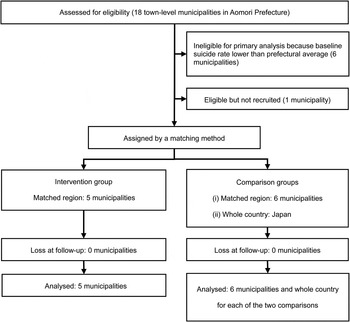
Aomori Prefecture consists of six medical zones (geographical areas with a proportional number of hospital beds within a prefecture in Japan, and usually approximately county-based in Aomori Prefecture). It had the second highest suicide rate in Japan between 1999 and 2008, particularly in four medical zones, across 27 municipalities. These include three urban municipalities with populations of ⩾180 000 and 24 rural municipalities with populations of <70 000. Of the 24 rural municipalities, 18 town-level municipalities with populations of at least 10 000 had units for mental health services and six village-level municipalities with populations of <10 000 did not have such units to deliver the intervention. The 18 town-level municipalities were therefore registered for this study (Fig. 1). Of those registered, 12 were included in the primary analyses because they had a suicide rate higher than the prefectural average (>49.2/100 000 middle-aged adults in 2005–2008). One municipality was excluded because it had recently received a depression-related intervention (see Fig. 1). The 11 eligible municipalities were assigned to either intervention (n = 5; IM1 to IM5; Table 1) or control (n = 6) conditions depending on municipal preference. We were unable to ensure that the unmeasured baseline characteristics between control and intervention municipalities were balanced because of the lack of randomization of the study municipalities. We therefore assessed the 11 assigned municipalities and the remaining six town-level municipalities using sensitivity analysis to examine the influence on outcomes of higher and lower levels of baseline suicide rate on the inclusion criteria for controls, as a primary cause of possible inequality between municipalities.
Flow chart of the study at baseline (2005–2008) and implementation (2009–2012). Note that there was no loss of regions between the baseline and implementation periods.

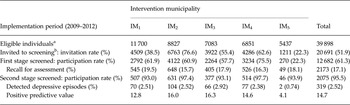
Invitation, uptake, and performance of depression screening among middle-aged adults in the intervention group, by municipality

a Average annual population aged 40–64 years in 2009–2012.
b An invitation was sent to the target population in priority districts for the screening component. Priority districts were those with a high suicide rate in 2005–2008.
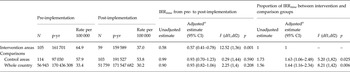
In 2008, the mean number (range) of middle-aged adults per municipality was 8010 (5356–11 804) in the intervention group and 8087 (4017–23 809) in the control group. Intervention and control areas were comparable in terms of average population size (22 708 intervention and 22 670 control), average annual gross income (2 408 000 and 2 473 000 yen), immigration rate (2.9% and 2.7%), and emigration rate (3.4% for both) in 2008, and unemployment rate (7.2% and 7.4%) in 2005. The two groups also had comparable suicide rates for the middle-aged adult population in 2005–2008 (64.9 and 57.9/100 000; mixed-effects negative binomial regression analysis adjusted for age group and sex (F 1,40 = 0.701, p = 0.41; Table 2). Of the 11 study municipalities, each of three of the intervention areas was geographically contiguous with one of three of the control municipalities. We also compared our findings with those from the whole of Japan (see Table 2).
Comparison of incidence rate ratios of suicide (40–64 years) for pre-implementation (2005–2008) and post-implementation (2009–2012) time frames between intervention and comparison groups

All analyses are based on mixed-effects negative binomial regression analysis.
IRRtime, Incidence rate ratio over time; N, number of suicides; p-yr, person years; CI, confidence interval; df, degrees of freedom.
a Adjusted for age group and gender.
Intervention
We provided each municipality with a standardized form of the work plan used in our study, which was then autonomously conducted from January 2009 to December 2012. We disseminated public information leaflets and newsletters designed to publicize information about depression as a risk factor for suicide, explain about depression screening and treatment options, and reduce the stigma of mental illness. This was designed to improve receptiveness to the main element of the intervention, depression screening.
Initial screening consisted of the Japanese version of the self-report Zung Self-Rating Depression Scale (SDS) (Zung, Reference Zung1965; Fukuda & Kobayashi, Reference Fukuda and Kobayashi1973). We chose to screen for depression rather than suicidality to avoid risk of social desirability bias and therefore under-reporting of suicidal thoughts. This version has good concurrent and discriminant validity and high test–retest and split reliability. It was mailed to all residents aged 36–64 years in districts with a history of high suicide rates within the intervention municipalities. Each resident was also sent two subsequent reminder letters. We considered that informed consent was implied by return of a completed questionnaire. We used the established cut-off score of 48 (range 20–80), which has published sensitivity ranging from 73% to 83% and specificity ranging from 77% to 95%. Anyone with a SDS score of ⩾48 was therefore contacted in the second screening stage. This was a telephone interview based on the major depressive episodes module in Japanese version 5.0.0 of the Mini-International Neuropsychiatric Interview (Sheehan et al. Reference Sheehan, Lecrubier, Sheehan, Amorim, Janavs, Weiller, Hergueta, Baker and Dunbar1998; Otsubo et al. Reference Otsubo, Tanaka, Koda, Shinoda, Sano, Tanaka, Aoyama, Mimura and Kamijima2005). Interviewers summarized the results, and the psychiatrist treating the five municipalities rated these results for severity of depressive episode according to the International Classification of Diseases (ICD-10) diagnostic criteria (WHO, 1993). Written feedback was mailed to all respondents, and those diagnosed with any depressive episode were contacted by health professionals and provided with a referral to a psychiatrist and support to help them continue treatment, including information about the importance of doing so.
Outcome measures
The primary outcome measure was the difference in changes in suicide rates in the target population from pre- to post-implementation period between the intervention areas and the comparison areas. We used national registry data (Ministry of Health, Labour and Welfare of Japan, 2014) to derive the number of deaths from suicide and the population per municipality from the dynamic cohort during the pre-implementation (January 2005–December 2008) and implementation period (January 2009–December 2012). We used the criteria in the ICD-10 (codes X60–X84) to identify deaths by suicide. While it remains difficult to determine suicidal intent after death, suicide reports in Japan are generally considered to be accurate because all reported or suspected suicides must be examined by a coroner (Chen et al. Reference Chen, Wu, Yousuf and Yip2012), and evidence of suicidal intent was consistently found among >70% of suicides during the study period (Ministry of Health, Labour and Welfare of Japan, 2014).
The secondary outcome measures were intervention uptake and the difference in suicide rates over the implementation period between intervention and control groups. The intervention group was divided into subgroups to be offered and receive various levels of services during screening. We used municipal registry data to determine the distribution of the screening and its link to suicide rates. We derived the population number from the registry data for the screening services to estimate the approximate number of lived person-years during the implementation period in the districts.
Statistical analysis
Sensitivity power analyses of our pooled data indicated that 80% power at 5% significance (two-tailed) was needed to detect a decline in incidence from pre-implementation of 36% in the intervention group and 35% in the control group. Two individuals who died by suicide and had no registered home municipality were excluded from all analyses.
We used IBM SPSS genlinmixed software for Windows v. 22J (IBM Corp., USA) to compare changes in suicide rates from pre-implementation to implementation between intervention and control groups via repeated-measures generalized mixed-effects regression models. A negative binomial distribution for modelling count variables and a log link function was used, and the negative binomial ancillary (dispersion) parameter was calculated by maximum likelihood estimation. The genlinmixed procedure treats for any overdispersion, by fitting a model with a Poisson or negative binomial distribution to add an ancillary parameter that was calculated by maximum likelihood estimation. We carried out unadjusted analyses of the event outcomes and adjusted analyses for two age groups (40–54 and 55–64 years) and gender, using mixed-effects negative binomial regression models to account for correlations among the number of suicides from the same municipalities. Each municipality implemented the intervention or usual care on its own schedule. In this model, municipality was nested within treatment condition (‘intervention’ or ‘control’) to account for the nested data structure. This was considered a random effect when comparing the intervention and control groups. The whole country was also considered a geographical area to remove the effects of national trends in suicide incidence on the results, and particularly any effects of the national suicide prevention intervention. Time (pre-implementation v. implementation) was the fixed effect in the models. Suicide rates within each municipality were treated as repeated observations over time. The offset term of the log (person-years) for the corresponding area was included. The time regression coefficient provided an estimate of the incidence rate ratio (IRRtime) for pre- to post-implementation comparison. The coefficient for the interaction term between condition and time provided an estimate of the IRRtime proportion between intervention and control groups. Significance for two pairwise comparisons between the intervention group and the two comparison groups was set at 0.025 by Bonferroni correction. We also performed two sets of sensitivity analyses for the primary outcome measure, as this may be influenced by two conditions: (i) the inclusion criteria for controls, using broad and narrow criteria with baseline suicide rates higher than the national average (>33.4/100 000 middle-aged adults in 2005–2008) and higher than the primary study area's average (>61.0/100 000 middle-aged adults in 2005–2008), instead of the original prefectural average, and (ii) the length of the baseline period prior to the intervention, using a 2-year (January 2007–December 2008) and a 6-year (January 2003–December 2008) period, instead of the original 4-year period. Significance for a pairwise comparison between the intervention and control groups was set at 0.05.
In the secondary analysis, we compared incidents reported among four intervention municipality subgroups (respondents who screened positive at the initial stage, those who screened negative, non-respondents, and those offered no screening) with incidents reported by the control municipalities over the implementation period. We used the pooled data and the approximate number of person-years, and provided an estimate adjusted for age group and gender of the incidence rate ratio (IRRgroup) between two groups using generalized linear models performed with Cytel LogXact software v. 11 (Cytel Inc., USA). We used a negative binomial distribution for modeling and a log link function, and Firth's penalized likelihood estimation was used because of the small subgroup sample sizes. Significance was set at 0.0125 by Bonferroni correction.
Ethical statement
The ethics committee of the Aomori University of Health and Welfare in Aomori, Japan, approved this study (approval no. 0550). The authors assert that all procedures contributing to this work comply with the ethical standards of the relevant national and institutional committees on human experimentation and with the Helsinki Declaration of 1975, as revised in 2008.
Results
Uptake of intervention
Table 1 shows the uptake of the screening. Of the 39 898 people within the eligible age range in the intervention areas, 20 691 (51.9%) were invited to complete the initial stage of screening, and 12 682 adults (participation rate 61.3%) responded over the 4-year implementation period. Of these, 2173 (17.1%) screened positive for depression using the SDS and were recalled to the second interview screen, and 2075 (95.5%) participated in the second stage. As a result of the two-step screening procedure, 319 participants (2.52% of the initial 12 682 participants) were diagnosed with a depressive episode and received care and support from health professionals for ⩾3 months, involving either regular contacts with health professionals (n = 108), referral to a psychiatrist (n = 40), or information about the importance of taking medication regularly and complying with treatment (n = 171). The overall positive predictive value of the SDS was relatively low (range 12.8–16.3%) in four municipalities, i.e. IM1–IM4 (participation rate >50%), and very low (4.1%) in the other municipality, IM5 (participation rate 22.3%). It was not possible to measure the number of ‘false negatives’, the number of those with depression who were not detected by the intervention.
There were no significant differences between respondents and non-respondents by age group (among those aged 40–54 years, there were 54.1% respondents and 45.9% non-respondents; among those aged 55–64 years, the figures were 54.5% and 45.5%; Fisher's exact test, p = 0.65). There was, however, a significant gender difference in response to the initial screening (the response rate was 45.6% for men and 54.4% for women; Fisher's exact test, p < 0.001), although the unadjusted and the adjusted estimates of IRRtime in the intervention area were similar (Table 2). This was probably because the difference in response by gender did not affect the outcomes.
Changes in suicide rates over time
Table 2 shows the regression-based estimates of IRRtime. A significant decrease of 43% (from 64.9 to 37.0/100 000) in suicide rates was observed from pre-implementation to implementation periods in the intervention areas. A statistically nonsignificant 7% decrease was observed in the control areas, with a similar decrease across the whole country. IRRtime proportion estimates between the two groups indicated a significantly greater decrease in suicide rates in the intervention area than in either the control area or the whole country.
As well as the results shown in Table 2, we performed a sensitivity analysis to examine the influence of the baseline suicide rate on the inclusion criteria for controls with respect to the outcome (results not tabulated). Over the pre-implementation and implementation periods, there were a total of 172 and 157 suicides during 3 48 565 and 3 40 228 person-years in the 10 comparison municipalities with a baseline suicide rate higher than the national average of 33.4. This achieved statistical significance (IRRtime proportion adjusted for age group and gender 1.67, 95% CI 1.11–2.51; F 1,114 = 6.21, p = 0.014). There were a total of 34 and 31 suicides during 50 906 and 48 585 person-years in the three comparison municipalities with a baseline suicide rate higher than the primary study area's average of 61.0 for the pre-implementation and implementation periods. This was slightly attenuated and only achieved borderline significance (adjusted IRRtime proportion 1.67, 95% CI 0.95–2.92; F 1,58 = 3.34, p = 0.073).
We also performed a sensitivity analysis for the length of the baseline period. Over the 2-year baseline period, there were 52 and 53 suicides during 80 321 and 97 487 person-years in the intervention and control groups. This achieved significance (adjusted IRRtime proportion 1.73, 95% CI 1.06–2.82; F 1,82 = 4.90, p = 0.030). Over the 6-year baseline period, there were 172 and 199 suicides during 2 43 471 and 2 97 827 person-years in the intervention and control groups. This also achieved significance (adjusted IRRtime proportion 1.53, 95% CI 1.01–2.32; F 1,82 = 4.08, p = 0.047). Together, the sensitivity analyses show that neither the length of the baseline period nor the precise period chosen affected the study outcomes, and that the baseline suicide rate used in the inclusion criteria for controls also had no effect.
Suicide risk associated with intervention uptake during implementation
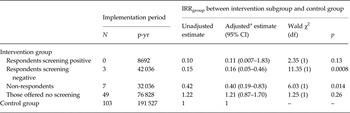
Table 3 shows IRRgroup estimates over the implementation period. There were highly significant differences in the suicide rate over the implementation period among the four intervention subgroups and the control group (Wald χ2 1 = 20.46, p < 0.0001). There were no suicides among the respondents who screened positive in the first stage. We found a significantly lower rate of suicide among the respondents who screened negative and a marginally significantly lower rate among non-respondents. There was no significant difference between those who were not offered the screening in the intervention group and the control group. There were also no suicides among dropouts from the second screening stage.
Suicide risk associated with screening uptake at first invitation and results during implementation period (2009–2012)

All analyses are based on mixed-effects negative binomial regression analysis.
IRRgroup, Incidence rate ratio between the two groups; N, number of suicides; p-yr, person years, based on the approximate number derived from the proportional population distribution by district; CI, confidence interval; df, degrees of freedom.
a Adjusted for age group and gender.
Discussion
We found a statistically greater decrease in suicide rate in the intervention area than the comparison areas. This suggests that the prevention efforts were probably successful in reducing suicide rates. The sensitivity analyses showed that this result was robust for the length of the baseline period and when the inclusion criteria for controls were changed for the level of the baseline suicide rate. These results should be interpreted in light of the following limitations. First, the pre/post nature of the study design may have caused time-dependent confounders, such as environmental change. However, the greater decrease in suicide rates in the intervention areas than among either of the two comparison areas indicates that the intervention probably had an effect beyond secular trends or potential effects of the improved level of mental health linked to a national suicide prevention policy in Japan over the same period (Nakanishi et al. Reference Nakanishi, Yamauchi and Takeshima2015). Suicide rates in the control areas also remained high (>50/100 000 individuals), and the change in control municipalities with the higher level of the baseline suicide rate was noticeably smaller than the decrease in the intervention area. Together, these results suggest that the intervention effect cannot be explained solely by a regression towards the mean and it is therefore deemed unlikely to be because of the regression effect. Second, the non-randomized procedure used for treatment assignment prevented comparisons between equivalent quantities of unmeasured factors related to outcomes. However, intervention and control groups had similar sociodemographic profiles, particularly the factors associated with regional suicide rate, including the levels of gross income, unemployment rate, and rurality (Yamasaki et al. Reference Yamasaki, Sakai and Shirakawa2005), and suicide incidence at baseline, and we also adjusted for the baseline suicide rate. Besides random fluctuations, there may be numerous other factors affecting suicide rate, which are hard to disentangle. However, the whole country comparison showed a similar decrease (7%) in suicide rates as the control areas, suggesting that these areas reflected only the secular trend. Finally, the contiguous borders of the intervention and control areas make it more likely that the control area was contaminated by spillover of information disseminated as part of the programme, which may have diluted the group differences.
These results are consistent with previous findings that early detection and prevention strategy interventions decrease suicide rates. Successful interventions have included gatekeeper programmes among young and middle-aged adults in a large military context (Knox et al. Reference Knox, Litts, Talcott, Catalano Feig and Caine2003), depression screening programmes among older adults in small communities (Sakashita & Oyama, Reference Sakashita and Oyama2015), and, in large communities, physician education programmes (Rutz et al. Reference Rutz, von Knorring and Wålinder1992; Szanto et al. Reference Szanto, Kalmar, Hendin, Rihmer and Mann2007) coupled with crisis helplines (Székely et al. Reference Székely, Konkolÿ Thege, Mergl, Birkás, Rózsa, Purebl and Hegerl2013).
The strengths of this study were its long intervention period, concurrent multi-site approach, use of population-based cohorts with very little missing data, use of reliable data about suicides, ability to link suicide data with exposure information, the fact that reasonable inferences could be drawn from mixed-effects models for clustered data, and the well-matched comparisons.
Two large-scale community-based studies of multimodal interventions reported reduced incidence of suicides combined with suicide attempts, but found no reduction in suicide rates (Hegerl et al. Reference Hegerl, Althaus, Schmidtke and Niklewski2006; Ono et al. Reference Ono, Sakai, Otsuka, Uda, Oyama, Ishizuka, Awata, Ishida, Iwasa, Kamei, Motohashi, Nakamura, Nishi, Watanabe, Yotsumoto, Nakagawa, Suzuki, Tajima, Tanaka, Sakai and Yonemoto2013). The two interventions used included gatekeeper training that extended beyond the organization's boundary, physician education, and screening that was introduced sporadically, although the outcomes of at-risk individuals identified by gatekeepers, physicians, and screening were not reported. Some literature reviews have indicated that systematic efforts were successful in gatekeeping but limited to specific organizations, such as clinics, schools, the military, and localized communities (Mann et al. Reference Mann, Apter, Bertolote, Beautrais, Currier, Haas, Hegerl, Lonnqvist, Malone, Marusic, Mehlum, Patton, Phillips, Rutz, Rihmer, Schmidtke, Shaffer, Silverman, Takahashi, Varnik, Wasserman, Yip and Hendin2005). We have previously shown that the screening procedure used in this study could detect depressive episodes given a participation rate of ⩾50% (Sakashita & Oyama, Reference Sakashita and Oyama2011). Gatekeeping beyond the organization's boundary and sporadic screening, resulting in low participation, would therefore be less likely to detect individuals at risk of suicide than the methods used in this study. This may partly account for the different impact on suicide rates found in this and the two previous intervention studies (Hegerl et al. Reference Hegerl, Althaus, Schmidtke and Niklewski2006; Ono et al. Reference Ono, Sakai, Otsuka, Uda, Oyama, Ishizuka, Awata, Ishida, Iwasa, Kamei, Motohashi, Nakamura, Nishi, Watanabe, Yotsumoto, Nakagawa, Suzuki, Tajima, Tanaka, Sakai and Yonemoto2013).
These results give preliminary insights into possible mechanisms for action. The screening may improve detection of individuals at risk of suicide, which is partly supported by the observed association between access to the screening and the decreased risk of suicide over the implementation period. However, we also found a marginally significant decrease in suicide rates among non-respondents to the first invitation. Screening was only offered to those living in areas designated as ‘high risk’, with previously high rates of suicide, so these results may be underestimated due to the different levels of potential suicide risk among districts. Recent reviews of brief contact interventions for reducing suicide risk have found that letter-based correspondence with people at risk of suicide who were less likely to adhere to treatment had a preventive influence (Luxton et al. Reference Luxton, June and Comtois2013; Milner et al. Reference Milner, Carter, Pirkis, Robinson and Spittal2015). The impact in our study may therefore have been as a result of outreach through the screening tool, reminder contacts, and newsletters. Simple use of personal contact, without screening, might be both cheaper and also provide a form of social support for individuals potentially at risk of suicide, reducing that risk (Milner et al. Reference Milner, Carter, Pirkis, Robinson and Spittal2015). No difference in suicide incidence over the implementation period was observed between adults who lived in the intervention areas, and so may have seen information about depression and suicide but were not screened and those in the control areas, although these subgroup analyses are limited by small sample sizes. This finding is consistent with the results of recent systematic reviews that discussed a lack of evidence for the impact of public awareness campaigns on suicidal behavior (Dumesnil & Verger, Reference Dumesnil and Verger2009; Fountoulakis et al. Reference Fountoulakis, Gonda and Rihmer2011). Together, these results suggest that the information dissemination alone had little to no effect on suicide rates. Possible explanations for our positive findings are that: (i) combined screening and information dissemination promote improved access and adherence to treatment, although we did not examine treatment uptake after completion of screening; (ii) the potential impact resulted from outreach through communication during the screening process (Milner et al. Reference Milner, Carter, Pirkis, Robinson and Spittal2015); (iii) the non-blinded nature of the study might have led to a decreased risk of suicidal behavior among the adults who were aware of their involvement (i.e. the Hawthorne effect), although this does not generally persist in the long term (Mayo, Reference Mayo1993), and (iv) the results could be attributed to a synergistic impact of our intervention with the national suicide prevention intervention in progress during the same period (Nakanishi et al. Reference Nakanishi, Yamauchi and Takeshima2015). Several of the intervention and control areas were running parallel but independent initiatives, supported by Cabinet Office funding, during the study period. These included public awareness campaigns, training for non-professional volunteers to provide support for mental health issues and provision of consultation services, and we were unable to make any assessment of the possible impact of these initiatives.
Our findings indicate that the 4-year community-based depression screening intervention examined in this study was probably successful in reducing suicide rates. Future studies should confirm these results using a cluster-randomized trial across more areas, to overcome the limitation that we could not randomize the treatment and control areas. Further studies will identify the long-term results of the interventions using data on suicide outcomes and intervention uptake by district. They could also explore the effect of a follow-up strategy using regular, long-term personal contact with non-respondents to the screening intervention. We could also better evaluate access and adherence to treatment after completion of screening. Finally, the practical implication of our findings might be limited to populations with a high suicide risk, and future prevention-related interventions should target areas with a modest increased risk for suicide.
Acknowledgements
This study was funded by the Ministry of Education, Culture, Sports, Science and Technology of Japan (Grants-in-Aid for Scientific Research No. 70404829) and by the Aomori University of Health and Welfare.
We thank the participating municipalities for their cooperation. The manuscript content does not necessarily represent the views of the Japanese government or Aomori Prefecture. (Trial registration: ClinicalTrials.gov NCT02468466.)
Declaration of Interest
None.