




No CrossRef data available.
Article contents
Learning in children and sleep disordered breathing: Findings of the Tucson Children's Assessment of Sleep Apnea (TuCASA) Prospective Cohort Study
Published online by Cambridge University Press: 12 February 2004
Abstract
We examined the relationship between nocturnal respiratory disturbance and learning and compared learning in children with and without nocturnal respiratory disturbance. Subjects were 149 participants in a prospective cohort study examining sleep in children ages 6–12: The Tucson Children's Assessment of Sleep Apnea study (TuCASA). Sleep was assessed via home polysomnography. Intelligence, learning and memory, and academic achievement were assessed. Parents rated attention. Group comparisons were used to test the hypothesis that the group with an apnea/hypopnea index (AHI) of 5 or more (n = 77) would have weaker performance than the group with AHI less than 5 (n = 72). The group with AHI of 5 or more had weaker learning and memory though differences between groups decreased when arousals were taken into account. There was a greater percentage of Stage 1 sleep in the AHI 5 or more group, and Stage 1 percentage was negatively related to learning and memory in the sample (n = 149). There were negative relationships between AHI and immediate recall, Full Scale IQ, Performance IQ, and math achievement. Hypoxemia was associated with lower Performance IQ. Thus, findings suggest that nocturnal respiratory disturbance is associated with decreased learning in otherwise healthy children, that sleep fragmentation adversely impacts learning and memory, and that hypoxemia adversely influences nonverbal skills. (JINS, 2003, 9, 1016–1026.)
Information
- Type
- Research Article
- Information
- Journal of the International Neuropsychological Society , Volume 9 , Issue 7 , November 2003 , pp. 1016 - 1026
- Copyright
- © 2003 The International Neuropsychological Society
INTRODUCTION
Sleep disordered breathing (SDB) is a condition characterized by collapse or narrowing of the pharynx. This results in episodes of complete upper airway obstruction called apneas or episodes of partial upper airway obstruction called hypopneas. In adults, SDB is a potentially debilitating and lethal condition characterized by excessive daytime sleepiness, repetitive episodes of apnea while asleep, nocturnal oxygen desaturation, and loud disruptive snoring (Orr & Quan, 1991). The prevalence of symptomatic SDB in middle-aged adults is estimated to be 2% in women and 4% in men (Young et al., 1993). SDB has been implicated as a risk factor for the development of hypertension and cardiovascular disease (Nieto et al., 2000; Shahar et al., 2001) and increases the likelihood of motor vehicle accidents related to sleepiness (Findley et al., 1988).
SDB in adults has been associated with decrements in overall neuropsychological and intellectual function (Cheshire et al., 1992; Greenberg et al., 1987). Studies have documented difficulties with aspects of attention, executive function, visual–spatial skills, and psychomotor speed as well as learning and memory (e.g., Adams et al., 2001; Bédard et al., 1991; Cheshire et al., 1992; Greenberg et al., 1987; Kales et al., 1985; Kim et al., 1997; Naegëlé et al., 1995; Redline et al., 1997; Yesavage et al., 1985). SDB severity has been related to cognitive impairment in a small controlled study (Bédard et al., 1991), and differences in findings of studies comparing learning and memory in groups of adults with and without SDB could be related to disease severity. Naegëlé and colleagues (1995) found that adult males with SDB (n = 17) had poorer learning but not memory than matched controls. On the other hand, Redline and colleagues (1997) did not find differences in learning or memory between a group with SDB (n = 32) and controls (n = 20). The mean intellectual function of groups examined in both of these studies was in the average range. However, there were differences in SDB severity in these studies. The average number of apneas and hypopneas/hr of sleep (AHI) of Redline et al.'s SDB group was approximately 17 with a range of 9 to 27, and the SDB group of Naegëlé et al. had AHI's greater than 10, and 10 subjects had AHIs exceeding 40.
Results of factor analytic studies also suggest that relationships between sleep variables and performance may be a function of severity or range of nocturnal respiratory disturbance (Adams et al., 2001; Kim et al., 1997). While the studies employed different measures of learning and neuropsychological function, factors with loadings from learning and memory variables were identified in both. In the study based on data from the Wisconsin Sleep Cohort study (Kim et al., 1997), a community based sample of over 800 subjects, the learning/memory factor was not related to AHI. In the study including 100 subjects with a spectrum of SDB (Adams et al., 2001), the memory factor was related to AHI. The degree of hypoxemia during wakefulness and sleep has been related to poorer cognitive function (Cheshire et al., 1992; Findley et al., 1986). However, cognitive difficulties could also be secondary to sleepiness, poor sleep quality or sleep fragmentation as well as diminished oxygen saturation. While these relationships remain to be elucidated, the factor analytic study conducted by Adams et al. examined relationships between performance and hypoxemia, sleep fragmentation, and sleepiness. They found a negative relationship between hypoxemia and factors related to memory and signal discrimination. Sleepiness was related to a vigilance factor. Sleep fragmentation (number of arousals/hr) was not related to neuropsychological factors in this study. While further work in this area is needed, there is also evidence to suggest that vigilance can be impaired in the absence of sleepiness (Redline et al., 1997). Thus, attention difficulties could also contribute to SDB related cognitive morbidity.
The prevalence of SDB in childhood has been estimated to be between 1 and 4% (American Thoracic Society, 1999; Brunetti et al., 2001; Marcus, 2001; Messner & Pelayo, 2000; Owens et al., 2000a). While the older teenager with obesity may resemble the classic adult patient with SDB, the clinical presentation of SDB in school age children typically differs markedly from presentation in adults (Marcus, 2001; Scholle et al., 2000). The otherwise normal child with SDB is more likely to have enlarged adenoids and tonsils, persistent obstructive hypoventilation and hypopnea, and less frank apnea than an adult with SDB. Sleep architecture may not be as fragmented in a child, and while excessive daytime sleepiness is less frequently reported in children, hyperactivity is common. Cardiovascular complications also appear to be less frequent in children than adults (American Thoracic Society, 1999).
Thus, it has been recognized that the neuropsychological correlates of SDB in children might also differ from those in adults, but there are few controlled studies examining SDB in children (American Thoracic Society, 1999). Two small studies compared children with clinically diagnosed SDB to controls, and these have had different results. In a group of morbidly obese children (N = 14), SDB was associated with decreases in vocabulary and memory (Rhodes et al., 1995). In this study the performance of 5 children with SDB was compared with that of the 9 children without SDB. Children who had an average AHI of 5 or more were included in the SDB group. Apnea and hypopnea episodes were counted if they were more than 10 s duration. Hypopnea was defined as a 50% or greater reduction in airflow accompanied by an arousal on electroencephalogram (EEG) and/or oxygen desaturation of at least 4%. Using this approach, the SDB group had significantly poorer performance on the Vocabulary subtest of the Wechsler Intelligence Scale for Children–Third Edition (WISC–III, Wechsler, 1991) and on the General Memory, Verbal Memory and Learning Index composites of the Wide Range Assessment of Memory and Learning (Sheslow & Adams, 1990). There was also a significant negative relationship between the AHI and General Memory and Learning Index scores. While the correlations between AHI and other study measures were not statistically significant in this small group, performance was consistently negatively related to AHI.
In contrast, another study of children diagnosed with SDB (N = 19) did not provide support for a relationship between neuropsychological function and disease severity (Owens et al., 2000b). Relationships were examined by dividing the children evaluated in a pediatric sleep clinic into groups with mild (n = 9) or moderate (n = 9) disease and comparing performance on measures of global intellectual function, language, executive functioning/attention, memory, visual perceptual and motor skills, and parent report of behavior. Mild disease was defined as AHI less than or equal to 4, and moderate disease was defined as AHI greater than or equal to 5. However, in this study apnea was defined as a total cessation of airflow for two or more respiratory cycles, and hypopnea was defined as an event that met two of the following criteria: (1) airflow reductions of 50% or more, (2) EEG arousal, or (3) oxygen desaturation of at least 2%. Using these less stringent criteria, there was no support for the hypothesis that moderate severity was associated with poorer neuropsychological or behavioral function.
Differences in disease severity, intellectual abilities, and/or age could account for differences in findings between these two studies. The SDB group in the study of Rhodes et al. (1995) had an average of 33 apneas and hypopneas/hr while the comparison group had less than 2. While the “mild” group studied by Owens et al. (2000b) had approximately 3 apneas and hypopneas/hr, the “moderate” group only had an average of about 17 apneas and hypopneas/hr. Moreover, less oxygen desaturation was required in their operational definition of hypopnea. In the Rhodes et al. study, expressive vocabulary skills (WISC–III Vocabulary; Wechsler, 1991) of the group without SDB were just within the average range (25th %tile), while the group with SDB's performance was significantly below average. Both groups in the Owens et al. study had above average general intellectual function (estimated using WISC–III Vocabulary and Block Design) and expressive vocabulary skills, and the moderate SDB group had significantly better intellectual function than the mild group. The moderate group was also significantly younger than the mild group, and the etiology and manifestations of SDB may be related to age (American Thoracic Society, 1999; Marcus, 2001).
On the other hand, Owens and colleagues (2000b) found that performance improved in the 8 children in their study who subsequently underwent adenotonsillectomy. While they did not compare performance of the children who had surgery to those who did not, adenotonsillectomy has been associated with improved performance in two other controlled studies (Ali et al., 1996; Gozal, 1998). Ali and colleagues compared two small groups of children waiting for tonsillectomy, one with SDB (n = 12) and one with milder symptoms including snoring (n = 11), and a control group receiving surgery for other reasons (n = 10). The children with SDB were identified using a combination of parent report, measures of oxygen saturation during sleep, and videos of behavior during sleep. While there were no differences between groups prior to surgery on attention measures, parents of the children in the SDB group reported decreases in aggression, inattention, and hyperactivity following surgery. There was also a decrease in hyperactivity in the group with milder symptoms, but no significant changes were found in the control group. Vigilance improved significantly in both groups receiving the tonsillectomy but not in the control group. Findings of a prospective study of 297 first graders with weak school performance also suggest that adenotonsillectomy can improve academic outcomes in children with SDB (Gozal, 1998). In this study 54 children with sleep-associated gas exchange abnormalities were identified using pulse oximetry and transcutaneous partial pressure of carbon dioxide. Twenty-four of these underwent elective adenotonsillectomy while 30 were not treated. The school grades of the treated group improved significantly in the 2nd grade, and there were no changes in performance in the untreated group or in the group who did not have gas exchange abnormalities.
There is also some evidence to support the hypothesis that nocturnal respiratory disturbance is associated with cognitive morbidity in healthy children. In a study comparing small groups of otherwise healthy children who snored and/or had very mild SDB (n = 13) and those who did not snore (n = 13), Blunden et al. (2000) found decreased attention, intellectual functioning, and scores on the Memory Screening Index of the Wide Range Assessment of Memory and Learning (Sheslow & Adams, 1990) in the group that snored though performance on the standardized measures remained in the average range. These findings and those of Ali et al. (1996), Gozal (1998), Rhodes et al. (1995), and Owens et al. (2000b) all provide support for a relationship between nocturnal respiratory disturbance and reduced cognitive performance in children. While the nature and etiology of cognitive morbidity related to SDB in children has yet to be elucidated, there is experimental evidence that acute sleep restriction in otherwise healthy children is associated with reduced creativity and problem solving (Randazzo et al., 1998). While there was not evidence of impaired memory function in this study, sleep was only restricted for a single night (5 hr) and the power to detect differences was also limited as the groups with and without sleep restriction only had 8 subjects.
Relationships between SDB and learning in children have yet to be prospectively evaluated in the general population. This paper examines learning in children ages 6 to 12 who participated in a prospective cohort study: the Tucson Children's Assessment of Sleep Apnea study (TuCASA). In the current study, performance on measures of intellectual function, learning and memory, and academic achievement and parent report measures of attention were compared in groups of children with and without respiratory disturbance during sleep (AHI ≥ 5 and AHI < 5, respectively). The relationships between performance and respiratory disturbance, amount of sleep, sleep quality, sleep fragmentation, and oxygen saturation were also examined. We hypothesized that the group with respiratory disturbance would have significantly weaker performance than the group without respiratory disturbance. We also expected that respiratory disturbance, decreased sleep time, decreased sleep quality, increased sleep fragmentation, and decreases in oxygen saturation could each be negatively related to performance.
METHODS
Research Participants
This paper reports findings from 149 children who completed evaluations of learning and memory in the TuCASA study. TuCASA is a prospective cohort study examining sleep in children ages 6 to 12. The study began in 1999, and data presented here come from children recruited during the 1999–2000 and 2000–2001 school years. Participants were recruited from the Tucson Unified School District (TUSD), a large district with a population representative of children living in Southern Arizona. The TuCASA study was approved by the University of Arizona Human Subjects Committee and the TUSD Research Committee. Parents of children in participating schools were asked to complete a 15-item screening questionnaire inquiring about symptoms which could be attributable to breathing problems during sleep. Twenty percent of the questionnaires were returned (Quan et al., 2000).
Participants were recruited by contacting parents who returned questionnaires and indicated that they were interested in participating in the study. The child's parent was asked about the child's medical history to see if the child qualified for the study. Children who had tonsillectomies or regularly took medications were excluded from the study. Children with a reported history of asthma or respiratory disorders, head injury with loss of consciousness, attention disorders, learning disabilities or disorders (including mental retardation), and other major medical conditions were also excluded. Parent consent and child assent were obtained prior to participation.
Polysomnography
Sleep was characterized using one night of polysomnography conducted at the child's home as soon as possible after recruitment. We have been able to obtain high quality polysomnography in children in the study age range in the home environment (Goodwin et al., 2001). In our previous work no significant night-to-night variability was found in repeated home studies, and comparison of unattended home polysomnography to sleep laboratory studies in the same children revealed similar sleep architecture and no consistent differences on measures of respiratory disturbance.
A two-person, mixed gender team arrived at the child's home approximately one hour prior to the child's normal bedtime. Polysomnograms were obtained using the Compumedics PS-2 system (Abbotsford, Victoria, Australia). The system consists of a patient interface box (PIB) containing amplifiers and filters to which electrodes and sensors are connected. The PIB is attached by cable to the data acquisition recorder that contains a 40 MB PCMCIA card, a 15-hr rechargeable battery, and an oximeter. The PIB, loose electrode wires, and sensor cables were secured inside a loose fitting vest that is worn by the child over his or her pajamas. The vest is a variation of the Compumedics adult vest, with modifications made specifically for children. The system contains a liquid crystal display (LCD) for visualizing signals after hook-up, and an internal impedance meter to verify electrode attachments. Gauze, tape, water-soluble pastes, and conductive gels were used to secure sensors and electrodes.
The following signals were acquired: C3/A2 and C4/A1 EEG, right and left electrooculogram (EOG), a bipolar submental electromyogram (EMG), thoracic and abdominal displacement (inductive plethysmography bands), airflow (nasal/oral thermocouple), nasal pressure cannula, oximetry (finger pulse oximeter, Nonin, Minneapolis, MN), electrocardiogram (ECG, single bipolar lead), snoring (microphone attached to the vest), body position (Hg gauge sensor), and ambient light (sensor attached to the vest to record lights on/off). The nasal pressure cannula was employed in an attempt to capture subtle events related to elevations in upper airway resistance which otherwise might have been undetected. The thermistor and nasal pressure signals were collected simultaneously by taping a nasal/oral thermocouple (Protech, Mukilteo, WA) on the superior surface of a nasal cannula (Salter Labs, Arvin, CA). All signals were verified using the LCD, and impedances were checked to insure that values were <5 Kohms. The equipment was removed the following morning by a research technician or a parent. A t-shirt and a water bottle were given to each child at the time of polysomnogram, and $25.00 was given to either the child or the child's parent based on parent request.
The Compumedics software system was used to process all polysomnograms (W-Series Replay, v 2.0, Release 22). The EEG, EOG and submental EMG signals were used to score wakefulness and sleep. Sleep stages were scored according to accepted criteria (Rechtschaffen & Kales, 1968). In brief, wakefulness was present when the EEG showed a predominance of alpha activity (8–13 Hz frequency) or a relatively low voltage, mixed frequency pattern in association with fast eye movements or eye blinks on the EOG. Stage 1 sleep was identified when there was a relatively low voltage, mixed frequency EEG pattern with associated slow rolling eye movements on the EOG. Stage 2 sleep was defined by the presence of K-complexes (sharp negative wave followed by a slower positive component) or sleep spindles (short burst of 12–14 Hz activity) on the EEG. Stages 3/4 (delta) sleep was present if at least 20% of each 30 s epoch had delta waves (1–3 Hz waves with an amplitude of >75 mV). Rapid eye movement (REM) sleep was characterized by the presence of rapid eye movements and a very low amplitude submental EMG. We determined the total sleep time as the total number of hours of staged sleep during the study. The sleep period time was calculated as the time interval beginning with lights out (or sleep onset when “lights off” did not precede sleep onset) and ending with the last epoch of sleep prior to awakening, or the end of the recording. Sleep efficiency was defined as the total sleep time divided by the sleep period time. Arousals were identified using American Sleep Disorders Association criteria (1992) and required an abrupt shift inEEG frequency of at least 3 s, but no greater than 15 s.
The number of respiratory events (apneas and hypopneas)/hr of total sleep time was determined using data from the thermistor, thoracic and abdominal signals, and oximeter. The apnea/hypopnea index (AHI) was the number of apneas and hypopneas per hour of the total sleep time. Apneas were scored if the amplitude (peak to trough) of the airflow signal using the thermistor decreased below at least 25% of the amplitude of “baseline” breathing (identified during a period of regular breathing with stable oxygen levels), if this change lasted for more than 6 s or two breath cycles. Hypopneas were designated if the amplitude of any respiratory signal decreased below (approximately) 70% of the amplitude of baseline. AHI was so defined in order to detect subtle changes in nocturnal respiration to test the hypothesis that respiratory disturbance would negatively impact cognitive performance. We also created indices that required that respiratory events be associated with either oxygen desaturation or an EEG arousal or both: AHI + 2% or arousal and AHI + 4% or arousal. These required arousal or desaturations of 2% or 4%, respectively, to accompany apneas and hypopneas as defined above. The former index would be more comparable to that used by Owens et al. (2000b) and the latter to that used by Rhodes et al. (1995).
Studies were scored by a single registered polysomnographic technologist. The scorer assigned an overall quality grade of excellent (at least one EEG channel, one EOG channel, chin EMG, oximetry, airflow, thoracic, and abdominal bands good for >5 hr), good (respiratory channels—airflow or either band—oximetry, and one EEG good for >5 hr), or fair (respiratory channels—airflow or either band—oximetry, and one EEG were good for >4 hr but <5 hr). Studies not meeting criteria for at least a fair grade were considered unacceptable. Consistency of scoring was assured by reviewing selected records with one of the investigators. Approximately 5% of studies were re-scored by the same scorer on a blinded basis to determine consistency in scoring. No systematic differences were observed between initial and re-scored studies.
Cognitive Evaluation
Evaluations were conducted within several weeks of the polysomnogram, and evaluators were blinded to polysomnogram findings. Children who did not speak English were excluded from this portion of the TuCASA study since evaluation measures were only appropriate for English speakers. Evaluations were conducted in the Pediatric Neuropsychology Clinic at the University of Arizona. The child or the child's parent was given $25.00 for participation, and parking fees were paid.
The measures administered to the children were completed in a fixed order as follows: the Wechsler Abbreviated Scale of Intelligence (WASI, The Psychological Corporation, 1999); Letter–Word Identification, Applied Problems, and Dictation from the Woodcock-Johnson Psycho-Educational Battery–Revised Tests of Achievement (WJ–R; Woodcock & Johnson, 1989, 1990); the Children's Auditory Verbal Learning Test–2 (Talley, 1993). Dependent measures from each of these tests are age based standard scores that have a mean of 100 and standard deviation of 15, and higher scores indicate better performance. The WASI (The Psychological Corporation, 1999) is a brief and reliable measure of intelligence and was used to facilitate characterization of the study participants. Measures of Full Scale IQ (Full Four IQ), Verbal IQ, and Performance IQ were obtained. The WJ–R (Woodcock & Johnson, 1989, 1990) academic achievement measures were used to assess learning of and memory for information learned prior to and outside of the evaluation setting. Letter–Word Identification assesses letter and single word reading. Applied Problems assesses math skills. Dictation is a measure of spelling, punctuation, grammar, and word usage. The Children's Auditory Verbal Learning Test–2 (Talley, 1993) was administered to assess learning of and memory for novel information learned within the evaluation setting. This multi-trial word list learning task provides age based standard scores for each of the following: five list learning trials; overall learning across trials (Level of Learning), recall of a second word list (Interference Trial) presented after the learning trials, and immediate and delayed recall of the original list.
Attention was evaluated using a parent rating scale (Conners, 1997). The Conners' Parent Rating Scale—Revised (L) questionnaire (Conners') was completed by the child's parent while their child was participating in the evaluation. The Conners' evaluates problem behaviors in a number of areas and contains a scale assessing Hyperactivity, an ADHD Index indicating risk for Attention Deficit Hyperactivity Disorder (ADHD), Inattentive and Hyperactive–Impulsive DSM–IV Symptom subscales that assess correspondence to DSM–IV criteria for the Predominantly Inattentive and Predominantly Hyperactive–Impulsive types of ADHD, respectively, and a DSM–IV Symptom Scales Total that evaluates correspondence to the criteria for the Combined type of ADHD. The Conners' provides T Scores with a mean of 50 and standard deviation of 10, and higher scores indicate poorer function.
Analytic Approach
Study participants were divided into groups based on AHI: those with AHI of 5 or more, and those with AHI below 5. This cut-off was used in previous studies comparing children with and without nocturnal respiratory disturbance (Owens et al., 2000b; Rhodes et al., 1995). An AHI of 5 or greater has also been used as an indication for treatment (Gozal, 2000). Parent report on the Conners' measures and performance of these two groups on evaluation measures were compared using one-tailed t tests. Analyses of covariance (ANCOVAs) were used to see if differences between groups remained after controlling for arousals (arousal index) since arousals are sometimes associated with apneas and hypopneas, and disruption of sleep could also account for cognitive difficulties. Two-tailed t tests were used to see if there were significant differences between groups in sleep characteristics: total sleep time; sleep efficiency; percentage of total sleep time in Stages 1, 2, 3/4 and REM; the arousal index (number of arousals/hr of total sleep time); apnea index (number of apneas/hr of total sleep time); and AHI. Correlations (Pearson r, one-tailed) were used to see if performance was negatively related to respiratory disturbance (increases in AHI, AHI + 2% or arousal, or AHI + 4% or arousal), decreased sleep time (total sleep time), decreased sleep quality and increased sleep fragmentation (decreased sleep efficiency, higher arousal index, increased percentage of Stage 1 sleep), and decreases in oxygen saturation (increases in the apnea index, number of oxygen desaturations ≥ 2% and ≥ 4%, percentage of time of oxygen saturation < 95%). Relationships between age and sleep characteristics were also examined using two-tailed correlations (Pearson r). Analyses were conducted using SPSS 9.0 (1998). The significance level was set at p ≤ .05 since findings in otherwise healthy children might be subtle.
RESULTS
The mean age of study participants was 8.36 years (SD = 1.69). There were 81 males and 68 females, and 95 Whites and 54 Hispanics in the overall sample (N = 149). The average parent education was 14.33 years (SD = 2.38, range 9–21). The mean Full Scale IQ was 107.11 (SD = 13.19, range 68–153). Mean Verbal IQ was 109.03 (SD = 13.25, range 76–155), and mean Performance IQ was 103.60 (SD = 14.49, range 63–144). One sample t tests comparing IQs to the expected mean of 100 revealed that the IQs of study participants were above average [Full Scale IQ: t (148) = 6.58, p < .01; Verbal IQ: t (148) = 8.32, p < .01; Performance IQ: t (148) = 3.04, p < .01].
There were 72 children with AHI below 5 and 77 with AHI of 5 or more. The mean AHI for the group with AHI below 5 was 3.53 (SD = .94); the mean AHI for the group with AHI of 5 or greater was 9.02 (SD = 8.23). There were no significant differences between groups in age [t (147) =.43, p = .67], parent education [t (128) = 1.20, p = .23], or ethnicity [χ2(1) = .51, p = .48]. The mean age of the AHI below 5 group was 8.42 (SD = .63) years, and the mean age of the AHI 5 or greater group was 8.30 (SD = 1.76) years. Mean parent educations were 14.58 (SD = 2.59) and 14.09 (SD = 2.15) years in the AHI less than 5 and AHI 5 or more groups, respectively. There were 48 Whites and 24 Hispanics in the group with AHI less than 5, and 47 Whites and 30 Hispanics in the group with AHI 5 or above. Twelve children (8 AHI ≥ 5; 4 AHI < 5) took allergy medication as needed though we do not know whether they took it the night of the polysomnogram. Children were not on medication at the time of the cognitive evaluations.
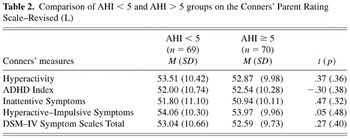
Group means and standard deviations for each measure as well as t and p values for comparisons of groups with AHI less than 5 and AHI 5 or more are presented in Table 1. As can be seen in Table 1, there were significant differences between groups with AHI below 5 and with AHI 5 or greater in recall across learning trials (Level of Learning), on Trial 3, Trial 4, and Trial 5, and on Delayed Recall. There were trends toward differences between groups in Performance IQ and in recall on Trial 2 and Immediate Recall. There were no differences between groups in Verbal IQ, in recall on trails where information had only been presented one time (Trial 1, Interference Trial), or in academic achievement. The Conners' was completed by 139 parents (AHI < 5: n = 69; AHI ≥ 5: n = 70). As can be seen in Table 2, there were no differences between groups in parent report of attention.
Comparison of performance of AHI < 5 and AHI > 5 groups on evaluation measures

Comparison of AHI < 5 and AHI > 5 groups on the Conners' Parent Rating Scale–Revised (L)

ANCOVA revealed that when the number of arousals/hr (arousal index) was taken into account and the p value was corrected for one-tailed analyses, there continued to be significant differences between groups in Level of Learning [F(1,136) = 3.72, p = .03], and in recall on learning Trial 3 [F(1,136) = 3.12, p = .04], and Trial 4 [F(1,136) = 2.68, p = .05]. Trends toward differences in recall on Trial 5 [F(1,136) = 2.38, p = .07], and Delayed Recall [F(1,136) = 2.58, p = .06], also remained.
Group sleep characteristics are summarized in Table 3. Eight subjects were not included in these analyses due to poor quality EEG: 3 in the AHI below 5 group and 5 in the AHI 5 or more group. As can be seen in Table 3, there was a significantly higher percentage of Stage 1 sleep in the group with AHI 5 or greater. AHI and the apnea index were also greater in the group with AHI 5 or more, and this would be expected based on how groups were selected. There were no other significant differences between groups in sleep characteristics, and there were no significant relationships between age and sleep characteristics.
Comparison of sleep characteristics of AHI < 5 and AHI > 5 groups

Oximetry data were available for 145 of the participants. There were only 13 subjects with AHI + 2% or arousal and only 5 subjects with AHI + 4% or arousal with 5 or more respiratory events per hour in this sample. Due to the small numbers of children comparisons with these groups were not conducted.
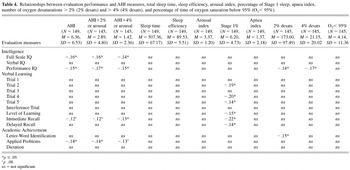
Relationships between performance and measures of respiratory disturbance in study participants are presented in Table 4. There were statistically significant negative relationships between AHI, AHI + 2% or arousal, and AHI + 4% or arousal and Full Scale IQ and Performance IQ. There was also a significant negative relationship between AHI + 4% or arousal and immediate recall, and there were trends toward negative relationships between immediate recall and AHI and AHI + 2% or arousal. Additionally, there were significant negative relationships between Applied Problems and AHI and AHI + 2% or arousal, and a trend toward a negative relationship between Applied Problems and AHI + 4% or arousal.
Relationships between evaluation performance and AHI measures, total sleep time, sleep efficiency, arousal index, percentage of Stage 1 sleep, apnea index, number of oxygen desaturations > 2% (2% desats) and > 4% (4% desats), and percentage of time of oxygen saturation below 95% (O2< 95%).

Relationships between performance and the measures reflecting the amount and quality of sleep are also presented in Table 4. The percentage of Stage 1 sleep was negatively related to recall on word list learning Trials 2, 4, and 5; Level of Learning; and Immediate and Delayed Recall. There were no significant relationships between performance and total sleep time, sleep efficiency or the arousal index.
Relationships between performance and measures of oxygen saturation can also be found in Table 4. The number of times that oxygen saturation fell 2% or more was negatively related to Performance IQ and Letter-Word Identification, and the number of times that oxygen saturation fell 4% or more was also negatively related to Performance IQ. There were no significant relationships between performance and the apnea index or the percentage of sleep time that oxygen saturation fell below 95%.
DISCUSSION
We found significant decreases in learning and memory in our group of otherwise healthy children with AHI 5 or more. Differences in learning and memory between our groups did not appear to be related to verbal intellectual function or observable attention difficulties since there were no differences between our groups in Verbal IQ or in parent report of attention problems. Additionally, the pattern of performance across learning trials suggested that differences between groups were related to differences in acquisition or recalling new information across trials rather than differences in attention or recalling information presented only one time. There were differences in recall between groups on learning Trials 3 to 5 and delayed recall and a trend toward differences in recall on Trial 2. There were no differences in recall following the first presentation of the word list (Trial 1) or following the only presentation of the second word list (interference trial). While there was a trend toward lower Performance IQ in the group with AHI 5 or more, there were no differences between groups on measures of academic achievement or in Verbal or Full Scale IQ. Additionally, the overall IQ, reading, math, and learning and memory scores of the group with AHI 5 or more were within the average range. Thus, despite statistically significant differences on learning and memory measures, there does not appear to be a clinically significant difference between these two groups.
Our group comparison results are generally consistent with those of Rhodes et al. (1995) but not those of Owens et al. (2000b). Rhodes and colleagues found differences between small groups of obese children with and without SDB on measures from the Wide Range Assessment of Memory and Learning (Sheslow & Adams, 1990), and performance of the SDB group was significantly below average. Their SDB group had more severe respiratory disturbance and lower intellectual function than the children in the study of Owens et al. and the children in our study. Owens et al. did not find group differences on Wide Range Assessment of Memory and Learning measures in their small study even though their moderate SDB group had more severe nocturnal respiratory disturbance than our group with AHI of 5 or more. While their subjects had above average general intellectual function and verbal skills, their moderate SDB group had significantly better intelligence than the mild group, and there were differences in age between their groups as well. The mean IQ of both of our groups was in the average range, and there were no differences between our groups in IQ or age.
Our findings are also consistent with those of Blunden et al. (2000) who found that otherwise healthy children who snored had poorer performance on measures of memory and learning than controls though performance remained in the average range. They also found evidence of poor attention in the snoring group. While we did not find differences in parent report of attention problems, Blunden and colleagues did not find differences between groups in parent reports of behavior and social competency although they also had less statistical power. Still, the possibility that attention could account for differences in memory between our groups cannot be disregarded since our measures of attention were limited to a parent report measure and performance on the first trial of the learning task.
While cognitive difficulties related to nocturnal breathing problems may manifest themselves differently in children (American Thoracic Society, 1999), our findings were similar to that of Naegëlé and colleagues (1995) in that there were group differences in learning. On the other hand Naegëlé et al. used a selective reminding task and did not find differences between groups in the rate of forgetting. Redline and colleagues (1997) did not find differences in learning or memory between subjects with relatively mild SDB and controls on a list learning task, though statistical power was limited.
We did not find much evidence to support the hypothesis that there is a linear negative relationship between respiratory disturbance and learning or memory. We found only one significant negative relationship and a couple of trends toward negative relationships between our AHI variables and memory measures (r ≥ −.12). In contrast, Rhodes et al. (1995) found stronger negative relationships between their AHI variable and memory measures (r > −.35). On the other hand, our findings do suggest that sleep fragmentation may adversely impact learning and memory. We found that differences between groups in memory performance decreased once the number of arousals was taken into account, that there was a greater percentage of Stage 1 sleep in the group with AHI 5 or more, and that the percentage of Stage 1 sleep was negatively related to performance on later learning trails, overall learning across trials, and immediate and delayed recall. Our findings also suggest that there may be a negative linear relationship between respiratory disturbance and nonverbal intellectual function and math performance. In particular, the relationship between nonverbal skills and hypoxemia merits additional study as Performance IQ was related to the number of times that oxygen saturation dipped below 2% and 4% in addition to our AHI variables. While the apnea index and percentage of sleep time below 95% were not related to nonverbal intellectual function, the number of apneas in the study sample was also very low, and this would be expected in otherwise healthy children. We did not find evidence that decreases in the amount of sleep were related to performance as Randazzo et al. (1998) did in their experimental sleep restriction study.
While we did find significant relationships between our AHI measures and Performance IQ and math achievement and measures of oxygen saturation and nonverbal skills, we did not find group differences in academic achievement. In Gozal's (1998) study, the grades of children with sleep-associated gas exchange abnormalities who had ranked in the lowest 10th percentile of their first grade class improved following tonsillectomy. Children in our cohort had average intellectual function and academic achievement. We used polysomnography to identify children with respiratory disturbance, and sleep-associated gas exchange abnormalities were identified using pulse oximetry and transcutaneous carbon dioxide measurements in Gozal's study. Additionally, while we used age appropriate standardized achievement measures, performance on these measures may or may not be related to school grades. Finally, we do not know what would happen to performance in our study if children with elevated AHIs were treated. Intriguingly, other studies of children with SDB suggest that cognitive function may improve after adenotonsillectomy, even when weaknesses in function are not detected prior to treatment (Ali et al., 1996; Owens et al., 2000b). The findings of Owens et al. actually raise the possibility that treatment of nocturnal respiratory disturbance could improve aspects of cognitive function in children who have above average intellectual function, though practice effects could have accounted for the better post surgery performance in this study.
Certainly we do not suggest that otherwise healthy children with elevated AHI have their tonsils and adenoids removed given our subtle findings and the lack of clinically significant decreases in performance in the group with higher AHI. On the other hand, our participants had highly educated parents (mean parent education of over 14 years). Higher socioeconomic status (SES) might protect one from the deleterious influences of nocturnal respiratory disturbance on cognitive function. Additionally, our sample included only healthy children, and children with attention and learning problems were excluded. Problems with attention are a frequent presenting symptom in children with sleep disordered breathing (Marcus, 2001). Thus, we may have actually eliminated a group of children with significant cognitive problems related to nocturnal respiratory disturbance. Finally, even subtle changes in performance associated with mild nocturnal respiratory disturbance could be important if they are present in a small percentage of children, and small changes in learning and memory could have a substantial impact over the years of a child's education.
Thus, our findings suggest that the hypothesis that sleep fragmentation adversely impacts learning and memory and the hypothesis that decreased nocturnal oxygen saturation is associated with poorer nonverbal skills should be evaluated prospectively. More generally, there continues to be a need for hypothesis driven research addressing the cognitive morbidity of nocturnal respiratory disturbance in the pediatric population. One significant obstacle to this endeavor is the lack of a common definition of SDB. It has been recognized that there is a need for normative data on polysomnographic parameters associated with sleep in children, and there is appreciation that SDB-related cognitive difficulties may manifest themselves differently in children than adults (American Thoracic Society, 1999). However, this hypothesis has yet to be tested. The possibility that there are developmental and acquired forms of SDB with different types of morbidity should be considered. When adults acquire SDB following normal development, there may be a more homogeneous and/or specific pattern of presentation than when children acquire the disorder at various ages. Longitudinal studies including adults and children are needed to address these questions. Interactions between sleep, socioeconomic factors, and cognitive function also remain to be examined. Finally, the possibility that treatment of SDB can improve cognitive function (even in children who do not appear to have cognitive deficits) should be studied.
CONCLUSION
In conclusion, findings of this study suggest that nocturnal respiratory disturbance is related to learning in otherwise healthy children. Our findings suggest sleep fragmentation may adversely impact learning and memory and that decreased nocturnal oxygen saturation may be related to nonverbal skills.
ACKNOWLEDGMENTS
This work was supported by the National Institutes of Health (HL 62373 to S.F. Quan and HD 37816 to K.L. Kaemingk). The authors thank Charles Wynstra, MBA, RRT, and Martin Ukockis, R.PSG.T., RRT, for assistance in data collection and polysomnogram scoring and Marissa Carey, Ph.D, and Robyn Kervick, Ph.D, for comments on drafts of this manuscript. The authors also thank Albert Gould, Ph.D, Chair, Research Committee, and the principals, teachers, parents and students from the Tucson Unified School District for their support of this research.
References
REFERENCES
Adams, N.,
Strauss, M.,
Schluchter, M., &
Redline, S.
(2001).
Relation of measures of sleep-disordered breathing to
neuropsychological functioning.
American Journal of Respiratory and Critical Care Medicine,
163,
1626–1631.CrossRefGoogle Scholar
Ali, N.J.,
Pitson, D., &
Stradling, J.R.
(1996).
Sleep disordered breathing: effects of adenotonsillectomy on
behaviour and psychological functioning.
European Journal of Pediatrics,
155,
56–62.CrossRefGoogle Scholar
American Sleep Disorders Association.
(1992).
EEG arousals: Scoring rules and examples. A preliminary report from
the Sleep Disorders Atlas Task Force of the American Sleep Disorders
Association.
Sleep,
15,
173–184.Google Scholar
American Thoracic Society.
(1999).
Cardiorespiratory sleep studies in children: Establishment of
normative data and polysomnographic predictors of morbidity.
American Journal of Respiratory and Critical Care Medicine,
160,
1381–1387.Google Scholar
Bédard, M.,
Montplaisir, J.,
Richer, F.,
Rouleau, I., &
Malo, J.
(1991).
Obstructive sleep apnea syndrome: Pathogenesis of
neuropsychological deficits.
Journal of Clinical and Experimental Neuropsychology,
13,
950–964.CrossRefGoogle Scholar
Blunden, S.,
Lushington, K.,
Kennedy, D.,
Martin, J., &
Dawson, D.
(2000).
Behavior and neurocognitive performance in children aged 5–10
years who snore compared to controls.
Journal of Clinical and Experimental Neuropsychology,
22,
554–568.CrossRefGoogle Scholar
Brunetti, L.,
Rana, S.,
Lospalluti, M.L.,
Pietrafesa, A.,
Francavilla, R.,
Fanelli, M., &
Armenio, L.
(2001).
Prevalence of obstructive sleep apnea syndrome in a cohort of 1,207
children in southern Italy.
Chest,
120,
1930–1935.CrossRefGoogle Scholar
Cheshire, K.,
Engleman, H.,
Deary, I.,
Shapiro, C., &
Douglas, N.J.
(1992).
Factors impairing daytime performance in patients with sleep
apnea/hypopnea syndrome.
Archives of Internal Medicine,
152,
538–541.CrossRefGoogle Scholar
Conners, C.K.
(1997).
Conners' Parent Rating Scale–Revised (L).
North Tonawanda, NY:
Multi-Health Systems.
Findley, L.J.,
Barth, J.T.,
Powers, D.C.,
Wilhoit, S.C.,
Boyd, D.G., &
Suratt, P.M.
(1986).
Cognitive impairment in patients with obstructive sleep apnea and
associated with hypoxemia.
Chest,
90,
686–690.CrossRefGoogle Scholar
Findley, L.J.,
Unverzagt, M.E., &
Suratt, P.M.
(1988).
Automobile accidents involving patients with obstructive sleep
apnea.
American Review of Respiratory Diseases,
138,
337–340.CrossRefGoogle Scholar
Goodwin, J.L.,
Enright, P.L.,
Kaemingk, K.L.,
Rosen, G.M.,
Morgan, W.J.,
Fregosi, R.F., &
Quan, S.F.
(2001).
Feasibility of using unattended polysomnography in children for
research: Report of the Tucson Children's Assessment of Sleep
Apnea study (TuCASA).
Sleep,
24,
937–944.CrossRefGoogle Scholar
Gozal, D.
(1998).
Sleep-disordered breathing and school performance in children.
Pediatrics,
102,
616–620.CrossRefGoogle Scholar
Gozal, D.
(2000).
Obstructive sleep apnea in children.
Minerva Pediatrica,
52,
629–639.Google Scholar
Greenberg, G.D.,
Watson, R.K., &
Deptula, D.
(1987).
Neuropsychological dysfunction in sleep apnea.
Sleep,
10,
254–262.CrossRefGoogle Scholar
Kales, A.,
Caldwell, A.B.,
Cadieux, R.J.,
Vela-Bueno, A.,
Ruch, L.G., &
Mayes, S.D.
(1985).
Severe obstructive sleep apnea—II: Associated psychopathology
and psychosocial consequences.
Journal of Chronic Diseases,
38,
427–434.CrossRefGoogle Scholar
Kim, H.C.,
Young, T.,
Matthews, C.G.,
Weber, S.M.,
Woodward, A.R., &
Palta, M.
(1997).
Sleep-disordered breathing and neuropsychological deficits. A
population based study.
American Journal of Respiratory and Critical Care Medicine,
156,
1813–1819.CrossRefGoogle Scholar
Marcus, C.L.
(2001).
Sleep-disordered breathing in children.
American Journal of Respiratory and Critical Care Medicine,
164,
16–30.CrossRefGoogle Scholar
Messner, A.H. &
Pelayo, R.
(2000).
Pediatric sleep-related breathing disorders.
American Journal of Otolaryngology,
21,
98–107.CrossRefGoogle Scholar
Naegëlé, B.,
Thouvard, V.,
Pépin, J.L.,
Lévy, P.,
Bonnet, C.,
Perret, J.E.,
Pellat, J., &
Feuerstein, C.
(1995).
Deficits of cognitive executive functions in patients with sleep
apnea syndrome.
Sleep,
18,
43–52.Google Scholar
Nieto, F.J.,
Young, T.B.,
Lind, B.K.,
Shahar, E.,
Samet, J.M.,
Redline, S.,
D'Agostino, R.B.,
Newman, A.B.,
Lebowitz, M.D., &
Pickering, T.G.
(2000).
Association of sleep-disordered breathing, sleep apnea, and
hypertension in a large community-based study. Sleep Heart Health
Study.
The Journal of the American Medical Association,
283,
1829–1836.Google Scholar
Orr, W.C. &
Quan, S.F.
(1991).
Sleep apnea syndromes—A primer of diagnosis and treatment.
Chanhassen, MN:
CNS, Inc.
Owens, J.A.,
Spirito, A.,
McGuinn, M., &
Nobile, C.
(2000a).
Sleep habits and sleep disturbance in elementary school-aged
children.
Developmental and Behavioral Pediatrics,
21,
27–36.Google Scholar
Owens, J.,
Spirito, A.,
Marcotte, A.,
McGuinn, M., &
Berkelhammer, L.
(2000b).
Neuropsychological and behavioral correlates of obstructive sleep
apnea in children: a preliminary study.
Sleep and Breathing,
2,
67–77.Google Scholar
Quan, S.F.,
Enright, P.L.,
Kaemingk, K.L.,
Rosen, G.M.,
Morgan, W.J., &
Fregosi, R.F.
(2000).
Prevalence of symptoms of obstructive sleep apnea in
children—Preliminary report of the Tucson Children Assessment of Sleep
Apnea Study (TuCASA).
Sleep, 23
(Abstract Supplement 2 A),
195.Google Scholar
Randazzo, A.C.,
Muehlbach, M.J.,
Schweitzer, P.K., &
Walsh, J.K.
(1998).
Cognitive function following acute sleep restriction in children
ages 10–14.
Sleep,
21,
861–868.Google Scholar
Rechtschaffen, A. &
Kales, A.
(1968).
A manual of standardized terminology: Techniques and scoring
systems for sleep stages of human subjects.
Washington, DC:
Public Health Service, U.S. Government Printing Office.
Redline, S.,
Strauss, M.E.,
Adams, N.,
Winters, M.,
Roebuck, T.,
Spry, K.,
Rosenberg, C., &
Adams, K.
(1997).
Neuropsychological function in mild sleep-disordered breathing.
Sleep,
20,
160–167.CrossRefGoogle Scholar
Rhodes, S.K.,
Shimoda, K.C.,
Waid, L.R.,
O'Niel, P.M.,
Oexmann, M.J.,
Collop, N.A., &
Willi, S.M.
(1995).
Neurocognitive deficits in morbidly obese children with obstructive
sleep apnea.
Journal of Pediatrics,
127,
741–744.CrossRefGoogle Scholar
Scholle, S.,
Rieger, B.,
Kemper, G.,
Seidler, E.,
Kemper, A.,
Glaser, S., &
Zwacka, G.
(2000).
Characteristics of sleep-related obstructive respiratory
disturbances in childhood.
Sleep and Breathing,
4,
17–21.CrossRefGoogle Scholar
Shahar, E.,
Whitney, C.W.,
Redline, S.,
Lee, E.T.,
Newman, A.B.,
Nieto, F.J.,
O'Connor, G.T.,
Boland, L.L.,
Schwartz, J.E., &
Samet, J.M.
(2001).
Sleep-disordered breathing and cardiovascular disease.
Cross-sectional results of the Sleep Heart Health Study.
American Journal of Respiratory and Critical Care Medicine,
163,
19–25.CrossRefGoogle Scholar
Sheslow, D. &
Adams, W.
(1990).
Wide Range Assessment of Memory and Learning.
Wilmington, DE:
Wide Range, Inc.
SPPS for Windows version 9.0.
(1998).
Chicago, IL:
Author.
Talley, J.L.
(1993).
Children's Auditory Verbal Learning Test–2.
Odessa, FL:
Psychological Assessment Resources, Inc.
The Psychological Corporation.
(1999).
Wechsler Abbreviated Scale of Intelligence.
San Antonio, TX:
Author.
Wechsler, D.
(1991).
Wechsler Intelligence Scale for Children
(3rd ed.).
New York:
Psychological Corporation.
Woodcock, R.W. &
Johnson, M.B.
(1989, 1990).
Woodcock-Johnson Psycho-Educational Battery–Revised.
Allen, TX:
DLM Teaching Resources.
Yesavage, J.,
Bliwise, D.,
Guilleminault, C.,
Carskadon, M., &
Dement, W.
(1985).
Preliminary communication: Intellectual deficit and sleep-related
respiratory disturbance in the elderly.
Sleep,
8,
30–33.CrossRefGoogle Scholar
Young, T.,
Palta, M.,
Dempsey, J.,
Skatrud, J.,
Weber, S., &
Badr, S.
(1993).
The occurrence of sleep-disordered breathing among middle-aged
adults.
New England Journal of Medicine,
328,
1230–1235.CrossRefGoogle Scholar

Comparison of performance of AHI < 5 and AHI > 5 groups on evaluation measures
Comparison of AHI < 5 and AHI > 5 groups on the Conners' Parent Rating Scale–Revised (L)

Comparison of sleep characteristics of AHI < 5 and AHI > 5 groups
Relationships between evaluation performance and AHI measures, total sleep time, sleep efficiency, arousal index, percentage of Stage 1 sleep, apnea index, number of oxygen desaturations > 2% (2% desats) and > 4% (4% desats), and percentage of time of oxygen saturation below 95% (O2< 95%).
 You have
Access
- 124
- Cited by