Introduction
Due to the rapidly increasing older adult population, the number of persons with dementia worldwide is projected to increase dramatically over the next several decades. By 2030, approximately 75 million people will have dementia, and the number will almost double to 132 million by 2050, according to the World Health Organization (http://www.who.int/mediacentre/factsheets/fs362/en/).
Providing care for institutionalized patients with dementia can be a daunting task for nursing staff. Nursing staff caring for persons with dementia may have difficulty in forming relationships with their patients due to patients’ disruptive behavior and psychological symptoms (Song and Oh, Reference Song and Oh2015), such as pacing, agitation, resistance to care, hallucinations, and delusions (Kleinman et al., Reference Kleinman, Frank, Ciesla, Rupnow and Brodaty2004; Herrmann et al., Reference Herrmann, Cappell, Eryavec and Lanctot2011). The stress associated with the care of such individuals has been proposed to contribute to high staff turnover (Kleinman et al., Reference Kleinman, Frank, Ciesla, Rupnow and Brodaty2004; Herrmann et al., Reference Herrmann, Cappell, Eryavec and Lanctot2011), which has been a pervasive problem (McGilton et al., Reference McGilton, Tourangeau, Kavcic and Wodchis2013).
Several studies have examined the factors affecting caregiver burden. While dementia severity, behavior disturbances, and impaired daily function have been found to be significant predictors in many studies (Schoenmakers et al., Reference Schoenmakers, Buntinx and Delepeleire2010; Song and Oh, Reference Song and Oh2015; Branger et al., Reference Branger, Enright, O'Connell and Morgan2017; Terum et al., 2017), cognitive function seems to be a controversial factor (Schoenmakers et al., Reference Schoenmakers, Buntinx and Delepeleire2010; Lee et al., Reference Lee, McKeith, Mosimann, Ghosh-Nodyal and Thomas2013; Kucukguclu et al., Reference Kucukguclu, Soylemez, Yener, Barutcu and Akyol2017; Sinha et al., Reference Sinha, Desai, Prakash, Kushwaha and Tripathi2017). Age, female gender, and some neuropsychiatric symptoms (e.g. psychosis and mood disturbance) may also be related (Leggett et al., Reference Leggett, Zarit, Taylor and Galvin2011; Lee et al., Reference Lee, McKeith, Mosimann, Ghosh-Nodyal and Thomas2013). However, most of these studies focused on informal caregivers (i.e. spouses and children of persons with dementia). Little is known about the burden of nursing staff in a long-term care setting.
This study aimed to explore correlates of caregiver burden in nursing staff in a long-term care setting examining patient characteristics including cognition, function, and behavior. Aggressive behavior, defined as any physical or verbal behavior that has the effect of harming or repelling others (Kolanowski, Reference Kolanowski1995), occurs in up to half of persons diagnosed with dementia (Fauth et al., Reference Fauth, Zarit, Femia, Hofer and Stephens2006; Kunik et al., Reference Kunik2007; Dettmore et al., Reference Dettmore, Kolanowski and Boustani2009). It is associated with more rapid cognitive decline, increased risk of abuse, and caregiver burden (Cipriani et al., Reference Cipriani, Vedovello, Nuti and Di Fiorino2011). As a novel aspect of the study, we also sought to determine if cognitive fluctuations (CFs), are associated with caregiver burden. CFs are defined as spontaneous alterations in cognition, attention, and arousal (Escandon et al., Reference Escandon, Al-Hammadi and Galvin2010) that can range from transient black-outs to a delirious state and stupor (Franciotti et al., Reference Franciotti2013), and are common among dementia patients (Franciotti et al., Reference Franciotti2013). The unpredictability in the person's care needs from one moment to the next, as well as to the increased need to monitor the individual, may lead to increased caregiver stress (Lee et al., Reference Lee, McKeith, Mosimann, Ghosh-Nodyal and Thomas2013). The influence of CFs on nursing burden, however, has not been examined in institutional care settings.
Methods
Participants
Patients with dementia were recruited from the Veterans Affairs Canada long-term care facility at Sunnybrook Health Sciences Centre in Toronto, Ontario. Participants had to be medically stable and have resided in the facility for at least two weeks in order to be included in the study. Participants were automatically excluded if they lacked adequate eyesight or motor functioning to complete the test measures. Each participant underwent a comprehensive diagnostic screening interview and a medical review by an experienced geriatric psychiatrist to ensure that they met DSM-IV (American Psychiatric Association, 2000) criteria for a primary degenerative dementia and to assign a specific dementia diagnosis (e.g. AD, VaD, DLB, etc.).
Informed consent was obtained from patients’ legal representative by the primary investigator when they were recruited to the research. This study was approved by the Research Ethics Boards at Sunnybrook Health Sciences Centre (REB # 280-2013) and Ryerson University (REB # 2013-278).
Measures
The Modified Nursing Care Assessment Scale (M-NCAS)
Nursing care burden was assessed using M-NCAS (Kleinman et al., Reference Kleinman, Frank, Ciesla, Rupnow and Brodaty2004). The M-NCAS is a 28-item nurse rating of burden associated with caring for institutionalized individuals with dementia. There are two dimensions for each item: one assesses the extent to which the nursing staff agree that the patient exhibits certain behaviors (attitude); and one assesses the extent to which these are a burden for them (strain) (Herrmann et al., Reference Herrmann, Cappell, Eryavec and Lanctot2011). In the original research (Kleinman et al., Reference Kleinman, Frank, Ciesla, Rupnow and Brodaty2004), three attitude subscales (attention-seeking, autonomy, and difficulty) were identified in attitude dimension, which were used to measure objective burden in this study, and five strain subscales (affect, job satisfaction, neediness, predictability, and self-direction) were identified in strain dimension, which were used to measure subjective burden in this study. The M-NCAS has been shown to be a valid and reliable means of obtaining care burden ratings from formal caregivers in long-term care settings (Kleinman et al., Reference Kleinman, Frank, Ciesla, Rupnow and Brodaty2004). The total score of both dimensions ranges from 28 to 112, with higher scores indicating more severe symptoms and heavier burden.
The Severe Impairment Battery (SIB)
Cognitive function was assessed using SIB (Saxton et al., Reference Saxton, McGonigle-Gibson, Swihart, Miller and Boller1990). The SIB was developed to assess a range of cognitive abilities in patients who are too impaired to complete other standard neuropsychological assessment scales. Given that the upper limit of the attention span of patients with severe dementia is 30 minutes (Saxton et al., Reference Saxton, McGonigle-Gibson, Swihart, Miller and Boller1990), the SIB was designed to take approximately 20 minutes to administer. The SIB has been found to be a reliable and valid measure for objectively evaluating patients with dementia, particularly for those in the moderate to severe range of functioning (Panisset et al., Reference Panisset, Roudier, Saxton and Boller1994; Schmidt et al., Reference Schmidt, Wagner and Kiesler1999). The total score ranges from 0 to 100, with higher scores indicating better cognitive function.
Alzheimer's Disease Functional Assessment of Change Scale (ADFACS)
Activities of daily living (ADLs) were assessed using the ADFACS (Saxton et al., Reference Saxton, McGonigle-Gibson, Swihart, Miller and Boller1990). It is comprised of a 16-item scale measuring both basic ADLs and instrumental ADLs. The ADFACS is a reliable, valid, and sensitive instrument used to assess functional abilities that is widely used in clinical research. The total score for the 16-item scale ranges from 0 to 54, with higher scores indicating greater impairment.
Aggressive Behavior Scale (ABS)
Aggressive behavior was assessed using the ABS from the Minimum Data Set (MDS), which has showed good reliability and validity in measuring severity of aggressive behavior (Perlman and Hirdes, Reference Perlman and Hirdes2008). It is a four-item summary scale measuring verbal and physical abuse, socially inappropriate behavior, and resisting care. The total score ranges from 0 to 12, with higher scores indicate higher levels of aggressive behavior.
Charlson Comorbidity Index (CCI)
Medical comorbidity was assessed using CCI (Charlson et al., Reference Charlson, Pompei, Ales and MacKenzie1987). It is a method of categorizing comorbidities of patients based on the International Classification of Diseases (Charlson et al., Reference Charlson, Pompei, Ales and MacKenzie1987) found in administrative data, such as hospital health records. Each comorbidity has an associated weight that is based on the adjusted risk of mortality or resource use and the sum of all the weights results in a single comorbidity score for a patient. A score of zero indicates that no comorbidities were found.
The Dementia Cognitive Fluctuation Scale (DCFS)
The presence of CFs was assessed using DCFS (Lee et al., Reference Lee2014), which is a recently developed scale with good levels of sensitivity, specificity, reliability, external validity, and internal consistency (Lee et al., Reference Lee2014). The research version of the scale is based on four items from the original 17-item scale that were found to best discriminate between patients with and without CFs, investigating the differences in daytime functioning, daytime somnolence, daytime drowsiness, and altered levels of consciousness during the day. These four items showed good test–retest and inter-rater reliability in the original report (Lee et al., Reference Lee2014). The total score ranges from 4 to 20, with higher scores indicating more severe CFs.
Data analysis
Missing data points found in years of education were imputed using expectation maximization (EM) (Schlomer et al., Reference Schlomer, Bauman and Card2010). Demographic characteristics and scores of scales were calculated. Bivariate correlations were conducted between potential predictors that may be associated with the outcome variables and score of M-NCAS.
Finally, multiple linear regression was conducted to determine whether variables significantly related in preceding bivariate correlation predicted nursing care burden (measured by the M-NCAS).
All analyses were conducted using SPSS 19.0, and statistical significance was set at a two-tailed p-value < 0 .05.
Results
Patient characteristics
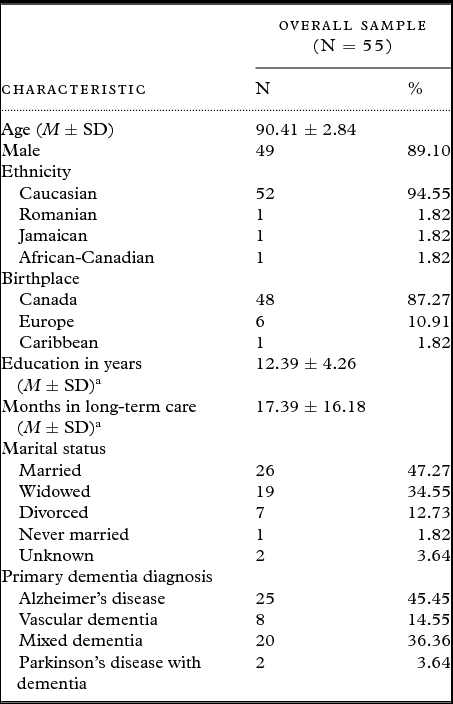
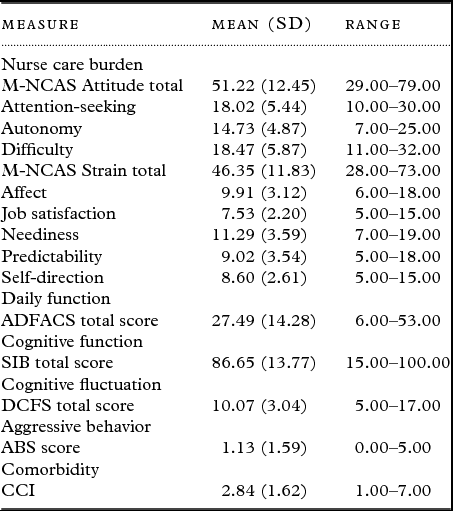
A total of 55 participants were found to be eligible to participate after screening 88 participants. The demographic characteristics of the sample are shown in Table 1. The majority of patients were male, Caucasian, and born in Canada. The most common primary dementia diagnosis was AD, followed by mixed dementia, VaD, and Parkinson's disease with dementia (PDD). The median age was 91 years, ranging from 81 to 97 years. Finally, the median number of months since entering long-term care was 13.70, ranging from 0.43 to 95.21 months. Means, standard deviations, and range of scores of rating scales are provided in Table 2.
Demographic characteristics of sample

aValues represent data set after using expectation maximization (EM) to estimate missing values.
Descriptive statistics of test measures

Note: M-NCAS, Modified Nursing Care Assessment Scale; ADFACS, Alzheimer's Disease Functional Assessment and Change Scale; IADL, Instrumental Activities of Daily Living; ADL, activities of daily living; SIB, Severe Impairment Battery; DCFS, Dementia Cognitive Fluctuation Scale; ABS, Aggressive Behavior Scale; CCI, Charlson Comorbidity Index.
Correlation between potential predictors and M-NCAS score
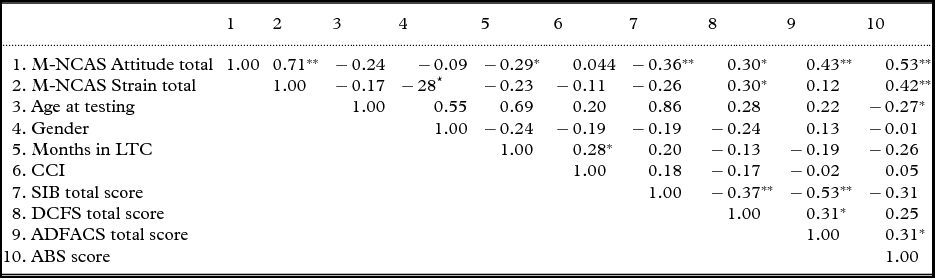
Bivariate correlations were conducted between each potential predictor and M-NCAS Attitude and Strain scores (Table 3). M-NCAS Attitude score was highly related to M-NCAS Strain score (r = 0.711, p = 0.000). M-NCAS Attitude score was also significantly related to number of months in long-term care (LTC) (r = −0.29, p = 0.030), as well as cognitive function measured by the SIB (r = −0.36, p = 0.007), CFs measures by the DCFS (r = 0.30, p = 0.025), daily function measured by the ADFACS (r = 0.429, p = 0.001), and aggressive behavior measured by the ABS (r = 0.530, p = 0.000). M-NCAS Strain score was significantly correlated with gender (r= −0.280, p = 0.039), CFs measured by the DCFS (r = 0.303, p = 0.027) and aggressive behavior measured by the ABS (r = 0.420, p = 0.001). However, M-NCAS Attitude score was not significantly related to age (r = −0.24, p = 0.082), gender (r = −0.092, p = 0.505) or CCI (r = 0.044, p = 0.751). M-NCAS Strain score was not significantly related to age (r =−0.17, p = 0.222) or number of months in long-term care (r = −0.23, p = 0.086), CCI (r =−0.112, p = 0.415), cognitive function measured by the SIB (r = −0.26, p = 0.053), or daily function measured by the ADFACS (r = 0.121, p = 0.381).
Correlation of M-NCAS score and related variables

Note: M-NCAS, Modified Nursing Care Assessment Scale; LTC, long-term care; CCI, Charlson Comorbidity Index; SIB, Severe Impairment Battery; DCFS, Dementia Cognitive Fluctuation Scale; ADFACS, Alzheimer's Disease Functional Assessment and Change Scale; ABS, Aggressive Behavior Scale.
*p < 0.05.
**p < 0.005.
Predicting M-NCAS Attitude and Strain scores
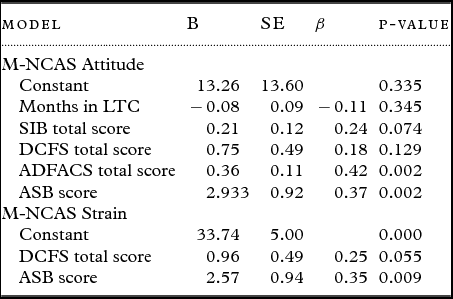
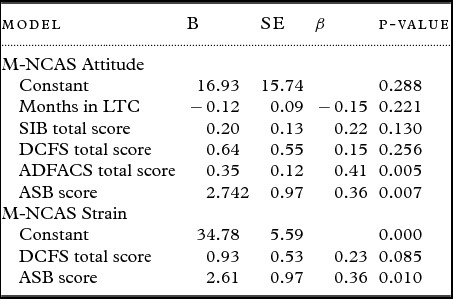
Table 4 displays the regression results for M-NCAS Attitude and Strain scores. Although gender was found to be significantly related to M-NCAS Strain score, we did not put it into the model, as most patients were male in this sample. Instead, we conducted a sensitivity analysis in male sample to explore the influence of gender (Table 5).
Linear regression of M-NCAS Attitude and Strain scores in the whole sample (N = 55)

Note: M-NCAS, Modified Nursing Care Assessment Scale; LTC, long-term care; CCI, Charlson Comorbidity Index; SIB, Severe Impairment Battery; DCFS, Dementia Cognitive Fluctuation Scale; ADFACS, Alzheimer's Disease Functional Assessment and Change Scale; ABS, Aggressive Behavior Scale.
Linear regression of M-NCAS Attitude and Strain scores in the male patients (N = 49)

Note: M-NCAS, Modified Nursing Care Assessment Scale; LTC, long-term care; CCI, Charlson Comorbidity Index; SIB, Severe Impairment Battery; DCFS, Dementia Cognitive Fluctuation Scale; ADFACS, Alzheimer's Disease Functional Assessment and Change Scale; ABS, Aggressive Behavior Scale.
ADFACS total score and ABS score were significant predictors of M-NCAS Attitude score both in the whole sample (R 2 = 0.41, F(5,49)=6.90, p = 0.000) and the male sample (R 2 = 0.39, F(5,43)=5.57, p = 0.000). Number of months in long-term care, SIB total score and DCFS score failed to account for unique variation in the scores of M-NCAS Attitude in both samples. ABS score emerged as the only significant predictor of M-NCAS Strain score both in the whole sample (R 2 = 0.22, F(2,52)=7.41, p = 0.001) and male sample (R 2 = 0.21, F(2,46)=6.27, p = 0.004). DCFS score was not a significant predictor of M-NCAS Strain score in both samples.
Discussion
This study explored the correlates of nursing burden in a sample of individuals with dementia living in a long-term care facility. As expected, M-NCAS Attitude score was significantly associated with Strain score. Aggressive behavior predicted both scores on M-NCAS Attitude and Strain. ADLs were also a predictor of M-NCAS Attitude.
Self-reported attitude was significantly associated with strain in patients’ primary nurses, which is consistent with previous findings indicating that both subjective and objective burden are correlated (Bastawrous, Reference Bastawrous2013). However, they may be influenced by different factors according to the previous literature (Montgomery et al., Reference Montgomery, Gonyea and Hooyman1985), and this was supported in our results.
Aggressive behavior was found to be significantly associated with both attitude and strain in nurses, consistent with a previous study (Song and Oh, Reference Song and Oh2015). That study found aggression was the most distressing symptom for registered nurses and care workers, but it failed to consider other important factors in the analysis, such as cognitive function and ADL impairment. This study further demonstrated the important role of aggressive behavior in predicting nursing burden, even taking into account cognition and daily function.
ADLs were found to be related to the Attitude score, but not the Strain score. This implies that although nurses agreed that these patients had impaired daily function, they did not see it as a source of stress. This is in contrast with previous studies with informal caregivers (Schoenmakers et al., Reference Schoenmakers, Buntinx and Delepeleire2010; Branger et al., Reference Branger, Enright, O'Connell and Morgan2017; Terum et al., 2017). Impaired daily function is associated with more functional dependence, likely resulting in more stress for family caregivers. In contrast, professional nursing caregivers possess specific expertise and have access to the facilities in the institutional care setting, which decreases the burden from these patients. Alternatively, the expectations of nursing staff working in LTC with these frail elderly patients may also allow them to cope better with impaired ADL function.
In a previous study (Lee et al., Reference Lee, McKeith, Mosimann, Ghosh-Nodyal and Thomas2013), CFs were found to be associated with a significantly increased level of burden for the caregiver. That study involved outpatients with family caregivers and found that patients with more severe CFs possessed lower autonomy and predictability, possibly resulting in family caregivers suffering from greater burden when caring for them. In addition, patients with more severe CFs were reported to have more dysfunctional affect and provide less job satisfaction, which could also increase the stress on the caregiver (Lee et al., Reference Lee, McKeith, Mosimann, Ghosh-Nodyal and Thomas2013). However, that study failed to assess the contribution of factors other than neuropsychiatric symptoms and cognition, which may have influenced the accuracy of the result. In this study, CFs were not associated with increased burden. This could have been due to the small size of the sample, the difference in patient population, and the nature of the caregiver. It is possible that nursing staff in LTC might assist patients with their ADLs regardless of their (varying) levels of cognition and function, in order to facilitate care. Allowing patients to perform their own ADLs (an important factor for family caregivers) likely requires more time than would be available for already over-burdened nurses.
Cognitive function was not significantly related to nursing burden in this study. Conflicting results have been found in previous studies (Kucukguclu et al., Reference Kucukguclu, Soylemez, Yener, Barutcu and Akyol2017; Sinha et al., Reference Sinha, Desai, Prakash, Kushwaha and Tripathi2017). However, one meta-analysis showed important heterogeneity due to the differences in study populations (Kucukguclu et al., Reference Kucukguclu, Soylemez, Yener, Barutcu and Akyol2017; Sinha et al., Reference Sinha, Desai, Prakash, Kushwaha and Tripathi2017). Partners are more sensitive to patients’ mental deterioration compared to other caregivers. In addition, caregivers experience the different phases of dementia as stressful to varying extents. Most of our patients were in the severe stage of dementia, which may be less stressful compared to restless patients (Schoenmakers et al., Reference Schoenmakers, Buntinx and Delepeleire2010).
The current study has some important limitations. One limitation is the relatively small sample, which limited the number of factors that could be included in the models. Future research using a larger sample size should more thoroughly investigate the role of other factors, such as the use of psychotropic medication. Another limitation is that correction for multiple comparisons was not applied to the correlation analyses. Given the limited sample size, the number of correlations completed in this study does raise the possibility of Type 1 error in the analyses. Thus, the relationships noted in this study should be confirmed with additional research employing larger sample sizes. Third, the sample was predominantly male due to the study being conducted in a veteran's long-term care facility. This hampered the exploration of the role of gender in nursing burden. Additionally, we did not collect demographic data on the nursing staff, which is another limitation. However, all professional caregivers in the study were the primary or associate nurse of the patients and knew the patient well enough to respond to the assessments. All staff in this institution who participated in the study were RNs (Registered Nurses), RNAs (Registered Nursing Assistants), or RPNs (Registered Practical Nurses). Finally, the cross-sectional nature of the study limited conclusions about causation.
Conclusion
The turnover of nursing staff in long-term care facilities has been a pervasive problem and has led to great societal costs. More attention should be given to the nursing burden and stress. Our results suggest that the aggressive behavior plays an important role in both increased subjective and objective domains of burden, while impaired ADLs increase the objective burden in the long-term care setting. These factors could be potential targets to reduce the negative impact that dementia has on nursing staff.
Conflict of interest
None.
Description of authors’ roles
N. Herrmann, M. Sun, B.J. Mainland, G.L. Sin, and T.J. Ornstein designed the study. N. Herrmann, B.J. Mainland, T.J. Ornstein, and G. L. Sin managed the data collection. M. Sun, B.J. Mainland, and N. Herrmann undertook data analysis and interpretation. M. Sun wrote the first draft of the manuscript. All authors were involved in the preparation of the manuscript.
Acknowledgments
We acknowledge the assistance of all nurses and elderly patients who volunteered to participate in this study. This research did not receive any specific grant from funding agencies in the public, commercial, or not-for-profit sectors.