

Faustina the Younger is well known for having a relatively large number of portrait types created for her during her lifetime. Fittschen identified nine distinct types; in fact there are even more.Footnote 1 The recent publication by Mittag of a new and exhaustive catalog of medallions of the Antonine period has made it clear that one rare portrait type of Faustina (not identified by Fittschen) is even more prevalent on the medallions than it had earlier appeared, and also that these medallions are closely die-linked.Footnote 2 What is more, it seems that this closely die-linked group may fit into the yearly pattern of medallion issues of Antoninus Pius and Marcus Aurelius in such a way as to make it possible to suggest a precise date for the creation of the portrait type which it bears.
The relative chronological order of Faustina's earliest numismatic portraits is clear, made so by the sequence of reverse types, legends, and die links.Footnote 3 Three distinct portrait types appear one after the other.Footnote 4 The first type (Fig. 1) shows Faustina with three or four looping bangs drawn up into a braid, which in turn is gathered into a small tight bun at the back of her head. The second (Fig. 2) shows a narrow wave of hair drawn back into a large bun composed of braids, while the third type (Fig. 3) shows all of Faustina's hair arranged in a single waved coiffure and gathered into a similar bun. The die sequence shows that Type 3 is short-lived and that it is soon replaced, not by a new type, but by a return to coin production using Type 2 portraits.Footnote 5 It is at this point that Faustina's fourth portrait type, the subject of this note, appears. It is almost unknown on the regular coinage. A unique aureus of Faustina the Younger in the collection of the American Numismatic Society (Fig. 4) bears the only known example of the portrait on the circulating coinage and illustrates its distinct components. At the crown of Faustina's head one can see a strong wave pattern that is reminiscent of the full-head wave of portrait Type 3. But the wave does not cover the whole head; instead, a medium-wide band of hair is pulled back from the brow, covering about half of the side of Faustina's head, and is gathered into a medium-sized, somewhat pyramidal bun. The single aureus die that bears this rare Type 4 portrait links to other aurei which employ a later form of Faustina's Type 2 portrait. This, and the reverse type it is used with (showing a dove surrounded by the legend CONCORDIA), demonstrate that it is later in date than portrait Type 3, but earlier than Type 5 (Fig. 5), with which it has sometimes been conflated.
Aureus of Faustina II with her portrait Type 1. (© American Numismatic Society 1965.66.32.)

Aureus of Faustina II with her portrait Type 2. (© American Numismatic Society 1956.184.56.)
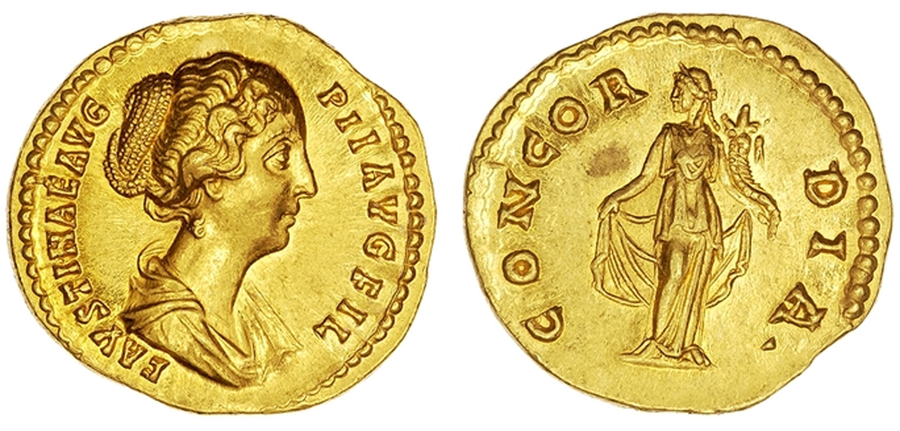
Cast of aureus of Faustina II with her portrait Type 3. (© American Numismatic Society 1944.100.82375.)

Aureus of Faustina II with her portrait Type 4. (© American Numismatic Society 2017.34.1.)

Aureus of Faustina II with portrait Type 3, die-linked to the aureus in Figure 4. (© A. Hess and Bank Leu. Antike Münzen. Luzern, 24 March 1959, 356.)

Not much more can be said about portrait Type 4 on the ordinary, circulating coinage, since it appears only on this one aureus die. But Type 4 is more common on another class of numismatic objects: medallions. Medallions were produced by the same mint (Rome) that struck the regular coinage; they are distinguished from coins by being normally much larger and heavier. In the early Antonine period, medallions are typically made of bronze or brass. Like circulating coins, they bear the portrait of the emperor or another member of the imperial family on one side. The images on their reverses, on the other hand, often differ strikingly from those of the normal coinage, and their inscriptions always omit the letters S C, for senatus consulto (‘by decree of the Senate’) that are found on all regular base-metal coinage. If senatorial authority (however nominal) did not lie behind the issue of these objects, then the only other option is imperial authority. It has generally been assumed that medallions were intended to be given as gifts by the emperor to select recipients, high-ranking figures in the army, administration, or court (one medallion of Faustina the Younger, Mittag cat. no. 270, bears the legend DOMVI AVG FELICITER, “good luck to the imperial house!”). New Year's Day has been plausibly suggested as an occasion for their distribution.Footnote 6
Medallions from the reign of Antoninus Pius bear the portraits of Antoninus, his wife Faustina the Elder, Marcus Aurelius as Caesar, and Faustina the Younger; they have been the subject of an exhaustive recent study by Peter Franz Mittag, who, in addition to creating a complete catalog of these objects, has conducted a die study.Footnote 7 Table 1 gives the simple count of specimens catalogued by Mittag for each family member. Antoninus Pius, with 4–5 times the number of preserved medallions as either Faustina the Elder or Marcus Aurelius and fully 10 times as many as Faustina the Younger, dominates this body of material.
Total numbers of medallions for Antoninus and his family members

Important information about the production of these medallions can be deduced from the observation of links between the different obverse and reverse dies used to produce them. Medallions (like coins) were struck from hand-engraved iron or steel dies; hand-engraving means that each die was different, and these dies can be identified by careful study of the medallions they produced. During production over a longer period of time, different obverse and reverse dies might be used together at different times; in this process, links may be formed through the sharing of dies (e.g., two reverse dies might be linked by being used with the same obverse die, or vice versa).Footnote 8 The main implication of die linkage is to indicate that the linked dies were in use at approximately the same time. Die links are frequent among the medallions of Antoninus Pius and Marcus Aurelius, often extending over multiple years (that is, an undated reverse die might be used with multiple obverse dies bearing different yearly dates). This phenomenon is common on medallions and creates an often complex web of die links, as can be seen in Mittag's charts for both Antoninus Pius and (to a lesser extent) Marcus Aurelius.Footnote 9 But the smaller groups of medallions bearing portraits of Faustina the Elder and Younger exhibit an interesting feature: a large number of them are die-linked into three compact groups, two for Faustina the Elder and one for Faustina the Younger.
The first die-linked group for Faustina the Elder consists of 22 medallions bearing a distinctive early portrait; this group should be dated to around the time of her death and deification (late in the year 140 CE).Footnote 10 The second group of medallions for Faustina the Elder, numbering 21, bears a later portrait, a shorter obverse legend, and a depiction of Aeternitas holding a globe with a bird on top; both the portrait and the type of Aeternitas have strong parallels with the regular coinage produced in the name of Diva Faustina. The type of Aeternitas in particular, in this specific configuration (with globe and bird), and the style of the portrait, can be dated to ca. 150 CE, the 10th anniversary of Faustina's deification.Footnote 11
The linked group for Faustina the Younger involves two obverse dies of different size, each bearing her rare Type 4 portrait. There are 12 medallions known that were struck from these dies, 6 for each.Footnote 12 The reverse types used are: for the small obverse die, Isis riding to the right on the back of a dog (Mittag cat. no. 273) and a peacock with tail spread (cat. no. 280; Fig. 6); for the large die, Diana standing in a rustic landscape (cat. no. 272), Venus with palm branch and cupids (cat. no. 277), and another frontal peacock with tail spread (cat. no. 279; Fig. 7, a different and larger reverse die than that used on cat. no. 280, to fit with the larger obverse die). There is no direct link between the large and small obverse dies, but the fact that both employ the peacock reverse type suggests that they belong together. None of the reverse dies used with Type 4 portrait obverse dies are used with any other obverse dies except for the small peacock die (cat. no. 280), which is paired once with a later Type 5 portrait obverse die.Footnote 13
Medallion (15 g) of Faustina II with portrait Type 4. (© Münzkabinett der Staatlichen Museen zu Berlin 1911/308.)

Medallion of Faustina II (38 g) with portrait Type 4. (Gnecchi Reference Gnecchi1912, pl. 69.10.)

By both object and die count (12 medallions, using two obverse and five reverse dies), this group is by far the largest linked group of Faustina the Younger's medallions. The fact that the reverse dies used in this group are not used with reverse dies bearing any other portrait type (with one exception, noted above) is an indicator of contemporary production (this is unlike the usual pattern for die use in Antoninus Pius's own medallions, where reverses are shared with obverse dies over multiple years). The group also seems to represent a high-volume issue relative to other issues in Faustina's name: by count, the medallions with Type 4 portraits make up almost 40 percent of all known medallions struck in the her name, in contrast to the single known aureus that bears this same portrait in the regular coinage. The rarity of the Type 4 portrait on the regular coinage furthermore suggests that it was short-lived. The conclusion to be drawn from this is that the die-linked group of medallions bearing Faustina's Type 4 portrait was issued at one time. It is possible that these dies were created at a single time but then used on and off over a period of years. But, aside from the fact that this would have resulted in the production of many out-of-date medallion portraits of Faustina, there is compelling evidence from the pattern of issue of medallions of Antoninus Pius and Marcus Aurelius that we should expect discrete groups of die-linked medallions in the name of the empresses dating to single years.
The medallions of Faustina are not dated, but those of Antoninus Pius and Marcus Aurelius are datable by iterations of the tribunician title to individual years between 147/8 CE (TRP XI for Antoninus Pius) and 160/1 CE (TRP XXIIII; the office was assumed yearly on 10 December). The earlier medallions of Antoninus's reign, which began in 138 CE, cannot be dated so accurately; some of a group dated only COS IIII may have been issued after 147 CE, but this is not certain.Footnote 14 For most years in the dated period, surviving medallion counts for Antoninus and Marcus range from around 10 to 25. But a graph of medallion counts by year (Fig. 8) shows two striking gaps: 149/50 CE, when there were no medallions at all produced for either Pius or Marcus, and 153/4 CE, when only one medallion (with two surviving examples) was produced for Antoninus and none for Marcus. If we assume that medallion production occurred each year, then the two gaps must have been filled with medallions bearing portraits other than those of Antoninus Pius and Marcus Aurelius.
Medallion counts by year for Antoninus Pius and Marcus Aurelius. (Graph by M. Beckmann.)

I suggest that the first gap in the dated medallion series of Antoninus and Marcus, 149/50 CE, should be filled by the die-linked group of medallions apparently intended to mark the 10th anniversary of Faustina the Elder's deification, which fell in the year 150 CE (see above). The second gap should be filled by the die-linked group of medallions in the name of Faustina the Younger bearing her Type 4 portrait, thus dating both the medallions and the new portrait type to 153/4 CE. This corresponds well to the die link evidence from the gold coinage, which places the single die bearing the Type 4 portrait in the period before the appearance of Faustina's fifth portrait type and roughly contemporary to her third, which was quite long-lived. It is not easy to identify a reason for a large emission of medallions depicting Faustina in this particular year. The iconography of the issue is focused firmly on goddesses (Juno, Venus, Diana, and Isis). The first three had associations with birth, although none of the iconographic schemes allude specifically to this theme; by this time Faustina was mother to at least three children, and perhaps more.Footnote 15 However, no specific birth is known in the year 153 or 154 CE. Another possibility is that the medallions were intended to celebrate an anniversary; this is unlikely to have been her receipt of the title of Augusta in 147 CE but could have been her 25th birthday. Again this is highly uncertain, especially since we do not know the exact year of Faustina's birth.
Regardless of the occasion, the situation of this group of medallions in the year 153/4 CE not only adds a new and datable type to the existing portrait typology of Faustina the Younger, but also provides new evidence of how brief a lifespan and how skewed a distribution in different media individual portrait types could have. It is surprising that a single portrait type would be represented on only one aureus die and not on any other denominations of the regular coinage, but at the same time appear on two medallion dies which produced almost 40 percent of all surviving medallions struck in the name of Faustina the Younger. The explanation is perhaps luck: that this was a very short-lived type that came into the mint fortuitously at the same time as the mint was ordered to produce a large batch of medallions bearing Faustina's image. The type was chosen for these medallion dies and made its way onto a single aureus die, but then was immediately dropped from the mint's repertoire.
The type may not have been exclusively employed in the mint. What appears to be a marble version was found in the Agora at Athens in 1978.Footnote 16 It depicts a young woman with hair parted and a substantial portion gathered into a single flat wave on each side of her head, which then join to form a bun of tightly wrapped braids at the back of the head. There are two main differences between this portrait and Faustina's Type 4 portrait as seen on coins: the hair on the top of the head does not have the pronounced wave pattern and the bun is not pyramidal. The overall structure of the hairstyle, however, is very close to that of Type 4. Stavridis identified the portrait as Faustina the Younger based on similarities of facial features between it and a known portrait of Faustina in the National Archaeological Museum in Athens. She also identified the hairstyle as Fittschen's fifth type, which, however, it is not (the hair on Fittschen's fifth type is all drawn back into the bun, and there is no broad flat wave distinct from the hair at the top of the head). The identification of Faustina's Type 4 portrait on medallions and one aureus lends weight to Stavridis's identification of this portrait as Faustina the Younger, which in turn suggests that it was not only disseminated through the mint.
The short life of the type in the mint was possibly connected to a series of quick changes in the type's actual model, Faustina. Following the traditional explanation of portrait-type creation, one might associate the type with the event that inspired this unprecedented outburst in medallion production in Faustina's name. As Fittschen argued with respect to Faustina: “the portraits of the empress were in no way a fashionable game, but their creation was due to very specific occasions and therefore was intended to fulfill concrete functions.”Footnote 17 But if that were in fact the case, the situation observed here would pose a serious challenge for the traditional interpretation. If the Type 4 portrait was created to mark some important event, perhaps the same event which the medallions were issued to commemorate, why did it not replace the other portraits in use in the mint for the regular coinage? Why did it apparently “fizzle out” after being used on just one such die? Perhaps because it (which is to say, this particular hair arrangement) had an equally short lifespan on Faustina's actual head. That is not to say that it is an artifact of fickle fashion; changes in personal appearance must have been orchestrated by Faustina in contexts entirely separate from the world of imperial portrait production: in the context of the imperial court, or of public appearances at shows and ceremonies. If this is the correct interpretation, it is evidence of a very nimble apparatus at work in the mint for transmitting changes in the appearance of the imperial family.



