In the field of SLA, research on relative clauses (RCs) has mostly focused on whether and why the difficulty of RC acquisition follows the noun phrase accessibility hierarchy (NPAH). The NPAH, originally proposed by Keenan and Comrie (1977) in the field of linguistic typology, is a hierarchy that concerns the relativizability of a noun phrase (NP) with respect to the grammatical relations between the head noun and the RC. It was later applied to SLA as a universal hierarchy that predicts the difficulty order of RC acquisition (e.g., Doughty, 1991; Eckman, Bell, & Nelson, 1988; Gass, 1979). Many studies have been conducted on the acquisition of postnominal RCs in second language (L2) English, and it appears that there is a general agreement in the field that the acquisition difficulty follows the NPAH. Many SLA textbooks discuss the NPAH as a universal of SLA in examining the effect of markedness in L2 development (e.g., Braidi, 1999; Ellis, 1985, 1994; Gass & Selinker, 2001). However, there has not been much research on the acquisition of languages with prenominal RCs, such as Japanese, and we still do not know whether the NPAH can predict the acquisition of RCs in prenominal RC languages. This means that we still do not know whether the NPAH can universally predict the acquisition difficulty of RCs, and it is therefore essential to investigate the acquisition of prenominal RCs. In this paper, we test whether RC acquisition in L2 Japanese follows the NPAH by analyzing spoken corpus data (Study 1) and by a sentence-combining experiment (Study 2).
PREVIOUS RESEARCH
SLA of RCs
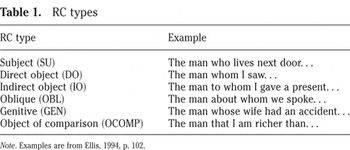
The NPAH is a hierarchy of relativizability of different NP types proposed by Keenan and Comrie (1977) based on more than 50 typologically diverse languages of the world, as shown in Table 1.
RC types

Keenan and Comrie's original generalization was that if, for example, indirect object (IO) can be relativized on, then any NPs higher on the hierarchy (i.e., less marked) can be relativized on as well. Although this hierarchy was not meant to predict acquisition order, it was hypothesized (e.g., Eckman, 1977), based on the idea that unmarked items are acquired earlier than marked items, that the difficulty of acquiring RCs in a L2 will follow the NPAH. This was borne out by many experimental studies with learners of languages that have postnominal RCs, mostly English but also a few European languages. Most of these studies employed either sentence combination tasks (Eckman et al., 1988; Gass, 1979) or grammaticality judgment tasks (Croteau, 1995, in Italian; Mitchell, 2001, in French). A few studies used oral picture-description tasks (Hyltenstam, 1984, in Swedish; Pavesi, 1986). In these studies, regardless of participants' first language (L1) or elicitation measures, the accuracy order followed the hierarchy of the NPAH, except for genitive (GEN).1
However, two studies that used listening comprehension (Hansen-Strain & Strain, 1989; Izumi, 2003) did not support the NPAH. See Shirai and Ozeki (this issue) for further discussion.
In contrast, there are few studies that have investigated the acquisition of prenominal RCs or non-European languages, and these studies do not necessarily support the predictions of the NPAH. Tarallo and Myhill (1983), in a crosslinguistic study that investigated RC acquisition by L1 English learners (N = 99), used a grammaticality judgment task and found that acquisition of postnominal RC languages (German, Portuguese, Persian) followed the NPAH, in that SU was easier than direct object (DO), whereas in prenominal RC languages (Chinese and Japanese), DO was easier than subject (SU). Specifically, in their combined analysis of Chinese and Japanese results, the accuracy order concerning the judgments of unacceptable sentences was: DO > oblique (OBL; with in) > IO > SU > OBL (with with).2
Keenan and Comrie (1977) defined oblique NPs as “NPs that express arguments of the main predicate, as the chest in John put the money in the chest rather than ones having a more adverbial function like Chicago in John lives in Chicago or that day in John left on that day” (p. 66). However, it appears that many studies in SLA do not distinguish arguments from nonarguments. Although most studies do not even give examples of oblique (which is often called object of preposition in SLA), some studies that give examples include nonargument locatives. For example, Gass (1982) included nonargument locative relatives (e.g., the table that he is standing on…) as examples of oblique relatives. Tarallo and Myhill (1983), Roberts (2000), and Sakamoto and Kubota (2000) also included nonargument locatives (e.g., The house that I live in is big.) in their test sentences. Study 1 of the present paper did not make the argument versus nonargument distinction and included nonargument locatives as oblique, which makes fair comparison with previous research possible.
Other studies of Japanese have shown conflicting results. Sentence combination tasks were used by Sakamoto and Kubota (2000) and Roberts (2000) to examine learners' acquisition of RCs in L2 Japanese. Sakamoto and Kubota employed a sentence-combining task to test the preferences of 19 Japanese as a second language (JSL) learners with various L1s (English, Chinese, Indonesian) for combining sentences with RCs.3
Sakamoto and Kubota (2000) also analyzed RCs in compositions written by JSL learners and compared them with compositions written by Japanese NSs. It was found that frequency count generally followed the NPAH, with SU being most frequent, followed by DO, and then OBL. However, the patterns of use by elementary and advanced learners were basically the same. Moreover, Japanese NSs' use of SU (56%) was proportionally more frequent than JSL learners' (43%). Therefore, this dataset cannot address the issue of the difficulty order of RC types.
In what follows, this notation is used only when significance tests were performed.
Three recent studies investigated how NPAH predictions are reflected by JFL learners' (L1 English) performance on comprehension tasks. Roberts (2000), in addition to the sentence-combining task, conducted a comprehension experiment on the same 68 participants and found SU relatives to be the most difficult, which completely runs counter to the predicted NPAH accuracy order (IO > DO > GEN > OBL > SU). In contrast, Kanno (2000, 2001) only compared SU and DO, and the results were consistent with the NPAH. Kanno (2000) tested comprehension of RCs by asking 94 JFL learners to choose the correct picture after hearing a NP such as onnanohito-o miteiru otokonohito “a man who is looking at a woman.” The accuracy order of SU > DO and the error pattern (i.e., learners more frequently misinterpreted DO relatives as SU relatives than vice versa) were consistent with the NPAH. Kanno (2001) measured the reading times of SU and DO relatives by 17 JFL learners and found that SU relatives were read significantly faster than DO relatives, which is also consistent with the NPAH prediction.
Hasegawa (2005) investigated RC acquisition by 36 child JSL learners (L1 Chinese, Vietnamese, Lao, Khmer), using an oral picture-description task. The accuracy order obtained was SU = locative oblique (OBLL) > instrumental oblique (OBLI) > DO. SU was the easiest for the participants, which is consistent with the NPAH. However, OBLL was not significantly different from SU, and DO was more difficult than both types of OBL, which is not consistent with the NPAH.
Finally, O'Grady, Lee, and Choo (2003) tested comprehension of Korean RCs by 53 English L1 learners of Korean as a foreign language (KFL). They employed the same method used by Kanno (2000); that is, they had participants listen to NPs that consisted of a RC and a head noun and choose the picture that matched what they had just heard. They obtained the same results: Learners made significantly more errors in comprehension with DO than with SU relatives and they made more errors of misinterpreting DO as SU than vice versa.
Studies on RC acquisition can thus be summarized as follows: Regarding postnominal RC languages (English, Swedish, Italian, French), the NPAH has been consistently supported, whereas the results for prenominal RC languages (Japanese, Korean, Chinese) have been inconsistent. However, the prenominal versus postnominal distinction might not be very important for the different patterns of acquisition, as we explore in what follows.
Methodological Considerations
The studies reviewed are all experimental studies (grammaticality judgment, sentence combining, elicited oral production, comprehension) that tested learners at some level of development and examined the accuracy (and production patterns) of different types of RCs. This is somewhat surprising because SLA research often relies on both experimental and naturalistic data. The reliance on experimental data is probably due to the low frequency of this target structure in discourse.
Fortunately, there are two studies that investigated natural production data. One was by Schumann (1980), who analyzed longitudinal speech data from five naturalistic learners of English as a L2 (L1 Spanish).5
Schumann (1980) also analyzed nonlongitudinal data from three more learners.
From the previous literature, it appears that the acquisition of RCs in European languages (all postnominal RCs), regardless of data type (i.e., experimental or naturalistic), follows the predictions of the NPAH, whereas the acquisition of RCs in Japanese does not necessarily follow the hierarchy. Are RCs in these two types of language qualitatively different? If so, the difference in acquisition patterns should also appear in L1 acquisition.
L1 Acquisition of RCs
Although the NPAH has been extensively tested in SLA, it has not been the focus of much research in L1 acquisition.6
However, whether SU is easier than DO has been investigated extensively without regard to the NPAH both in L1 acquisition and adult psycholinguistics.
This is further confirmed in an elicited imitation study by Diessel and Tomasello (2005), who showed that accuracy of imitation by English- and German-speaking children followed the NPAH.
It should be noted here that if adjacent positions on the NPAH behave alike, this is not necessarily in contradiction to the NPAH, although it provides no evidence in its favor. However, many SLA studies on European languages have shown clear differences between various positions in terms of acquisition difficulty. Thus, the fact that L1 acquisition of English follows the NPAH whereas L1 Japanese does not is suggestive of qualitative differences between Japanese and English RCs.
Comrie's New Typology of Noun-Modifying Clauses
What, then, makes the two types of RCs (in European languages and in Asian languages) so different? One possible answer might come from Comrie (1996, 1998, 2002; also Comrie & Horie, 1995), one of the original proponents of the NPAH, who recently proposed a new typology of noun-modifying clauses. Building on Matsumoto's (1988, 1997) work on Japanese noun-modifying clauses, Comrie argued that noun-modifying clauses in many Asian languages (e.g., Ainu, Chinese, Japanese, Korean) are structurally different from RCs in European languages and that they should be distinguished from RCs and classified as attributive clauses.
Relative clauses in European languages are assumed to involve a gap as in (1a),9
List of abbreviations: acc = accusative, app = appositive, cop = copula, des = desiderative, gen = genitive, loc = locative, nom = nominative, top = topic.

However, Comrie (2002) proposed that noun-modifying clauses in Japanese and many Asian languages have the structure of merely “attaching a modifying clause to a head noun” (p. 31) and that their acceptability depends not on structural factors but on whether a native speaker (NS) can readily establish a plausible interpretation. Comrie's argument is based on three pieces of evidence. First, in languages that allow zero anaphora, there is no need to argue that there is a gap that corresponds to the relativized NP. Second, Japanese seems to lack syntactic constraints (such as the subjacency condition) on the relation between the head noun and the covert coreferential noun in the subordinate clause (see also Haig, 1996). Third, attributive clauses can have the same function as the fact-S construction in English (e.g., the fact that John died). This is a very important proposal because virtually all work in psycholinguistics, including studies that involve L2s, has treated noun-modifying clauses in East Asian languages as RCs and tried to test universalist hypotheses such as the filler-gap hypothesis (e.g., Hsiao & Gibson, 2003; Miyamoto & Nakamura, 2003).
The contrasting results from English and Japanese L1 acquisition revealed by Diessel and Tomasello (2000) and Ozeki and Shirai (2007) are perfectly consistent with Comrie's new typology. If Japanese RCs do not involve a syntactic operation and if their formation is semantically and pragmatically (not syntactically) constrained, then it is not surprising that the production of putatively marked RCs (or perhaps we should say attributive clauses) such as OBL relatives is not very difficult for Japanese children, whereas it is difficult for children acquiring English.
Effect of Animacy
Finally, sentence processing research in European languages has also investigated the effect of grammatical relations on the processing difficulty of RCs, and, generally speaking, SU relatives have been shown to be easier to process than DO relatives (e.g., Mak, Vonk, & Schriefers, 2002). However, recent research has revealed strong effects of the animacy of the nouns involved; studies have shown that NSs of Dutch (Mak et al., 2002) and English (Traxler, Morris, & Seely, 2002; Weckerly & Kutas, 1999) are heavily influenced by the animacy of head nouns in their comprehension of RCs. For example, when DO relatives have an inanimate head noun and the agent is animate (e.g., the book that John bought), their difficulty is not significantly different from that of SU relatives. This might reflect the higher frequency of SU relatives with animate head nouns and DO relatives with inanimate head nouns in discourse, as shown by Mak et al. (2002) in their analysis of German and Dutch newspaper corpora. Therefore, in the current studies, we investigate the effect of animacy among other factors.
In this paper, we report on two studies that tested whether Japanese L2 learners follow the predictions of the NPAH in their acquisition of RCs. (For convenience, we will use the term RCs for Japanese noun-modifying clauses unless it is necessary to use another term.) In Study 1, we analyze oral proficiency interview (OPI) corpus data for learners' use of RCs. It is hypothesized that L2 learners of Japanese can produce more marked RCs even at the early stages of their interlanguage development. In Study 2, we report on an experimental study that employed a sentence combination task. It is hypothesized that grammatical relations do not affect the difficulty of RCs; that is, there will be no difference in the accuracy rate for SU, DO, and OBL relatives.
STUDY 1: LEARNER CORPUS ANALYSIS
Data and Analysis
All data used in this study is from the KY corpus (Kamada, 1999, 2006), a learner corpus that consists of transcribed ACTFL OPI interviews from 90 JSL learners. The learners' L1s are English, Korean, and Mandarin Chinese (N = 30 for each L1 group). The corpus includes learners at different proficiency levels, which makes it possible to see the effect of proficiency. For each L1 group, the number of learners is 5 novice, 10 intermediate, 10 advanced, and 5 superior. The duration of each interview is approximately 15–30 min. Also analyzed for baseline comparison were data from 15 Japanese NSs (randomly selected from 54 in the database) in the Hypermedia Corpus of Spoken Japanese10
The corpus is available at http://www.env.kitakyu-u.ac.jp/corpus/.
Whereas nonnative data included various topics for role-plays, native data for some reason included the same two topics for almost all role-plays, which was considered to bias the use of RCs greatly. For example, most NS data included the sentence “I am XXX (name) who has just moved here.”
All sentences that contained noun-modifying clauses were extracted and coded. In Japanese, however, it is not easy to determine what constitutes a noun-modifying clause. Because all noun-modifying elements are prenominal and there is no overt marker of relativization, the distinction between phrasal and clausal modification is not easy to make. In this study, we included all nouns modified by any of the following elements: verbs, as in (2) and (3), adjectives with complements, as in (4), and adjectives in past tense form, as in (5).

Some grammaticized noun-modifying clauses that conveyed modality or conjunction functions involving abstract nouns were not included in the analysis (for example, the Japanese equivalent of the English conjunction when consists of the noun toki “time” and a modifying clause). Self and other repetitions that appeared within three utterances of the original were also excluded from the analysis.
Each noun-modifying clause identified was classified into one of the following categories: SU, DO, IO, OBL, GEN, or a category labeled as no grammatical relations (NoGR). This last category would benefit from clarification. Examples (2)–(5) roughly correspond to RCs in European languages, in that each one can be classified as one of the RC types. In contrast, Japanese also has noun-modifying clauses for which grammatical relations cannot be determined. For example, (6) corresponds to appositive clauses in English, and (7) does not correspond to noun-modifying clauses. These were classified as NoGR.

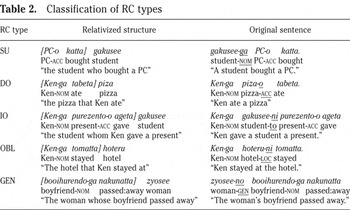
As noted earlier, because Japanese does not clearly mark grammatical relations between the head noun and the noun-modifying clause, it is not easy to classify tokens of RCs as instances of the established types that are based on grammatical relations. To classify RCs in this study, we used Teramura's (1975) test, which involves putting a RC token back into the original sentence and determining the grammatical role by the case marker attached to the head noun. If the relativized structure can be put back into the original sentence from which it is derived, with the head noun marked by a case particle, then the head noun is considered to have grammatical relations with the RC. For example, the relativized structure in (8a) can be considered to be derived from the sentence in (8b):

In (8b), the head noun raketto “racket” is marked by accusative -o and is therefore considered to have clear grammatical relations with the RC and is categorized as DO. In contrast, (9a) cannot be put back into the original sentence with a case marked head noun; thus, it is classified as NoGR.

Examples of how RC types other than NoGR were determined are given in Table 2. Case markers that determine the classification are underlined.
Classification of RC types

Results and Discussion
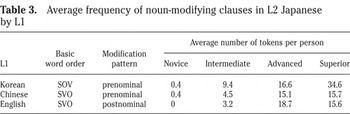
One thousand five noun-modifying clauses were extracted from the learner corpus. The pattern of use by each L1 group is summarized in Table 3.
Average frequency of noun-modifying clauses in L2 Japanese by L1

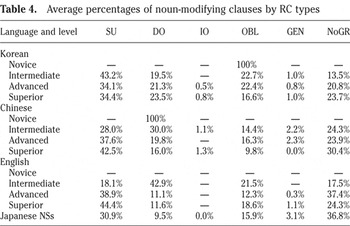
Table 4 shows the pattern of use by types of RCs, which are shown by average proportion. The percentages were obtained by first calculating proportions of use for each individual learner, and then the average was calculated for each group (e.g., L1 Chinese novice, L1 English superior). For comparison, NS baseline data (231 total tokens) are shown at the bottom of Table 4.
Average percentages of noun-modifying clauses by RC types

First, it should be noted that IO and GEN are very infrequent in NS as well as nonnative speaker (NNS) data; therefore, it appears that these are infrequent structures in the type of discourse used in our study. Thus, the following discussion will not refer to IO and GEN but will focus on the SU, DO, OBL, and NoGR categories. We first discuss the three RC types in terms of the NPAH predictions; then we consider the overall pattern, including NoGR.
Regarding the novice learners, only two of them used RCs—two DO relatives and two OBL relatives. At the intermediate level, when RC production increased, the frequency order of SU followed by OBL and then DO was observed for Korean NSs, DO followed by SU and then OBL was observed for Chinese NSs, and DO followed by OBL and then SU was the frequency order for English NSs. It appears that there is no particular RC type among the three that is difficult to produce at this stage. Even at the early stages of development, L2 Japanese learners produced all three types of RCs, including OBL, as in (10)–(12); they did not restrict themselves to SU, which was predicted to be easiest. [Examples (11) and (12) also involve overuse of the particle -no, which is often observed in L2 Japanese; see Huter, 1996.]

In contrast, advanced and superior groups, regardless of L1, used SU relatives most frequently (34.1–44.4%), which is similar to NSs' pattern of use (30.9%). For English and Chinese speakers in particular, the higher the proficiency level, the higher the ratio of SU relatives. This indicates that it is not the case that SU is more likely to be used at the earlier stages of development in L2 Japanese, which goes against the prediction of the NPAH.
It appears that learners are guided by the animacy of the head noun rather than grammatical relations in their use of different types of RCs.12
In this analysis, RCs involving the stative verb tigau “differ” are excluded because this verb is functionally used more like an adjective (corresponding to different in English), as in tigau tokoro “different place.”
Ozeki (2005a) also analyzed spoken data from eight JSL learners (L1 Tagalog, Telugu, Russian, Marathi) and found the same associations (i.e., SU relatives with animate head nouns and DO/OBL with inanimate head nouns) in the four learners who produced a meaningful number of tokens that could be interpreted. (The other four learners produced only a very small number of RCs.)
An anonymous SSLA reviewer pointed out that such a bias might apply generally, not just to the head nouns of RCs. However, an analysis of data from a stratified sample from nine learners (i.e., one learner from each L1 group and from lower intermediate, intermediate, and upper intermediate) found that there was no skewing for subject NPs; that is, the ratios of animate subjects were 56% for English L1 learners, 62% for Chinese L1 learners, and 60% for Korean L1 learners, which suggests that the SU with animate-head association is unique to RCs.
Is this association between RC types and noun animacy unique to learners? It is noteworthy that NSs' use of SU relatives, unlike the learners' use, are not restricted to animate head nouns. For NSs, only 54.4% of SU relatives modify animate nouns, and SU relatives include many inanimate heads, such as tubureta risaikuru syoppu “the recycle shop that went bankrupt” or agattekita genkoo “the manuscript that came.” Therefore, the restriction of SU relatives to animate heads is unique to learners.
From another perspective, however, an animacy effect is evident in NS speech as well. Among the RCs that modified animate nouns in NS speech, 87.4% were SU relatives. In other words, although NSs do not have the bias toward using SU relatives to modify animate nouns observed in learners, they still have a bias toward using animate head nouns in SU relatives. Therefore, it appears that L2 learners might create a bidirectional association based on the unidirectional association in the native Japanese speech to which they are exposed. This is where NSs and NNSs differ. It should also be noted that for the NS data, DO and OBL were used almost exclusively with inanimate head nouns (57 out of 59), just as in NNS data. Thus, this would appear to be how DO and OBL are normally used (i.e., to modify inanimate head nouns).15
The unidirectional bias for SU with animate heads and the bidirectional bias for DO with inanimate heads were also observed in newspaper corpora in Dutch and German (Mak et al., 2002).
Such a strong correlation between animacy and RC type—and the fact that all three types of relatives (SU, DO, OBL) are used frequently by L2 learners regardless of proficiency—suggests that L2 learners of Japanese are not at any point constrained by the markedness relations of the NPAH but, rather, that RCs are used differentially, depending on whether they modify animate or inanimate head nouns (although this is not the case for L1 Korean learners, who are not constrained by animacy).16
A possible reason why L1 Korean learners were not constrained by animacy is that they probably did not have to create idiosyncratic form-function mapping in the L2 because Korean is so similar to Japanese in its grammar (including noun-modifying clauses) that learners can mostly use translation strategies, even at early stages of RC use.
STUDY 2: SENTENCE-COMBINING TASK
Method
Although the results from Study 1 suggest that L2 Japanese RC acquisition does not follow the predictions of the NPAH, this should be tested with an experimental task because most previous studies involved experimental data rather than natural production data. Therefore, Study 2 investigated whether L2 learners of Japanese follow the predictions of the NPAH in a sentence-combining experiment. Given the effect of animacy observed in Study 1, we controlled for the animacy of the head NPs and the arguments of the verbs. The hypotheses to be tested are the following:
- There is no difference in accuracy among SU, DO, and OBL.
- SU relatives with animate heads and DO/OBL relatives with inanimate heads are easier than SU relatives with inanimate heads and DO/OBL relatives with animate heads.
Participants.
The participants for this experiment were 50 NSs of Cantonese studying JFL at a university in Hong Kong. Of these students, 17 were at the intermediate level (third-semester Japanese at the university) and 33 were at the advanced level (currently enrolled in third-year Japanese, after two semesters of Japanese at the university and 1 year of study in Japan). They were recruited by the instructors of their classes with a monetary reward of HK$40 (approximately US$5).
Materials and Procedure.
Each participant was given a written sentence-combining test that consisted of 24 pairs of sentences in a four-page booklet that also included a language background questionnaire at the end. Participants were instructed to combine two sentences for each test item, using relativization as in the illustrative examples provided to them. Three examples that immediately followed the instructions provided one instance each of SU, DO, and OBL relativization. Of the 24 test items, 8 items were included for each of the three RC types (SU, DO, and OBL). Examples of the test sentences to be combined (A and B) as they appeared in the test are shown in (13a) and their romanized versions with glosses and English translations are presented in (13b). The entire test, including instructions, is given in the Appendix.

For this example, the target formulation is a DO relative, and the correct answer is Hayasi-san-ga heya-de matteiru tomodati-wa nihonzin-da “The friend who Mr. Hayashi is waiting for in the room is Japanese.”
As seen in (13), the head noun to be modified by the RC is underlined. Test sentences were given in normal Japanese writing consisting of Kanji (Chinese characters) and Kana (Japanese phonograms), and all Chinese characters were given phonetic explanations in small Kana characters on top of them, as in the example in (13a). Vocabulary items that might have been difficult for participants, as determined by the students' instructor, were given English translations.
For each test item, sentence A consisted of a subject NP, a verb, a direct object, and an adverbial phrase containing a NP that indicated elements such as place, time, instrument, or indirect object. Sentence A for OBL relatives necessarily had one more NP in addition to SU or DO; therefore, to make the sentences the same length, an adjunct phrase such as kinoo “yesterday” or asokode “over there” was added to sentence A for SU and DO items. Sentence B was an equational copula sentence.
Of the 24 test items, 8 were designed to elicit SU relatives, 8 were designed to elicit DO relatives, and 8 were designed to elicit OBL relatives. For each type of relative, four items incorporated animate head nouns and four items included inanimate head nouns. For SU and DO relatives, the animacy of the head noun and the argument NP in the RC were randomized, as in (14)–(17) (animate = A, inanimate = I)17
In previous research, it has been shown that different combinations of animacy of the head noun and the noun in the RC have an effect on comprehension difficulty both in the processing of L1 (e.g., Mak et al., 2002; Traxler et al., 2002; Weckerly & Kutas, 1999) and L2 (e.g., O'Grady et al., 2003), and therefore we controlled for this variable.

For both SU and DO, two items each of A-A, I-A, A-I, and I-I types were included.
For OBL relatives, an animate head was combined with an indirect object NP (ask someone a question, write someone a letter) or an ablative NP (receive or borrow something from someone), and an inanimate head was combined with an instrumental NP and a goal NP. Two items for each type were included, for a total of eight OBL items. Following Eckman et al. (1988), we treated IO as OBL.
The order of different types of items appearing in the test was randomized. Additionally, two versions of the same test were created to control for the effect of the order of presentation of the items. The order in one version was the reverse of the other, and the two versions were randomly distributed to the participants. The test was administered immediately after the regular class time, with only those who agreed to participate in the experiment staying in the classroom. A graduate student in linguistics, a NS of Cantonese, administered the test in Cantonese. The test was not timed, but all participants finished the task in 30 min; the fastest participants finished in about 15 min. There were no questions about vocabulary, even though participants were told that they could ask about the meanings of unfamiliar words.
Scoring.
The test was scored on the basis of whether the participant produced the correct target sentence. The scoring was all or nothing: 1 (correct) or 0 (wrong). Only errors relevant to the formation of the target RC were counted, as in previous studies (e.g., Eckman et al., 1988; Izumi, 2003). Thus, for example, errors that involved verb conjugation or case marking were ignored. Previous research on European languages often reported pronoun retention as a frequent error (e.g., Eckman et al., 1988; Gass, 1979), but no pronoun retention was observed in this study. On the other hand, if a participant combined the sentences in the wrong order, the response was scored as an error, regardless of whether a grammatically correct sentence was produced. For example, the correct response to the item presented previously in (13) is a DO relative; the correct answer is Hayasi-san-ga heya-de matteiru tomodati-wa nihonzin-da “The friend who Mr. Hayashi is waiting for in the room is Japanese.” However, the error of miscombination, which was actually made by many participants, does not result in a RC, as in (18).

Additionally, errors were classified into different types, explained in detail in the next section.
Results and Discussion
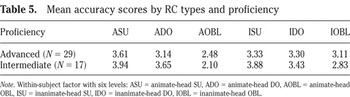
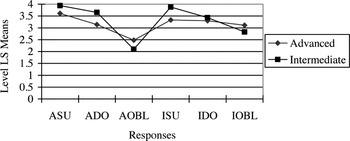
Table 5 presents the mean accuracy scores for the six types of RCs. For both proficiency levels, the highest scores were obtained for SU, followed by DO, and then OBL, regardless of animacy (see Table 5 and Figure 1).
Mean accuracy scores by RC types and proficiency


Interaction of mean accuracy scores by RC type and proficiency.
A repeated measures MANOVA and post hoc comparisons of means were performed to determine the effect of the two versions of the tests, the level of the learners (between-subject factors), and different types of RCs (within-subject factor). The alpha level for significance was set at .05. First, a MANOVA was performed with both learners' proficiency level and the two versions of the tests as between-subject factors. There was no significant effect of proficiency, F(1, 46) = 0.004, p = .67, or version, F(1, 46) = 0.006, p = .59, or significant interaction between the two, F(1, 46) = 0.003, p = .71. However, there was a significant effect of RC type, F(5, 42) = 1.484, p < .0001, and a significant interaction of RC type and proficiency, F(5, 42) = 0.351, p < .05. Because there was no main effect of version or interaction of version and RC type, we excluded version as a variable from the subsequent analysis, assuming that the two versions of the tests were equivalent. Another MANOVA was run with proficiency as the between-subject factor and RC type as the within-subject factor, which yielded the same result: no significant main effect of proficiency. However, there was a significant main effect of RC type and of the interaction of proficiency and RC type.
To identify where differences lie, a series of post hoc comparisons of mean scores were performed with the Bonferroni correction for multiple comparisons. Because there was no significant main effect of proficiency, in what follows we combine the data from the two proficiency groups and refer to interaction of RC type and proficiency level only when relevant.
First, the means of the three types of RC (SU, DO, and OBL) were compared. It was found that there was no difference between SU and DO, whereas OBL was significantly different from both SU and DO. Thus, the accuracy pattern for responses on the combination task is SU = DO > OBL. This partially confirms our hypothesis, in that SU was no more difficult than DO, but the fact that OBL was more difficult than DO is not consistent with our hypothesis.
Second, the mean scores of the six types of RC were compared. The following comparisons were significant (A = animate, I = inanimate): ASU and AOBL, IDO, IOBL; ADO and AOBL; ISU and AOBL; IDO and AOBL; AOBL and IOBL; ISU and IOBL; and IDO and IOBL. This generally confirms the first post hoc analysis: There is no significant difference between SU and DO, but there are significant differences between OBL and the other two types. Furthermore, this pattern generally shows that animacy has no effect, contrary to our hypothesis. For example, ASU should be easier than ISU according to our hypothesis, but there was no difference. However, there was one exception to this pattern: An effect of animacy was observed for OBL relatives, in that there was a significant difference between AOBL and IOBL, with IOBL proving to be easier than AOBL. This is consistent with our hypothesis because inanimate-head OBL is hypothesized to be easier than animate-head OBL.
Finally, the hypothesis regarding SU versus DO and OBL in their interaction with animacy was tested. The hypothesis posited was ASU = IDO/IOBL > ISU = ADO/AOBL because SU relatives tended to have animate heads, whereas IO and OBL relatives had inanimate heads in the learners' speech in Study 1.18
Although the combination of different types of noun animacy (e.g., A-A, A-I) was controlled for, the descriptive statistics, to our surprise, did not show any observable pattern and, therefore, we did not systematically test the effect of different combinations of noun animacy in this paper.
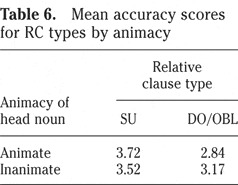
Mean accuracy scores for RC types by animacy

There were six comparisons because four types of RC were compared with each other. All comparisons turned out to be significant except that between ASU and ISU (which was already done in the post hoc analysis of means) and between IDO/IOBL and ADO/AOBL. Thus, the accuracy order obtained was ASU = ISU > IDO/IOBL = ADO/AOBL. This entirely goes against our hypothesis because no effect of animacy was found.
Further Analysis of Animacy Effects
Low-Score Learners.
To further investigate the effect of animacy, which was not very obvious in the statistical tests, further analysis of individual response patterns was performed. Five participants scored extremely low: 0, 1, 1, 3, and 8 out of 24 total items. The learners who got one to three items correct were only able to answer animate-head SU items correctly, and the participant who scored 8 responded correctly to all four animate-head SU items. Thus, even though no statistical difference was observed between ASU and ISU overall, there appears to be asymmetry between the two, with ASU being easier for learners.
Error Types.
Most errors can be categorized into one of two categories: (a) miscombination, in which, contrary to the instruction, the two sentences were combined in the wrong order; or (b) phrase-internal error, in which sentences A and B were correctly combined to form a RC, but changes were made to some elements (e.g., case markers, verbs) inside the RC. Other errors were almost negligible (1.4%).19
For example, participants produced sentences that resulted in a totally different meaning.
Miscombination errors in this study did not generate RCs because B sentences were all copular sentences, which was necessary to control for animacy in the RCs. For example, given (A) “John bought a book” and (B) “The book is expensive,” some learners gave a Japanese sentence equivalent to “John bought an expensive book” instead of the target form “The book that John bought is expensive.”
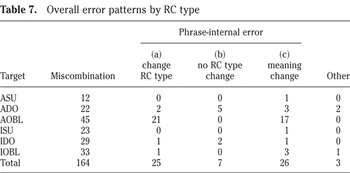
Phrase-internal errors were of three types: (a) errors that changed RC types by using passives or changing verbs but with no change in propositional meaning, (b) errors that did not change RC types but changed case marking on the subject of sentence A, and (c) errors that changed the meaning of the RC by some operation. Phrase-internal errors mostly involved DO and OBL as the target (with only 2 exceptions out of 58). In Table 7, we focus on the 40 cases in which RC types were changed, which include all the phrase-internal errors classified in (a) and some of the phrase-internal errors classified in (c).
Overall error patterns by RC type

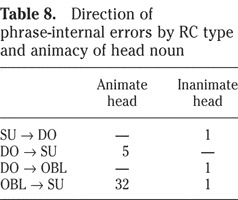
The 40 cases in which the RC type was changed are shown in Table 8. Most are errors of changing DO or OBL to SU, with only two exceptions (SU into DO and DO into OBL); this result is consistent with the NPAH. However, such errors consisted almost exclusively of ASU (37 out of 38), with only one exception, in which an IOBL relative was erroneously changed to an ISU relative. This might indicate that the DO/OBL to SU conversion is not necessarily triggered by grammatical relations but by the animacy of the head noun.
Direction of phrase-internal errors by RC type and animacy of head noun

The most frequent errors of using SU in place of the targeted OBL construction were errors of changing the verbs of giving and receiving, which 12 learners made, as in (19), or passivization errors, which 6 learners made, as in (20):

It is evident that learners produced SU sentences in the DO/OBL target contexts by changing verbs, case markers, and voice, which gives the impression that SU is easier than DO/OBL. However, given that there was only one error of producing a SU sentence when an inanimate-head DO/OBL was the target,20
The target was [Otooto-ga hon-o ireta] kaban “the bag that (my) brother put the books in” (OBL), and the RC produced (SU) was [otooto-ni hon-o irerareta] kaban “the bag which was put in the books by (my) brother” [literal translation].
GENERAL DISCUSSION
In Study 1, it was hypothesized that L2 learners of Japanese can produce marked RCs even at the early stages of their language development. The results supported this hypothesis: Japanese L2 learners in the OPI corpus produced OBL RCs at the early stages of RC development. It was also found that the animacy of head nouns strongly influenced the production of different types of RCs.
Based on Study 1, Study 2 first tested the hypotheses that there is no difference in accuracy among SU, DO, and OBL. Hypothesis 1 was partially supported, in that there was no significant difference in accuracy between SU and DO relatives. This is consistent with Study 1 and is not entirely consistent with the prediction of the NPAH as proposed based on the acquisition of European languages. However, OBL was significantly more difficult than SU/DO. This can be accounted for as follows: As noted earlier, because OBL relatives involve one more NP than SU or DO relatives, we added an adjunct phrase to SU and DO sentences to control for the number of NPs. However, because such NPs are not arguments of the sentence, OBL with one more argument might be more complex than SU and DO. Given that OBL is produced as frequently as SU and DO in Study 1, even at the early stages of RC development, this is probably the most parsimonious explanation. Because Study 2 tried to control for the animacy of the arguments, it was difficult to include SU and DO relatives with three arguments. Future studies need to control for the number of arguments and test whether OBL is more difficult than DO/SU in L2 Japanese.
We can conclude from the two studies that the NPAH might not predict the acquisition of RCs in L2 Japanese as accurately as in L2 European languages. Now, is this because Japanese RCs are prenominal? For example, do all prenominal RCs behave similarly in terms of the NPAH? Actually, this is not the case. Slobin (1986), who analyzed natural conversation data from 57 children (2;4–4;8) acquiring Turkish—another prenominal RC language without a relative pronoun—found a strong SU primacy. The ratio of SU relatives among all RCs was 94% for 3-year-olds and 90% for 4-year-olds,21
Although the ratio was 67% for 2-year-olds, the number of tokens was very small (a total of four RCs from 57 children).
A major difference between Japanese and Turkish RCs is that, in Turkish, a nominalizing suffix is attached to the verb stem in the RC and different suffixes are used depending on whether the RC is SU. Thus, even though Turkish RCs are prenominal like Japanese RCs, the syntactic role of the head noun in the RC results in formal differences. In contrast, in Japanese, syntactic roles of the head noun in the RC cause no formal differences either syntactically or morphologically.
Based on this and other observations, Comrie (1996, 1998) claimed that Turkish has RCs—not attributive clauses—although some other Turkic languages have attributive clauses.22
In fact, Comrie (1998) suggested that Thai and Khmer, which employ postnominal modification, also have attributive clauses rather than RCs. Thus, the RC versus attributive clause distinction is orthogonal to prenominal versus postnominal modification.
Hypothesis 2 of Study 2 predicted that learners would find animate-head SU and inanimate-head DO/OBL relatives easier than SU with inanimate heads and DO/OBL with inanimate heads, because these are the types of relatives that L1 Chinese and English learners produced almost exclusively at the beginning stage of RC use. The accuracy scores did not support this hypothesis. The difficulty order found was ASU = ISU > IDO/IOBL = ADO/AOBL, with no effect of animacy. However, error pattern analysis revealed that learners especially preferred animate-head SU relatives. Finally, learners with the lowest scores were only able to correctly answer animate-head SUs. These observations strongly indicate that learners at the early stages associate animacy and grammatical relations as they acquire RCs.23
The applicability of this prediction needs to be tested with more diverse groups of learners, of course. In particular, given the findings of Study 1, it might be possible that Korean learners of Japanese do not go through a stage in which SU relatives are restricted to animate heads.
Then why was there a minimal effect of animacy in significance testing? This is probably because a majority of the participants in Study 2 had already reached the stage at which they could form RCs quite well. Study 2 also found that the error of incorrectly changing DO/OBL into SU was almost exclusively made when the head noun was animate and that the learners with the lowest scores were only able to form animate-head SU relatives correctly and could not form inanimate-head SU relatives. Further, among the OBL relatives that had the lowest scores in this study, we found a significant effect of animacy, with IOBL being easier than AOBL, as predicted. Based on these observations, we might assume that the acquisition of SU relatives starts with animate heads and later extends to inanimate heads. This supports the results of Study 1, in which this bias was only observed with intermediate learners and disappeared for advanced- and superior-level learners. We can verify this hypothesis by replicating Study 2 with intermediate-level L1 English learners of Japanese, who have been observed to show strong animacy bias in conversation (in Study 1).
The similar animacy effect is also observed in Korean. Jeon and Kim (this issue) report on a study that employed a picture-description task to elicit RCs from high-beginning- and intermediate-level KFL learners (L1 English, including heritage learners), in which the head of 91% of SU relatives was animate and the head of 89% of DO relatives was inanimate. Given this observation, it is not surprising if L2 learners of Japanese and Korean form a strong animacy bias. This might explain why the comprehension experiments by O'Grady et al. (2003) and Kanno (2000) showed SU primacy over DO. As Ozeki (2005a, 2005b) pointed out, when learners make a strong connection between animate heads and SU, then if both protagonists are animate, the learner will be biased to choose a SU interpretation.
Finally, we should consider the implication of similar animacy-related bias in European languages (Mak et al., 2002). It has been shown that the animacy of the head noun influences processing ease of RCs by NSs in Dutch (Mak et al.) and English (Traxler et al., 2002; Weckerly & Kutas, 1999). Given this observation, it is highly likely that not just in Japanese and Korean but also in European languages whose RC acquisition is thought to be governed by the NPAH, the animacy effect is at work. In fact, sentences used in experiments were mostly SU relatives with animate heads and DO/OBL relatives with inanimate heads (e.g., Eckman et al., 1988), as noted by Ozeki (2003). The interplay between animacy and the NPAH in SLA needs to be investigated further, not only in Asian languages but also in European languages.
APPENDIX
SENTENCE COMBINATION TASK

Make one sentence by combining the two sentences as in the following examples.

Note: The original test is available from the authors upon request.