

INTRODUCTION
Water stress affects many aspects of plant metabolism, such as photosynthesis, which are limited by decreases in stomatal conductance, the first line of defence that is activated even before reductions in the leaf water content (Chaves et al., Reference Chaves, Flexas and Pinheiro2008; Yordanov et al., Reference Yordanov, Velikova and Tsonev2003). In addition to stomatal limitation, photosynthesis is also down-regulated by decreases in total soluble protein and chlorophyll content and photochemical and biochemical inefficiencies, indicating a metabolic limitation under severe stressful conditions (Ghannoum et al., Reference Ghannoum, Conroy, Driscoll, Paul, Foyer and Lawlor2003; Lawlor and Tezara, Reference Lawlor and Tezara2009). Some plant species subjected to water deficit have significant changes in their leaf carbohydrate content, which may be related to the activation of responses to cope with such adverse environmental condition (Chaves et al., Reference Chaves, Flexas and Pinheiro2008). As a consequence, plant growth and yield is inhibited by drought.
Under water deficit, sucrose accumulation may occur due to reduced plant growth. In addition, starch hydrolysis may increase the content of soluble sugars, amino acids and organic acids under drought conditions (Lee et al., Reference Lee, Jin, Jung, Avice, Morvan-Bertrand, Ourry, Park and Kim2008). In fact, increases in the leaf osmolyte concentration is an important strategy to maintain a high leaf water potential under limiting water conditions (Molinari et al., Reference Molinari, Marur, Daros, Campos, Carvalho, Bespalho Filho, Pereira and Vieira2007). These physiological responses have been reported in many plant species, with large differences when comparing crop species and even varieties of the same species (Ghannoum et al., Reference Ghannoum, Conroy, Driscoll, Paul, Foyer and Lawlor2003). Such natural sources of variation should be explored for increasing our knowledge about the main physiological traits related to drought resistance in sugarcane.
Sugarcane (Saccharum spp.) plants present significant decreases in biomass production due to drought, reaching reductions of approximately 35% of the dry matter and 33% in the total leaf area when water deficit occurs in parallel with a high evaporative demand (Inman-Bamber, Reference Inman-Bamber2004). According to Machado et al. (Reference Machado, Ribeiro, Marchiori, Machado, Machado and Landell2009), the drought sensitivity of sugarcane may be verified when the water deficit occurs during the initial growth phase and the plants are tillering. During the last 10 years, sugarcane breeding programmes have launched many varieties for cultivation in arid lands (Landell et al., Reference Landell, Campana, Figueiredo, Silva, Vasconcelos, Bidoia, Xavier, Dinardo-Miranda, Prado, Rossetto, Santos, Cavichioli, Martins, Kanthack, Gallo, Veiga Filho and Silva2004, Reference Landell, Campana, Figueiredo, Vasconcelos, Xavier, Bidoia, Prado, Silva, Dinardo-Miranda, Santos, Perecin, Rossetto, Silva, Martins, Gallo, Kanthack, Cavichioli, Veiga Filho, Anjos, Azania, Pinto and Souza2005); however, the physiological mechanisms responsible for better crop performance and yield are poorly understood.
Adding complexity to the management of drought resistance, plant breeders have developed and launched genotypes by evaluating their stalk yield under limiting conditions. However, one cannot assess drought tolerance of any species in such a stressful situation if well-hydrated plants are not present as a reference. Indeed, this misleading interpretation of plant performance may lead to an erroneous evaluation and to the conclusion that a given genotype is drought resistant when, in fact, it is very sensitive to water shortage. Within such a context, the aim of this study was to evaluate the plant response to water deficit and its consequence for stalk yield using three commercial sugarcane varieties to identify resistance and sensitivity patterns and the related physiological traits.
MATERIALS AND METHODS
Plant material and water deficit
Three sugarcane (Saccharum spp.) varieties were evaluated in this study: IACSP94-2094 is considered to be drought resistant (Machado et al., Reference Machado, Ribeiro, Marchiori, Machado, Machado and Landell2009); IACSP96-2042 is sensitive to water deficit (Machado et al., Reference Machado, Ribeiro, Marchiori, Machado, Machado and Landell2009); and SP87-365 is extensively planted in Brazil. Thirty-five days after bud planting (DBP) in plastic pots (2 March 2008), one plant of each genotype was transferred to a container (0.6 m3) inside a greenhouse. The three genotypes (one plant of each genotype) were grown in each container, for a total of eight containers. The soil in the container was fertilised according to the recommendations for sugarcane cultivation, and the plants were grown as the main stalk with three tillers.
The sugarcane plants were subjected to two water treatments: a well-hydrated condition, with the soil water potential approximately –20 kPa maintained through irrigation every two to three days (reference), and a water deficit induced by withholding water during the initial growth phase. The water-deficit treatment began at 83 DBP (19 April 2008) and ended three days after the first plant presented null values of leaf CO2 assimilation at 108 DBP (14 May 2008). Plant recovery was evaluated through evaluations performed at 115 DBP (21 May 2008). During the experimental period, soil water content was monitored by the gravimetric method, with soil samplings collected at approximately 0600 h at a depth of 0.2 m. Soil rehydration was performed on the evening of 108 DBP, with the plants being maintained under well-hydrated conditions until the stalk harvest at 300 DBP (22 November 2008). During the experiment, the average air temperature was 19.7°C, and the average soil temperatures were 22.3°C under the well-watered conditions and 23.6°C under the drought treatment. The maximum photosynthetic active radiation (Q) registered during the experimental period was approximately 2000 μmol m−2 s−1.
Physiological evaluations
The leaf gas exchange was measured using an infrared gas analyser model LI-6400 (Licor, Lincoln NE, USA), with the following physiological variables being evaluated: leaf CO2 assimilation (PN), transpiration (E), stomatal conductance (gS) and leaf water-use efficiency (PN/gS). The cumulative reductions in PN due to drought were calculated after the integration of the CO2 uptake (PNI) during the experimental period. The air CO2 concentration during the measurements was 390 ± 13 μmol mol−1, and Q was artificially fixed at 2000 μmol m−2 s−1 during the measurements. The evaluations were performed between 1400 and 1500 h using the first fully expanded leaf with visible ligule (leaf +1) at the middle third of the leaf blade and considering the natural variation of the air relative humidity and air temperature in intervals of one to two days. For the PNI calculation, we divided the integrated values by half throughout the experimental period (photoperiod of 12 h) and considered the evaluations obtained in the afternoon as representative of the leaf gas exchange during the diurnal period between 83 and 115 DBP. In addition to these integrated data, we also present herein (Table 1) the instantaneous leaf gas exchange measured at 105 DBP, when the lowest values were recorded in the water-stressed plants.
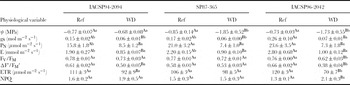
Physiological responses of sugarcane genotypes to water deficit1: leaf water potential (ψ); stomatal conductance (gS); CO2 assimilation (PN); transpiration (E); potential (FV/FM) and effective (ΔF′/FM′) quantum efficiency of PSII; apparent electron transport rate (ETR); non-photochemical quenching (NPQ). The plants were subjected to well-hydrated conditions as a reference (Ref) or to water deficit (WD).

1Water deficit was imposed between 83 and 108 days after planting (DBP). The measurements were obtained at 105 DBP (leaf gas exchange) and at 108 DBP (leaf water potential and photochemistry). The different capital letters indicate significant differences between the water regimes within the same genotype (p ≤ 0.05 for all variables, with the exception of ψ and NPQ in which p ≤ 0.09), whereas the lowercase letters indicate differences among the genotypes in the same water regime. The values refer to the average of four replications (±SE).
Measurements of the chlorophyll fluorescence emission were performed using a modulated fluorometer PAM-2000 (Heinz Walz GmbH, Effeltrich, Germany). Using basic signals recorded before and after saturation pulses (λ < 710 nm, Q ~ 10,000 μmol m−2 s−1, 0.8 s) and after exciting photosystem I with far-red light (λ = 735 nm, Q < 15 W m−2, 3.0 s), selected photochemical variables were estimated according to McCormick et al. (Reference McCormick, Cramer and Watt2008), as follows: the potential (FV/FM) and effective (ΔF′/FM′) quantum efficiency of photosystem II (PSII), the non-photochemical quenching (NPQ) and the apparent electron transport rate (ETR). The photochemical activity was evaluated at 108 DBP, with a Q value of 450 μmol m−2 s−1, leaf-to-air vapour pressure difference of 1.3 ± 0.3 kPa and leaf temperature of 24.5 ± 1.7°C.
The leaf water potential (ψ) was measured by the psychrometric method using a microvoltmeter model HR-33T (Wescor, Logan, UT, USA). Leaf samples were collected at predawn (0600 h) at 108 DBP, and leaf discs (diameter of 0.6 cm) from the middle region of fully expanded leaves exposed to solar radiation were excised and immediately placed in a sample chamber model C-52 (Wescor, Logan UT, USA). Leaf samples were also collected at 108 DBP, frozen at –80°C and then dried in an oven (60°C) with forced-air circulation until a constant weight. The soluble carbohydrates (SS) and sucrose (Suc) were extracted and purified using a methanol:chloroform:water (12:5:3, v/v) solution according to Bieleski and Turner (Reference Bieleski and Turner1966). The quantification of SS was performed using the phenol–sulphuric acid method (Dubois et al., Reference Dubois, Gilles, Hamilton, Rebers and Smith1956), and Suc was quantified by the method described by van Handel (Reference van Handel1968). The starch (Sta) concentration was evaluated by the enzymatic method proposed by Amaral et al. (Reference Amaral, Costa, Aidar, Gaspar and Buckeridge2007). The total non-structural carbohydrate concentration (NSC) was calculated as NSC = SS+Sta. The proline concentration in the leaves was evaluated by the classical method of Bates et al. (Reference Bates, Waldren and Teare1973) using the same procedure of extraction and purification as described for carbohydrates.
After 300 DBP, the stalks of each plant were harvested, and the dry matter was determined after drying the samples in an oven (60°C) with forced-air circulation until a constant weight was achieved. The soluble solid content of the stalk tissues was also measured at the harvest time using a digital refractometer PAL-1 (Atago, Tokyo, Japan) and expressed as oBrix. These evaluations were performed to assess the overall impact of water deficit on the sugarcane yield.
Experimental design and data analysis
The causes of variation were the genotype (three levels) and water condition (two levels). The experiment was arranged in a randomised block design, and the data were subjected to the analysis of variance (ANOVA). The mean values (n = 3 or 4) were compared using the Scott-Knott test (p ≤ 0.05 and p ≤ 0.09) when a significant difference was detected. The relative changes in the physiological variables induced by drought were evaluated through a radar plot.
RESULTS
The soil water content was maintained near field capacity (approximately 0.29 g g−1) in the control treatment throughout the experimental period and was significantly reduced by the withholding of water. The soil moisture reached 0.16 g g−1 after 25 days of withholding water. At this time (108 DBP), the leaf water potential (ψ) was reduced in the SP87-365 and IACSP96-2042 genotypes, due to water shortage, and varied at approximately −1.8 MPa at predawn. Non-significant changes were noted in ψ of IACSP94-2094 due to water withholding (Table 1).
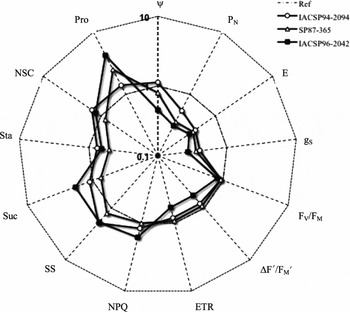
The leaf gas exchange measurements revealed that all the genotypes were affected by the water deficit; however, the sensitive genotype IACSP96-2042 was more severely affected (Table 1 and Figure 1). Considering the instantaneous measurements of gS, PN and E, IACSP94-2094 was less affected by drought compared to the other genotypes (Figure 1). Non-significant changes due to water deficit were found in PN/gS among the sugarcane genotypes (data not shown). The consequences of water deficit were also evaluated considering the cumulative reduction of PN throughout the experimental period. The largest reduction of PN was observed in IACSP96-2042 (–38%), whereas the lowest reductions were found in IACSP94-2094 and SP87-365 (−17%).
Relative changes in the leaf water potential (ψ), CO2 assimilation (PN), transpiration (E), stomatal conductance (gS), potential (FV/FM) and effective (ΔF′/FM′) quantum efficiency of PSII, apparent electron transport rate (ETR), non-photochemical quenching (NPQ), leaf concentrations of soluble carbohydrates (SS), sucrose (Suc), starch (Sta), total non-structural carbohydrates (NSC) and proline (Pro) in sugarcane genotypes subjected to water deficit. The values higher than 1 indicate increases in a specific variable under water deficit. Ref = reference (unit).

There were decreases in FV/FM due to the water deficit in SP87-365 and IACSP96-2042, with the latter being more sensitive to drought (Table 1). This negative response was not found for IACSP94-2094. Water deficit also significantly affected the ΔF′/FM′ and ETR values in IACSP96-2042, with reductions of 42% in both photochemical variables (Table 1 and Figure 1). NPQ was not affected by water deficit in IACSP94-2094 and SP87-365, whereas IACSP96-2042 exhibited increases in NPQ under water stress (Table 1 and Figure 1).
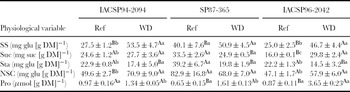
Drought caused increases in the concentration of soluble carbohydrates (SS) in all the genotypes (Table 2). Although the leaf sucrose concentration (Suc) of IACSP94-2094 was not affected by drought stress, the stress condition caused decreases in Suc in SP87-365 and a large Suc increase in IACSP96-2042 (Table 2 and Figure 1). Comparing the genotypes, significant differences were observed only under the well-watered conditions in which SP87-365 had the highest Suc concentration and IACSP96-2042 the lowest concentration. The starch concentration was affected by water deficit only in SP87-365, with a reduction of 50% compared to the control condition (Table 2). However, withholding water increased the NSC only in IACSP94-2094 (Table 2). Under well-hydrated conditions, SP87-365 had the highest NSC when compared to the other genotypes.
Physiological responses of sugarcane genotypes to water deficit1: leaf concentrations of soluble carbohydrates (SS), sucrose (Suc), starch (Sta), total non-structural carbohydrates (NSC) and proline (Pro). The plants were subjected to well-hydrated conditions as a reference (Ref) or to water deficit (WD).

1Water deficit was imposed between 83 and 108 days after planting (DBP). The measurements were taken at 108 DBP. The different capital letters indicate significant differences between the water regimes within the same genotype, whereas the lowercase letters indicate differences among the genotypes in the same water regime. The values refer to the average of four replications (±SE).
The leaf proline concentration increased in SP87-365 and IACSP96-2042 (Table 2), with the latter showing the highest values. The leaf proline concentration in IACSP96-2042 was approximately 2.3 to 2.7 times higher than in the other genotypes under water deficit (Figure 1).
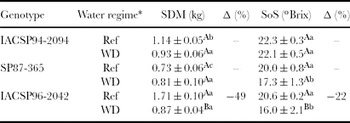
The water shortage affected the growth of IACSP96-2042, causing a reduction of almost 50% in the stalk dry matter production, whereas genotypes SP87-365 and IACSP94-2094 were not affected by water shortage (Table 3). Regarding the soluble solids in the stalk tissues, only genotype IACSP96-2042 was affected by drought, with a reduction of 22% compared to the well-hydrated plants (Table 3). Among the genotypes subjected to water-limiting conditions, IACSP94-2094 presented the highest values of soluble solids at harvest (Table 3).
Stalk dry mass (SDM) and soluble solids in the stalk juice (SoS) of three sugarcane genotypes subjected to well-hydrated conditions (Ref) or to water deficit by withholding water (WD)1.

1Water deficit was imposed between 83 and 108 days after planting (DBP). Stalks were harvested at 300 DBP. The different capital letters indicate significant differences between the water regimes within the same genotype (p ≤ 0.05), whereas the lowercase letters indicate differences among the genotypes in the same water regime. Δ is the relative variation between the Ref and WD conditions. The values refer to the average of four replications (±SE).
DISCUSSION
Genotypic differences in physiological responses to water deficit
In our study, the degree of drought resistance in sugarcane was defined according to the stalk yield and soluble solids in the stalk juice, the most important indexes of productivity in sugarcane crop. Varieties IACSP94-2094 and SP87-365 were drought-resistant genotypes, as water deficit did not cause changes in those indexes in these varieties (Table 3). In fact, water deficit caused severe water stress in IACSP96-2042, with ψ reaching –1.85 MPa at predawn (Table 1). Cell elongation is interrupted, and impairments in sugarcane growth have been reported under water stress (Inman-Bamber and De Jager, Reference Inman-Bamber and De Jager1986; Machado et al., Reference Machado, Ribeiro, Marchiori, Machado, Machado and Landell2009). Although SP87-365 had reached similar ψ under water deficit that was similar to IACSP96-2042 (Table 1), its growth was not affected; thus, we may consider that its susceptibility to drought occurs at a ψ value lower than −1.73 MPa at predawn or that it presents high performance after a drought event. However, the last possibility was not verified herein, with IACSP94-2094 and SP87-365 showing a similar recovery of leaf gas exchange (data not shown). With regard to the IACSP94-2094 drought-resistant genotype, we observed an absence of a significant variation in ψ (Table 1 and Figure 1).
The maintenance of ψ in IACSP94-2094 may be caused by an efficient acclimation to water-deficit conditions. A loss in leaf area to limit water use is considered an acclimatory response (Chaves et al., Reference Chaves, Flexas and Pinheiro2008); however, Machado et al. (Reference Machado, Ribeiro, Marchiori, Machado, Machado and Landell2009) reported a similar loss of active leaf area in IACSP94-2094 and IACSP96-2042 under conditions of water deficit. Another acclimatory change is the accumulation of solutes with osmoregulatory potential (Inman-Bamber and Smith, Reference Inman-Bamber and Smith2005; Molinari et al., Reference Molinari, Marur, Daros, Campos, Carvalho, Bespalho Filho, Pereira and Vieira2007). Typically, increases in the leaf proline concentration are related to osmotic adjustment, a physiological mechanism for protecting plants against severe dehydration and maintaining the shoot water status (Molinari et al., Reference Molinari, Marur, Daros, Campos, Carvalho, Bespalho Filho, Pereira and Vieira2007). The non-significant change in the proline concentration is an indicator that IACSP94-2094 did not face an environmental constraint due to water deficit. In fact, the stalk dry matter and yield of soluble solids of IACSP94-2094 (Table 3) were not affected by water deficit. The small variation in the leaf proline concentration of SP87-365 may be considered a metabolic response to water shortage rather than a protective mechanism. This is also true for the IACSP96-2042 genotype (Table 2). According to Molinari et al. (Reference Molinari, Marur, Daros, Campos, Carvalho, Bespalho Filho, Pereira and Vieira2007), the proline concentration must achieve values higher than 15 μmol g DM−1 to be effective against drought stress in sugarcane plants.
With regard to sugars, we noted increases in the leaf carbohydrate concentration under water stress (Table 2). The IACSP94-2094 genotype showed an expressive increase in SS under drought, which was also observed in IACSP96-2042. The increases of SS in the IAC genotypes and the increase of Suc in IACSP96-2042 were not related to the degradation of starch (Table 2). Changes in leaf carbohydrates are related to the activation of physiological responses to cope with adverse environmental conditions and have function in the maintenance of the cellular water relations and the protection of enzymes and the membrane system through the stabilisation of proteins and lipids (Yordanov et al., Reference Yordanov, Velikova and Tsonev2003). There is evidence of a significant accumulation of soluble sugars other than Suc in IACSP94-2094 under water deficit, which may be verified by comparing the relative variation in SS and Suc (Figure 1). Zhang et al. (Reference Zhang, Yang, Feng, Chen, Luo, Cai and Liu2006) reported the accumulation of trehalose, a disaccharide related to the stabilisation of the cellular structure, in a tolerant sugarcane genotype under drought. As the main non-reducing sugar is sucrose, the difference between SS and Suc represents the concentration of reducing sugars, such as hexoses (glucose and fructose). Considering this assumption, drought caused considerable increases in the leaf hexose concentration of IACSP94-2094 (+8.9 times) and SP87-365 (+3.9 times). In fact, these genotypes were less affected by water shortage when considering the cumulative reduction in photosynthesis throughout the experimental period and plant growth (Table 3). We may argue that the increases in NSC noted in IACSP94-2094 and IACSP96-2042 under water deficit (Table 2) are physiological responses to avoid the negative effects of water shortage on the leaf water status. However, this acclimatory response was efficient only in IACSP94-2094, as indicated by the non-significant changes in ψ and yield indexes (Tables 1 and 3).
Water deficit reduced the stomatal conductance in all the genotypes (Table 1), and this response in plants subjected to water stress is considered one of the first strategies to prevent the excessive dehydration of leaves (Inman-Bamber and Smith, Reference Inman-Bamber and Smith2005; Yordanov et al., Reference Yordanov, Velikova and Tsonev2003). Stomatal sensitivity to water stress is an important physiological trait related to drought resistance and is a response caused by an efficient plant signalling between the roots and shoots (Inman-Bamber et al., Reference Inman-Bamber, Bonnett, Smith and Thorburn2005; Smit and Singels, Reference Smit and Singels2006). The reduction of the stomatal aperture under water-stress conditions may be caused by decreases in the turgor of stomatal guard cells. This association is valid for SP87-365 and IACSP96-2042, as low gS values were found in parallel with low ψ values (Table 1).
The reduction of the stomatal opening caused significant decreases in E under water deficit in all the genotypes (Table 1) and is a successful strategy for the avoidance of excessive water loss. However, such a strategy also affected PN, as expected and has been reported in many crop species (Chaves et al., Reference Chaves, Flexas and Pinheiro2008). All the genotypes exhibited reductions in the CO2 uptake due to water deficit, with IACSP94-2094 and SP87-365 being less affected than IACSP96-2042 when considering the cumulative PN reduction (17% vs. 38%). We would like to emphasise that the effects of water deficit on the leaf gas exchange of sugarcane genotypes were more informative when we evaluated the cumulative reduction of PN compared to the instantaneous measurements. In addition to the reduction of photosynthesis due to the low CO2 availability (low stomatal aperture), we may argue for the occurrence of non-stomatal limitations. The low RuBP regeneration due to the reduced production of ATP is an important cause of reduced photosynthesis in plants exposed to severe water deficit (Lawlor and Tezara, Reference Lawlor and Tezara2009), which is related to the impairment of photochemistry. This response was observed only in IACSP96-2042, which presented significant reductions in FV/FM, ΔF′/FM′ and ETR (Table 1).
Overall, IACSP96-2042 exhibited impairments in photosynthesis caused by stomatal and non-stomatal limitations, whereas SP87-365 and IACSP94-2094 were limited only by stomatal closure (Table 1). Although all the genotypes exhibited recovery of the leaf gas exchange after soil rehydration, IACSP96-2042 showed a slower recovery of gS (data not shown). Flexas et al. (Reference Flexas, Ribas-Carbo, Bota, Galmés, Henkle, Martinez-Canellas and Medrano2006) argued that both the speed and extent of recovery are affected by the oxidative stress caused by severe drought, with a rapid recovery being observed in plants with an efficient antioxidant system. Excessive energy pressure on photochemistry may be indirectly evaluated by increases in NPQ (Horton et al., Reference Horton, Ruban and Walters1996), which, again, occurred only in IACSP96-2042 (Table 1). Although oxidative stress had most likely occurred in IACSP96-2042, the differential response of sugarcane genotypes with regard to antioxidant protection under drought remains to be investigated in future research.
Drought resistance or stalk yield: which is more important?
Our data clearly show that IACSP96-2042 is a drought-sensitive genotype, exhibiting a severe reduction in the stalk yield when water deficit occurs during the initial growth phase (Figure 1 and Table 3). In contrast, we tested two sugarcane genotypes, IACSP94-2094 and SP87-365, which presented less physiological sensitivity to drought and no impairment in either stalk production or yield of soluble solids (Table 3). From another perspective, we should also consider the stalk yield under each environmental condition. Under water deficit, all three sugarcane genotypes had a similar stalk yield (Table 3), whereas IACSP96-2042 presented the best performance under well-hydrated conditions. On average, the most productive genotype was IACSP96-2042, even showing the highest sensitivity to drought stress.
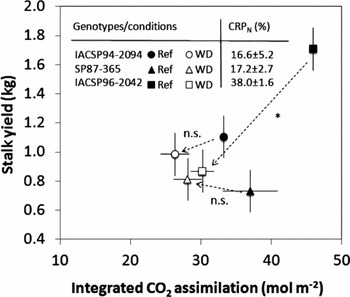
We found an interesting relationship between the overall CO2 assimilation throughout the experimental period and the stalk yield (Figure 2). The productive genotype IACSP96-2042 presented the highest CO2 uptake, which was related to its high stalk yield. However, IACSP96-2042 was the most sensitive to drought conditions, showing reductions of 38% in CO2 uptake (Figure 2) and 49% in stalk yield (Table 3). The physiological cost of drought-resistance is clearly shown in Figure 2, with IACSP94-2094 and SP87-365 exhibiting the lowest values of CO2 uptake, regardless of the water availability.
Relationship between integrated CO2 assimilation throughout the experimental period and the stalk yield in sugarcane genotypes grown under well-watered conditions (Ref, closed symbols) or subjected to water deficit (WD, open symbols). Water deficit was imposed between 83 and 108 days after planting (DBP). The stalks were harvested at 300 DBP. The values refer to the average of three (axis-X) or four (axis-Y) replications (±SE). The relative reduction in integrated CO2 assimilation is also shown (CRPN). The arrows indicate the reduction due to drought. n.s. = non-significant; *p ≤ 0.05.

This cost should be taken into account when considering crop production in sustainable agriculture, with the question arising of what is the most important trait. From an agronomic point of view, productive genotypes would be chosen; thus, our choice would be IACSP96-2042 for growth in regions in which the water deficit is seasonal or not severe. Such conditions are predominant in the State of São Paulo (Rolim et al., Reference Rolim, Camargo, Lania and Moraes2007), the main sugarcane-producing region in Brazil. Even after being affected by drought stress, the re-growth capacity and high yield of IACSP96-2042 are essential traits for competitive agriculture in which the sucrose yield and bagasse production have importance for energy production from first and second generations (Hattori and Morita, Reference Hattori and Morita2010). Many rainfed areas are used for sugarcane production worldwide, and, under such conditions, the practice of irrigation is not always a technological alternative for increasing the sugarcane yield. This is the scenario for drought-resistant sugarcane genotypes, such as IACSP94-2092 and SP87-365, as water deficit can affect plants during most of the annual cycle and cause significant yield losses in crop production.
In conclusion, there is significant variation in drought resistance among sugarcane genotypes, with the resistant genotypes showing less photosynthetic sensitivity to water shortage. The leaf carbohydrate metabolism and water relations are also differentially affected by water deficit in resistant genotypes; however, there is no unique pattern of response for IACSP94-2094 and SP87-365. From an agronomical point of view, we may distinguish between productive (IACSP96-2042) and drought-resistant genotypes; both are important for sugarcane production, and the best choice depends on the water availability during the crop cycle.
Acknowledgements
This research was supported by the Sao Paulo Research Foundation, Program for Research on Bioenergy (Fapesp/Bioen, 2008/57495-3), Brazil. The authors acknowledge the São Paulo Research Foundation (Fapesp, Brazil) and the National Council for Scientific and Technological Development (CNPq, Brazil) for the scholarships (D.F.S.P.M. and J.R.M.F.) and fellowships (E.C.M. and R.V.R.) granted.