Introduction
The Subarctic is experiencing increasingly frequent warm weather; for example, western Hudson Bay air temperatures have increased by 2–3 °C over the past 50 years (Gagnon and Gough Reference Gagnon and Gough2005), and near Churchill, Manitoba, Canada the decade between 1997 and 2007 saw six of the 10 hottest years on record (and all of the top five) (Fernandez-Triana et al. Reference Fernandez-Triana, Smith, Boudreault, Goulet, Hebert and Smith2011). These temperature changes may be linked to faunal shifts observed over the past half century (Fernandez-Triana et al. Reference Fernandez-Triana, Smith, Boudreault, Goulet, Hebert and Smith2011).
In 1969, Robert E. Gregg (Reference Gregg1972) sampled ants (Hymenoptera: Formicidae) near the tree-line in northern Manitoba in the vicinity of the town of Churchill. He collected at three sites along a small north-south transect (~6–7 km) that featured sites of exposed tundra and bluffs immediately along Hudson Bay (near the mouth of the Churchill River), boggy tundra, and boggy boreal forest. The ant community that he uncovered was not diverse but was abundant in some cases near the southern end of his investigation. In total, Gregg found five ant species in the Churchill region: Camponotus herculeanus (Linnaeus) (Formicinae), Formica neorufibarbus algida Wheeler (Formicinae), Leptothorax canadensis kincaidi Pergande (Myrmicinae), Leptothorax canadensis Provancher (Myrmicinae), and Myrmica brevinoidis Emery (Myrmicinae). Francouer (Reference Francouer1983) re-examined Gregg’s specimens, now held at the Field Museum of Natural History in Chicago (Illinois, United States of America), and noted that the specimens originally identified as L. canadensis kincaidi were L. acervorum Fabricius, and M. brevinoidis were actually M. alaskensis Wheeler.
As climate changes across the world, the importance of comparing contemporary collections to any measure of “historical” material is critical – as it allows us to determine whether there have been shifts in species composition (Tingley and Beissinger Reference Tingley and Beissinger2009). Documenting the presence or absence of any biotic change is particularly important when collections occur on large ecological ecotones since the isotherms that determine these areas are predicted to move drastically in the coming decades and, further, since the effects of a changing climate are unlikely to be felt in the same manner by all taxa. For example, in Churchill, some groups have seen a substantial change (parasitoid Hymenoptera (Braconidae) – (Fernandez-Triana et al. Reference Fernandez-Triana, Smith, Boudreault, Goulet, Hebert and Smith2011)), while others were not significantly different across collection periods (Diptera – (Renaud et al. Reference Renaud, Savage and Roughley2012b)). In 2012, we collected ants from the same locations visited by Gregg in 1969 to determine if the ant community had changed in the intervening time.
Methods
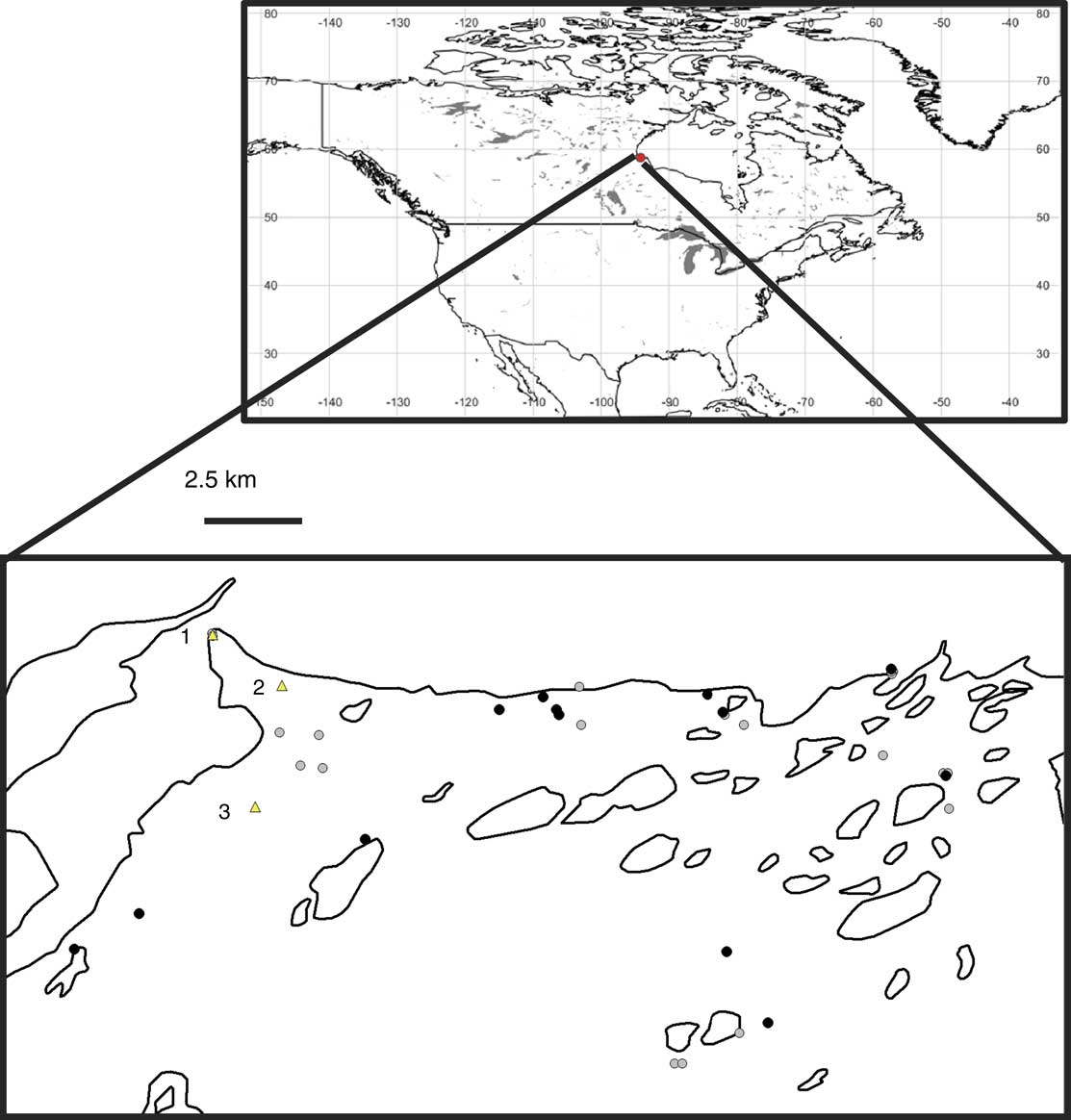
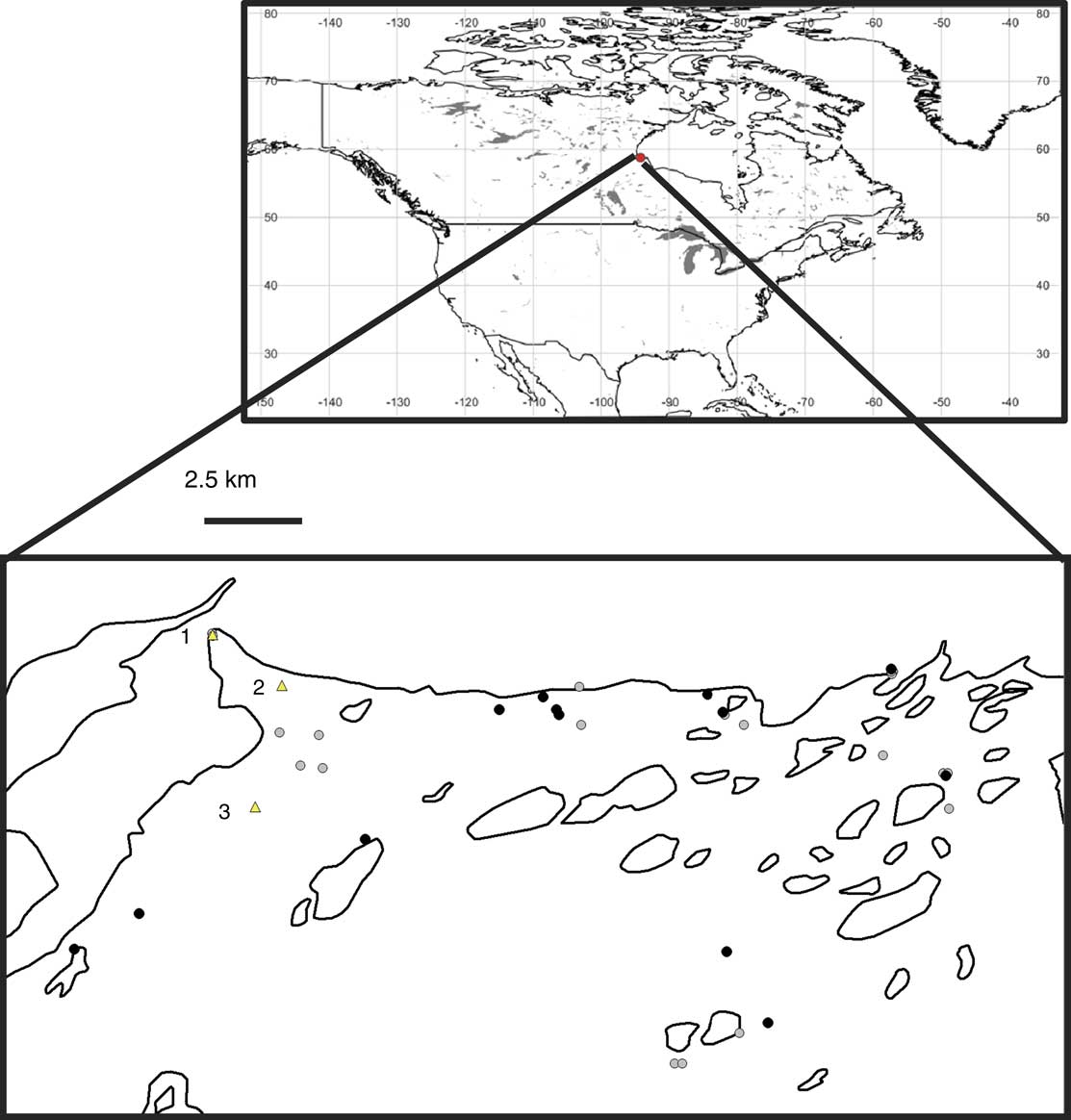
As part of a field course in Arctic Ecology offered by the University of Guelph (Guelph, Ontario, Canada) through the Ontario Universities Program in Field Biology, the instructors and students (22 people total) used descriptions from Gregg (Reference Gregg1972) (including his Fig. 2) to revisit the exact sampling locations that Gregg had sampled (1 site/day between 9 and 11 August 1969) on 10 July 2012 (south to north: Goose Creek (bog), Welcome Sign (tundra), and Cape Merry (tundra)) (Fig. 1). Due to descriptions and aspects of the local environment that were likely to be invariant between collection times (e.g., intersections of railway and road, peninsula) we were confident in sampling the same sites that Gregg did in 1972. At each collection locality we actively searched for ants using standard myrmecological collection methods (actively turning woody debris and stones, breaking twigs, pulling apart moss and lichen hummocks, and sampled ants using feather weight forceps and aspirators) for three hours within an area bounded by ~100×100 m. In addition to the ant fauna, we recorded the non-grass vascular plants and documented the habitat at each site using high-resolution, panoramic photographs captured using a GigaPan (www.gigapan.org) system (Smith et al. Reference Smith, Adamowicz, Boyd, Britton-Foster, Cahill and Desnoyers2013). The resultant panoramic photographs are publically available (http://www.gigapan.com/galleries/9086/gigapans).
Ant sampling localities in the Churchill region. Yellow triangles represent the Gregg, 1969 sampling locations with numbers corresponding to site names in Table 1. Grey circles are the ant collections made in 2005/2006, while black circles are the 2010 ant collections that were analysed in Stahlhut et al. (Reference Stahlhut, Fernández-Triana, Adamowicz, Buck, Goulet and Hebert2013).
Collected ants were separated into genera and then morphospecies. Ant species were identified using available taxonomic resources (Creighton Reference Creighton1950; Francoeur Reference Francoeur1973, Reference Francouer1983, Reference Francouer1997; Fisher and Cover Reference Fisher and Cover2007). From these, we selected representatives to be DNA barcoded (~10/morphospecies). These individuals were then point-mounted, photographed, and a single leg (the point-side middle leg) was removed during preparation to serve as template for the total genomic extraction. DNA extractions were prepared from this tissue using a glass-fibre extraction protocol (Ivanova et al. Reference Ivanova, DeWaard and Hebert2006), and the DNA was resuspended in 30 μL of dH2O. We amplified the DNA barcode region of cytochrome c oxidase I (COI) (a 658-base pair region near the 5′ terminus of the COI gene) using the insect primers LepF1 (5′- ATTCAACCAATCATAAAGATATTGG -3′) and LepR1 (5′- TAAACTTCTGGATGTCCAAAAAATCA-3′) and uni-directionally sequenced the amplicons using LepR1. All laboratory information associated with the individual sequences can be retrieved from the Barcode of Life Data System (BOLD, www.barcodinglife.org (Ratnasingham and Hebert Reference Ratnasingham and Hebert2007)) using the Process ID (sequence accessions). All sequence data and detailed collection information is available on BOLD in the public dataset: Arctic Ecology Student Projects 2012 (dx.doi.org/10.5883/DS-AEDNA12) and in Table 1.
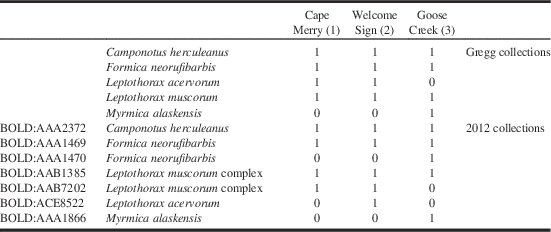
Two incidence matrices comparing Gregg’s 1969 collections and our July 2012 resampling from the same locations in and around Churchill, Manitoba.

Note: Matrices are presented separately since, without barcoding specimens from the historic collections, we are uncertain which BIN-divergent record to align with which morphologically determined historic collection.
We assessed the degree to which our sampling effort approached the estimated site maximum for alpha diversity (based on the techniques described above) using the incidence matrices in Table 1 and a sample-based rarefaction completed using EstimateS and 1000 randomisations (v9.1; Colwell and Elsensohn Reference Colwell and Elsensohn2014).
Identification of provisional species within BOLD
The barcode index number (BIN) (Ratnasingham and Hebert Reference Ratnasingham and Hebert2013) is a unique alpha-numeric applied to significant sequence clusters in BOLD – clusters with unique and resilient sequence divergence from other BINs of ~2%. In the ants (and other insect groups) the BIN and the ~2% range of divergence has proven a useful proxy for formally named species (Smith et al. Reference Smith, Fisher and Hebert2005, Reference Smith, Fernandez-Triana, Roughley and Hebert2009, Reference Smith, Hallwachs and Janzen2014; Fisher and Smith Reference Fisher and Smith2008).
Analyses on Churchill ants collected before 2012
Recent collections (2005–2010)
In addition to the Gregg exact site re-sampling comparison between two time periods, we also used the DNA barcodes to compare the diversity we recovered in the Gregg-resampling of 2012 to the diversity of ants we had previously collected in the wider Churchill region between 2005 and 2010 (Fig. 1) (Stahlhut et al. Reference Stahlhut, Fernández-Triana, Adamowicz, Buck, Goulet and Hebert2013). Collection methods and localities are described in Smith et al. (Reference Smith, Fernandez-Triana, Roughley and Hebert2009) and Stahlhut et al. (Reference Stahlhut, Fernández-Triana, Adamowicz, Buck, Goulet and Hebert2013) (dx.doi.org/10.5883/DATASET-HYMCHUR1).
For a sub-set of the collection (from 2006), we analysed the prevalence of Wolbachia Hertig (Rickettsiaceae) in somatic tissue-derived total genomic DNA extracts using the polymerase chain reaction-based wsp assay as described in Smith et al. (Reference Smith, Bertrand, Crosby, Eveleigh, Fernandez-Triana and Fisher2012). This analysis was completed since the differential presence of a Wolbachia infection can lead to large intra-specific mitochondrial divergences.
Gregg collections (1969)
Select specimens from Gregg’s initial collection are accessioned at the Field Museum of Natural History. We photographed and examined some of these and sub-sampled a small number (12) for DNA extraction and analysis. We designed four reverse primers to be used with the general insect forward primer LepF1 amplify two short fragments of COI for the ants in general and Formica neorufibarbis Emery in particular (Primers sequences are 5′ to 3′. 145 base-pair amplicons: CO1-211-Formicidae-reverse: ATAATTTTTTTAATRGTWATACCTT and CO1-211-neorufibarbis-reverse: ATGGTATTACTATGAAAAAAATTAT; or 213 base-pair amplicons: CO1-281-Formicidae-reverse: GGATCTCCTGATATAGCCTATCCTCG, and CO1-281-neorufibarbis-reverse: CGAGGATAAGCTATGTCGGGAGATCC.
Results
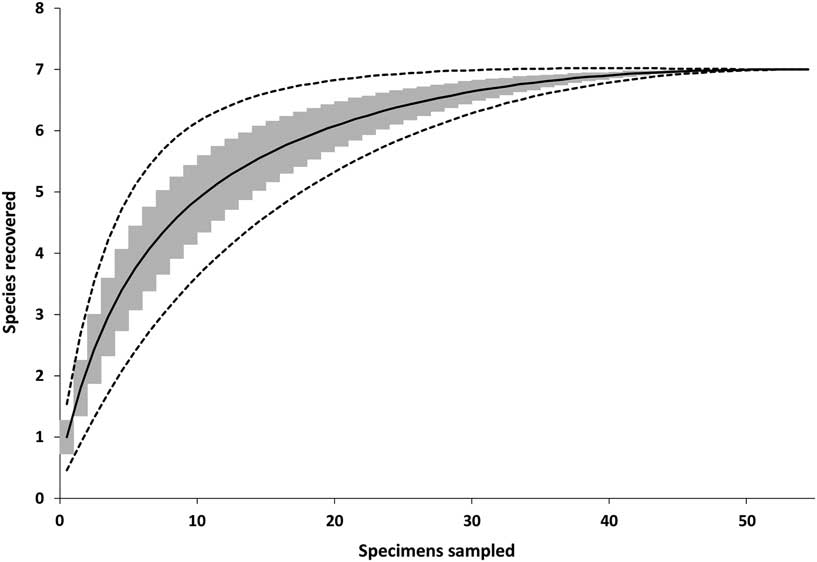
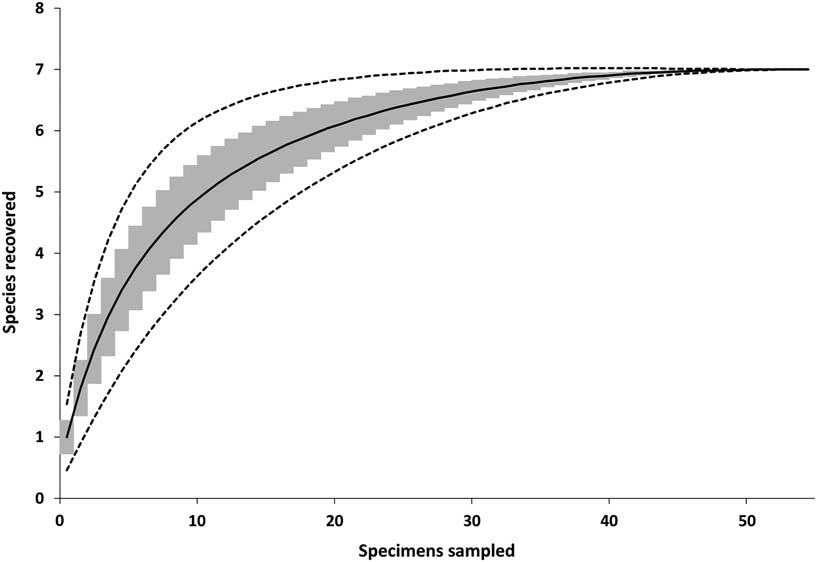
When we revisited the Churchill sites sampled by Gregg in the summer of 1969 we located nests of all species in all collection sites. Using morphological and genetic methods, we found evidence for seven species of ants (Table 1 and Fig. 2). Two of these species were members of species complexes known to be widely distributed across the Nearctic (F. neorufibarbis and Leptothorax muscorum Nylander). In each case we found evidence for multiple DNA barcode clusters, suggesting the presence of multiple species under the same name.
Accumulation curve for ant collections made in Churchill in 2012 at sites originally collected by Gregg in 1969. Dashed lines represent the 95% confidence interval, and grey bars represent the standard deviation of the expected number of species (S(est)) based on 1000 simulations in EstimateS (v9.1).
Most of the seven species were found in all three sites. Exceptions were Myrmica alaskensis and F. neorufibarbis (BOLD:AA1470) (found only in the most southerly bog site) and two of the Leptothorax species (L. muscorum complex and L. acervorum) (each found only at one or both of the two more northerly tundra-like sites) (Table 1).
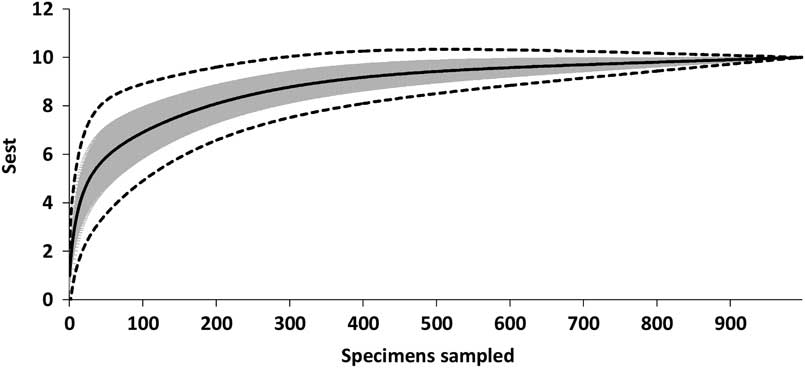
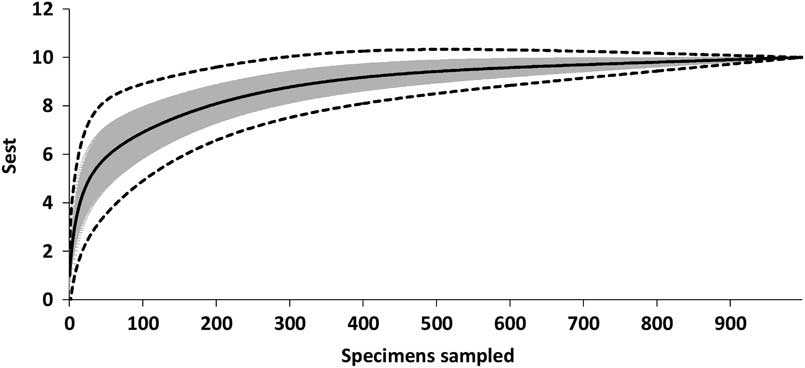
Sampling the broader Churchill area (over the years 2005–2010 yielded three additional species compared to our geographically restricted Gregg resampling (Fig. 3). As in the species set recovered in the 2012 Gregg resampling, the new species from across the wider Churchill area were also DNA barcode divergent and not apparently morphologically different, and likely further members of the F. neorufibarbis and L. muscorum complexes as well as one further species of Myrmica Latreille.
Accumulation curve for all ant collections made in Churchill (2005–2012). Dashed lines represent the 95% confidence interval, and grey bars represent the standard deviation of S(est) based on 1000 simulations in EstimateS (v9.1).
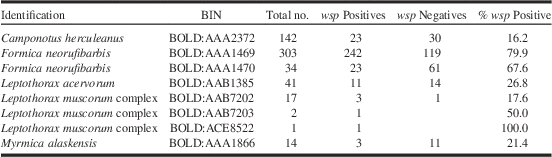
Although sample sizes varied among species (n ranged from 1 to 303), Wolbachia infection was detected in all species, with incidence rates varying between 16% and 100% (Table 2).
Incidence of Wolbachia in Churchill ants determined using the wsp polymerase chain reaction assay.
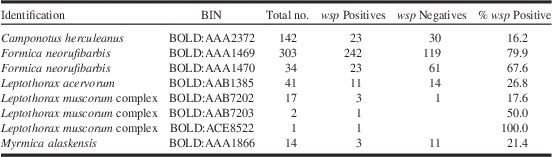
Note: All species tested were found to contain the endosymbiont.
Gregg’s 1969 collections from the Field Museum of Natural History
Specimens appear to have been originally preserved in a low concentration in ethanol and at room temperature and DNA appear to be degraded. This scenario is not uncommon in museum collections and so our strategy was to design primers that amplified shorter fragments that would be less likely to be degraded (while also retaining species identification characteristics). To date, based on nearly 100 amplification trials, we have been able to amplify small fragments of COI DNA from only two species (C. herculeanus and L. muscorum) and so the direct DNA to DNA comparison of the contemporary collection to Gregg’s collections is not possible here.
Discussion
In 1969 Gregg documented the occurrence of five species of ants in the vicinity of Churchill, Manitoba – the same ant species that would be expected to be found near the tree-line in Canada (Francouer Reference Francouer1983). Using the integration of traditional methods based on morphology and DNA barcoding, we report seven species present at the same sites Gregg sampled 40 years earlier. We conclude that the apparent increase is more likely due to morphologically cryptic species (that are genetically divergent) rather than the arrival of species from the south. However, it should be noted that since we were unable to DNA barcode the Gregg collections we are unable to conclusively exclude the possibility that the “new” BINS recovered in 2012 were also present 43 years earlier. Gregg (Reference Gregg1972) found only a single worker of the carpenter ant, Camponotus herculeanus, in the exposed tundra near Cape Merry, but no nests. This differentiates our study as we located nests of all species in all collection sites.
The apparent increase we report in ant diversity at Churchill is more likely to be due to changes in systematics (Francouer Reference Francouer1983; Heinze Reference Heinze1993) and the resolution of species-level diversity afforded by DNA barcoding (Smith et al. Reference Smith, Rodriguez, Whitfield, Deans, Janzen and Hallwachs2008, Reference Smith, Fernandez-Triana, Roughley and Hebert2009) than to the intervening arrival of more southerly distributed species (Fernandez-Triana et al. Reference Fernandez-Triana, Smith, Boudreault, Goulet, Hebert and Smith2011). The two new species recorded in our 2012 collection, one Formica Linnaeus and one Leptothorax Mayr species, are members of species complexes that are difficult to identify morphologically. Furthermore, we did not detect any species that others have predicted could soon be added to the northern ant fauna due (in part) to increased human activity in the area (Francouer Reference Francouer1997) (e.g., Tapinoma sessile (Say)).
Crypsis in apparent species complexes: Formica neorufibarbis and Leptothorax muscorum
Formica neorufibarbis
Churchill ants that were morphologically identified as F. neorufibarbis contained two DNA barcode BINs (BOLD:AA1469 and BOLD:AAA1470) that were 4.74% divergent (K2P distance). In addition to these DNA barcode divergences, the BINs were characterised by a single evident fixed base pair difference within rDNA (D2B region of 28S) (Smith et al. Reference Smith, Fernandez-Triana, Roughley and Hebert2009), and each provisional species are infected with Wolbachia. Infections from different Wolbachia strains can still cause reproductive isolation between host populations, even when both populations maintain Wolbachia (Hurst and Jiggins Reference Hurst and Jiggins2005; Smith et al. Reference Smith, Bertrand, Crosby, Eveleigh, Fernandez-Triana and Fisher2012). The Wolbachia test here was polymerase chain reaction-based and so no direct comparison of sequence divergence is possible. Thus while the specific effects of Wolbachia on these provisional ant species remain unknown, the bacteria may affect host fitness and the mitochondrial divergence of the ant host. Alternatively, the observed genetic divergence may be due to other mechanisms, such as speciation in allopatry during prior glacial cycles. Formica neorufibarbis BOLD:AA1469 was recovered from all three Gregg re-sampling sites, while F. neorufibarbis BOLD:AA1470 was only recovered in the farthest south site of Gregg’s sampling (Goose Creek bog). Each ant keys out (using Creighton (Reference Creighton1950) or Francoeur (Reference Francoeur1973)) to F. neorufibarbis; however, BOLD:AA1469 is a smaller, dark, and concolorous ant, while BOLD:AA1470 is larger and bicoloured with a mesosoma that is lighter in colour than the head or gaster. If we were to align these BINs with existing, but synonymised names, BOLD:AA1469 would be the synonymised subspecies F. gelida Wheeler and BOLD:AA1470 would be F. neorufibarbis. Our evidence suggests that these names should be reconsidered for resurrection to species status.
Although, both species of Formica collected in the Gregg resampling key to F. neorufibarbis they are nearly 5% divergent in the DNA barcode region. The combination of a deep mtDNA divergence congruent with an evident fixed difference in an independent gene region (Smith et al. Reference Smith, Fernandez-Triana, Roughley and Hebert2009), a shared Wolbachia infection, morphological differences, and an apparently sympatric distribution supports the hypothesis that these F. neorufibarbis BINs are, in fact, different species. Before 1973, F. neorufibarbis contained two additional subspecies (F. neorufibarbis gelida and F. neorufibarbis algida) (Francoeur Reference Francoeur1973). However, others felt that Creighton’s subspecies were “untenable” (Brown Reference Brown1955), and in 1973 Francouer synonymised them as representing geographical variants of the same species.
When we compared the Churchill F. neorufibarbis BINs to those found when barcoding Francoeur’s collection in BOLD (http://www.barcodinglife.org/index.php/Public_SearchTerms; search “public data” for “Francoeur”), we found that each BIN was present in geographically broad collections, while one BIN (BOLD:AA1469) was more common than the other (note that each BIN can be searched directly on BOLD to see the breadth of this distribution). Gregg (Reference Gregg1963) reported that the subspecies F. gelida was more characteristic of high-altitude or northern distributions than the F. neorufibarbis ants. Interestingly, we note that while Gregg knew F. gelida, he did not identify it as being present in his Churchill collections.
Leptothorax muscorum
Although the name L. muscorum is still widely applied, it is likely to be a complex of closely related species (Francouer Reference Francouer1997). For instance, using chromosome enumeration, Loiselle et al. (Reference Loiselle, Francoeur, Fischer and Buschinger1990) found that there were at least four species hidden within the name L. muscorum as used by Brown (Reference Brown1955). Furthermore, some historical collections that were originally identified as L. muscorum subsequently had these identifications corrected to L. acervorum, a species formerly thought to be restricted to the Palaearctic, but is now known to occur in northern Canada (including northern Québec and Churchill based on Francouer’s (Reference Francouer1983) re-examinations of previous collections). In Churchill, our sampling over more than five years, has recovered evidence for L. acervorum (BOLD:ACE8522) and for two further species that key out as members of the L. muscorum complex (BOLD:AAB1385 and BOLD:AAB7202).
The important role of DNA barcodes in comparing time periods in Arctic collections
In the recent past, there have been other examples of sampling the arthropods from the Churchill area using DNA barcodes (Araneae – Blagoev et al. (Reference Blagoev, Nikolova, Sobel, Hebert and Adamowicz2013); Diptera – Renaud et al. (Reference Renaud, Savage and Adamowicz2012a); Ephemeroptera, Plecoptera, and Trichoptera – Zhou et al. (Reference Zhou, Adamowicz, Jacobus, DeWalt and Hebert2009); Coleoptera – Woodcock et al. (Reference Woodcock, Boyle, Roughley, Kevan, Labbee and Smith2013); and Hymenoptera – Smith et al. (Reference Smith, Fernandez-Triana, Roughley and Hebert2009), Fernandez-Triana et al. (Reference Fernandez-Triana, Smith, Boudreault, Goulet, Hebert and Smith2011), Stahlhut et al. (Reference Stahlhut, Fernández-Triana, Adamowicz, Buck, Goulet and Hebert2013). In a few cases (Fernandez-Triana et al. Reference Fernandez-Triana, Smith, Boudreault, Goulet, Hebert and Smith2011; Renaud et al. Reference Renaud, Savage and Roughley2012b), these recent collections were compared with historical collections. In the case of the Hymenoptera (specifically the subfamily Microgastrinae (Braconidae)) there were dramatic changes in the community between samples collected over a 50-year period. However, in the case of the Diptera (specifically the family Muscidae) there were no changes observed.
The increasing number of comparisons between historical collections and contemporary collections in the Canadian Arctic or Subarctic has recorded incidences of change and stasis (including for the Diptera (Subarctic – Renaud et al. Reference Renaud, Savage and Roughley2012b) and Hymenoptera (High Arctic – Timms et al. Reference Timms, Bennett, Buddle and Wheeler2013)). In each of these two studies, they found no significant differences between sampling periods in spite of demonstrably large changes in climate. However, it is important to note that in these cases the analyses used expert-identified specimens (via morphology alone) as their taxonomic grain size (no genetic evidence). In many cases with many insect groups (including both parasitoids and flies) it is increasingly accepted that species boundaries can be most accurately estimated using an integrative approach that includes both morphology and DNA, as many species are morphologically quite cryptic and perhaps variant in only qualitative character states (Rodriguez et al. Reference Rodriguez, Fernández-Triana, Smith, Janzen, Hallwachs and Erwin2012). Thus, it is interesting to contrast Renaud et al. (Reference Renaud, Savage and Roughley2012b) and Timms et al. (Reference Timms, Bennett, Buddle and Wheeler2013) with the findings of Fernandez-Triana et al. (Reference Fernandez-Triana, Smith, Boudreault, Goulet, Hebert and Smith2011), who used both DNA and morphology-based species estimates to compare historical and contemporary collections and found differences in the community composition. Renaud et al. (Reference Renaud, Savage and Roughley2012b) and Timms et al. (Reference Timms, Bennett, Buddle and Wheeler2013) both note that the Fernandez-Triana et al. (Reference Fernandez-Triana, Smith, Boudreault, Goulet, Hebert and Smith2011) finding may have been skewed by large intra-specific differences being analysed as representative of inter-specific differences, which is true. However, what is missing from their analysis is a recognition that by not barcoding any (Timm’s) or only half (Renaud) of their chrono-sequence, their analyses would be unable to capture species differences in community composition hidden by cryptic species. We call attention to this methodological difference (barcoding only one of multiple, chrono-sequences) here as it is germane to our work. In the case of our comparison of the ant fauna at Churchill over 40 years, we have barcoded the 2012 ant collections – but not the Gregg collections due to degraded DNA. Thus, we cannot exclude the possibility that in our own analysis, we have missed morphologically cryptic species present only in the 1969 collections but absent in the contemporary collections. However, we consider this unlikely given that we recovered precisely the same morphospecies as Gregg and have no evidence of additional species that have migrated northward. Moreover, the additional species we have documented are largely morphologically cryptic and divergent in COI, and thus we cannot reject the hypothesis that these new species are simply intraspecific variants.
Conclusions
The ant fauna in the subarctic locality surrounding Churchill, Manitoba does not appear to have significantly changed since the area was surveyed in the late 1960s. The fauna is dominated by species known to be characteristic of the tree-line and tundra environment in Canada and is characterised by taxonomically difficult species complexes. As a locality with a long history of hosting scientific inquiry, there is great value in continuing to regularly survey the insect and arthropod fauna in and around the Churchill region, as the response of this diverse community is unlikely to be simple.
Acknowledgements
The authors would like to thank LeeAnn Fishback and all the staff at the Churchill Northern Studies Centre (CNSC) for logistical support before, throughout, and following the 2012 field course in Arctic Ecology offered by the University of Guelph and through the Ontario Universities Program in Field Biology (OUPFB). They acknowledge Chelsie Xavier-Blower’s help in taking specimen photographs in the intervening time at the University of Guelph. They thank Dr. Corrie Moreau and Beka Baquiran from the Field Museum of Natural History for the rapid and helpful loan of Gregg’s 1969 specimens that are accessioned in Chicago. We thank the University of Guelph for support that allowed the 2012 DNA barcoding and GigaPan photography through the Learning Enhancement Fund (LEF). MAS’s work is supported by a Discovery Grant from the Natural Sciences and Engineering Research Council of Canada (NSERC) and the Leaders Opportunity Fund (LOF) from the Canada Foundation for Innovation (CFI). Laboratory analyses of the COI sequences generated from the 2012 collection were subsidised by the Government of Canada through Genome Canada and the Ontario Genomics Institute (2008-0GI-ICI-03).