


Scholars of public policy have long observed the critical role that problem definition plays in the process of policy initiation and the specification of policy alternatives (Baumgartner and Jones Reference Baumgartner and Jones1993; Best Reference Best1995; Cobb and Elder Reference Cobb and Elder1983; Kingdon Reference Kingdon1984; Schattschneider Reference Schattschneider1975; Schneider and Ingram Reference Schneider and Ingram1993; Stone Reference Stone1989). Through problem definition, decision makers link claims about the causes, consequences, and solutions to public problems, often reducing a complex issue to a simple causal story (Roe Reference Roe1994; Stone Reference Stone1989). This can be a contentious process, because the power to define alternatives is a fundamental expression of political power (Schattschneider Reference Schattschneider1975) and the causes of policy problems are “matters of interpretation and social definition” (Cobb and Elder Reference Cobb and Elder1983, 172). Policy innovations emerge as policy makers attend to a new dimension of a policy problem, combining the goals, instruments, and targets of policy into a single policy idea.
This process of problem definition has been largely neglected in studies of policy diffusion across the United States.Footnote 1 Most studies have focused on “the process and conditions for [policy] transfer rather than the content of new policies” (Reference StoneStone 2001, 3), leaving aside questions as to how variations in the design and content of innovations influence policy diffusion (Karch Reference Karch2007). Recent research has begun to explore how policy characteristics shape diffusion, but this work has focused on attributes related to the ease of policy implementation, analyzing how the cost, complexity, and salience of innovations shape the speed of policy diffusion (Boushey Reference Boushey2010; Makse and Volden Reference Makse and Volden2011; Nicholson-Crotty Reference Nicholson-Crotty2009). Although important, this approach overlooks more basic factors that shape preferences for policy adoption. It often overlooks the fact that complex information about policy information is distilled into a simple policy image (Baumgartner and Jones Reference Baumgartner and Jones1993) that becomes “embedded in policy as messages that are absorbed by citizens and affect their orientations and participation patterns” (Schneider and Ingram Reference Schneider and Ingram1993, 993). The decision to adopt a neighbor's policy innovation is often influenced as much by information connecting the target to the goals of policy as by the technical details of the innovation itself (Mossberger Reference Mossberger2000).
There is evidence that shifts in problem definition influence the diffusion of innovations. For example, the moral panic leading to the rapid diffusion of state marijuana prohibitions in the 1930s was triggered by widespread concern over the dangers of the “sex-crazed drug menace” caused by the “burning weed of hell” (Goode and Ben-Yehuda Reference Goode and Ben-Yehuda1994, 153). The redefinition of child abuse as a public problem in the 1960s resulted in the rapid implementation of new child abuse reporting regulations across states (Reference NelsonNelson 1986). Similarly, disagreement about the severity of the problem and the appropriateness of proposed solutions impeded the diffusion of statutory rape (Reference CoccaCocca 2002) and spousal abuse (Best Reference Best1995) legislation in the United States. In each of these cases scholars have explored how a shift in the public understanding of a problem influenced the diffusion of innovations.
This study draws on Schneider and Ingram's (Reference Schneider and Ingram1993; Reference Schneider and Ingram2005) policy design framework to examine how differences in the social construction of public problems shape the diffusion of criminal justice policy innovations. This policy design framework provides a systematic approach for thinking about how popular perceptions of Target populations—the group singled out for special treatment in public policies (Donovan Reference Donovan2001, 4–5)—may influence both the design and diffusion of innovations. Diffusion occurs most readily when policy design is congruent with that target population—meaning the prescription of policy burdens and benefits to a specific target population aligns closely with how that group is perceived in the broader social context. Diffusion is impeded when an innovation is noncongruent, providing benefits or burdens to a target population in a manner that is incompatible with the popular understanding of the justice, fairness, or propriety of policy intervention. There are few barriers to congruent policy diffusion. These policies enjoy widespread public support, engender minimal counter-mobilization by the target population, and promise strong electoral returns for policy makers. Noncongruent policies offer less immediate benefits to elected officials, because these innovations may invite counter-mobilization by either the mass public or the target group itself.
To understand these processes I examine the mechanisms of criminal justice policy diffusion in the United States, exploring whether the same factors that shape policy design also influence policy diffusion. I specifically assess whether electoral incentives lead policy makers to converge on select forms of policy making, as politicians work to maximize the electoral benefits of congruent policy making and avoid the potential costs of noncongruent reforms. I extend this research to explore the determinants of criminal justice policy diffusion, examining how changes in partisanship, problem severity, and geographic and ideological contiguity influence the probability that a state will adopt different types of innovation.
To explore these dynamics, I draw on a dataset of 44 criminal justice policies adopted by U.S. state governments from 1960 through 2008. I code historical newspaper coverage of each criminal justice innovation, estimating simple measures of the image and political power of the primary targets of legislation, as well as the allocation of policy benefits and burdens. I rely on this coding scheme to construct several measures of policy congruence. I then employ pooled event history analysis to model how differences across policies, states, and time shape policy diffusion.
This approach provides for a unique empirical test of policy design theory, because it enables evaluation of key predictions regarding the congruence of policy, the electoral incentives of public officials, and the temporal dynamics of policy making within a single model. Although Schneider and Ingram (Reference Schneider and Ingram1993, 335) contend that the “social constructions of target populations are measurable, empirical, phenomena” that “have boundaries that are empirically verifiable and exist within objective conditions,” I know of no study that has operationalized and evaluated the key propositions of policy design theory in a large comparative framework. I draw on diffusion of innovations theory to develop and test falsifiable propositions regarding the politics of policy design, contributing to a growing body of research examining the empirical implications of constructivist theories of the policy process (Jones and McBeth Reference Jones and McBeth2010; Mcbeth et al. Reference McBeth, Shanahan, Arnell and Hathaway2007; Shanahan, Jones, and McBeth Reference Shanahan, Jones and McBeth2011).
This research connects the study of U.S. state policy making to the rich tradition of constructivist scholarship on public policy diffusion (Checkel Reference Checkel2001; Stone Reference Stone2001; Strang and Meyer Reference Strang and Meyer1993; Victor Reference Victor1998) by introducing a framework for thinking about how bias in the design of policy innovations shapes patterns of policy adoption across states.
My findings strongly support the central claim of policy design theory: that congruent criminal justice policies that reinforce popular stereotypes diffuse more readily than noncongruent policies that challenge biases over who is deserving of policy intervention. I also extend research on the paths of influence in diffusion, demonstrating that ideological alignment enhances the probability that governments will adopt controversial policy reforms.
My findings regarding the role of electoral pressure on state policy making are more nuanced. Following recent research on elite responsiveness in contemporary criminal justice policy making (Enns Reference Enns2014; Nicholson-Crotty, Peterson, and Ramirez Reference Nicholson-Crotty, Peterson and Ramirez2009), I find that state governments are more likely to adopt congruent policy innovations when crime is a nationally salient public problem. Contrary to widespread expectations in the diffusion of innovations (Berry and Berry Reference Berry and William1990), policy design (Schneider and Ingram Reference Schneider and Ingram1993), and criminal justice (Gottschalk Reference Gottschalk2008) literatures, however, I find little evidence that the timing or competitiveness of state elections leads governments to adopt congruent “tough on crime” policy reforms. Instead, I find that rising electoral competition increases the chance that governments will adopt noncongruent innovations that extend social services to marginalized and stigmatized groups. This helps resolve a central puzzle of policy design theory regarding the pressures leading to policy change and provides new insight into the political forces shaping the recent proliferation of alternative sentencing innovations in the United States.
PROBLEM DEFINITION AND THE DIFFUSION OF INNOVATIONS
In recent years researchers have directed attention to how the characteristics of innovations shape policy diffusion (Boushey Reference Boushey2010; Makse and Volden Reference Makse and Volden2011; Nicholson-Crotty Reference Nicholson-Crotty2009). The emerging perspective focuses on the virulence of the policy idea itself, drawing on existing typologies (Lowi Reference Lowi1972; Rogers Reference Rogers1983) to model how attributes such as cost, complexity, salience, and fragility shape the spread of innovations over time (Boushey Reference Boushey2010; Makse and Volden Reference Makse and Volden2011; Nicholson-Crotty Reference Nicholson-Crotty2009; Savage Reference Savage1985). These studies have refined our understanding of the mechanisms of policy diffusion. Policies characterized by high salience and limited complexity engender widespread citizen support for their adoption, triggering rapid diffusion across states (Boushey Reference Boushey2010; Nicholson-Crotty Reference Nicholson-Crotty2009). In contrast, complex and costly innovations require specialized analysis, increasing the costs of decision making and slowing rates of diffusion (Boushey Reference Boushey2010; Makse and Volden Reference Makse and Volden2011).
Although policy complexity and cost determine the feasibility of implementation, political actors may prioritize other relevant dimensions of policy when evaluating a new innovation. Mossberger (Reference Mossberger2000) found that information regarding innovations spread through what she termed policy labels—condensed narratives regarding the overarching principles and goals of innovation rather than details of the policy instruments themselves. This echoes what May (Reference May1992, 336–37) referred to as “superstitious” policy learning, where “beliefs about effectiveness of particular actions or individuals dominate any understanding of evaluation of performance.” Decision makers may not engage in comprehensive policy evaluation prior to adoption, but instead may selectively rely on simple arguments regarding the general benefits of innovation (Boushey Reference Boushey2010).
This perspective is consistent with a nearly axiomatic assumption of public policy process theory—that political responses to policy problems change with the way a problem is defined and understood by the public and elites (Baumgartner and Jones Reference Baumgartner and Jones1993; Cobb and Elder Reference Cobb and Elder1983; Kingdon Reference Kingdon1984; Roe Reference Roe1994; Stone Reference Stone1989). Studies of agenda setting emphasize that preferences for policy action are determined by the connection between problem definition and proposed governmental solutions (Baumgartner and Jones Reference Baumgartner and Jones1993; Schattschneider Reference Schattschneider1975; Stone Reference Stone1989). As Baumgartner and Jones (Reference Baumgartner and Jones1993, 29) note, “policymaking is strongly influenced not only by changing definitions of what social conditions are subject to government response. . . but also and at the same time by changing definitions of what would be the most effective solution to a given public problem.”
Such shifts in problem definition can trigger sudden policy change (Baumgartner and Jones Reference Baumgartner and Jones1993; Kingdon Reference Kingdon1984). For example, the dramatic increase in drunk driving (DUI) legislation in the early 1980s occurred after perceptions of drunk driving shifted from it being a “folk crime” committed frequently by “good citizens” to a negligent and immoral act that threatened the lives of innocents (Reinarman Reference Reinarman1988). The changing image of the DUI problem prompted unprecedented policy change at virtually every level of government, as policy makers enacted new standards related to the regulation and enforcement of drunk driving. Although students of public policy have theorized that these same dynamics shape policy diffusion (Best Reference Best1995; Boushey Reference Boushey2010; Nelson Reference Nelson1986; Savage Reference Savage1985), they have yet to rigorously address how differences in problem definition shape patterns of policy adoption across state governments.
POLICY DESIGN THEORY
Researchers have focused on the social construction of target populations to gain insights into how problem definition shapes policy design (Donovan Reference Donovan2001; Nicholson-Crotty and Nicholson-Crotty Reference Nicholson-Crotty and Nicholson-Crotty2004; Schneider and Ingram Reference Schneider and Ingram1993; Reference Schneider and Ingram2005; Schneider and Sidney Reference Schneider and Sidney2009). These scholars note that political conflict is shaped by the way that policy makers and the public assign stereotypes to target populations: “groups of people delimited by some set of shared characteristics who are identified as the recipient of a benefit, a burden or special treatment under [sic] law” (Donovan Reference Donovan2001, 4). Policy design theory offers a systematic way of identifying components of problem definition that are empirically verifiable across a broad class of innovations (Schneider and Ingram Reference Schneider and Ingram1993).Footnote 2
In general terms, policy design theory conceptualizes the design of new public policy as a simple binary choice: New policy can either extend benefits or prescribe policy burdens to targeted groups. For example, in addressing the problem of HIV transmission among intravenous drug users, policy makers may opt to increase the criminal penalties for possession of drug paraphernalia, thereby imposing a new policy burden on the target population. Conversely, policy makers could respond to the problem of disease transmission by extending a government benefit to drug users—establishing needle exchange programs and providing medically supervised injection facilities for intravenous drug users.
Such choices over the design of public policy are influenced by the characteristics of the target populations. First, policy makers must account for the social image of the group targeted by legislation. Target groups are recognized by stereotypes that define how they are perceived in the broader social context (Schneider and Ingram Reference Schneider and Ingram1993). Their image influences the type of government intervention that policy makers favor in policy design. Groups stigmatized by negative images are typically targeted with policy burdens, as government seeks to alter behavior through coercion. Groups with positive images receive policy benefits in the form of expanded programs and services. The key insight is that elected officials anticipate public responses as they design policy. Politicians fear electoral costs should policy design conflict with widely held stereotypes over who is entitled to policy benefits or deserving of policy burdens.
Policy makers must also account for the political power of groups targeted by legislation. Target populations vary in their ability to engage the policy process, shape their image, and pressure for favorable policy. Powerful target groups can mobilize in opposition to or support of policy, whereas weaker or marginalized target populations lack the political power to effectively engage the policy process (Goode and Ben-Yehuda Reference Goode and Ben-Yehuda1994; Schneider and Ingram Reference Schneider and Ingram1993). Policy makers have incentives to confer policy benefits on politically powerful groups, but receive little electoral reward for providing benefits to weak populations.
The central dynamics in policy design theory emerge as a result of the strategic behavior of public officials seeking to win and retain political power (Ingram, Schneider, and deLeon Reference Ingram, Schneider, deLeon and Sabatier2007). When formulating policy, elected officials work to bring the power, image, and logic of policy into congruence—meaning that they attempt to engineer the design of policy in a manner that meets public preferences for policy making while also maximizing support or minimizing opposition from the targets of policy interventions themselves. Policy makers have strong electoral incentives to engage in only two forms of congruent policy making: imposing policy burdens on negatively viewed and powerless deviant populations and rewarding strong advantaged groups with distributive and symbolic benefits (Ingram, Schneider, and deLeon Reference Ingram, Schneider, deLeon and Sabatier2007). All other transfers of policy benefits or burdens are noncongruent, because they produce electoral risks. Policy making invites conflict when public officials target powerful but negatively viewed contenders—groups that are powerful enough to mobilize and pressure elected officials, but are widely viewed as undeserving of policy benefits. Officials prefer to pass symbolic and indirect policy benefits to dependents, because these targets lack the power to mobilize and reward policy makers with votes or other electoral subsidies.Footnote 3 Whenever possible, policy makers will avoid imposing burdens on any population but deviants, because such noncongruent policy invites electoral costs stemming from public disapproval, counter-mobilization from strong target populations, or both (Schneider and Ingram Reference Schneider and Ingram1993).
These dynamics influence virtually every stage of the policy process. When confronted with rising public pressure to resolve a salient policy problem, politicians work to formulate congruent policy solutions that show “how a proposed policy is logically connected to these widely shared public values” (Schneider and Ingram Reference Schneider and Ingram1993, 336). Such congruent policy proposals “will be high on the legislative agenda, especially during election campaigns,” as public officials work strategically to manipulate the agenda to maximize electoral returns (337). Policy design theory therefore predicts that electoral pressures shape both the content and the timing of policy proposals.
POLICY DESIGN AND THE DIFFUSION OF INNOVATIONS
Although policy design theory has been widely applied to model the development and implementation of public policy (Ingram, Schneider, and deLeon Reference Ingram, Schneider, deLeon and Sabatier2007), it has not been integrated into research on the diffusion of public policy innovations. This is surprising, because studies of policy diffusion anticipate that many of the same factors that shape the design of new innovations also shape policy diffusion. For example, constructivists theorize that shifts in collective perceptions of deviance can trigger moral panics, leading to the rapid diffusion of innovations across states (Best Reference Best1995; Goode and Ben-Yehuda Reference Goode and Ben-Yehuda1994; Victor Reference Victor1998). This same research suggests that homophily plays a critical role in shaping state susceptibility to innovation, because states are more likely to adopt policy innovations that have been legitimized by their geographic, cultural, or ideological peers (Dobbin, Simmons, and Garrett Reference Dobbin, Simmons and Garrett2007; Strang and Meyer Reference Strang and Meyer1993; Victor Reference Victor1998).
Students of American state politics likewise recognize how factors that shape elite preferences in the design of public policy explain the diffusion of innovations. Savage (Reference Savage1985) argued that the speed of diffusion is shaped by innovation fragility—the strength of organized political forces standing in opposition to policy adoption. Boushey (Reference Boushey2010) extended this research, suggesting that criminal justice policies designed to protect dependent children would spread rapidly due to widespread public support and limited opposition. Just as the strength of target populations influences the design of public policy, the threat of counter-mobilization by target groups is a key factor in the diffusion of innovations.
Scholars have also dedicated attention to the electoral mechanisms leading to policy diffusion. Walker (Reference Walker1969, 885) anticipated that electoral pressure was an essential mechanism leading to the development and diffusion of state policy innovation, writing that parties that “face closely contested elections would try to out-do each other by embracing the newest, most progressive programs.” Policy diffusion researchers have subsequently argued that strategic electoral calculations are important determinants of a state's decision to adopt innovations, finding that politicians imitate the politically popular policies of their neighbors in order to secure electoral rewards (Berry and Berry Reference Berry and William1990; Karch Reference Karch2007; May Reference May1992).
Although there is general agreement that political pressures shape the diffusion of innovations, there is less consensus over the precise electoral mechanisms leading to policy diffusion. Building on the idea that policy makers strategically time decisions on popular legislation to maximize electoral returns, scholars have explored how the proximity (Berry and Berry Reference Berry and William1990) and competitiveness (Haider-Merkel Reference Haider-Markel1998) of state elections increase the probability that state governments will adopt policy innovations.Footnote 4
More recently, scholars have explored how public pressures for responsive policy making lead policy makers to enact salient or popular policy innovations (Nicholson-Crotty Reference Nicholson-Crotty2009; Pacheco Reference Pacheco2012). As Nicholson-Crotty (Reference Nicholson-Crotty2009, 196) explains, citizen support for popular innovations “compels lawmakers interested in reelection to forgo policy learning in order to gain the electoral benefits of quick adoption.” This perspective is consistent with broader research on representation, which contends that electoral incentives influence the behavior of lawmakers representing safe and competitive districts alike (Mann Reference Mann1978).
The policy design framework allows us to identify how the social construction of target populations influences policy diffusion. First, if preferences for policy adoption are shaped by political conflict produced by policy design, then state governments will be more likely to adopt congruent policies due to mass public support and limited political opposition. To the extent that noncongruent policies achieve agenda status at all, the diffusion of these policies will be impeded due to low public support and high political opposition. This suggests the following policy congruence hypothesis:
H1: States will be more likely to adopt congruent policies than noncongruent policies.
Policy design theory also suggests a specific electoral mechanism leading to policy adoption. If reelection-driven policy makers form policy preferences because of electoral pressures, then politicians will be more likely to engage in selective policy making to secure the electoral awards of enacting congruent policy. This points to the following electoral pressure hypothesis:
H2: States will be more likely to adopt congruent policy reforms as electoral pressure increases.
Policy design theory also proposes that policy makers have distinct electoral incentives to engage in policy making depending on the power and image of the target population. Policy makers have strong incentives to transfer policy benefits to advantaged groups and impose policy burdens on deviants. This leads to two refinements of the electoral pressure hypothesis:
H3: States will be more likely to adopt policies transferring benefits to advantaged populations as electoral pressure increases.
H4: States will be more likely to enact policy imposing policy burdens on deviant populations as electoral pressure increases.
METHODOLOGY
Data
To model how policy design shapes the diffusion of innovations I constructed a sample of 44 criminal justice policies adopted by U.S. state governments between 1960 and 2008; this sample accounted for cyclical patterns in criminal justice policy in recent U.S. history (Schneider Reference Schneider2006). Focusing on criminal justice provides a good opportunity to observe the dynamics of policy design theory in state policy diffusion. Crime control is a salient policy area for state governments and invites both public and elite participation in policy making. Perhaps more importantly, policy design theory has been widely applied to model sources of conflict in criminal justice policy innovation (Nicholson-Crotty and Nicholson-Crotty Reference Nicholson-Crotty and Nicholson-Crotty2004; Schneider Reference Schneider2006). If policy design theory cannot be applied to understand the diffusion of criminal justice reform, then it is unlikely to inform a more general understanding of policy diffusion.
I relied on two general resources to construct this sample of criminal justice policies. First, I identified a large set of criminal justice policies that were included in prior research on policy innovation and diffusion (Boehmke and Skinner Reference Boehmke and Skinner2012; Boushey Reference Boushey2010; Makse and Volden Reference Makse and Volden2011). I then identified additional reforms from the legislative tracking services of various professional organizations and government agencies such as the National Council of State Legislatures (NCSL) and the U.S. Department of Justice (2012). This sample included a mix of congruent and noncongruent criminal justice reforms adopted by states through the period of observation.
Measuring Policy Congruence
I constructed measures of policy congruence and noncongruence based on the three dimensions of policy design theory: the social image of the intended target of criminal justice legislation, the perceived power of the target population, and the assignment of policy benefits and burdens. Policy design theory suggests that these dimensions can be captured with a matrix indicating the power of target groups (weak/strong), the image of target groups (positive/negative), and the tools of policy design (policy benefits/burdens) (Schneider and Ingram Reference Schneider and Ingram1993, fig. 2).Footnote 5
Despite the seeming simplicity of policy design theory, researchers have faced considerable challenges implementing classification schemes to identify the targets of policy innovation. Critics of policy design theory note that the image of policy targets can shift across jurisdictions and over time (Lieberman Reference Lieberman1995). Equally problematic is that criminal justice policies often appear to have multiple targets, as lawmakers impose burdens on deviant populations in order to protect the social welfare of victims (Donovan Reference Donovan2001). Schneider and Ingram (Reference Schneider and Ingram1993) offer no clear rules for discerning the target or the political power of groups.
Prior studies have overcome these challenges by narrowing the definition of target populations. Donovan (Reference Donovan2001, 5) focused on the explicit targets of legislation: “If lawmakers aim a policy provision at group A and say they are doing so to improve the welfare of group B, only group A is held to be a target population. Such a distinction helps disentangle policies from rhetoric and sets up analysis of the various ways that policy rationales are, or not, connected to the actual content of policies.”
Of course, a limitation of such a narrow coding rule is that it ignores the rhetorical targeting that may influence public support for criminal justice policy reform. For example, although the Amber Alert program targets state radio and television stations to broadcast missing children alerts, public support for the program was almost certainly motivated by a desire to protect kidnapped children. The important dynamic I wished to capture was how elected officials and publics perceived the intended target of legislation when they were made aware of the policy innovation.
To capture these dimensions I analyzed coverage of policy innovations in national newspapers.Footnote 6 Relying on newspapers allows an identification of how politicians and publics perceived the target and goals of criminal justice innovation as policy was being evaluated.Footnote 7 When possible I collected articles for each innovation from multiple sources over time, allowing assessment of the consistency of social constructions across time and place.Footnote 8
I employed research assistants to code newspaper coverage of the criminal justice policies in the sample. Coders first identified the target population, noting the name of the group singled out for legislative attention or special treatment under law (Donovan Reference Donovan2001, 5), who writes that target populations are groups “singled out in a statute.” Coders then classified the social construction of policy along the three dimensions of policy design theory. To preserve the key elements of policy design theory, coders were given explicit examples taken from prior research on the social construction of target populations (Ingram, Schneider, and deLeon Reference Ingram, Schneider, deLeon and Sabatier2007, 102; Schneider and Sidney, 107).
Table 1 presents this classification, listing the image, power, design, and congruence for each policy in the sample. Coder agreement on the open-ended identification of the target population was 88%.Footnote 9 Coder agreement for the three dimensions of policy targets averaged 85%, with an average Cohen's kappa of .60.
Policies Coded by Image, Power, Design, and Congruence

Note: The design and category columns together identify the seven different policy design types.
I drew on this classification to capture how the politics of policy design shape the diffusion of innovations. I first created a simple dichotomous variable for Policy Congruence, collapsing policies that impose burdens on deviants and benefits on advantaged target groups into a single category and generating a second category for noncongruent innovations. In keeping with the policy congruence hypothesis, I expected that states would be more likely to adopt congruent policies than noncongruent policies.
To understand political dynamics that emerge as policy makers allocate policy benefits and burdens to distinct target populations I created separate indicators for innovations falling in each cell of Schneider and Ingram's (Reference Schneider and Ingram1993; Reference Schneider and Ingram2005) target population typology: Benefits Advantaged, Burdens Advantaged, Benefits Dependents, Burdens Dependents, Benefits Contenders and Benefits Deviants, and Burdens Deviants.Footnote 10 These variables allowed an exploration of heterogeneity in the determinants of congruent and noncongruent policy diffusion.
Analyzing Electoral Pressure, Temporal Dynamics, and Diffusion Effects
Following Berry and Berry (Reference Berry and William1990) I included two dummy variables to evaluate the impact of the electoral cycle on policy making. Elect1 is an indicator capturing whether a gubernatorial election was held in a given year, whereas Elect2 is an indicator assigned to years that were neither a gubernatorial election year nor the year following a gubernatorial election. These variables allowed an assessment of how the proximity of top-of-the-ticket elections shapes policy diffusion.Footnote 11 If policy makers strategically time congruent policy adoption to win voter support prior to elections, then I would expect large and positive coefficients for Elect1 and smaller positive coefficients for Elect2.
I included a separate measure of state Electoral Competition to account for how competitive political environments influence policy making. This is a four year moving average of Holbrook and Van Dunk's (Reference Holbrook and Van Dunk1993) index of district-level electoral competition, as calculated by Klarner (Reference Klarner2013).Footnote 12 These data provided a longitudinal measure of the average electoral pressure facing state legislatures from 1970 through 2008. I expected that states would be more likely to adopt congruent policy as electoral competition increased.
I also included the Policy Agendas Project's measure of National Crime Salience taken from Gallup's Most Important Problem survey to capture public attention to crime as a policy problem (Policy Agendas 2012).Footnote 13 Following both policy design theory and recent research on representation and responsiveness in criminal justice policy making (Enns Reference Enns2014; Nicholson-Crotty, Peterson, and Ramirez Reference Nicholson-Crotty, Peterson and Ramirez2009) I expected that state governments would be more likely to adopt congruent criminal justice reforms as national concern over the crime problem increased.Footnote 14
I added several variables to explore the mechanisms of criminal justice policy diffusion. To account for regional influence in the diffusion of innovations I constructed a measure of the proportion of Neighbors that adopted a given criminal justice policy innovation in the year under observation. I included a measure of state Political Ideology (Berry et al. Reference Berry, Ringquist, Fording and Hanson2007) to control for the possibility that liberal or conservative states hold different preferences for criminal justice reform.Footnote 15 Following Grossback, Nicholson-Crotty, and Peterson (Reference Grossback, Nicholson-Crotty and Peterson2004), I used this indicator to calculate the Ideological Distanc e between adopting and nonadopting states for each policy/year. This enabled me to test whether governments were more likely to adopt criminal justice policies that have already been adopted by their ideological peers.Footnote 16 I expected the probability of policy adoption to decrease as ideological distance increased.
I also included several control variables to account for factors that may shape the diffusion of crime policy innovations over time. Legislative Session accounts for differences in opportunities for lawmaking across states with annual versus biennial sessions.Footnote 17 Squire's (Reference Squire1992) measure of Legislative Professionalism captures how variation in the staff, resources, and days in session shape a state's preferences for criminal justice reform.Footnote 18 Democratic Party Strength represents the percentage of the upper and lower legislative chambers controlled by the Democratic Party, whereas Democratic Governor controls for the party of the governor.Footnote 19
I measured problem severity using annual statistics on state Violent Crime Rates taken from the U.S. Department of Justice (2012). To evaluate more precisely whether the rising costs of incarceration or policing shape rates of criminal justice policy adoption I included Crime Control Spending per Capita and Crime Control Spending per Capita,2 created by combining the U.S. Census's Annual Survey of State Government Finances measures of per capita corrections expenditures and per capita police expenditures.
I included a set of demographic variables taken from the U.S. Census (2012). To account for how state size and wealth shape preferences for criminal justice reform policy I included Logged Population and Per Capita Income. To control for the impact of racial composition on criminal justice policy making, I included a measure of the Pct. Population White.
Finally, to evaluate the temporal dynamics of policy design theory I included a simple counter variable indicating the time elapsed from the point a state is first at risk for adopting a given policy. Because policy design theory offers an explicit hypothesis about the relationship between time and the oversubscription of policy (Schneider and Ingram Reference Schneider and Ingram1993) I included a polynomial transformation of the time variable to capture whether a state's probability of policy adoption changes over time (Carter and Signorino Reference Carter and Signorino2010). Time, Time2 , and Time3 enabled an interpretation of historical trends in the diffusion of criminal justice policy innovations.
Using Event History Analysis
To estimate the probability of state policy adoption over time, I organized the data for event history analysis (Box-Steffensmeier and Jones Reference Box-Steffensmeier and Jones2004). The period of observation started with the year the first state adopted a policy innovation. The dependent variable recorded whether each state adopted a given policy within a specific year. Once a state adopted a given policy it was removed from all subsequent years under observation, because it was no longer at risk for adopting that reform. Following studies on the diffusion of multiple innovations (Boehmke Reference Boehmke2009; Makse and Volden Reference Makse and Volden2011) I organized a panel dataset, with observations pooled by policy, state, and year. The dependent variables represented the year of state policy adoption for each policy from 1960–2008.
I used pooled event history analysis to model the diffusion of multiple innovations (Boehmke Reference Boehmke2009; Makse and Volden Reference Makse and Volden2011). Because the dependent variable was dichotomous, I employed a logit time series model (Carter and Signorino Reference Carter and Signorino2010). I clustered standard errors by state- year to account for dependency and correlated errors in the model.
RESULTS
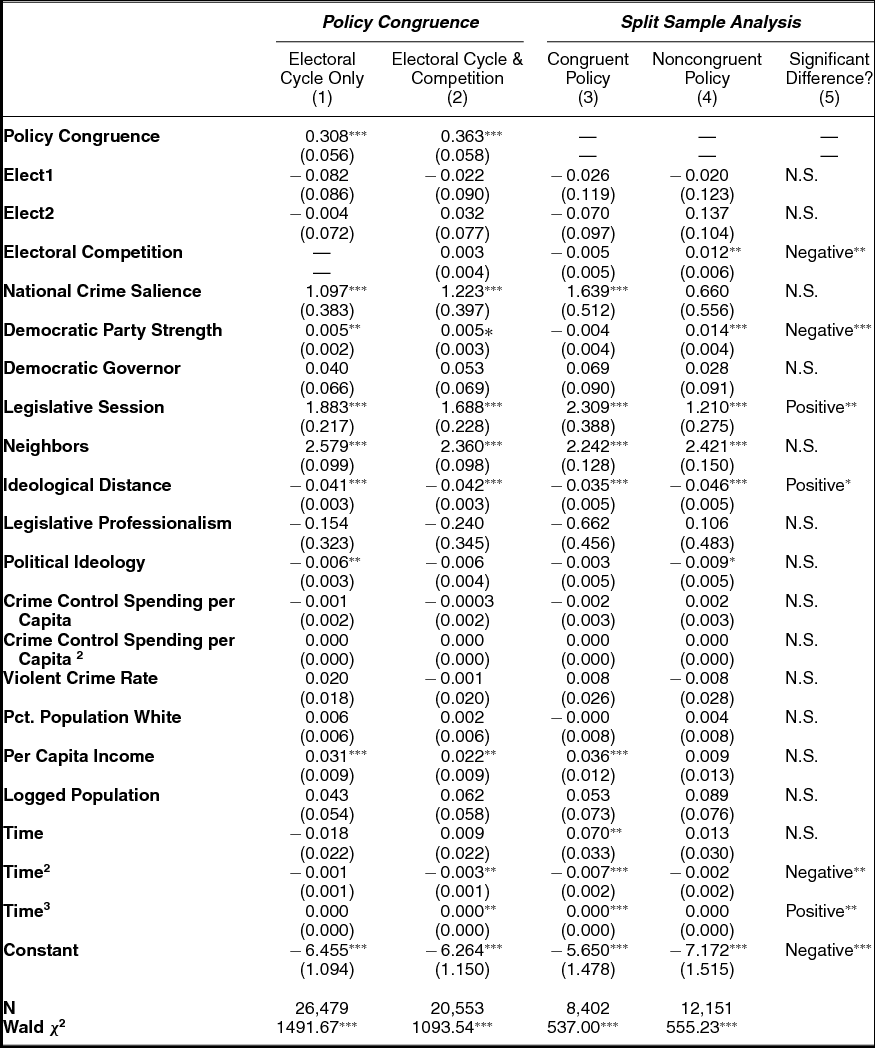
I begin by exploring the impact of policy congruence on the diffusion of criminal justice policy innovations, as shown in the first two columns of Table 2. Because the measures of district-level electoral competition are only available from 1970 forward, I estimate two models—one with only the electoral cycle measures and a second adding electoral competition. The variables of interest are the measures of policy congruence—constructed by calculating the power, social image, and assignment of benefits and burdens embedded in policy.
Congruence, Electoral Pressure, and the Mechanisms of Criminal Justice Policy Diffusion

Note: Observations clustered by state-year. Robust standard errors in parentheses.
*** p < 0.01, ** p < 0.05, * p < 0.1. N.S. = not statistically significant
Table 2 allows for an assessment of the impact of policy congruence on the diffusion of innovations. The coefficients for the policy congruence variables in columns 1 and 2 are positive and statistically significant, providing strong support for the policy congruence hypothesis.Footnote 20 The odds ratio for policy congruence in the electoral cycle model (1.36, p < 001) and the electoral competition model (1.43, p < .001) indicate that congruent policies are more than 35% more likely to be adopted than noncongruent reforms.
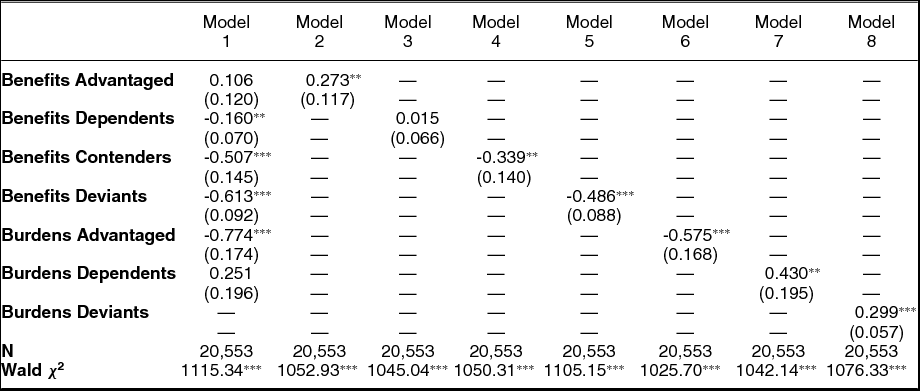
To more precisely measure the effects of policy design on policy diffusion I replicated this analysis with a dummy variable for each category of congruent and noncongruent policy innovation in the sample. These results are presented in Table 3. Model 1 includes dummy variables for all categories of policy in a single model. Models 2 through 8 present separate estimates for each category of congruent and noncongruent policy. The control variables are identical to those presented in the full models in Table 2; however, to preserve space I present only the coefficients for the policy design variables. Models 2 and 8 contain information for the two types of congruent policy innovations.
The Effect of Policy Congruence and Noncongruence on the Likelihood of Policy Adoption

Note: Models 2 and 8 contain information for congruent policies. Observations clustered by state-year. Robust standard errors in parentheses. Control variables are identical to those in the full model of Table 2, but are not reported here to preserve space.
*** p < 0.01, ** p < 0.05, * p < 0.1.
Table 3 provides further support for the policy congruence hypothesis. Policies providing benefits to advantaged target populations in the form of expanded consumer protections and police powers (Model 2) are 31% more likely to be adopted, whereas congruent “tough on crime” laws imposing burdens on deviants (Model 8) are 35% more likely to be enacted than other reforms. The barriers to diffusion are strongest for three classes of noncongruent policy. Policy innovations imposing burdens on advantaged groups by limiting the discretion of police, prosecutors, and physicians (Model 6) are 44% less likely to be adopted, whereas policies transferring benefits to deviants (Model 5) and contenders (Model 4)—in the form of needle exchange laws, drug treatment programs, prison furlough programs, and hate crime protections—are 39% and 29% less likely to be enacted, respectively.
Model 1 reveals a similar pattern in the relative rates of diffusion. The omitted reference category is Burdens Deviants. The coefficients for the two classes of congruent policy (Benefits Advantaged and Burdens Deviants) do not differ significantly. However, in keeping with the policy congruence hypothesis, policies extending benefits to dependents, contenders, and deviants and those imposing burdens on advantaged groups have a lower probability of being adopted than congruent reforms.Footnote 21 Model 1 also suggests that the barriers to policy adoption for policies targeting dependents (such as child welfare and victims rights initiatives) are less severe than for other forms of noncongruent policy innovations.
Electoral Pressure, Policy Congruence, and the Mechanisms of Policy Diffusion
A key insight of policy design theory is that public policy is shaped by the different political incentives for congruent and noncongruent policy making. Hypotheses 2 through 4 predict that policy makers will respond to electoral pressure by proposing congruent policy innovations. Beyond this expectation, studies of criminal justice policy making indicate that broader political pressures—such as changes in state partisanship, ideology, or the severity of the crime problem—may influence the probability that state governments will experiment with different criminal justice policies (Gottschalk Reference Gottschalk2008). The preceding analysis provides little leverage for evaluating heterogeneity in the mechanisms of congruent and noncongruent policy diffusion.
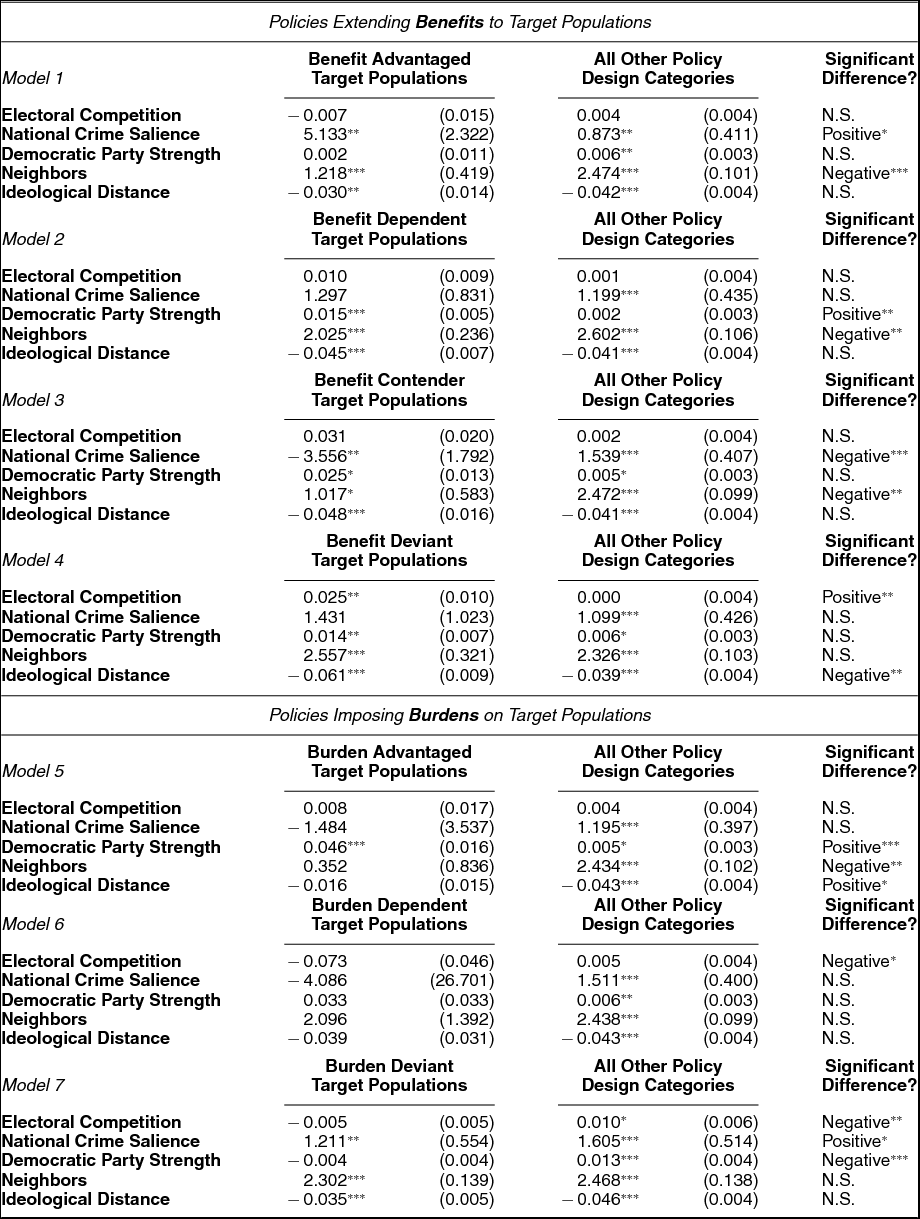
To evaluate differences in the determinants of criminal justice policy diffusion I conducted separate split-sample analyses for congruent and noncongruent policy innovations (Table 2, columns 3–5), as well as for each specific configuration of policy design (Table 4). This approach closely follows Makse and Volden's (Reference Makse and Volden2011) strategy for evaluating the conditional effects of policy attributes on diffusion mechanisms.Footnote 22 Drawing on the policy classification presented in Table 1, I first assigned policies to categories of policy congruence and then estimated identical regressions for each of these distinct categories of criminal justice policy innovation. The coefficients for these split- sample models allow an interpretation of differences in the impact of electoral competition and control variables on the diffusion of congruent and noncongruent policy innovation.
Split-Sample Analysis: Electoral Competition and the Mechanisms of Diffusion by Policy Design Category

Note: Models 1 and 7 contain information for congruent policy innovations. Observations clustered by state-year. Robust standard errors in parentheses. Control variables are identical to those presented in Columns 3–5 in Table 2, but are omitted here to preserve space. *** p < 0.01, ** p < 0.05, * p < 0.1. N.S. = Not statistically significant.
To assess whether predicted differences in the determinants of policy diffusion are statistically significant, I estimated an additional analysis for each split-sample comparison, this time pooling the data and fully interacting the policy congruence dummy variable with the full set of independent variables in the model. The coefficients for these interactions allow a calculation of whether the differences in effects of independent variables in the split-sample comparisons are statistically significant.Footnote 23 I begin by exploring general differences in the determinants of congruent and noncongruent policy diffusion (Table 2, Columns 3–5) before investigating specific differences in mechanisms of diffusion for each category of policy design (Table 4).
The split-sample analysis in Table 2 provides some support for the idea that electoral pressures for responsive policy making lead state governments to emulate congruent innovations. The coefficient for national crime salience is statistically significant and positive in the congruent policy model, suggesting that policy makers respond to rising public concern over crime by enacting congruent criminal justice reforms. Although this effect is strong, the differential effect across the congruent and noncongruent models is not statistically significant.
Columns 3–5 of Table 2 also reveal an unexpected difference in the role of electoral pressure in criminal justice policy diffusion. Although the electoral cycle and electoral competition measures are not statistically significant in the congruent policy model, I find that increasing electoral competition has a positive and meaningful impact on noncongruent policy adoption. In substantive terms a 10-point increase in the district-level electoral competition raises a state government's probability of adopting noncongruent policy reforms by 12% (1.012, p <. 05). Column 5 indicates that this differential effect of electoral competition is statistically significant.
Table 2 provides insight into the geographic and nongeographic mechanisms of criminal justice policy diffusion. The coefficients for the neighbors variable in both the congruent and noncongruent policy models are statistically significant, positive, and large, consistent with prior work on the importance of geographic contiguity in state policy diffusion. Having a neighboring state adopt a policy increases the odds of congruent policy adoption by 9.4 (p < .001) and of noncongruent policy adoption by 11.25 (p < .001). The coefficients for ideological distance in both models are negative, indicating that states are generally more likely to emulate policies when they are ideologically aligned with prior adopters. The predicted impact of ideological alignment is larger for noncongruent policy diffusion, although the difference is not significant.
Finally, Table 2 suggests that legislative balance influences the probability of noncongruent policy adoption. The coefficients for Democratic Party strength indicate a statistically significant difference in the impact of party control on noncongruent policy making. A 10% increase in Democratic seat share is associated with a 14% increase in the probability that states will enact noncongruent criminal justice reforms.
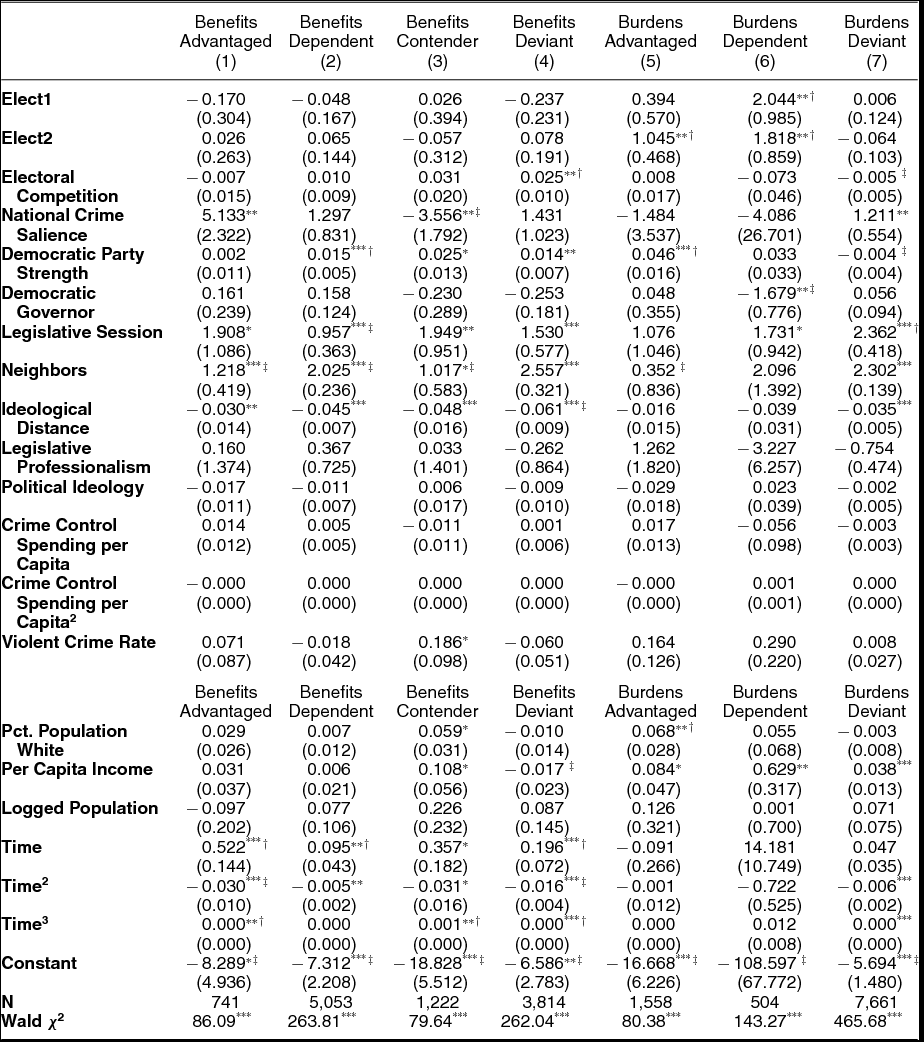
Table 4 allows us to assess differences in the diffusion of innovations by policy design category. Models 1–4 identify policies extending benefits to target populations, whereas Models 5–7 identify policies imposing burdens on different groups.Footnote 24 To preserve space, Table 4 presents the results for the variables highlighted in the preceding discussion. A complete version of Table 4 can be located in Appendix A.
The split-sample analyses in Table 4 reveal some interesting differences in the influence of electoral pressure and elite partisanship on congruent and noncongruent policy making. As in the preceding analysis, I find that national crime salience has a positive and substantively large impact on congruent policy adoption. A one standard deviation increase in crime salience increases a state's probability of increasing benefits for advantaged groups (Model 1) by more than 60%. A similar increase in crime salience increases a state's probability of adopting an innovation imposing burdens on deviants by more than 10% (Model 7). Although suggestive, the differences between these estimates and the reference category are not significant at conventional levels. This may be the result of the very different effect of national crime salience across the policies included in the reference categories.
The role of issue salience in noncongruent policy making is also informative. The national crime salience variable is statistically significant and negative in the benefits contender model (Model 3), indicating that state governments are less likely to extend policy benefits like hate crime protections when crime salience is high. Issue salience is not statistically significant in the other noncongruent policy models, suggesting that the salience of the crime problem plays a diminished role in the diffusion of these reforms.
Table 4 provides additional perspective on the role that electoral competition plays in noncongruent policy making. Most interestingly, the analysis indicates that rising electoral competition specifically affects the probability that governments will extend policy benefits to deviant populations (Model 4). A one standard deviation increase of 12.5 points in electoral competition increases the likelihood that a state will enact alternative reforms such as clean needle legislation, work furlough programs, and drug treatment programs by more than 37%, a finding that is both statistically significant and distinct from the role that electoral competition plays in the diffusion of other types of criminal justice policy.
There is less evidence that the timing or competitiveness of state elections influences congruent policy making. The electoral competition variables in the benefit advantaged (Model 1) and burden deviants (Model 7) models are not statistically significant, providing little support for the idea that state policy makers adopt congruent policies in order to secure public support during contested elections.
Table 4 also illustrates how legislative partisanship influences criminal justice policy making. The positive coefficients for Democratic Party strength in Models 2 through 5 indicate that states are more likely to adopt a broad range of noncongruent criminal justice policy reforms such as hate crime protections, racial profiling bans, and child abuse reporting requirements as Democratic Party strength increases, although these difference are only significant in the benefit dependent and the burden advantaged models.
The analysis provides more detail on the role that geographic contiguity and ideological alignment play in the diffusion of innovation. The coefficients for the neighbor variable are statistically significant, positive, and substantively large for both congruent policies (benefits advantaged [Model 1] and burdens deviant [Model 7]), as well as two forms of noncongruent policy (benefits dependent [Model 2] and benefits deviants [Model 4]). The coefficients for ideological distance are negative and statistically significant for all but two of the policy types (burdens advantaged [Model 5] and burdens dependents [Model 6]), indicating that states are generally less likely to adopt laws that have been enacted by states with dissimilar ideologies. This effect is strongest for innovations that extend benefits to deviants. A one standard deviation difference in ideological distance decreases the chance that a state will adopt this type of innovation by more than 50%. An identical change in ideological distance for other policies decreases the likelihood of policy emulation by 36%.
Discussion and Conclusion
This research examined ways that “policies determine politics” (Lowi Reference Lowi1972, 299), exploring whether the same political and social pressures that lead to bias in the design of criminal justice policy innovations also lead to differences in the diffusion of criminal justice policy innovations. Drawing on policy design theory, I analyzed newspaper coverage of 44 state-level criminal justice policies adopted by state governments between 1960 and 2008, identifying the social image and political power of groups targeted by different types of policy interventions. I relied on this coding scheme to test a central insight of policy design theory—that the “social construction of target populations has a powerful influence on public officials and shapes both the policy agenda and the actual design of policy” (Schneider and Ingram Reference Schneider and Ingram1993, 334). I found strong support for this intuition: Policies with congruent policy design—those extending benefits to popular, powerful target populations and those imposing burdens on weak and politically marginalized deviants—are more likely to be adopted by state governments than noncongruent innovations, which allocate policy benefits and burdens in ways that invite political conflict and controversy.
I then explored how electoral pressure influences the probability that state governments will adopt congruent and noncongruent criminal justice innovations. Following recent research on elite responsiveness in federal criminal justice policy making (Enns Reference Enns2014; Nicholson-Crotty, Peterson, and Ramirez 2012), I found that state governments are more likely to adopt congruent “law and order” policy innovations when crime is a nationally salient public problem. This suggests that shifts in public attention affect both agenda setting and the specification of policy alternatives. Increasing issue salience leads policy makers to be strategically responsive, adopting innovations that reinforce popular stereotypes regarding the appropriate role of government in reducing crime. In fact, when crime salience is high the incentives for emulating congruent policy initiatives may lead elected officials to limit consideration of other potentially effective policy solutions, resulting in the oversubscription of law and order policies within and across states. This finding casts light on the barriers to noncongruent policy making, because the electoral costs of being accused of being “soft on crime” make “it difficult for elected officials to provide beneficial policy to the powerless, negatively viewed groups (such as rehabilitation programs for criminals) despite the fact that these programs may be more effective than those that involve punishment” (Schneider and Ingram Reference Schneider and Ingram1993, 338).
I also examined how more immediate pressure stemming from competitive elections influence the diffusion of criminal justice policy innovations. I anticipated that rising electoral competition would increase the probability of congruent policy adoption. I found no support for this hypothesis: Neither the timing nor the competitiveness of elections appears to influence the probability that states will adopt congruent law on order policies. In fact, contrary to expectations, increasing electoral competition appears to increase the likelihood that state governments will adopt alternative sentencing reforms that extend policy benefits to stigmatized groups.
Taken together, these findings help refine our understanding of how electoral pressure shapes the design and diffusion of policy innovations. First and foremost, policy design and policy diffusion theory may overstate the impact of electoral competition on agenda setting. Reelection-driven policy makers operate as if they are “unsafe at any margin” and work diligently to be responsive to salient policy problems in order to minimize threats from challengers in current or future elections (Mann Reference Mann1978). Politicians may therefore see limited payoff in strategically placing policy innovations on the ballot when public attention is directed elsewhere. Indeed, when salience is low, policy makers may enjoy greater fewer constraints to the pursuit of noncongruent policy reforms. Future research will help us refine our understanding of how pressure for responsive policy making shapes the diffusion of innovations. Although my research finds that issue salience has a strong impact on congruent policy diffusion, it falls short of confirming that public pressure works differently in the diffusion of congruent and noncongruent policy reforms.
Second, policy design theory says relatively little about how differences in state partisanship or ideology moderate preferences for policy making. Although students of criminal justice policy making contend that electoral competition has fueled bipartisan support for punitive sentencing laws (Gottschalk Reference Gottschalk2008), research on state politics provides a more nuanced picture of the impact of competition and partisanship on state policy outputs. Rather than leading parties to converge on common policy goals, electoral competition may “induce parties in government to be responsive to the demands of their activists and to provide benefits to policy oriented amateurs whose support is sought in contested races” (Barrilleaux, Holbrook, and Langer Reference Barrilleaux, Holbrook and Langer2002, 420). Competitive elections therefore lead Democratic- and Republican-controlled governments to support very different types criminal justice reforms, as liberal activists who make up an influential part of the Democratic Party coalition have historically opposed congruent law and order policies that have an unequal impact on minority communities. There is some empirical support for this perspective: Criminologists have found that incarceration rates decrease most sharply when Democratic-controlled governments face rising electoral competition (Stucky, Heimer, and Lang Reference Stucky, Heimer and Lang2005).
Accounting for partisanship and electoral competition also helps us understand the political forces leading to support for policy reversals. There is growing bipartisan pressure for state governments to adopt alternative sentencing laws directed toward nonviolent offenders.Footnote 25 In the last decade liberal civil rights organizations such as the American Civil Liberties Union have joined with fiscally conservative groups like Grover Norquist's Americans for Tax Reform in pursuing “smart on crime” reforms to stem the rising costs of incarceration. Here, electoral competition provides an incentive and an opportunity for state governments to experiment with alternative sentencing reforms, because such innovations appeal to liberal and conservative activists of both parties. Not surprisingly, support for these reforms has increased in a period where low crime rates have permitted “a more robust political discussion of enacting real criminal justice reform” (Lowery Reference Lowery2015). Future researchers may wish to explore how competition, issue salience, and partisanship moderate state policy adoption in more detail.
This growing bipartisan support for alternative sentencing reforms should have a significant impact on criminal justice policy making in the American states. I find that ideological alignment is especially influential in the diffusion of noncongruent innovations that extend social services to marginalized populations, which is especially important in the context of contemporary criminal justice policy making. Texas and California have both recently enacted innovations extending social services for parolees and expanding diversion programs for nonviolent offenders. These actions may legitimize identical reforms for ideologically aligned states that might otherwise be reluctant to experiment with nonpunitive approaches to crime control.
This research points to some interesting questions that will help further our understanding of how the social construction of public problems shapes the diffusion of innovations. First, social constructions change as groups compete to define problems and influence their own social stereotypes (Schneider and Ingram Reference Schneider and Ingram1993). Future studies modeling the impact of state-level differences on the social construction of public problems will permit evaluation of how changes in problem definition alter a state's propensity to adopt innovation—as has occurred with gay marriage and immigration reform in the American states. Second, this research is limited by a narrow focus on criminal justice policy. A more general understanding of these dynamics requires testing the propositions of policy design theory in other policy domains where there is more ambiguity in identifying the image and power of target populations.
Finally, the approach presented in this article may be useful to the growing community of researchers interested in exploring the empirical implications of constructivist theories of the policy process (Jones and McBeth Reference Jones and McBeth2010; McBeth et al. Reference McBeth, Shanahan, Arnell and Hathaway2007; Shanahan, Jones, and McBeth Reference Shanahan, Jones and McBeth2011). I integrated insights from policy design theory to explore how changes in problem definition shape the diffusion of innovations. The results of this analysis extend our understanding of how innovation attributes influence diffusion and provides for a novel empirical test of the core assumptions of policy design theory. Future studies employing the methods of comparative policy analysis to operationalize and test theories of the policy process will add to our understanding of policy making in the states and will lead to a more rigorous understanding of how the social construction of public problems leads to policy change.
Split-Sample Analysis: Electoral Pressure and the Mechanisms of Diffusion by Policy Design Category (Expanded)





Comments
No Comments have been published for this article.