Introduction
Paediatric unilateral sensorineural hearing loss (SNHL) is diagnosed more often and at an earlier age as a result of the wide international implementation of universal newborn hearing screening programmes. Previously published studies have shown that unilateral SNHL may present with adverse effects on speech and language development, behaviour, and school performance.Reference Culbertson and Gilbert 1 – Reference Dancer, Burl and Waters 4 The estimated prevalence in school children is 3–5 per cent.Reference Niskar, Kiezak, Holmes, Esteban, Rubin and Brody 5 , Reference Bess, Dodd-Murphy and Parker 6
Worldwide implementation of universal newborn hearing screening has recently allowed better understanding of the timing of unilateral SNHL onset, and differentiation between congenital and acquired hearing loss. Computed tomography (CT) and magnetic resonance imaging (MRI) scans are an integral part of the clinical investigations, although it is still controversial as to which type of scan should be performed first and if there is a role for both. This study aimed to examine the various concomitant radiological and genetic abnormalities in a cohort of non-syndromic children with unilateral SNHL.
Materials and methods
A retrospective case series was conducted, comprising 60 children diagnosed with unilateral SNHL between January 2005 and December 2015 in a tertiary-level paediatric institution in Auckland, New Zealand. The study was approved by the local Auckland District Health Board ethical committee (ethical approval reference: 16/NTA/19).
All caregivers of newly diagnosed children with unilateral SNHL were counselled in the clinic by a paediatric otolaryngologist. Careful clinical history and physical examination findings were obtained prior to embarking on further investigations. All children were reviewed by a paediatrician to rule out associated syndromes; only non-syndromic children were considered for inclusion in the study.
The universal newborn hearing screening programme was implemented in specific areas around New Zealand from July 2007. The programme was later expanded, and, since April 2010, all New Zealand born babies are screened. Automatic auditory brainstem response (ABR) testing is the first-line screening tool in our programme. Babies who do not pass screening for one or two ears are referred to audiology services, and formal ABR testing is completed. Babies who are confirmed to have hearing loss are urgently referred to our paediatric otolaryngology unit at Starship Children's Hospital, Auckland. We aim to complete diagnostic testing by three months of age and provide appropriate amplification by six months of age.
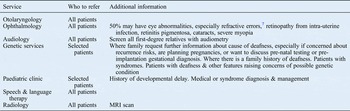
Age-appropriate audiometry with air and bone thresholds was available for all patients included in this cohort. Auditory brainstem response testing was performed on children who were either too young or unable to co-operate with behavioural audiometry. See Table I for our management protocol for children with newly diagnosed SNHL.Reference Sirimanna 7
Starship children's hospital hearing loss investigation protocol

MRI = magnetic resonance imaging
Demographic data were collected, including age at diagnosis and ethnicity. Pre- and post-natal risk factors were assessed, including: maternal alcohol and/or drug abuse; gestational diabetes mellitus; gestational hypothyroidism; gestational toxoplasma, others (syphilis), rubella, cytomegalovirus (CMV) and herpes (‘TORCH’) exposure; prematurity; birth weight of less than 1500 g; jaundice; ventilation for more than 4 days; ototoxic medication exposure; and family history of hearing loss. Cytomegalovirus testing was performed in babies aged less than six months. Cytomegalovirus was tested with a polymerase chain reaction assay using blood retrieved from the newborn Guthrie card test.
Imaging was conducted as part of the routine investigation, and included CT scanning and/or MRI of the temporal bones and brain. Some caregivers preferred to delay imaging until an older age.
Parental consent for genetic evaluation was obtained for 51 children. A multi-gene screening panel (microarray) was used to test for 11 possible genetic abnormalities. Blood samples were taken from each child at our institute and one sample per child was sent for testing. The genotyping took place at Asper Biotech laboratory, Tartu, Estonia.
The inclusion criteria were: any newly diagnosed child with unilateral SNHL, aged 0–15 years. The exclusion criteria were: any diagnosed syndrome, mixed SNHL and conductive hearing loss, asymmetrical bilateral SNHL, and inconsistent audiometry results.
Unilateral sensorineural hearing loss
Unilateral SNHL was defined as bone conduction hearing thresholds over 25 dB in any three consecutive frequencies in the worse ear. In addition, the better ear did not have any three consecutive frequencies with hearing loss over 20 dB.
Hearing loss severity
Hearing loss was classified as mild (25–45 dB HL), moderate (46–70 dB HL), severe (71–90 dB HL) or profound (more than 90 dB HL). High-frequency hearing loss was considered if the lowest abnormal frequency was more than 2 kHz. Low-frequency hearing loss was considered if the highest abnormal frequency was less than 2 kHz.
Genetic testing
Sensorineural hearing loss can follow a pattern of autosomal dominant, autosomal recessive, X-linked recessive or mitochondrial inheritance. Targeted mutation analysis was performed using DNA microarray for the genotyping of 11 different genes known to be correlated with non-syndromic SNHL, including: GJB2 (OMIM® entry: 121011), GJB3 (OMIM entry: 603324), GJB6 (OMIM entry: 604418), KCNQ4 (OMIM entry: 603537), MYO7A (OMIM entry: 276903), MYO15A (OMIM entry: 602666), MTRNR1 (OMIM entry: 561000), MTTS1 (OMIM entry: 590080), SLC26A4 (OMIM entry: 605646), SLC26A5 (OMIM entry: 604943) and TMC1 (OMIM entry: 606706).Reference Gardner, Oitmaa, Messner, Hoefsloot, Metspalu and Schrijver 8 A total of 249 detectable mutations were tested from each sample. Criteria for assigning a variant as pathogenic or benign are based on scientific publications and data available from relevant databases (ClinVar, ExAC, Ensembl and so on). All detected variants were confirmed by Sanger sequencing. The data were analysed using Genorama® Basecaller™ and PicDB™ software. A full list and information on the tested genes (hearing loss pathologies and analysed mutations) are shown in Appendices I and II (available in the online version of this article).
This specific array for SNHL was used for the analysis of 1282 samples, conducted in Asper Biotech laboratory. Seven false negatives and zero false positives were detected with the particular array. The sensitivity and specificity of this method are as follows: sensitivity = (true positives / (true positives + false negatives)) = 1275 / 1282 = 0.9945 (99.4 per cent); and specificity = (true negatives / (true negatives + false positives)) = 1282 / 1282 = 1 (100 per cent).
Statistical analysis
Statistical analysis was performed using chi-square analysis and Fisher's exact test. The significance level was set at p < 0.05.
Results
A total of 60 children with unilateral SNHL were included in this cohort. The average age at diagnosis was 4.3 years. Sixteen children were diagnosed at birth following a referral from the newborn hearing screening programme. Forty-one children were diagnosed at a later age, all of whom were born prior to the universal implementation of the hearing screening programme. The median age at diagnosis of this subgroup of patients was 6.3 years. There were no data on the age at diagnosis of three children.
All children were considered non-syndromic. Hearing loss was categorised as mild (17 children), moderate (17 children), severe (7 children) or profound (19 children). A total of 51 patients completed genetic testing. Table II shows the genetic test results according to hearing level.
Genetic test results according to hearing level*

* For the 51 patients who completed genetic testing
The cohort was comprised of children living in or around Auckland, New Zealand. Regarding the ethnicity of the children, 25 (42 per cent) were European, 14 (23 per cent) were Asian or Indian, 10 (17 per cent) were Maori, 6 (10 per cent) were Pacific islanders (Tonga, Samoa and so on), and 5 (8 per cent) were Middle Eastern, Arab or African.
Post-natal risk factors were assessed for all children in this cohort. Fifteen children (25 per cent) suffered from jaundice, six (10 per cent) were premature, five (8.33 per cent) had a positive family history of hearing loss, five (8.33 per cent) were admitted to the neonatal intensive care unit, two (3.33 per cent) were ventilated for more than 4 days and one child received an ototoxic medication. Seventeen children (28.33 per cent) had only one risk factor, four (6.66 per cent) had two risk factors, two (3.33 per cent) had three risk factors and one child had four risk factors.
We also reviewed possible pre-natal risk factors, such as: gestational diabetes mellitus; fetal alcohol exposure; hypothyroidism; and toxoplasma, others (syphilis), rubella, CMV and herpes exposure. Two children had gestational exposure to alcohol and one mother had gestational diabetes mellitus.
No patient had a history of meningitis. No patient was suspected to suffer from syphilis; however, eight patients were tested and found negative for this infection. Ten patients tested negative for congenital CMV infection and one patient tested positive for this condition. The genetic testing and CT scan for the CMV-positive patient were reported as normal.
Radiology
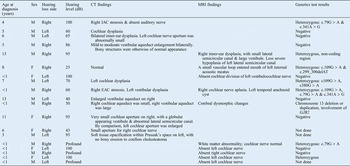
Computed tomography and/or MRI were performed in 43 children (71.66 per cent). Of the children who underwent CT and/or MRI scanning, 27 (62.8 per cent) had negative findings. Nineteen patients (44.2 per cent) had positive scan findings; of these, nine had a CT scan, seven had an MRI scan, and three underwent both CT and MRI scanning.
Eight patients (50 per cent) with positive imaging findings had positive genetic test results, and eight patients (50 per cent) with positive imaging findings had negative genetic test results. As might be suggested from these rates, a comparison of both groups did not yield a statistically significant difference (p = 0.3069). Three patients with positive imaging findings did not have a genetic evaluation. Hence, for those children who underwent scanning and were tested genetically, there was a 50 per cent likelihood of having a genetic abnormality if the scan findings were positive. In the cohort overall, the likelihood of having a genetic abnormality was 31 per cent.
Ten patients (23 per cent) were found to have an absent or abnormal cochlear nerve on MRI or CT. Six patients were found to have an absent cochlear nerve on MRI. Four patients were found to have a small cochlear aperture or narrow internal auditory canal on CT, which was regarded as suggestive of an abnormal or absent cochlear nerve in the context of normal homolateral facial nerve examination findings.
Cochlear dysplasia was seen in four patients (9 per cent); three of these patients were diagnosed using CT and one with MRI. Three children (7 per cent) were found to have an enlarged vestibular aqueduct on CT. Only one of these patients had the unilateral enlarged vestibular aqueduct on the same side as the unilateral SNHL; the second patient had bilateral enlarged vestibular aqueducts and the third patient had a contralateral enlarged vestibular aqueduct.
See Table III for a description of the imaging findings in the children with positive radiology results.
Imaging findings of children with positive radiology results

CT = computed tomography; MRI = magnetic resonance imaging; M = male; IAC = internal auditory canal; F = female; EAC = external auditory canal
Genetic results
Sixteen children in this cohort (31 per cent) had positive genetic results. One child had a homozygous mutation of GJB2. The heterozygous carrier rate for GJB2 mutations amongst our cohort was 29 per cent (15 children). Seven children with different CT and/or MRI abnormalities tested positive as heterozygous carriers of a GJB2 mutation. Seven of 15 children with positive carrier status for GJB2 mutations (47 per cent) had positive imaging findings. Nine (31 per cent) of the 29 children with negative genetic results and unilateral SNHL had positive imaging findings. Comparisons of children with various imaging findings and positive versus negative genetic results showed a trend toward an association between positive imaging findings and positive genetics results, although the findings did not reach statistical significance (p = 0.15). No association between ethnicity and genetic results was demonstrated.
Discussion
Early diagnosis of paediatric unilateral SNHL is important to promote better speech and language abilities, coupled with improved child behaviour and academic outcomes. Treatment modalities include classroom modifications, speech and language therapy, hearing amplification, a contralateral routing of signal (‘CROS’) aid (with or without a bone-anchored device), and cochlear implantation.Reference Wiley, Arjmand, Meinzen-Derr and Dixon 9
Imaging is an important part of the clinical investigation for children with unilateral SNHL, as it may reveal an underlying structural abnormality. The presence of an enlarged vestibular aqueduct, for example, is significant, as affected patients are at risk of progressive hearing loss, especially if secondary to head trauma. This finding has important implications for the patient and family, and the avoidance of contact sports might be suggested (as head trauma may be a concomitant risk factor). Genetic analysis as part of unilateral SNHL evaluation is frequently considered. It may aid understanding of hearing loss aetiology, which often allows ‘closure’ and facilitates family counselling regarding the risk of hearing loss in future pregnancies.
Historically, unilateral SNHL was believed to have little consequence on a child's development, and, prior to the implementation of the universal newborn hearing screening programme, it was usually diagnosed late. However, there is an increasing body of evidence to suggest that unilateral SNHL may affect speech and language development, behaviour, and academic achievements.Reference Culbertson and Gilbert 1 – Reference Dancer, Burl and Waters 4 , Reference Lin, Chowdhury, Mody, Tonini, Emery and Haymond 10 This has enhanced our understanding of the importance of early diagnosis, which allows the prompt institution of interventions such as those mentioned above.
Ghogomu et al. studied the epidemiology of unilateral SNHL before and after implementing a universal newborn hearing screening programme.Reference Ghogomu, Umansky and Lieu 11 They showed that, prior to screening, only 3 per cent of patients were identified by the age of six months, compared to 42 per cent after screening started. They reported that a significant number of patients (60 per cent) were not detected by the universal screening programme and were likely to develop hearing loss later in life.Reference Ghogomu, Umansky and Lieu 11 This finding underscores the importance of continued awareness regarding hearing loss, even after successfully passing a newborn screening test.
In New Zealand, a behavioural screening hearing test is routinely performed for children of early school age (the ‘B4 school assessment’), and this has resulted in new unilateral SNHL referrals to our service. This explains the average age at presentation in this cohort (4.3 years), with a population mainly consisting of babies who did not pass the newborn hearing screening and children who failed school-age hearing screening. We believe that this routine school-age screening remains important in the era of universal newborn hearing screening programmes.
Haffey et al. reviewed unilateral SNHL evaluation in children, and suggested that genetic testing be recommended for patients with risk factors or abnormal clinical examination findings.Reference Haffey, Fowler and Anne 12 Fourteen patients out of a cohort of 89 pursued genetic evaluation, and 3 (21 per cent) of the 14 children were confirmed to be heterozygous carriers of the connexin 26 mutation. They suggested that CT be the first radiological modality to be used in children with unilateral SNHL and that MRI should be considered in children with negative CT findings. They did not comment regarding any possible correlation between genetics and radiological findings.
Lee et al. investigated the audiological and temporal bone findings in a cohort of children with hearing loss and GJB2 mutations.Reference Lee, Larson, Shott, Rasmussen, Cohen and Benton 13 They conducted a retrospective review of patients with SNHL, both bilateral and unilateral. Fifty-four patients in this cohort had unilateral SNHL. Three patients tested positive as heterozygous carriers of a GJB2 mutation and 51 had negative genetic results. Amongst all patients with GJB2 mutations (bilateral and unilateral) and asymmetrical hearing loss, those with heterozygous mutations (n = 14 (20 per cent)) had a higher rate of asymmetric SNHL loss than those with bi-allelic mutations (n = 6 (7.9 per cent)) (p = 0.03). Those with heterozygous mutations were more likely to experience progression than were those with bi-allelic mutations, although this difference was only marginally significant.
The rate of positive heterozygosity in our cohort is higher; however, Lee et al.Reference Lee, Larson, Shott, Rasmussen, Cohen and Benton 13 used a different genetic assessment method to ours. They performed polymerase chain reaction amplification, and the polymerase chain reaction products were sequenced with an ABI Prism® 3700 automated fluorescent sequencer. We believe that our genetic investigation method, using a microarray technique combined with Sanger sequencing, may eventually uncover more mutations and might explain the difference in heterozygosity rates. Their results do support our data, which indicate that heterozygous carriers of GJB2 mutations may be more prone to unilateral SNHL. Using a next-generation sequencing tool in a large cohort of unilateral SNHL patients may help to clarify these results, and will be the most accurate, up-to-date method of assessing for genetic mutations and establishing their significance.
A study by Preciado et al., published in 2005, prior to the wide initiation of the universal newborn screening programme, evaluated 150 consecutive patients with bilateral or unilateral SNHL.Reference Preciado, Lawson, Madden, Myer, Ngo and Bradshaw 14 Twenty children from this cohort had unilateral SNHL. None of the children had a bi-allelic homozygous connexin 26 mutation, although overall they showed 12 per cent bi-allelic connexin 26 mutations (for bilateral cases). The authors concluded that connexin 26 analysis should be the first investigation performed for severe-to-profound bilateral SNHL; starting the clinical investigation with a CT scan for patients with milder forms of hearing loss should be avoided. This aimed to support a more cost-effective congenital SNHL investigation.
We found no significant association between degree of hearing loss and presence of mutation. According to our results, the degree of hearing loss should therefore not influence the decision whether to perform genetic testing or not. One patient from our unilateral SNHL cohort had bi-allelic GJB2 mutations and his hearing loss was only mild. This patient did not present any imaging abnormalities. Our data suggest that hearing levels should not influence decisions regarding whether to perform genotyping by sequencing or imaging, as both methods may prove helpful.
Previous studies have demonstrated the detrimental effect of ionising radiation and increased risk of malignancy related to the use of CT scanners, especially in children, who are more radiosensitive.Reference Pearce, Salotti, Little, McHugh, Lee and Kim 15 The radiation exposure dose of high-resolution CT of the temporal bones is 0.8 millisievert (mSv). High-resolution CT also irradiates the orbits, hence mildly increasing the risk of cataracts. This is in comparison to the radiation exposure dose of 2 mSv for head CT and 0.04 mSv for chest X-ray (0.04 mSv equates to one long-haul airplane flight).
Magnetic resonance imaging is not free of limitations, and usually requires sedation or general anaesthetic (such as for CT) in young children older than three to four months. There is growing evidence that sedation in young children may result in neuronal toxicity, although the clinical implications are still to be determined.Reference Yu, Yuen, Wong and Irwin 16 , Reference Olsen and Brambrink 17 In very young babies, usually up to the age of three to six months, an MRI scan can sometimes be completed using a feed-and-wrap protocol.Reference Shariat, Mertens, Seed, Grosse-Wortmann, Golding and Mercer-Rosa 18 This can allow imaging without the need for sedation or ionising irradiation, although it is not always successful, and is limited by age and movement artefacts. The sensitivity of either imaging modality (CT and MRI) in investigating unilateral SNHL has yet to be fully determined.
In 37 per cent of our patients, we were able to show a structural abnormality on CT and/or MRI that was possibly related to the hearing loss. This rate is comparable to that of other studies on unilateral SNHL. Friedman et al. reported on a series of children with severe-to-profound unilateral SNHL and showed a 40.8 per cent likelihood of abnormal CT findings overall.Reference Friedman, Guillory, Ramakrishnaiah, Frank, Gluth and Richter 19 Their study showed: semicircular canal dysplasia (10.2 per cent), cochlear aperture stenosis (10.2 per cent), a hypoplastic cochlea (8.1 per cent), an enlarged vestibular aqueduct (14.3 per cent), incomplete partition types I or II (6.1 per cent), and an anomalous internal auditory canal (2.0 per cent). They concluded that imaging is a valuable part of unilateral SNHL evaluation, which supports our data and personal impression.
A study by Clemmens et al. investigated absent cochlear nerves in children with unilateral SNHL using MRI.Reference Clemmens, Guidi, Caroff, Cohn, Brant and Laury 20 They showed absent nerves in 26 per cent of cases, with a higher prevalence in severe-to-profound hearing loss cases, of up to 48 per cent. Again, these numbers are comparable to our data, which show absent cochlear nerves in 23 per cent of children with unilateral SNHL. Importantly, GJB2 mutations are relevant to cochlear-originated SNHL and have not yet been shown to result in cochlear nerve aplasia.
Our results suggest that children with positive genetic results (mainly heterozygous carriers of a GJB2 mutation) are more likely to have positive radiological findings. This subgroup of children with diagnosed genetic abnormalities had a 47 per cent likelihood of positive imaging, compared to a 31 per cent likelihood of positive imaging when no genetic abnormalities were demonstrated. Importantly, a GJB2 heterozygous carrier state is not commonly believed to be a cause of hearing loss by itself. Interestingly, 29 per cent of the children in our unilateral SNHL cohort were heterozygous carriers of a GJB2 mutation, in comparison to less than 3 per cent in a European population.Reference Hall, Pembrey, Lutman, Steer and Bitner-Glindzicz 21 These data are surprising and question the common thinking behind the non-significant role that GJB2 carrier state is thought to play in congenital hearing loss.
The data presented in this study highlight the potential value of imaging in a subgroup of children with unilateral SNHL and positive genetic findings, and indicate a possible association between some positive genetic results and imaging findings. Furthermore, there was a significant likelihood (50 per cent) of having positive genetic tests findings in children who presented with positive imaging findings. This is in comparison to an overall likelihood of 31 per cent for having abnormal genetic results in our cohort. We recommend completing genetic testing in children with positive imaging findings, and vice versa.
The optimal imaging modality for unilateral SNHL remains unclear. Age at the time of imaging, and the risks of radiation exposure and general anaesthesia, are the main issues, as discussed above. Based on the presented data, we believe that in children with unilateral SNHL the preferred modality should be MRI. This will provide accurate detailed anatomical data, with no ionising radiation risks. Ideally, it should be performed using a feed-and-wrap method in babies, or when the child is old enough to co-operate.
-
• Unilateral sensorineural hearing loss (SNHL) can have adverse effects on speech and language development, behaviour, and school performance
-
• In this cohort, 50 per cent of the patients with positive imaging findings had concomitant positive genetic results
-
• Thirty-one per cent of children had positive genetic results; the most common condition was positive carrier status for GJB2
-
• Forty-seven per cent of children with positive carrier status for GJB2 had positive imaging findings
-
• In comparison, 31 per cent of children with negative genetic results had positive imaging findings
-
• Both imaging and genetic studies are of value in the investigation of children with unilateral SNHL
The limitations of this study are its retrospective nature, and the fact that not all children with unilateral SNHL underwent the full investigation including genetic testing and radiology. The genotyping method used in this study may be replaced in the future by a more sensitive and specific targeted mutation analysis. Deep genomic sequencing may be helpful to fully appreciate the complexity of GJB2 mutations and other candidate genes. The role of GJB2 carrier state is still to be determined.
Conclusion
Unilateral SNHL is now being diagnosed at an earlier age following the wide implementation of universal newborn hearing screening. However, the evaluation and management of a newly diagnosed child is still evolving. Our results suggest that both imaging and genetic studies are of value in the investigation of children with unilateral SNHL.
Supplementary material
The supplementary material for this article is available at https://doi.org/10.1017/S0022215117001219