1. Introduction
Recent studies have shown that potassium isotopes are sensitive to crust–mantle interactions and can be used to trace deep potassium cycles (Sun et al. Reference Sun, Teng, Hu, Chen and Pang2020; Hu et al. Reference Hu, Teng and Chauvel2021 a; Wang, Z.-Z. et al. Reference Wang, Teng, Prelević, Liu and Zhao2021; Parendo et al. Reference Parendo, Jacobsen, Kimura and Taylor2022). Orogenic high-potassium rocks and island arc lavas show large variations in K isotopic composition, indicating the mixing of mantle sources and subducted sediments. This is because the sediments display more variable K isotopic compositions, ranging from –1.31 ‰ to –0.02 ‰, while the mantle has a limited range of –0.42 ± 0.08 ‰ (two standard deviations (2 SD)) (Hu et al. Reference Hu, Teng, Helz and Chauvel2021 b). In addition to subducted sediment melts or fluids, metasomatized lithospheric mantle roots (MLMRs) are also affected by the asthenosphere (McKenzie, Reference McKenzie1989). The creation of interstitial melts from the partial melting of MLMRs is consistent with modern physical observations that the lithosphere–asthenosphere boundary (LAB) is enriched in the melt (Naif et al. Reference Naif, Key, Constable and Evans2013; Debayle et al. Reference Debayle, Bodin, Durand and Ricard2020). Combined with the observation that the convective asthenosphere also contains a significant amount of melt (Kawakatsu et al. Reference Kawakatsu, Kumar, Takei, Shinohara, Kanazawa, Araki and Suyehiro2009; Debayle et al. Reference Debayle, Bodin, Durand and Ricard2020), the interaction between the MLMR and asthenosphere is the mass exchange of interstitial melts by chemical diffusion in these two reservoirs. Chemical diffusion tends to homogenize an initially inhomogeneous system in chemical and isotopic compositions (Lasaga, Reference Lasaga1998; Zhang, Reference Zhang2008); thus, different elements with different diffusivities will show different extents of homogeneities within a given time span. Considering the fast diffusion rate of K compared with Sr and Nd (Behrens & Hahn, Reference Behrens and Hahn2009; Zhang et al. Reference Zhang, Ni and Chen2010), the decoupling of K from the Sr and Nd isotopic compositions of the MLMR is expected if the interaction between the MLMR and asthenosphere is mainly controlled by chemical diffusion. However, this process has not been evaluated before.
Alkaline rocks derived from MLMRs can offer opportunities to investigate the interaction of MLMRs and the asthenosphere (Foley et al. Reference Foley, Venturelli, Green and Toscani1987). The K, Sr and Nd isotopic compositions of alkaline rocks are similar to those of the subducted sediments (Wang, K. et al. Reference Wang, Li, Li, Tian, Koefoed and Zheng2021; Wang, Z.-Z. et al. Reference Wang, Teng, Prelević, Liu and Zhao2021) and should be distinctly different from those of the asthenosphere, which has a limited K isotopic composition range at the initial stage (Hu et al. Reference Hu, Teng, Helz and Chauvel2021 b). Therefore, the isotopic compositions (K, Sr and Nd) of alkaline rocks derived from MLMRs are good proxies for evaluating the extent and nature of the interaction between the MLMR and asthenosphere. The Saima alkaline complex is situated on the northeastern margin of the North China Craton (NCC). Previous studies have suggested that the Saima complex formed at 224 Ma, originating from the lithospheric mantle. The Saima alkaline rocks have heterogeneous initial 87Sr/86Sr ratios (0.7072 to 0.7089), low ϵNd(t) (−11.3 to −13), extremely negative zircon ϵHf(t) (−11 to −14) and elevated δ18O (+7.1 ‰ to +8.4 ‰) values, indicating their mantle source was metasomatized by melts derived from subducted sediments (Zhu et al. Reference Zhu, Yang, Sun, Zhang and Wu2016, Reference Zhu, Yang, Sun and Wang2017). Therefore, in this study, we report high-precision K isotopes, apatite U–Pb ages, whole-rock elements and Sr–Nd isotopes of the Saima alkaline rocks and perform numerical simulations to evaluate the extent of interaction between the lithospheric and asthenospheric mantle beneath the NCC.
2. Methods
2.a. Apatite U–Pb dating
Apatite U–Pb dating was performed on an Analytik-Jena M90 quadrupole inductively coupled plasma mass spectrometer (ICP-MS) with a 193 nm NWR193 Ar-F excimer laser at the State Key Laboratory of Ore Deposit Geochemistry, Institute of Geochemistry, Chinese Academy of Sciences, Guiyang, China. Apatite was sampled on 40-micron spots using a laser at 8 Hz and a density of ∼4 J cm−2. The data are provided in online Supplementary Material Table S1.
2.b. Whole-rock major- and trace-element analyses
The rock samples were crushed to 200 mesh. After drying at 105 °C for 4 h, the rock powders were treated to produce glass beads for analysis using X-ray fluorescence spectroscopy (XRF) at the ALS Laboratory Group, Analytical Chemistry and Testing Services, Guangzhou, China. The relative standard deviations of the major-element concentrations in repeat analyses were <5 %.
Whole-rock trace-element analyses were performed on an Agilent 7700e ICP-MS at Wuhan Sample Solution Analytical Technology, Wuhan, China. A solution of Rh was used as an internal standard to monitor signal drift during the analysis. The measured concentrations were calibrated against the AGV-2, BHVO-2, BCR-2 and RGM-2 standards. The precision during trace-element analysis was generally better than 5 %. The major- and trace-element data are listed in online Supplementary Material Table S2.
2.c. Whole-rock Sr–Nd isotope analyses
Strontium and Nd isotopic analyses were carried out at the State Key Laboratory of Isotope Geochemistry, GIGCAS. Approximately 100 mg of sample powder were dissolved in HF + HNO3 acid in Teflon bombs at ∼195 °C for two days. Sr, Nd and rare earth elements (REEs) were separated by applying cation columns; Nd was further separated using HDEHP-coated Kef columns. Sr and Nd isotopic analyses were completed using a Micromass Isoprobe multi-collector (MC)-ICP-MS. To correct for mass fractionation, the measured Sr and Nd isotope ratios were normalized to 86Sr/88Sr = 0.1194 and 146Nd/144Nd = 0.7219. Isotopic compositions and calculated initial 87Sr/86Sr and ϵNd(t) values are listed in online Supplementary Material Table S3.
2.d. Whole-rock K isotope analyses
Potassium isotopic analyses were performed at the Isotope Laboratory at the University of Washington, Seattle. In addition to samples of the nephelite syenites, a USGS rock standard (G-2) was also processed and analysed to assess the accuracy and reproducibility of our analytical procedure. Approximately 1–8 mg of rock powder were digested with a concentrated HF-HNO3 acid mixture and heated on a hotplate until complete dissolution. The dissolved samples were then fully dried under heat lamps and redissolved in 0.5 N HNO3. Following the previous purification procedure (Xu et al. Reference Xu, Hu, Chen, Huang, Sletten, Zhu and Teng2019), samples were passed twice through column chemistry with Bio-Rad AG 50 W-X8 cation exchange resin (200–400 mesh) in 0.5 N HNO3 media to separate K from other elements. The purified K solution was dried and dissolved in 3 % HNO3 for instrumental analysis. Potassium isotopic ratios were measured by the sample-standard bracketing method using a Nu Plasma II MC-ICP-MS and are reported in standard delta (δ) notation relative to NIST SRM 3141a (Hu et al. Reference Hu, Chen, Xu and Teng2018), that is, δ41K (‰) = ((41K/39K)sample/(41K/39K)NIST SRM 3141a − 1) × 1000. The long-term external precision based on the replicate analysis of geo-standards and seawater samples was <0.06 ‰ (95 % confidence interval (c.i.)). G-2 yielded δ41K values of –0.47 ± 0.04 ‰ (95 % c.i., N = 10) within the uncertainty of previously published data (Xu et al. Reference Xu, Hu, Chen, Huang, Sletten, Zhu and Teng2019). The data are listed in Table 1.
Potassium isotopic compositions for the Saima nephelite syenites in northeastern China

Note: *2SD = twice the standard deviation of the population of N repeat measurements of a sample solution; †95 % c.i. = 95 % confidence interval. The 95 % c.i. was corrected using the student t-factor (Platzner, Reference Platzner1997) and calculated from the 2SD of the sample measurements in the analytical session; ‡N = number of analyses.
3. Results and discussion
3.a. K–Sr–Nd isotopic compositions of samples
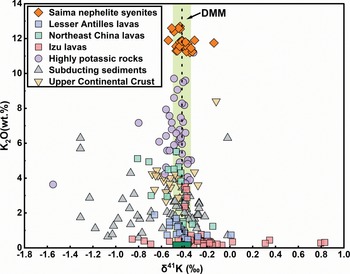
Apatite U–Pb dating results showed that the syenites formed at 236 ± 55 Ma (MSWD = 1.07) (online Supplementary Material Fig. S1). The Saima syenites have relatively high initial 87Sr/86Sr ratios (0.7085 to 0.7087) and low 143Nd/144Nd ratios (0.511709 to 0.511719) (online Supplementary Material Fig. S2) at an intrusion age of 230 Ma, indicating the involvement of crustal material during magma ascent or in the source region (Hawkesworth & Vollmer, Reference Hawkesworth and Vollmer1979; Jahn et al. Reference Jahn, Wu, Lo and Tsai1999). Except for one sample (δ41K = –0.14 ± 0.09 ‰), K isotopic compositions of the Saima nephelite syenites display a restricted range between –0.54 ‰ and –0.28 ‰, with an average of –0.41 ± 0.06 ‰ (2 SD; Fig. 1; Table 1), suggesting a mantle-like K isotopic composition. Evidently, K isotopes decoupled from the Sr–Nd isotope system for the Saima alkaline complex in the northeastern NCC. To investigate why the isotopes were decoupled, the influence of the magma evolution process, e.g. magma differentiation and crust contamination, should first be evaluated.
K2O versus δ41K for the Saima nephelite syenites from the northeastern North China Craton. The data for subducting sediments, island arc lavas and orogenic high-potassic rocks are from Sun et al. (Reference Sun, Teng, Hu, Chen and Pang2020), Hu et al. (Reference Hu, Teng and Chauvel2021 a,b), Wang, Z.-Z. et al. (Reference Wang, Teng, Prelević, Liu and Zhao2021) and Parendo et al. (Reference Parendo, Jacobsen, Kimura and Taylor2022). The K isotopic composition of the upper continental crust varies from –0.68 ‰ to –0.12 ‰, with an average of –0.44 ± 0.05 ‰ (Huang et al. Reference Huang, Teng, Rudnick, Chen, Hu, Liu and Wu2020). The K isotopic compositions of fresh ocean island basalts are used to represent depleted mantle (depleted MORB mantle (DMM): δ41K = –0.42 ± 0.08 ‰ (Hu et al. Reference Hu, Teng, Helz and Chauvel2021 b); K2O = 0.006 % (Workman & Hart, Reference Workman and Hart2005)).

All samples of the Saima nephelite syenites are highly enriched in light rare earth elements (LREEs) and large ion lithophile elements (LILEs) compared to OIB and E-MORB (Sun & McDonough, Reference Sun and McDonough1989), showing a distribution pattern like that of UCC (Rudnick & Gao, Reference Rudnick, Gao, Holland and Turekian2014) (online Supplementary Material Fig. S3), which indicates the involvement of crustal material. No significant correlations were observed in the ISr–1/Sr and ISr–MgO plots (online Supplementary Material Fig. S4), indicating that crustal contamination was not significant during magma ascent. The simple binary mixing simulation results showed that the degree of contamination was low, at ∼3 % (online Supplementary Material Fig. S2), suggesting that crustal material mixing into the source region was derived from subducting melts. In addition, the lack of correlation between δ41K and major elements (SiO2, MgO and K2O) or loss on ignition (LOI) (online Supplementary Material Fig. S5) indicates that there is no obvious K isotope fractionation in the process of magma differentiation and post-magmatic alteration, which is consistent with the findings of the previous research (Hu et al. Reference Hu, Teng, Helz and Chauvel2021 b). Therefore, the Saima alkaline rocks represent the original K–Sr–Nd isotope characteristics of the source region of the lithospheric mantle.
3.b. Diffusion modelling of K–Sr–Nd in the interactions of cratonic roots and asthenosphere
The presence of partial melt at the LAB has been confirmed by simulations based on modern seismic and electromagnetic observations (Kawakatsu et al. Reference Kawakatsu, Kumar, Takei, Shinohara, Kanazawa, Araki and Suyehiro2009; Naif et al. Reference Naif, Key, Constable and Evans2013; Rychert et al. Reference Rychert, Tharimena, Harmon, Wang, Constable, Kendall, Bogiatzis, Agius and Schlaphorst2021). Besides facilitating plate motion, such melts beneath the lithospheric plates also interact with the lithospheric mantle and affect the composition of the lithosphere over a long time interval. Here, we propose that the initially metasomatized lithospheric mantle was later altered by chemical diffusion between melts at the LAB, and the difference in diffusion rates between K and Sr–Nd is the main factor for the isotope decoupling.
The Fuxian kimberlites formed at ∼465 Ma and originated from subduction-related lithospheric mantle metasomatism in the eastern NCC (Zhang & Yang, Reference Zhang and Yang2007); thus, the enrichment events associated with their origin should have occurred earlier. Here, it is assumed that the metasomatism of K-rich melts occurred at ∼500 Ma. Because of the close geographical location and similar geological background to the Fuxian kimberlites, it is assumed that the lithospheric mantle roots of the Saima alkaline complex were coevally metasomatized by K-rich melts at ∼500 Ma, after which no further metasomatism events occurred. The relatively oxidized upper mantle can produce partial melts with different volatile (carbon, hydrogen) ratios, which efficiently extract highly incompatible elements. The interstitial melts enriched in volatiles (such as CO2, carbonate, H2O and hydroxyl) were produced by the partial melting of the lithospheric mantle root, which was metasomatized by K-rich melts in the ancient subduction process. Such carbon and hydrogen oxides strongly influence the stability of partial melts in the lithospheric mantle root (Dasgupta et al. Reference Dasgupta, Chowdhury, Eguchi, Eguchi, Sun and Saha2022). To evaluate the impact of chemical diffusion between these melts on the K–Sr–Nd isotopic compositions of the melts, and provide further indications for the decoupling of K isotopes from Sr–Nd isotopic compositions in the Saima alkaline complex, the diffusion model of K–Sr–Nd in the interactions of the cratonic roots and asthenosphere was simulated. The detailed modelling method is described below.
In the numerical simulation, diffusion coefficients were calculated using experimental data from Behrens & Hahn (Reference Behrens and Hahn2009) with a mantle potential temperature of 1280 °C for Sr and Nd, assuming that the temporal lithospheric thickness is 80 km and diffusion coefficient of K is three times that of Sr based on the compilations of Zhang et al. (Reference Zhang, Ni and Chen2010). The calculation yields D K = 3.53 × 10⁻¹⁰ m2/s, D Sr = 1.17 × 10⁻¹⁰ m2/s and D Nd = 1.62 × 10⁻¹¹ m2/s (for other parameters, see online Supplementary Material Table S4). Diffusion models of K–Sr–Nd were calculated based on Fick’s second law and the conservation of mass in a convection system (Zhang, Reference Zhang2008). For the Sr–Nd radioactive decay system, the radioactive decay law was also considered. The interstitial melts in these two interacting reservoirs were chemically equilibrated with peridotites. We only considered the isotopic evolution of the MLMR as a result of chemical diffusion or radioactive decay with the asthenosphere and neglected the variations in element concentrations caused by diffusion. In addition, the MLMR is more volatile rich than the asthenosphere, and the diffusion of K, Sr and Nd in the MLMR is much faster than in the asthenosphere. Thus, the diffusive isotopic flux from the asthenosphere can be homogenized via diffusion over a finite time interval, i.e. the MLMR can be treated as an isotopically uniform system.
Based on the above discussion, there are interactions between the interstitial melts, from the MLMR and asthenosphere reservoirs, caused by chemical diffusion. The chemical evolution of the MLMR as a result of chemical diffusion with the asthenosphere can be described using the following equation:
 $${{\partial C} \over {\partial t}} = D{{{\partial ^2}C} \over {\partial {x^2}}} + \upsilon {{\partial C} \over {\partial x}}$$
where C is the element concentration, t is the time, x is the distance, D is the diffusivity of the element in the interstitial melt and υ is the plate velocity or convective velocity of the asthenosphere. We neglected the variations in element concentrations caused by diffusion and only considered the evolution of the isotope ratios. According to isotope exchange experiments (Baker, Reference Baker1989; Lesher, Reference Lesher1990; van der Laan et al. Reference van der Laan, Zhang, Kennedy and Wyllie1994), the evolution of the isotopic ratio of the MLMR can be calculated using Equation (1) (Zhang, Reference Zhang2008); thus, the isotopic evolution of the system can be expressed as:
 $${{\partial R} \over {\partial t}} = D{{{\partial ^2}R} \over {\partial {x^2}}} + \upsilon {{\partial R} \over {\partial x}} + I$$
where R is the isotopic ratio or isotope per mil variation δ, and the third term I on the right-hand side of Equation (2) represents the isotopic variation owing to radioactive decay. For the 147Sm–143Nd system, the 143Nd/144Nd variation due to 147Sm decay to 143Nd after time t can be calculated using Equation (3):
 $$I = {{{\;^{{\rm{143}}}}{\rm{Nd}}} \over {{\;^{{\rm{144}}}}{\rm{Nd}}}} - {\left( {{{{\;^{{\rm{143}}}}{\rm{Nd}}} \over {{\;^{{\rm{144}}}}{\rm{Nd}}}}} \right)_0} = {{{\;^{{\rm{147}}}}{\rm{Sm}}} \over {{\;^{{\rm{144}}}}{\rm{Nd}}}}\left( {{e^{\lambda t}} - 1} \right)$$
where 143Nd/144Nd is the present isotopic ratio, (143Nd/144Nd)0 is the initial isotopic ratio, 147Sm/144Nd is the parent–daughter ratio at time t and λ is the decay constant. The isotopic evolution of the MLMR and solutions of Equation (2) can be calculated using numerical methods. However, if we neglect the diffusive flux between the metasomatized and unmetasomatized lithospheric mantle, the isotopic flux J from the asthenosphere can be approximately expressed by Equation (4) (Mungall, Reference Mungall2002),
 $$J = {{3\sqrt 2 } \over 4}\left( {{R_a} - {R_m}} \right){\rho _a}\sqrt {{{D\upsilon } \over X}}$$
where ρ a is the density of the asthenosphere and X is the characteristic length of the MLMR. R a and R m are the isotopic ratios of the asthenosphere and the MLMR, respectively. Note that R a and R m vary with time for radioactive decay systems such as the 147Sm–143Nd and 87Rb–87Sr systems. For a nonradioactive system, such as K isotopes, R a is a constant, while R m also varies with time owing to the flux from the convective asthenosphere. As mentioned above, the MLMR was more volatile rich than the asthenosphere, and the diffusions of K, Sr and Nd in the MLMR were much faster than those in the asthenosphere; thus, the diffusive isotopic flux from the asthenosphere can be homogenized by diffusion in a finite time interval, Δt; hence, R m can be considered a constant within Δt.
If the initial K isotopic composition of the MLMR, R 0 m , is set as a random value between −1.55 ‰ and +0.2 ‰ (the range of K isotopic compositions of orogenic high-potassic rocks and island arc lavas), R 1 m of the MLMR after the first time step Δt can be calculated by
 $$R_m^1 = R_m^0 + {{J\Delta t} \over {{M_m}}} = R_m^0 + {{3\sqrt 2 } \over {4V}}\left( {{R_a} - R_m^0} \right)\sqrt {{{D\upsilon \Delta {t^2}} \over X}} $$
where V is the volume of the MLMR expressed as V=M m /ρ m , and M m and ρ m are the mass and density of the MLMR, respectively.
At the next time step, R 1 m is reset as the initial isotopic composition, and then R 2 m can be calculated as
 $$R_m^2 = R_m^1 + {{J\Delta t} \over {{M_m}}} = R_m^1 + {{3\sqrt 2 } \over {4V}}\left( {{R_a} - R_m^1} \right)\sqrt {{{D\upsilon \Delta {t^2}} \over X}} $$
By repeating the calculations using Equations (5–6), the entire K isotopic evolution of the MLMR can be evaluated.
If the metasomatism of the MLMR was t m years ago for the 147Sm–143Nd system, then the 143Nd/144Nd ratios of the MLMR and asthenosphere at t m are the initial compositions, denoted as R 0 m and R 0 a , respectively, and can be calculated using Equation (3). Thus, the R 1 m of the MLMR after the first time step Δt can be calculated as follows:
 \begin{align}R_m^1 &= R_m^0 + {{J\Delta t} \over {{M_m}}} + {I_1}\\
&= R_m^0 + {{3\sqrt 2 } \over {4V}}\left( {R_a^0 - R_m^0} \right)\sqrt {{{D\upsilon \Delta {t^2}} \over X}} + {\left( {{{{\;^{{\rm{147}}}}{\rm{Sm}}} \over {{\;^{{\rm{144}}}}{\rm{Nd}}}}} \right)_m}\left( {{e^{\lambda \Delta t}} - 1} \right)\end{align}
where (147Sm/144Nd)m is the parent–daughter ratio of the MLMR and I 1 is the ingrowth due to radioactive decay after Δt.
In the next time step, R 1 a can be calculated by
 $$R_a^1 = {\left( {{{{\;^{{\rm{147}}}}{\rm{Sm}}} \over {{\;^{{\rm{144}}}}{\rm{Nd}}}}} \right)_a}\left( {{e^{\lambda \Delta t}} - 1} \right)$$
where (147Sm/144Nd)a is the parent–daughter ratio of the asthenosphere. R 1 m is reset as the initial isotopic composition and R 2 m can be calculated as
 \begin{align}R_{}^2 &= R_m^1 + {{J\Delta t} \over {{M_m}}} + {I_2}\\
&= R_m^1 + {{3\sqrt 2 } \over {4V}}\left( {R_a^1 - R_m^1} \right)\sqrt {{{D\upsilon \Delta {t^2}} \over X}} + {\left( {{{{\;^{{\rm{147}}}}{\rm{Sm}}} \over {{\;^{{\rm{144}}}}{\rm{Nd}}}}} \right)_m}\left( {{e^{\lambda \Delta t}} - 1} \right)\end{align}
By repeating the calculations using Equations (7–9), the entire Nd isotopic evolution of the MLMR can be evaluated. Similarly, other radioactive isotopic systems of MLMRs, such as Sr, can also be evaluated.
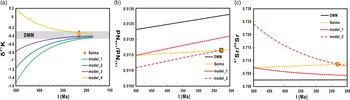
The simulation results were obtained through the above process. For the nonradioactive system (Fig. 2a), with the chemical diffusion of K between interstitial melts from the MLMR and asthenosphere, K isotopic compositions with sediment signals of the MLMR tended to be in equilibrium with the asthenosphere at 230 Ma, consistent with the present K isotopic composition of the Saima alkaline rocks. Compared with the K isotopic data for orogenic high-potassic rocks and island arc lavas (–1.55 ‰ to +0.2 ‰) (Fig. 2), the nearly identical K isotopic compositions for the Saima and asthenospheric mantles are low probability events (<10 %). For the Sr–Nd radioactive decay system (Fig. 2b, c), the Sr–Nd isotope ratios of the MLMR cannot evolve into the isotope ratio values of the Saima alkaline rocks at 230 Ma based on Model_1. Other processes are required for the isotopic evolution of the MLMR. Through the processes of radioactive decay and chemical diffusion (Model_2), the Sr–Nd isotope system of the MLMR could evolve to the ratios of the Saima alkaline rocks at 230 Ma. Therefore, because of the faster diffusion rate of K than that of Sr and Nd, the Sr–Nd isotope system could preserve the signals of both the mantle and crust, while the K isotopes only reflect the characteristics of the asthenospheric mantle.
Simulation calculation diagrams of K–Sr–Nd isotopes for the Saima alkaline rocks from the northeastern North China Craton. (a) Diffusion model diagram of K isotopes. The yellow box corresponds to the isotope ratios of the Saima alkaline rocks. (b, c) Diffusion model diagrams of Sr–Nd isotopes. Depleted MORB mantle (DMM) represents the isotope radioactive decay system of the asthenosphere data from Workman & Hart (Reference Workman and Hart2005). Model_1 represents the isotopic evolution of the MLMR as the result of radioactive decay, taking 0.707285 and 0.511487 as the initial values of 87Sr/86Sr and 143Nd/144Nd at 500 Ma, respectively. Model_2 represents the isotopic evolution of the MLMR as a result of chemical diffusion and radioactive decay, and the reset initial values are 0.72415 and 0.51109 by repeating the calculation, respectively. Nd isotope data of Saima alkaline complex from this study, Zhu et al. (Reference Zhu, Yang, Sun, Zhang and Wu2016) and Yang et al. (Reference Yang, Chung, Wilde, Wu, Chu, Lo and Fan2005).

In our numerical simulations, the variations of elements are not considered since isotope exchange by diffusion is much greater than element exchange (Zhang, Reference Zhang2008), according to isotope exchange experiments (Baker, Reference Baker1989; Lesher, Reference Lesher1990; van der Laan et al. Reference van der Laan, Zhang, Kennedy and Wyllie1994). Moreover, the element concentrations of interest in the Saima source region are not well constrained. In addition, the time required to homogenize the isotopic composition of the MLMR highly depends on the size of the MLMR and the diffusivities of elements, which in turn depends on the temperature. Assuming that the temporal lithospheric thickness was 200 km 500 Ma ago, the actual temperature at the LAB was 1380 °C, and the diffusivity of the isotopic element is three times that of the element; thus, the calculated time to homogenize the K isotopic composition of the MLMR is less than 100 Myrs with other parameters fixed. This exercise demonstrates our model is robust and reasonable although many parameters are not well constrained. The above results show that the K isotopic composition of this particular size MLMR is gradually homogenized under mantle convection within a certain time span. However, although mantle convection can reduce mantle heterogeneity to some extent, the mantle still has heterogeneity at different scales from thousands of kilometres to several centimetres (Kogiso et al. Reference Kogiso, Hirschmann and Reiners2004; Huang & Davies, Reference Huang and Davies2007; Iwamori & Nakamura, Reference Iwamori and Nakamura2015).
Besides K, He, H and Li are also fast-diffusion components, and their diffusivities are higher than that of K in the silicate melts or solid mantle (Sun et al. Reference Sun, Yoshino, Sakamoto and Yurimoto2015; Wang et al. Reference Wang, Brodholt and Lu2015; Demouchy & Bolfan-Casanova, Reference Demouchy and Bolfan-Casanova2016). According to our model, identical He, H and Li isotopic compositions to the asthenospheric mantle in the Saima alkaline complex are therefore expected. However, these isotopic systems are more sensitive to crustal contamination (Hilton & Porcelli, Reference Hilton, Porcelli, Holland and Turekian2014) and diffusion-driven isotopic fractionation after intrusion into wall rocks (Teng et al. Reference Teng, McDonough, Rudnick and Walker2006); thus, their original asthenospheric signatures cannot be easily preserved.
4. Conclusions
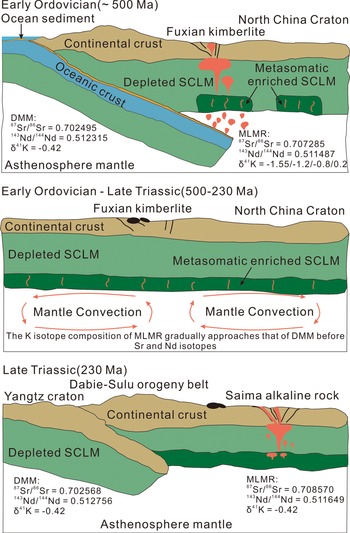
This research provides examples of the decoupling of K isotopes and Sr–Nd isotopes when the interaction of MLMR and asthenosphere is rate-limited by diffusion. The numerical simulations reproduced the K–Sr–Nd isotopic compositions of the Saima alkaline complex if its source area was modified before 500 Ma. In early Palaeozoic time (∼500 Ma), the sub-continental lithospheric mantle of the eastern NCC was metasomatized by subducted sediment-derived melt (Fig. 3). The continuous interaction of the metasomatized lithospheric mantle and convective asthenosphere by chemical diffusion of interstitial melts resulted in homogenized K isotopic compositions in these two reservoirs before ∼230 Ma, from which the Saima alkaline rocks formed. The Sr–Nd isotope system of the metasomatized lithospheric mantle still records the original signatures because of its long radioactive half-life and slow diffusion. Our data confirm the elimination of K isotopic heterogeneity by mantle convection in the Saima mantle source, and it highlights the role of the size of the MLMR and the diffusion rate of the element in determining the composition of the MLMR.
Schematic diagram of the petrogenesis of the Saima alkaline rocks from the northeastern North China Craton. The Fuxian kimberlites are used to represent the initial formation of the metasomatized lithospheric mantle in the Saima alkaline rock source area in early Ordovician time (∼500 Ma). SCLM – sub-continental lithospheric mantle.

Supplementary material
To view supplementary material for this article, please visit https://doi.org/10.1017/S001675682300016X
Acknowledgements
This work was financially supported by the Strategic Priority Research Program of the Chinese Academy of Sciences (Y.X., grant number XDB 41000000); Pre-Research Project on Civil Aerospace Technologies (D.Z., grant number D020202); the National Natural Science Foundation of China (Y.X., grant number 42073020); and the Guizhou Provincial 2020 Science and Technology Subsidies (Y.X., grant number GZ2020SIG). We are grateful to Fangzhen Teng, Zezhou Wang, Liemeng Chen, Zhi Li and Deliang Wang for their assistance during the academic exchanges. We also thank Yan Hu for assisting with laboratory work during the epidemic period in March 2020.
Conflict of interest
None.