Introduction
A relationship between marijuana use and reduced psychological adjustment, in the form of affective disorders and symptomatology, has been established in both cross-sectional (Degenhardt et al. Reference Degenhardt, Hall and Lynskey2001; Chen et al. Reference Chen, Wagner and Anthony2002) and longitudinal (Patton et al. Reference Patton, Coffey, Carlin, Degenhardt, Lynskey and Hall2002; Friedman et al. Reference Friedman, Terras, Zhu and McCallum2004) research. The majority of the research suggests that marijuana use is negatively associated with measures of psychological adjustment (for exceptions see Shedler & Block, Reference Shedler and Block1990; Galaif et al. Reference Galaif, Chou, Sussman and Dent1998).
Recent longitudinal research, which has focused on developmental patterns of marijuana use from adolescence to young adulthood, has found that differential trajectories of marijuana use are related to different levels of adjustment in young adulthood (Brown et al. Reference Brown, Flory, Lyman, Leukefeld and Clayton2004; Ellickson et al. Reference Ellickson, Martino and Collins2004; Flory et al. Reference Flory, Lynam, Milich, Leukefeld and Clayton2004; Windle & Wiesner, Reference Windle and Wiesner2004; Schulenberg et al. Reference Schulenberg, Merline, Johnston, O'Malley, Bachman and Laetz2005). In general, usage patterns characterized by earlier onset, longer duration and higher frequency of marijuana use are associated with less desirable outcomes.
Although marijuana use is more prevalent in men than in women (Stinson et al. Reference Stinson, Ruan, Pickering and Grant2006), the areas of psychological adjustment most often affected by marijuana use are those in which women generally do worse than men. For example, women exhibit a higher prevalence of mood disorders (Hasin et al. Reference Hasin, Goodwin, Stinson and Grant2005; Kessler et al. Reference Kessler, Chiu, Demler and Walters2005) and higher subclinical levels of depression and distress than their male counterparts (McDonough & Walters, Reference McDonough and Walters2001; Denton et al. Reference Denton, Prus and Walters2004). Marijuana use may, therefore, have especially strong implications for psychological adjustment in women. This consideration takes on further weight from research, which has documented a stronger relationship between marijuana use and psychological adjustment in females as compared with males (Thomas, Reference Thomas1996; Patton et al. Reference Patton, Coffey, Carlin, Degenhardt, Lynskey and Hall2002; Friedman et al. Reference Friedman, Terras, Zhu and McCallum2004).
There are several mechanisms that may be responsible for the link between psychological functioning and marijuana use. One explanation, postulated by Problem Behavior Theory (Jessor et al. Reference Jessor, Donavan and Costa1991), may be an underlying third factor, which predisposes individuals for both problem behaviors (including substance use) and psychological maladjustment. Thus, a common cause, possibly in the form of a personality dimension, such as unconventionality, shared by ‘high-risk’ individuals would be responsible for a broad range of adjustment problems, including drug use, deviant behaviors and psychological maladjustment (Jessor et al. Reference Jessor, Chase and Donovan1980; Donovan & Jessor, Reference Donovan and Jessor1985). Similarly, it is possible that other confounding factors, such as family dysfunction, may underlie both marijuana use and later psychological adjustment (Fergusson & Horwood, Reference Fergusson and Horwood1997; Degenhardt et al. Reference Degenhardt, Hall and Lynskey2003).
Another possibility is that marijuana use is precipitated by lower levels of psychological adjustment (MacLeod et al. Reference MacLeod, Oakes, Copello, Crome, Egger, Hickman, Oppenkowski, Stokes-Lampard and Smith2004). Specifically, those suffering from psychological maladjustment may be more inclined to use marijuana, possibly in an attempt to ameliorate their psychological symptoms. However, most longitudinal research has not supported this theory of self-medication (Bovasso, Reference Bovasso2001).
Finally, marijuana use, particularly at high levels and over a long period of time, may have a negative impact on psychological adjustment (Kandel, Reference Kandel1989), either directly or through its relationship with other psychosocial constructs. Research has established that marijuana use in adolescence and young adulthood is related not only to later psychological maladjustment but also to a host of other undesirable outcomes, including lower levels of education (Fergusson et al. Reference Fergusson, Horwood and Beautrais2003; Lynskey et al. Reference Lynskey, Coffey, Degenhardt, Carlin and Patton2003a), reduced occupational attainment (Schuster et al. Reference Schuster, O'Malley, Bachman, Johnston and Schulenberg2001), impaired cognitive functioning (Solowij et al. Reference Solowij, Stephens, Roffman, Babor, Kadden, Miller, Christiansen, McRee and Vendetti2002; Pope et al. Reference Pope, Gruber, Hudson, Cohane, Huestis and Yurgelun-Todd2003) and failure to make a transition to adult roles and behaviors (Brook et al. Reference Brook, Adams, Balka and Johnson2002). Failing at important developmental tasks of adolescence and young adulthood (e.g. graduating from high school, obtaining employment) may give rise to psychological maladjustment in young adults (Degenhardt et al. Reference Degenhardt, Hall and Lynskey2003).
In addition, some longitudinal research has established a link between earlier marijuana use and later substance use disorders, including alcohol and other illicit drug use disorders (Fergusson & Horwood, Reference Fergusson and Horwood1997; Windle & Wiesner, Reference Windle and Wiesner2004). As part of psychological adjustment, this research therefore assessed the relationship between trajectories of marijuana use and later substance use disorder.
To date, the majority of the research on marijuana use and related outcome variables has been conducted on samples that were primarily or exclusively of European American descent (but see Brown et al. Reference Brown, Flory, Lyman, Leukefeld and Clayton2004). However, given that marijuana use patterns, and also the outcomes associated with disparate patterns, may differ across race and/or ethnicity (Brown et al. Reference Brown, Flory, Lyman, Leukefeld and Clayton2004), it is important to evaluate developmental patterns of marijuana use and associated outcome measures among ethnic and racial minority groups.
The current study thus had three aims: (1) to identify distinct homogeneous subgroups of marijuana use from adolescence (age 14.0 years) to young adulthood (age 26.1 years) among African American and Puerto Rican women, (2) to examine potential racial/ethnic differences in marijuana usage patterns, and (3) to identify differences among trajectory groups in self-reported levels of psychological adjustment, including symptoms of depression, anger/hostility and the presence of a substance use disorder at mean age 32.5 years. We hypothesized that individuals in trajectories characterized by an earlier onset, longer duration and/or higher frequency of marijuana use would report significantly higher levels of symptoms of depression and/or anger/hostility, and be at greater risk for substance use disorder than individuals in trajectory groups characterized by later onset, abstinence, shorter durations and/or lower frequencies of marijuana use. To rule out the possibility that earlier psychological maladjustment may be underlying both marijuana usage patterns and later levels of psychological adjustment, we controlled for earlier levels of psychological maladjustment. In addition, we controlled for a measure of earlier unconventionality to determine whether this construct may be underlying the relationship between marijuana use patterns and psychological functioning, as suggested by Problem Behavior Theory. We also included measures representing conflict in the participants' relationships with their mothers at the beginning of the study to control for earlier levels of family dysfunction.
Method
Participants
Participants in the current research were 474 females who had participated in at least three waves of a five-wave longitudinal study of African American and Puerto Rican adolescents/young adults. Data for the Time 1 (T1) sample (n=716) were collected in 1990, Time 2 (T2, n=654) in 1995, Time 3 (T3, n=335) in 2000–2001, Time 4 (T4, n=241) in 2001–2003, and Time 5 (T5, n=382) in 2008–2009 for a study investigating tobacco use among African American and Puerto Rican young adultsFootnote 1Footnote †. The Institutional Review Board at Mount Sinai School of Medicine approved the study's procedures for all data collections and the Institutional Review Board at New York University School of Medicine has approved the study annually since 2004.
Participants came from grades 7–10 in school districts serving the East Harlem area of New York City. Because of budget limitations, the T3 data collection did not target the entire T2 sample, but oversampled those respondents who reported using marijuana or other illicit drugs at T2. The main reason for this strategy was to sample a sufficient number of drug users and stay within budgetary limitations. At T4, a stratified random sample of T3 participants were invited to participate in the study. Sampling was proportionate to sex and ethnicity. At T5, we sought the participation of all those who had participated at least at two previous time points. Data were collected by trained interviewers who were matched on sex and ethnicity, whenever possible.
Of the 474 female participants eligible for inclusion in this research, 39% had participated in three waves of data collection, 20% had participated in four waves, and 41% had participated in all five waves. Of these 474 females, 52.3% (n=248) were African American and 47.7% (n=226) were Puerto Rican. Their mean ages were 14.0 years (s.d.=1.3) at T1, 19.1 years (s.d.=1.5) at T2, 24.5 years (s.d.=1.4) at T3, 26.1 years (s.d.=1.4) at T4, and 32.5 years (s.d.=1.4) at T5. Attrition analyses revealed that those who participated at both T1 and T5 compared to those who participated at T1 and not at T5: (1) used marijuana more frequently at T2 ( T1,T5=0.58, T1=0.35, t=−2.88, p<0.05), (2) reported greater unconventionality at T1 (T1,T5=10.06, T1=9.56, t=−2.05, p<0.05), and (3) were younger at T1 (T1,T5=13.9, T1=14.5, t=5.59, p<0.0001). No statistically significant differences were found with regard to marijuana use at T1, T3 or T4, levels of conflict in the participants' relationships with their mothers, or T1 levels of psychological maladjustment (depression, anger/hostility) (p>0.05).
For determining the trajectories of marijuana use, all 474 participants were included in the analyses. In the next step, linking trajectory group membership to T5 outcomes, we only included those women who participated at T5 (n=382)Footnote 2.
Measures
Marijuana use at each wave (T1–T4) was measured by an item asking how often in the past year the respondent had used marijuana. Answering options were (0) ‘never’, (1) ‘a few times a year or less’, (2) ‘about once a month’, (3) ‘several times a month’ and (4) ‘once a week or more’. Parallel items were used to assess other illegal drug use (cocaine, ecstasy) and alcohol use in the past 12 months at T5. Answering options for how often and how much alcohol was consumed in the past year ranged from (0) ‘None at all’ to (5) ‘Five drinks or more every day’. Variables representing psychological adjustment in young adulthood (T5) included depression, anger/hostility and the presence of a substance use disorder (including marijuana, other illicit drugs and alcohol) in the past 12 months. Scales measuring depression and anger/hostility were adapted from the Hopkins Symptom Checklist (HSCL; Derogatis et al. Reference Derogatis, Lipman, Rickels, Uhlenhuth and Covi1974). The stem for all items from the HSCL read: ‘Over the past few years, how much were you bothered by the following?’ Answering options ranged from (0) ‘not at all’ to (4) ‘extremely’. Sample items for the depression and anger/hostility scales were ‘feeling hopeless about the future’ and ‘temper outbursts you cannot control’ respectively. Mean scores were computed across the six items measuring depression and the five items measuring anger/hostility. Cronbach's α was acceptable for both scales: 0.78 for depression and 0.68 for anger/hostility.
To control for the presence of depressive symptoms and anger/hostility at T1, we used partial/similar measures of these constructs, which were available at T1. Depressive symptoms were measured by two items assessing (1) feelings of hopelessness and (2) depressive affect (‘sad, unhappy, depressed’, r=0.61). Two items reflecting anger (‘losing temper’, ‘feeling like swearing’) were combined to form a measure of anger/hostility at T1 (r=0.39). Earlier unconventionality was assessed with a six-item measure of tolerance of deviance/risk taking. A sample item read: ‘You like to live dangerously’ (α=0.67). Two measures were used to assess the degree of conflict in the women's relationships with their mothers at T1. One measure assessed the degree to which the adolescent daughter resisted the mother's control (three items, α=0.77), whereas the other measure reflected the mother's punitive behavior toward her daughter (two items, r=0.42). Sample items for the two measures read: ‘You try to see what you can get away with’ and ‘She acts cold and unfriendly when you do something she does not like’ respectively.
The presence of a substance use disorder in the past 12 months was assessed by the Mini-International Neuropsychiatric Interview (MINI; Sheehan et al. Reference Sheehan, Lecrubier, Sheehan, Amorim, Janavs, Weiller, Hergueta, Baker and Dunbar1998). Questions assessed all seven criteria specified by DSM-IV-TR (APA, 2000). A diagnosis of dependence (on marijuana, other illicit drugs, and/or alcohol) was assigned if three or more of the criteria were met. Abuse of these substances was assessed by four criteria specified by DSM-IV-TR (APA, 2000). A diagnosis of abuse was assigned if one or more of the criteria were met. Marijuana, other illicit drug, and alcohol use disorders were assessed separately according to the following logic: if a participant did not meet criteria for dependence, the presence of abuse was assessed. Scoring positively for marijuana dependence, marijuana abuse, other illicit drug dependence, other illicit drug abuse, alcohol dependence, or alcohol abuse resulted in being classified as having a substance use disorder. The MINI has demonstrated good reliability and validity (Sheehan et al. Reference Sheehan, Lecrubier, Sheehan, Janavs, Weiller, Keskiner, Schinka, Knapp, Sheehan and Dunbar1997; Otsubo et al. Reference Otsubo, Tanaka, Koda, Shinoda, Sano, Tanaka, Aoyama, Mimura and Kamijima2005).
Data analysis
We used growth mixture modeling (GMM) using the MPlus software (Muthén & Muthén, Reference Muthén and Muthén2007) to identify longitudinal trajectories of marijuana use from adolescence (mean age 14.0 years) to young adulthood (mean age 26.1 years). We established the number of trajectories using several criteria: (1) the Bayes information criterion (BIC; Schwarz, Reference Schwarz1978; Raftery, Reference Raftery1985) (the most parsimonious model has the smallest absolute value of the BIC, with a BIC difference of ⩾2.0 representing positive evidence in favor of the lower-scoring model; Raftery, Reference Raftery1995), (2) the entropy (values closer to 1 indicate a better fit; McLachlan & Peel, Reference McLachlan and Peel2000), (3) the Lo–Mendell–Rubin likelihood ratio test (LMR-LRT; Lo et al. Reference Lo, Mendell and Rubin2001), (4) the parametric bootstrap likelihood ratio test (BLRT; Nylund et al. Reference Nylund, Asparouhov and Muthén2007), (5) a minimum 5% proportion of the sample in each latent class, and (6) theoretical considerations and interpretability. Using the LMR-LRT and the BLRT, a low p value indicates that the model with one less class is rejected in favor of the estimated model.
In addition, we considered the accuracy of group classification indicated by the average modal Bayesian posterior probability (BPP) for each latent class. Average modal posterior probabilities of ⩾0.70 are considered sufficient to avoid classification error (Nagin, Reference Nagin2005).
Next, we conducted multiple and logistic regression analyses with depressive symptoms and symptoms of anger/hostility and the presence of a substance use disorder respectively at T5 as the dependent variables. To address the issue of uncertainty of assignment to a latent class, we used the BPPs rather than the class assignments when predicting adjustment outcomes in the regression analyses. Race/ethnicity (dummy coded), age, total household income (measured at T5), education (T5), earlier measures of the respective outcomes, a measure of tolerance of deviance/risk taking, and the two measures of conflict with one's mother were included as covariates when predicting symptoms of depression and anger/hostility. When predicting the presence of a substance use disorder, we controlled for race/ethnicity, age, household income, education, past-year alcohol and other illicit drug use at age 32.5 years, T1 tolerance of deviance/risk taking, and the two measures of conflict with one's mother (T1).
Results
Preliminary analyses
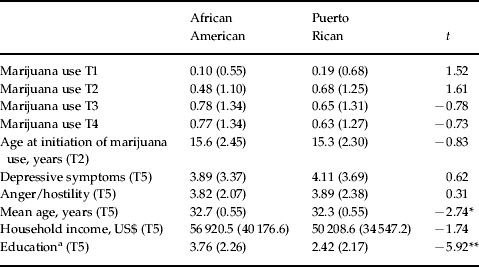
T tests comparing African American and Puerto Rican women indicated no statistically significant differences in marijuana use at any time point (see Table 1) or in the age of onset of marijuana use. In addition, there were no ethnic/racial differences in levels of anger/hostility and depressive symptoms (Table 1), or in the prevalence of substance use disorders at T5 (χ2=0.83, p>0.05). A table of the frequencies of other illicit drug use at T5 revealed that there was no use of illegal drugs other than marijuana, ecstasy and cocaine. In addition, only one person reported use of cocaine at T5. Therefore, the logistic regressions predicting the presence of a substance use disorder at T5 only controlled for concurrent alcohol and ecstasy use.
Means and standard deviations for African American and Puerto Rican women

a Education: 0=11th grade or below; 7=postgraduate degree.
* p<0.01, ** p<0.001.
Trajectories of marijuana use
Given the similarities in age of onset and levels of marijuana use between African American and Puerto Rican women, we performed the trajectory analyses on the combined sample of women. We fitted the data using the categorical data option in MPlus to accommodate the ordered categorical (ordinal) nature of the data. We specified a quadratic model because the developmental progression of marijuana use typically entails an increase of use between adolescence and young adulthood, followed by a leveling off (O'Malley et al. Reference O'Malley, Bachman, Johnston, Schulenberg, Juster and Kahn2004). A likelihood ratio test indicated the superior fit of the quadratic versus a linear model [χ(3)2=52.46, p>0.001].
We fitted one-, two-, three-, four- and five-group models respectively. A three-group model was chosen based on the following results: it had the lowest BIC (2276.2 v. 2279.5 for the two-group model and 2287.2 for the four-group model); the LMR-LRT and the BLRT for the three-group model were statistically significant compared to the two-group model; the LMR-LRT was not statistically significant when comparing the four-group model to the three-group model. Finally, the entropy (0.68 for the three-group model), although lower than for the two-group model (0.74), was higher than for the four-group model (0.56). All BPPs for the three-group model were above 0.75, indicating adequate classification (Nagin, Reference Nagin2005).
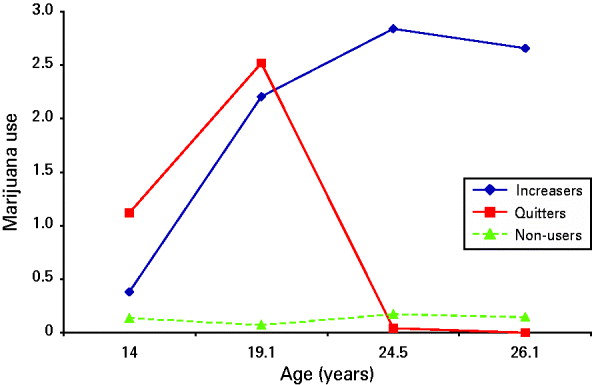
We named the three trajectory groups ‘non-users’ (participants who reported no or negligible marijuana use at all four times), ‘increasers’ (participants who reported some use at age 14.0 years that continued to increase until age 24.5 years and then leveled off slightly), and ‘quitters’ (participants who reported some marijuana use at age 14.0, rapidly increased their use until age 19.1 years, and had essentially ceased use by age 24.5 years) (see Fig. 1). The occurrence probabilities were 73.6% non-users, 17.9% increasers, and 8.5% quitters.
Trajectories of marijuana use for African American and Puerto Rican women (n=474).

Including race/ethnicity as a predictor of trajectory group membership did not result in an improved model fit, nor did the ethnicity dummy code reach statistical significance. Thus, no racial/ethnic differences in group membership were present, confirming our preliminary finding that there were no racial/ethnic group differences in marijuana use over time.
Group differences in psychological adjustment
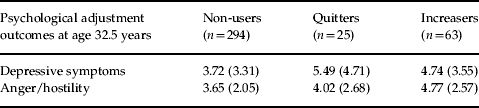
The results from the multiple regression analyses showed that increasers, compared to non-users, displayed higher levels of depression (b=1.31, s.e.=0.60, t=2.20, p<0.05) and anger/hostility (b=1.40, s.e=0.38, t=3.71, p<0.001) at age 32.5 years, controlling for age, race/ethnicity, T5 household income and education, T1 tolerance of deviance/risk taking, T1 level of conflict in the mother–daughter relationship, and T1 levels of the respective outcome. Increasers also displayed higher levels of anger/hostility than quitters (b=1.48, s.e=0.63, t=2.37, p<0.05). Adjusted means for the three groups are displayed in Table 2.
Means and standard deviations of psychological adjustment for women's marijuana trajectory latent classes (n=382)

A multiple logistic regression, controlling for the participant's age, race/ethnicity, T5 household income and education, T1 intolerance of deviance/risk-taking, T1 level of conflict in the mother–daughter relationship, and alcohol and ecstasy use at age 32.5 (T5), revealed that increasers were more likely than non-users to meet criteria for a substance use disorder at age 32.5 years [adjusted odds ratio (aOR) 4.86, confidence interval (CI) 1.52–15.57]. There were no statistically significant differences between quitters and non-users, or between quitters and increasers.
Discussion
Trajectories of marijuana use
Our longitudinal study of African American and Puerto Rican females identified three trajectories of marijuana use over a period extending from adolescence (mean age=14.0 years) to young adulthood (mean age=26.1 years): non-users, increasers, and quitters. Race/ethnicity was not related to marijuana trajectory group membership in the analyses, suggesting that urban African American and Puerto Rican women follow similar developmental patterns of marijuana use. Possibly, their substance use patterns were similar because these urban Puerto Rican and African American adolescents/young adults shared similar socio-economic backgrounds, attended the same schools, and lived in the same neighborhoods. These contextual similarities may have given rise to similar patterns of substance use, including marijuana use (Brook et al. Reference Brook, Pahl and Ning2006).
Similar to other researchers, we identified a trajectory of increasers, a group of women who started using marijuana early and continued to increase their use until their mid-twenties. Although women tend to use marijuana less frequently than men (Stinson et al. Reference Stinson, Ruan, Pickering and Grant2006), almost 20% of these urban African American and Puerto Rican women engaged in relatively frequent use (more than once a month) into their mid-twenties, a time during which marijuana use typically declines. Future research should try to identify the risk factors for this high-risk group of women.
Women in the quitters group increased their use sharply between early and late adolescence in a manner similar to the increasers, but, by age 24.5 years, levels of use in this group had dropped to the same level as that of the non-users. Although other authors have also identified groups of decreasers (e.g. Ellickson et al. Reference Ellickson, Martino and Collins2004; Windle & Wiesner, Reference Windle and Wiesner2004; Schulenberg et al. Reference Schulenberg, Merline, Johnston, O'Malley, Bachman and Laetz2005), this pattern of rapid increase followed by rapid decrease is somewhat different and may well be gender specific. Possibly, women in this group stopped using marijuana because they had children. Indeed, a greater percentage of women who quit (75.0%) had a child by age 24.5 (T3), compared to women in the other two trajectory groups (42.1% among non-users; 44.7% among increasers). Becoming a parent is a powerful incentive for ceasing substance use among women (Bachman et al. Reference Bachman, O'Malley, Schulenberg, Johnston, Bryant and Merline2002).
Trajectories of marijuana use and later psychological adjustment
As predicted, among the three trajectory groups, increasers reported more depressive symptoms and anger/hostility and were at greater risk of having a substance use disorder than non-users at age 32.5 years. Although, perhaps unexpectedly, the mean depression values reported by the quitters were also higher than those of the non-users and increasers, this difference was not statistically significant. The lack of statistical significance may have been due to the limited statistical power, as the group of quitters for whom T5 data were available was rather small.
Increasers also reported higher levels of anger/hostility than did quitters at age 32.5. This finding is consistent with previous research, which has found that the psychosocial sequelae of marijuana use do not seem to persist over time (Schulenberg et al. Reference Schulenberg, Merline, Johnston, O'Malley, Bachman and Laetz2005). However, in light of the modest size of the group of quitters, and the finding that the mean value of depression for the quitters was higher than those of the increasers at age 32.5, this result should be replicated before final conclusions can be drawn.
Overall, our results are in agreement with those of Ellickson et al. (Reference Ellickson, Martino and Collins2004), who found that trajectory classes of increased marijuana use, compared to abstainers, reported reduced psychological adjustment. However, some authors who have investigated trajectories of marijuana use and their association with psychological adjustment have not identified a link between membership in a high-frequency marijuana use trajectory group and lower levels of psychological adjustment (e.g. Brown et al. Reference Brown, Flory, Lyman, Leukefeld and Clayton2004; Flory et al. Reference Flory, Lynam, Milich, Leukefeld and Clayton2004). Given the clear association found in this study, it is possible that the membership in a high-frequency marijuana use trajectory is associated with less psychological adjustment mainly among women. This notion is supported by research, which finds a stronger relationship between marijuana use and psychological adjustment in females than in males (Thomas, Reference Thomas1996; Patton et al. Reference Patton, Coffey, Carlin, Degenhardt, Lynskey and Hall2002; Friedman et al. Reference Friedman, Terras, Zhu and McCallum2004).
Our finding that increasers reported higher levels of depression and anger/hostility substance use disorders at age 32.5 than non-users and, in the case of anger/hostility, than quitters clearly shows a link between early-starting continued use of marijuana and psychological adjustment in adulthood among women. This finding is supported by the fact that our analyses included variables representing earlier (T1) levels of psychological adjustment. Marijuana use in adolescence and young adulthood is associated with several other negative correlates and outcomes, most notably reduced functioning in age-appropriate roles (for a review, see MacLeod et al. Reference MacLeod, Oakes, Copello, Crome, Egger, Hickman, Oppenkowski, Stokes-Lampard and Smith2004). Failure to fulfill age-appropriate developmental tasks (e.g. graduating from high school, obtaining employment), in turn, may be linked to reduced psychological adjustment in women (Degenhardt et al. Reference Degenhardt, Hall and Lynskey2003).
The relationship between membership in a marijuana trajectory group and depressive symptoms and anger/hostility, respectively, was also maintained despite statistical control of a variable representing an early (T1) propensity for unconventionality and risk-taking behavior. Thus, it is less likely that such a personality dimension explains fully the relationship between membership in a marijuana use group and later psychological adjustment in women.
Similarly, controlling for earlier levels of conflict in the relationship between the participant and her mother, a construct reflecting family dysfunction, did not render the association between marijuana use group membership and later psychological adjustment statistically insignificant. However, it should be noted that there are many other psychosocial influences, not measured in the current study, that may account for the relationship between marijuana use and women's psychological maladjustment. In addition, it is possible that a common genetic liability predisposes individuals to both marijuana use and psychological maladjustment (e.g. Sullivan et al. Reference Sullivan, Neale and Kendler2000).
Women who followed trajectories of high and increasing marijuana use into their mid-twenties were more likely than non-users to have a substance use disorder (including marijuana, other illicit drug, and alcohol use disorders) at age 32.5. This association was maintained despite control on concurrent (T5) use of alcohol and ecstasy. Long-term marijuana use, especially when started early, results in addiction for some users (Iversen, Reference Iversen2003; Haney et al. Reference Haney, Hart, Vosburg, Nasser, Bennett, Zubaran and Foltin2004). High levels of marijuana use have also been shown to be related to increased use of other substances, possibly due to a biochemical effect (Lynskey et al. Reference Lynskey, Heath, Bucholz, Slutske, Madden, Nelson, Statham and Martin2003b; Fergusson et al. Reference Fergusson, Boden and Horwood2006). It is also possible that those following trajectories of high and increased use are more likely to suffer from an underlying diathesis to addiction (Agrawal et al. Reference Agrawal, Neale, Prescott and Kendler2004; Kreek et al. Reference Kreek, Nielsen, Butelman and LaForge2005).
Limitations
Limitations of the current study included the oversampling of participants who displayed more deviant behaviors at T2. Possibly, our results would have differed had we been able to recruit participants representing a broader spectrum of risk-taking behaviors. Another limitation was our sole reliance on self-report measures. However, a recent study by Harrison et al. (Reference Harrison, Martin, Enev and Harrington2007) showed that most marijuana users reported their use accurately. Furthermore, despite our attempts to control for other underlying factors that may explain the relationship between membership in a latent class of elevated marijuana use and psychological maladjustment, our results cannot be considered causal. Finally, our study is limited by the small size of the group of quitters at T5. Nevertheless, our results regarding the differences in psychological adjustment between non-users and increasers were consistent across all three outcomes.
Conclusions
In general, the findings of the present longitudinal study of women supported our hypotheses. Among women, longer duration and more frequent use of marijuana was associated with poorer outcomes on measures of psychological adjustment. Although the relationships between marijuana use trajectories and psychological adjustment cannot be considered causal, the fact that we chose to assess adjustment in young adulthood (measurement wave 5) and the inclusion of variables representing earlier levels of the outcomes, in addition to measures of unconventionality and family conflict, support the idea that marijuana use may contribute to women's psychological maladjustment over time. This relationship may well be mediated by other psychosocial factors not included in this research.
Practitioners who observe symptoms frequently reported by women, such as depressive mood and feelings of anger/hostility, are well advised to take into account the possibility of marijuana use. Clinicians may consider screening women who present with symptoms of depression and/or anger for marijuana and other substance use.
Our findings also suggest that high-frequency marijuana use over time among women should be considered as a serious risk factor for the development of substance abuse and dependence. In treating marijuana users reporting such a pattern of long-term high-frequency use, practitioners should be aware of the associated diminished adjustment. Similarly, prevention programs should focus on the long-term psychological cost associated with marijuana use, pointing out that the best psychological health is reported by those who abstain from the drug.
Acknowledgments
This research was supported by National Institutes of Health (NIH) Grant DA005702 and Research Scientist Award DA00244, both from the National Institute on Drug Abuse; and Grant 7R01CA84063 from the National Cancer Institute. The grants were awarded to J.S.B.
Declaration of Interest
None.