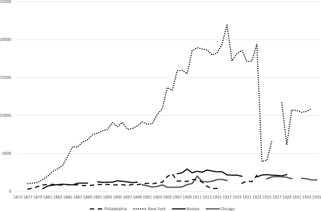
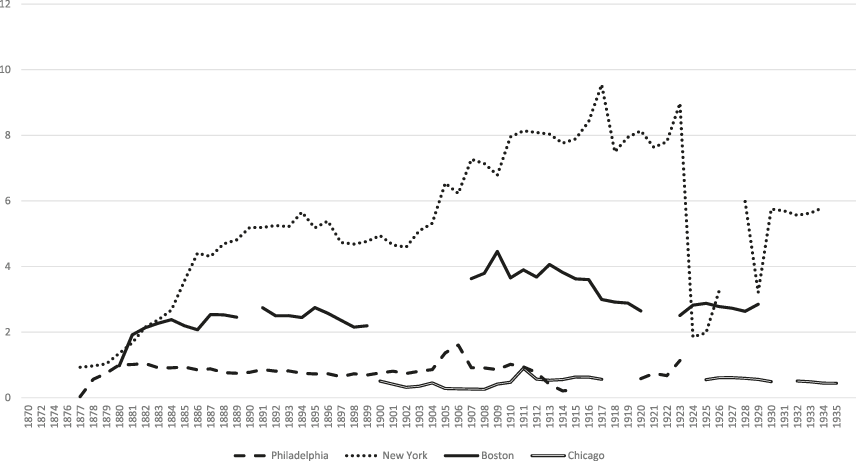
Why did the number of citizen complaints about child abuse stagnate in many cities during the early twentieth century, even as urban populations continued to climb? Initially, child protection advocates believed that their work would expand as urbanization and immigration continued unabated, and the public recognized the value of their work. In 1905, for example, the New York Society for the Prevention of Cruelty to Children (NYPCC) called attention to “the constantly increasing needs of the society” that were particularly due to “the unprecedented increase in immigration.” In a similar fashion, the Pennsylvania Society for the Prevention of Cruelty to Children (PSPCC) boasted that “in each succeeding year, because of the growing size of our city, and because of the increased appreciation on the part of the public of the services which this Society can render, the number of complaints and calls for assistance increases, and the number of children under its protecting care grows larger.”Footnote 1 However, in many cities, both the absolute number of reported child abuse cases and the per capita number of reported child abuse cases diminished after 1905 (Figures 1 and 2).Footnote 2 Meanwhile, the American Humane Association reported a declining number of societies devoted to child abuse after 1910 and noted in 1914 that “many organizations for the welfare of children are inactive.” Instead of maintaining child abuse as a salient issue that generated citizen complaints and support for their cause, child-protection groups ultimately declined in influence and numbers.Footnote 3
Number of Cases of Reported Child Abuse, 1875–1935, in Philadelphia, New York, Boston, and Chicago.
Sources: Annual Reports of the New York Society for the Prevention of Cruelty to Children, 1877–1935; Annual Reports of the Massachusetts Society for the Prevention of Cruelty to Children, 1880–1930; Annual Reports of the Pennsylvania Society for the Prevention of Cruelty to Children 1876–1925; Annual Reports of the Illinois Humane Society, 1930–1925. This data captures new complaints, not old complaints that were subsequently re-investigated.

Reported Cases of Child Abuse per 1,000 Residents, 1875–1935 in Philadelphia, New York, Boston, and Chicago.

Political scientists who study the salience of political issues like child abuse have developed a substantial literature about agenda setting, which begins with the premise that the number of potential public issues far exceeds the capabilities of policymakers and the citizenry to process them. Hence, issues and their proponents compete for a place on the public agenda. Once on the public agenda, issues are more likely to endure if they gain an institutional response that perpetuates their significance through positive feedback. As Frank R. Baumgartner and Bryan D. Jones write, “Governmental interest in social problems . . . follows a self-reinforcing pattern where each increase in attention leads to incentives for even greater levels of attention in the future. These increases may not be uniform, but with increased budgets come the creation of whole new policy communities charged with ameliorating the problem under question. These professionals, be they social workers, psychologists, law enforcement officials, welfare administrators, or whatever, are likely to demand continued governmental vigilance in their area.”Footnote 4
While scholars like Baumgartner and Jones have developed sophisticated models for understanding the persistence of issues on the public agenda, they have less to say about the disappearance of issues, and in particular, that of valence issues like child abuse. Valence issues are typically defined as those in which only one side of debate is legitimate, and thus do not provoke countermobilization by opponents who might seek to topple policy monopolies held by interested parties. Baumgartner and Jones, for one, illustrate that policy communities can be particularly tenacious in sustaining the presence of valence issues on the public agenda even though the solutions to the problems associated with those issues vary over time. With regards to the marginalization of issues, they suggest that some valence issues may be subject to the “issue attention cycle,” first proposed by Anthony Downs.Footnote 5
According to Downs, public attitudes toward domestic problems in American life do not reflect changes in real conditions so much as they reflect the operations of a systematic cycle of heightening public interest and then increasing detachment from such problems as they prove difficult to solve. He posits that public attention to a “problem” often follows a sequence that involves a pre-problem stage, alarmed discovery, the realization that high costs are attached to solving the problem, a gradual decline of intense public interest, and then a post-problem stage.Footnote 6 Indeed, Barbara J. Nelson contends that Downs’s issue attention cycle “aptly describes media, public, and governmental interest in child maltreatment at the point when the problem was ‘discovered’ in 1874.” However, it is not entirely clear to Nelson whether or not child abuse’s “short tenure in the spotlight was indeed caused by the reason Downs suggests,” namely, that citizens became less interested in the issue as they realized that a major restructuring of society might be necessary to solve this problem.Footnote 7
Instead of focusing on the public’s limited appetite for challenging problem-solving, this article focuses instead on frame contestation, and how child-protection organizations gradually lost control of the narrative about fragile families to a competing set of advocacy groups—those that emphasized “family saving.” Like many interest groups, the SPCCs developed an “issue frame” in their efforts to publicize their mission which sought to define a situation in need of change (child abuse and neglect), attribute blame for that situation (inadequate parents), propose a solution (the removal of children from parents who failed to mend their ways), and encourage others to support their cause (by lodging complaints and becoming group contributors). After the turn of the nineteenth century, however, “family saving” groups identified a problem related to child abuse and neglect (fragile families), portrayed poverty as a cause of family instability, and supported policies (e.g., mothers’ pensions) that sought to preserve the family unit.Footnote 8 While advocating for policies that strengthened families, however, they undercut the SPCC’s most crucial weapon against child abuse and neglect, namely, the removal of affected children from inadequate parents.
This shift in perspectives about how best to address children who lived in troubled families can be viewed as an outcome of frame contestation within the urban-reform community in the United States during the Progressive Era. Students of framing processes note that advocacy groups often encounter rival problem frames that contend for public acceptance in the policy arena. While much of that contestation involves interests that directly oppose one another (e.g., environmentalists and the fossil-fuel industry), it can also occur between interests that have similar goals but differ in how they hope to achieve those goals.Footnote 9 In the case of “family saving” groups, their decision to blame family instability on environmental factors like poverty meshed particularly well with the emergence of social science in American reform circles. After 1900, many cities became home to progressive reform networks, centered in universities, where scholar-activists and their allies spearheaded campaigns for civic improvement, proposed structural explanations for social problems, and depicted administration as the domain of experts.Footnote 10 In the process, however, they delegitimized the efforts of advocacy groups like the SPCCs, which were staffed by amateurs and relied primarily on knowledge gleaned through personal experience or common sense.
This article acknowledges that a strong, enduring policy community is necessary to sustain an issue’s place on the public agenda, and that this is particularly the case when policy communities fail to create public agencies that are capable of producing positive policy feedback. It also suggests that issues don’t fall off the agenda simply because the public recognizes that the solution to a problem is complex and requires a substantial shift in public priorities. Rather, I will maintain that when policy communities push for complex solutions to a whole matrix of problems, specific issues often get buried in the process. Indeed, the emergence of social science and its emphasis on holistic solutions to social problems obscured the fact that specific issues were being ignored. Ultimately, I will contend that child abuse and neglect became less salient when a new set of reformers emphasized “family saving,” which sought to preserve the family unit above all other concerns, even family dysfunction. As “family saving” advocates gained influence in various public arenas, “child saving” reformers became less prominent in state politics, the family policy arena, and among prospective supporters.
Child Abuse, the Policy Community, and Institutional Arrangements, 1874–1925
For much of its history, the American polity did not define child abuse as a problem. Families were considered well within their rights to discipline resident children as they saw fit, and the courts addressed only a handful of cases involving the egregious abuse of children. Only after the humane movement “discovered” child abuse during the late nineteenth century did state and local governments seek to enforce existing measures or to enact new laws on behalf of child protection. This discovery, as so often noted, grew out of the massive publicity surrounding the 1874 case of Mary Ellen Wilson, a child who had been severely beaten and whipped by her foster mother in New York City. While the details of Wilson’s life were surely horrific and sensational, the case vividly illustrated the shortcomings of America’s traditional indenture system, which placed orphans and other homeless children with “masters” and (later) foster parents in their homes. Within the indenture system, “masters were supposed to provide children with food, clothing, shelter, a general education, and work skills; the children, in return, were obligated to serve the masters.” Typically, indenture agreements included protections against cruelty. Unfortunately for Mary Ellen, the indenture system was poorly monitored; her foster mother did not even comply with the minimal reporting requirements of her indenture agreement, and the city’s Commissioners of Charities did nothing about it.Footnote 11
Once child abuse was “discovered,” state and local governments responded by encouraging the enforcement of existing laws that could protect children and by passing new legislation that sought to ban particular behaviors deemed cruel to children.Footnote 12 Rather than create new agencies to address cruelty to children, however, public officials empowered voluntary associations—Societies for the Prevention of Cruelty to Children (SPCCs) and the Humane Societies that provided child protectionFootnote 13—to investigate and prosecute cases of child abuse and neglect. This delegation of public authority to private associations was far from unusual during the nineteenth century. Whereas professionalized agencies are central to today’s administrative regulation, a key component of common-law regulation was “private policing,” or the private sponsorship of actions that were designed to trigger the enforcement of regulatory laws and judicial proceedings. Such actions included the pursuit of offenders, the apprehension and arrest of offenders, the hiring of private detectives, the collection of evidence, the lodging of complaints, the initiation of civil lawsuits, the sponsorship of criminal prosecution (payment of fees, etc.), and the provision of other trial-related services, including supplying witnesses for trials and providing expert testimony. In addition to enforcing laws against child abuse, private action helped to uphold laws against theft, robbery, trespassing, counterfeiting, cruelty to animals, pornography, abortion, prostitution, gambling, illicit alcohol sales, air pollution, and the depletion of wildlife.Footnote 14
As the enforcers of child-protection measures, the SPCCs were typically located in cities. Their urban locale reflected the fact that child abuse and neglect were particularly visible in an environment where scores of poor and immigrant children wandered the streets, lived in filthy tenements, and were exposed to “immoral” practices. Though they sent agents out on the streets to discover cases of abuse and neglect during their infancy, established groups devoted the bulk of their resources to responding to complaints brought to their offices in person, by letter, and by telephone. Neighbors, family members, teachers, charitable workers, and the police contacted these groups to report that children were endangered, and society agents would investigate such reports. If confirmed and considered severe, agents frequently sought some form of punishment for the perpetrator, who was typically a parent, step-parent, or foster parent. Such individuals could lose custody of children; they could be imprisoned; they could be placed on probation; or they could be warned, with the implication that more severe penalties would follow if the warning went unheeded. In addition to their child-protection work, SPCCs also responded to a wide variety of situations that involved wayward children and negligent parents, including absconding fathers, alcohol abuse, runaways, and juvenile crime and mischief.Footnote 15
Since the Mary Ellen case arose in New York, the first SPCC was established in that city. Founded in 1874 as an offshoot of the American Society for the Prevention of Cruelty to Animals, the New York Society for the Prevention of Cruelty to Children was initially empowered by the state of New York to bring complaints based upon any law affecting children. Two years later, the attorneys general of New York State and New York City appointed a government representative in all child-abuse cases. By 1888, the state authorized NYSPCC agents “to arrest anyone violating child protective laws.” Among other things, the NYSPCC was well known for suppressing child performances in public venues, which included securing the custody of child performers and the closing of various dime museums, theaters, and music halls. However, the NYSPCC also investigated reports of cruelty to children, prosecuted parents, seized children found in neglectful and abusive homes, and provided their wards with temporary shelter until the courts or the group determined their fates. Whereas other SPCCs typically responded to reports of abuse from relatives and neighbors, the NYSPCC was particularly proactive in wielding its legal powers, and placed its agents in magistrates’ courts to monitor cases involving neglected, destitute, and errant children.Footnote 16
As was often the case with reform organizations, the NYSPCC’s example generated many imitators. In 1878, the Massachusetts Society for the Prevention of Cruelty to Children (MSPCC) was established; 34 such societies were operating in the United States by 1888, and in 1914 there were 494 organizations that addressed child abuse and neglect.Footnote 17 Some had greater ties to the government than others, and profited from public funds and the common-law power to arrest without a warrant. In four states—Colorado, Minnesota, Wyoming, and Montana—the state legislatures went so far as to convert their humane societies into bureaus of child and animal protection that received annual appropriations and were required to report on their activities to state officials. In Louisiana, the state authorized municipalities to appoint officers of the Louisiana Society for the Prevention of Cruelty to Children (LSPCC) to enforce child-protection laws as special police officers, and the society received “all fines, penalties and forfeitures” that were collected as a result of its prosecutions. Still, other child-protection agencies, most notably the MSPCC and the Wisconsin Humane Society, operated for years without much direct government support.Footnote 18
In any case, the power of these organizations was substantial, as they visited homes where abuse and neglect were suspected, made their own determinations as to the presence of abuse and neglect, and then passed on their recommendations to the courts. To bolster their authority, the SPCCs used their positions as state-sanctioned guardians to use the common-law writ of habeas corpus to shape decisions about child custody. Long used to resolve the custody of minor children, this writ assisted SPCCs in their attempts to remove children from homes where they had been presumably abused and neglected.Footnote 19 Anticruelty agents did not always win habeas cases, but state governments often granted these societies legal standing to participate in them and judges often took their advice about child custody very seriously.
In making their investigations, SPCC agents did not always meet the ideal contemporary legal standards. For example, representatives of the MSPCC searched homes without warrants and climbed through windows when they were unable to gain entry through other means. In a similar fashion, an investigation into the practices of Richard Whitehead, an agent of the Wisconsin Humane Society, revealed that he may have cut corners in taking children away from their families. Witnesses testified that he made hasty decisions for removal “over the protest of relatives, and at times before the parents had time to understand what he was doing.”Footnote 20
Moreover, the humane societies focused on “abuse and neglect” as their local communities and cultures defined it. In their early years, the SPCCs’ approach to abuse and neglect was uncomplicated and straightforward. From their perspective, child abuse was the product of the inadequacies of individual parents, who often abused alcohol, were ignorant of proper parenting techniques, engaged in licentious sexual behavior, relied on unwarranted violence to control their children, and/or were “feeble-minded.” Indeed, given their understanding of “proper” child-rearing, prosperous, teetotaling SPCC agents might declare a child “neglected” if he were found in a filthy apartment strewn with liquor bottles and under the care of a twelve-year-old sibling. Not surprisingly, they often intervened in the lives of immigrant families whose poverty and alcohol use were alien to their middle-class sensibilities.Footnote 21 In other cases, informants used claims about “abuse and neglect” to convince the SPCCs to do their part in upholding the social order. For instance, informants often complained to the LSCC when they discovered white children being raised by poor black families in homes and neighborhoods that were deemed inadequate. While the LSCC never prosecuted the black families for abuse or neglect, the society typically removed the white children from their homes and placed them in orphanages.Footnote 22
Of course, these associations’ influence over the removal of children constituted their most coercive weapon against child abuse and neglect. On paper, these organizations proclaimed that they would only recommend severing the ties between parents and children as a last resort, and in some cases they lived up to their promises. For instance, the Illinois Humane Society rarely sought to take children from the home, even when its agents detected abuse and neglect. Instead, the group preferred to warn, advise, or seek probation for the parents. In contrast, the Pennsylvania Society for the Prevention of Cruelty to Children removed youngsters from their homes in 30 percent of the cases it handled in the late nineteenth century. In either case, the anticruelty movement’s ability to assume control over children under the legal doctrine parens patriae (the state as parent) was a radical departure from the traditional understanding of parental custody, in which parents had virtually unchallenged control over their children’s care. Because many SPCCs laid claim to this power, they were more often feared than loved. In fact, poor and working-class individuals sometimes tried to exploit this fear when informing (or threatening to inform) “the Cruelty” about family members and neighbors in efforts to gain control over their embattled personal lives.Footnote 23
Though empowered to essentially police families, most SPCC agents were amateurs in training and in outlook, especially in the early years of the humane movement. For example, the Wisconsin Humane Society (WHS) seems to have appointed Richard D. Whitehead as its superintendent because he had held a variety of jobs that involved horses and other animals, and had been active in the Illinois Humane Society in its efforts to prevent cruelty to animals. Ironically, Whitehead spent much of his tenure at the WHS investigating claims involving cruelty to children, an area where he completely lacked prior experience. Nevertheless, no one challenged his authority to do so on those grounds.Footnote 24 In New Orleans, the LSPCC’s founder, Alfred E. Clay, was a Methodist minister who initially led his organization while working full-time as pastor of the Dryades Street Methodist Church. Concerned that Clay couldn’t manage both tasks, the group’s Board of Directors insisted in 1893 that “he resign from his pastoral charge and give his entire time to the work of the society.” Meanwhile, the MSPCC’s first established leader, Frank Fay, was a local politician who had been active in a variety of charities and moral-reform efforts. Since he himself was a generalist, it is not surprising that Fay employed agents who “had no special experience with family problems.” In some ways, though, the SPCC agents’ lack of specialized training meshed well with their varied activities, especially in the smaller societies. For instance, Dan Healy, the lone agent of the Sacramento Society for the Prevention of Cruelty to Children, “was quite a jack-of-all trades—part social worker, part policeman, part probation officer, part truant officer, part counselor, and part community problem solver for children.”Footnote 25
Despite their amateur character, the SPCCs could be construed as the primary actors in the policy community that helped maintain child abuse as an issue on the nation’s policy agenda. They trumpeted the issue and their rescues of abused and neglected children, often posing the children in “before” and “after” photographs for publicity purposes.Footnote 26 It was also these groups that lobbied the state legislatures for legislation that banned behavior they considered abusive, such as exhibiting deformed children in circuses and selling tobacco to minors.Footnote 27 Of course, other child-welfare groups helped sustain the SPCCs’ approach to child saving. For example, while some SPCCs maintained their own temporary homes and placement services, other anticruelty groups often relied on orphanages and children’s aid societies to house and place the children they removed from their parents. Furthermore, the SPCCs worked with public officials such as judges, the police, and overseers of the poor to resolve family crises. Unlike today’s agency-centered policy communities, however, the child-abuse policy community relied heavily on the SPCCs’ internal organizational resources and community support, both of which declined precipitously by the mid-1920s. By 1923, C.C. Carstens, former secretary of the MSPCC, wrote that only half of the humane societies formed since 1874 had survived, and many of them were only limping along.Footnote 28
Why did the anticruelty movement decline as the twentieth century wore on? Looking at the accounts of individual groups produces a variety of reasons for decline. Some humane societies apparently suffered from their dual purpose in protecting both animals and children. For example, the Arkansas Humane Society was “originally organized for the protection of animals. In 1909 after a startling case of brutality to a child, it was given jurisdiction over children as well, and was reincorporated as a state-wide organization. From then until the entry of America into the World War, it struggled to maintain both fields with varying success until its demise.”Footnote 29 Likewise, one could make the case that the Wisconsin Humane Society also suffered from its dual purpose and eventually chose to abandon child protection in favor of animal welfare. However, Raelene Freitag posits that this group lost public trust when the Milwaukee socialist Victor Berger used his newspaper to publish a series of charges against its agent, accusing him of the unwarranted removal of children from their parents, financial improprieties, and the sexual abuse of the children he was supposed to protect. Hence, fewer citizens took their concerns about child abuse and neglect to the WHS, and in 1912 the cash-strapped group eventually chose to focus entirely on the prevention of cruelty to animals.Footnote 30
Indeed, what was most striking about the SPCCs’ decline was the fact that while urban populations continued to swell, residents, the police, and charitable workers lodged fewer complaints per capita to these groups about child abuse and neglect.Footnote 31 In Chicago, for instance, while the Illinois Humane Society continued to receive hundreds of complaints about child abuse and neglect well into the 1940s, its complaints per capita regarding children peaked in 1911. In a similar fashion, the Boston office of the Massachusetts Society for the Prevention of Cruelty to Children continued to investigate approximately two thousand new cases per year during the 1920s, but its new cases per capita had hit its highest point in 1909. The PSPCC’s caseload and per capita caseload peaked in 1906, while the New York society received the most complaints and complaints per capita in 1917.Footnote 32
Furthermore, these groups often seemed to be short of members and funds after 1910.Footnote 33 In Macon, Georgia, the local press viewed discussions of reviving the city’s Society for the Prevention of Cruelty to Children and Animals as futile in 1918. “Experience has proved,” wrote Bridges Smith, “that there are not enough people who are sufficiently interested in the work of the society to pay the dues and thus warrant the employment of a special officer to look after cases of cruelty.”Footnote 34 During the early years of the twentieth century, the Pennsylvania SPCC acknowledged that its income wasn’t covering expenses, but after 1910 it increasingly complained of ballooning deficits, which its leaders blamed on the group’s responsibility for the costs of sheltering children who were removed from their homes. Even the venerable MSPCC saw its deficits soar during the 1920s as it competed with other groups engaged in social work. “It is difficult in these crowded days to get one’s message across to every one whom it ought to reach,” wrote President Grafton D. Cushing in 1924. “From our own experience . . . it is evident that a very small fraction of the people of the State are contributing to this or to any other charity. The problem is how to reach them and how to interest them.” In fact, in several cases, humane societies and SPCCs that had once been financially independent began to look to the state legislature to fund some of their activities. The PSPCC, for one, argued that the state of Pennsylvania should assume the costs of housing abused and neglected children, a responsibility that other states had already assumed.Footnote 35
The “child abuse” policy community’s decline was also evident in the decreasing number of new legislative proposals it directly sponsored to address various facets of child abuse. For example, the annual reports of the MSPCC typically reported at least one or two legislative successes each year until 1914, and they reprinted the texts of statutes sponsored by the society. Significantly, 1914 was the last year that the Massachusetts society celebrated that fact that it made “a direct and valuable contribution to the laws of the State.” Beginning in 1915, the group no longer discussed its legislative endeavors because it joined a new collective effort to lobby the state legislature:
A legislative committee has lately been formed on which a number of organizations engaged in social work are represented, which will consider all propositions for legislation before they are submitted to the Legislature. This is a movement of great importance which will prevent duplication of effort and will ensure a careful consideration of measures before a bill is presented to the Legislature. The community has suffered much from ill-considered legislation which is passed in a hurry and which is modified and amended every succeeding year.
As part of this committee, the society contributed to the enactment of measures that provided “for the better care for defectives, for the improvement of the non-support law, and for the maintenance of illegitimate children.” However, the MSPCC’s distinctive voice was gone and, in 1921, General Secretary Theodore A. Lothrop celebrated the MSPCC’s past legislative successes as though they were part of some bygone era.Footnote 36 Indeed, by the 1920s, the SPCCs’ emphasis on policing abuse and neglect had been bypassed in the social policy universe by those who emphasized family saving.
From Child-Saving to Family-Saving: The Emergence of a New Policy Community, 1890–1935
During the early twentieth century, the amateurs’ punitive “child saving” efforts lost out to the “family saving” campaigns of social workers, women’s groups, and philanthropists, informed by the insights of early sociologists, psychiatrists, and psychologists. Instead of focusing on removing children from hazardous situations (including care-giving arrangements), Progressive Era reformers increasingly sought to address broader social problems, such as poverty, that indirectly produced child abuse and neglect in families. In doing so, they underscored the importance of professionally trained social workers who relied on casework to preserve the family unit, which in turn would presumably strengthen society as a whole. They also created new public institutions, social welfare organizations, and government programs to advance their approach to fragile families. New public institutions included the juvenile courts, state and county child welfare departments, and the U.S. Children’s Bureau (1912). New social welfare organizations included settlement houses, child guidance clinics, and the Child Welfare League of America (1921). Meanwhile, the programs that best exemplified the “family saving” approach to child welfare were the mothers’ pensions, first adopted in the states and then later at the federal level (1935). These pensions were designed to provide financial assistance to poor widows and deserted wives, thus allowing them to care for their children themselves, rather than placing them in an orphanage or foster care. Though initially providing meager sums to only a small proportion of the nation’s impoverished families, they reflected the growing marginalization of approaches to child welfare that emphasized the removal of children from the home.Footnote 37
Some SPCCs and Humane Societies tried to adjust to this new emphasis on the systematic preservation of family and society. Under the leadership of Carl C. Carstens (1907–20), for example, the MSPCC undertook more methodical recordkeeping, emphasized worker training, encouraged specialization in its workforce, and sought to impose professional supervision. These groups also increasingly framed their work in terms of addressing endemic family problems as opposed to policing isolated incidents of abuse and neglect. In 1915, the secretary of the Pennsylvania SPPC spoke of discarding its previous role as “a hand affixed to the arm of the law,” arguing instead that “the new type of society must deal with the family as a unit of treatment. It is a family rehabilitation society.” Whereas the Pennsylvania group boasted of removing children “from the custody of debased parents or of other equally worthless relatives” in 1898, by 1910 its Board of Managers was emphasizing its “family saving” function and contended that the “amount of work done by this Society in the endeavor to preserve family relationships is not yet fully appreciated by the public.” In 1926, the LSPCC leapt onto the “family saving” bandwagon when it changed its name and focus. Newly christened the Children’s Bureau, this organization pledged to “dig down into the roots of children’s problems and treat . . . not symptoms, but the underlying disease.” In many cases, however, it was often easier for anticruelty organizations to remain focused on “child saving,” even if it meant that they faced criticism from the rest of the reform community and other opinion leaders.Footnote 38
The New York SPCC was one such organization that maintained a determined emphasis on “child saving.” As one of the most robust SPPCs, the New York society benefited from a contract system that dispensed public money to private institutions for the care of dependent, abused, neglected, and wayward children. These institutions and the NYSPCC “formed a partnership wherein the SPCC found children, the orphanages provided care, and the state supplied a constant stream of funds.” After 1900, however, the New York SPCC faced ever more criticism of its child removal policies. In 1900, the state legislature sought to subject the society to the state Board of Charities’ oversight so as to secure some accountability for its actions, only to have the Court of Appeals rule that the NYSPCC did not constitute a charitable organization in light of the state’s Constitution. Moreover, news reports increasingly published complaints about the society’s child removal policies after 1900.
For example, in 1902, the New York Times reported on the case of E. J. Pelkan and his son, Irving, a situation in which the younger Pelkan was removed from his family because he skipped school to go to the Star Theatre, thus violating a ban on juveniles in public theaters. The Times quoted E. J. Pelkan at length, giving him the opportunity to criticize the SPCC for creating “the most outrageous affair” and for treating him like a dog when its officers denied him access to his son. In 1909, a Times editorial opined that the NYPSCC leaders had a responsibility to the public to explain their rationale for child removal when it didn’t seem warranted. Later, in 1924–25, the newspaper provided extensive coverage the New York Commission of Accounts’ investigation of the society that explored the group’s purported lack of transparency, its policies concerning armed agents, and its alleged failure to obtain warrants and court orders before making arrests and taking children into custody. In doing so, the Times detailed multiple critiques of the NYSPCC’s practices by other reformers, some of whom maintained that the society needed to shift from “child saving” to “family saving.” As Sophie Irene Loeb of the Board of Child Welfare put it, “The SPCC undoubtedly filled a great want when it was founded years ago. But we have progressed since then. If the SPCC is to fulfill its real function, it should carry on real welfare work in rehabilitating families.”Footnote 39
Still, as many SPCCs either wound down or shifted their missions, some anticruelty societies persisted in their original mission because Americans who suspected abuse and neglect had nowhere else to go. Significantly, the “array of agencies doing some degree of child protective work helped mask the absence of any clearly designated responsibility for child abuse.” Hence, it is not surprising that eighty-four SPCCs were still in business in 1956.Footnote 40 As the anticruelty groups either closed up shop or sputtered along, no prominent reformers, child-welfare organizations, or public agencies singled out child abuse as an issue of particular concern. Citizens could lodge complaints about child abuse with the police (and they did), but the police did not give special consideration to this issue and treated it as just another crime. Police officers investigated claims and determined whether or not they had enough material evidence to arrest and prosecute. If they didn’t, the case was dropped. In contrast, the SPCCs maintained a broader array of weapons against child abuse and neglect than mere arrest. Their agents offered advice about child rearing, issued cautions and warnings to parents about their mistreatment of children, and kept records of fragile families that could be referred to again and again should further trouble arise. They also investigated situations that were unlikely to lead to legal action. For example, throughout its long history, the Illinois Humane Society followed up on reports from neighbors about children crying excessively, few of which ever turned out to involve cases of child abuse and neglect.Footnote 41
In short, the police became the default organization for detecting child abuse and neglect in most communities. Increasingly, child-welfare workers weren’t interested in addressing narrow social problems like abuse so much as they sought to improve the harmful environment that generated such problems. Among other things, they promoted advances in public health, decent housing, workmen’s compensation programs, bans on child labor, and mothers’ pensions. Similarly, with regards to child protection, reformers viewed the wayward child as the victim of his environment and sought to use state power to ameliorate those environmental factors that led him to stray. Hence, the post-1900 “family saving” organizations and agencies were most concerned with addressing and preventing juvenile delinquency, a vague offense that embodied a wide variety of behaviors. Indeed, statutory definitions of “delinquency” encompassed “1) acts that would be criminal if committed by adults; 2) acts that violated county, town, or municipal ordinances; and 3) violations of vaguely worded catch-alls—such as ‘vicious or immoral behavior,’ ‘incorrigibility,’ and ‘truancy.’” Indeed, this new fixation with delinquency was most apparent in the juvenile courts, agencies that were established during the Progressive Era to remove youthful offenders from the punitive criminal justice system and to rehabilitate them.Footnote 42
According to their advocates, juvenile courts would usher in a new age, “one in which the wisdom of emerging social science disciplines would turn delinquent, dependent, and abused children into productive citizens.” In fact, juvenile courts could simultaneously address the dependent, the abused/neglected, and the delinquent because Progressive reformers saw “a definite relationship between the unfortunate, the ill-treated, and the criminal.” After all, “[a] child who today is simply neglected may be dependent tomorrow, truant the next day and delinquent the day after that.” Hence, when founded, juvenile courts were typically granted legal jurisdiction over children who had suffered abuse and neglect.Footnote 43 Still, these courts should not be viewed as purely public replacements for the private efforts of the SPCCs. As a recent study of the Chicago Juvenile Court (CJC) shows, in some cases these courts could be considered public-private hybrids. For example, Carol Nackenoff and Kathleen Sullivan demonstrate that private groups like the Chicago’s Women Club, the Catholic Visitation and Aid Society, and Hull House not only secured legislative support for the CJC but also helped fund and staff its early corps of probation officers.Footnote 44
The story of the CJC clearly demonstrated that the American system remained open to public-private partnerships as traditional private policing waned. However, even in that case, the privately backed probation officers did not embrace the punitive approach that characterized the efforts of many SPCC agents. Instead of making autonomous decisions about culpability, they “served as case workers, collecting information about children to present to the judge. They would investigate, interview, provide the court with information about the child’s environment, help make decisions about the disposition of particular cases, and provide ‘guidance and friendly interest.’” In fact, policing child abuse was not a focal point of the probation officers or the juvenile courts more generally. Since these courts were inundated with cases involving unruly and incorrigible children, traditional abuse cases comprised only a small proportion of the cases they heard. These courts were also not designed to investigate reports of child abuse or to try adults who were accused of this crime. Instead, only criminal courts could try abuse cases, and the juvenile court’s jurisdiction over child abuse was limited to deciding where the abused and neglected child should reside—back home or in an orphanage, foster home, industrial school, or reform school. These courts were thus dependent on relatives, the police, and child-welfare workers to bring victims of child abuse and neglect to them so their judges could determine placement (and sometimes probation).Footnote 45
Despite their limited role in addressing child abuse, many SPCC leaders welcomed the creation of the juvenile courts and hoped that they would make their work easier. However, in some states, these courts actually made their work more difficult. In Philadelphia, the PSPCC complained that they contributed to a “double Court process”: “In order to get a punishment or an imprisonment meted out to the guilty parent, our case must be presented to a magistrate; in order to get a commitment giving a valid custody of the child, our case must be presented to the Juvenile Court. Even in cases of merely juvenile delinquency, this double hearing is necessary. This is cumbrous, wasteful, and often demoralizing.” Likewise, one SPCC leader noted that juvenile courts contributed to the confusing array of legal institutions that addressed child abuse and neglect. According to Charles H. Warner, if a man were arrested for failure to support his family in Detroit, his case would be addressed by the police court, but if he were arrested for deserting his family, his case would be heard by the recorder’s court. Meanwhile, if this man were arrested for neglect of his children, his case would be referred to the juvenile court, and, if he and his wife lost custody of said children, they would seek relief from the circuit court. Warner concluded that “no one Judge has a full history of the matter, nor a suitable experience to develop this vital field of the adjustment of Domestic Relations.”Footnote 46
Unfortunately, fewer child-welfare workers were likely to uncover child abuse after 1910, since the “family saving” policy community relied on social science approaches that were at odds with the central elements of child protection, namely, the investigation of complaints, the determination of whether abuse occurred, and immediate intervention to prevent further abuse. Increasingly, social workers who performed casework for public and private child-welfare agencies adopted a set of values, borrowed from psychotherapy, “that emphasized client self-determination, accepting the client’s reality, and accepting the client as he or she is.” These values conflicted with what was often required in child protection: exercising authority, calling into question a client’s account of a child’s injuries, or criticizing the client’s child-rearing practices. Indeed, social workers preferred not to confront child abusers, and hid behind the idea that “protective work could only be done when a parent wanted help.” Their timidity was upheld by the norms of their profession, which emphasized that family workers had to be realistic about what they could accomplish and, thus, invest their efforts in those who were most likely to benefit from their work. Hence, it is not surprising that most social workers chose not to aggressively investigate child abuse when performing their “family saving” casework. Furthermore, their emphasis on confidentiality meant that whatever child-protection work was performed did not reach the public eye, unlike that of the SPCCs.Footnote 47
By the 1950s, social work had also adopted a “psychodynamic” approach to family preservation, which was based on the idea that removing children from their biological parents would harm their personality and impede their personal development. Although foster homes had replaced orphanages as the preferred destination for children from troubled homes, the profession viewed foster parents as subpar, for they could never re-create the deep emotional ties that existed between children and their natural parents. In fact, “the psychodynamically-informed family preservation framework inferred that the removal of a child from his or her home was equally, if not more, psychologically damaging than the abusive or neglectful experiences that justified the child’s removal in the first place.” Because placement in foster care was so problematic, social workers viewed it as a last resort, and, if deemed necessary, considered it to be a temporary step on the path to permanent family reunification in the future.Footnote 48
If ideas borrowed from psychotherapy contributed to a passive approach to physical abuse, they also led to the erroneous belief that sexual abuse was rare and that children frequently lied about it. While they often considered the details of child sexual abuse cases to be “too revolting to publish,” the SPCCs had responded to complaints about such abuse, and they accounted for a small but significant percentage of the cases investigated by these groups. As the MSPCC’s Carl C. Carstens wrote in 1914,
Every year the Society is called upon to take part in the prosecution of those who are guilty of sex crimes against children and particularly girls. Its agents have shown that intelligence, tact, and devotion which has in most instances brought assured success to the police departments and prosecuting officers in their efforts to protect the community, and has brought greater safety to the children of those communities. The Society has been willing to do this work because it needed to be done and because its agents have been asked by the constituted authorities to render assistance in this important task.Footnote 49
As the twentieth century wore on, however, psychoanalytic thinking held that child sexual abuse was often a fantasy or involved relations that children had initiated themselves. Drawing on distorted elaborations of Freud’s ideas, legal scholar John Henry Wigmore could write in 1904 that “errant young girls” suffered from “psychic complexes” that involved “contriving false charges of sexual offenses by men.” Hence, “no judge should ever let a sex offense charge go to the jury unless the female complainant’s social history and mental makeup have been examined by a qualified physician.” Despite the prevalence of such ideas, John E. Meyer’s research has shown that sex offenders were prosecuted and convicted from 1900 to 1950 and that their convictions were upheld on appeal. Within the “family saving” policy community, however, social workers were heavily influenced by psychoanalytic views and failed to consider child sexual abuse to be a significant social problem, worthy of their attention. In fact, given that they believed childhood sexual abuse wasn’t prevalent, it is not surprising that social workers were an integral part of efforts to blame poor hygiene for an epidemic of gonorrhea among young girls during the early twentieth century.Footnote 50
In short, the “family saving” policy community’s reliance on social science decreased the likelihood that child abuse would be a prominent issue on the public agenda. Of course, social science provided child welfare workers with both structural explanations for family violence and a more nuanced understanding of their clientele. But the policy community’s emphasis on the complexity of the causes of family fragility and its reliance on cooperation rather than coercion meant that child abuse fell off the radar screen for the time being. Surveying the literature on child welfare, Vincent De Francis of the American Humane Association regretfully recorded in 1955 that “for at least a decade, the writer has been concerned over the fact that . . . there has been no great wealth of literature on [child] protective services and none attempting to cover the subject as a whole.” While most scholars agree that child-welfare professionals downplayed the importance of child abuse and protection during the years 1925–62, Le Roy Ashby goes so far as to claim that these ideas also permeated popular culture, which periodically treated cruelty to children “in a lighthearted fashion.”Footnote 51 There was no child abuse “crisis” that called forth special efforts on the part of the polity. At most, child abuse was a crime, and newspapers reported on it as such.Footnote 52
By the 1960s, the number of states with SPCCs was down to ten. In Illinois, citizens continued to alert the humane society about suspected child abuse until the mid-1960s, when the state legislature finally assigned the responsibility for such cases to the Illinois Department of Children and Family Services. Even before government agencies assumed their responsibilities, however, such groups were considered anachronisms which were “operating on the fringe of a large and growing network of child and social welfare societies, but cut off from that network.” Still, the persistence of these groups eventually paid off. During the 1950s, Vincent De Francis of the American Humane Association sought to breathe new life into child protection, and he succeeded in drawing the attention of the U.S. Children’s Bureau. As that agency geared up to take on the issue of child abuse, the Journal of the American Medical Association published an article announcing the discovery of a new medical condition: the “battered child syndrome.” The confluence of these two developments set up a period of “alarmed discovery,” in the Downsian sense. Nevertheless, the child welfare community’s long absence from the child abuse issue may have contributed to the construction of child abuse as a narrow medical problem. Doctors quickly framed the issue as a social illness to be cured, and legislatures and policymakers responded accordingly.Footnote 53
Conclusion
In today’s agency-centered world, it may very well be the case that “initial public enthusiasm” for an issue typically produces positive policy feedback and resources that enhance the issue’s viability on the crowded public agenda. With new legislation comes new institutions, and they “do not disappear, even if public or media concern with the issue fades away. In fact, they can easily perpetuate themselves, because for the first time they may be able to generate statistics and reports that substantiate what they have suspected all along: that their issue is of alarming proportions, and increased governmental vigilance is called for.”Footnote 54 In the age of private policing, however, robust policy communities were necessary to perpetuate an issue’s position on the public agenda. Such communities could not always count on a steady stream of resources or legitimacy, as the child abuse case illustrated.
Furthermore, I found little evidence to support Downs’s claim that the public tires of issues when it encounters the complexity of their solutions. If anything, I suggest that Americans periodically embrace structural solutions to problems, even when simpler, more individualistic alternatives are available. In contrast, the “family saving” approach of the Progressives was far more ambitious and holistic, and yet it dominated the child-welfare scene for decades.
Most significantly, this research illustrates that frame contestation has real consequences for the advocacy groups that are weakened by this process. When advocacy groups lose control of the narrative that undergirds their purpose, they often lose support from the media, government officials, group supporters, and the public as a whole. As “family saving” groups cast doubts on the efficacy of removing abused and neglected children from their parents, they helped marginalize “child saving” advocates, and banished them to the fringes of the reform community. In the process, however, they also inadvertently devalued child abuse as an issue deserving of public attention and solutions.