INTRODUCTION
Echinococcosis is a neglected zoonotic disease (WHO, 2010) caused by infection with the larval stage of cestode tapeworms in the genus Echinococcus (Eckert and Deplazes, Reference Eckert and Deplazes2004). Human cystic and alveolar echinococcosis are caused by Echinococcus granulosus sensu lato (Alvares Rojas et al. Reference Alvares Rojas, Romig and Lightowlers2014) and Echinococcus multilocularis, respectively (Eckert and Deplazes, Reference Eckert and Deplazes2004), and humans are usually infected by eggs released in the faeces of an infected carnivore host, often domestic dogs (WHO/OIE, Reference Eckert, Gemmell, Meslin and Pawłowski2001). Both diseases are characterized by the formation of cysts, usually in the liver or lungs (WHO/OIE, Reference Eckert, Gemmell, Meslin and Pawłowski2001), and may be fatal if untreated (Fujikura, Reference Fujikura1991; Moro and Schantz, Reference Moro and Schantz2009). Echinococcosis affects mainly pastoral communities worldwide, although the burden of the disease varies greatly in different locations (WHO/OIE, Reference Eckert, Gemmell, Meslin and Pawłowski2001). Echinococcosis is relatively common in Central Asia (Torgerson et al. Reference Torgerson, Oguljahan, Muminov, Karaeva, Kuttubaev, Aminjanov and Shaikenov2006; Torgerson, Reference Torgerson2013; Usubalieva et al. Reference Usubalieva, Minbaeva, Ziadinov, Deplazes and Torgerson2013), and is a public health concern in Kyrgyzstan (Torgerson et al. Reference Torgerson, Oguljahan, Muminov, Karaeva, Kuttubaev, Aminjanov and Shaikenov2006). There are concerns the disease is re-emerging, and human cases of cystic and alveolar echinococcosis have increased greatly since Kyrgyzstan's independence from the Soviet Union in 1991 (Torgerson et al. Reference Torgerson, Oguljahan, Muminov, Karaeva, Kuttubaev, Aminjanov and Shaikenov2006; Usubalieva et al. Reference Usubalieva, Minbaeva, Ziadinov, Deplazes and Torgerson2013; Raimkylov et al. Reference Raimkylov, Kuttubaev and Toigombaeva2015).
In 2011, the Kyrgyz Ministry for Agriculture and the World Bank considered echinococcosis to be of sufficient concern to implement an intervention programme which included providing anthelmintics for dogs (World Bank, 2010). Dosing of domestic dogs with praziquantel (PZQ) began in the summer of 2012, with an aim to dose all owned dogs four times a year (WHO, 2011). When implementing control programmes, it is important to evaluate how well these are meeting their targets (Schantz et al. Reference Schantz, Chai, Craig, Eckert, Jenkins, Macpherson, Thakur, Thompson and Lymbery1995; Schantz Reference Schantz, Andersen, Ouhelli and Kachani1997). However, as echinococcosis often affects rural and remote communities (Craig et al. Reference Craig, Budke, Schantz, Li, Qiu, Yang, Zehyle, Rogan and Ito2007), the same challenges associated with implementing the control scheme will affect the evaluation of the control scheme itself. Relatively quick and easy evaluation tools are therefore beneficial to assess the impact of echinococcosis control schemes (see also van Kesteren et al. Reference van Kesteren, Qi, Tao, Feng, Mastin, Craig, Vuitton, Duan, Chu, Zhu and Hao2015).
Coproantigen ELISAs have proved a useful diagnostic approach for canine echinococcosis (Allan and Craig, Reference Allan and Craig2006; Craig et al. Reference Craig, Mastin, van Kesteren and Boufana2015). However, testing all dogs is difficult and therefore a sample of dogs is generally taken. In remote areas such as the Alay Valley, where communities and households may be scattered, it is difficult to attain large sample sizes for owned dogs not only because of logistical constraints, but also because many dogs are frequently free-roaming and people (and their dogs) may be semi-nomadic (van Kesteren et al. Reference van Kesteren, Mastin, Mytynova, Ziadinov, Boufana, Torgerson, Rogan and Craig2013). Lot quality assurance sampling (LQAS, Dodge and Romig, Reference Dodge and Romig1929), provides a statistically robust method of interpreting data despite requiring a relatively small sample size. The LQAS methodology has been adapted and simplified for application in field studies (Valadez et al. Reference Valadez, Weiss, Leburg and Davis2002), and has been applied to studies related to healthcare (see Robertson and Valadez, Reference Robertson and Valadez2006) and canine echinococcosis (van Kesteren et al. Reference van Kesteren, Qi, Tao, Feng, Mastin, Craig, Vuitton, Duan, Chu, Zhu and Hao2015). In order to evaluate the echinococcosis intervention programme, 10 communities in the Alay Valley were visited in April 2013 and April 2014 and LQAS methodology was applied to assess PZQ dosing compliance, and canine echinococcosis coproELISA prevalence.
METHODS
Scheme for control of echinococcosis
The Kyrgyz Ministry of Agriculture, with financial support from the World Bank, proposed an echinococcosis control programme (World Bank, 2010). The proposal aimed to improve the livestock sector in Kyrgyzstan, specifically aiming to increase productivity and reduce zoonotic diseases (World Bank, 2010). Funding was allocated to several programmes, including the development of a national disease control action plan, establishment of an animal disease surveillance system, implementation of a national public information campaign, and implementation of a comprehensive nationwide vaccination and testing programme for eight diseases of livestock and/or dogs (foot and mouth disease, anthrax, rabies, brucellosis, sheep pox, peste des petits ruminants, echinococcosis and tuberculosis). One proposed project was the provision of anthelmintics to domestic dogs in an attempt to control echinococcosis (World Bank, 2010).
PZQ tablets were provided to local community veterinarians at regional centres (for Alay Valley communities this was either Daroot Korgon or Gulcha), with community veterinarians instructed to go around to the households in their communities once in each season (winter, spring, summer and autumn) and either dose household dogs themselves or leave tablets with dog owners and instruct them to dose their dogs if dogs were not present at the time (T. Sultanov, Taldu Suu veterinarian, personal communication). In addition, veterinarians provided dog passports to monitor PZQ dosing. The programme in the Alay Valley was considered a pilot project, and between 2013 and 2014, an estimated 7610 dogs were registered with dog passports and dosed four times per year (unpublished data provided by the Kyrgyz Ministry of Agriculture and Land Reclamation and the Kyrgyz State Inspectorate for Veterinary and Phytosanitary Safety). In 2015, the dosing campaign was expanded to other parts of Kyrgyzstan by the Kyrgyz Ministry of Agriculture, as well as being continued in the Alay Valley. Parallel to the dosing campaign, dog culling campaigns are implemented in Alay Valley communities. These are not specifically aimed at reducing echinococcosis but at controlling dog numbers. Prior to culls, which occur somewhat randomly during the year, and vary per village, community members are advised to tether or lock up their dogs for a specified period; untethered dogs are considered unwanted and culled (A. Gaitanbekov, Sary Mogul community veterinarian, personal communication).
Communities
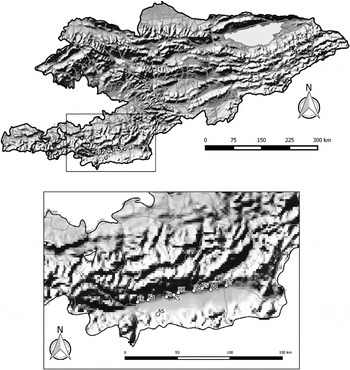
Ten communities in the Alay Valley were selected as part of this study. All were situated along the major road (A327) that runs through the valley from west (the border with Tajikistan) to east (the border with Xinjiang, China). The communities sampled were (from west to east): Kyzyl Eshme (39·57°, 72·27°), Kabyk (39·59°, 72·39°), Achyk Suu (39·47°, 72·50°), Jaylima (39·62°, 72·59°), Kashka Suu (39·64°, 72·67°), Kara Kavak (39·66°, 72·72°), Sary Mogul (39·68°, 72·89°), Taldu Suu (39·70°, 72·98°), Archa Bulak (39·69°, 73·08°) and Sary Tash (39·73°, 73·25°) – see Fig. 1. All communities were small villages with up to ~400 households, and populations of between a few hundred to at most ~3000 people (see also van Kesteren et al. Reference van Kesteren, Mastin, Mytynova, Ziadinov, Boufana, Torgerson, Rogan and Craig2013; Mastin et al. Reference Mastin, van Kesteren, Torgerson, Ziadinov, Mytynova, Rogan, Tursunov and Craig2015).
Locations of the study sites within Kyrgyzstan (top) and a region of southern Kyrgyzstan (bottom). KE, Kyzyl Eshme; Ka, Kabyk; AS, Achyk Suul; Ja, Jaylima; KS, Kashka Suu; KK, Kara Kavak; SM, Sary Mogul; TS, Taldu Suu; AB, Archa Bulak; ST, Sary Tash.

Establishing a pre-intervention coproELISA prevalence
Four communities (Taldu Suu, Sary Mogul, Kara Kavak and Kashka Suu) were visited in May 2012, prior to the start of the World Bank funded intervention programme (Mastin et al. Reference Mastin, van Kesteren, Torgerson, Ziadinov, Mytynova, Rogan, Tursunov and Craig2015). All available households (i.e. those where occupants were at home at the time we visited) in Taldu Suu, Sary Mogul and Kara Kavak were visited, and all dogs present were sampled. If the occupants of a house were not home, we selected a neighbouring house and inquired about the presence or absence of dogs in unavailable households to be able to accurately assess the dog population. Due to time constraints it was not possible to census all dogs in Kashka Suu. Instead, random locations within the community were selected and the six nearest available households were registered, with enquiries made about dog ownership of unavailable households at neighbouring households to be able to accurately assess the dog population. This process was continued until approximately 50 dogs had been registered in total. Based on estimation of total household numbers from satellite imagery, this process resulted in the registration of approximately 25% of all households in the village. The number of dog faecal samples collected and analysed from each community was as follows: Kara Kavak = 35, Kashka Suu = 42, Sary Mogul = 155, Taldu Suu = 86 (Mastin et al. Reference Mastin, van Kesteren, Torgerson, Ziadinov, Mytynova, Rogan, Tursunov and Craig2015).
LQAS: faecal sample and questionnaire data collection
A LQAS framework was adopted to evaluate the levels of canine echinococcosis in April 2013. A minimum of 19 dogs were sampled in Achyk Suu, Archa Bulak, Kabyk, Kyzyl Eshme, Jaylima and Sary Tash (a sample size of 19 is the smallest sample size that minimizes the risk of type A and B errors, see Valadez et al. Reference Valadez, Weiss, Leburg and Davis2002). To select dogs, a GPS coordinate for the centre of each community was determined using Google Earth images (based on imagery collected by the ‘SPOT5’ satellite in 2010). This location was taken as a starting point. Upon arriving at this point, the second hand on a watch was used to determine a random direction in which to walk, with a straight line then followed towards the edge of the community. Along this route, alternate households visited and if dogs were present they were sampled and questionnaires were administered to their owners. If a dead end or the end of the community was reached, the second hand of the watch was again used to determine at random a new walking direction and the same approach was used, until a minimum of 19 dogs had been sampled, with additional dogs sampled if time allowed (however one sample collected from Achyk Suu in 2013 was lost in transport).
In the remaining four communities (Taldu Suu, Sary Mogul, Kara Kavak and Kashka Suu), more extensive sampling was undertaken as part of another study in which all household sampled in 2012 prior to the dosing campaign were sampled again in spring and autumn 2013 and 2014 to collect more detailed information on Echinococcus spp. in these communities with an aim to create a mathematical model of transmission (Mastin, Reference Mastin2015 and Mastin et al. in preparation). For these communities, maps of visited households were used to re-create the LQAS sampling approach – again, by selecting a theoretical start point in the centre of the community, choosing a random direction (using a watch) and selecting 19 sampled households in that direction from the ‘start point’, and including any dogs in these households. The number of samples analysed per community was as follows (shown as 2013; 2014): Kyzyl Eshme = 19;19, Kabyk = 19;19, Achyk Suu = 18;19, Jaylima = 19;21, Kara Kavak = 21;19, Kashka Suu = 19;19, Sary Mogul = 19;19, Taldu Suu = 19;19, Archa Bulak = 19;19 and Sary Tash = 19;19.
Dog owners were asked about the age and sex of their dogs, and when their dog was last dosed with PZQ. We expected that the start of the dosing campaign, as well as the start of an international research study on echinococcosis in the area, would increase awareness about echinococcosis in the local communities, as both veterinarians and researchers visiting local households often explained their work to dog owners. Also, the dosing campaign coincided with the appearance of public health notices on Kyrgyz television about echinococcosis (A. Gaitanbekov and T. Sultanov, local veterinarians, personal communication). Therefore, in 2014, dog owners were also asked if they had heard of echinococcosis, and if they knew what caused the disease. Questionnaires were administered in Kyrgyz by a native speaker (Bermet Mytynova). Faecal samples were collected from around the dog owner's homes and subsamples were stored in 0·3% PBS Tween (Fisher Scientific, Loughborough, UK) with 10% formalin (sourced locally). Faecal samples were shipped at room temperature to the University of Salford, UK.
The LQAS method was also used to determine whether the dosing programme was effectively reaching people in each community. Although PZQ dosing schemes may aim to reach all owned dogs, it is unrealistic to assume a 100% compliance rate, with rates of <60% to >80% previously reported from Kenya and China (see Torgerson, Reference Torgerson2003). The intervention programme aimed to dose dogs four times a year, and mathematical simulation models have shown that with dosing every 3–4 months, a compliance rate of 75% can be effective in reducing transmission of echinococcosis (Torgerson, Reference Torgerson2003; Torgerson and Heath, Reference Torgerson and Heath2003). For this reason we set our criterion at 75% of dogs dosed in the 4 months prior to our visit. Because dog owners could often not remember the exact day of dosing, only the month was noted and all reported dosings in January, February, March and April were included as being within 4 months prior to our visit (samples were collected between 6 and 20 April 2013 and 5 and 12 April 2014). Where the latest dosing was not known, it was assumed the dog had not been dosed in the previous 4 months.
Choosing LQAS decision numbers
Although simplified field manuals including decision numbers are available for LQAS sampling (Valadez et al. Reference Valadez, Weiss, Leburg and Davis2002), it is possible to calculate decision numbers more accurately if the population size and exact prevalence are known. This can be done using the hypergeometric distribution and applying the following formula (from Lemeshow and Taber, Reference Lemeshow and Taber1991):
 $$P(d \le d^{^\ast}) = \mathop \sum \limits_{d = 0}^{d^{^\ast}} \displaystyle{{\left( {\matrix{ {NP_0} \cr d \cr}} \right)\left( {\matrix{ {N(1 - P_0)} \cr {n - d} \cr}} \right)} \over {\left( {\matrix{ N \cr n \cr}} \right)}}$$
where N is the total dog population size in a community, P 0 is the prevalence threshold, n is the number of dogs sampled, and d* is the decision number-1. The decision number must be an integer and should be the lowest possible integer at which P is greater than or equals 10%. If d* or fewer positive samples are obtained (i.e. if d is not reached), this is interpreted as some evidence that the true prevalence is lower than P 0. For example, in Taldu Suu, a census of the dog population revealed there were 98 dogs in the community (N = 98), the dosing target was set at 75% (P 0 = 0·75), and the number of dogs sampled was 19. By adjusting d in the equation above, the probability of sampling at least d dosed dogs can be estimated, given that the true proportion of dosing was at least 75% for n = 11:
 $$\mathop \sum \limits_{d = 0}^{d^{^\ast}} \displaystyle{{\left( {\matrix{ {98 \times 0.75} \cr {11} \cr}} \right)\left( {\matrix{ {98(1 - 0.75)} \cr {19 - 11} \cr}} \right)} \over {\left( {\matrix{ {98} \cr {19} \cr}} \right)}} = 0.06$$
For n = 12:
 $\mathop \sum \limits_{d = 0}^{d^{^\ast}} \displaystyle{{\left( {\matrix{ {98 \times 0.75} \cr {12} \cr}} \right)\left( {\matrix{ {98(1 - 0.75)} \cr {19 - 12} \cr}} \right)} \over {\left( {\matrix{ {98} \cr {19} \cr}} \right)}} = 0.16$$
As such the decision number for which P exceeds or equals 10% was calculated as 12, meaning that any sampling round which found fewer than 12 dosed dogs would provide some evidence that the true proportion of dosed dogs was lower than 75%. R code for calculation of the decision number based upon the hypergeometric distribution is provided in the Supplementary Information.
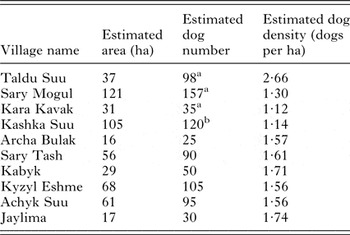
In order to calculate N, data collected in May 2012 from Sary Mogul, Taldu Suu and Kara Kavak was used, and extrapolated from the randomly sampled houses in Taldu Suu (for details see Mastin et al. Reference Mastin, van Kesteren, Torgerson, Ziadinov, Mytynova, Rogan, Tursunov and Craig2015). The size of the four villages was estimated using the ‘measure distance’ tool in Google Earth, to select the area that contained most of the houses. The number of dogs (from census data) was then divided by the area of the villages to give an estimate of the dog density (average of 1·56 dogs/100 m2, s.e. = 0·30). The sizes of the other six communities were then estimated using Google Earth and the dog population estimated using the average dog density of 1·56 dogs/ha from the four main study villages (Table 1). It is worth noting that dog population numbers in the Alay Valley do fluctuate due to a bi-annual dog culling campaign. The data from May 2012 was collected just prior to dog culling and as such the dog population numbers shown in Table 1 are estimates extrapolated from populations that had not recently been culled. Because of this, and the irregular nature of the dog culling, we may have overestimated the dog populations present in some communities, which could affect decision numbers, particularly for communities with small dog populations. However, sensitivity analysis found that even if dog populations were overestimated by a third, LQAS results for dosing compliance and coproELISA prevalence would not change, so uncertainty of exact population sizes is not considered further.
Estimated dog populations in the 10 communities sampled

a Indicates known dog number from census.
b Indicates extrapolated dog number from sample.
P 0 was set at the pre-intervention prevalence as calculated from the samples collected from Sary Mogul, Taldu Suu, Kashka Suu and Kara Kavak in 2012, and n was determined as the number of dogs sampled in each community in each year (18, 19 or 21). For PZQ dosing, P 0 was set at 75% (Torgerson, Reference Torgerson2003; Torgerson and Heath, Reference Torgerson and Heath2003).
CoproELISA
Details of the coproELISA are given in Mastin et al. (Reference Mastin, van Kesteren, Torgerson, Ziadinov, Mytynova, Rogan, Tursunov and Craig2015). Briefly, after decontaminating at −80 °C for ⩾4 days (WHO/OIE, Reference Eckert, Gemmell, Meslin and Pawłowski2001), faecal samples were extracted by homogenizing, shaking, and centrifuging at 2500 r.p.m (1125 g ) for 5 min, and collecting the supernatant. Faecal samples were analysed for Echinococcus spp. coproantigen using a genus-specific sandwich ELISA (see Allan et al. Reference Allan, Craig, Garcia Noval, Mencos, Liu, Wang, Wen, Zhou, Stringer, Rogan and Zeyhle1992; Craig et al. Reference Craig, Gasser, Parada, Cabrera, Parietti, Borgues, Acuttis, Agulla, Snowden and Paolillo1995; van Kesteren et al. Reference van Kesteren, Qi, Tao, Feng, Mastin, Craig, Vuitton, Duan, Chu, Zhu and Hao2015). Supernatants of two known positive samples (one natural infection, one sample spiked with E. granulosus adult worm extract) were used as positive controls throughout. Three known coproELISA negatives from a very low endemic area (Falkland Islands) were also included as negative controls.
The ‘pre-intervention’ faecal samples collected in May 2012 and the post-intervention samples collected (LQAS) in April 2013 and April 2014 were analysed in two batches. Aliquots of all reagents were pooled to a sufficient volume to test all the faecal samples in each lot and mixed, to ensure minimum variation in coproELISA test conditions.
Cut-offs for OD values were determined for the coproELISA using ROC curve panels (Gardner and Greiner, Reference Gardner and Greiner2006) of faecal samples of known infection status. These panels included arecoline purge samples from dogs in the Alay Valley (van Kesteren et al. Reference van Kesteren, Mastin, Mytynova, Ziadinov, Boufana, Torgerson, Rogan and Craig2013) and samples from necropsied dogs in communities in Hobukesar County, Xinjiang China (van Kesteren et al. Reference van Kesteren, Qi, Tao, Feng, Mastin, Craig, Vuitton, Duan, Chu, Zhu and Hao2015). The aim was to compare the pre-intervention data to the data collected in April 2013 and 2014, and as such cut-offs were chosen to give similar sensitivities (Se) and specificities (Sp) between the two batches of samples, rather than choosing cut-offs that necessarily maximized Se/Sp. For the pre-intervention samples (May 2012) a cut-off was chosen that gave a diagnostic sensitivity of 90% and a specificity of 86%. For the post-intervention ‘LQAS’ samples (April 2013 and April 2014) a cut-off was chosen that gave a diagnostic sensitivity of 89% and a specificity of 88% (Note that for this reason the pre-intervention coproELISA prevalence described here is different from that described in Mastin et al. Reference Mastin, van Kesteren, Torgerson, Ziadinov, Mytynova, Rogan, Tursunov and Craig2015, which used a cut-off to maximize Se and Sp).
RESULTS
Pre-intervention coproELISA prevalence
The dog faecal samples collected in May 2012 (n = 318) gave an overall average coproELISA prevalence of 20·1%, with a within-village range from 16·3% in Taldu Suu to 22·9% in Kara Kavak. Village differences were ignored for the purposes of the current study, and the P0 for coproELISA prevalence was therefore set at 20·1%
Dog demographics and PZQ dosing in April 2013 and April 2014
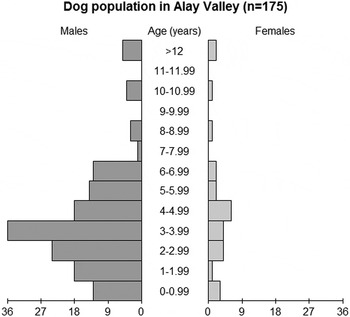
A total of 191 dogs were sampled in April 2013. The majority of these (157 or 82·2%) were male, with 28 females (14·7%). For six dogs (3·1%) the sex was not recorded. Most dogs were younger than 5 years (131 or 69·3% see Fig. 2), although the age of 10 dogs was not recorded, and for six dogs neither age nor sex was recorded.
Dog demographics in the Alay Valley in April 2013, based on LQAS sampling of 10 communities. (Note: age and/or sex of 16 dogs not recorded).

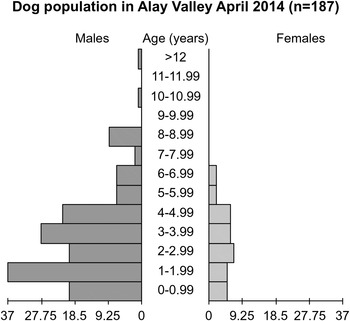
A total of 192 dogs were sampled in April 2014. The majority of these (156 or 81·3%) were male, with 35 females (18·2%). The sex of one dog (0·5%) was not recorded. Most dogs were younger than 5 years (156 or 81·3%, Fig. 3), and for five dogs the age/sex was not recorded.
Dog demographics in the Alay Valley in April 2014, based on LQAS sampling of 10 communities. (Note: age and/or sex of 5 dogs not recorded).

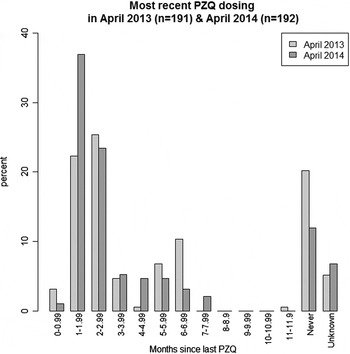
In 2013, the majority of dog owners reported dosing their dog at some point in the 7 months before sampling (141 or 73·8%, Fig. 4), with one person reportedly dosing their dog 11 months before sampling (0·5%). However, 39 dog owners (20·42%) reported never dosing their dogs, and a further 10 owners (5·2%) did not know when their dog had last been dosed, if ever (Fig. 4). In 2014, 152 dog owners (79·2%, Fig. 4) reported dosing their dog in the 7 months before sampling, with four dogs (2·1%) being dosed between 7 and 8 months prior to sampling. In 2014, 23 dog owners (12·0%) reported never dosing their dogs and for a further 13 dogs (6·8%), the latest dosing was not known (Fig. 4).
Most recent PZQ dosing for dogs in the Alay Valley in April 2013 and April 2014.

Local knowledge of echinococcosis
In 2014, dog owners were asked whether or not they had heard of human echinococcosis, and what they thought caused human echinococcosis (open question). A total of 149 dog owners were asked these questions (some owners had multiple dogs, and some owners did not answer these questions). For the cause of echinococcosis, answers were classified as either ‘correct’, ‘incorrect’ or ‘partially correct’. ‘Correct’ answers included: dog faeces, foxes, wolves, and contact with dogs. If owners correctly identified dogs and dog faeces as possible sources of infection but also listed incorrect sources such as sheep or mice (which are potential sources of canine echinococcosis, but not human infection), these were classed as ‘partially correct’. If owners said they did not know what caused echinococcosis, or gave wrong responses, for example ‘livers’ (which would be correct for canine echinococcosis but not human echinococcosis) then the answer was classed as ‘incorrect’. Out of the 149 respondents, 126 (84·6%) had heard of echinococcosis, and 93 of these (78·3%) correctly identified causes of echinococcosis, with a further 13 respondents (10·3%) giving partially correct responses. Twenty-three dog owners (15·4%) had not heard of echinococcosis and could not correctly identify its causes, but of the respondents who had heard of echinococcosis, 20 could also not correctly identify its causes. As such a total of 43 dog owners (28·9%) could not correctly identify causes of echinococcosis.
Using the LQAS method to evaluate PZQ dosing
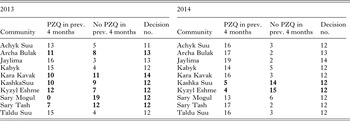
Although the majority of dogs were dosed in the 4 months prior to sampling in 2013 (109 or 56·5%), there were marked differences between villages. None of 19 dogs were dosed in the previous 4 months in Sary Mogul in 2013, compared with 16 out of 19 dogs dosed in Jaylima in 2013 (Table 2). Six out of 10 communities (Archa Bulak, Kara Kavak, Kashka Suu, Kyzyl Eshme, Sary Mogul and Sary Tash) did not meet the LQAS decision number for PZQ dosing, suggesting that the PZQ dosing scheme failed to reach at least 75% of owned dogs in these communities in 2013 (see Table 2).
Dogs dosed in the 4 months prior to sampling in each of the 10 communities in April 2013 and April 2014
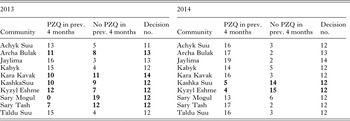
Communities in bold type did not meet the LQAS requirements, meaning that for these communities there was evidence that fewer than 75% of households had recently dosed their dogs with PZQ.
In 2014, the overall proportion of dogs dosed no more than 4 months prior to sampling was higher than in 2013 (128 or 66·7%). Dosing compliance rates also seemed to have improved, with only two communities (Kashka Suu and Kyzyl Eshme) failing to meet the decision number (see Table 2). This suggests that the PZQ dosing scheme was reaching more owned dogs in 2014 than in 2013.
Using LQAS to evaluate the impact of 2 years of intervention on coproELISA prevalence
The LQAS methodology described above was also used to evaluate whether the coproELISA prevalence had decreased following the start of the intervention programme. P 0 was set at 20·13% based on the pre-intervention sampling, and we aimed to identify villages that had achieved a reduction in their coproELISA prevalence.
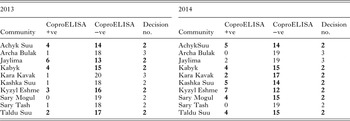
In 2013, five communities in the Alay valley (Archa Bulak, Kara Kavak, Kashka Suu, Sary Mogul and Sary Tash) did not meet the decision number set according to LQAS requirements (Table 3). In 2014, three communities (Archa Bulak, Jaylima, and Sary Tash) did not meet the LQAS decision number (Table 3). These results provide some evidence that the canine coproELISA prevalence in these communities was lower than the pre-intervention value of 20·13%.
CoproELISA positive and negative faecal samples in the 10 communities sampled in April 2013 and April 2014
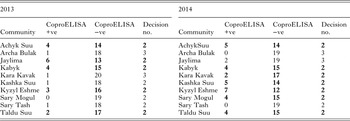
Communities in bold type met the LQAS requirements, meaning that for these communities there was no evidence of a decrease in coproantigen prevalence from the baseline of 20.1%.
DISCUSSION
Echinococcosis is a neglected zoonotic disease that can be fatal in humans (WHO/OIE, Reference Eckert, Gemmell, Meslin and Pawłowski2001) and can also have a large economic impact on rural communities due to the detrimental effects on livestock productivity (Benner et al. Reference Benner, Carabin, Sánchez-Serrano, Budke and Carmena2010). Echinococcosis is re-emerging in Kyrgyzstan (Torgerson et al. Reference Torgerson, Karaeva, Corkeri, Abdyjaparov, Kuttubaev and Shaikenov2003; Raimkylov et al. Reference Raimkylov, Kuttubaev and Toigombaeva2015) and was specifically mentioned as one focus of a livestock disease control programme in the country (World Bank, 2010). However, echinococcosis is very difficult to control or eliminate (WHO/OIE, Reference Eckert, Gemmell, Meslin and Pawłowski2001) especially in continental regions that are relatively remote and where people are nomadic or semi-nomadic (Schantz et al. Reference Schantz, Wang, Qiu, Liu, Saito, Emshoff, Ito, Roberts and Delker2003; Craig and Larrieu, Reference Craig and Larrieu2006). In these cases frequent PZQ dosing of domestic dogs (standard recommended dosing every six weeks) may not be practically feasible (Gemmell et al. Reference Gemmell, Lawson and Roberts1986; Lembo et al. Reference Lembo, Craig, Miles, Hampson, Meslin, Macpherson, Meslin and Wandeler2013), and surveillance of the effectiveness of the scheme in the field is made even more challenging.
The implementation of control programmes for echinococcosis is costly in terms of both financial and human resources, and as a result, control programmes have frequently not had the long-term success hoped for (Craig and Larrieu, Reference Craig and Larrieu2006). As such, it is important to evaluate the real impact of control programmes, rather than focusing on easily available metrics such as the amount of money spent, or the number of PZQ tablets distributed. Effective evaluation of control programmes requires data to be collected from the communities in question, including reliable pre-intervention data, and data collection should continue at suitable intervals during the control programme itself. The data collected will depend on the questions being asked, but of particular value are infection-centred measures such as the prevalence of canine infection (or the copro-prevalence, as a proxy), or the prevalence of human echinococcosis. However, the challenges of implementing control programmes will also apply to the evaluations of control programmes. As such, relatively quick and easy tools to evaluate echinococcosis control programmes are highly desirable.
In order to evaluate the impact of the intervention programme in the Alay Valley, a pre-intervention coproELISA prevalence was established (see also van Kesteren et al. Reference van Kesteren, Mastin, Mytynova, Ziadinov, Boufana, Torgerson, Rogan and Craig2013; Mastin et al. Reference Mastin, van Kesteren, Torgerson, Ziadinov, Mytynova, Rogan, Tursunov and Craig2015). To assess the impact of the control programme, 10 communities were visited in April 2013 and April 2014 (~9 and 21 months after the start of the dosing scheme). From these, we aimed to assess PZQ dosing compliance and coproELISA prevalence, with the PZQ dosing threshold set at 75% of dogs dosed in the previous 3–4 months (Torgerson, Reference Torgerson2003). In 2013, four of the 10 communities reached the decision number associated with this dosing target, and in 2014 this number had increased to eight out of 10. Although the LQAS methodology does not allow us to state that the target was reached for these communities, the number of communities for which there was evidence of the target not being met was lower in 2014 than 2013, which is suggestive that the dosing scheme was reaching at least 75% of owned dogs in most communities sampled. Furthermore, in 2014 a majority of dog owners (84·6%) had heard of human echinococcosis and could describe its causes (78·3%).
In 2013, there was evidence that the copro-prevalence was lower than the pre-intervention estimate of 20·13% in five out of 10 communities sampled. However, in 2014, this had decreased to three out of the 10 communities sampled, despite the higher number of communities reaching the threshold for reported PZQ dosing. Although LQAS methodology, by virtue of the small sample sizes collected, does not lend itself well to individual-level interpretation, it was reported that over half of the 33 dogs found to be coproELISA positive in 2014 were reported to have been dosed within the previous 4 months. This may reflect information biases from owners regarding the timing of dosing, errors in dosing (for example, tablets not swallowed or incorrect dosages administered), or re-infection. Although PZQ is highly effective in treating canine echinococcosis, it provides no protection against re-infection, and if dogs continue to have access to offal and/or small mammals, they may become re-infected with E. granulosus, E. canadensis or E. multilocularis: all three of which are known to be transmitted in dogs in the Alay valley (van Kesteren et al. Reference van Kesteren, Mastin, Mytynova, Ziadinov, Boufana, Torgerson, Rogan and Craig2013). Deworming dogs using PZQ is considered to eventually reduce the infection pressure to dogs through decreasing the infection pressure to livestock and small mammals, although this takes time due to the longevity of cysts in livestock (e.g. Torgerson and Heath, Reference Torgerson and Heath2003). Similarly, although the lifespan of voles and other small mammals is much shorter than that of sheep (Bobek, Reference Bobek1969; Devevey and Christe, Reference Devevey and Christe2009), it will take 1–2 years for infected small mammals to die off (Moss et al. Reference Moss, Chen, Li, Qiu, Wang, Giraudoux, Ito, Torgerson and Craig2013). Furthermore, E. multilocularis transmission is expected to be less responsive to dog dosing campaigns due to its sylvatic lifecycle (Eckert and Deplazes, Reference Eckert and Deplazes2004). Therefore, even if dogs were correctly dosed, they may still be subject to high re-infection pressures, which may explain the poor correlation between reported PZQ dosing and coproELISA prevalence.
When using LQAS, it is important to be aware of the limitations of this methodology. LQAS methodology remains statistically robust in the presence of small sample sizes by operating on the group level rather than the individual level, and by classifying groups (in the current study, villages) in a dichotomous fashion. As a result, conclusions can only be made at the level of the village, and individual-level associations within these villages cannot be assessed. This latter issue means that although possible reasons for a lack of association between PZQ dosing and coproantigen positivity at the individual dog level can be postulated (see above), further studies would be required to evaluate this more fully. Another important consideration in interpreting the results presented here is that of limitations in the diagnostic test itself. It has been well reported that the coproantigen ELISA functions best in the presence of higher worm burdens (Allan and Craig, Reference Allan and Craig2006). Control schemes using anthelmintics may affect the degree of overdispersion in a community since treatment of high-burden individuals (which contribute most to overdispersion) bring the mean worm burden closer to the threshold for detection using the coproantigen ELISA, resulting in greater instability in the prevalence estimates obtained when using a single cut-off for ‘positivity’. It should also be noted that as pre-intervention coproELISA prevalences were estimated from the four communities (Sary Mogul, Taldu Suu, Kara Kavak and Kashka Suu) sampled prior to the dosing campaign, we are not able to draw detailed conclusions about individual communities, which would require more extensive data collection (e.g. Mastin, Reference Mastin2015; Mastin et al. Reference Mastin, van Kesteren, Torgerson, Ziadinov, Mytynova, Rogan, Tursunov and Craig2015).
Surveillance of echinococcosis in domestic dogs allows for a practical evaluation of a control programme, with the benefit that dogs can be sampled and tested for Echinococcus spp. non-invasively through coproELISA analysis of faecal samples collected from the ground (e.g. Pierangeli et al. Reference Pierangeli, Soriano, Roccia, Bergagna, Lazzarini, Celescinco, Kossman, Saiz and Basualdo2010). In addition, the application of novel sampling methodology such as LQAS can reduce some of the laboriousness associated with evaluating control programmes, and provide a relatively quick and easy tool to test if control programmes are meeting their targets. Here we found evidence that a minority of villages failed to reach reasonable levels of PZQ dosing by 2014, suggesting that the echinococcosis control programme was reaching the other communities. Although analysis of the canine infection data did not show evidence of a gradual decrease in coproELISA prevalence over time, longer timescales are required to evaluate these changes. Effective control of echinococcosis takes years if not decades, and a sustained effort will be required to reduce infection pressures and effectively control cystic echinococcosis in the Alay Valley, and the co-endemicity with alveolar echinococcosis in the Alay valley (Usubalieva et al. Reference Usubalieva, Minbaeva, Ziadinov, Deplazes and Torgerson2013) also makes control more challenging. Fortunately control efforts in the Alay Valley by the Kyrgyz Ministry of Agriculture are ongoing, with an estimated ~6000 and ~4000 dogs treated in 2015 and 2016, respectively, with an estimated total of 24 162 and 15 501 PZQ tablets provided to dogs (unpublished data provided by the Kyrgyz Ministry of Agriculture and Land Reclamation and the Kyrgyz State Inspectorate for Veterinary and Phytosanitary Safety). Following the initial project in the Alay Valley, the control programme has also been expanded to other parts of Kyrgyzstan. The LQAS methodology described here would provide a relatively low-cost method of evaluating canine infection status over the coming years, given that the control scheme is maintained.
SUPPLEMENTARY MATERIAL
The supplementary material for this article can be found at https://doi.org/10.1017/S0031182017000397
ACKNOWLEDGEMENTS
The authors would like to thank Akjol Gaitanbekov and Turdumamat Sultanov for logistical support and hospitality in the field, and Iskender Ziadinov for help in facilitating fieldwork in Kyrgyzstan. They would also like to thank the Kyrgyz Ministry of Agriculture and Land Reclamation and the Kyrgyz State Inspectorate for Veterinary and Phytosanitary Safety for providing the data on the numbers of dogs registered and treated with PZQ in the Alay Valley in 2013–2016.
FINANCIAL SUPPORT
This project was funded by the Wellcome Trust (Grant no. 094325/Z/10/Z).