Introduction
Idiopathic sudden sensorineural hearing loss is defined as the loss of hearing of at least 30 dB over at least 3 contiguous frequencies occurring within 3 days with no identifiable cause despite adequate investigation.Reference Chandrasekhar, Tsai Do, Schwartz, Bontempo, Faucett and Finestone1 The underlying aetiology and pathogenesis of idiopathic sudden SNHL remains unclear, but it is thought to relate to vascular, viral, inflammatory or immune-mediated causes.Reference Eisenman and Arts2 The spontaneous recovery rate in untreated patients ranges from 32 to 65 per cent,Reference Mattox and Simmons3 with the majority of patients recovering within 14 days and many recovering within the first few days. Disease prognosis is dependent on various factors, including age, severity and pattern of hearing loss at the time of diagnosis, presence or absence of vertigo, and delay between hearing loss onset and treatment.Reference Fetterman, Saunders and Luxford4,Reference Byl5
There is a lack of clear consensus in the management of idiopathic sudden SNHL. Systemic treatment with high dose steroids is the most commonly used treatment modality because of perceived anti-inflammatory action; however, this may be associated with systemic side effects and be ineffective at non-toxic doses because of limited permeability through the blood-perilymph barrier.Reference Chandrasekhar6 The most recent Cochrane review on steroids for idiopathic sudden SNHL identified only two suitable randomised control trials, of which only one, Wilson et al., demonstrated significant hearing improvement (61 vs 32 per cent).Reference Wei, Stathopoulos and O'Leary7,Reference Wilson, Byl and Laird8
Intratympanic injection has emerged as a novel technique to deliver high concentrations of steroid into the inner ear via the tympanic cavity, bypassing systemic circulation and therefore reducing the incidence of systemic side effects. This method has been increasingly used as both primary (initial) and salvage therapy. Salvage therapy can be defined as ‘any therapy offered after two weeks from symptom onset, even if initial therapy was observing’ based on American Academy of Otolaryngology-Head and Neck Surgery (AAO-HNS) guidelines.Reference Chandrasekhar, Tsai Do, Schwartz, Bontempo, Faucett and Finestone1
Several studies have since suggested that primary treatment with intratympanic steroids is as effective as oral steroids, with no significant differences in post-treatment pure-tone averages or hearing recovery.Reference Mirian and Ovesen9,Reference Qiang, Wu, Yang, Yang and Sun10 A number of systematic reviews and meta-analyses have also investigated the role of intratympanic steroid injections as salvage therapy in idiopathic sudden SNHL.Reference Spear and Schwartz11–Reference Barreto, Ledesma, de Oliveira and Bahmad16 The majority demonstrated statistically significant improved hearing outcomes following intratympanic steroid therapy despite considerable design flaws and differences in experimental methods. This finding is surprising given the lack of evidence for primary therapy with oral or intratympanic steroids.Reference Crane, Camilon, Nguyen and Meyer15 A limited meta-analysis of the higher-quality studies showed a mean difference in improvement of 13.3 dB in the intratympanic salvage group versus placebo (95 per cent confidence interval: 7.7 to 18.9; p < 0.0001); however, it remains to be seen whether this difference is clinically significant.Reference Spear and Schwartz11
Our current practice is to routinely offer oral steroids with or without intratympanic steroids as a primary treatment (or intratympanic steroids alone if systemic steroids are contraindicated) and salvage intratympanic steroids up to three months afterwards where treatment has failed. The injection is repeated weekly until symptom resolution or to a maximum of three doses. Patients with idiopathic sudden SNHL can be referred from the general practitioner or emergency department to either the ENT emergency clinic and then to the otology out-patient clinic or directly to the otology out-patient clinic itself. In most cases, patients would be expected to receive their first injection at the consultant led otology out-patient clinic.
The aim of this study was to determine the probability of clinically significant hearing recovery following salvage treatment with intratympanic steroids in the ‘real world’ where, unlike in a clinical trial, patients often present late or elect to delay the onset of treatment. Our results, together with the prognostic factors described above, would enable patients to make a more informed decision about treatment. This is particularly pertinent in an era of coronavirus as many of these patients are elderly and may wish to avoid numerous trips to hospital for repeated procedures if there is little evidence of benefit.
Materials and methods
A retrospective case note review of all patients who received salvage intratympanic steroid injections for idiopathic sudden SNHL between January 2014 and December 2019 was performed.
Data on demographic information, time from onset to treatment, grade of doctor performing the procedure, pure tone average before and after treatment, magnetic resonance imaging of the internal acoustic meatus result, and complications were collected.
The decision to offer intratympanic steroid therapy was made on an individual clinician basis. Patients with a history of trauma, chronic ear disease, slowly progressive hearing loss, bilateral hearing loss, previous otological surgery in the affected ear, neurological or systemic symptoms were excluded. Patient identifiable information was anonymised, and records were stored on National Health Service password protected computers. Ethical committee approval was not required because of the retrospective nature of the study.
Intratympanic steroid injection technique
Patients were placed in a supine position with the head rotated 45° to the opposite side. Local anaesthesia was administered by applying a topical EMLATM (lidocaine or prilocaine) cream onto the tympanic membrane for approximately 15 minutes. A solution of dexamethasone 3.3 mg/ml was then slowly injected through the posterior-inferior quadrant into the middle ear via a 22- or 25-gauge spinal needle. Patients were instructed to swallow once during the injection and then avoid swallowing, speaking and movement of the head for 30 minutes following injection. All registrars performing the procedure had demonstrated competence to one of the consultants in the study before being allowed to perform independently.
Treatment outcomes
Pre- and post-treatment audiograms were compared with the unaffected ear. The pure tone average was calculated by taking the average pure-tone hearing level at 500, 1000, 2000 and 3000 Hz. In contrast to many previous studies, we report clinically significant changes in hearing divided into the following three categories based on recent AAO-HNS criteriaReference Chandrasekhar, Tsai Do, Schwartz, Bontempo, Faucett and Finestone1: (1) hearing loss more than 50 dB (non-serviceable), with improvement at less than 50 dB (partial recovery) or no improvement to less than 50 dB (no recovery); and (2) hearing loss less than 50 dB (serviceable) with improvement more than 10 dB (partial recovery) or return to within 10 dB hearing loss of either unaffected ear or the affected ear before hearing loss (complete recovery).
The word recognition score component to the AAO-HNS criteria is not routinely performed in our hospital and therefore could not be included.
In order to provide a comparator for our results, a literature search was performed to identify all potentially relevant metanalyses and systematic reviews evaluating the role of salvage intratympanic steroid therapy in idiopathic sudden SNHL in order to identify individual studies which met the Preferred Reporting Items for Systematic Reviews and Meta-Analyses guidelines for inclusion from which we could harvest individual patient data.
An electronic search was performed in Medline, Embase and Cochrane Library databases from January 1975 to May 2020. The following search strategy was used: ‘sensorineural hearing loss’ or ‘sudden hearing loss’ or ‘sudden deafness’ or ‘SSNHL’ AND ‘dexamethasone’ or ‘steroid’ or ‘corticosteroid’ AND ‘intratympanic’ or ‘injection’ AND ‘systematic review’ or ‘meta-analysis’. Articles were limited to humans and the English language. The reference and citation lists from the included studies were also searched to identify any additional studies.
Results
A total of 22 patients were treated with salvage intratympanic steroids for idiopathic sudden SNHL between January 2014 and December 2019. Five patients did not meet the criteria for idiopathic sudden SNHL because of previous fluctuating hearing loss, hearing loss less than 30 dB and bilateral hearing loss. An additional two patients had incomplete data and were therefore excluded (Figure 1).
Flow diagram showing patients undergoing intratympanic steroid injection for idiopathic sudden sensorineural hearing loss (SNHL).

Of the remaining 15 patients who underwent salvage intratympanic steroid therapy, the mean age was 50.6 ± 19.1 years (range, 16–74 years). There were 11 male patients and 4 female patients. Nine patients were treated with prednisolone prior to intratympanic injection, at a dose between 40 and 60 mg, up to 10 days in duration. Six patients were not treated with oral steroids before intratympanic injection because of late presentation, type 2 diabetes and incorrect initial diagnosis, including wax or otitis media.
One patient had a partial recovery, and the remainder were non-responders. The patient with partial recovery did not receive primary treatment with oral steroids and had a moderate hearing loss on their pre-treatment audiogram. Their injections were performed by a consultant, and they received treatment at two months following onset of hearing loss. Within the group of 14 patients who did not respond, 5 patients had profound hearing loss, 5 had severe hearing loss, 2 had moderate hearing loss and 2 had mild hearing loss (Figure 1).
The median duration of time between symptom onset and ENT referral was 5.5 days (range, 0–31 days) (Figure 2). Nine patients were referred to the ENT emergency clinic before being seen at the otology out-patient clinic, and 6 patients were referred directly to the otology out-patient clinic, with a median wait time of 2 days and 34.5 days, respectively. Once patients were seen in the otology out-patient clinic, they received their first intratympanic injection between a median of 0–2 days. The median time between symptom onset and first salvage intratympanic steroid treatment was 47 days if patients were first seen in the ENT emergency clinic and 53 days if patients were first seen in the otology out-patient clinic, giving a median delay of 52 days (range, 14–81 days) across both pathways (Figure 2).
Flow diagram showing patients and median number of days between each healthcare encounter. *One patient received their first intratympanic steroid injection by an appropriately trained registrar at the ENT emergency clinic. GP = general practitioner; ED = emergency department

Fifteen of the 16 patients underwent a magnetic resonance imaging scan to exclude a lesion of the cerebellopontine angle. None the scanned patients were found to have a vestibular schwannoma at follow up. None of the 16 patients experienced any complication of intratympanic steroid injection.
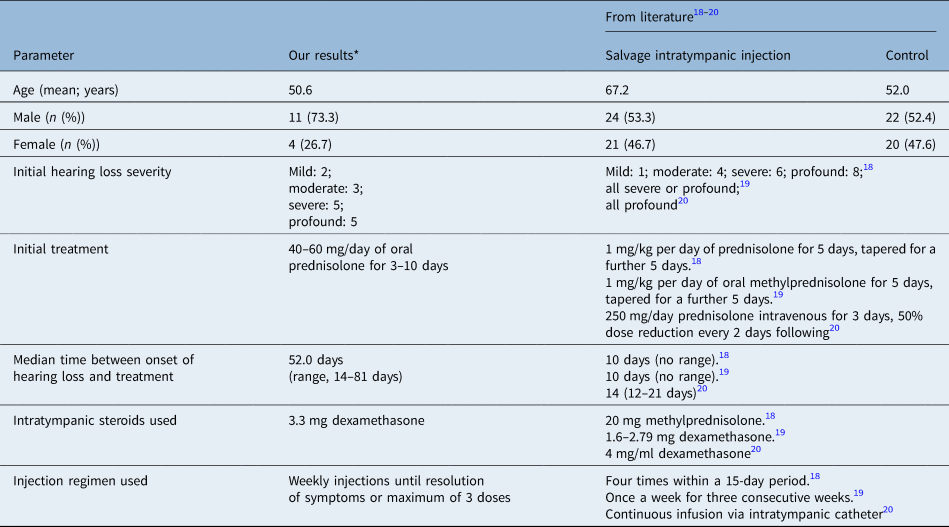
A search of the existing literature identified five systematic reviews and metanalyses that evaluated the efficacy of salvage intratympanic steroid treatment.Reference Spear and Schwartz11–Reference Crane, Camilon, Nguyen and Meyer15,Reference Lavigne, Lavigne and Saliba17 The systematic review by Spear and Schwartz in 2011 contained all studies providing individual patient data on the results of salvage intratympanic steroid therapy. The authors categorised studies into five tiers based on the quality of data. Tier 1 comprised articles where intratympanic steroids were one of the treatment groups for idiopathic sudden sensorineural hearing loss with two or more comparator groups, where inclusion criteria and outcome were clearly specified, where outcome was prospectively tracked, where follow up was adequate, where the patient and assessor were blinded to treatment, and where patients were randomly assigned to the treatment arm and comparator group having placebo for alternative. Tier 2 articles did not include patient or assessor blinding, or random assignment to the treatment arm or a comparator group having a placebo for alternative.Reference Spear and Schwartz11 Of the six tier 1 and 2 studies meeting inclusion criteria, three listed before and after pure tone average results for both patients undergoing intratympanic steroid therapy (45 patients) and the control group (42 patients) and were therefore included in the present study.Reference Xenellis, Papadimitriou, Nikolopoulos, Maragoudakis, Segas and Tzagaroulakis18–Reference Plontke, Löwenheim, Mertens, Engel, Meisner and Weidner20 A comparison of patient demographic data and treatment between our results and results from the literature can be seen in Table 1.
Comparison of salvage intratympanic patient demographic data and treatment for our results and results from literature

* n = 15
We categorised each individual patient result from both our own study and the results in the literature into total, partial and no recovery based on the AAO-HNS guidelines.Reference Chandrasekhar, Tsai Do, Schwartz, Bontempo, Faucett and Finestone1 Fisher's exact test was performed using SPSS® statistical software (version 25) to compare the differences in hearing recovery between the group in the literature receiving intratympanic steroid injections and our own results, and between the control group in the literature and our own results. Significance was determined to be at the confidence interval of p < 0.05.
Table 2 demonstrates a patient treated by us is 24.4 per cent (6.7 vs 31.1 per cent) less likely to make a partial or total recovery than in the comparison treatment group. This result almost reached statistical significance (p = 0.086). Table 3 demonstrates there is no statistically significant difference in recovery in a patient treated by us and the comparison control group (p = 1).
Fisher's exact test comparing differences in hearing recovery between the group in literature receiving intratympanic steroid injections and our own results

Fisher's exact test comparing differences in hearing recovery the between control group in literature and our own results

Discussion
The exact incidence of idiopathic sudden SNHL is not known, but it is estimated to be between 5 and 27 per 100 000 people per year.Reference Chandrasekhar, Tsai Do, Schwartz, Bontempo, Faucett and Finestone1 Given the population of NHS Lothian was 907 580 in 2019,21 a predicted incidence of idiopathic sudden SNHL between 45 and 245 persons each year would be expected. Assuming an optimistic recovery rate following primary treatment of 70 per cent, based on the study by Wilson et al., this would leave 13 to 73 patients in our catchment area eligible for salvage therapy each year.Reference Wilson, Byl and Laird8
Although we did not collect specific data on the number of patients declining intervention, our study suggests that only a minority of patients with idiopathic sudden SHNL presented and proceeded with intratympanic therapy. Of note, 6 out of 15 patients presented too late to either the general practitioner or emergency department to receive primary treatment with oral steroids. This may be because of patient perceptions (e.g. ‘hearing loss is not significant’, ‘not treatable’, ‘not bad enough to warrant invasive treatment’). This requires further research to see if there would be any merit in a public information campaign. There is currently a proposed multicentre nationally funded study to evaluate the role of intratympanic steroids in idiopathic sudden SNHL, and our finding may have significant implications in terms of patients dropping out of the intervention arm.
Another interesting finding was that although 22 patients were initially identified as receiving intratympanic steroids for sudden sensorineural hearing loss, on review of clinical history and audiograms, 5 patients did not meet the definition for idiopathic sudden SNHL. We felt some of the patients were misdiagnosed and in fact represented presbycusis or insignificant hearing loss. This highlights the importance of ensuring early review by an appropriately trained professional and accurate initial diagnosis.
Current guidelines advocate that clinicians should offer intratympanic steroid injections in patients who failed to respond to initial management.Reference Chandrasekhar, Tsai Do, Schwartz, Bontempo, Faucett and Finestone1 It is thought that salvage therapy may help reduce secondary inflammatory cascades which inhibit repair of the inner ear preventing recovery from hearing loss.Reference Chandrasekhar, Tsai Do, Schwartz, Bontempo, Faucett and Finestone1 Animal and human studies have reported that higher perilymphatic concentration of steroids may be achieved in the inner ear following intratympanic injection compared with systemic administration; this is thought to be related to reduced ability to penetrate the blood-labyrinth barrier.Reference Chandrasekhar6,Reference Parnes, Sun and Freeman22
The other primary advantage of the intratympanic drug delivery route is minimal systemic absorption and thus avoidance of systemic side effects associated with high dose steroids, such as glucose intolerance, avascular necrosis of the hip, insomnia, irritability, gastritis and osteoporosis.Reference Bird, Begg, Zhang, Keast, Murray and Balkany23 In addition, intratympanic steroids can also be given to patients in whom systemic steroids are contraindicated, such as those with immunosuppression and diabetes.
However, reported drawbacks of intratympanic steroid injection included residual tympanic perforation, pain during and after treatment, infection, vertigo (usually temporary), dysgeusia, hearing loss, and need for multiple hospital or out-patient visits.Reference Chandrasekhar, Tsai Do, Schwartz, Bontempo, Faucett and Finestone1,Reference Dispenza, Amodio, De Stefano, Gallina, Marchese and Mathur24 We saw no complications as a result of intratympanic steroids. However, in an era of coronavirus there is a risk of contracting infection by making numerous trips to hospital for intratympanic injections. It is also recommended that systemic steroids (accepting there is minimal systemic steroid absorption from intratympanic therapy) be avoided at this time unless there is clear indication as they may adversely affect the outcome in infected patients.Reference Russell, Millar and Kenneth Baillie25
Our hearing recovery rate was 25 per cent worse than the published data (6.7 vs 31.1 per cent) and statistically no different to no treatment at all. One explanation is the ‘sham’ effect: where apparent success of early treatment is in fact because of the increased chance of spontaneous recovery in any patient caught early enough.Reference Liebau, Pogorzelski, Salt and Plontke26 The median time to instigate salvage therapy in the comparison studies was 14 days (range, 10–21 days) compared with 52 days (range, 14–81 days) in our study. We propose that ‘real world’ patients are a different cohort from study patients (Figure 3). For example, some patients in the ‘real world’ will get better spontaneously at 10 to 21 days before seeking intratympanic therapy. These patients would have been recorded as a success in the comparison papers but are not captured in our study. Conversely some of the patients in our study, not captured in the comparison studies, have waited well beyond that time and thus their chance of success is statistically reduced. Another explanation could be the use of methylprednisolone rather than dexamethasone by Xenellis et al.Reference Xenellis, Papadimitriou, Nikolopoulos, Maragoudakis, Segas and Tzagaroulakis18 A previous animal study has demonstrated that intratympanic injections result in higher concentrations of methylprednisolone in the endolymph but that dexamethasone is more efficacious.Reference Hamid and Trune27 As mentioned above, half our group had no primary treatment with oral steroids which may have affected our later success with salvage treatment. However, the one patient who did have partial recovery had no oral steroids. Lastly, it is also possible that our technique was poor; however, this would seem unlikely given we were trained in this procedure by consultants who are in turn authors of studies with better results. Because of small numbers we are unable to comment on the effect that experience with this procedure may have on success.
Comparison of management pathway for patients presenting with sudden sensorineural hearing loss in the (a) ‘real world’ and in (b) clinical trials. GP = general practitioner; ED = emergency department. SSNHL = sudden sensorineural hearing loss

Low- and mid-frequency hearing losses recover spontaneously more frequently than flat or high frequency losses.Reference Fetterman, Saunders and Luxford4,Reference Byl5 As accepted outcome measures are based on pure tone average over 500, 1000, 2000 and 3000 Hz, we have not been able to capture improvements in hearing at higher frequencies. Prognosis also depends on the severity of the initial hearing loss; mild hearing losses have been associated with a recovery rate of up to 83 per cent compared with 22 per cent in patients with profound hearing loss.Reference Byl5 This was reflected in the results of our study where only the patient with moderate hearing loss gained any benefit from intratympanic therapy, with the majority of non-responders having worse hearing on presentation. Although the initial degree of hearing loss was worse in the comparison studies, they had a greater degree of hearing recovery (Table 1). An interesting paradox emerges: the worse a patient's hearing is, the more likely they appear to try salvage intratympanic therapy and yet the worse their chance of success.
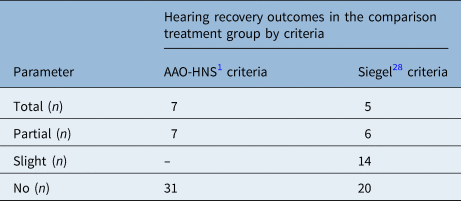
Our decision to report clinically significant improvement in hearing using the new AAO-HNS criteria rather than mean improvement of pure tone audiogram or Siegel's criteria,Reference LG28 as most papers do, was so that patients can understand what their chances of a success are in real terms. The main difference between the two criteria relates to the AAO-HNS defining a complete recovery as a return to within 10 dB of hearing of either the unaffected ear or the affected ear, while the Siegel criteria defines complete recovery as final hearing better than 25 dB. Therefore, the AAO-HNS criteria may overestimate success and underestimate patients with no recovery in their hearing compared with the Siegel criteria as demonstrated in Table 4 where comparator studies demonstrate an increased level of success when using the AAO-HNS rather than the Siegel criteria.
• ‘Real world’ patients with idiopathic sudden sensorineural hearing loss (SNHL) are different from those presented in the literature
• A diagnosis of idiopathic sudden SNHL should be confirmed before proceeding to intratympanic steroid injections
• Intratympanic steroid injections should be initiated early if considered appropriate
• Patients should make an informed decision on treatment based on prognostic factors and local success rates
Comparison of American Academy of Otolaryngology-Head and Neck Surgery rates of hearing recovery compared with Siegel's criteria for results from the literatureReference Xenellis, Papadimitriou, Nikolopoulos, Maragoudakis, Segas and Tzagaroulakis18–Reference Plontke, Löwenheim, Mertens, Engel, Meisner and Weidner20

AAO-HNS = American Academy of Otolaryngology-Head and Neck Surgery
Our study was limited by its retrospective study design, small sample size and relatively short follow up. In addition, there was no control group to determine the incidence of spontaneous improvement.
Conclusion
‘Real world’ patients with idiopathic sudden SNHL are different from those presented in the literature. They are less likely to present for intratympanic therapy, receive their first injection within two weeks, receive primary treatment with oral steroids and are less likely to recover.
Based on our findings, we recommend ensuring idiopathic sudden SNHL is appropriately diagnosed before offering intratympanic therapy and auditing one's own results (as they may be worse than the published literature). If intratympanic therapy is offered, all patients should be seen within 14 days of primary treatment as the literature demonstrates that early treatment, whether because of a ‘sham effect’ or not, is associated with a better outcome.
Where a patient is seen after 14 days, an honest discussion about one's own results with delayed treatment (together with the effects of age, severity and pattern of hearing loss and presence or absence of vertigo) is required for informed consent.
Competing interests
None declared