

Strategic changes in organizations, although integral to performance, can evoke a mindset that actually provokes resistance rather than openness. In particular, strategic changes, by definition, shift the values or priorities of the organization (e.g., Cocks, Reference Cocks2010). Consequently, the execution of these changes underscores the possibility that values-or the achievements that are rewarded or appreciated-may be malleable. When people are attuned to this possibility, they recognize that perhaps their own values, goals, roles, and interests could also change in the future (Ersner-Hershfield et al., Reference Ersner-Hershfield, Garton, Ballard, Samanez-Larkin and Knutson2009a). Importantly, once people arrive at this insight, they are not as receptive to change.
Specifically, after individuals realize the values and goals they seek may be fundamentally different in the future, they are not as motivated to accrue resources that could be beneficial in future years and, instead, seek immediate pleasure (Ersner-Hershfield et al., Reference Ersner-Hershfield, Wimmer and Knutson2009b). These individuals, therefore, often reject the uncertainty or apprehension that changes can evoke and are not especially inspired by the prospect of future improvements (Bartels & Rips, Reference Bartels and Rips2010). Strategic changes, therefore, may activate a mindset that provokes resistance to these very developments.
This paper reports a pair of studies that was undertaken to explore the practices that organizations utilize to reconcile this paradox. Specifically, this research characterized the strategies and tactics executives utilize to instill in employees the belief that workplace values and priorities will persist over time rather than change erratically. In addition, this research examined whether practices instilling this belief do indeed override the obstacles that often impede strategic initiatives (Hrebiniak, Reference Hrebiniak2006; Reference Hrebiniak2008), such as resistance to change.
The Significance of Continuity in Values
Consistent with a diversity of findings and theories, when individuals feel the values or priorities of society have changed, or will change, considerably and abruptly, they do not withstand stress as well. Their resilience and wellbeing decline.
Sani et al. (Reference Sani, Bowe and Herrera2008), for example, conducted a study that assessed the benefits of this perceived continuity in community values. In this study, participants from the Spanish community indicated the degree to which the values, traditions, and culture of the Spanish people have persisted over time and have been transmitted across the generations. In addition, they indicated the extent to which they derive wellbeing from this community. Continuity in values was positively associated with this measure of wellbeing.
Many other studies have also confirmed the benefits of this continuity in values. Such continuity in values, for example, has been shown to promote openness to diversity instead of prejudice (Jetten & Wohl, Reference Jetten and Wohl2012).
Psychological Connectedness to the Future
The notion of psychological connectedness, distilled from the seminal work of Parfit (Reference Parfit1971), offers some key insights into the sequence of events explaining the benefits of continuity in values. According to this perspective, in many circumstances, people feel their identity now — their values, goals, roles, and interests, for example — will overlap considerably with their identity in ten or so years (Bartels & Urminsky, Reference Bartels and Urminsky2011; Ersner-Hershfield et al., Reference Ersner-Hershfield, Garton, Ballard, Samanez-Larkin and Knutson2009a). Consequently, these individuals are willing to sacrifice their immediate pleasure somewhat to assist this future identity or instantiation of themselves (Bartels & Rips, Reference Bartels and Rips2010).
In contrast, in other circumstances, epitomized by conditions of flux, in which the values, goals, roles, and interests of individuals are vulnerable to change, people do not feel their identity now will overlap with their identity in ten years. In essence, they perceive this future instantiation of themselves as a separate person altogether (Bartels & Urminsky, Reference Bartels and Urminsky2011). They are not as motivated to accrue resources — knowledge, skills, or social networks, for instance — to assist this unrelated identity but instead seek only immediate pleasure (Parfit, Reference Parfit1971).
Consistent with this account, when people feel their identity now is divorced from their identity in ten years, their resistance to temptations plummets. Their behavior is more impulsive, expedient, and shortsighted (e.g., Hershfield et al., Reference Hershfield, Cohen and Thompson2012). To illustrate, in one study, conducted by Bartels and Urminsky (Reference Bartels and Urminsky2011), some participants received information that implies their identity — that is, their values, roles, and interests — is likely to shift dramatically over the next few years. Other participants received information that implies their identity will not shift appreciably during this time. If participants felt their identity would change considerably, they were especially likely to choose small, immediate rewards over larger, delayed rewards (for analogous results, see Bartels & Rips (Reference Bartels and Rips2010); Ersner-Hershfield et al. (Reference Ersner-Hershfield, Garton, Ballard, Samanez-Larkin and Knutson2009a)).
Socio-emotional Selectivity Theory
As the concept of psychological connectedness implies, if individuals feel their values, goals, or roles may shift appreciably in the future, they may reject changes that provoke immediate complications but future benefits. That is, these individuals discount the significance of future rewards. The literature that surrounds socio-emotional selectivity theory, however, verifies and clarifies the consequences of this expected shift in personal values, roles, or interests (Carstensen, Reference Carstensen and Jacobs1993; Reference Carstensen1995; Reference Carstensen2006).
According to socio-emotional selectivity theory (Carstensen et al., Reference Carstensen, Isaacowitz and Charles1999), many events, from aging and illness (Carstensen & Fredrickson, Reference Carstensen and Fredrickson1998) to transitions in the environment (DeWall et al., Reference DeWall, Visser and Levitan2006), can diminish the extent to which individuals feel their identity is enduring. When people do not feel their identity will endure, they do not strive to extend their resources — such as their skills and knowledge — but instead are susceptible to a variety of biases that enhance their immediate mood (Carstensen & Mikels, Reference Carstensen and Mikels2005).
To demonstrate, as many studies show, if individuals perceive their identity as transient instead of permanent, they orient their attention, memory, and interpretations to positive features in lieu of negative features (e.g., Mather & Carstensen, Reference Mather and Carstensen2003; Reference Mather and Carstensen2005). They seek information or events that are uplifting or comforting rather than accurate and informative (Fung & Carstensen, Reference Fung and Carstensen2003; Reference Fung and Carstensen2004).
Most of the empirical support of socio-emotional selectivity theory has emanated from comparisons between older and young people. For example, as Charles et al. (Reference Charles, Mather and Carstensen2003) showed, unpleasant memories seem to decline more rapidly than pleasant memories, but especially in older people. Presumably, older people are more inclined to perceive their identity as transient and, therefore, bias their memory to positive episodes.
Yet, this disparity between older and younger individuals could be ascribed to other attributes rather than transience of identity. To override this confound, Pruzan and Isaacowitz (Reference Pruzan and Isaacowitz2006) conducted a study in which they compared third year students, weeks before graduating, and were thus aware their roles, goals, and values are likely to shift soon, with first year students. Consistent with socio-emotional selectivity theory, third year students tended to fixate their attention on pleasant images rather than unpleasant images. First year students, in contrast, did not bias their attention to pleasant images.
The Meaning Maintenance Model
The notion of psychological connectedness (Bartels & Urminsky, Reference Bartels and Urminsky2011), when combined with socio-emotional selectivity theory (Carstensen, Reference Carstensen2006), indicates that people who feel their values, interests, roles, and goals might soon shift dramatically will tend to denigrate changes that initially provoke complications. Furthermore, because they are not especially motivated to seek accurate information, they may bias their attention to cues that vindicate this cynicism toward the change.
The meaning maintenance model, first proposed by Heine et al. (Reference Heine, Proulx and Vohs2006), indicates that discontinuities in values over time can provoke other biases as well. According to this model, if individuals feel the values of society, and hence their own identity, may shift considerably in the future, they recognize their activities now may not cohere with their future goals or pursuits. They do not perceive their activities now as meaningful or germane to their future. As proponents of the meaning maintenance model have demonstrated empirically, when people experience this sense of incoherence, instead of meaning, they demonstrate a suite of biases (e.g., Proulx & Heine, Reference Proulx and Heine2006; Reference Proulx and Heine2008; Reference Proulx and Heine2009).
Specifically, in these studies, participants were exposed to stimuli that impede a sense of coherence or meaning, such as incongruous pairs of words (Randles et al., Reference Randles, Proulx and Heine2010), absurdist tales (Proulx & Heine, Reference Proulx and Heine2009), or words that are synonymous with futility (e.g., Van Tongreen & Green, Reference Van Tongreen and Green2010). When exposed to these stimuli, participants tended to inflate their self-esteem (e.g., Van Tongreen & Green, Reference Van Tongreen and Green2010). That is, they inflated the degree to which they perceived themselves as worthy and capable. In addition, after their sense of coherence and meaning was threatened, participants were inclined to exhibit a need for closure (Heine et al., Reference Heine, Proulx and Vohs2006), in which they gravitate to predictable, unambiguous, and organized settings (Kruglanski & Webster, Reference Kruglanski and Webster1996). They dismissed changes from the status quo, concerned these shifts could provoke uncertainty or ambiguity.
Impediments to this sense of coherence and meaning not only provoke biases but can impede work engagement. For example, as May et al. (Reference May, Gilson and Harter2004) showed, when people do not experience a sense of meaning at work, their level of engagement declines — a decline that has been shown to damage performance (e.g., Haudan & MacLean, Reference Haudan and MacLean2002; Rich et al., Reference Rich, Lepine and Crawford2010).
Implications for Strategic Change
In short, in the aftermath of strategic changes — that is, changes to the values and priorities of the organization — individuals recognize that goals, roles, and interests are malleable and assume their activities now might not align to their future objectives. Consequently, according to the notion of psychological connectedness (Bartels & Urminsky, Reference Bartels and Urminsky2011) and socio-emotional selectivity (Carstensen, Reference Carstensen2006), these individuals are not as concerned about their future needs and, therefore, may dismiss changes or initiatives that could provoke immediate complications. They may also bias their attention, memory, and interpretation to information that vindicates this cynicism toward change. Furthermore, because they may overestimate their capabilities (Van Tongreen & Green, Reference Van Tongreen and Green2010), they may not dedicate enough time and resources to this change, a vital impediment to the implementation of initiatives (Hrebiniak, Reference Hrebiniak2006). Finally, their level of engagement and performance may decline.
These individuals, because of their cynicism toward change and disengagement, may withdraw from the activities that expedite the change (cf., Hrebiniak, Reference Hrebiniak2006). They may not agree on how to institute the change, share information about the change, assign responsibilities and accountabilities, or offer suitable incentives.
To override this paradox, this research explores the strategies and practices that executives utilize, while implementing a strategic change, to instill in employees the belief that workplace values will endure in the future. In addition, this research examines the implications of these strategies and practices to the implementation of changes.
Study 1
The first study was conducted to assess the notion that a perception of instability in values over time may impair a sense of meaning — in which individuals feel their activities now are vital to their future. Consequently, according to the meaning maintenance model (Heine et al., Reference Heine, Proulx and Vohs2006), these individuals will be susceptible to biases or inclinations that impede the implementation of change, compromising the performance of their organization. Furthermore, this decline in meaning may compromise engagement (May et al., Reference May, Gilson and Harter2004), also undermining performance. Hence:
Hypothesis 1. Consistency of values should be positively associated with firm performance.
Hypothesis 2. A sense of meaning should mediate this positive association between consistency of values and firm performance.
Hypothesis 3. Diminished hurdles to strategic change should also mediate the positive association between consistency of values and firm performance.
Method
Participants and Procedure
The participants were 208 executives and senior managers, 75% of whom were male. In addition, 29% of participants were aged between 50 and 59; 37% of participants were aged between 40 and 49. These participants were chosen because senior managers, relative to other employees, may be more aware of workplace characteristics that typify the entire organization rather than only specific departments.
Each participant was recruited from a different corporation or government organization — partly to maximize variability in workplace performance. In particular, 26% of these organizations earned revenues that exceeded $1 billion; the revenue of 23% of these organizations was less than $2 million. Furthermore, 49% of the organizations employed more than 1,000 people; 21% of the organizations employed between 100 and 499 individuals. The majority of participants operated in North America (26%) or Oceania (21%).
Each participant was invited to click the mouse on a hyperlink that activated an online survey. The survey entailed five main sections. First, participants answered demographic questions that sought the revenue, size, sector, industry, and location of the organization and their own age, gender, position, and experience in management. Second, participants completed questions that assess the degree to which leaders communicate a strategy that is consistent over time. Third, the survey included questions that assess the degree to which the employees manifest a sense of meaning. Fourth, participants indicated the extent to which they believed that various impediments had obstructed their attempts to implement strategic change. Finally, a measure of firm performance was included. All these questions were embedded within a broader survey that also assessed other features of the organization.
Measures
Consistency
A measure comprising six items, developed by the authors, was administered to gauge the extent to which leaders convey values that are consistent over time. This measure distilled items from several other scales, including the Multifactor Leadership Questionnaire (Bass & Avolio, Reference Bass and Avolio1997), Leadership Practices Inventory (Posner & Kouzes, Reference Posner and Kouzes1988), as well as other instruments (e.g., Podsakoff et al., Reference Podsakoff, MacKenzie and Bommer1996; Rafferty & Griffin, Reference Rafferty and Griffin2004; Wang & Howell, Reference Wang and Howell2010). Only items, however, that emphasize continuity or consistency over time, as defined by Jetten and Wohl (Reference Jetten and Wohl2012), were included.
To increase the clarity and reliability of items, each item comprised two statements. One statement epitomized consistency over time, such as ‘The expectation and objectives of leaders are consistent over time’; the other statement epitomized inconsistency over time, such as ‘The expectation and objectives of leaders are inconsistent over time’. Participants specified the degree to which one statement was more accurate than was the other statement on a 7-point scale. Cronbach's alpha for this scale was 0.87
Sense of meaning
A set of three items was also constructed to gauge the extent to which a sense of meaning pervades the workplace. Again, each item comprised two statements such as ‘At my organization, managers and employees seem determined and passionate at work’ and ‘At my organization, managers and employees sometimes seem uninspired at work’. Participants indicated the degree to which one statement was more accurate than was the other statement on a 7-point scale. Cronbach's alpha for this scale was 0.82.
Hurdles to the execution of strategy
Thirteen items, adapted from the questions that were validated by Hrebiniak (Reference Hrebiniak2006), were administered to gauge the degree to which participants believed the execution of their strategies were obstructed by various hurdles — including ‘Lack of upper management support of strategy execution’, ‘Lack of incentives, or inappropriate incentives, to support execution objectives’, and ‘Change fatigue’. Each item was measured on a 7-point Likert scale, ranging from (1) not at all a problem to (7) a major problem. The Cronbach's alpha for this scale was 0.94.
Firm performance
To assess performance, a scale that was evaluated and validated by Shea et al. (Reference Shea, Cooper, De Cieri and Sheehan2012), was administered. The scale comprises two subscales — organizational performance and market performance — although the optimal number of sub factors has been disputed (for a discussion, see Shea et al. (Reference Shea, Cooper, De Cieri and Sheehan2012)). Organization performance corresponds to the extent to which managers believe the products, services, and operations of their organization are favorable. That is, this subscale reflects positive attitudes of executives and managers toward the internal operations of their organization. In contrast, market performance reflects the extent to which managers feel their organization has achieved, or will achieve, financial success. Items were preceded by the stem ‘How would you compare your organization's performance over the past year to that of other organizations in your industry sector on. . .’. For organization performance, the stem was completed by phrases such as ‘Quality of products, services, or programs’ and ‘Ability to attract essential employees’. For market performance, the stem was completed by phrases such as ‘growth in sales’, ‘market share’, and ‘profitability’. Each item was measured on a 4-point Likert scale, ranging from (1) worse to (7) much better. Cronbach's alpha for organization performance and market performance were 0.87 and 0.80, respectively.
Control variables
Controls included number of employee, industry sector, and the revenue of organizations.
Results
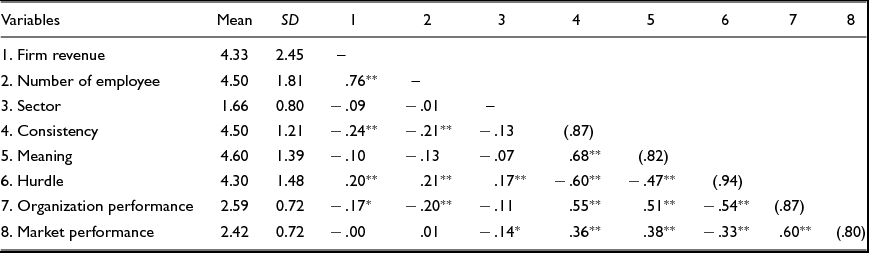
Table 1 presents the mean and standard deviation of all study variables, coupled with the correlation between each pair of study variables. Besides the high correlation between firm revenue and number of employees, none of the correlations were high enough to indicate multicolinearity or redundancy. Consistent with Hypothesis 1, consistency of values was positively associated with both measures of firm performance.
Means, Standard Deviations, and Correlations Associated with the Study Variables

N = 208 organizations. Measures’ reliability coefficients are in parentheses along the diagonal.
*p < .05.
**p < .01.
To assess the hypotheses, and especially the indirect effects, the asymptotic and re-sampling strategy, recommended by Preacher and Hayes (Reference Preacher and Hayes2008), was applied. The bias corrected method, propounded by Williams and Mackinnon (Reference Williams and Mackinnon2008), was utilized to optimize the power of confidence limits for indirect effects. The bootstrap sample size was 20,000. For each analysis, firm revenue, number of employees, and industry sector was controlled. Four industry sectors were dummy coded: private sector, public sector, non-profit organization, and other.
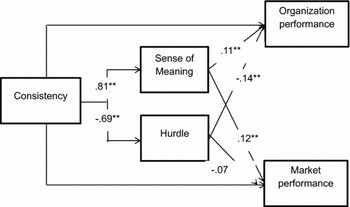
Figure 1 presents the model that was tested, coupled with the coefficients that were generated. According to Hypothesis 2, sense of meaning should mediate the relationship between consistency of values and firm performance, manifested as both organization performance and market performance. Consistency of values was positively associated with sense of meaning, (β = 0.81, p < .01). In addition, sense of meaning was positively related to both organization performance (β = 0.11, p < .01) and market performance (β = 0.12, p < .01). Finally, the mediation effect was significant: According to the PROCESS calculation, as defined by Preacher and Hayes (Reference Preacher and Hayes2008), the 95% confidence limit did not contain zero [BootLLCI: 0.02, BootULCI: 0.15] and [BootLLCI: 0.03, BootULCI: 0.16]) for the pathways that predicted organization performance and market performance, respectively.
Regression coefficients that emanated from the mediation model.

According to Hypothesis 3, hurdles to the execution of strategy should mediate the relationship between consistency and firm performance. Consistency of values was negatively associated with hurdles, and hurdles were inversely related to organization performance (β = −0.14, p < .01) but not market performance (β = −0.07, p > .05). In addition, hurdles significantly mediated the association between consistency and organization performance, because the 95% confidence limit derived from the PROCESS calculation did not contain zero [BootLLCI: 0.04, BootULCI: 0.17]. However, hurdles did not significantly mediate the association between consistency and market performance; the 95% confidence limit derived from the PROCESS calculation did contain zero [BootLLCI: -0.001, BootULCI: 0.14].
Discussion
When individuals feel the values they need to pursue are stable over time, they should be more inclined to embrace the immediate complications of strategies to enjoy the future benefits — a possibility that is consistent with both the notion of psychological connectedness (Bartels & Urminsky, Reference Bartels and Urminsky2011) and socio-emotional selectivity (Carstensen, Reference Carstensen2006). Because of this openness to change, individuals are not as susceptible to the obstacles of these changes (cf., Hrebiniak, Reference Hrebiniak2006); for example, they are more inclined to share information about the change as well as assign or accept their responsibilities. Furthermore, this consistency in values over time should instill a sense of meaning, because people are more inclined to feel their activities now are meaningful to their goals in the future. This sense of meaning tends to diminish the extent to which individuals overestimate their capabilities (Van Tongreen & Green, Reference Van Tongreen and Green2010) as well as foster engagement (May et al., Reference May, Gilson and Harter2004) and performance. Accordingly, consistent values over time should foster a sense of meaning, override many of the obstacles to strategic change, and enhance firm performance.
The results largely vindicate these possibilities. When leaders promulgated consistent values over time, firm performance improved, and these associations were mediated by a perceived sense of meaning in employees and fewer hurdles to change.
Contrary to the rationale, however, a decline in hurdles was not significantly associated with market performance in particular. Arguably, practices that override the hurdles that impede change, such as limited resources, may not initially enhance market performance, such as growth, revenue, or profitability. Indeed, resources and efforts that are directed to changes in strategy may divert resources and efforts from more immediate opportunities to increase returns, offsetting the predicted association between a decline in hurdles and market performance.
Study 2
Study 1 showed that consistent values over time are vital to the implementation of strategic change. Yet, during times of change, many employees may doubt the stability of these values. Strategic changes can transform the values, priorities, and agendas of the organization — and imply that similar transformations are possible in the future (cf., Sani et al., Reference Sani, Bowe and Herrera2008).
Consequently, even during periods of flux, managers should somehow reinforce the assumption that values are stable over time. Study 2 was undertaken to gather insights from executives on their attempts to promote this sense of stability. In particular, these individuals were asked to describe how they promulgate a stable and consistent set of values and priorities over time in the midst of change.
Method
Participants and Procedure
The participants were 35 executives of companies in Asia, Australasia, North America, Europe, and Africa, invited to participate by the Palladiam Group. Each interview lasted approximately 30 minutes.
Interview Schedule
The interviews were designed to characterize the practices and strategies that executives utilize to promote a vision and strategy that is consistent and stable over time. The first few questions were designed to evoke memories of recent strategic changes they had been implemented. Participants were prompted to describe between one and three strategic changes they have implemented at the organization — defined as changes that affect an entire department, business, or organization. Next, they were asked to characterize how they implemented this change and to delineate the impediments that obstructed this endeavor.
Next, to fulfill the aims of this study, participants were asked to characterize the practices the organization implemented to promote a vision and strategy that seems consistent over time, even in the midst of flux. Finally, participants were granted opportunities to discuss other practices or approaches that were utilized to facilitate and expedite the execution of these changes.
Data Analysis
The responses these individuals offered were subjected to the six phases of thematic analysis that Braun and Clarke (Reference Braun and Clarke2006) stipulated. First, two researchers skimmed — and then carefully read — the transcripts. While reading these transcripts, the researchers transcribed their initial assumptions and conclusions. Second, the researchers assigned codes to chunks of data that, putatively, related to practices that may foster a vision or strategy that seems consistent over time. These chunks of data ranged from about 5 to 25 words and typically comprised 1 to 3 sentences. For example, the response ‘Directors of different departments need to be involved’ was coded as ‘Involvement of directors’. Third, to uncover themes, the researchers sought clusters of codes that seemed to be conceptually related to one other. Discrepancies between researchers were discussed and reconciled. Fourth, the researchers ascertained whether or not these themes were comprehensive enough to represent all the codes and responses of participants. One theme was modified to achieve this goal. Fifth, the researchers defined the cardinal features of each theme. Finally, to generate a cohesive account of these data, the themes were compared and contrasted.
Results and Discussion
In this study, executives were asked to describe the practices they apply during periods of strategic change to instill a stable and consistent set of values and priorities over time.
Regular Communication of Strategic Plan
The first theme revolved around the regular and frequent communication of workplace goals and strategies, and this theme was mentioned by four of the executives. According to these interviewees, recurrent communication of the values, priorities, and plans may reinforce the belief that such strategies will persist over time.
In particular, the communication should revolve around how the goals and strategies will evolve over time (e.g., ‘communication around strategy map’). In addition, these plans should be communicated frequently and regularly rather than sporadically (e.g., ‘keep communicating with people’).
When employees understand how the strategy may evolve over time, they adopt a more abstract, holistic perspective of this change (e.g., Forster et al., Reference Forster, Friedman and Liberman2004). This abstract perspective can reconcile a diverse array of unexpected or diverging events (Forster et al., Reference Forster, Friedman and Liberman2004). Consequently, even if managers need to deviate from their plans, this abstract perspective of the strategic change will remain consistent over time (cf., Torelli & Kaikati, Reference Torelli and Kaikati2009).
In addition, this strategic plan, if communicated frequently, tends to seem more familiar over time and can be processed more fluently (e.g., Nordhielm, Reference Nordhielm2002). As research indicates, information that can be processed more fluently tends to be perceived as more valid or true (Reber & Schwarz, Reference Reber and Schwarz1999). Regular communication of the strategic plan, therefore, should increase the perceived validity, and hence the probable longevity, of these goals and values.
Clarity of the Communication to Facilitate Consistency
In contrast to the first theme that emphasizes the regularity of communication, the second theme, broached by three of the executives, emphasizes the clarity of this communication. Specifically, as these interviewees stated, managers should be able to demonstrate how their choices, decisions, or courses of action epitomize the strategy (e.g., ‘Clarity around the choices within that strategy’). In addition, workplace practices need to reinforce, rather than contradict, these explicit strategies. For example, inadequate resources to achieve a strategy may undermine the explicit message (e.g., ‘Choices need to match resources so that there are internal consistencies’).
The possibility of a mismatch between the availability of resources and the goals of a strategy has been shown to diminish flow or the extent to which people feel absorbed in their tasks (Keller & Bless, Reference Keller and Bless2008). That is, when people feel the challenges they need to achieve exceed the resources that are available, this sense of flow is unlikely (e.g., Keller & Bless, Reference Keller and Bless2008). Instead, individuals are not as likely to feel absorbed in their activities, diminishing persistence (e.g., Salanova et al., Reference Salanova, Bakker and Llorens2006). The changes are not as likely to be implemented.
Ubiquitous Contributions
The third theme revolved around the notion that all employees, as well as all workgroups, departments, and businesses, should both embrace and contribute to the strategic changes. That is, as four executives emphasized, strategic changes should not be confined to specific teams or individuals.
Specifically, executives recommended that all teams or departments be granted opportunities to design, and ultimately to agree, to the strategic changes (e.g., ‘directors of different departments need to be involved’). Likewise, all individuals, regardless of their management level, should also be granted these opportunities (e.g., ‘Even the secretary level need to be part of it’). Finally, all employees need to be assigned measurable targets and responsibilities, guaranteeing they are accountable for these changes (e.g., ‘We used a framework (that entails) objectives, measures, action items responsibilities and timelines’).
Arguably, strategies and values that are ubiquitous across the organization are more likely to be sustained over time. In contrast, strategies and values that are restricted to particular sectors may be dismissed once the dominance of these sectors abates.
Support from Senior Management
Even though all individuals and teams should be empowered to embrace the strategy, one interviewee underscored the importance of support from senior management: ‘Support from senior management is the key: Luckily our senior management was very supportive’. This perspective has been echoed by many scholars over several decades (e.g., Raps, Reference Raps2004).
General Discussion
Inadequate resources, limited planning, conflicts with commercial interests, a paucity of incentives, and many other hurdles, as defined by Hrebiniak (Reference Hrebiniak2006), could explain the observation that many, if not most, strategic changes are regarded as unsuccessful (e.g., Franken et al., Reference Franken, Edwards and Lambert2009). Accordingly, attempts to change an organization will often fail to enhance workplace performance.
One vital complication, arguably, is that strategic changes imply that values and priorities can shift markedly over time. If individuals feel the values they need to pursue may shift, they are not as inclined to sacrifice their immediate motives to achieve future goals (cf., Bartels & Urminsky, Reference Bartels and Urminsky2011; Carstensen, Reference Carstensen2006). They are more likely to resist the immediate complications that change entails — and are not inspired by the future possibilities these initiatives may offer.
However, if managers can somehow instill consistent values over time, even in the midst of change, these problems are likely to dissipate. Individuals will feel their activities now are germane to their future, manifesting as a sense of meaning (cf., Heine et al., Reference Heine, Proulx and Vohs2006). They are more inspired by the future possibilities that change may offer, increasing their willingness to withstand the immediate complications and diminishing the hurdles that impede change. Ultimately, this sense of meaning and erosion of obstacles should enhance firm performance. Aligned to this account, in Study 1, a sense of meaning and decrease in hurdles mediated the association between consistent values over time and firm performance.
These observations raise the question as to how managers can forge this sense of consistency while they implement change. Study 2 was conducted to resolve this question. Overall, the managers underscored the possibility that communication and participation is vital to the perception that values and strategies are consistent over time. Specifically, communication and participation can shape whether existing practices or policies are perceived to fulfill or to contradict a set of values.
To illustrate, managers emphasized the need to communicate the values frequently as well as to justify their choices and decisions cogently — showing how their actions align to their values. Arguably, in response to these approaches, employees may be more likely to appreciate the stability and consistency of values. They may be more inclined to recognize how changes in the practices and policies of organizations nevertheless align to overarching, stable values.
In addition, managers underscored the need to assign all management levels, departments, and fields the responsibility to implement the change. When everyone pursues the same values actively, these priorities are robust to unexpected perturbations in the organization. Even shifts in the distribution of power should not affect which values are cherished in the workplace.
Several limitations will need to be addressed in future studies. First, the sense of meaning of employees was assessed obliquely — by asking executives to rate the sense of meaning both they and their employees enjoy at work. Yet, executives may have projected their own sense of meaning onto their employees. That is, people tend to assume that other individuals share the same experience as do they (Epley et al., Reference Epley, Keysar, Van Boven and Gilovich2004). This bias is pronounced when people are not motivated to contemplate the perspective of other individuals (Epley et al., Reference Epley, Keysar, Van Boven and Gilovich2004) — a tendency that is common in anyone assigned a position of power (Galinsky et al., Reference Galinsky, Magee, Inesi and Gruenfeld2006). Future research, therefore, should ask employees to rate their own sense of meaning. Similarly, employees could also be asked to rate consistency in values and hurdles to change, also to offset the potential biases of executives.
Second, this study did not clarify the mechanisms that underpin the association between a sense of meaning at work and firm performance. Future research should assess whether cognitive biases, work engagement, wellbeing, or other states and tendencies mediate the relationship between sense of meaning and firm performance.
Third, firm performance could actually foster consistency in values rather than vice versa. That is, when organizations flourish, they may be more likely to retain their strategies. Nevertheless, this account is unlikely to explain why meaning in life and hurdles seemed to mediate the association between firm performance and consistency in values.
In short, this study highlighted that changes are more effective when buttressed by a consistent and enduring set of values. The role of manager, therefore, is partly to show how unexpected perturbations in the procedures, policies, and practices are nevertheless consistent with a stable vision. In addition, changes need to pervade each department, function, and level of management to guarantee that workplace values and strategies are robust to shifts in the power or dynamics of the organization.
Acknowledgments
This research was supported by an Australian Research Council Linkage Grant.