Introduction
The Canadian food and agriculture sector is facing some significant environmental, food safety and financial difficulties. These difficulties are affecting the market's perceptions of Canadian food, both domestically and internationally. These realities explain, in part, the development of the 2002 Agricultural Policy Framework (APF), implemented in 2003–2008 by the federal, provincial and territorial governments, and the agreement to create a next generation of APF programs (or APF2).
Despite these preoccupations, with the possible exception of Quebec, Canadian governments have treated organic food and farming as a niche market, with very limited attention given to it in the new suite of APF programs. In many parts of the world, organic farming has been similarly promoted, but rapid growth rates this past decade suggest that providing policy supports on a niche market basis is misplaced. In several European countries, the organic sector has reached 10% of the agri-food economy and/or production areaReference Willer and Yussefi1. At such levels, it is estimated that some of the proposed benefits of organic farmingReference MacRae, Martin, Macey, Doherty, Gibson and Beauchemin2, Reference MacRae, Frick and Martin3 could be realized.
With growth in retail sales estimated at 15–25% yr−1, organic food represents the only significant growth sector in Canada's food system4. This explains, in part, the recent spate of organic firm acquisitions by conventional food companiesReference Howard5. However, only 15–40% of the organic food consumed in Canada is produced domestically4, Reference Macey6. The rest is imported, primarily from the United States (perhaps 70–75%) and EuropeReference Macey6. In contrast, 70% of conventional foods consumed domestically are produced in Canada7. Consequently, Canadian farmers are missing out on many of the market opportunities that organic demand presents, at a time when net farm income in aggregate has been low7. Without domestic production to match demand, the significant environmental, health, financial and social benefits that can be associated with organic food production, processing and distribution are accruing elsewhere. Global trade in organic food is also contributing to greenhouse gas (GHG) emissions, causing many in the sector to question an export/import-oriented organic agricultural strategy and to call for a new post-organic or ‘beyond organics’ approachReference Howard and Allen8, Reference Moore, Holt and Reed9. At the leading edge of this opposition to global organic is the UK Soil Association, which has suggested in a discussion paper that air-freighted organic may not in future be eligible for certification10.
Market demand, on its own, appears to be insufficient to rapidly attract new Canadian organic producers and processors. It appears that even the presence of significant price premiums is insufficient to overcome the anxieties about and real challenges of the transition to organic production. European evidence suggests that only with supportive government interventions will the supply of organic foods increase relatively rapidlyReference Michelsen, Lynggaard, Padel and Foster11.
Government involvement is justified for many reasons consistent with historical interventions in the food and agricultural economy. Organic agriculture is an immature industry and governments have supported infant agricultural industries in the past, in Canada notably the canola oil industry on the Prairies and the wine sector in Ontario. These government investments in the organic sector progressively correct market failures—the fact that current approaches to production, processing and distribution do not reflect real costs, generating significant externalized costs the private landowners, the general public and governments have to pay for later. In theory, as the social and environmental benefits grow with organic farming adoption, government liabilities for these unfunded externalized costs should declineReference Pretty, Brett, Gee, Hine, Mason, Morison, Raven, Rayment and van der Bijl12, Reference Tegtmeier and Duffy13.
In earlier work (2002), the Canadian organic sector established a series of targets for growth, setting out some of the governmental and sectoral interventions considered necessary to expand organic food and farmingReference MacRae, Martin, Macey, Beauchemin and Christianson14. This study was designed to further that analysis, focusing specifically on governmental and sectoral initiatives for the province of Ontario. Ontario was chosen for several reasons:
1. One of the most concentrated areas of market demand for organic products in Canada is the Greater Toronto Area (GTA)4 and therefore Ontario farmers are well placed to meet this local market.
2. Production remains very limited, despite significant demand for a wide range of organic foods. In 2004 (the most up to date information at the time of the study), Ontario only had about 489 certified organic producers covering about 24,000 ha of cropland. Farm gate receipts were estimated at over $25 million. Certified organic processors only numbered in the hundredsReference Macey6. Data from 2005 showed very small increases from 2004Reference Macey15.
3. Although organic farming and processing data are generally weak in Canada, Ontario data are relatively better than many other provinces.
4. There is interest in organic agriculture at a political level. The Ontario government in the 2003–2007 period relied to some degree on external organizations to put forward detailed action plans that they might implement. Senior politicians expressed interest in seeing detailed ideas on advancing organic agriculture, as part of their consultations with the agricultural sector.
Since some countries in Europe have the most advanced organic sectors, the European experience developing the organic sector reveals key instruments that have been critical to successReference Michelsen, Lynggaard, Padel and Foster11. Most of the countries with significant development have used a mixture of supply-side and demand-side policies and programs, including:
1. Definitions of organic agriculture.
2. A uniform national (and for Europe an EU level) standard, with political recognition of standards, certification and accreditation. In the EU, there have been statistically positive impacts from introduction of the EU standard.
3. Financial support for transitional growers. Numerous studies show initial positive impacts from direct payments in the agri-environmental schemes; however, modifications to the schemes in the more mature countries like Denmark and Austria appear to have accelerated existing organic farming growth, but not necessarily brought in significant numbers of new organic farmers.
4. Advisory services and training to support the adoption process.
5. Local institutional supports for organic farming.
6. Supports for the development of organic markets—supermarkets and institutional buyers are often drivers of demand in Europe.
7. Coordinating and advising institutions to advance organics with positive participation and interaction with the conventional farming sector.
The European experience has led many states to recognize the need for a more integrated and balanced mix of policy and program measuresReference Lampkin and Powell16. This has produced a number of national action plans (and an EU plan) with both supply (push) and demand (pull) instruments with proposals for coordinating and implementation bodies. Denmark was the first to develop a plan (1995) and now England, Finland, France, Germany, the Netherlands, Norway, Sweden, Wales and Spain have plans. The plan rationales are to increase the size of the organic sector because of the public benefits that result. They normally include targets for adoption (typically 5–10% by 2000/2005 or 10–20% by 2010), direct financial support through the agri-environment/rural development programs; marketing and processing support; producer information initiatives; consumer education and infrastructure support. A typical mix is 50% of expenditures for direct payments and 50% for a host of other infrastructure- and training-related supports. Some plans focus more on demand-side interventions (e.g., the Netherlands), others on building information support systems for all players in the organic food chain (Germany) and others on increasing supply (England and Wales). Interestingly, almost all plans focus on the need for integrated farming systems and cooperation among all players in the food chain, and for formal advisory bodies that guide government decision-making on organic agriculture. Plans generally commit millions of dollars in public funds to implementation.
Among Canadian jurisdictions, only Quebec has a full strategic plan that rivals plans in Europe. A comparison of Quebec and European plans can be found at http://www.oacc.info/DOCs/Paper_Supports_Version2_rm.pdf.
The hypothesis of the present paper is that an Ontario plan can be designed and delivered that takes lessons from plans in other jurisdictions and adapts them to the Ontario environment, to accelerate the adoption of organic farming and food processing, and to reap the associated benefits for Ontario farmers and consumers.
Methods
Working from targets set out in the National Organic Strategic Plan (NOSP)Reference MacRae, Martin, Macey, Beauchemin and Christianson14 for adoption of organic farming and processing in different commodity areas, the study used an iterative process of analysis to identify specific and reasonable conversion targets in multiple commodity areas. Consistent with the NOSP, an overall target of 10% of cropped area was chosen but a wider range of targets was considered for individual commodities (see Table 4 for the list of commodities) in order to meet the overall target. Target setting allowed for estimates of the required number of new entrants to farming and conventional producers converting to organic. Programs and program initiatives were proposed to help meet those targets, based on successes elsewhere and expert opinion, and estimates of expenditures developed including the costs of a transition payments program that included payments for environmental services. Based on adoption targets, potential savings were identified in fertilizer, pesticide and antibiotic use associated with those transition targets.
Setting targets
The analysis determined:
• the number of hectares to be converted to organic production;
• crop by crop contributions to the overall 10% organic production target;
• the number of animal head to be converted;
• an estimate of the overall number of farms to be converted and new entrants to farming.
Crops were chosen based on data available on organic production (primarily production years 2003 and 2004). Specialty crops, such as ornamentals, herbs, bird seeds and ginseng, were excluded from the analysis because of insufficient data. Data on organic wheat, corn and hay/pasture had to be disaggregated, based on conventional ratios and expert informationReference Hugh17. Organic vegetable production data were limited, so all vegetables had to be reported together, except potatoes. The fruit production analysis was based on availability of organic production data.
Animals were chosen based on data available on organic production. Specialty, smaller volume animal production and aquaculture were excluded from the analysis because of insufficient data. Conventional crop and animal production data were taken from 2004 Ontario Ministry of Agriculture, Food and Rural Affairs (OMAFRA) statistics18, unless otherwise noted in our earlier report.
To establish 5 and 15 year targets for Ontario, we started from the national targets set out in the NOSPReference MacRae, Martin, Macey, Beauchemin and Christianson14. These were modified to reflect Ontario conventional and organic production realities and to balance crop and animal production requirements. Target hectares and head were calculated by multiplying conventional hectares (or animal head) by the target percentage for organic conversion. Current data on organic production, organic head and current organic farms were based on 2003 data provided by MaceyReference Macey6 unless updated with 2004 data provided by MaceyReference Macey19. Area (and head) to be converted was calculated by subtracting current organic area (head) from 15-year target area (head). To estimate how many farms would be required to convert to a specific commodity production, we estimate the current size of an average organic operation. Where that information was not available, we used conventional averages. We also took account of the size dispersal of operations in conventional production, under the assumption that most converting operations would not be in the largest size classes. Estimated additional numbers of farms reporting conversion to that crop (animal) were calculated by dividing area (head) to convert by the average size of an operation.
The average number of new organic farming entrants was estimated from conventional entrants. In the 1996–2001 period, 50,000 new farms entered20, most existing farms under new management. In an average year, then, 10,000 new operations started up. Assuming an even distribution according to provincial farm ratios, then 24% of those entered in Ontario, meaning 2400 new farms annually. Assuming that 1% annually of those new entrants are organic, then 24 new farms yr−1 entered or 120 new farm entrants over a 5-year period. In Phase II, with a fuller suite of supports in place, we anticipated a doubling of new entrants to organic farming or 48 farms yr−1. This would total 480 farms over 10 years, for a 15-year total of 600.
Since many operations are diversified, the farm totals for each commodity will not reflect accurately the total number of farms required for conversion. To estimate that, we found that in the 2001 Census of Agriculture, when adding up farms reporting crops in each commodity studied and comparing that to the total number of farms, the ratio was 2.5. In other words, each farm reported on average 2.5 of the studied crops. We assumed the number would be higher in organic production, since these operations are usually more diversified, so we divided the total of all farms required by three to come up with our estimate. We did not add in animal production numbers since we assumed that all organic livestock operations would also report crops.
As a check on the merits of our preliminary targets, we also examined rotation patterns and feed requirements for cattle (assuming primarily forage-based diets) and adjusted our targets accordingly. Given the relatively low rates of non-ruminant conversions, we did not anticipate any problems ensuring sufficient feed grain availability, although current shortages are acute in some regions and often a product of price differentials between human and animal feed markets.
One weakness of this analysis is that we were unable to account for dynamic changes in crop rotations, in part because Ontario does not collect sufficient crop rotation data. Organic farmers usually diversify and employ longer course rotations. This would cause shifts in the relationships between different crops for which we could not account in this study. For example, many producers converting from conventional to organic production would likely reduce hectares planted to corn, with more cropped area in small grains and forages. In this sense, our study assumed that organic farmers keep producing what they did as conventional producers. More dynamic modeling in future studies could correct for this inaccuracy.
Synthetic fertilizer savings
We calculated savings on nitrogen, phosphorus and potassium fertilizer for farms converting as follows:
• Conventional fertilizer application rates were taken from OMAFRA recommendations21–23, focusing on mid-range soil test results, loam soils and mid-range yield objectives, unless otherwise noted in our earlier report. We assumed that all hectares would have been fertilized at such rates prior to organic conversion.
• Fertilizer prices were taken from the Ontario Farm Input Monitoring Project21.
• The N price (Cdn$0.47 kg−1) was an average of ammonium nitrate, anhydrous ammonia, urea and nitrogen solution.
• The P price (Cdn$0.47 kg−1) was an average of mono-ammonium phosphate (MAP), di-ammonium phosphate (DAP) and triple super-phosphate.
• The K price (Cdn$0.35 kg−1) was for muriate of potash 60%.
Pesticide savings
We undertook detailed calculations of pesticide applications avoided (in kg active ingredient) and the input savings for farms converted, as follows:
• Pesticide use data came from the OMAFRA survey of pesticide useReference Gallivan, Berges and McGee24. Adjustments were made to vegetable and fruit production use totals by subtracting Bt, copper hydroxide and sulfur from the savings, as these actives are permitted in organic production. Use patterns of these materials would likely be different as organic farmers have limitations on their use of copper and sulfur, but we were unable to account for this in the estimates, so assumed that the same levels would be used in organic production.
• Pesticide costs are provided on a use weighted basis, using data from the Ontario Farm Input Monitoring Project SurveyReference McEwan25.
• Since not all pesticides were listed in that survey, we used the ones available that generally accounted for 80% of the active ingredient (ai) applied, except for fruits and vegetables where they accounted for about 66%. We assumed that closely related products were the same price if they were not separately listed. The estimate of pesticide costs in vegetables is high due to the cost of rimsulfuron use in sweet corn. The estimates provided here likely underestimate pesticide savings.
Avoided medications in feed
This analysis was carried out to estimate the amount of sub-therapeutic medication that would not be consumed in animal feed resulting from the transition to organic production of beef, swine and chicken (broilers) only as these were the commodities for which sufficient data could be assembled.
Few Canadian data are available on consumption of medications in feed, so the analysis was adapted from a method used in a US study by Mellon et al.Reference Mellon, Benbrook and Lutz Benbrook26. The first part of the analysis required a comparison of sub-therapeutic antibiotics approved in both Canada27 and the United StatesReference Mellon, Benbrook and Lutz Benbrook26, 28. The comparison was frequently straightforward, as the list of approved materials is slowly being harmonized. However, some medications are approved in the United States, but not in Canada, or they are approved as a slightly different formulation, or on different animals or at different growth stages, or they are approved at different doses or for different lengths of time. For these, we made the following assumptions:
• We eliminated from our analysis any medication approved in the United States but not in Canada.
• We eliminated from the analysis any medication/growth stage combination that is not approved in Canada; the largest discrepancies occurred in the broiler analysis, so this is likely the most conservative estimate.
• When it appeared that a slightly different formulation was used in Canada, we considered the Canadian medication equivalent to the United States formulation.
• No veal, pregnant animals or breeding stock were included in our analysis, so no medications used exclusively on those animals were included.
• We substituted Canadian doses for US doses where they differed.
• When multiple dose options were provided in the Compendium of Medicated Ingredients Brochures (CMIB)27, we used those most related to weight gain and efficiency, not options for treatment of acute conditions; if there was more than one option related to weight gain and efficiency, we chose the one closest to US use patterns.
• We did not include medications that appear to be approved in Canada but not in the the United States, since we had no data on percentage of animals treated to support an analysis.
We used the Mellon et al.Reference Mellon, Benbrook and Lutz Benbrook26 estimates of percentage of animals treated, which assumes that treatment patterns between the two countries are consistent. Since there are no public Canadian data on treatment patterns, we do not know how accurate this assumption is. We used their estimates of average days on feed unless there was Canadian information27 that indicated that a shorter period was required in Canada. We used their estimates of feed intake for swine and broilers. In a few cases for beef, the Canadian doses were reported in ways that required that we multiply them by average daily feed intake for a particular growth stage, so we used standard animal production guides of feed intake to determine those. We substituted the number of animals converted to organic production.
Other assumptions relative to the Mellon et al.26 analysis include:
• No mortalities.
• No medication combinations in the broiler analysis for which the majority of medications in the combination are not approved in Canada.
• Because the size ranges used in different growth stages were sometimes different from those employed in the United States, no medications used in Canada were included that extended beyond US growth stage categories.
Avoided cost payments
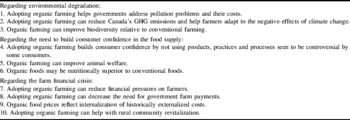
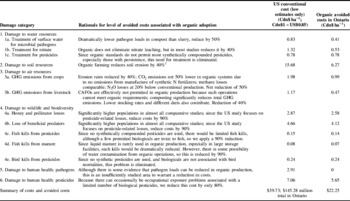
Canadian studies of the full costs of Canadian agriculture are lacking, but US and British studies attempting to account for a relatively full suite of costs have recently been completedReference Pretty, Brett, Gee, Hine, Mason, Morison, Raven, Rayment and van der Bijl12, Reference Tegtmeier and Duffy13. Of these, the most pertinent is a US study that builds upon methodologies used in other research, and its extensive agriculture is closer to Canadian realities than those in Britain. The authors, US agricultural economists Tegtmeier and DuffyReference Tegtmeier and Duffy13, concluded that US externalized costs of conventional agriculture ranged from Cdn$39.73 to 112.56 ha−1, assuming an exchange rate of $1Cdn=$0.85US. We drew on previous workReference MacRae, Martin, Macey, Doherty, Gibson and Beauchemin2, Reference MacRae, Frick and Martin3 and expert opinion to evaluate the degree to which organic production might reduce these costs (see Table 1 for a summary of organic farming benefits). We conservatively used the low-end range of the Tegtmeier and Duffy costs for two main reasons: the intensity of production in Canada is generally lower and government program expenditures are lower on a farm area basis. However, just because Canadian governments chose to allocate fewer resources to solving agricultural problems does not mean that they do not exist at a comparable level. For example, pesticide contamination of surface waters is largely viewed as a localized problem, but Canadian monitoring capacity remains limited, although a national indicator is now under developmentReference Cessna, Farenhorst, MacQueen, Lefebvre, Eilers and Chunn29. Given limited knowledge in this area, it is not clear whether water treatment facilities allocate sufficient resources to address what problems may exist.
The multiple benefits of organic agricultureReference MacRae, Martin, Macey, Doherty, Gibson and Beauchemin2.

To produce useful comparisons between organic and conventional production, it is important to focus on the entire farming system or larger food system dynamics as opposed to examining specific elements outside of their larger operating context. It is also important to compare systems that have common components, including comparable management capacities. Clearly, poorly managed organic and conventional systems generate problems. We were interested in structural comparisons, so we assumed good management in systems being compared. In doing so, we have used an agro-ecological frameworkReference Altieri30 to analyze how the structure of organic farming offers benefits that are not necessarily associated with conventional farmingReference MacRae, Martin, Macey, Doherty, Gibson and Beauchemin2, Reference MacRae, Frick and Martin3. We also took account of the strength of the current literature, which results, for example, in an assignment of zero reductions to human health costs associated with agricultural pathogens, since the literature in this area has produced divergent results.
Transition payments
The following assumptions guided calculations for our proposed Transition Risk Offset Program and Payments for Environmental Services.
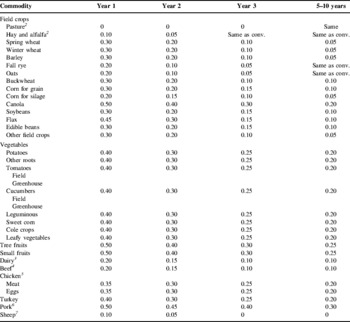
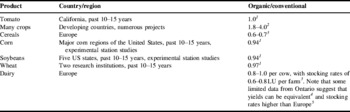
• The payments are set at 10% of the gross revenue loss associated with average yield declines during the transition (see Table 2 for estimated average yield declines in organic commodities and Table 3 for sources providing justification for a range of production systems). This level was chosen to be slightly lower than Europe, where such payments range from 15 to 20% of foregone revenue31, but at a base minimum suggested for improving adoption of other low-input systems in US studiesReference Fernandez-Cornejo and Castaldo32.
• Payments to animal production are on a per animal basis, assuming the same conditions of yield loss and compensation.
• To receive payments, farmers would have to belong to a certification agency, be actively committed to the transition process, and to be participating in mentoring and training programs. Since this element of the program starts in Phase II, farmers who convert in the first 5 years of this strategy would be eligible to receive payments retroactively, based on record keeping provided by the certification agencies.
• Transition year—we reported payments for each of the 3 years of required transition, except in animal production for which the period on farm is less than 3 years.
• Yield decline—estimates were derived from the literature and expert opinion (see Tables 2 and 3).
• Average 5-year yield and prices (2000–2004) were taken primarily from OMAFRA statistics33, with supplemental data provided by some commodity organizations.
Yield reduction averages relative to conventional production during 3-year transition to organic in Ontario (comparison with a small- to medium-sized conventional operation).Footnote 1

1 For most field crops, the assumption is that the transition does not start from a forage crop.
2 Assumes that conventional farmers managed hay and pasture without excess fertilization.
3 Assumes herd reduction and increased hectares to accommodate increased pasture and hay production.
4 Assumes integrated operation, birth to slaughter, no feedlots, major yield declines are associated with reduced weight gain. See Ag Ventures, February 2001. Agdex 420/830–3. Available at Web site http://www1.agric.gov.ab.ca/$department/deptdocs.nsf/all/agdex3458/$file/420_830–3.pdf?OpenElement (accessed 5 January 2009).
5 Assumes floor operations. Available at Web site http://www.acornorganic.org/pdf/poultryeggsprofile.pdf
6 Most difficult comparison: assumes small independent hog operation with most feed produced on the farm. Assumes that 100 sows/1000 market hogs versus 100 sows/2000 market hogs in conventional operation. Transition focuses on 6.5% of Ontario operators roughly in this size range. Farrow to finish.
7 Assumes most conventional sheep operations are low input, so differences are largely due to stocking rates and yield reductions from changes in de-worming agents. Meat only.
Comparing yields in organic versus conventional production: higher order studies.

1 Liebhardt, B. 2003. What is organic agriculture? What I learned in my transition. In: OECD (ed.). Organic Agriculture: Sustainability, Markets and Policies. CABI Publishing, Wallingford, UK. p. 31–49.
2 Pretty, J. and Hines, R. 2001. Reducing Food Poverty through Sustainable Agriculture. Centre for Environment and Society, University of Essex, UK.
3 Nieberg, H. and Oppermann, N. 2003. The profitability of organic farming in Europe. In: OECD (ed.). Organic Agriculture: Sustainability, Markets and Policies. CABI Publishing, Wallingford, UK. p. 141–152.
4 Ogini, Y., Clark, E.A., and Stonehouse, P. 1999. Comparison of organic and conventional dairy farms in Ontario. American Journal of Alternative Agriculture 14:122–134.
5 Roberts, C.J., Lynch, D.H., Voroney, R.P., Martin, R.C., and Juurlink, S.D. 2008. Nutrient budgets of Ontario organic dairy farms. Canadian Journal of Soil Science 88:107–114.
Program expenditures
The elements of the program proposed below met the following criteria:
• They have been shown to work elsewhere and can be adapted to Ontario.
• They strike a balance between cost and positive effects.
• They are relatively straightforward to implement.
• Most have significant cost-sharing opportunities with other levels of government, industry and NGOs.
• Most have the potential for third party delivery, which reduces government overhead costs.
We made a number of assumptions:
1. Ontario would participate in the federal program of organic standards development and accreditation, i.e., it would not set up its own system as has been done by Quebec.
2. Ontario would participate in a national organic logo and associated publicity campaign initiated at a federal level, i.e., Ontario would not develop its own provincial organic logo.
3. For most food safety and quality programming, the organic sector would take advantage of existing federal funding programs34 and develop a national food safety and quality improvement plan for the sector.
4. Additional elements would be added as existing organizations identified suitable grant programs to provide funding. For instance, consumer education is one area in which such opportunities could be explored, especially in Phase II.
5. Organic farmers would have participated in Environmental Farm Plan (EFP) programs consistent with the existing program35.
6. New rules for nutrient management36 and source water protection37 may require technical adjustments as it relates to organic producers, but we assumed these would not impose additional costs for government.
7. Although the programs were designed to accommodate all farmers, we assumed that it would tend to be small- to medium-sized farms that participated, because their transition challenges might be lower relative to large operations.
8. The distribution of costs by year is usually an average or a graduated increase with a fixed formula, since the rate of uptake of programs is difficult to predict at this point.
Estimating organic market share
Limited data make pinpointing the current and possible future size of the organic food market difficult. We derived our estimates of Ontario's current organic market from multiple sources including national organic market estimates ($1.3 billion4), conventional ratios of food retail value/farm gate value, and industry estimates of the percentage of organic production that is exported and organic consumption that is imported. To estimate how much organic farmers contribute to the total Ontario organic retail market after 5 and 15 years, we conservatively assumed a 15% annual growth rate in organic retail sales over the first 10 years of the program, and 10% in the last 5 years. We assumed growth rates in the conventional food market of 1.5% annually. We also assumed modest increases in the portion of organic production that goes to domestic versus export markets.
Results and Discussion
Organic targets
Production
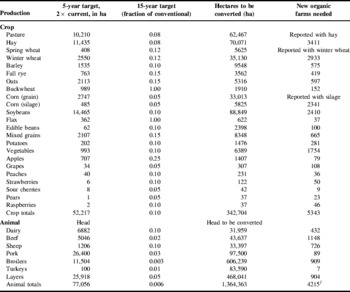
Results of the analysis are provided in Table 4. In Phase I, supply increases would come from a combination of new organic farms and expansion of scale and/or enterprises among existing organic operations. For example, organic field crop producers might certify an existing conventional beef herd, or a producer whose home farm is certified organic might subsequently certify another farm within the total operation. Regarding new organic operations, many farms are already organic but not certified, or in the process of transition38, and many companies are working with conventional producers to gradually bring them into their organic supply chain. Additionally, some new entrants to farming would enter organic production directly.
Five- and 15-year organic conversion targets.

1 Farms reporting animals are not added to the crop total since it is assumed that all farms reporting animals would also report crops. The ratio of farms reporting animals to crops is slightly higher than the 2001 Census of Agriculture, but this is sensible given that organic producers tend to report livestock to higher degrees than conventional producers.
(For details on calculations and assumptions, see http://www.oacc.info/Docs/OntarioOrgStrategy/TargetOOS_Statistics_sheet1.pdf.)
By the end of Phase II (15 years), 5343 organic farmers would be producing organically in all major commodities. Organic production would occur on about 367,000 ha of land (about 10% of current crop area), and some 1.4 million animals would be reared organically. This figure includes existing and converted acres.
Processing
Processing targets were more difficult to establish because of the very limited current data on organic processing. Of the conservatively estimated 64 certified processors and handlers in 2003Reference Macey6, the majority fell into the following categories: five in dairy, four in bakery, two in flax, three in fruit, two in nuts, five providing meat processing, three doing beverages, 14 considered packers and handlers and four animal feed. How many were exclusively organic, versus processing both conventional and organic foods, is unclear from the data. Data from the OMAFRA show that the following primary processing organic products are available from Ontario processors: flours, eggs, fruits and vegetables (including fresh cut, roasted garlic and soybeans, and seasoned beans), honey, maple syrup, alternative sweeteners, soup mixes (dry, containing beans), fluid milk and meats. Available in the secondary processing category are: breads, rolls and baked goods (including cookies and pitas, and baking mixes), snacks and cereals (including seeds, chips and popped snacks, snack crackers and nut/fruit/meal replacement bars), beverages (including alcohol, teas, coffees, fruit and grass juices and seltzers, and powder mixes), prepared soups, condiments (including ketchup, salad dressings, miso, sauces, nut and fruit butters, and jams and jellies), chocolates, processed dairy products, pasta, ethnic meals and prepared foods (curries, entrees, pates, baby foods) and ingredients—including starches, gums, flavors and extracts. What percentage, however, of the ingredients of these processed goods are purchased from Ontario producers is not knownReference Christianson and Morgan39.
In 2003, there were a total of 2300 Ontario food processors with registered employees and an additional approximately 800 operated by the owner and/or family members and/or contract employees. The total estimated value of agricultural shipments (2001) was $24.5 billion40; thus organic processors would represent about 2% of the total by number of enterprises, and even less by value of shipments. Doubling the number of firms processing organic food within 5 years would be a reasonable target. Sub-sector targets for year 15 were impossible to determine at this point.
A key question is where organic processors will come from. In most food sub-sectors, smaller firms represent the majority, with over half the firms having 20 registered employees or less40. Smaller processors tend to focus on local markets, which is the objective of the organic strategies set out in the present paper. However, to optimize production costs, many processors find that they must serve local markets but do so across the country. This often requires a shift to medium scale, or the firm may move to larger markets to accommodate a larger local market when product is perishable. This type of scaling up often has investment challenges.
Plants of smaller scale are often more flexible and accommodate a wider product range, with better capacity for new product introductions. But countering this reality, smaller firms often face cost-effectiveness challenges and often do not have the resources to invest in new products while running day to day operations41. Despite these challenges, it is likely that organic processing capacity will come from existing small operations, perhaps many without registered employees, and new small firms that start out as exclusively organic processors. There are five main areas of processing activity in the province—SW near Windsor, Grand River Region, Niagara, Toronto, Quinte area—and organic firms will likely similarly concentrate.
Avoided costs
Based on the Tegtmeier and Duffy analysisReference Tegtmeier and Duffy13, we estimated that with widespread adoption, organic farming could avoid 56% of these externalized costs, or Cdn$22.25 ha−1. As shown in Table 5, we estimate that organic farming can reduce from 0 to 100% of specific externalized costs, depending on the type of negative impact.
Analysis of conventional agriculture costs (from Tegtmeier and DuffyReference Tegtmeier and Duffy13): How much does organic production avoid?

Assumptions:
(1) that organic adoption is sufficiently widespread to have an impact in an area;
(2) that the comparison is between well-run organic and conventional operations;
(3) that the averages are blended across a variety of production systems;
(4) in the face of limited data, estimates are always on the conservative side.
1 We are comparing here conventional systems with simple crop rotations and minimal soil cover and those under organic management with longer course rotations and significant soil cover. Earlier reports of long-term comparative studiesReference Reganold, Elliott and Unger46, Reference Arden-Clarke and Hodges47 reported erosion reductions associated with organic production much higher than 40%, but we moderated those results on the assumption that soil erosion rates have generally come down under conventional management. We exclude arid land estimates of erosion reductions, which are usually lower than 40% because they are not pertinent to the Ontario situation.
At $39.73 ha−1, Ontario cropland (restricted to cropland to make it comparable with US estimates) in 2001 was generating $145.28 million in annual environmental and health costs, many of which are avoidable. These environmental and health costs are currently borne by three levels of government and private landowners.
Input savings
Over the 15 years of the program, converted organic farmers would reduce fertilizer applications by about 43 million kg, pesticide applications by about 296,000 kg active ingredient (8% of pesticides applied on studied crops in 2003), and 7079 kg of antibiotics consumed in animal feed. Financial savings (2004–2005 prices) would amount to about $18.3 million in saved fertilizer applications and $9.1 million for pesticides42. Given current trends in input prices, these are conservative estimates.
Programs and expenditures
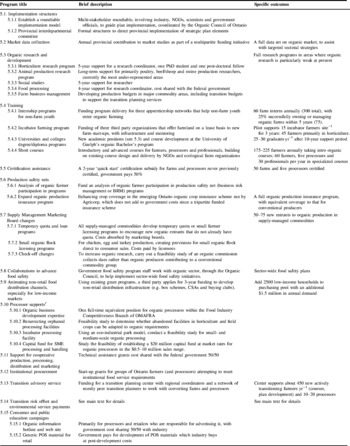
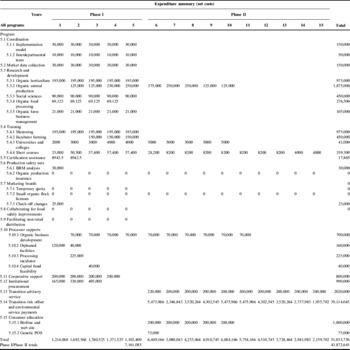
The plan is organized into two phases. Phase I (a 5-year phase) involves programs to build information, research and development (R&D), market development and technology transfer infrastructure. Phase II (years 6–15) is concerned with the provision of active supports for the process of converting from conventional to organic production. Some Phase I elements would continue into Phase II. In total, the plan comprises 30 elements. Brief program descriptions are provided in Table 6 and expenditures in Table 7.
Brief program and outcome descriptions.

1 Additional details of processor supports can be found in a supplemental report by Christianson and MorganReference Christianson and Morgan39.
Program expenditures (Cdn$).

Transition risk offset and environmental service payments
As the largest proposed program expenditure, this element of the overall program warrants more specific discussion. The objective of this initiative would be to pay farmers some of the revenue lost during the transition period, typically the most difficult period for organic farmers. In addition, this initiative provides a one-time payment for environmental services, an amount that recognizes the farmers’ contributions to internalizing some of the costs of conventional production.
With program expenditures of over $39 million (Table 7, Phase II), this element will likely be the most challenging for the government to implement in the current policy climate. Despite recent pilot projects, such as the Alternate Land Use Services initiative in Norfolk County, Ontario, that is paying producers for environmental services43, many policy-makers are reluctant to adopt this EU-style approach to ensuring environmental improvements with an additional dose of farm financial security.
In this analysis, annual payment levels varied from 0 to $883 ha−1, depending on commodity and transition year. The payment for avoided environmental costs would be delivered 3 years after full organic certification (assuming no intervening loss of certification status post transition). Following on the analysis provided in Table 5, this payment is set at $22.25 ha−1 for all crops, except pasture. The benefits of transition, as defined in the Tegtmeier and Duffy studyReference Tegtmeier and Duffy13, are much lower for pasture (and in fact they did not include pasture lands in their analysis), so we have set the level at $0.5 ha−1, largely to recognize the potential for lower GHG emissions on organically managed pasture. No per head payments are provided for animals, as it is assumed that all converting animal producers have a cropping base for their farm.
We assumed a 30% reduction in financial safety net payouts based on historical payment patterns of net new program costsReference Friesen44, and assume that the province saves 12% on other costs once making payments for this program. We assumed that program delivery is carried out by existing agencies involved in farm financial safety nets, with additional administrative costs of $200,000 annually. Additionally, to support record keeping, each certification agency would receive a one-time administrative payment per certified farm of $100×4854 new organic producers=$485,400.
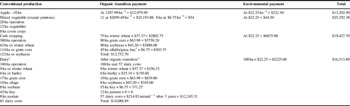
We also ran several scenarios for different farms to test total payments. This analysis is provided in Table 8. Of the four case studies presented, total payments to farmers would range from $13,000 to 25,000 spread out over 4 years, well within the typical range of average government payments to farmers under present conditions7.
Case studies of transition risk offset and environmental payments: Estimates for a 3-year transition period plus one-time environmental service payment 3 years after certification.

1 Sold to nearby livestock operators.
2 Derived from Canadian Dairy Commission (CDC), Dairy Farmers of Ontario (DFO), University of Guelph. 2005. Ontario Farm Dairy Accounting Project (OFDAP): Annual Report 2004 and Statistics Canada 2001 Census of Agriculture.
3 Derived from Ogini, Y., Clark, E.A., and Stonehouse, P. 1999. Comparison of organic and conventional dairy farms in Ontario. American Journal of Alternative Agriculture 14:122–134.
Market share
Implementation of this plan would allow the Ontario organic sector to capture 51% of Ontario's organic consumption, up from the currently estimated 15%. Organic sales would represent 1.9% of the total retail market after 5 years and 5.3% of the total market after 15 years.
Conclusions
A two-phase, 30 point plan was developed to boost organic production to 10% of agricultural area within 15 years and to capture 51% of Ontario's organic consumption, up from the currently estimated 15%. As with other government efforts, the objective is to stimulate organic production and processing with government initiatives so that sufficient size and momentum allow it to evolve on its own after 15 years. Although the impacts of implementing this proposed strategic plan cannot directly be predicted, the mix of policy instruments is generally consistent with those traditionally used in Canadian agricultureReference Brinkman and Grenon45, with the exception of payments for environmental services and transition payments. These instruments, however, have been widely tested in other jurisdictionsReference Michelsen, Lynggaard, Padel and Foster11, are adaptable to the Ontario scene and are increasingly part of the policy discussion43.
This overall program would cost the provincial government about $51 million over 15 years. The net total program costs would be significantly lower than $51 million since farmers would have saved almost $28 million in synthetic chemical inputs and received premium organic prices for most of their goods sold. This will unavoidably reduce pressures on the farm financial safety net system and government costs.
Additionally, this program contributes significantly to eliminating the long-term externalized costs of current approaches to agriculture, conservatively estimated at $145 million annually or $2.18 billion over the 15 year life of the program. Not all those costs will be saved within 15 years, but this exceedingly modest investment in organic production, representing only 2.3% of these externalized costs, will generate savings in externalized costs far beyond this one-time investment.
Acknowledgements
We are grateful to the Laidlaw Foundation and the World Wildlife Fund Canada (WWF-Canada) Conservation Fund for financing this research. Members of the Organic Council of Ontario, an organization working to implement many elements of this plan, played a significant role in refining earlier versions of this paper. We very much appreciate the very helpful comments of two anonymous reviewers.