Since the work of Goffman (Reference Goffman1963), disability has been linked to stigmatization, and thus, also to rejection and discrimination. Stigmatization is considered to exist when a person or group possesses (or is believed to possess) some attribute or characteristic which conveys a social identity that is negative or devalued in a particular context (Crocker, Major, & Steele, Reference Crocker, Major, Steele, Gilbert, Fiske and Lindzey1998).
Quiles and Morera (Reference Quiles, Morera, Morales, Huici, Gómez and Gaviria2008) identify three different types of stigma: physical, psychological and sociocultural (modern denominations for what Goffman called abominations of the body, blemishes of character, and tribal stigmas, respectively). In their study, these authors found that people with disabilities were one of the most stigmatized groups in the physical stigma category.
In their groundbreaking and militant 1988 paper, Fine and Asch defended that many of the problems and handicaps that people with disabilities face are not a direct consequence of their disabilities, but rather the product of a disabling environment that does not accommodate their needs and builds physical and social barriers that keep them excluded and discriminated (Fine & Asch, Reference Fine and Asch1988). In other words, many of the difficulties that people with disabilities face are, in fact, a product of stigma, not of their disability, and society’s failure to acknowledge this exacerbates public and structural stigma.
In line with this idea, the main goal of this research is to explore the way in which people with physical, hearing, and visual impairments perceive discrimination in different domains of their lives, and their emotional responses to this discrimination.
Perceived discrimination
In a study with 494 people with disabilities in Spain (Jiménez & Huete, Reference Jiménez and Huete2002), around 60% of the interviewees claimed to have suffered discrimination at some time, and about 15% claimed to have suffered it very often. Most of them (60%) perceived that discrimination was directly related to the fact that they had a disability and, in 34% of cases, discrimination was associated with inadequate environmental conditions to perform their daily activities.
The perception of prejudice and rejection has a negative impact on the well-being and even on the physical health of members of stigmatized groups, including people with intellectual disabilities (Ali, King, Strydom, & Hassiotis, Reference Ali, King, Strydom and Hassiotis2015; Pascoe & Richman, Reference Pascoe and Smart Richman2009). Moreover, the perception of public stigma often leads to internalized stigma, which is the endorsement of negative stereotypes about the stigmatized group, their self-application, and the resulting emotional and behavioral consequences (reduction of self-worth, psychological distress, withdrawal, and secrecy) (Corrigan, Watson, & Barr, Reference Corrigan, Watson and Barr2006; Ritsher, Otilingam, & Grajales, Reference Ritsher, Otilingam and Grajales2003; Ritsher, & Phelan, Reference Ritsher and Phelan2004; Yanos, Roe, Markus, & Lysaker, Reference Yanos, Roe, Markus and Lysaker2008). Studies conducted in other highly stigmatized groups, such as people with mental illness (Cavelti, Kvrgic, Beck, Rüsch, & Vauth, Reference Cavelti, Kvrgic, Beck, Rüsch and Vauth2012; Muñoz, Pérez Santos, Crespo & Guillén, 2009; Pérez-Garín, Molero, & Bos, Reference Pérez-Garín, Molero and Bos2015) or people with HIV (Lee, Kochman & Sikkema, Reference Lee, Kochman and Sikkema2002; Parker & Aggleton, Reference Parker and Aggleton2003; Visser, Kershaw, Makin, & Forsyth, Reference Visser, Kershaw, Makin and Forsyth2008) show that internalized stigma has an important negative impact on well-being.
Although most studies use quantitative methodology, some have used qualitative techniques, such as individual interviews or discussion groups. A qualitative study in which eight adults with disabilities (all of whom had physical impairments, although two of them also had a hearing impairment and a mental disability, respectively) and seven mothers of children with disabilities (which included cerebral palsy, Down syndrome, severe autism, non-specific development delay, and early childhood stroke) from the USA were interviewed found support for the components of stigma described by Link and Phelan (Reference Link and Phelan2001): labeling, stereotyping, separation, status loss, and discrimination within the context of power differential (Green, Davis, Karshmer, Marsh, & Straight, Reference Green, Davis, Karshmer, Marsh and Straight2005). According to the study’s participants, people without disabilities tend to behave kindly and offer to help a person with a disability that they perceive as minor or temporary, while they usually avoid contact with or even pretend not to see someone with a disability that they perceive as severe and permanent. On another hand, people whose disabilities appear to be mild or that are invisible to others are more likely to be blamed for actions resulting from their impairments, or even accused of faking their disabilities (Green et al., Reference Green, Davis, Karshmer, Marsh and Straight2005).
A qualitative study questioned 56 adults with disabilities (including addictions, learning, cognitive, mental, and physical disabilities) in the Canadian cities of Calgary and Regina about the barriers they encounter in the labor market (Shier, Graham, & Jones, Reference Shier, Graham and Jones2009). Interviewees agreed that the social stigma associated with disability acts as a barrier to securing employment due to employers’ discrimination, to being labeled as disabled, and to having their skills and training negated or disregarded. Participants stated that having a disability could also act as a barrier to maintaining employment, both directly (because sometimes their impairments prevent them from continuing to work) and as a result of stigma (because people are sometimes dismissed by their employers because of their disabilities).
Emotional reactions to stigma
Similar gaps and limitations can be found in literature about the emotional reactions to stigma. Several researchers agree that emotional responses are critical to understand the behavior both of the perpetrators and of the people who are recipients of stigmatizing reactions (Link, Yang, Phelan, & Collins, Reference Link, Yang, Phelan and Collins2004). Nevertheless, the vast majority of studies on this topic (qualitative and quantitative) have focused on people without disabilities. In this vein, Link, Yang, Phelan, and Collins (Reference Link, Yang, Phelan and Collins2004) found that the perpetrator’s emotions of anger may lead to verbal and physical abuse of an individual with intellectual disability, whereas emotions of pity and the use of a different tone of voice tend to signal to the individual that he/she is different. Similarly, in a study of emotional reactions in general population, Silván-Ferrero (Reference Silván-Ferrero, Morales, Huici, Gómez and Gaviria2008) found that interacting with people with disabilities that affect communication elicits more anxiety and, therefore, a greater desire to end the interaction with them as soon as possible.
From the perspective of the stigmatized people, the emotional aspects of experiencing stigma have long been relegated (Link et al., Reference Link, Yang, Phelan and Collins2004). Although there are a few studies examining the emotional reactions of people with disabilities to stigma, all of them (qualitative and quantitative) agree that most emotional consequences of feeling stigma include anger (Dinos, Stevens, Serfaty, Weich, & King, Reference Dinos, Stevens, Serfaty, Weich and King2004; Link et al., Reference Link, Yang, Phelan and Collins2004). Nevertheless, there are significant differences in the emotional reactions to stigma as a function of the type of disability (Silván-Ferrero, Reference Silván-Ferrero, Morales, Huici, Gómez and Gaviria2008). In this vein, qualitative and quantitative research has shown that shame-related discrimination beliefs about mental illness, if endorsed by stigmatized individuals, may be a vulnerability factor for accepting stigma as legitimate over time (Dinos et al., Reference Dinos, Stevens, Serfaty, Weich and King2004; Rüsch, Todd, Bodenhausen, Olschewski, & Corrigan, Reference Rüsch, Todd, Bodenhausen, Olschewski and Corrigan2010; Scheff, Reference Scheff, Gilbert and Andrews1998). On the contrary, people with HIV express a range of emotional responses to perceived discrimination, including not only feelings of shame but also of anger, discouragement, and rejection of others’ thoughts (Zukoski & Thorburn, Reference Zukoski and Thorburn2009). In the same vein, high-school students tend to report negative emotions (sadness, depression, shame) in response to weight-based discrimination, which, in turn, trigger coping strategies related to unhealthy behaviors (e.g., avoiding gym class) (Puhl, Luedicke, & Heuer, Reference Puhl, Luedicke and Heuer2011).
Although much research has been conducted on the stigma of disability there are still some important gaps in the literature:
a) Most studies have focused on the perspective of the general population (de Boer, Pijl, & Minaert, Reference de Boer, Pijl and Minnaert2012).
b) Most of them use only quantitative methodology, but qualitative methodologies may be very useful to explore some of the opinions and experiences of people with disabilities, which could be essential to explore certain aspects of stigma (Link et al., Reference Link, Yang, Phelan and Collins2004).
c) Even when qualitative studies with people with diverse disabilities have been conducted, they often focus on those experiences and opinions that are common to all of them (sometimes even including those of their family members) instead of on the different perspectives of people living with different types of disabilities (Green et al., Reference Green, Davis, Karshmer, Marsh and Straight2005; Shier et al., Reference Shier, Graham and Jones2009).
Thus, the goals of this study are:
1. To assess the differences between the perceptions of stigma of people with physical, hearing, and visual disabilities in Spain.
2. To assess the differences between their emotional reactions to those experiences of stigma.
Method
Participants
Table 1 displays the main sociodemographic and clinical characteristics of the sample
Sociodemographic and Clinical Data of the Three Groups

Note: Except for the mean and SD of age, all data are frequencies
Procedure and instrument
In order to achieve the aims of the study, selective sampling was used (Glaser, Reference Glaser1978). Several national institutions of Spain (the Convives con Espasticidad Association, the National Confederation of Deaf People, the Care Services for people with severe disabilities, UNIDIS [the support service for students with disabilities at UNED], the National Organization of Spanish Blind People, and the Oír es Clave Foundation) were contacted. The directors of these institutions were informed in detail about the purposes of the research and the time required to carry out the interviews and they authorized the participation of their members in the study. The final sample complied with requirements of homogeneity (people with disabilities) and heterogeneity (men and women with different types —physical, hearing and visual—and degrees of disability, of different ages and educational levels).
The study received approval from the UNED Ethics Committee and was performed in accordance with the ethical standards of the Declaration of Helsinki. Participants in the final sample consented to participate in the study, and they could withdraw from the study at any time.
Once the necessary permission was obtained (Plain Language Statement and the consent form), two interviewers conducted in-depth interviews (between 45 and 90 minutes-long) using a semi-structured format. In the case of people with hearing impairment, a sign language interpreter was also present. As proposed by Minichiello, Aroni, Timewell, and Alexander (Reference Minichiello, Aroni, Timewell and Alexander1990), these interviews were designed and carried out to encourage men and women with impairments to talk about themselves and their lives and to provide insights into how having a disability influenced their daily life. The interviews included questions such as: (a) What does being a person with [disability] make you think and feel?; (b) To what extent do you feel able to face your difficulties?; (c) Is there anything that makes you feel better or makes it easier for you to face this problem; (d) In your opinion, what does society think of people with [disability]?; (e) Which do you think are the main problems or difficulties that people with [disability] face in our society?; (f) In your particular case, have you ever been treated differently for having [disability]? With the participants’ permission, all interviews were tape-recorded and later transcribed.
Data analysis
Qualitative data were analyzed using the constant comparison technique based on the grounded theory (Glaser & Strauss, Reference Glaser and Strauss1967). Core categories were established by descriptive coding analysis, that is, by open, axial, and selective coding, using the software Atlas Ti.7. Six experts (in qualitative research and research on disability) assessed the methodological and theoretical quality of the core categories and subcategories (Przyborski & Wohlrab-Sahr, Reference Przyborski and Wohlrab-Sahr2010). Analytic induction and current research on discrimination (e.g., Molero, Recio, García-Ael, Fuster, & Sanjuán, Reference Molero, Recio, García-Ael, Fuster and Sanjuán2012) were applied in order to interpret the emerging themes. The next step was to test the reliability of a sample of responses (14–22% of quotes) obtained by two coders to demonstrate agreement between the coders. For this research, we used percent agreement and kappa as a reliability coefficient to measure agreement between the coders. A high percentage (visual = 87%, Kappa = .82; hearing = 96%, Kappa = .95; physical = 94%, Kappa = .91) indicated that the category system was consistent. Most discrepancies occurred when the user responses fell into more than one predefined code. Upon completion of the coding responses, the two coders collectively reviewed each response, debating and resolving any discrepancy, until they were satisfied with a single consensus code.
Main categories were later transformed into a numerical matrix that could be further analyzed with SPSS statistical treatment program. First, the frequencies of occurrence of the different categories for each group (people with a physical, hearing, or visual impairment) were analyzed. Then, two simple correspondence analyses (SCAs) were conducted: one for the types of discrimination experienced by participants and other for their emotional reactions to discrimination. SCA allows one to analyze the pattern of relationships of two categorical dependent variables. As such, it can also be seen as a generalization of principal component analysis when the variables to be analyzed are categorical instead of quantitative. The purpose of SCA is to find quantifications that are optimal in the sense that the categories are separated from each other as much as possible. This implies that objects in the same category are plotted close to each other and objects in different categories are plotted as far apart as possible.
Results
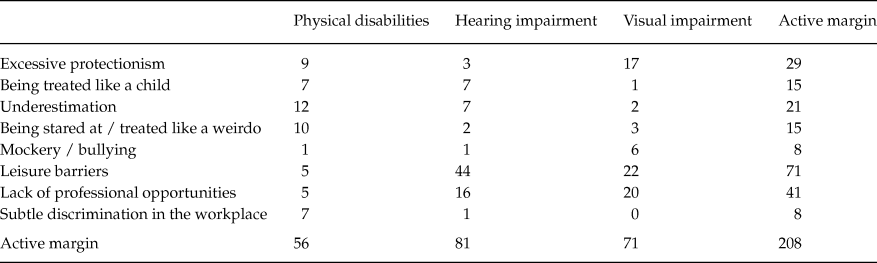
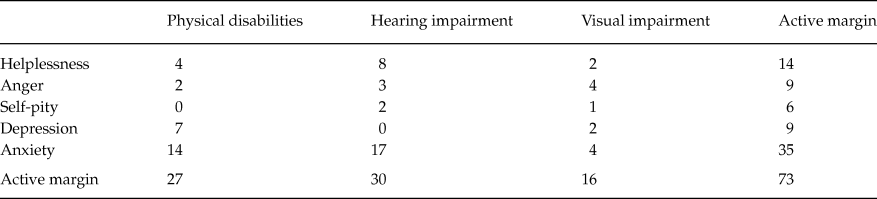
In order to analyze the articulate discourse system as a function of the interviewees’ perceptions of discrimination, emotional reactions, and their disabilities, we carried out two SCAs. As can be seen in Figures 1 and 2, the three groups are positioned in different dimensions as a function of the perceived discrimination and the emotional reactions elicited. Results showed that participants with physical disabilities perceived a totally different type of discrimination (subtle discrimination in the workplace, being stared at/treated like a weirdo, and underestimation) from that of participants with visual impairment (excessive protectionism, bullying, lack of professional opportunities), whereas participants with hearing impairment shared certain discriminatory behaviors perceived by both groups (being treated like a child and lack of professional opportunities). As for their emotional reactions, anxiety was the emotion most commonly mentioned by all three groups, although anger was equally frequent for people with visual impairments. Depression and helplessness were also frequently mentioned by people with physical disabilities and hearing impairments, respectively.
Correspondence Factor Analysis of Perceived Discrimination.

Correspondence Factor Analysis of Emotional Reactions.

Physical disabilities
Perceived discrimination
Participants with physical disabilities reported that people sometimes treated them as if they were children: “They are obviously afraid of speaking to you, or sometimes they even treat you like a child.” This type of attitude occurs in several different forms, such as a change in intonation or even approaching them through a third person: “…I am making some arrangements and suddenly, the person who is assisting me addresses my companion, as if I were underage” (man with physical disability, 46 years old).
Moreover, they also reported experiences of being stared at by casual bystanders, or treated like weirdos because of their disabilities: “A normal person, logically, when they see us or see a wheelchair somewhere they see us a little bit like weirdos. This is real” (man with physical disability, 56 years old). Paradoxically, most of them do not consider this kind of behavior as a discriminatory act, but rather discount it as a product of nosiness: “People in general are very nosy, and are always like ‘look at this poor guy’. In this case it’s because of dystonia, but if you wore a green shirt, you would also get stares” (man with physical disability, 37 years old); or curiosity:
Well, I think we get stared at out of curiosity ... I think so. I have not had anyone mistreat me. I have just been stared at, but not discriminated. But, well, I think it is natural they look at me. This is not a very normal thing, and so they stare at you. It’s only that (woman with physical disability, 49 years old).
On another hand, they frequently reported that people tended to think they were incompetent, dependent, or that they were worth less than people without disabilities: “(…), but the worst are phrases like ‘poor thing’. I try to ignore that, but it is not always easy” (woman with a physical disability, 34 years old); “Or they think ‘that poor cripple on his wheelchair’ … Sometimes you can tell what they are thinking just from the look on their face.” (man with physical disability, 56 years old). This underestimation also leads to a subtle rejection in the workplace. More specifically, several participants reported sensing ambiguous signs of distrust that they cannot clearly identify but that make them feel less valued than their coworkers: “I have not felt discriminated but I have perceived that some people were afraid I could not perform the task I was given. Sometimes they were right, and other times—most times—that fear was dispelled through contact” (man with physical disability, 46 years old). Table 1 provides the frequency of appearance of each type of perceived discrimination in the discourse of the participants of each group.
Emotional reactions
The most frequently mentioned emotional response by far was anxiety: “Yes, well, it takes away part of your confidence, makes you feel more insecure” (woman with physical disability, 36 years old).
Feelings of sadness and depression were frequently mentioned by participants with a physical disability: “There are times when you lock yourself in and feel down, and other times… well, you feel better” (woman with physical disability, 36 years old). Table 2 provides the frequency of appearance of each type of emotional reaction in the discourse of the participants of each group.
Frequency of Appearance of Perceived Discrimination

Visual impairment
Perceived discrimination
In contrast to participants with physical disabilities, some interviewees with visual impairment recalled being mocked or bullied because of their disability, especially during their childhood or adolescence: “When I was in school they would tease me, sometimes insult me. Truth be told, I had a bit of a hard time in school. Yes” (visually impaired woman, 28 years old).
Frequency of Appearance of Emotional Reactions

They also reported that people try to protect them excessively, either in the family setting: “I think I have already told you about how my parents treat me. I have known them forever and they still treat me like I need to be protected, and… like they didn’t know exactly what I want” (man with visual impairment, 51 years old) or in the public sphere, for example, offering help when it is not wanted or needed: “It is true that, at first, when you enter a group in which you are the only person with a disability, it is a little hard… for people to get used to you. To… to not have that… that feeling that they constantly have to protect you… they are walking with you and you bump into something, because… that is the hardest part” (woman with visual impairment, 39 years old). One of the most negative consequences of this overprotection is the lack of privacy: “Well, look… there is a… there are many things, but the hardest for me is having no privacy” (visually impaired woman, 39 years old).
Many interviewees also report that people with disabilities have problems finding a job, and can usually only get jobs that require low or no qualification: “There are no positions for a person with a visual disability. That is a… a mirage. And then, all you find is offers like telemarketer, or some kind of janitor, or something like that” (woman with visual impairment, 53 years old). When they do find a job, their position is usually not adapted, and they seldom get promoted:
And then, once you get the position, it turns out they don’t know what to do with you. And many of the things you receive are not accessible, you get a lot of papers. I don’t understand how… I also have some fellow members who are working and they still receive papers and post-its. His boss sticks post-its on his computer! But how can you stick post-its on this person’s computer, if he is completely blind? And of course there is no such thing as a professional career development, so to speak. You enter the organization and if you want to move forward and be promoted, that just isn’t possible. Forget about it. Thank God you got a job, but that is just so you sit in a corner and do not cause any trouble. Do not disturb, do not cause any trouble. You will just look good in pictures, and that’s it. Nothing else” (woman with visual impairment, 53 years old).
As will be commented on below, people with visual impairments share their concern for leisure barriers with people with hearing impairments.
The main problems? Awareness, mobility, educational, labor issues… um… access to leisure, culture, free-time activities. Although much has been done, there is still a lot to be done. Because, for instance, if I go to a movie, to the theater, I have the same right to go to the movies as you do. Then, I, in the theater, I miss… half of the movie, and you don’t have to tell me the whole movie, when you do that… you are bothering the person next to us, or in front of us (man with visual impairment, 34 years old).
Emotional reactions
An emotional response to discrimination that was frequently mentioned by our participants is anger:
Well, first of all, you feel anger. Because you think that… well, you do not have equal conditions, that you do not have equal opportunities when it comes to handling yourself and functioning in daily life. And besides, suffering discriminatory situations many times (woman with visual impairment, 50 years old).
People with visual impairment also frequently reported feeling sorry for themselves when they faced discrimination or barriers related to their disability: “Sometimes, I think about it and I say, ‘damn, why? Why did this have to happen to me?’” (woman with visual impairment, 39 years old), or when they face different kinds of aversive circumstances. “Well… when I… when I can’t… can’t find a job I feel… well… I don’t know, a little like… kind of sad, like (…) because, jeez, I think ‘Jeez, I still can’t find a job’. Or, I don’t know… Sometimes, some friends didn’t understand my disability and kind of shunned me. And, well, that makes you fill a little… sad, a little low” (woman with visual impairment, 28 years old).
Hearing impairment
Perceived discrimination
The type of discrimination most frequently mentioned by people with hearing impairments were the barriers they found to their access to leisure activities:
They are now starting to subtitle theater, but it is generally out of bounds for us. Radio, out of bounds. When you go out, you need to do things that are somewhat adapted. For example, my partner might like music, and he likes it. He likes music, theater, he likes those things, but we have to adapt. I’m not going to any concert, because it doesn’t make sense. We don’t go to the theater… movies… you have to look for subtitled ones (hearing-impaired woman, 50 years old).
This problem is more frequent in smaller cities: “(…) like, for instance, going to the movies. You cannot go in Burgos, because there are no subtitled movies. In Madrid, however, there are several” (hearing-impaired woman, 25 years old).
Another problem they face is being treated like children, a problem that they share with people with physical disabilities: “(…) perhaps they look at you with prejudice, they infantilize you, treat you like you were a girl” (woman with hearing impairment, 24 years old). “I think some things are not necessary. It is like they were treating you like a little girl, and that is the feeling I often have. And sometimes that can be frustrating, of course” (woman with hearing impairment, 24 years old).
Like people with visual impairment, participants with hearing impairment consider they have fewer opportunities to access the labor market, and when they do, it is usually a low-skill position: “Deaf people usually have low-skill jobs, especially in the field of cleaning… Office jobs, desk jobs, are rare” (woman with hearing impairment, 24 years old). In these positions, they usually have low salaries and fewer promotion opportunities: “Deaf people are usually given low-paid manual jobs, such as cleaning… or handcraft like… I don’t know. Low-paid jobs in which they have no promotion opportunities” (woman with hearing impairment, 50 years old), even when they attend special employment services. Moreover, they also perceive a subtle lack of trust in their performance, which results in their bosses not assigning them certain tasks. “Sometimes I had the subjective feeling that… well… That there were some tasks which were never assigned to me… like I was not able to do them” (woman with hearing impairment, 33 years old).
Emotional reactions
Participants with hearing impairment tend to react to these discriminatory behaviors with anxious responses: “You are really always alert with deafness. You are always tense. Always” (hearing-impaired woman, 62 years old). However, some interviewees also report feeling helpless, powerless, or frustrated when they face discrimination and social barriers. “It is like they were treating you like a little girl, and that is the feeling I often have. And sometimes that can be frustrating, of course.” (woman with hearing impairment, 24 years old). “Many times you think ‘if I was a hearing person I could do this for sure, and now I cannot.’ Um… well, I could be a professional soccer player, for instance. Deaf people are not allowed to” (woman with hearing impairment, 25 years old).
Discussion
The results of this study illustrate how people with different disabilities perceive discrimination towards themselves and their group, and how they feel when they face this discrimination. Regarding perceived discrimination, the SCA shows that people with physical disabilities feel they are treated with excessive protectionism, or sometimes even like children, which means their abilities are underestimated. Likewise, they also occasionally claim to be considered weird. Their predominant emotional reactions to these types of discrimination are anxiety and depression.
On another hand, people with hearing impairments mainly perceive the existence of barriers to leisure activities and a lack of professional opportunities. The emotions associated with these situations are anxiety and a feeling of helplessness. As for people with visual impairment, they mainly perceive discrimination related to three domains: leisure, professional opportunities, and excessive protectionism. Emotional reactions appear less frequently in their discourse than they do in the other two groups, with anxiety and anger being the most frequent.
Taking the results as a whole, we underline the importance of perceived discrimination in the domain of leisure activities, especially in the case of people with hearing and visual impairments. Strangely enough, people with physical disabilities do not report many problems in this area, although, due to their mobility problems, many of them have difficulties accessing leisure venues.
All the groups, but mainly people with visual and hearing impairments, report feeling discriminated through a lack of professional opportunities, and people with physical disabilities also report feeling discriminated in the workplace. This is consistent with Shier et al.’s (2009) claim that people with disabilities have difficulties to find and keep a job that are not only derived from their disabilities, but also a result of social stigma. Schur, Kruse, Blasi, and Blanck (Reference Schur, Kruse, Blasi and Blanck2009) found that people with disabilities perceived more discrimination towards them in those organizations that were perceived as having low organizational justice and sensitivity levels and, as a result, these workers had lower levels of commitment and satisfaction, and were more willing to leave their jobs. Such differences were not found in organizations that were considered as having a high organizational justice, in which workers with disabilities perceived no discrimination. This suggests that promoting more just and sensitive organizational practice could have a highly beneficial effect for workers with disabilities.
It is noteworthy that people with visual and hearing impairments perceive a greater lack of professional opportunities, when people with physical disabilities are the ones who are least integrated in the labor market. According to the Instituto Nacional de Estadística [Spanish Statistical Office] (INE), people with physical impairment are the group that receives the most disability pensions in Spain (760,000 people), followed by people with mental (267,000), intellectual (175,000), and sensorial (166,000) disabilities (INE, 2014). Perhaps it is precisely because they are less likely to be working or looking for a job that people with physical disabilities do not perceive their lack of professional opportunities and discrimination in the workplace as such a serious problem as do people with sensorial impairments.
As for the emotions associated with the perception of discrimination, consistently with a previous study (Silván-Ferrero, Reference Silván-Ferrero, Morales, Huici, Gómez and Gaviria2008), they were different for people with different disabilities. Anxiety is predominant in the case of people with physical disabilities and hearing impairments. Depression is most frequent in people with physical disabilities, whereas feelings of helplessness are frequent in people with hearing impairment and also, to a lesser extent, in people with physical disabilities. The most frequently mentioned emotion in the group of people with visual impairments is anger. Perhaps these differences are related to the different types of discrimination experienced by each group. The numerous experiences of underestimation cited by people with physical and hearing impairments may elicit feelings of depression, whereas the more hostile forms of discrimination faced by people with visual impairments (such as mockery and bullying) are more likely to elicit anger. Strangely enough, there is an overall scarcity of negative emotions associated with discrimination in the discourse of people with visual impairments. Future research should address these aspects, which could be due to higher levels of well-being in people with visual impairments, or simply to the existence of some kind of bias in our sample.
In short, data show that, although people in the three groups do not perceive a great amount of direct and hostile discrimination from society, they do perceive more subtle discrimination, such as excessive protectionism (especially in the case of people with visual impairments), or being underestimated and treated like children (especially in the case of people with physical disabilities), difficulties to take part in leisure activities, and they all perceive a lack of professional opportunities.
From the results of these interviews, we can conclude that, in accordance with our predictions, stigma and discrimination towards people with disabilities take many forms, and these forms are different for different types of disabilities. Although, as previously pointed out, some of these forms are not openly hostile (e.g., protectionism), they all have a negative impact on the lives and well-being of people with disabilities. Other forms of discrimination, like leisure barriers or lack of professional opportunities, not only affect the emotions or well-being of people with disabilities but, in fact, constitute a violation of their rights. Participants mention discriminatory policies such as not allowing hearing-impaired people to travel in planes or on ships unless accompanied by a hearing person, or companies not wanting to hire them for jobs for which they are perfectly fit. These are examples of what experts call structural stigma, a term that refers to the ways in which the dominant institutions and ideologies in a society legitimize, perpetuate, and exacerbate a stigmatized status, maintaining the status quo, inequalities, and power differentials (Bos, Pryor, Reeder, & Stutterheim, Reference Bos, Pryor, Reeder and Stutterheim2013). Improving the accessibility of leisure activities and venues seems especially important, given that about 34% of the perceived discrimination in all three groups is related to this domain. Besides the previously mentioned structural discrimination, which needs changing, there are other leisure-related aspects which need to be acted upon, such as subtitling movies or theater plays, making audio description available in theaters, or improving physical accessibility in leisure venues.
Also, in order to improve the well-being of people with disabilities, it is necessary to carry out educational campaigns that emphasize that people with disabilities may have some limitations but they can function perfectly well in many other areas and do their jobs like any other person. To the extent that people with disabilities enter the labor market, they will probably be seen as full members of society and stop being underestimated.
The current study is subject to some limitations that deserve mention. First of all, due to the small size of the sample, our ability to draw conclusions on the differentially perceived discrimination and emotions experienced by the three groups is limited. Groups should also be more homogeneous. Future studies should include the same number of participants in each of the three groups and use a larger sample. Secondly, the qualitative approach of our study also limits our ability to draw conclusions from it, and future research should confirm these results using longitudinal or experimental methods. Future studies should also explore gender differences in the experience of stigma of people with disabilities. As stated by the intersectionality perspective, the discriminatory experiences of women with disabilities might not be an additive combination of the experiences of women and of people with disabilities but instead, the combination of the two could result in a qualitatively different experience of discrimination (Bowleg, Reference Bowleg2008). It is also necessary for future research to explore in more detail the role of internalized stigma as a barrier. The low levels of self-esteem and self-efficacy that characterize internalized stigma are known to dissuade people with mental illness from pursuing their personal goals, in what has been called the “why try effect” (Corrigan, Larson, & Rüsch, Reference Corrigan, Larson and Rüsch2009). This effect has not yet been studied in people with other types of disabilities, and it would be interesting to confirm its existence in this group. Finally, future research should also assess the contents of both hetero-stereotypes and self-stereotypes of people with disabilities, and how they relate to their perception of stigma and their emotional reactions to it.
Despite these limitations, the current study offers new directions for the study of the relationship between perceived discrimination and emotional reactions in people with different types of disabilities. We believe that future studies should continue analyzing this important topic both for improving the life conditions of individuals with disabilities, and also as part of efforts to denounce the discrimination that this collective suffers.
This study makes some contributions with respect to the previous literature. To our knowledge, no other study has investigated the relationship between perceived discrimination and emotional reactions in people with different types of disabilities from a qualitative approach. We believe that this article enriches and extends the field of the stigma of individuals with disabilities, as it provides a series of approaches that have not been taken into account before.