The goal of the present study is to investigate the extent to which bilingual speakers can produce nativelike speech in two languages. Rather than study individuals who learned their second language (L2) during late childhood, the bilinguals included in this study are highly proficient bilingual speakers of Canadian English and Canadian French who acquired these two languages simultaneously or as toddlers. These bilingual speakers will be compared to monolingual speakers of both languages and their use of voice onset time (VOT) to contrast homorganic stops will be compared. The following paragraphs provide information about stop production across languages, the specific contrasts that occur in Canadian English and Canadian French, and a review of a model for bilingual speech production.
Cross-linguistically, stop consonants vary in a number of parameters including the number of stop consonants that contrast in the language, the place of articulation, the laryngeal features associated with production of the stops, and onset of voicing relative to the release of the articulators (i.e., VOT). In their influential acoustic study, Lisker and Abramson (Reference Lisker and Abramson1964) first identified the parameter of VOT as a primary cue used by languages to contrast stop consonants that share the same place of articulation. Research has shown that languages use three or fewer values of VOT to distinguish homorganic stops: lead VOT, associated with negative values, short-lag VOT, associated with small positive values, and long-lag VOT, associated with larger positive values (Cho & Ladefoged, Reference Cho and Ladefoged1999; Lisker & Abramson, Reference Lisker and Abramson1964).
Lead VOT, short-lag VOT, and long-lag VOT are important in distinguishing homorganic stop consonants in Canadian English (CE) and Canadian French (CF). As with English spoken in the United States and England, voiced stops of CE tend to have short-lag voicing, with values typically between 0 ms and 20 ms; voiceless stops are produced with long-lag voicing, with VOT values typically between 65 and 150 ms (Auzou et al., Reference Auzou, Ozsancak, Morris, Jan, Eustache and Hannequin2000; Caramazza, Yeni-Komshian, Zurif, & Carbone, Reference Caramazza, Yeni-komshian, Zurif and Carbone1973; Kessinger & Blumstein, Reference Kessinger and Blumstein1997; Lisker & Abramson, Reference Lisker and Abramson1964; Macken & Barton, 1979; Ryalls, Zipprer, & Basldauff, Reference Ryalls, Cliché, Fortier-Blanc, Colombe and Prud'Hommeaux1997; Sundara, Reference Sundara2005). As with French spoken in France, the voiced stops of CF tend to have lead voicing, typically resulting in negative values between –200 and −50 ms; and the CF voiceless stops tend to have short-lag voicing with values typically between 0 and 40 ms (Kessinger & Blumstein, Reference Kessinger and Blumstein1997; Ryalls, Cliche, Fortier-Blanc, Colombe, & Prud'Hommeaux, Reference Ryalls, Zipprer and Baldauff1997; Sundara, Reference Sundara2005). As a result, the short-lag stops in English and French are associated with different phonological categories, with “voiced” stops in CE (i.e., /b/ “beg,” /d/ “dog,” and /g/ “got”) and “voiceless” stops in CF (i.e., /p/ “père” father, /t/ “table” table, and /k/ “coude” elbow).
The phonetic and phonological characteristics of bilingual speech production have been explicitly discussed within the speech learning model (SLM) proposed by Flege (Reference Flege and Strange1995). This model emerged from adult L2 learning research to account for age-related limits on the ability to produce L2 vowels and consonants in a nativelike way. Flege (Reference Flege and Strange1995) proposed that L2 speakers fail to perceive the phonetic differences between pairs of L2 sounds for two reasons: the pair of L2 sounds are assimilated to a single native-language phonetic categories; or the phonology of the native language filters out properties of the L2 sounds that are important for phonetic discrimination. Based on SLM, nativelike L2 production requires three main components: (a) an accurate perception of the properties that differentiate L2 sounds from one another, and from sounds in the L1; (b) the storing and structuring of this information in a person's long-term memory; and (c) the learning of the articulations required to reliably and accurately produce L2 sounds. From these three components, Flege proposed seven hypotheses form the SLM of L2 acquisition; two of these hypotheses can be applied to the current study.
The first hypothesis states that there is a perceptual relationship between the sounds in a speaker's first language (L1) and L2. This relationship is described as “allophonic” and “sensitive to the syllable position of the sound” (Flege, Reference Flege and Strange1995). Applying this hypothesis to the stops of CE and CF is not straightforward. It may be that bilingual speakers group the voiced stops of the two languages in a single category with VOT in the prevoiced range occurring as the allophone for CF, and short-lag VOTs as the allophone for CE. In this case, one might expect greater variability in VOT values for bilinguals as their allophones cover a wide range of VOTs. Another possibility is that the bilingual speakers form three perceptual categories for voicing: prevoiced (for /b, d, g/ in CF) short-lag stops (/p, t, k/ in CF; /b, d, g/ in CE), and long-lag (/p, t, k/ in CE). In this case, it would be expected that bilingual speakers of CE and CF would show overlap in VOT values of CE /b, d/ and CF /p, t/, whereas productions of /p, t/ in CE and /b, d/ in CF would be distinct. The second hypothesis states that phonetically similar sounds from the L1 and L2 are more likely to be distinguished when the L2 is learned at a younger age. Predictions of this hypothesis are straightforward: by definition, “early” bilinguals are exposed to both languages at a young age, and thus, according to Flege, should have established phonemic categories for each stop in each language. Consequently, their stops productions would exhibit monolingual-like VOT in both languages as measured by mean and standard deviation. These two hypotheses will be explored in this study.
PREVIOUS RESEARCH
The production of VOT has been studied in many languages, with contrasting pairs of homorganic stops including Dutch (Van Alphen & Smits, Reference Van Alphen and Smits2004), English (Kessinger & Blumstein, Reference Kessinger and Blumstein1997; Ryalls et al. Reference Ryalls, Zipprer and Baldauff1997), French (Fougeron, Reference Fougeron2001; Kessinger & Blumstein, Reference Kessinger and Blumstein1997; Sundara, Reference Sundara2005), Spanish (Magloire & Green, Reference Magloire and Green1999), and German (Haag, Reference Haag1979); and in languages with more than two contrasting homorganic stops such as Korean (Cho, Jun, & Ladefoged, Reference Cho, Jun and Ladefoged2002), Thai (Gandour & Dardarandanda, Reference Gandour and Dardarandanda1984; Kessinger & Blumstein, Reference Kessinger and Blumstein1997), and Hindi (Davis, Reference Davis1995). Few studies have investigated the production of VOT by bilingual speakers of two languages using different VOT values to contrast homorganic stops (e.g., Spanish vs. English, or French vs. English).
Four studies have investigated the production of VOT in bilingual speakers of English and French who have learned their two languages during childhood. In the 1970s, Caramazza and colleagues (Reference Caramazza, Yeni-komshian, Zurif and Carbone1973) analyzed VOT of bilabial, coronal, and velar stops produced by bilingual speakers of CE and CF, and in the 1990s, Hazan and Boulakia (Reference Hazan and Boulakia1993) investigated VOT of bilabial stops in the speech of British English and Continental French. More recently, MacLeod and Stoel-Gammon (Reference MacLeod and Stoel-Gammon2005) reported preliminary findings of early bilinguals’ production of VOT for labial and coronal stops, and Sundara, Polka, and Baum (Reference Sundara, Polka and Baum2006) explored how simultaneous bilinguals speakers of CE and CF produced VOT of coronal stops. The results from these four studies shaped the current research questions and are reviewed in detail below.
In their seminal study, Caramazza and colleagues (Reference Caramazza, Yeni-komshian, Zurif and Carbone1973) investigated how bilingual and monolingual speakers of CE and CF speakers produced and perceived VOT by testing bilingual CE–CF participants, and monolingual participants in a speech production and a speech perception task. The 20 bilingual subjects were all native speakers of French from Ottawa, Canada, who had begun to learn CE by the age of 7 years; their bilingual proficiency was self-assessed using a 7-point scale and a reading rate that exceeded 180 words per minute, reported to be an effective measure of bilingualism (Macnamara, Reference Macnamara and Kelly1969). The bilingual participants were tested in two separate sessions, one for each language, and by different experimenters in each session. The participants read a word list consisting of stop-initial words from the targeted language of the session and completed a VOT identification task. For production, VOT was measured using wideband spectrograms created from the audio recordings.
Caramazza et al. (Reference Caramazza, Yeni-komshian, Zurif and Carbone1973) found that the CE monolingual speakers produced distinct VOT distributions for the voicing contrast at the three places of articulation (bilabial, coronal, velar); thus, at each place of articulation the short-lag stop did not overlap with the long-lag stop. In contrast, the monolingual CF speakers were found to have overlapping distributions at each place of articulation, the “voiced” stop was produced with both lead VOT and short-lag VOT, and the “voiceless” stop was produced with short-lag VOT. Based on this finding, the authors suggested that VOT was a primary cue for voicing distinctions in CE but not for CF. The bilingual speakers exhibited overlap in their VOT distributions for each stop contrast in CF, which resembled the VOT distributions of the CF monolingual speakers in the study; in CE, the bilingual speakers showed a clear separation of voiced and voiceless stops, which was similar to the distinction in productions of CE monolingual speakers. The researchers reported unidirectional interference of CF on CE in both production and perception of VOT, likely because of the fact that the bilinguals learned CE later in childhood. Although the bilinguals produced distinct VOTs for the voiced and voiceless cognates of CE, they produced less separation than that observed in monolingual CE speakers. The bilinguals maintained language distinctions in VOT by increasing the amount of voicing lag for voiceless stops in English. However, Caramazza and colleagues (Reference Caramazza, Yeni-komshian, Zurif and Carbone1973) did not conduct statistical analysis on the productions of voiced stops in either CE or CF, because of “clearly bimodal, in fact discontinuous, distributions of the voiced stops” (Caramazza et al., Reference Caramazza, Yeni-komshian, Zurif and Carbone1973, p. 425). The authors did not report how frequently a voiced stop was produced with lead VOT or short-lag VOT, but instead provided an illustration of the distributions in both CE and CF. Based on visual inspection of this illustration (figure 4 of Caramazza et al., Reference Caramazza, Yeni-komshian, Zurif and Carbone1973), the bilinguals appeared to produce similar frequency of lead VOT and short-lag VOT for /b, d, g/ in CE and CF. The results from Caramazza et al. (Reference Caramazza, Yeni-komshian, Zurif and Carbone1973) indicate that monolingual English speakers use VOT as a cue to voicing to a greater extent than the monolingual French speakers. The bilingual speakers showed a unidirectional influence of French on English that was especially apparent in their production of voiced stops with prevoicing in both English and French. This unidirectional influence is likely due to having learned English as an L2 by the age of 7 years.
Hazan and Boulakia (Reference Hazan and Boulakia1993) investigated the production of VOT in bilabial stops by monolingual and bilingual speakers of British English and Continental French. As with English and French spoken in Canada, British English and Continental French speakers use VOT to contrast homorganic stops: British English contrast short- and long-lag VOT, whereas Continental French contrasts lead VOT and short-lag VOT. Hazan and Boulakia (Reference Hazan and Boulakia1993) collected data from four groups of participants: 12 bilinguals living in Paris, 9 bilinguals living in London, 11 British monolinguals, and 13 French monolinguals. The bilinguals were defined by their age of L2 acquisition, before or after the age of 5 years; their degree of bilingualism, established using listener rating of accent on specific sentences; and their language dominance, established using responses to a questionnaire. The bilingual participants were tested on separate days by a bilingual experimenter using one language throughout each session; the monolinguals were tested in single sessions. Ten target words with bilabial stops in initial position were elicited using in a short carrier phrase for each speaker. VOT was measured from digitized waveforms. Even though productions of /b/ had a somewhat bimodal distribution (i.e., the presence of negative VOT values and small positive VOT values within a category), Hazan and Boulakia (Reference Hazan and Boulakia1993) conducted a statistical analysis to test group differences in VOT values of the voiced and voiceless labial stops. From this analysis, the authors concluded that the monolingual speakers of both English and French produced distinct VOT distributions for the voicing contrast at the bilabial place of articulation. However, unlike the bilinguals in the Caramazza study, the French-dominant bilinguals were found to produce /p/ in English with a significantly shorter VOT than monolingual English speakers. The same group of French-dominant bilinguals in this study produced significantly more frequent lead voicing of /b/ in English, a result that concurs with the findings of Caramazza et al. (Reference Caramazza, Yeni-komshian, Zurif and Carbone1973). Regardless of language dominance, speakers exhibited some lead voicing when producing /b/ in English, although this phenomenon occurred less frequently for the English-dominant group (23.9%) than the French-dominant group (early learners of English = 69%, late learners of English = 75%). Based on their findings, Hazan and Boulakia (Reference Hazan and Boulakia1993) propose that bilingual speakers produce a voicing pattern in their L2 that is based on the voicing pattern of their L1, despite proficiency in an L2.
MacLeod and Stoel-Gammon (Reference MacLeod and Stoel-Gammon2005) provided preliminary findings from their study of VOT production of labial and coronal stops by early bilingual speakers of CE and CF. The three bilingual participants were exposed to CE and CF prior to the age of 3 years, they used both languages during their education, and continued to use both languages at least 50% of the time in two of three contexts of home, leisure, or work (or school). The bilinguals were compared to three monolingual speakers of CE and three monolingual speakers of CF. The bilingual participants were tested by a bilingual speaker in two sessions: one in CE, the other in CF. Participants were recorded producing monosyllabic words with labial or coronal stops in word initial position in a carrier phrase for each language.
MacLeod and Stoel-Gammon (Reference MacLeod and Stoel-Gammon2005) reported that the bilingual speakers produced phonemically distinct stops in both languages, although some overlap between voicing categories was observed. When compared to monolingual speakers, the bilingual speakers produced VOT that was not significantly different from monolingual CF speakers in either mean or standard deviation. In CE, the bilinguals’ productions were not significantly different from monolingual CE speakers in mean or standard deviation for voiceless tokens; however, their VOT values for voiced stops were significantly different from monolingual CE speakers because of occurrences of prevoiced tokens. The researchers concluded that early bilinguals could achieve VOT productions that were monolingual-like but not identical across all phonemes. This conclusion must be interpreted cautiously because of the small number of participants in the study (three per group).
Sundara et al. (Reference Sundara, Polka and Baum2006) investigated early bilinguals’ production of coronal stops in CE and CF. The five bilingual participants were exposed to CE and CF simultaneously at home from their parents, and their schooling was completed in both languages (at different school levels); they had a high self-rating of knowledge of both languages, and did not have detectable accents. To compare productions of bilingual and monolingual speakers, six monolingual CE and six monolingual CF participants were included in the study. The bilingual participants were tested in two separate sessions, one for each language, and by different experimenters in each session. Participants were recorded producing bisyllabic words with coronal stops in word initial position in a carrier phrase for each language. Differences in VOT may have been affected by the different word-level stress patterns of CE and CF: in CE, stress varies but tends to fall on the first syllable in bisyllabic words, whereas CF stress falls on the final syllable (or penultimate in the case of words ending in the vowel schwa). Thus, in Sundara et al., VOT may be underestimated in CF because the word initial syllable was never the syllable that received word level stress.
Findings from Sundara et al. (Reference Sundara, Polka and Baum2006) yielded two major differences compared to Caramazza's study. First, unlike the speakers in the Caramazza study, all speakers (monolinguals and bilinguals) produced nonoverlapping distributions of VOT for /t/ and /d/. Second, the bilingual speakers produced different VOT values for voiced and voiceless stops when speaking CE than when speaking CF: when speaking CE, the bilingual participants produced lead VOT for /d/ in 73.6% of tokens; in CF, the bilingual participants produced lead VOT for /d/ in 100% of tokens and short-lag VOT for /t/ in all tokens. Despite the somewhat bimodal distribution of /d/ in CE, Sundara et al. (Reference Sundara, Polka and Baum2006) conducted statistical analysis to test for group differences in the production of coronal stops in CE and CF and concluded that bilingual speakers can achieve nativelike production of VOT in CF for /t/ and /d/, and in CE for /t/, but not /d/, when exposed to both languages simultaneously.
In summary, Caramazza et al. (2006), Hazan and Boulakia (Reference Hazan and Boulakia1993), MacLeod and Stoel-Gammon (Reference MacLeod and Stoel-Gammon2005), and Sundara et al. (Reference Sundara, Polka and Baum2006) investigated the production of VOT by English–French bilinguals who acquired their two languages during childhood. However, based on these studies, the question of phonological proficiency in childhood bilinguals is difficult to address because of two methodological issues: (a) differences in the selection of target words, and (b) differences in the ages of second language acquisition. With regard to target words, Caramazza et al. (2006) analyzed production of stops in all three places of articulation, but only 3 target words per place were used in the production task, and these words were produced in isolation. Production of a very small set of target words makes it difficult to generalize to a wider set of lexical targets, and the production of words in isolation is a poor approximation of spontaneous speech. In contrast, Hazan and Boulakia (Reference Hazan and Boulakia1993) elicited 10 monosyllabic target words in carrier phrases, but limited their investigation to labial stops. This focus on one place of articulation makes it difficult to generalize the results to other stops. Sundara et al.'s (Reference Sundara, Polka and Baum2006) investigation was limited to coronal stops, which differ in CE and CF in VOT and also in place of articulation: CE coronals are produced with lingual contact to the alveolar ridge, whereas CF coronals are produced with lingual contact to the back of the front teeth. Finally, Sundara et al. (Reference Sundara, Polka and Baum2006) elicited a wider variety of target words in carrier phrases but used bisyllabic words. Because English tends to stress the first syllable of words and French the last syllable of words, the resulting differences in VOT may be due to prosodic rather than phonological effects. The current study differs from these studies by analyzing labial and coronal stops, selecting monosyllabic real words with vowels that are similar across the two languages, and eliciting the target word in a carrier phrase.
For studies designed to address the question of phonological proficiency in childhood bilinguals, another important aspect of the methodology is the issue of age of L2 acquisition. In the Caramazza et al. (2006) and Hazan and Boulakia (Reference Hazan and Boulakia1993) studies, late bilinguals’ production (and perception) of VOT was influenced by age of exposure to their L2, presumably leading to biases in both phonetic production and perception toward speakers’ L1. Moreover, in addition to age of L2 acquisition, frequency of language use should be considered in the selection of bilingual participants (Piske, MacKay, & Flege, Reference Piske, MacKay and Flege2001). For instance, despite early ages of exposure to their L2, one-third of the “early” bilinguals in Hazan and Boulakia's (Reference Hazan and Boulakia1993) study were rated as having moderate accents, suggesting that one language was used more frequently than the other. Thus, production of VOT in their L2 may have been compromised. Contrasting monolingual speakers with early bilinguals without accented speech, as was done in study by MacLeod and Stoel-Gammon (Reference MacLeod and Stoel-Gammon2005) and Sundara et al. (Reference Sundara, Polka and Baum2006), provides a better understanding of the bilingual capacity for phonetic and phonological differentiation; in other words, the extent to which a bilingual can be a native speaker of two languages. Thus, the current study includes only early bilinguals who acquired their L2 by age 4 and used both languages in daily living contexts after acquisition.
CURRENT STUDY
The goal of this study is to investigate the extent to which bilingual speakers can produce nativelike speech in two languages. Three research questions were of interest: What are the general patterns of VOT production in the bilingual and monolingual participants? For each phoneme in each language, do the bilinguals produce different mean VOT than monolinguals of the two languages? For each phoneme in each language, do monolinguals and bilinguals produce different degree of variability in VOT? Based on the research reviewed above and the two applicable hypotheses presented by Flege's (Reference Flege and Strange1995) SLM, two possible outcomes are expected. Either the bilinguals will treat similar sounds as allophones, resulting in greater variability in VOT for particular CE–CF stop pairs (this outcome would result in larger standard deviations for VOT and means with different VOT values compared to monolingual speakers for that particular CE–CF stop pairs), or the bilinguals will produce monolingual-like VOT in both languages because they have been exposed to both languages since early childhood and continue to use both languages daily (this would result in standard deviations and means for VOT that are not significantly different from monolingual speakers).
Method
Participants
All participants resided between Ottawa and Montreal, Canada, a region that provides an ideal situation for investigating bilingual acquisition because of the similar contexts available for using both languages and the similar social status of the two languages (Mougeon & Beniak, Reference Mougeon and Beniak1991). This region includes both urban and rural areas between Ottawa, Ontario, and Montreal, Quebec, where approximately 70 to 90% of inhabitants speak CF as their L1 (Statistics Canada, 2001), and the remaining population speaks predominantly CE. For political, social, and economic reasons, the region also provides numerous contexts for using both CE and CF, thus strengthening the linguistic skills of bilingual residents. An understanding of the nature of bilingualism in this region and related factors guided the selection of participants for this study.
Twenty-three individuals (6 males, 17 females) participated in this investigation: 7 monolingual French speakers, 8 monolingual CE speakers, and 8 “early” CE–CF bilingual speakers; for this study, early bilinguals are defined as bilinguals who acquired their L2 before the age of 4 years either in the home or at daycare. All participants were identified as “good examples” of each group by community contacts and met the following inclusionary criteria: (a) they were lifetime residents of the region between Ottawa and Montreal; (b) they were between 18 and 62 years of age; and (c) according to self-report, they had normal language development.
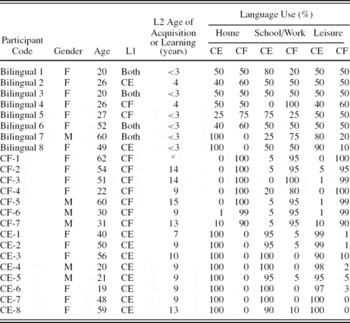
Table 1 summarizes participant demographic and language information including gender of participant, age in years, L1, age of L2 acquisition, and self-reported use of each language at home, at work, and in leisure. The bilinguals are presented first, followed by the CF monolinguals, and the CE monolinguals. The bilinguals met four additional inclusionary criteria: (a) they used both CE and CF in two of the three contexts (i.e., home, work/school, or leisure), (b) they used CE and CF approximately equal frequency in at least one context, (c) they reported continuous use of both languages since acquisition, and (d) they were observed to use both languages proficiently by the experimenter (the first author, an early CF–CE bilingual) and by community contacts. It is important to note that all bilinguals worked (or attended school) full-time and thus the context of work/school represents a minimum of 40 hr/week. Thus, the context of home and work/school likely represents the majority of waking hours in a typical week for these participants.
Participant demographic and language information including gender of participant, age of participant, first language (L1), age of second language (L2) acquisition, and self-report of frequency of use of each language

a CF-1 had not learned CE at the time of the experiment.
Because the research was conducted in a bilingual area of Canada, the monolinguals in this study had exposure to either CE or CF in addition to their first language. Despite this exposure, it was important to select monolingual speakers from this region to eliminate the possibility of dialectal variation in use of VOT. Thus, for the monolingual groups, exposure to CE or CF was limited to L2 classes in school and very limited use of the L2 within the community (in either work or leisure). All monolinguals reported limited proficiency in their L2, which was corroborated by the experimenter and by the community contacts.
Stimuli
The present study investigates VOT in the production of labial and coronal stops of CF and CE. In terms of articulation, the bilabial stops are produced similarly in both languages, whereas coronal stops of CE are produced with an alveolar place of articulation and those of CF with a dental place of articulation (Sundara, Reference Sundara2005; Tranel, 1980; Walker, 1985).
VOT was examined in productions of stop-initial CE and CF words. Target words were selected so that they would be phonologically similar in both languages, especially with regard to target consonant and the vowel context; the following criteria were used: (a) all words were common, real words in CE or CF; (b) all words were monosyllabic (to reduce the effects of language-specific stress patterns); (c) all words contained one of three vowels, in CE /æ, u, ϵ/ and in CF /a, u, ϵ/ (those vowels that are produced similarly in CE and CF); and (d) all words began with coronal or bilabial stops (velar stops were not included because of the low frequency of real words that met the second and third criteria). There were nine words for each of the four stop consonants for each language (except /d/-words in CF, where there were only seven words), and each vowel was equally represented. For example, there were three /bæ/-words, three /bu/-words, and three /bϵ/-words. In total, there were 36 different words in CE and 34 different words in CF. Appendix A contains a list of target words used in the study.
Participants were tested individually in a quiet room either at their home or their work. The monolingual participants were tested in a single session; the bilingual participants were tested in two separate sessions separated by several days. The first author conducted all the data collection using the target language of the session throughout each session. Each session began with a brief interview regarding language use and experience (two interviews for bilingual participants to establish the language of testing and to maintain the same task order across sessions). The interviews were followed by the carrier phrase task, in which the participants were asked to read the target words, printed on index cards, in the carrier phrase “I can say target word again target word.” (in CF “Je peux dire target word encore target word.”) The target words were elicited within a carrier phrase to achieve similar prosodic environments for the production of the target words: first in utterance medial position, and second in utterance final position. Although within a language VOT varies because of position within an utterance, the differences in VOT between groups of monolingual and bilingual speakers have been found to remain stable (Flege, Reference Flege1991). In addition, the use of carrier phrases in this study provides comparable data to previous studies using this elicitation method (Hazan & Boulakia, Reference Hazan and Boulakia1993; MacLeod & Stoel-Gammon, Reference MacLeod and Stoel-Gammon2005; Sundara et al., Reference Sundara, Polka and Baum2006).
Digital audio recordings of each session were recorded at a 16 bit rate and 44.1 kHz using either (a) audio recordings using a Casio DA-7 Digital Audio Tape recorder or (b) an Apogee Mini-Me portable microphone converter and an Apple PowerBook. All recordings were made using an AKG Condenser Microphone (C420 MicroMic Series II).
Acoustic analysis
Both productions of the target word in the carrier phrase were analyzed. Because of extraneous noise, mispronunciation, or signal that otherwise did not meet the criteria for measurement, a small number of words were excluded from the analysis of each group: for bilinguals, 36 of 576 possible words in CE and 6 of 544 possible words in CF; for CE monolinguals 4 of 576 possible words; and for CF monolinguals, all words were analyzed. Acoustic analysis of the remaining tokens was completed using PRAAT (Boersma, Reference Boersma2001); each token was viewed within a 200-ms window and measurements were taken within this window size. The VOT values were obtained from the waveform and verified with the corresponding wide-band spectrogram because the waveform is resistant to temporal smearing, whereas the spectrogram is not (Davis, Reference Davis1995; Johnson, Reference Johnson2003). Positive VOT exhibited a sharp spike in the waveform denoting a release burst, and the onset of voicing was identified as the last extreme negative deviation from 0 in the waveform that preceded the onset of regular voiced pulsation (i.e., jagged and “saw-tooth” waveforms). Negative (or lead) VOT values exhibited regular waves prior to the release burst associated with glottal pulsations; these waves were regular and small in amplitude with a corresponding band of voicing in the spectrogram.
In fewer than 10% of tokens with lead VOT, glottal pulsations were continuous from the preceding consonant through to the release of the stop burst. Additional criteria used to distinguish the lead VOT from preceding voiced sounds were as follows: (a) when the stop followed the trill allophone, /r/, of the uvular fricative (/ /), an allophone that is in free variation in CF of this region (Baligand, Reference Baligand1995), lead VOT was identified by the end of vertical striations on the spectrogram (i.e., the frication noise), and a waveform that becomes smooth with regular pulsation; (b) when the stop followed an alveolar nasal (CE /n/), lead VOT was identified by the beginning of smooth and regular pulsing waveform combined with the absence of all formants in the spectrogram (Johnson, Reference Johnson2003; Stevens, Reference Stevens1998).
RESULTS
Three research questions were addressed in this study. First, what are the general patterns of VOT production in bilingual and monolingual speakers? Second, for each phoneme in each language, do early bilinguals produce different mean VOT than monolinguals of the two languages? Third, for each phoneme in each language, do monolingual and bilingual speakers produce different degree of variability in VOT? Three independent variables were included in this study: group, language, and phoneme. The groups were created based on their language background: CF–CE bilinguals, CF monolingual, and CE monolingual. Group membership was treated as the main independent variable. Two additional independent variables were language (CE or CF), and phoneme (/p/, /b/, /t/, or /d/).
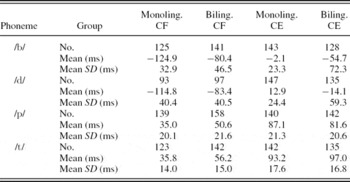
Group data for VOT are summarized in Table 2, which shows the grand mean VOT (calculated for each group by adding the mean VOT for each participant divided by the number of participants in the group) and the mean standard deviations (calculated for each group by adding the standard deviation for each participant divided by the number of participants in that group) for the three groups: monolingual CF, bilinguals in CF, monolingual CE, and bilinguals in CE. In the statistical analyses, mean VOT and standard deviation (SD) of VOT were calculated for each participant and then used to compare across groups. First, for participant, a mean was calculated for each stop category in each language by adding the VOT values for each stop and dividing by the number of repetitions of that stop. Then, based on this mean the SD was also calculated for each stop category in each language using the VOT values of each stop.
VOT for each group, including number of tokens analyzed, mean VOT across speakers, and mean standard deviation across speakers

Group patterns and individual differences
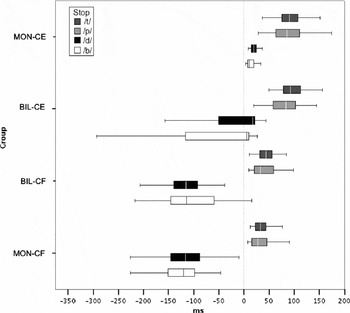
This section briefly describes the group patterns and individual differences observed in the data. The VOT patterns for monolingual English (MON-CE), bilingual English (BIL-CE), bilingual French (BIL-CF), and monolingual French (MON-CF) are presented in Figure 1. The brackets contain 80% of the distribution. The center half of the distribution occurs within the boxes, and the line within each box represents the median value of the distribution. Two main patterns emerge from visual inspection of the box plots of Figure 1. First, the CE and CF monolingual groups exhibit different ranges of VOT for different targets: the CE monolinguals produce short-lag tokens for /b/ and /d/ and long-lag tokens for /p/ and /t/; by comparison, the CF monolinguals produce prevoiced tokens for /b/ and /d/ and short-lag tokens for /p/ and /t/, with few long-lag tokens. Statistical analyses of these distributions are presented below.
A box plot of VOT production (ms) by the three groups: monolingual English (MON-CE), bilingual (BIL-CE and BIL-CF shown separately), and monolingual French (MON-CF). The brackets contain 80% of the distribution, and the center half of the distribution lies within the boxes; the line within each box represents the median point.

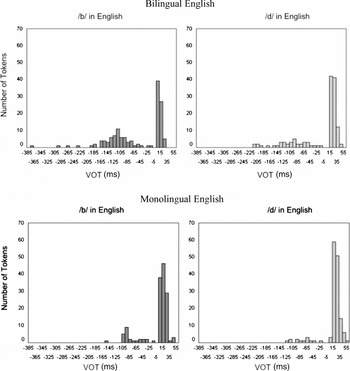
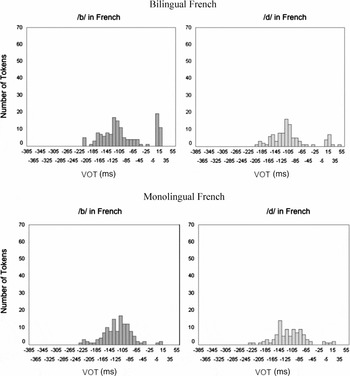
The second pattern that can be seen in Figure 1 is that the voiced tokens, /b/ and /d/, had a somewhat bimodal distribution, especially for the bilingual speakers. This bimodal distribution is illustrated in Figure 2 for the monolingual and bilingual groups production English, and in Figure 3 for the same groups producing French. An examination of the percentage of negative VOT values revealed the following patterns. All groups produced some tokens with VOT ranges in either the short-lag or lead VOT regions. In CE, the bilinguals produced lead voicing for /b/ in 48.6% of tokens (67 prevoiced out of 138 tokens), and /d/ in 27.8% of tokens (38 of 135); the monolingual CE speakers produced lead voicing for /b/ in 20.2% of tokens (26 of 125) and for /d/ in 10.1% of tokens (13 of 129); the remaining productions had positive VOT values. In CF, the bilinguals produced lead voicing for /b/ in 81.3% of tokens (111 of 141) and for /d/ in 88.5% tokens (84 of 97); whereas the monolingual CF produced lead voicing for /b/ in 98.4% of tokens (123 of 125) and for /d/ in 96.8% of tokens (90 of 93); the remaining productions had positive VOT values. For the bilingual speakers’ productions of English stops, Figure 1 shows greater variability for voiced stops as well as the bimodal distribution described above. This pattern is discussed further in the section on variability below. Despite the somewhat bimodal distributions for voiced stops produced by the bilinguals in CE, a repeated measures analysis of variance (ANOVA) was conducted to investigate the original research questions.
Histograms of the production of voiced stops in English by bilinguals and monolinguals for /b/ and /d/.

Histograms of the production of voiced stops in French by bilinguals and monolinguals for /b/ and /d/.

VOT: Central tendencies
The statistical analysis compared the groups in each language separately because the bilingual participants took part in two testing sessions, whereas the monolingual participants took part in only one. Within each language, a repeated-measures ANOVA was conducted: the repeated measure was mean VOT in milliseconds of /b/, /d/, /p/, and /t/ for each participant. In cases of significant main effects, the repeated-measures ANOVA was followed by either ANOVA or t tests to investigate the relationship between the variables. In cases where the sphericity assumption was violated (i.e., standard deviations that are too different from one measure to the next), the repeated-measures ANOVA was corrected by reducing the degrees of freedom using the Greenhouse–Geisser epsilon (McCall & Aplebaum, Reference McCall and Appelbaum1973). The analysis was conducted using SAS-JMP version 7, with a significance level of .05.
Mean VOT for each stop category was calculated for each participant and used to compare the production of the CF monolingual, CE monolingual, and bilingual groups. For the analysis in CF and CE, the test for sphericity using Mauchly's criterion revealed a violation of the sphericity assumption (in CF, p = .0001, and in CE, p = .001). Consequently, the repeated-measures ANOVA corrected by Greenhouse–Geisser epsilon is reported. In CF, a repeated-measures ANOVA (corrected Greenhouse–Geisser epsilon) resulted in a main effect for consonant, F (3, 26.52) = 266.21, p < .0001, but not for group, F (1, 13) = 2.17, p < .1642, and there was no interaction, F (3, 26.52) = 0.59, p < .5641. This finding indicates that both the bilinguals and the CF monolinguals produced significantly different VOTs for the four stops, but that VOT did not differ across groups. In CE, a repeated-measures ANOVA resulted in a significant main effect for consonant, F (3, 25.30) = 228.49, p < .0001, a significant main effect for group, F (1, 14) = 4.49, p < .044, and an interaction between consonants and group, F (3, 25.30) = 9.52, p < .0011, indicating that the bilinguals were producing VOTs that were significantly different from the CE monolingual speakers. To investigate this interaction further, a one-way ANOVA was conducted testing group differences for the production of stops in CE. When speaking CE, the monolingual and the bilingual groups exhibited significantly different mean VOT for words beginning with voiced stops: /b/, F (1, 14) = 11.59, p < .004, and /d/, F (1, 14) = 23.84, p < .001, but not for voiceless stops: /p/, F (1, 14) = .26, p < .618, and /t/, F (1, 14) = .24, p < .632. In summary, in CF the monolingual CF group and the bilinguals did not produce different mean VOT, but in CE the bilinguals produced significantly different VOT for the voiced stops /b/ and /d/ as a result of more frequent prevoicing of these stops than the monolingual CE group.
Variability of VOT
In addition to comparing the mean VOT values, variability across the groups was investigated by testing for equality of variance across groups and phonemes using Brown Forsythe's test for equality of variances (a robust test with regards to Type 1 error; Brown & Forsythe, Reference Brown and Forsythe1974; Hayes, Reference Hayes2005). For each language, the VOT values for each phoneme produced by each participant were compared across groups. In CF, the results from Brown Forsythe's test indicated no significant differences in the equality of the variances across the monolingual and bilingual groups, F (1, 1016) = 2.08, p < .1490, but did show significant differences in the equality of variance across the phonemes, F (3, 1014) = 65.72, p < .0001. When the CF stops were grouped by voicing, the Brown Forsythe test revealed significant differences the equality of the variances across voicing categories, F (1, 1016) = 189.62, p < .0001. In CE, the results from Brown Forsythe's test indicated significant differences in the equality of the variances across the monolingual and bilingual groups, F (1, 1120) = 47.96, p < .0001, and across the phonemes, F (3, 1118) = 18.15, p < .0001. To investigate these results in CE, the variance between the monolinguals and the bilinguals was compared for voiced and voiceless stops. The results from the Brown Forsythe's test indicate that the groups have significant differences in the equality of variances for voiced stops, F (1, 561) = 63.4089, p < .0001, but not voiceless stops, F (1, 557) = 0.24, p < .6224.
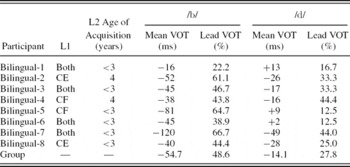
An examination of the individual productions of lead voicing (i.e., negative VOT) tokens by bilinguals in English revealed no patterns associated with L1 or age of L2 acquisition. Table 3 presents individual data for the bilingual group including L1, age of L2 acquisition, mean VOT for /b/ and /d/, and the percentage of tokens with lead voicing for these stops. As shown in Figure 2, these bimodal distributions are larger for the bilingual speakers than for the monolingual speakers, although all groups produce some /b/ and /d/ tokens that were outside the expected range. In addition, in productions of CE, both bilingual and monolingual speakers tended to exhibit more frequent prevoicing for /b/ than /d/.
Individual data for the bilingual group regarding first language (L1), age of second language (L2) acquisition, CE /b/ and /d/ mean VOT and lead VOT used

To summarize, this question targeted the variance across groups for each stop in each language by asking: was a difference observed in the variance in VOT values produced by members of one group when compared to members of the other? The results indicated that in CF both the monolinguals and bilinguals produced significantly more variability in VOT for /b/ and /d/ than for /p/ and /t/, but there were no group differences. In contrast, in CE the bilinguals speakers were significantly more variable than monolingual speakers for /b/ and /d/, but there were no significant differences in variability for /p/ and /t/.
GENERAL DISCUSSION
Three research questions were targeted in this study. The first question was, what are the general patterns of VOT production in bilingual and monolingual speakers? This descriptive analysis revealed that monolingual productions are similar to those reported for English and French by both Caramazza et al. (Reference Caramazza, Yeni-komshian, Zurif and Carbone1973) and Sundara (Reference Sundara2005). However, in contrast with Caramazza et al. (Reference Caramazza, Yeni-komshian, Zurif and Carbone1973) findings, it is the English monolinguals in the present study who have overlap in VOT distributions, whereas the French do not. The descriptive analysis also showed that distribution of voiced tokens for bilingual speakers was more bimodal than for monolingual speakers.
The second question examined the existence of distinct phonological categories: for each phoneme in each language, do bilinguals produce different mean VOT than monolinguals of both their languages? The results demonstrated that when speaking French, the bilinguals did not produce significantly different mean VOT than the French monolinguals; however, when speaking English, bilingual speakers produced significantly more prevoicing of VOT for the voiced stops.
The third question targeted phonetic variation: for each phoneme in each language, do monolinguals and early bilinguals produce different variability in VOT? The findings revealed a similar pattern: when speaking French, the bilinguals were not statistically different from the French monolinguals, but when speaking English, the bilinguals produced significantly more variation in voiced stops than the English monolinguals.
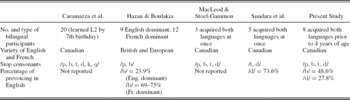
The occurrence of bimodal distributions in the production of voiced stops in CE was expected based on the results reported by Caramazza et al. (Reference Caramazza, Yeni-komshian, Zurif and Carbone1973), Hazan and Boulakia (Reference Hazan and Boulakia1993), MacLeod and Stoel-Gammon (Reference MacLeod and Stoel-Gammon2005), and Sundara et al. (Reference Sundara, Polka and Baum2006). In contrast to previous studies, it was possible to address individual variability in lead voicing in CE across both voiced stops in the present study. It appears that individual variability was not related to L1 or age of exposure to L2, nor was it related to frequency of language use (because all participants shared similar frequency of use across contexts). Table 4 summarizes findings from the three studies reviewed and the present study regarding types of bilinguals included, the stops targeted, and the frequency of lead voicing for CE stops, as reported in the four studies reviewed and the present study. Based on this summary, the bilinguals across the four studies produce English stops with both lead voicing and short-lag voicing. Compared to Hazan and Boulakia (Reference Hazan and Boulakia1993), who examined British English and continental French, the bilinguals in the present study produced more frequent prevoicing for /b/ (48.6%) than the English-dominant bilinguals (23.9%), but less frequent lead voicing than the French-dominant bilinguals (69–75%). Compared to Sundara et al. (Reference Sundara, Polka and Baum2006), the bilinguals in the present study produced less frequent prevoicing of /d/ (27.8%) in monosyllables than the simultaneous bilinguals (73.6%) in disyllables.
Summary of types of bilinguals included, the stops targeted, and the frequency of lead voicing for CE stops as reported in Caramazza et al. (Reference Caramazza, Yeni-komshian, Zurif and Carbone1973), Hazan and Boulakia (Reference Hazan and Boulakia1993), Sundara et al. (Reference Sundara, Polka and Baum2006), and the present study

The SLM model for bilingual speech learning provides a set of predictions (Flege, Reference Flege and Strange1995), two of which can be applied here. The first hypothesis proposes that sounds in a speaker's L1 and L2 are related to one another at an allophonic level, rather than at a more abstract phonemic level. This hypothesis is only partially supported in this study: although, the bilinguals maintained monolingual-like phonemic contrasts in both languages, and for six of the eight phonemes studied they produced mean VOT within the monolingual range (i.e., for all but /b/ and /d/ in English). The bilinguals had monolingual-like variation in all stops but English /b/ and /d/. Thus, it is possible that the bilinguals voiced stops (/b/ and /d/ in CE and CF) in the bilingual's system are related at an allophonic level. SLM's second hypothesis proposes that bilinguals who acquired two languages during early childhood will produce monolingual-like phonetic values in both languages. However, like the bilinguals in Caramazza et al.'s (Reference Caramazza, Yeni-komshian, Zurif and Carbone1973) study who learned their L2 by the age of 7 years, the bilinguals in this study (who acquired both languages before the age of 4 years) exhibited phonetic variation for VOT that was more similar to the French monolinguals across all tokens, than to the English-speaking monolinguals for voiced tokens.
The finding that bilinguals produced phonetic variation for VOT that was more similar to French than English monolinguals cannot be because of language dominance (as was the case in the Caramazza study): four of the participants in the present study are “simultaneous bilinguals (i.e., exposed to both languages from birth; of the remaining four bilinguals, two were exposed to English first and two French first). If there were a definitive difference associated with simultaneous versus early L2 acquisition in VOT production, the participants who were exposed to English later (i.e., Bilingual-4 and Bilingual-5, see Table 1) would be expected to have the most French-like VOT distributions; that is, these speakers would be expected to have the longest lead VOT and highest percentage of lead VOT. As shown in Table 3, this was not the case, as there is no clear pattern of lead VOT use within this early period of exposure to two languages between simultaneous and early bilinguals.
One possible explanation for the finding is a phonetic one: VOT control may only be important at phonemic boundary regions, as suggested by Caramazza and colleagues (Reference Caramazza, Yeni-komshian, Zurif and Carbone1973). Previous research has demonstrated that monolingual English speakers categorize short-lag VOT and lead VOT as “voiced” (Caramazza et al., Reference Caramazza, Yeni-komshian, Zurif and Carbone1973; Hazan & Boulakia, Reference Hazan and Boulakia1993). Thus, the early bilingual speakers in the present study may be taking advantage of this large “voiced” category for English listeners, and thus producing VOT values ranging from prevoiced to short lag. This explanation is supported by the bilingual speakers’ maintenance of the other stop categories more likely to interfere with accurate perception by monolingual listeners. For instance, the voicing contrast between short- and long-lag VOT in English is maintained by the bilingual speakers in this study, and likewise for the lead VOT and short-lag VOT important for French. Watson (1990) observed a similar pattern in the development of VOT in bilingual children. He proposed that bilinguals tend to maintain acceptable language-specific distinctions while reducing the processing load by allowing for overlap in specific contrasts. In line with this suggestion, bilinguals in this study are maintaining VOT precision at the phonemic boundary regions, thus producing acceptable VOT distinctions; at the same time, they appear to be reducing the processing load by allowing overlap in the voicing contrast of CE.
A second possible explanation is that the bilingual speakers associate the English voiced category with two subcategories: a prevoiced stop and a short-lag stop that leads to the presence of a somewhat bimodal distribution. If the English voiced category is analyzed as a single category, the bilinguals appear to produce more variability around a single mean for voiced stops; if, in contrast, the English voiced category is analyzed as two subcategories, the bilinguals would not have more variability around the two means for voiced stops. This “two category” explanation applies only to English voiced stops; it does not hold for voiced stops in French or voiceless stops in either language, and does not explain why the distribution is more bimodal for English voiced labials than voiced coronals for this group of bilinguals.
A third explanation is that the contrast between prevoiced and short lag stops, as in CF, is more “natural” (or less marked) than the contrast between short-lag and long-lag stops, as in CE. In the survey published by Madiesson (Reference Madiesson1984), 72% of languages with a two-way distinction in voicing of stops had a contrast between “plain voiceless” and “voiced” stops (as in CF); in contrast, 17% of the languages had a contrast between plain voiceless and aspirated voiceless (as in CE). The finding that, regardless of language dominance, VOT patterns of the bilingual speakers in the present study were more similar to CF than CE may reflect the distribution of voicing contrasts across languages of the world.
CONCLUSION
In conclusion, this study provides important data regarding early bilingual speakers’ ability to maintain phonemic contrasts and phonetic variation associated with these contrasts in CE and CF. The early bilingual participants were produced monolingual-like VOT with regard to mean and standard deviation for six of the eight stops studied: they produced monolingual-like VOT for /p, b, t, d/ of CF, and monolingual-like VOT for voiceless stops /p, t/ of CF. Despite the bilingual participants’ history of the balanced use of both languages across contexts and similar ages of language acquisition, unexpectedly, they did not exhibit a monolingual-like VOT production pattern for voiced stops in English. These findings speak directly to the nature of two phonetic systems within one speaker and to individual variation in production of these phonemic categories, suggesting that even early, balanced bilinguals will have phonological systems that are not identical to monolingual speakers of both their languages. It is interesting to note that for these bilinguals, the only contrasts that is not monolingual-like (CE /b, d/) is a distinction in voicing that does not cross a category boundary in CE, and thus would not impair perception of those stops as voiced by a monolingual English listener. Future research with this population would benefit from studies of perception of VOT to determine similarities and differences between bilingual and monolingual speakers in this domain.
APPENDIX A
English target words for VOT production study

French target words for VOT production study