INTRODUCTION
Over the last 30 years it has been repeatedly demonstrated that 25–30% of cancer patients present symptoms of emotional distress and maladaptive coping, secondary to the disease and treatment, irrespective of the stage of disease (Mitchell et al., Reference Mitchell, Chan, Bhatti, Halton, Grassi, Johansen and Meader2011). Since distress and psychosocial disorders have been reported to negatively influence cancer patients' quality of life, screening and assessment result to be mandatory in clinical settings (Donovan et al., Reference Donovan, Grassi, McGinty and Jacobsen2014; Grassi et al., Reference Grassi, Caruso, Sabato, Massarenti and Nanni2015). Some aspects related to this topic, that have not the object of specific attention, merit however, to be considered. A first aspect is that only a few studies have been cross-culturally conducted regarding psychosocial distress, by analyzing the differences existing according to the cultural context. In the Southern European Psycho-Oncology Study (SEPOS), for example, Portuguese cancer patients showed higher levels of fatalism and lower levels of anxiety and depression with respect to Italian cancer patients, as well as higher levels of spirituality (Grassi et al., Reference Grassi, Travado, Moncayo, Sabato and Rossi2004b; Travado et al., Reference Travado, Grassi, Gil, Martins, Ventura and Bairradas2010). In another cross-cultural study, differences were found on health, vitality and emotional symptoms, with South Korean cancer patients reporting lower scores compared to German and Japanese patients (Shim et al., Reference Shim, Mehnert, Koyama, Cho, Inui, Paik and Koch2006). Also differences were found between German and Chinese cancer patients in a further cross-cultural study analyzing anxiety, depression, and unmet psychosocial needs (Lam et al., Reference Lam, Au, Wong, Lehmann, Koch, Fielding and Mehnert2011). A second aspect regards the implications that distress and psychosocial symptoms have within the doctor-patient relationship, with a possible influence in the communication process (Brédart et al., Reference Brédart, Bouleuc and Dolbeault2005). The interaction of patients with their doctors may impact the experience of disease at many levels. Some studies have for example shown that poor abilities of doctors in listening and addressing emotional concerns and needs has been associated to patients' dissatisfaction (Ross et al., Reference Ross, Petersen, Johnsen, Lundstrom and Groenvold2013), and that physician disengagement and scarce perceived support in the doctor-patient relationship were related to poorer health-related quality of life (Landen et al., Reference Landen, Younger, Collins Sharp and Underwood2003). In line with these findings, attention and emotional support by oncologists, physician's empathy, caring attitude and a patient-centered and facilitative approach have been reported to favor patients' satisfaction with care (Wang et al., Reference Wang, Adams, Pasick, Gomez, Allen, Ma, Lee and Huang2013), psychological adjustment (Gilbar & Zusman, Reference Gilbar and Zusman2007), lower levels of anxiety (Takayama et al., Reference Takayama, Yamazaki and Katsumata2001), and distress (Zachariae et al., Reference Zachariae, Pedersen, Jensen, Ehrnrooth, Rossen and von der Maase2003). It is however important to underline the potential reciprocity and mutual influence of this relationship in cancer settings: patients' characteristics and coping styles may in fact have a strong effect on the interaction itself, with positive (or negative) communication styles from one participant leading to possibly similar responses from the other (Ong et al., Reference Ong, Visser, van Zuuren, Rietbroek, Lammes and de Haes1999; Street et al., Reference Street, Gordon and Haidet2007).
With this as a background and in order to extend our understanding of this area, the aim of this study was two-fold, (1) to examine the rate of and the differences between emotional distress and maladaptive coping in three European countries, namely southern and middle European countries and (2) to measure the association of cancer patients' subjective perception of the interaction with their doctors with emotional distress and coping, also taking into account cultural factors.
SUBJECTS AND METHODS
Participants
The study was conducted at the departments of oncology in three European countries, Italy (University of Ferrara and S. Anna Hospital, Ferrara as the coordinating center; Cancer Institute of Romagna, Forlì and regional area; Cà Foncello Hospital, Treviso); Spain (Hospital de la Santa Creu i Sant Pau, Barcelona; University Hospital Sant Joan de Reus, Reus); and Austria (Medical University, Graz). As detailed elsewhere (Grassi et al., in press), patients referred to cancer outpatient clinics and day-hospital services were consecutively recruited if the following inclusion criteria were met: age between 18 and 65; cancer diagnosis at any site; no cognitive deficits due to disease or treatment during clinical evaluation; a Karnofsky Performance Status Scale ≥60. The study was approved by the ethical committees of the participating hospitals, and each patient received detailed information regarding the aim of the study and gave his or her written consent to participate. Each patient was given by a research psycho-oncologist a booklet with self-report psychometric instruments to be completed. For the purposes of the present report, the NCCN Distress Thermometer, the Mini-MAC Anxious Preoccupation and Hopelessness subscales, and the Patient Satisfaction with Doctor Questionnaire (PSQ) were analyzed.
The Distress Thermometer (DT) is a one-item instrument indicating patients' general distress level on a 0–10 visual analogue scale (0 = no distress; 10 = extreme distress), developed by the National Comprehensive Cancer Network (NCCN) panel, within their guidelines for the management of emotional distress (NCCN, 2014). The DT has been used in a number of international studies, with a cut-off ≥4 accepted as the optimal score to identify “cases” with clinically significant levels of distress and caseness rated as mild (score of 4/5), moderate (score of 6/7), and severe (score ≥8) (Mitchell et al., Reference Mitchell, Hussain, Grainger and Symonds2011).
The Mini-Mental Adjustment to Cancer (Mini-MAC) scale (Watson et al., Reference Watson, Law, dos Santos, Greer, Baruch and Bliss1994) was used to assess the patients' cognitive and behavioral attitudes toward cancer, specifically Hopelessness (H) and Anxious Preoccupation (AP) (Grassi et al., Reference Grassi, Rossi, Sabato, Cruciani and Zambelli2004a). Both subscales consist of eight items, the first measuring the tendency to adopt a pessimistic and despairing attitude about the illness; the second measuring the tendency to feel worried and preoccupied about illness. Each item is rated on a 1–4 Likert scale (from 1 = it definitely does not apply to me, to 4 = it definitely applies to me) (range score for both H and AP = 8–32). Cut-off scores on H and AP (mean score ± 1 SD) were also used to identify “caseness” of maladaptive coping.
The Physician Patient Satisfaction with Doctors Questionnaire (PSQ) (Loblaw et al., Reference Loblaw, Bezjak and Bunston1999; Reference Loblaw, Bezjak, Golowiec, Joubert, Mah and Devins2004) was used to measure the patients' satisfaction with their interactions with the physician responsible for their care. The PSQ is a 24-item scale (each item rated on 1–4 response scale: 1 = lower end of agreement; 4 = higher end of agreement), on two factors: (1) medical disengagement (PSQ-MD), consisting of 13 items measuring the extent to which patients appraise their physicians as being interested only in the medical aspects of the disease (e.g., “It seemed to me that the doctor was not really interested in my emotional well-being”); and (2) perceived support (PSQ-PS), consisting of 11 items measuring the extent to which patients perceive their physicians as supportive, and aligned with the patient's best interests (e.g., “The doctor was interested in me as a person and not just my illness”).
Statistical analysis was performed with the SPSS 20 package. Distribution and frequency analyses were used to evaluate the samples. Correlational analysis was performed with Pearson's r coefficient test. Student's t-test, ANOVA (F), and χ2 test were used to examine inter- and intra-samples differences. Internal reliability of the scales was examined by using Cronbach's alpha coefficients. Hierarchical multiple regression analysis was used to examine the role of psychosocial variables (DT, Mini-MAC AP, and Mini-MAC H) in predicting patients' perception of the interaction with doctors (PSQ-MD and PSQ-PS, as dependent variables), after adjusting for socio-demographic (age, sex, education) and medical variables (stage). Statistical significance was set at the 0.05 level.
RESULTS
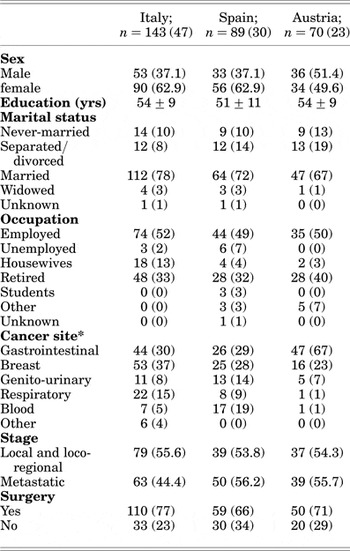
The general characteristics of the patients are reported elsewhere (Grassi et al., in press). In summary, a total of 302 patients participated in the study (Italy, n = 143, Spain, n = 89; Austria, n = 70). The mean ± SD age was 53.3 ± 9.6 years. Most patients were females (n = 180, 59.6%), half had a metastatic illness, with primary tumor sites including mainly breast (31%), and gastrointestinal (31%) cancer (see Table 1 for details).
Socio-demographic and clinical data of the patients (% in parentheses)

*p < 0.05.
General Data on Emotional Distress and Maladaptive Coping
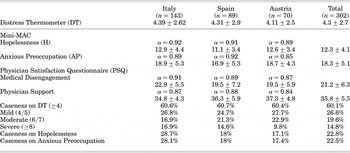
In Table 1, the descriptive results for the psychosocial data are presented separated by country and in the total sample. The prevalence of cases on the DT (cut-off ≥4) was similar in the three countries (χ2 0.09, p = ns), with a total caseness of 60% (n = 181). Likewise, no difference was shown between countries according to the grade of caseness (mild, moderate, severe: χ2 4.5, p = ns) with 26.1% (n = 79) having mild distress, 18.8% (n = 57) moderate distress, and 14.9% (n = 45) severe distress (Table 2). Females showed a higher prevalence of DT caseness than males (65.9% vs. 51.6%, χ2 = 6.1, df, 1, p = 0.01), and higher scores on the DT (F = 5.3, df, 1, p = 0.02).
Emotional distress (DT), coping (Mini-MAC) and perception of interaction with the physician (PSQ)

Regarding coping, both Mini-MAC sub-scales showed good internal consistency properties in the three countries (Table 2) and globally (H α = 0.84; AP α = 0.82). There was no difference between countries regarding H and AP caseness (apart from a slightly higher rate in Italy than Spain and Austria, on both H, χ2 = 5.24, p = 0.07, and AP, χ2 = 4.64, p = 0.09) with a prevalence in the whole sample of cases on hopelessness of 22.8% (n = 69) and 22.5% on anxious preoccupation (n = 68). Females showed higher scores on AP (F = 8.37, df, 1; p = 0.001) and H (F = 3.9, df, 1; p = 0.05) than males. Mini-MAC sub-scales were significantly correlated with DT scores in both the three countries and the global sample (H: r = 0.44, p = 0.01; AP: r = 0.45, p = 0.01). Analysis of the differences on the mean scores in the three countries indicated lower scores on AP and H among Spanish patients compared to Italian and Austrian patients (F = 4.4, df, 2; p = 0.01; F = 5.8, df, 2, p = 0.01). No difference on the DT and Mini-MAC were found according to age, education, stage, type of cancer.
Doctor-Patient Relationship and Association with Psychological Variables
The PSQ showed good levels of internal consistency in the three countries (Table 2) and globally (PSQ-MD α = 0.87; PSQ-PS α = 0.91). PSQ-MD and PSQ-PS were negatively correlated each other (r = −0.65; p = 0.001). There were no difference on PHQ-MD and PHQ-PS scores in relation to socio-demographic and medical variables, while, in the comparison, between countries, Italian patients showed higher scores on PSQ-MD and lower scores on PSQ-PS than Spanish and Austrian patients (F = 10.9, df, 2, p = 0.01; F = 6.4, df, 2, p = 0.01, respectively) (Table 2).
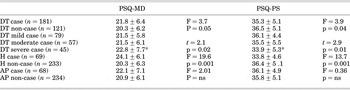
Compared to non-cases, DT cases reported higher scores on PSQ-MD (p = 0.05) and lower scores on PSQ-PS (p = 0.04). These findings were confirmed by ANOVA within caseness, according to distress level severity, with severely distressed cases showing the highest scores on PSQ-MD and the lowest on PSQ-PS in comparison with no cases (t = 2.1, p = 0.03; and t = 2.96, p = 0.01, respectively) (Table 4).
Regarding the Mini-MAC, a significant correlation was shown between Mini-MAC/H and both PSQ-MD (r = 0.34, p = 0.01) and PSQ-PS (r = −0.31, p = 0.01), while Mini-Mac/AP score was associated only with PSQ-MD (r = 0.31, p = 0.01) (Table 3). Also, Mini-MAC Hopelessness cases showed higher scores on PSQ-MD and lower scores on PSQ-PS than non-cases (p = 0.001) (Table 4).
Correlations among variables by country

*p < 0.01; **p < 0.05.
Differences on the PSQ-MD and PSQ-PS according to distress and maladaptive coping “caseness”

*t-Student differences with DT non-cases.
In hierarchical multiple regression, analyses were conducted by first entering socio-demographic (sex, age, education), followed by medical (Karnofsky score, tumor stage), and then psychological variables (DT, Mini-MAC/H and AP), regressed on PSQ-MD and PSQ-PS (dependent variables). In the prediction of PSQ-MD, after adjusting for socio-demographic and medical variables (none of which reached a level of statistical significance: Step 1 F = 1.1, p = ns; Step 2 F = 1.5, p = ns), Mini-MAC/H was the only factor among psychosocial variables fitting the model (Step 3 F = 5.2, p = 0.001) and entering the equation (b = 0.58, SEb = 0.13, Beta = 0.39, t = 5.9, p = 0.001). In the prediction of PSQ-PS, after adjusting for socio-demographic and medical variables (none of which reached a level of statistical significance: Step 1 F = 1.7, p = ns; Step 2 F = 1.5, p = ns), Mini-MAC/H also was the only factor among psychosocial variables fitting the model (Step 3 F = 3.9, p = 0.001) and entering the equation (b = −0.39, SEb = 0.11, Beta = −0.34, t = −3.78, p = 0.001).
DISCUSSION
In this study, we examined the rate of emotional distress and maladaptive coping styles and its relationship with cancer patients' perception of the interaction with their physicians, in three European countries.
As regards the first aim of the study, about one-third of the patients reported moderate or severe distress needing clinical attention. These data are in line with other studies showing that symptoms of psychological distress repeatedly indicated as the 6th vital sign, should be constantly monitored across the cancer trajectory (Bultz & Carlson, Reference Bultz and Carlson2006). Also, about one-fourth of the patients reported maladaptive coping to cancer, specifically hopelessness-helplessness and anxious preoccupation, confirming the need to integrate the psychosocial domain in clinical practice as a way to improve the quality of care of cancer patients (Jacobsen & Wagner, Reference Jacobsen and Wagner2012). Age, education, tumor status did not influence caseness, while, as reported in other studies, females were more prone to show distress and maladaptive coping to cancer (Grassi et al., Reference Grassi, Rossi, Sabato, Cruciani and Zambelli2004). Unlike other cross-cultural studies carried out in different parts of the world (e.g., Europe vs. Asia), a few differences were found between Southern (Italy, Spain) and Middle European (Austria) centers, confirming what already shown in a previous European study (Grassi et al., Reference Grassi, Travado, Moncayo, Sabato and Rossi2004).
Relevant to the second aim of the study, psychological variables were significantly associated to the patients' perception of their interaction with their physicians. More specifically, in all three countries, patients showing hopelessness, and, in part, emotional distress, tended to appraise their physicians as disengaged, in a hurry, scarcely empathic and interested only in the medical aspects of the disease, rather than being supportive and aligned to the person with his/her emotional concerns and desire to be listened. These results support other studies indicating that greater patient satisfaction, increased self-efficacy, and emotional well-being were associated with their physicians' attentiveness and empathy. This underlies the importance of the doctor-patient relationship as a keystone of quality healthcare across the trajectory of cancer (Arora et al., Reference Arora, Street, Epstein and Butow2009) and the need to implement communication skills training aimed at increasing oncologists' emotional support toward their patients and rapidly identifying their symptoms of emotional distress and depression (Gysel et al., Reference Gysels, Richardson and Higginson2005). As far as inter-country differences, Austrian physicians were perceived as more engaged and supportive and less cold than Italian physicians. The interpretation of this finding is not easy since we did not explore some factors, such as the experience of physicians on communication according to their specific cultural background (Surbone, Reference Surbone2008), and the several dimensions as far of doctor-patient relationship that may influence trust and satisfaction (Seetharamu et al., Reference Seetharamu, Iqbal and Weiner2007). As shown in other cross-cultural studies the different level of training of doctors in communication skills and the possible impact upon the relationship with their patients is a significant area to explored in a more detailed way (Travado et al., Reference Travado, Grassi, Gil, Ventura and Martins2005).
There are limitations that should be considered. The first is that, because of the relatively small number of patients participating in the study, we cannot generalize our findings, as larger sample may allow. Also, given the cross-sectional nature of the study, we cannot infer causality or direction regarding the association between the doctor-patient relationship, emotional symptoms and coping mechanisms over time, acknowledging that needs of communication may actually change over time (Neumann et al., Reference Neumann, Wirtz, Bollschweiler, Mercer, Warm, Wolf and Pfaff2007; Thorne et al., Reference Thorne, Hislop, Kim-Sing, Oglov, Oliffe and Stajduhar2014). A second limitation is that many other variables implicated in determining or influencing distress and maladjustment to cancer, such as patients' personality characteristics, family and social support, stressful life events and previous psychological disorders (Grassi et al., Reference Grassi, Malacarne, Maestri and Ramelli1997; Inoue et al., Reference Inoue, Saeki, Mantani, Okamura and Yamawaki2003), and the possible interaction of these factors in the perception of doctor-patient relationship were not examined here. A third issue is that we limited our investigation to the perception of the patients through a self-report questionnaire, while more specific methods (e.g., video-taping of the encounter) would have been allowed to better examine the content and characteristics of the communication (e.g., verbal and non-verbal cues, empathic statements, open questions etc.), as other authors have done (Zandbelt et al., Reference Zandbelt, Smets, Oort, Godfried and de Haes2007; Pollack et al., Reference Pollak, Arnold, Alexander, Jeffreys, Olsen, Abemethy, Rodriguez and Tulsky2010). Likewise we did not study physician variables, such as personality (e.g., empathic attitude, locus of control) and burnout, that have been considered important in doctor-patient interaction and in patient's satisfaction (Libert et al., Reference Libert, Merckaert, Reynaert, Delvaux, Marchal, Etienne, Boniver, Klastersky, Scalliet, Slachmuylder and Razavi2006; De Vries et al., Reference De Vries, de Roten, Meystre, Passchier, Despland and Stiefel2014).
In spite of these limitations, the study suggests that, given the high prevalence of emotional distress and maladaptive coping among cancer patients, physicians should monitor these variables in their patients and adjust their communication and relational styles accordingly. Also, cultural variables should be taken into account when examining psychosocial variables and when models of communication-skills training curricula are applied in clinical settings (Barth and Lannon Reference Barth and Lannen2011; Kissane et al., Reference Kissane, Bylund, Banerjee, Bialer, Levin, Maloney and D'Agostino2012). Attention to both these issues is to be paid in guide-lines relative to screening, assessment and referral of distressed cancer patients.
ACKNOWLEDGMENTS
The study has been funded by the Istituto Oncologico Romagnolo (IOR) and the University of Ferrara (FAR funding). The authors are grateful to all the patients participating to the study and the health care professionals who contributed in facilitating the phase of data collection. Phyllis Butow, AM MClinPsych, MPH, PhD, Professor of Psychology, University of Sydney, Australia, is also acknowledged for her helpful comments to the manuscript. The authors declare that the research was conducted in the absence of any commercial or financial relationships that could be construed as a potential conflict of interest.