INTRODUCTION
Sea cucumber is one of the echinoderms belonging to the branch of Echinodermata and from the class of Holothuroidea that appeared during the evolutionary period, 540 million years ago in the oceans. At present, 1400 species of sea cucumber have been identified and reported in the seas of the world (Conand, Reference Conand and Bruckner2006). Sea cucumbers are aquatic creatures that have many important and useful properties known for human health (Mamelona et al., Reference Mamelona, Pelletier, Girard-Lalancette, Legault, Karboune and Kermasha2007). The wall of the body, which includes 56% of the entire body, is used in the process of beche-de-mer production. The amount of sea cucumber protein is high at 81.8% of the dry body weight (Silchenko et al., Reference Silchenko, Avilov, Antonov, Kalinovsky, Dmitrenok, Kalinin, Stonik, Woodward and Collin2005). Increasing demand for beche-de-mer along with steady price increases has led to worldwide intensification of sea cucumber harvesting (Conand, Reference Conand2004).
The rearing of sea cucumber with shrimp serves to control the environmental pollution resulting from the extra enriched nutrition, which builds up on the pond bottom. These animals eat detritus and while devouring organic materials on the surface, not only do they make the environment clean, but also they contribute to the rapid growth of shrimp and their own (James, Reference James2001). Although sea cucumber is commercially important, its biology, ecology and population dynamic are not well known. The available information about the growth rate, larval ecology, return fisheries process, habitat use, ecological function, maximum allowable harvest and threshold for the success of reproduction, is only available for some species. Therefore, the shortage of scientific information impedes managers when attempting to improve comprehensive management plans to attain sustainable fisheries.
MATERIALS AND METHODS
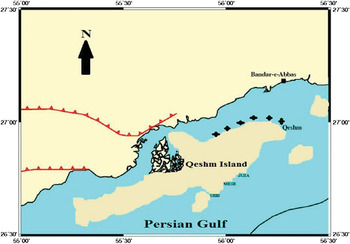
Qeshm Island is one of the most important recreational areas along the coast of the northern part of the Persian Gulf and, also, as a free trade zone, imposing much pressure on the marine environment. There is no information about sea cucumber communities around this island. Sea cucumber samples (N = 20) have been taken near Hamoon jetty on the north coast of Qeshm Island in January 2011 by SCUBA diving at depths of 5–12 m (Figure 1). The samples were transferred to the laboratory to photograph and extract their ossicles. For these, samples were anaesthetized with magnesium chloride (MgCl2) 5% (Jiaxin, Reference Jiaxin2003). To extract the ossicles, a small piece of dorsal and abdominal skin of the samples was placed into commercial bleaching liquid for almost 30 minutes (Hickman, Reference Hickman1998). White sediments accumulated at the end of the test tube. One drop of liquid was spread on the glass slide and photographs were taken to identify the species using valid identification keys (Conand, Reference Conand1993; Samyn et al., Reference Samyn, VandenSpiegel and Massin2006).
Map of Qeshm Island and location of all sampling sites. Black dots show sampling points.

RESULTS AND DISCUSSION
SYSTEMATICS
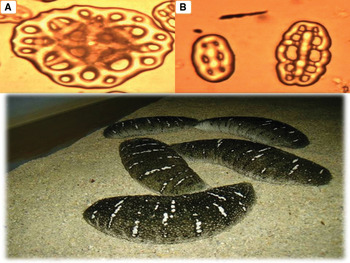
Holothuria scabra in the Persian Gulf: (A) ossicles of dorsal tegument; (B) ossicles of dorsal and ventral tegument.

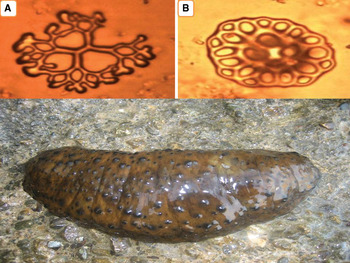
Stichopus hermanni in the Persian Gulf: (A) ossicles of dorsal tegument; (B) ossicles of tentacles.

DESCRIPTION
Holothuria (Metriatyla) scabra: body oval, arched dorsally (bivium) and flattened ventrally (trivium). Bivium is characterized by wrinkles and small papillae within black dots that are covered by sediment when the animal is coming out of the bottom. Mouth is ventral and surrounded by a collar of papillae and 20 grey, short and stout tentacles. Anus is terminal and surrounded by a circle of 5 radial papillae groups. Bivium whitish to dark brown, occasionally with dark transverse markings and trivium lighter (whitish). Spicules of H. scabra are very numerous; ventral tegument with tables and buttons, the tables having a moderately small disc, perforated by a varying number of holes of variable size, the spire with 4 pillars and a cross-like bridge, ending in a spiny crown with a hole in the middle; small rods and denticulate plates also present; tables and buttons in dorsal tegument are with a nodose disc, much larger than in ventral tegument; buttons variable, larger, and more perforated than those in ventral tegument; ventral and dorsal podia with long and large spinose rods; tentacles with long spiny rods, small smooth rods, and large denticulate plates. In the coast around Qeshm Island H. scabra is found in Hamoon, Tolla, Kovei, Ramchah, Messen and Hengam.
Stichopus hermanni: this species is long shaped with a rectangular cross-section and upper side wrinkled or deeply ridged with small black bumps and underside smoother. Entire body has different shades of beige to brown with irregular brown patches and fleshy tubercles projecting along the sides without cuts or small cuts across the mouth. Tentacles usually are twenty in number (non-retractile). Papillae which are smaller and less in number are scattered on dorsal and lateral surfaces. The body is broad, considerably flattened ventrally, and the dorsal side is slightly arched and the lateral sides are almost vertical; the body wall is fairly thick and soft; mouth sub-terminal; anus central; and tentacles usually 20 in number of moderate length and leaf-shaped. Podia consisting of numerous crowded ventral pedicles, approximately cylindrical in shape and often confined to the three ambulacra, and papillae which are smaller and less in number, scattered on the dorsal and lateral surfaces, sometimes in rows, and placed on small warts. Calcareous ring slender but variable in development, with the radial plates approximately half of the length of the inter radials. Ossicles numerous, consisting of tables with large discs having usually 7 to 15 peripheral holes, but they are often irregular or incomplete, and spire of moderate height ending in groups that are spineless (sometimes in the form of a cross) about as wide as the disc, rosettes of variable development, and c-shaped rods (sometimes very few), some of which may be c-shaped or have several branches. Colour of live specimens variable, it is usually brownish yellow and often mottled and with darker papillae giving a spotted appearance. On the coast around Qeshm Island S. hermanni is found in Hamoon, Ramchah, Messen, and Shibdraz.
CONCLUSION
Holothuria scabra (sandfish) are aspidochirote holothurians, widely distributed in coastal regions throughout the Indo-Pacific region (Conand, Reference Conand, Lessios and Macintyre1997). Holothuria scabra is often found on inner reef flats and near estuaries, half buried in the silt–sand during the day and emerging at night to feed (Mercier et al., Reference Mercier, Battaglene and Hamel1999). Holothuria scabra is among approximately 20 aspidochirote species that constitute the beche-de-mer fishery in the Indo-Pacific and is among the most valuable species in the trade (Conand & Byrne, Reference Conand and Byrne1993). The results of the researches of Al-Rashdi et al. (Reference Al-Rashdi2005) in Oman show that because of over-exploitation of the H. scabra population on the coasts of Oman, density has decreased, and the size was reduced from 20 cm in 2004–2005 to 15 cm in 2007–2008. Also, because of the intense reduction of the reserves of this species, the fishermen are searching for those species that have low commercial values so as to utilize them. Many of the sea cucumber populations have rapidly decreased because of too many commercial operations (Conand, Reference Conand, Lessios and Macintyre1997).
Curry sea cucumber (Stichopus hermanni) is considered to be of low value in the export market because of the tendency of the body wall to disintegrate easily, while exposed to air after harvesting and during boiling. It is reported that in the Pacific region, the intestine and gonad from this species are considered to be a delicacy among the locals and are eaten raw on the spot or squeezed into bottles and sold. The taste is slightly metallic, similar to raw oysters. Heding (Reference Heding1940) recorded 17 species of holothurians found in the waters around Iran. Because there is an expansive coastal area in Iran, most coastal cities include some species of holothurians (Shakouri et al., Reference Shakouri, Aimorirad, Nbavi, Kochanian, Savari and Safahyie2009). Therefore, only a few authors dealt with their taxonomy, biology and culture (Amini Rad, Reference Amini Rad2004; Shakouri et al., Reference Shakouri, Aimorirad, Nbavi, Kochanian, Savari and Safahyie2009; Dabbagh et al., Reference Dabbagh and Keshavarz2011b). The first report of successful H. leucospilota larval development in Iran was conducted by Dabbagh et al. Reference Dabbagh, Sedaghat, Rameshi and Kamrani(2011a). There have been a few publications on echinoderms on the Sultanate of Oman's coastline (e.g. Price, Reference Price1982, Reference Price1983; Campbell, Reference Campbell, Burke, Mladenov and Lambert1988; Al-Rashdi et al., Reference Al-Rashdi, Al-Busaidi and Al-Rassadi2007a, Reference Al-Rashdi, Claereboudt and Al-Busaidib). This paper reports two species of sea cucumber from the Qeshm Island coast, which is located on the north coast of the Persian Gulf. Although they are local species in this area they have not been previously recorded in the Persian Gulf. From the above description of two sea cucumber species in Qeshm Island, planning of research projects to identify species, density and distribution of sea cucumber species especially on the Persian Gulf coast of Qeshm Island are suggested by this study. Research projects should approach ecological studies in order to maintain stocks and should include a reproductive biology programme.
ACKNOWLEDGEMENT
We thank Dr Gustave Pauly, the Chairman of the Invertebrate Department of Florida University for Species Identification.