


Introduction
Dust is ubiquitous in the Universe, growing in a variety of diverse environments from the interstellar medium; the Earth's troposphere; to the atmospheres of gas giant exoplanets, where mineral dust clouds form. Without it, the Universe would lack the building blocks essential for planetary formation, and possibly even for the synthesis of life itself. Mineral dust clouds play an important role in substellar atmospheres (objects whose mass is sufficiently low that they cannot sustain hydrogen fusion). Their formation causes a significant depletion of the ambient gas, which alters the subsequent gas-phase chemistry and the consequent observable absorption features (Bilger et al. Reference Bilger, Rimmer and Helling2013). Notably, oxygen is depleted (bringing the C/O ratio closer to one) and so the grain surface may find itself in an environment more favourable to carbon-bonding molecules (hence promoting organic chemistry) more than a dust-free atmosphere. The dust grains that compose the clouds present a rich catalytic surface conducive to the formation of complex, prebiotic molecules sourced from the surrounding environment (Charnley et al. Reference Charnley, Ehrenfreund and Kuan2001; Hill & Nuth Reference Hill and Nuth2003). In substellar atmospheres, dust forms at a certain altitude, depleting the local gas-phase species. The dust particles gravitationally settle, falling to lower altitudes where they evaporate and are mixed by convective processes, which replenish the atmospheric gas (Burrows et al. Reference Burrows, Marley, Hubbard, Lunine, Guilot, Saumon, Freedman, Sudarsky and Sharp1997; Allard et al. Reference Allard, Hauschildt, Alexander, Tamanai and Schweitzer2001; Marley et al. Reference Marley, Seagar, Saumon, Lodders, Ackerman, Freedman and Fan2002; Tsuji Reference Tsuji2002; Helling et al. Reference Helling, Dehn, Woitke and Hauschildt2008a; Morley et al. Reference Morley, Fortney, Marley, Visscher, Saumon and Legget2012).
If regions of the atmospheric gas are ionized, the dust will become charged and the surrounding environment becomes electrically activated, allowing otherwise improbable chemical reactions. Miller and Urey were among the first to demonstrate the importance of electrical activation in the synthesis of prebiotic molecules (Miller Reference Miller1953; Miller & Urey Reference Miller and Urey1959). They considered a planetary atmosphere rich in H2, CH4, NH3 and H2O and successfully synthesized prebiotic amino acids (e.g. glycine, alanine, etc.) and other biological molecules (e.g. urea, lactic acid, etc.) when such a gas mixture participates in an electrical discharge. Amino acids are critical ingredients for life on Earth since they are required for the formation of proteins, peptides and enzymes. A similar yield of amino acids was also found in experiments carried out to investigate prebiotic synthesis in steam-rich volcanic eruptions (Johnson et al. Reference Johnson, Cleaves, Dworkin, Glavin, Lazcano and Bada2008). Nebular lightning has also been postulated as a mechanism for the processing of nebular dust in order to explain the oxygen isotopic content in the Solar system (Nuth et al. Reference Nuth, Paquette and Farquhar2012).
It is important to note that the atmospheric conditions simulated in the Miller–Urey experiment do not correspond to those thought to exist in the primitive Earth since CH4 and NH3 were not believed to be very abundant. Modern volcanic gas emission shows that most of the carbon and nitrogen exists as CO2 and N2, respectively (Kasting Reference Kasting1993); if past volcanic emission was similar, this would infer a lower abundance of CH4 and NH3 than that used in the Miller–Urey experiment. For atmospheres more representative of primitive Earth, no significant organic molecules are produced using electrical (sparking) discharges (Kasting & Catling Reference Kasting and Catling2003). However, the presence of hydroxy acids in the famous Murchison meteorite indicates that the Strecker mechanism (triggered by a Miller–Urey-type electrical discharge) may be responsible for the extraterrestrial synthesis of amino acids (Peltzer & Bada Reference Peltzer and Bada1978).
Laboratory experiments have established that irradiation of interstellar ice analogues with polarized and unpolarized UV radiation leads to the formation of amino acids (Sorrell Reference Sorrell2001; Bernstein et al. Reference Bernstein2002; Muñoz Caro et al. Reference Muñoz Caro2002; Woon Reference Woon2002; Nuevo et al. Reference Nuevo2006; Elsila et al. Reference Elsila2007; Nuevo et al. Reference Nuevo2007). Furthermore, Nuevo et al. (Reference Nuevo2006, Reference Nuevo2007) found that the enantiomeric excess in the ice mixtures (H2, CO, CO2, CH4, CH3OH and NH3) as a result of the circularly polarized radiation was very small. The processes leading to the formation of amino acids has long been an outstanding problem. Elsila et al. (Reference Elsila2007) experimentally tested if the formation of amino acids in interstellar ices occurred via Strecker-type synthesis (Bernstein et al. Reference Bernstein2002) or radical–radical interactions (Sorrell Reference Sorrell2001; Woon Reference Woon2002) finding that neither satisfactorily explained their laboratory results.
There are collective consequences if grains are charged. Inter-grain electrical discharges (sparking) (Helling et al. Reference Helling, Jardine, Witte and Diver2011a) is a collective effect that activates the ambient gas, creating physical conditions similar to those thought responsible for life in early planetary atmospheres, analogous to the Miller–Urey experiment (Miller Reference Miller1953; Miller & Urey Reference Miller and Urey1959). This process is amplified by the very strong electric fields that develop at the poles of prolate grains (Stark et al. Reference Stark, Potts and Diver2006). Moreover, prolate grains have two key advantages over spherical grains: a greater surface area that promotes surface catalysis; and inhomogeneous electric fields. In a magnetized medium, such grains become aligned to the ambient field, polarizing passing electromagnetic radiation (Davis & Greenstein Reference Davis and Greenstein1949) and altering the subsequent chirality-dependent biological chemistry (Bailey et al. Reference Bailey, Chrysostomou, Hough, Gledhill, McCall, Clark, Ménard and Tamura1998). Polarization also provides an extremely useful diagnostic to probe the ambient environment.
Classically, in the gas-phase, grain surface chemistry occurs via the absorption of neutral species via the stochastic kinetic motions of the gas. The probability of a particular chemical reaction occurring depends on the reaction rate coefficients, which itself is determined by the underlying velocity distribution of the participating neutral species. A particular reaction will occur provided that the thermal energy of the ambient gas can surmount the required activation energy. However, in an atmospheric dusty plasma (a plasma containing dust particles), the absorption of species is electrostatically driven and the resulting reactivity on the grain surface can be amplified.
Consider a dusty plasma in the atmosphere of a substellar object such as a giant gas exoplanet. The dust particles will be negatively charged and as a result a plasma sheath (an electron-depleted region, see ‘Electrostatic activation of prebiotic chemistry’ section) forms around the particle. As a consequence, the ionic flux at the grain surface increases as the plasma ions are attracted to and are accelerated towards the grain surface. Upon reaching the surface, the ions have fallen through an electrostatic potential and have been energized. In comparison to the neutral case, the ionic flux is enhanced and the ionic energy amplified, increasing the probability that chemical reactions will occur and that reactions with higher activation energies are accessible. In this way, charged particles' surfaces help catalyse chemical reactions otherwise inaccessible at such low-temperatures present in planetary atmospheres.
The aim of this paper is to investigate the energization of plasma ions as they are accelerated from the bulk plasma to the surface of a charged dust grain. If the ions gain a significant amount of energy, this energy may be sufficient to overcome the activation barrier of certain chemical reactions that would be inaccessible via classical thermal ion and neutral fluxes. This may lead to an increase in the creation of prebiotic molecules on the grain surface. This paper is structured as follows: ‘Substellar atmospheric plasmas’ discusses the sources of ionization and the generation of plasmas in substellar atmospheres, focusing on Alfvén ionization and summarizing the findings of Stark et al. (Reference Stark, Diver, Helling and Rimmer2013); ‘Electrostatic activation of prebiotic chemistry’ discusses the charging of dust grains immersed in a plasma and how the plasma ions can be energized by the local electric fields of the dust grains; and the penultimate section discusses the electrostatic activation of particular chemical reactions as a result. We are particularly interested in these plasma processes in the atmospheres of exoplanets. We will use an example atmosphere using the Drift–Phoenix model atmosphere and cloud formation code, characterized by log g=3.0 and T eff=1500 K. In such an atmosphere the gas-phase temperature varies from T gas≈500 K at low atmospheric pressures to T gas≈3300 K at high atmospheric pressures (see Fig. 1). Drift–Phoenix considers collisionally dominated atmospheres where the gas-phase and dust cloud particles have the same temperature T dust=T gas; therefore, for the dust-populated regions of the atmosphere the dust temperature is T dust≈600−1900 K.
(p gas,T gas) diagrams and the dust number density n d for an example substeller atmosphere characterized by log g=3.0, T eff=1500 K and [M/H]=0.0. These are results from Drift–Phoenix simulations.

Substellar atmospheric plasmas
Electromagnetic emission from substellar objects in the radio and X-ray frequency bands infer the presence of plasmas in their atmospheres. A number of ionization processes occur in substellar atmospheres that produce volumes of gas–plasma mixtures. For an ionized gas to exhibit plasma behaviour, the dynamics of the ionized particles must be dominated by long-range collective electromagnetic effects and not by short-range collisions (such as in a neutral gas) (Chen Reference Chen1984). An ionized gas will become a plasma when the degree of ionization is ⩾10−7 (Fridman Reference Fridman2008; Diver Reference Diver2013). On its own, thermal ionization is insufficient to ionize a significant fraction of the neutral substellar atmosphere, so that the resulting ionized gas is a plasma.
In substellar atmospheres where cloud formation occurs, gas discharge events (i.e. lightning) involving charged cloud particles can generate a local plasma volume with sufficiently high number densities (Helling et al. Reference Helling, Jardine, Witte and Diver2011a). Helling et al. have investigated the conditions for inter-grain and large-scale electrical discharge events to occur in the atmospheres of substellar objects (Helling et al. Reference Helling, Jardine, Stark and Diver2013). Cosmic-ray interactions with the atmosphere can also ionize the atmospheric gas (Rimmer & Helling Reference Rimmer and Helling2013). In addition, turbulence-induced dust–dust collisions can ionize fractions of the atmosphere, enhancing the local degree of ionization (Helling et al. Reference Helling, Jardine and Mokler2011b). Alfvén ionization is an alternative process by which volumes of atmospheric plasma can be efficiently generated. The following is a summary of the Alfvén ionization process in substellar atmospheres (Stark et al. Reference Stark, Diver, Helling and Rimmer2013).
In Alfvén ionization, a flow of neutral gas impinges on a low-density, magnetized seed plasma. The kinetic energy of the neutral flow is
 ${1\over 2} m_{gas}v^{2}_{0} $; where m gas is the mass of a neutral atom or molecule and v 0 is the flow speed. By magnetized, we mean that the electrons are localized and their motion is impeded in the perpendicular direction to the ambient magnetic field due to the Lorentz force. The neutral atoms of the flow collide with and elastically scatter the plasma ions, sending them off to participate in Larmor orbits due to the magnetic field. As more and more ions are displaced, an unscreened pocket of electrons, or charge imbalance, is exposed. The electrons are unable to rectify the charge imbalance due to their magnetically restricted motion. The charge imbalance stops growing when further ionic displacement is inhibited by the local electric field of the exposed electrons. This occurs when the electrostatic potential energy of the charge imbalance equals the kinetic energy of the initial neutral flow. At this point, the pocket of electrons due to their mutual self-electrostatic repulsion, are accelerated parallel to the magnetic field to an energy equal to
${1\over 2} m_{gas}v^{2}_{0} $. If these electrons go on to collide with the surrounding atmospheric neutral gas and their kinetic energy equals or exceeds the electrostatic potential energy required to ionize the neutral, more electrons and ions are liberated.
Alfvén ionization requires: a low-density, magnetized seed plasma and a neutral gas flow, which has a kinetic energy that exceeds the electrostatic potential energy required to ionize a neutral atom or molecule of the surrounding atmospheric gas:
${1\over 2} m_{gas}v^{2}_{0} $⩾eϕI. The critical flow speed required is v c=(2eϕI/m gas)1/2, where ϕI is the first ionization potential of the species of interest. In substellar atmospheres, the seed plasma can be generated from local electrical discharge events (sparking) in mineral clouds and cosmic-ray bombardment of the atmosphere, enhancing the ambient electron number density by n e≈1023 m−3 (Uman & Orville Reference Uman and Orville1964; Guo et al. Reference Guo, Yuan, Shen and Wang2009; Chang et al. Reference Chang, Zhao and Yuan2010) and n e≈1010 m−3 (Rimmer & Helling Reference Rimmer and Helling2013), respectively.
The low-density, seed plasma must also be magnetized. Giant gas planets and Brown Dwarfs have typical large-scale magnetic flux densities estimated to be of the order of 10 G and 1 kG, respectively (Sánchez-Lavega Reference Sánchez-Lavega2004; Christensen et al. Reference Christensen, Holzwarth and Reiners2009; Donati & Landstreet Reference Donati and Landstreet2009; Shulyak et al. Reference Shulyak, Seifahrt, Reiners, Kochukhov and Piskunov2011; Reiners Reference Reiners2012), which are sufficient to ensure that the seed plasma is magnetized for a large fraction of the atmosphere. In general, for the neutral species expected to populate the envelopes of substellar objects, the critical neutral gas flow speeds required are ≈O(1–10 km s−1). Studies of substellar atmospheric circulation, flows and winds have shown that flow speeds of v 0≈1−10 km s−1 (Showman & Guilot Reference Showman and Guilot2002; Cooper & Showman Reference Cooper and Showman2005; Dobbs-Dixon & Lin Reference Dobbs-Dixon and Lin2008; Showman et al. Reference Showman, Cooper, Fortney and Marley2008, Reference Showman, Fortney, Lian, Marley, Freedman, Knutson and Charbonneau2009; Menou & Rauscher Reference Menou and Rauscher2009, Reference Rauscher and Menou2010; Dobbs-Dixon et al. Reference Dobbs-Dixon, Cumming and Lin2010, Reference Dobbs-Dixon, Agol and Burrows2012; Lewis et al. Reference Lewis, Showman, Fortney, Marley and Freedman2010; Heng et al. Reference Heng, Menou and Phillips2011) (and possibly higher) are attainable. These flow speeds are averaged over an underlying particle distribution of speeds, and so a population of high-energy particles will be present that will be able to reach larger critical speeds.
If the required criteria can be met, Alfvén ionization is an efficient process by which volumes of plasma with degrees of ionization ranging from 10−6 to 1 can be obtained. The atmospheric plasma volumes can vary from small to large scales. If we assume that in a localized atmospheric volume the entirety of a particular target species can be 100% ionized, then the gas-phase species that has the greatest relative density will yield the greatest degree of ionization resulting from Alfvén ionization. In the model, substellar atmospheres considered He, Fe, Mg, Na, H2, CO, H2O, N2 and SiO for all atmospheric pressures yield a degree of ionization ⩾10−7, producing an atmospheric plasma. In reality, the resulting plasma volumes will be composed of multi-species plasmas (composing of NH3, CH4, CO, etc.), even containing ionic species that if ionized on their own would have an insufficient degree of ionization to constitute a plasma. Of particular interest in the synthesis of prebiotic molecules are NH3 and CH4, which can be dominant molecular species in substellar atmospheres (Helling et al. Reference Helling2008b; Bilger et al. Reference Bilger, Rimmer and Helling2013)
The properties and characteristics of the plasma, such as the plasma temperature, depend on the process, which created it. Since the electrons are much less massive than the neutrals and ions, they only lose a small fraction of their energy following a collision. As a result, the plasma electrons and ions will not necessarily be in thermal equilibrium with each other or the ambient gas and the electron temperature can differ from the ion and gas-phase temperature. Typical terrestrial, gas discharge electron temperatures are T e≈1−100 eV (≈104−106 K) (Fridman Reference Fridman2008; Diver Reference Diver2013); in substellar atmospheres electrons from thermal ionization are in thermal equilibrium with the ambient neutral gas (T e≈T gas) and have electron temperatures of T e≈O(0.01−0.1 eV) (≈O(102−103 K)).
In this paper, we shall assume an atmosphere that contains plasma volumes composed of multi-species plasmas (e.g. Fe, H2, NH3, CH4, CO, H2O, SiO, etc.) populated with dust grains, with plasma electron temperatures ranging from T e≈0.01−100 eV (≈O(102−103 K)).
Electrostatic activation of prebiotic chemistry
Alfvén ionization creates volumes of plasma in the atmospheres of substellar objects, which are populated with dust cloud particles. Let us consider a dust grain immersed in an electron–ion (a multi-species) plasma that is in thermal equilibrium (T e=T i=T gas). For a given thermal energy, the electrons have a greater mean thermal speed than the ions due to their smaller mass and as a result are far more mobile. This greater mobility ensures that the electrons are more likely to strike and stick to the grain surface and so the grain quickly becomes negatively charged. As the net negative charge on the grain grows, further electron attachment is discouraged and is restricted only to those electrons energetic enough to overcome the electrostatic barrier. Additionally, the plasma ions are attracted to the grain and are accelerated towards it. The flux of ions are deposited on the grain surface and alter the net charge of the grain, consequently influencing the electron flux towards the grain and further changing the grain's net charge. The net charge of the dust grain fluctuates in this way until a particle-flux equilibrium is reached where the flux of electrons and ions at the grain surface is equal. When this is achieved, the surface of the grain is at the floating potential ϕf (Bouchoule Reference Bouchoule1999),
 $${\rm \phi} _{\rm f} = - \displaystyle{{k_{\rm B} T_{\rm e}} \over {2{\rm \alpha} e}},$$
where
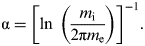 $${\rm \alpha} = \left[ {\ln {\rm \;} \left( {\displaystyle{{m_{\rm i}} \over {2{\rm \pi} m_{\rm e}}}} \right)} \right]^{ - 1}. $$
The floating potential is dependent on the electron plasma temperature T e and the plasma mass ratio m i/m e, where m e and m i are the electronic mass and ionic mass, respectively. Since the natural logarithm in α is largely insensitive to variations in the mass ratio m i/m e we can approximate α≈0.1 without loss of generality. For increasing electron temperature, the electrons in the bulk plasma become more energetic and so a greater number of electrons have sufficient energy to overcome the electrostatic barrier of a negatively charged grain and reach its surface. As a result, the grain becomes increasingly negatively charged and the magnitude of its electrostatic potential greater.
When the floating potential is reached, the dust grain has a constant net negative charge; is surrounded by a plasma sheath (an electron-depleted region) and is screened by the bulk plasma. The sheath length is of the order of the Debye length λD=(ϵ0k BTe/(n 0e 2))1/2, such that on length scales greater than λD the electric field from the dust grain is zero. The plasma ions are accelerated from the bulk plasma by the electrostatic field of the grain and are deposited on the grain's surface where they recombine with the surface electrons. The energy of the plasma ions upon reaching the grain surface may be sufficient to overcome the activation energy of particular chemical reactions that would be unattainable via ion and neutral bombardment from classical, thermal excitation. As a result, prebiotic molecules or their precursors could be synthesized on the dust grains surface more easily than in the gas-phase. This is similar to the deposition and manufacture of molecular species on the surface of dust grains in laboratory plasmas (Shi et al. Reference Shi, Wang, Wim, van Ooij and Wang2001; Yarin et al. Reference Yarin, Rovagnati and Mashayek2006; Qin & Coulombe Reference Qin and Coulombe2007). Note that the energy of the ions may lead to sputtering of the grains mantle, mitigating significant molecular formation.
The energy gain (E es) of an ion-carrying charge q i accelerated by the electrostatic field is,
 $$\eqalign{E_{{\rm es}}& = q_{\rm i} |{\rm \phi} _{\rm f} | \cr & = \displaystyle{{k_{\rm B} T_{\rm e}} \over {2{\rm \alpha}}},} $$
where q i=Z ie; and Z i is the ion charge number (we will assume that Z i=1). Prior to their energization the ions are in thermal equilibrium with the neutrals (T i≈T gas) and have a thermal of energy of
 $$E_{{\rm th}} = \displaystyle{3 \over 2}k_{\rm B} T_{\rm i}. $$
The ratio of the ionic electrostatic energy gain relative to the ionic thermal energy is
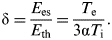 $${\rm \delta} = \displaystyle{{E_{{\rm es}}} \over {E_{{\rm th}}}} = \displaystyle{{T_{\rm e}} \over {3{\rm \alpha} T_{\rm i}}}. $$
When δ>1 the electrostatic energy of the ion is greater than its thermal energy. Therefore, the total energy of a plasma ion after being accelerated in the electric field of a dust grain is
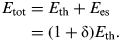 $$\eqalign{E_{{\rm tot}} &= E_{{\rm th}} + E_{{\rm es}} \cr &= (1 + {\rm \delta} )E_{{\rm th}}.} $$
In the regime where the electrostatic potential energy of the ion is much greater than its thermal energy, δ≫1 and the entirety of the ion's energy stems from its electrostatic energization, E tot≈δE th. When δ=1, the electron temperature T e=3αT i and T e<T i inferring that for the electrostatic and thermal energies of the ions to be equal the electrons must be cooler than the ions. Therefore, in thermal equilibrium the electrostatic energy gain of the ions will always exceed their thermal energy.
Discussion
We are interested in such plasma processes in the context of exoplanetary atmospheres (and other substellar objects such as Brown Dwarfs). We use an example substellar atmosphere using the Drift–Phoenix model atmosphere and cloud formation code (Hauschildt & Baron Reference Hauschildt and Baron1999; Helling et al. Reference Helling, Klein, Woitke, Nowak and Sedlmayr2004, Reference Helling, Woitke and Thi2008d; Helling & Woitke Reference Helling and Woitke2006; Dehn Reference Dehn2007; Witte et al. Reference Witte, Helling and Hauschildt2009, Reference Witte, Helling, Barman, Heidrich and Hauschildt2011) defined by log g=3.0, T eff=1500 K and solar metallicity ([M/H]=0.0). Figure 1 shows the (p gas,T gas) diagram and the dust number density n d of the substellar atmosphere considered here. In Drift–Phoenix model atmospheres T dust=T gas; therefore, for the dust-populated regions of the atmosphere the dust temperature is T dust≈600−1900 K. Drift–Phoenix considers an atmosphere in hydrostatic and chemical equilibrium and uses mixing length theory and radiative transfer theory to consistently calculate the thermodynamic structure of the model atmospheres (Hauschildt & Baron Reference Hauschildt and Baron1999). In addition, Drift–Phoenix kinetically describes the formation of cloud particles as a phase transition process by modelling seed formation, grain growth and evaporation, sedimentation (in phase-non-equilibrium), element depletion and the interaction of these collective processes (Woitke & Helling Reference Woitke and Helling2003; Helling et al. Reference Helling2008b, Reference Helling, Woitke and Thic). Figure 2 shows the mean grain size 〈a〉 as a function of atmospheric pressure p gas. In the nucleation-dominated upper atmosphere (p gas≈10−11 bar) seed particles form with a mean grain size 〈a〉≈10−7 cm. The dust particles gravitationally settle and grow as they fall, increasing in size. In the lower atmosphere (p gas≈1 bar) the mean particle size is 〈a〉≈10−5 cm.
Mean grain particle size 〈a〉 as a function of gas pressure p gas for a exoplanetary atmosphere with log g=3.0, T eff=1500 K and [M/H]=0.0.
Figure 3 shows δ (equation 5, blue lines) as a function of atmospheric pressure p gas for varying electron temperature T e=1−100 eV (≈104−106 K), for the example atmosphere considered here. As the electron temperature increases, more electrons are likely to strike and stick to the dust grain and so the local electrostatic field in the plasma sheath is greater in magnitude. The ions that are accelerated by this electric field gain a greater amount of energy as the electron temperature increases.
δ=E es/E th and ξ=E 0/E th as a function of atmospheric pressure p gas using data from Fig. 1. δ is the ratio of the ionic electrostatic potential energy gain relative to the ionic thermal energy. ξ is the argument of the Boltzmann factor the chemical reactions considered here: CO+NH3→HCN+H2O (equation 8, E 0=0.52 eV); CH4+NH3→HCN+3H2 (equation 9, E 0=2.65 eV); CH2O+HCN+NH3→NH3+NH2CH2COOH (equation 10, E 0=0.77 eV).
In the scenario where the electrons have had sufficient time to come into thermal equilibrium with the local ions and neutrals (T e≈T i≈T gas) then δ≈(3α)−1≈3.33 (solid blue line). Even in this case the ions are accelerated by the sheath field to greater energies than that from thermal excitation only. For example, when T e≈T i≈T gas≈600 K and the atmospheric pressure is p gas≈10−15 bar, the electrostatic energy gain of the ion is E es≈0.26 eV (≈3000 K); the ionic thermal energy is E th≈0.08 eV (≈900 K); and the total energy of the ion upon reaching the grain surface is E tot≈0.33 eV (≈4000 K). Consider the surface of a charged dust grain that contains molecules of previously deposited OH. CH4 ions that are accelerated by the sheath electric field from the bulk plasma will strike the surface with an average energy ≈0.33 eV, enhancing the likelihood that the chemical reaction OH+CH4→CH3+H2O (activation energy, E a=0.2 eV or ≈2300 K) will occur. If the dust grain populates the atmosphere at an altitude where p gas≈10−15 bar and T i≈600 K, the thermal energy of the ion (E th≈0.08 eV) would be insufficient to surmount the activation energy for this particular reaction.
At higher electron temperatures, the ions are accelerated to greater energies and so chemical reactions with larger activation energies are accessible. For example, when T e=1 eV (blue dashed line) at p gas≈10−15 bar (δ≈102) the total energy gain of the ion is E tot≈4.8 eV (≈9.05×10⁴ K).
To exemplify the significance of the electrostatic activation of prebiotic chemistry on the surface of a charged dust grain, let us consider the sequence of chemical reactions that lead to the formation of formaldehyde, ammonia, hydrogen cyanide and ultimately the amino acid glycine (NH2CH2COOH):
 $${\rm CH}_4 + {\rm O}_2 \to {\rm CH}_2 {\rm O} + {\rm H}_2 {\rm O}$$
 $${\rm CO} + {\rm NH}_3 \to {\rm HCN} + {\rm H}_2 {\rm O}\quad E_0 = 0.52\,{\rm eV}$$
 $${\rm CH}_4 + {\rm NH}_3 \to {\rm HCN} + 3{\rm H}_2 \quad E_0 = 2.65\,{\rm eV}$$
 $$\eqalign{\tab\hskip -3pt{\rm CH}_2 {\rm O} + {\rm HCN} + {\rm NH}_3 \to {\rm NH}_3 + {\rm NH}_2 {\rm CH}_2 {\rm COOH}\cr\tab\quad E_0 = 0.77\,{\rm eV}$$
We have chosen glycine because it is the simplest of the amino acids. The reactions (8)–(10) have formation energies (an indicator of the activation energy of the chemical reaction) of E 0≈0.52, 2.65 and 0.77 eV, respectively. Figure 3 shows ξ=E 0/E th as a function of p gas (red lines), where E th=
 ${3\over 2} k_{\rm B}T_{\rm i} $, T i≈T gas and using the values for T gas from Fig. 1. The plot shows the argument of the Boltzmann factor for the respective chemical reactions and exhibits the energy required for their activation in comparison with E es. For reactions (8) and (9) we assume that one of the reactants has been previously deposited on the grain surface and the other is accelerated from the bulk plasma. This is reasonable to presume since the multispecies plasma formed in the atmosphere may contain NH3, CO and CH4 ions. For reaction (10) the reactants CH2O and HCN are presumed to be formed on the grain surface via reactions (7)–(9) and NH3 is accelerated from the bulk plasma. However, note that this reaction is less likely than the preceding bimolecular reactions since it requires the previous reactions to have already occurred.
High in the atmosphere where p gas≈10−15 bar, the ion temperature is ≈600 K and the resulting thermal energy of an ion is ≈0.08 eV, which is lower than the energies required to form the reaction products above. However, when the electron temperature T e=1 eV the ions are accelerated to E tot≈7.8 eV (blue lines), which surpasses the require formation energies (red lines), increasing the likelihood that these reactions will occur. At lower atmospheric pressures where it is hotter, the thermal energy can reach ≈0.45 eV (≈5200 K) and there will exist a population of higher energy ions that, once neutralized on the surface, may be energetic enough to activate the required chemical reactions to form glycine.
The proportion of the grain surface made up of molecular reaction partners depends on the composition of the ambient plasma and the ionization process that created it. The ionization processes may be transient and so these conditions could evolve with time enhancing or diminishing the fraction of the grain surface populated by reaction partners. If the reactant is a minority species then the fraction will be small and the probability of the reaction occurring will be reduced; if the reactant is quite abundant then the probability is enhanced. This problem is also pertinent for grain surface chemistry where the reactants are acquired from the ambient gas-phase. However, in contrast to the neutral gas scenario, the enhanced flux of reactants due to the electrostatic acceleration from the bulk plasma enhances the probability of reactions occurring. In both the plasma and neutral gas cases, the problem can be alleviated through hot-atom kinetics where upon being adsorbed onto the grain surface the reactant has relatively high translational energy and diffuses across the surface (e.g. see Kammler et al. Reference Kammler, Kolovos-Vellianitis and Küppers2000). This surface trajectory increases the effective fraction of the grain surface covered by the reactant and hence increasing the probability of it encountering and reacting with another species.
Note that in the chemical reactions considered here we assume that the ions and electrons recombine on the surface before their involvement in the neutral–neutral reactions. Upon recombining the product can either remain on the surface or return to the plasma. In the former case, particle growth occurs via plasma deposition, this is observed in the laboratory (e.g. see Matsoukas & Cao Reference Matsoukas and Cao2004) and so it seems reasonable to presume that the product is retained on the surface. In the latter case, the ejection of the product will mitigate further surface reactions that the product could participate in and could potentially eject prebiotic and organic molecules into the surrounding gas-plasma mixture. These molecules may be subsequently reabsorbed by another dust grain. To ascertain the effect of the grain surface properties (and other factors) on the retention or ejection of the product warrants further investigation.
Instead of neutral–neutral reactions, the incoming ions may also interact directly with the neutrals via ion–neutral chemistry. In the ion–neutral case, the activation energies are reduced and so easier to occur. In this scenario, the increased flux of ions due to the electrification of the dust grains is what drives the enhancement of chemistry relative to the thermally driven case. As an example, we list the most likely series of ion–neutral reactions that lead to the formation of glycine (Largo et al. Reference Largo, Redondo, Rayón, Largo and Barrientos2010):
 $${\rm NH}_3^ + + {\rm CH}_3 {\rm COOH} \to {\rm NH}_4^ + + {\rm CH}_2 {\rm COOH}$$
 $${\rm NH}_3^ + + {\rm CH}_2 {\rm COOH} \to {\rm NH}_3 {\rm CH}_2 {\rm COOH}^ + $$
 $$\to {\rm NH}_2 {\rm CH}_2 {\rm COOH}^ + + {\rm H}$$
The formation of CH3COOH (acetic acid) by ion–neutral reactions is not well understood (see also Blagojevic et al. Reference Blagojevic2003). However, it could be synthesized via neutral–neutral reactions on the grain surface in analogy with its formation in interstellar ices containing CO2 and CH4 (Bennett & Kaiser Reference Bennett and Kaiser2007).
The bombardment of the grain surface by electrostatically energized ions also contributes to the heating of the grain surface, increasing the grain temperature T dust. Dust grain heating also occurs due to electron–ion recombination and chemical reactions at the grain surface. For example, modelling of dust in laboratory plasmas for pressures of ≈10−3 bar and a plasma density of ≈1017 m−3, give dust particle temperatures of ≈1000 K (Kilgore et al. Reference Kilgore, Daugherty, Porteous and Graves1994). These calculations considered 0.1 μm sized grains composed of aluminium, taking into account heating due to electron–ion recombination, positive ion impact; heat losses due to radiative cooling and Knudsen conduction (Daugherty & Graves Reference Daugherty and Graves1993; Kilgore et al. Reference Kilgore, Daugherty, Porteous and Graves1994). Although the situation in substellar atmospheres is different (e.g. grains are composed of multiple materials) these values are indicative as to what to expect in an astrophysical environment where dusty plasmas exist. In substellar atmospheres, the different properties of the dust grown and their radiative behaviour have to be carefully considered (Woitke & Helling Reference Woitke and Helling2003).
For metal grains, heating can lead to the thermionic emission of electrons from the grain surface, contributing to the charging of the grain. In Drift–Phoenix model atmospheres the dust is at the same temperature as the gas-phase (≈600−1900 K, equivalent to ≈0.05−0.16 eV). The work function for most materials is in the range of ≈1−7 eV (or of the order of 104 K). In general, Drift–Phoenix dust grains are insulators and so most of the valence electrons are busy participating in bonds, resulting in large work functions ≈4−7 eV (and may even be higher). Furthermore, for non-conductors there is usually quite a considerable energy band gap between the valence band and the conduction band and so any available electrons find it hard to surmount this barrier to escape. In the atmospheric model presented here, most of the dust grains have a temperature below 0.1 eV (≈103 K) and so only work functions ≲2–3 eV will be affected by thermionic emission (Wu & Xie Reference Wu and Xie2005). The hottest grains have temperatures ≈0.16 eV (≈1900 K); for these grains thermionic emission starts to become important for work functions ≲3–4 eV (Wu & Xie Reference Wu and Xie2005). Therefore, in our model it is assumed that the charging of the dust grain is dominated by the collection of electrons and ions from the surrounding plasma and thermionic emission is a second-order effect.
The increase in the thermal energy of the grain can lead to the enhanced thermal activation of surface chemistry provided k BT dust⩾E a. However, ionic bombardment can cause the sputtering of material off the surface of the grain and if the temperature of the grain exceeds a critical value, grain evaporation can occur. The extent to which this happens is dependent upon the material composition and properties of the dust grain. Note that grain heating can alter the solid-state properties of the grain, potentially changing the internal microstructure of the material resulting in increasing its ductility (cf. annealing).
Summary
Substellar atmospheres are composed of localized volumes of gas–plasma mixtures populated with dust and mineral dust clouds. In a plasma, dust particles become negatively charged and as a result a plasma sheath forms around the particle accelerating the plasma ions towards the surface. In this paper, we have investigated the energization of plasma ions as they are accelerated from the bulk plasma to the surface of a charged dust grain. If the ions gain a significant amount of energy, this energy may be sufficient to overcome the activation barrier of certain chemical reactions that would be inaccessible via classical thermal ion and neutral fluxes. This may lead to an increase in the creation of prebiotic molecules on the grain surface. The electrostatic potential of the dust grains, and hence the energy gain of the ions upon falling through this potential, is proportional to the plasma electron temperature. Even in the case where the electrons and ions are in thermal equilibrium (T e≈T i), the ions are accelerated by the sheath field to greater energies than that from thermal excitation only. To highlight the significance of the electrostatic activation of prebiotic chemistry on the surface of a charged dust grain we considered a simplified sequence of reactions that form formaldehyde, ammonia, hydrogen cyanide and ultimately glycine (a variation of Strecker synthesis). We found that for modest plasma electron temperatures T e≈1 eV (≈104 K), the energy gain of the accelerated ions is sufficient to exceed the formation energies required for the chemical reactions to occur. Higher electron temperatures will allow the ions to surmount higher activation barriers and enable other chemical reactions normally inaccessible at low temperatures. However, in some scenarios the ionic flux at the grain surface may lead to heating and the ultimate evaporation of the dust grain.
This paper establishes the feasibility of the electrostatic activation of prebiotic chemistry. This idea can be developed to explicitly model the surface chemical kinetics, describing the incoming accelerated ions interacting with the grain surface. In this way, the effect of the plasma ionic species, the composition of the grain surface and the effect of the grain charge on the resulting surface chemical reactions can be quantified.
Acknowledgements
The authors would like to thank the anonymous referees for their invaluable comments and suggestions that have helped improved this paper. ChH, CRS and PBR are grateful for the financial support of the European Community under the FP7 by an ERC starting grant. DAD is grateful for funding from the UK Science and Technology Funding Council via grant number ST/I001808/1. We also acknowledge our local IT support.



