Introduction
The 4th International Polar Year (IPY) generated intensive research mobilisation in both the Arctic and the Antarctic over the two-year period 2007–2009, involving an estimated 10,000 scientists and 50,000 participants (educators, students, engineers, technicians, logisticians, etc.) from over 60 countries (Carlson, Reference Carlson, Barr and Ludecke2010; Krupnik et al., Reference Krupnik, Allison, Bell, Cutler, Hik, López-Martinez and Summerhayes2011). In total, IPY consisted of 170 science projects, 58 education and outreach projects and one integrated data services project (Carlson, Reference Carlson, Barr and Ludecke2010). In order to realise the societal benefit not only of large scientific programmes such as IPY but also individual research projects, participants require an array of practical or ‘soft’ skills, defined as skills that are interpersonal in nature, such as networking, collaborating and communicating (Harrison, Cohen, Hinchey, Moerke, & von Dassow, Reference Harrison, Cohen, Hinchey, Moerke and von Dassow2009; LeDee et al., Reference LeDee, Barnes, Emanuel, Fisher, Henkel and Marlon2011; Schulz, Reference Schulz2008). Although widely termed as ‘soft’, these skills are by no means second-class or less important in science than ‘hard’ skills such as statistical analysis. Soft skills are practical and essential for all researchers and the authors will therefore use these terms interchangeably for ‘soft’ in this paper to describe these skills. A decade ago the focus on so-called soft skills training in the polar research community was not considered a priority (Provencher et al., Reference Provencher, Baeseman, Carlson, Badhe, Bellman, Hik and Zicus2011). In contrast, the majority of funding calls today require not only research excellence but also strong collaborations, cross-disciplinary research, skills development and a plan to communicate research outcomes to diverse public communities. For example, since 2009 the Natural Environment Research Council (UK) requires all funding proposals to contain a ‘Pathways to Impact’ statement (NERC, 2013) and the National Science Foundation (USA) requires ‘Broader Impacts’ components, including a project outcomes report for the general public (since 2010) and a postdoctoral researcher mentoring plan (since 2009) (NSF, 2010). Nevertheless, it can remain challenging for early career researchers (ECRs) to gain experience in soft skills within their formal graduate programmes or postdoctoral appointments, as they are often absent from academic training (e.g. Darlington, Waite, & Balsdon, Reference Darlington, Waite and Balsdon2015; Gordon, Reference Gordon2014; Kumar & Hsiao, Reference Kumar and Hsiao2007; LeDee et al., Reference LeDee, Barnes, Emanuel, Fisher, Henkel and Marlon2011; Schulz, Reference Schulz2008).
The Association of Polar Early Career Scientists (APECS) was founded during the 4th IPY and provides ECRs with a network within which they can develop the transferable skills required by today’s professionals. APECS is an international and interdisciplinary organisation for undergraduate and graduate students, postdoctoral researchers, early faculty members, educators and others with interests in polar and alpine regions and the wider cryosphere. The organisation’s goals are to create opportunities for the development of innovative, international and interdisciplinary collaborations among current ECRs as well as recruiting, retaining and promoting the next generation of polar enthusiasts. APECS aims to (a) maintain a network of polar researchers across disciplinary and national boundaries to facilitate the sharing of ideas and experiences and development of new research directions and collaborations; (b) offer opportunities for career development in both traditional and alternative professions related to the polar regions and the cryosphere; and (c) promote education and outreach as an integral component of polar research (APECS, 2016a; Baeseman & Pope, Reference Baeseman and Pope2011).
This paper documents the development of APECS over the past decade and highlights how APECS has contributed to two of the identified legacies of the 4th IPY: promoting polar education, outreach and communication (EOC) activities and training ECRs (Krupnik et al., Reference Krupnik, Allison, Bell, Cutler, Hik, López-Martinez and Summerhayes2011). We draw on the analysis of APECS documents and the results of two surveys: a 2015 Organisational Review Survey, which examined members’ perceptions of the value of various APECS activities and resources, and a 2017 EOC engagement survey, which assessed the impact that participating in and organising EOC activities had on members’ skill development. We argue that APECS provides members with unique opportunities to acquire and practise valuable soft skills, such as leadership and communication, standing them in excellent stead for their future careers.
History of APECS
The 4th IPY developed a ground-breaking dedicated campaign to promote EOC in the polar sciences by requiring EOC to be an integral part of every IPY-endorsed project (Kaiser, Zicus, & Allen, Reference Kaiser, Zicus and Allen2010; Salmon et al., Reference Salmon, Carlson, Zicus, Pauls, Baeseman, Sparrow and Raymond2011). In this regard, it was successful, with over 550 IPY EOC activities registered in the Polar Outreach Catalogue and an estimated reach of over 14 million people from over 70 countries (Provencher et al., Reference Provencher, Baeseman, Carlson, Badhe, Bellman, Hik and Zicus2011). In the subsequent analyses of IPY activities (Provencher et al., Reference Provencher, Baeseman, Carlson, Badhe, Bellman, Hik and Zicus2011), it was highlighted that ECRs were critical to the success of the EOC; they understood the importance of EOC activities and proceeded to support them with swift and tangible actions. The ECR community recognised that there was a need for an organisation to continue the momentum of IPY EOC projects and the training of ECRs after IPY.
As a consequence of the increased focus on EOC during the IPY, the Association of Polar Early Career Scientists (APECS) was formed by Jenny Baeseman, Hugues Lantuit and Rhian Salmon in late 2006 (Baeseman et al., Reference Baeseman, Xavier, Lantuit, Taylor, Drobot, Else, Weiler, Krupnik, Allison, Bell, Cutler, Hik, López-Martinez and Summerhayes2011). APECS was initially one among several young researcher initiatives established around the time of the IPY, including the IPY Youth Steering Committee in 2005, the Permafrost Young Researchers Network (PYRN) in 2005 and the UK Polar Network (UKPN) in 2007. In September 2007, representatives from the various groups met at Sånga-Säby (Sweden) to discuss collaborating and potentially combining efforts to help secure a long-term IPY legacy for the training of ECRs (Baeseman et al., Reference Baeseman, Xavier, Lantuit, Taylor, Drobot, Else, Weiler, Krupnik, Allison, Bell, Cutler, Hik, López-Martinez and Summerhayes2011). The result of the meeting was the merger of these groups into one large network with the name of APECS. Regional networks such as the UKPN, and discipline-specific networks such as PYRN, continued their work and either became National Committees of APECS or retained their own identities, while closely cooperating with APECS (Baeseman et al., Reference Baeseman, Xavier, Lantuit, Taylor, Drobot, Else, Weiler, Krupnik, Allison, Bell, Cutler, Hik, López-Martinez and Summerhayes2011). The name chosen for the merged ECR organisation was APECS, as the original APECS had already gained much support from the senior polar science community. APECS was later identified by the IPY sponsors, the International Council for Science (ICSU; now the International Science Council, ISC) and the World Meteorological Organization (WMO) as being one of the primary organisations responsible for continuing to promote polar EOC activities beyond IPY (ICSU & WMO, 2010; Provencher et al., Reference Provencher, Baeseman, Carlson, Badhe, Bellman, Hik and Zicus2011). Shortly after the end of the IPY in 2009, APECS was fortunate to secure critical financial support for a secretariat, primarily from the Research Council of Norway, the Norwegian Polar Institute and UiT, The Arctic University of Norway. This funding, which lasted until December 2016, provided the foundation for APECS to grow and develop into the organisation it is today. Since February 2017, the Alfred-Wegener Institute Helmholtz Centre for Polar and Marine Research in Germany has provided financial support for the APECS secretariat, allowing APECS to continue to evolve and serve ECRs.
Over the years, APECS has come to be recognised as the voice for ECRs within the polar science community. APECS has formal (via Memoranda of Understanding) and informal relationships with most of the international organisations involved in Arctic, Antarctic, alpine and cryosphere research, as well as education and outreach (APECS, n.d.a). These range from the more education-focused Polar Educators International (PEI) and the University of the Arctic, to the more science-focused Scientific Committee on Antarctic Research (SCAR) and the International Arctic Science Committee (IASC). APECS also partners regularly with other ECR networks and often advises, mentors and guides ECR groups with other focus areas during their establishment phases, e.g. the Young Earth System Scientists (YESS) network. This expansive network offers APECS members opportunities to engage with multiple actors, from primary-school children to international polar policy advisory boards, and is pivotal to APECS’ ability to serve as a hub for international opportunities relevant for early career polar researchers. Building these linkages is of primary importance for building a continuum of leadership, which is essential if the next generation of researchers and educators are to effectively identify and address 21st century challenges in the polar and alpine regions.
History of Polar Weeks and Antarctica Day
As of 2018, APECS’ EOC activities are primarily concentrated around two main events: Polar Weeks and Antarctica Day. International Polar Weeks were initially started during the IPY as quarterly International Polar Days, each of which had a specific focus area, such as ‘sea ice’ or ‘people’ (Zicus et al., Reference Zicus, Almeida, Edwards, Hik, Huffman, Kaiser, Xavier, Krupnik, Allison, Bell, Cutler, Hik, López-Martinez and Summerhayes2011). In 2009 and 2010 Polar Days were expanded into International Polar Weeks and events centred on the theme “What happens at the poles affects us all” (Xavier, Azinhaga, Seco, & Fugmann, Reference Xavier, Azinhaga, Seco and Fugmann2017; Zicus et al., Reference Zicus, Almeida, Edwards, Hik, Huffman, Kaiser, Xavier, Krupnik, Allison, Bell, Cutler, Hik, López-Martinez and Summerhayes2011). In 2012, APECS restarted the International Polar Weeks, organising them twice a year around the equinoxes, in March and September, when both poles receive 12 hours of daylight. Each year, APECS and its National Committees lead a programme of EOC events with a strong focus on public engagement. The exact activities vary from year to year but common themes are online classroom connections to field researchers, public lectures and social media activities. Further education and outreach activities, such as school visits, are also organised by individual APECS members and National Committees (Beck, Huffman, Xavier, & Walton, Reference Beck, Huffman, Xavier and Walton2014; Caramello et al., Reference Caramello, Ivar do Sul, Souza, Santos, Piuco, Affonso and Costa2017; Xavier et al., Reference Xavier, Azinhaga, Seco and Fugmann2017).
Antarctica Day (1 December) was conceived in 2011 by the organisation Our Spaces – The Foundation for the Good Governance of International Spaces to celebrate the spirit of international peace and scientific cooperation that accompanied the signing of the Antarctic Treaty on 1 December 1959. APECS has been a partner to the event from the start and APECS members have worked closely with Our Spaces to translate an educational book on the Antarctic Treaty, entitled Celebrating Antarctica: A Treaty Protecting a Continent, into 22 languages (http://celebratingantarctica.tumblr.com/). Polar Weeks and Antarctica Day are considered exemplary educational activities for promoting both Antarctic science and the Antarctic Treaty System (SAT, 2016, 2017; Xavier, Gray, & Hughes, Reference Xavier, Gray and Hughes2018).
Methods
In addition to an assessment of the existing literature on education and outreach activities during the 4th IPY (Kaiser et al., Reference Kaiser, Zicus and Allen2010; Provencher et al., Reference Provencher, Baeseman, Carlson, Badhe, Bellman, Hik and Zicus2011; Salmon et al., Reference Salmon, Carlson, Zicus, Pauls, Baeseman, Sparrow and Raymond2011), a number of internal documents and the results from two surveys were used to document APECS’ training initiatives and to assess the participation of APECS members in EOC activities, and whether engagement in these activities led to the acquisition of skill sets not gained through traditional education and academia.
APECS documents and social media
APECS documents consulted for this paper include the APECS member database, an internal document containing basic personal information on APECS members (APECS, 2017a); the Organisational Review Recommendations Report (Zaika et al., Reference Zaika, Beck, Badhe, Dubinenkov, Kuznetsova, Pope and Xavier2015); and the APECS Strategic Plan (APECS, 2016a), which incorporates the findings of the Organisational Review Committee. Since 2007, APECS has produced an annual report that details all of the activities that APECS and its National Committees have been involved with over the previous year. In addition, APECS produced a summary report covering the period 2013–2016 for the Norwegian Research Council, which partly funded the APECS Directorate in Tromsø, Norway at that time. These reports were used to extract information on trends pertaining to APECS’ EOC activities. Quotes of personal experiences from those involved in events, workshops and representative opportunities were included in these reports and are published on the APECS website under ‘Meeting Summary From Representatives’ (APECS, n.d.b).
Data on the statistics and demographics of APECS social media derive from the platform-based administrator analytical tools. APECS established its Facebook page and group in 2006 and its Twitter account (@PolarResearch) in 2009. Data regarding geographical and gender diversity were collected up to 2 January 2018. Data on hashtag usage was obtained from Twitter’s search function.
Organisational review and EOC surveys
A specially appointed committee conducted an Organisational Review in 2015 in order to inform the 2016–2020 APECS strategic plan. As part of this process, the Organisational Review Committee launched an online survey in March 2015 to consult APECS members, mentors and partners, as well as the wider polar community on APECS’ work and how it could improve. At the time the survey was sent out (9 March 2015) the APECS membership was 5002. For the purposes of this study, responses to the set of questions aiming to assess the relevance of APECS’ EOC activities and soft skill training were analysed. The full set of questions is published in the Organisational Review Recommendation Report (Zaika et al., Reference Zaika, Beck, Badhe, Dubinenkov, Kuznetsova, Pope and Xavier2015). A subsequent survey conducted in 2017 was designed to focus specifically on the impact of APECS’ Education and Outreach activities. The survey was divided into four sections: (1) background demographics, (2) involvement in APECS, (3) Education and Outreach activities not organised by APECS, and (4) Education and Outreach activities organised by APECS. For sections 3 and 4, information on the participation in and the organisation of education and outreach activities as well as the skills gained during each were collected. In total, there were 16 questions with options for constrained-choice answers and two open-ended questions inviting general comments (Supplementary Material). The survey was open for one month from 19 August 2017 and the link was sent to the APECS mailing list, which included 2741 members at that time. To facilitate comparison with the Organisational Review survey, the numbers of survey participants selecting a specific answer were recalculated as a percentage of the total number of survey participants.
Results
APECS membership, growth and social media
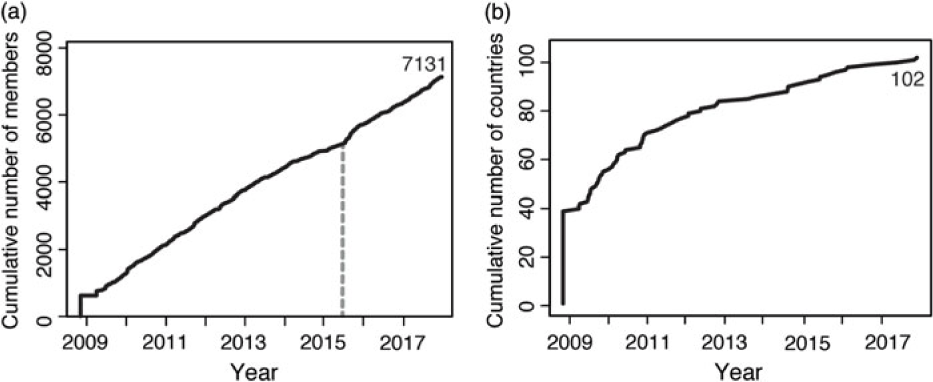
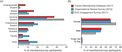
Although the network began with only a few dozen members, APECS has expanded significantly over the past 10 years. Since APECS’ inception, 7131 members from 102 countries and territories have subscribed to the APECS mailing list (Fig. 1; APECS, 2017a). The current membership database, started in June 2015, has 2972 members from 67 countries (31 December 2017). Members may unsubscribe at any time and APECS maintains a separate mailing list for non-early career scientists and professionals who wish to receive information about APECS’ activities. In terms of career stage, doctoral students comprise the largest group of members (37%, Fig. 2) and the proportion of female members (59%) is greater than male (40%). Members identifying their gender as ‘other’ or ‘prefer not to say’ each comprise <1% of the APECS membership. In the period 2008–2017, an average of 713 new members joined the APECS mailing list each year. Since 2007, around 300 early career researchers from 32 countries have joined the APECS Council, Executive Committee and Directorate, whilst many more have been involved in its National Committees (20 in 2017, APECS, 2017b). These numbers demonstrate the wide reach of APECS, as well as the growth in recruitment of new members.
Cumulative growth of (a) the number of unique APECS members and (b) the number of countries (where members live and work) represented. The dashed grey line indicates when APECS established a new member database in June 2015. Data are from the APECS membership database, accessed on 31 December 2017 (APECS, 2017a).

(a) Career stage and (b) gender of the current membership database and of survey respondents.

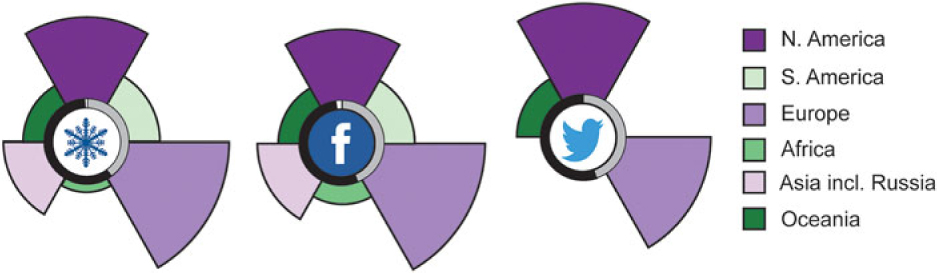
APECS maintains a social media presence on both Facebook (page and group) and Twitter. The Facebook page is the official communication channel and has 3998 fans (2 January 2018). The Facebook group, on the other hand, serves as a discussion forum for members. The group has 3073 members, of which 1937 were active (posting, commenting, ‘liking’ posts) in the 60-day period prior to 2 January 2018. The APECS Twitter account has more followers than either Facebook platform, with 5861 followers. Gender distributions are similar on all platforms (Facebook page 54% female and 44% male; Facebook group 57% female and 43% male; Twitter 54% female and 46% male). APECS’ social media accounts are dominated by followers from North America and Europe, which reflects the geographical distribution of APECS members (Fig. 3).
Overview of gender (circle; black = female, grey = male, white = non-binary and declined to respond) and geographical distribution on various APECS platforms (main mailing list n = 3152, Facebook page n = 3998, Twitter n = 5861). Geographical data for Twitter are for the top 10 countries only, which represent 74% of users. More than half of APECS members are female and membership is dominated by North America and Europe. Data are from 31 December 2017 (mailing list) and 2 January 2018 (Facebook and Twitter).

Survey response rates and demography
The 2015 Organisational Review survey received 214 responses, whilst the 2017 EOC survey received 112 responses. For both surveys the response rate was 4% of the APECS membership at the time the respective surveys were launched. Despite the low response rate compared to that expected for web-based surveys (around 30%, Cook, Heath, & Thompson, Reference Cook, Heath and Thompson2000; Nulty, Reference Nulty2008), the demography of survey participants approaches that of the general APECS membership both in terms of career stage and gender (Fig. 2). In terms of career status, the organisational review survey had a greater contribution from senior APECS members, (‘Other’ and ‘Faculty’) than the overall membership. This reflects the fact that views from more senior members were actively sought. The EOC engagement survey had a higher relative proportion of doctoral students (47%) compared to the general membership (37%), possibly reflecting that this is the career stage when members are most actively engaged in EOC activities. The gender balance of the organisational review survey is similar to that of the general membership, with participants identifying as 59% female, 39% male, and 2% declined to respond. Female participation in the EOC engagement survey, however, was greater, at 70% (Fig. 2). Those who responded to the survey are likely to systematically differ from those who did not respond, potentially leading to non-representative results (Nulty, Reference Nulty2008; Sax, Gilmartin, & Bryant, Reference Sax, Gilmartin and Bryant2003). For example, 96% of survey respondents in the EOC survey had been involved in EOC activities. In contrast, a survey of outreach activities conducted by CNRS (French) scientists found that only 47% were involved in EOC activities (Jensen, Rouquier, Kreimer, & Croissant, Reference Jensen, Rouquier, Kreimer and Croissant2008).
The level of EOC engagement in the wider APECS membership is probably lower than that recorded by the survey. People join APECS for a variety of reasons, not just to participate in EOC activities, and these members may have felt that the survey was not relevant to them. Studies in other scientific fields report that despite widespread acknowledgement of the societal benefits of EOC, there remain a number of perceived barriers to participation (Royal Society, 2006; Varner, Reference Varner2014). If this hypothesis is true, then it serves to highlight the continuing exigency of APECS’ mission, 10 years after IPY, to promote EOC as an integral part of polar research. Although the low response rate of both surveys prevents us from reaching robust conclusions regarding the impact of participation in APECS EOC activities, the survey results do provide instructive context when examining examples of EOC activities and skill development throughout this paper.
Survey results
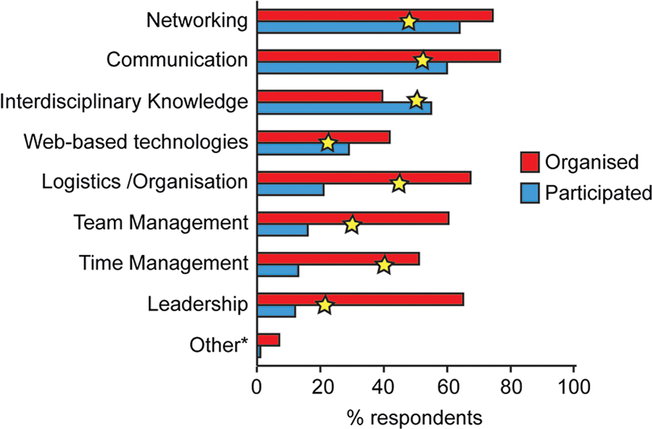
The results of the Organisational Review Survey are published in Zaika et al. (Reference Zaika, Beck, Badhe, Dubinenkov, Kuznetsova, Pope and Xavier2015). In terms of APECS’ activities, the most highly valued was APECS’ work in creating ECR opportunities, with 83% of members rating this activity as 4 or 5 on a 5-point Likert scale. The twin EOC activities of Polar Weeks and Antarctica Day were rated 4 or 5 by 48% of participants (Fig. 4) and 64% rated the development of EOC resources as 4 or 5. The top three highly valued skills (rated 5 on a 5-point Likert scale) were communication (53%), interdisciplinary knowledge (50%) and networking (48%) (Fig. 5).
Percentage of survey participants in the EOC survey (n = 112) who participated in or organised EOC events. Note that National Committee (NC) activities are activities not associated with Antarctica Day or Polar Weeks. The stars indicate the percentage of respondents in the Organisational Review Survey (n = 214) who rated the events as 5 ‘very valuable’ on a 5-point Likert scale.

Survey respondent reports of skills gained by organising or participating in APECS EOC activities. Figure shows the percentage of respondents who self-identified as organising activities (n = 43) or participating in activities (n = 85). Multiple answers were possible. ‘Other’ includes understanding of funding mechanisms, international collaboration, project management and challenges of a predominantly volunteer-led organisation. The stars indicate the percentage of respondents in the Organisational Review Survey (n = 214) who rated the skills as 5 (very valuable) on a 5-point Likert scale.

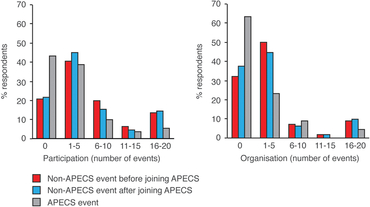
Since joining APECS, 79% of EOC survey respondents reported having participated in an EOC activity external to APECS and 57% reported having participated in an APECS EOC activity. A smaller percentage of respondents had helped organise an activity: 68% for non-APECS and 37% for APECS activities. The five most common APECS activities members reported being involved in (organised plus participated) were webinars, Polar Weeks, workshops, National Committee activities and Antarctica Day (Fig. 4). Those who get actively involved are most likely to participate in, or organise, a small number (<5) of activities (Fig. 6). The reported perception of skills gained from involvement in APECS activities varied depending on whether the respondent was participating in or organising the event. The three main skills gained by participating in an APECS EOC event were networking (75%), communication (71%) and interdisciplinary knowledge (65%). Those who organised events also identified gaining those same three skills, and in addition they reported gaining leadership skills such as team management (Fig. 5).
The number of times survey participants (n = 112) participated in or organised EOC events.

Discussion
The legacy of IPY continues to unfold. Sloan and Hik (Reference Sloan and Hik2008) proposed that the legacy should include raising the public profile of the polar regions, linking science and policy more effectively, improving opportunities for northerners and sharing logistical information more broadly and efficiently. Krupnik et al. (Reference Krupnik, Allison, Bell, Cutler, Hik, López-Martinez and Summerhayes2011) identified the many scientific achievements and enhanced scientific and political cooperation, the development of a new generation of polar scientists and engineers and a broad public interest in the polar regions as emerging legacies of IPY. The elements highlighted in both papers continue to be of interest for APECS members. To ensure the legacies pertaining to EOC and ECRs are fulfilled, APECS has continued to build on the work started during IPY to promote polar education and outreach as well as the training of the next generation of polar researchers.
Polar education and outreach: raising the public profile of polar regions
The implementation of effective public outreach has been identified as a key area in which researchers should improve their efforts in order to meet societal obligations (Leshner, Reference Leshner2007; Lubchenco, Reference Lubchenco1998). Raising the public profile of polar regions by placing a strong emphasis on education and outreach initiatives was therefore one of the foci of the 4th IPY (Provencher et al., Reference Provencher, Baeseman, Carlson, Badhe, Bellman, Hik and Zicus2011; Salmon et al., Reference Salmon, Carlson, Zicus, Pauls, Baeseman, Sparrow and Raymond2011) and has been one of the key pillars of APECS activities since its foundation (APECS, 2016a). In the 2015 organisational review survey, 83% of respondents thought APECS’ goal of Developing effective future leaders in polar education and outreach was important or very important (4 or 5 on a 5-point Likert scale). Indeed, many APECS members were contributors to the polar resource book Polar Science and Global Climate: An International Resource for Education and Outreach (Kaiser et al., Reference Kaiser, Zicus and Allen2010). This book aimed to inspire educators, students and polar researchers to continue their education and outreach efforts. In addition, the Polar Education and Outreach Catalogue, an archive of more than 550 education and outreach activities that took place during IPY, is hosted on the APECS website (Provencher et al., Reference Provencher, Baeseman, Carlson, Badhe, Bellman, Hik and Zicus2011) and was deemed valuable or very valuable (4 or 5 on a 5-point Likert scale) by 51% of the organisational review survey participants.
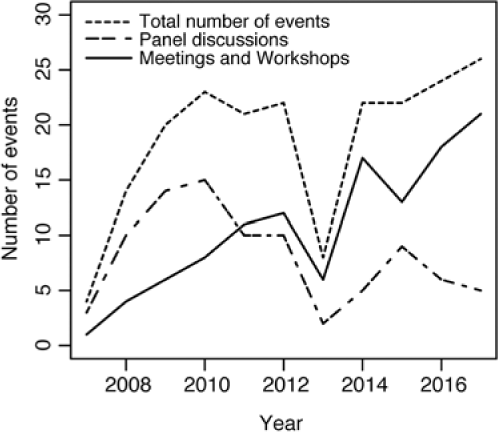
Today, the education and outreach momentum from the IPY is carried on by APECS, in conjunction with other organisations, such as Polar Educators International (PEI) (Walton, Xavier, May, & Huffman, Reference Walton, Xavier, May and Huffman2013). This is reflected in APECS members’ participation and organisation of non-APECS EOC events (Fig. 6) and the efforts of APECS and its National Committees, which have, since 2007, organised 117 workshops and meetings and 89 panel discussions. The number of events organised annually has increased from 4 in 2007 to 26 in 2017 (up until 30 September) (Fig. 7; APECS, 2017b). Many early career researchers have been involved in communicating both their own research and the importance of the polar regions to a wider audience, using a combination of face-to-face methods (e.g. presentations at schools, workshops on polar education, polar exhibitions) and various online platforms (Beck et al., Reference Beck, Huffman, Xavier and Walton2014). A number of EOC survey participants commented that APECS provided a platform where they could learn about and share outreach methods. For example, one respondent wrote “Through involvement in APECS activities I have learned excellent new ways to communicate polar science that I have then utilized in my own outreach activities.”
Number of events (workshops, meetings and panel discussions) organised by APECS per year since 2007. Data for 2017 are until 30 September.

Engagement in APECS’ flagship EOC activities of Antarctica Day and Polar Weeks continues to grow. Both the number of National Committees involved in Polar Weeks and the number of activities continue to increase every year. In the September 2012 Polar Week, six National Committees actively engaged around 4000 students, 115 teachers and 25 scientists and educators through school visits (APECS, 2013). In September 2017, 11 National Committees organised 16 activities, ranging from film viewings to symposia, in addition to the traditional school visits (APECS, 2017b). In 2015, 22 schools participated in the Antarctic Day Flag project (currently led by the UK Polar Network, UKPN) and 150 flags were created (APECS, 2016b). The flags, representing Antarctica or Antarctic values, are designed by school children and taken to Antarctica by researchers and photographed. Preliminary data for 2017 demonstrate the growth of this project, with over 600 flags created from 100 schools (S. Buzzard, UKPN, personal communication, 1 December 2017).
Online social media are increasingly being used to broaden outreach (Benderly, Reference Benderly2014; Shiffman, Reference Shiffman2012; Smith, Reference Smith2014; Spencer, Gunderson, Hoiland, & Schleiffarth, Reference Spencer, Gunderson, Hoiland and Schleiffarth2017) and is a key component of APECS’ Polar Weeks and Antarctica Day activities (Nielsen, Thornton, & Fugmann, Reference Nielsen, Thornton, Fugmann, Abu Samah and Baeseman2016). Since 2015, a Reddit ‘Ask Me Anything’ (AMA) has been organised in conjunction with the Polar Weeks. This allows APECS to communicate with an audience who may not otherwise come into contact with polar research. The March 2016 thread made it to the front page of Reddit, with 1911 votes, thereby showcasing current research themes to the general public. Twitter has been used to promote Polar Weeks amongst the wider community already engaged in polar regions by employing specific hashtags, such as #PolarPeople (March 2017 Polar Week) and #PolarWorld (September 2017 Polar Week). The #PolarPeople hashtag in particular resulted in a spike of engagement, with 121 tweets during the Polar Week, with 189 retweets and 262 ‘likes’. The use of such hashtags encourages interaction and provides both members and those with an interest in learning more about polar research with a platform to engage with one another. By taking part in these social media activities, APECS members not only help promote EOC activities but they also learn how to tailor science messages to different audiences and how to communicate their own research effectively.
Capacity building for the next generation of polar researchers
The other major IPY legacy APECS has focused on is capacity building and training for the next generation of polar scientists. Since the creation of APECS, emphasis has been put on experiential training and the development of soft skills (Pope, Fugmann, & Kruse, Reference Pope, Fugmann and Kruse2014). Members learn new skills by being involved in the process of planning and implementing APECS activities, or by attending training sessions run by experienced scientists or professionals, both online (e.g. webinars) and in person (e.g. workshops). Skills such as networking and communication (Fig. 5) are not necessarily part of the standard curriculum of a graduate school or a postdoctoral fellowship in polar sciences, but are often key elements of a successful career in both academic and non-academic professions (Gordon, Reference Gordon2014; Kumar & Hsiao, Reference Kumar and Hsiao2007; Weiler, Reference Weiler2007). A survey by LeDee et al. (Reference LeDee, Barnes, Emanuel, Fisher, Henkel and Marlon2011) found that informal methods, including self-teaching and peer-learning, were the primary means of acquiring new skills during postgraduate education. Providing opportunities for ECRs to run and participate in workshops and other events can therefore have impacts that last well beyond the event itself. We identify three main pathways for APECS members to acquire skills: participatory, leadership and external. Participatory skill acquisition involves making use of APECS’ resources, e.g. webinars, web materials, workshops; leadership skill acquisition involves the active creation of resources for other APECS members, e.g. organising a workshop and external refers to skills gained by taking on a position advertised through APECS with one of APECS’ partner organisations, e.g. IASC Fellowship scheme.
Skills gained through participatory activities
Many of the activities and projects organised by APECS members on behalf of APECS are focused on soft-skills training for ECRs. APECS provides in-person training through regular workshops and panel discussions, often connected to large polar conferences, such as SCAR Open Science Conference (OSC) and Arctic Science Summit Week (ASSW). Workshop topics have focused on a variety of skills, including proposal writing, conducting fieldwork, science communication and working with Indigenous people (Schmale, Lisowska, & Smieszek, Reference Schmale, Lisowska and Smieszek2013; Thomas, Baeseman, Lantuit, Xavier, & Baker, Reference Thomas, Baeseman, Lantuit, Xavier and Baker2008). By giving ECRs responsibility for organising these events, relevant themes are selected. This means that practical skills are gained not only by those organising the events but also by those who participate. For example, at the APECS World Summit in 2015 (Vick-Majors, Engelbertz, & Fugmann, Reference Vick-Majors, Engelbertz and Fugmann2016), a dedicated session on data management was organised, following growing interest from ECRs. This topic was highlighted as being of key importance during IPY and is ever more pertinent today (Friddell, LeDrew, & Vincent, Reference Friddell, LeDrew and Vincent2014; Mokrane & Parsons, Reference Mokrane and Parsons2014). Another example, and a theme highlighted during IPY (Krupnik, Reference Krupnik, Krupnik, Lang and Miller2008), was the recognition by APECS members that collaborations with Indigenous community members could be improved. The resultant webinar series (part of the APECS Nordic Project Bridging Polar Early Career Researchers and Indigenous Peoples in Nordic Countries) was a solutions-focused activity that identified research challenges from the perspectives of both ECRs and Indigenous peoples (Sharp, Paquin, & Fugmann, Reference Sharp, Paquin and Fugmann2015). Through APECS’ involvement in larger funded projects, such as the four EU Horizon 2020 funded projects APPLICATE (Advanced Prediction in Polar regions and beyond: modelling, observing system design and LInkages associated with a Changing Arctic climaTE), INTERACT (International Network for Terrestrial Research and Monitoring in the Arctic), Nunataryuk and ARICE (Arctic Research Icebreaker Consortium), APECS is able to provide and develop larger training programmes, such as online courses and field schools for its members (Tummon, Day, & Svensson, Reference Tummon, Day and Svensson2018).
APECS was an early adopter of webinars as an effective means to reach a geographically dispersed membership (Nielsen et al., Reference Nielsen, Thornton, Fugmann, Abu Samah and Baeseman2016). These webinars, many of which focus on the development of soft skills that may not be developed during formal training, are a valuable resource for APECS members and the wider community. All webinars are recorded and available as free and open-access resources on the APECS website and Vimeo. More than 135 webinars are currently archived on the APECS website, and APECS webinars uploaded to Vimeo were played 3693 times in 2017, which is roughly equivalent to every APECS member watching one video during that year. Maintenance of an archive of webinars means the lessons shared at one point in time are not temporally constrained; rather, they continue to be available as a development resource for years to come.
In contrast to preceding early-career networks, APECS developed an interdisciplinary approach from the outset, breaking new ground with its geographical (polar) focus and its efforts to cross disciplinary boundaries. The geographical focus allows members to meet other ECRs from the whole spectrum of scientific backgrounds and find common ground; disciplinary borders therefore become less important, making it a fruitful ground for discussions that encompass a wide range of views. The inclusion of researchers from both the natural and social sciences marks APECS apart from many national organisations for ECRs, which often have a much narrower focus (e.g. Australia’s Early- and Mid-Career (EMCR) Forum). Events such as the annual APECS Online Conference are deliberately structured to juxtapose research from different fields, and to provoke curiosity, questioning and discussion. Indeed, networking, communication and interdisciplinary knowledge were identified as the three most valuable skills for polar researchers and the top three skills respondents perceived they had gained as a result of participating in APECS’ EOC activities (Fig. 5). These skills stand APECS members in excellent stead for engaging in a polar research environment where interdisciplinary and multinational research is increasingly common.
Skills gained through leadership activities
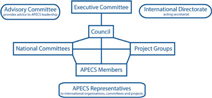
By having an inclusive leadership structure (Fig. 8), in which any actively contributing member is part of the leadership, APECS creates a low barrier to entry. Tiered and progressive leadership roles enable ECRs to learn and grow, as does a strong peer-to-peer support network. APECS’ success is built on the enthusiasm and dynamism of its members, who suggest new ideas and are provided with the support needed to follow them through. A participant in the 2015 organisational review survey commented that this enabled them “to practise leadership skills in an environment that feels safe”. Through a variety of positions, from local project coordinators for National Committees to the APECS Executive Committee, APECS members are exposed to challenges, an international, multidisciplinary network and opportunities that may differ from those normally encountered at their home institutions. Opportunities such as planning a workshop, scheduling and hosting an online meeting, crafting a partnership agreement with a potential partner organisation, or learning how to communicate science to students at a high school (potentially on the other side of the planet) all offer the chance for further skill development. Responses to the EOC engagement survey hint that rather than a small core of very active members who organise the majority of activities, there exists a large pool of members, who each organise a number of small activities (Fig. 6). This finding highlights the effectiveness of APECS in training a broad pool of ECRs; a trait that is amplified due to the high turnover of ECRs within the APECS leadership. Similar bottom-up organisational structures have been adopted in other early-career organisations, e.g. Young Earth System Scientists (YESS; Rauser, Schemann, & Sonntag, Reference Rauser, Schemann and Sonntag2015) and APECS has been highlighted as a best practice example. APECS has regularly helped mentor other ECR networks with different regional or disciplinary foci (e.g. YESS, the International Penguin Early Career Scientists (IPECS) and the Early Career Researchers Network of Networks (ECR NoN)) during their establishment phases, willingly sharing the experiences gained in developing a sustainable ECR network, including setting up an organisational structure, defining aims and procedures and coping with high membership turnover.
The organisational structure of APECS as of October 2015.

APECS’ EOC activities provide a vehicle with which ECRs can learn valuable and transferable soft skills such as leadership, communication and organisation. One preliminary finding from the 2017 EOC survey is that different skill-sets are gained by organising activities, compared to simply participating in them. Those who organised activities were more likely to report gains in management-related skills compared to those who only participated (Fig. 5). Examples include leadership (65 vs 14%), team management (60 vs 19%), time management (51 vs 15%) and logistics and organisation (67 vs 25%). This finding is in agreement with previous studies reporting the acquisition of soft-skills during active participation in EOC activities (e.g. Carpenter, Reference Carpenter2015; Laursen, Liston, Thiry, & Graf, Reference Laursen, Liston, Thiry and Graf2007). Taking part in the planning of an event and seeing it through to the execution stage provides insights into the bigger-picture planning required and makes visible the work that happens behind the scenes at any large event. One EOC engagement survey participant stated: “…you learn how to organize small to large event [sic] and the (heavy) logistics that are hidden behind it”, and another stated “APECS definitely balanced out my academic scientific learning with needed skills in networking, communications, and team organization & leadership”. Such comments demonstrate the perceived value of APECS’ EOC activities in fostering positive skill development. Furthermore, the skills gained by participating in EOC events are highly transferable and are identified as such by ECRs. In response to a 2017 EOC survey question on whether involvement in EOC activities had benefited their career, 77% of participants affirmed that it had, by providing contacts, skills, or exposure to new opportunities.
Skills gained through external activities
Since its inception, APECS has worked with partner organisations to provide leadership opportunities external to APECS. This has enabled more than 150 individual ECRs (some of them more than once) to further develop their skills by:
Nominating ECRs to boards and planning committees of major international polar research-focused organisations such as IASC, SCAR, the European Polar Board (EPB) and the Conservation of Arctic Flora and Fauna (CAFF) working group of the Arctic Council;
Nominating ECRs to sit on conference committees and act as session conveners for major international polar conferences such as the IPY Conferences in 2010 and 2012, the Arctic Science Summit Weeks and the SCAR Open Science Conferences (31 out of the 43 sessions at the 2016 SCAR OSC had ECR session co-chairs);
Creating opportunities for ECRs to be involved in the production or review of scientific synthesis reports, such as the Intergovernmental Panel on Climate Change’s (IPCC) special report on the Ocean and Cryosphere in a Changing Climate and the Arctic Monitoring Assessment Programme (AMAP) Adaptation Actions for a Changing Arctic regional reports;
Facilitating the application and selection process for various ECR opportunities, such as the IASC Fellowship programme; and
Enabling ECRs to attend meetings of international polar-research focused organisations and planning groups either as observers or as regular meeting participants.
During 2017, 19 APECS members served as representatives to partner organisation committees and five represented APECS at meetings (APECS, n.d.c). APECS strives to garner widespread attention for the value of ECR involvement within the wider polar community and to address key issues within polar science. Examples are a workshop at the International Conference on Arctic Science: Bringing Knowledge to Action entitled Scientific Assessments: Process, Dissemination and Impact (Timm, Pope, Smieszek, Fugmann, & Zaika, Reference Timm, Pope, Smieszek, Fugmann and Zaika2017) and a panel discussion at the 2010 SCAR OSC entitled Antarctic Science: Role of SCAR in Promoting Early Career Research Opportunities. The success of the latter event may be gauged by the increasing number of ECR representatives on SCAR committees; there are currently 14 ECR representatives on seven committees, with eight of these positions established since December 2016 (APECS, n.d.c). These types of opportunities have allowed ECRs to gain early experience of tasks that may await them in a future academic career, whilst also developing skills valued by both the private and public sectors.
The work that APECS does to create ECR opportunities was identified as one of the most valued aspects of APECS, with over 80% of the organisational review survey participants rating these positions as valuable or very valuable (4 or 5 on a 5-point Likert scale). The feedback from the ECRs who participated in these international opportunities and from senior scientists has been overwhelmingly positive, as the following examples highlight:
Karolina Paquin, ECR representative CAFF Board Meeting (2016): “The CAFF working group is a wonderful collection of experts … their board meetings allow for young scientists to gain insight into how working groups function.”
Andreas Preußer, APECS Germany representative to the 26th Annual Meeting of the German National Committee SCAR/IASC (2017): “The invitation …to participate … can give valuable insights into national science activities and the translation of international science agreements and guidelines to a national level. Not less important – the NK SCAR/IASC is an ideal occasion to extend an ECS’s professional network by facilitating communication with experienced senior researchers, federal institutions and/or funding agencies.”
Gabriela Roldan, ECR session co-chair SCAR Open Science Conference (OSC) 2016: “This has been an amazing experience for me, not just for the expertise gained … but most of all for the helpfulness and collegiality from all involved”.
Anonymous Organisational Review Survey respondent: “Through APECS positive engagements [sic] it has become mandatory to always ask “what early career scientist should we involve in this” rather than seeing this as an “unnecessary must”. APECS has shown that high-level organisations can benefit from and rely on the organisational skills of young scientists.”
Anonymous Organisational Review Survey respondent: “In the past, few young people had the courage to step up and say ‘I can contribute’. APECS has helped give many young people a voice and a path to engagement.”
Anonymous Organisational Review Survey respondent: “I know of no other scientific field where a consistent and persevere [sic] presence of early career scientists and their perspectives is at the forefront as it is in polar sciences. I can only assume this is because of the work by APECS.”
These quotes demonstrate the enormous value of ECR positions on boards and committees, where ECRs interact directly with the leading scientists in their field. ECRs are not passive observers, but rather active participants, invited to provide an ECR perspective on discussions; their suggestions and insights can shape final decisions in positive and exciting ways. The skills gained at the international level can then be used at a national level. For example, APECS members who have been active at the international level have gone on to develop active public polar outreach programmes in non-traditional polar countries, including Portugal, Bulgaria and Brazil (Schiermeier, Reference Schiermeier2009; Xavier et al., Reference Xavier, Gray and Hughes2018). This in turn inspires the next generation of researchers.
An increasingly sought-after skill is communicating science to policy makers. To create opportunities at the science–policy interface, APECS has worked closely with partner organisations such as the Arctic Council Working Groups AMAP and CAFF (Timm et al., Reference Timm, Pope, Smieszek, Fugmann and Zaika2017). Engagement of ECRs in CAFF and AMAP has been achieved through inclusion as co-authors in reports and their presence as observers at meetings and workshops (Provencher, Gantner, Schmale, Swanson, & Baeseman, Reference Provencher, Gantner, Schmale, Swanson and Baeseman2012). APECS members actively contributed to the Arctic in Rapid Transition (ART) priority sheets, which outlined research of areas of high priority in the Arctic, for the Third International Conference on Arctic Research Planning (ICARP III) (Werner et al., Reference Werner, Fritz, Morata, Keil, Pavlov, Peeken and Wegner2016). In 2017 APECS cooperated with CAFF and IASC in the lead up to the Arctic Biodiversity Congress 2018, which was organised by CAFF, to establish a new CAFF–IASC Science Policy Fellowship programme that provided two fellows with direct science–policy experience. The establishment of these opportunities may be considered a result of the increased visibility of ECRs within the polar science community since the 4th IPY, and indicates the success of APECS in providing a single voice for ECRs in lobbying for such opportunities.
Diversity
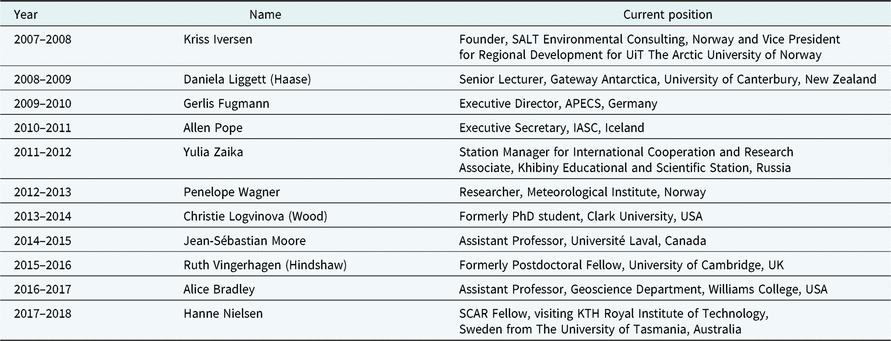
APECS aims to be inclusive and provide a welcoming space for all polar researchers, regardless of their gender, sexual orientation, disability, race, religion or national origin (APECS, 2018). The organisation continues to work to ensure that researchers from a broad range of backgrounds are represented at the leadership level. In the following we focus on gender diversity within APECS. The lack of gender parity at higher levels of academia has been highlighted extensively (e.g. Barres, Reference Barres2006; Larivière, Ni, Gingras, Cronin, & Sugimoto, Reference Larivière, Ni, Gingras, Cronin and Sugimoto2013; Nash, Davies, & Moore, Reference Nash, Davies and Moore2017; Shen, Reference Shen2013) and popularised through the ‘leaky pipeline’ metaphor (e.g. Pell, Reference Pell1996). In this context, it is therefore noteworthy that in the last decade eight of 10 APECS Presidents were female (Table 1) and 11 of APECS’ 20 National Committees in 2016–2017 were led by women (APECS, 2017b). Women have been found to take on a greater proportion of service roles within university institutions and this has been partly attributed to an inability to ‘say no’ (Guarino & Borden, Reference Guarino and Borden2017). The fact that APECS, as a volunteer-led organisation, has a greater proportion of female leaders may indicate another factor: that female researchers are more likely to volunteer and actively seek out leadership opportunities that may not be readily available to them within their home institution. The bottom-up ethos of APECS allows participation of under-represented groups, increasing their opportunities and visibility on the international stage. Female role models have been identified as one factor in helping to improve retention of women in science, technology, engineering and mathematics (STEM) fields (Dasgupta, Reference Dasgupta2011; Drury, Siy, & Cheryan, Reference Drury, Siy and Cheryan2011). A positive consequence, which would need to be tested and will need to wait until these ECRs are more senior in their careers, is that the high proportion of female leaders within APECS may help improve gender equality in the next generation of polar scientists.
The current job titles (in June 2018) of the first 11 APECS Presidents.

Next generation of polar leaders
Skills gained through work on APECS projects and through the training provided by APECS’ international partners have an ongoing impact on ECRs; this is evidenced by the range of careers that past APECS leaders have gone on to succeed in, including academia, consultancy and science management (Table 1). Not all the benefits of active APECS membership are tangible, but the observed benefits from the point of view of individual members are wide ranging. At times the benefits are directly acknowledged: one EOC survey participant stated that: “APECS was the single most beneficial organization to my current career. I can’t say enough good things about it. In my current faculty position, I strongly encourage any student who even mentions polar regions in passing to join APECS.” In other instances, formative experiences in an APECS forum can help ECRs to develop soft skills and come into contact with mentors from APECS’ partner organisations, thus opening up new career opportunities: 35% of the respondents in the 2017 EOC survey were inspired to consider non-academic career pathways as a result of their involvement in APECS. Previous studies have highlighted that EOC activities provide low-risk opportunities to explore career options (Laursen, Thiry, & Liston, Reference Laursen, Thiry and Liston2012). All of the initiatives discussed in the preceding sections contribute to the training of the next generation of leaders in both science and policy and have proven to be highly successful for the ECRs, the host organisations, and for APECS. Indeed, the involvement of ECRs in international research communities as contributors to projects, working groups and organisations has been found to improve career success and retention of ECRs in polar science (Majaneva, Hamon, Fugmann, Lisowska, & Baeseman, Reference Majaneva, Hamon, Fugmann, Lisowska and Baeseman2016). Having ECRs participate in these activities not only builds their communication and management skills, it also builds talent from within the organisation and supports institutional memory.
Conclusions and perspectives
Through its inclusive structure, ability to adapt to new technologies and the desire to grow both national and international networks, APECS has been an active force in continuing the IPY legacy. Part of maximising the scientific return of such a programme requires coordinated international efforts that can engage diverse stakeholders (Kennicutt et al., Reference Kennicutt, Chown, Cassano, Liggett, Massom, Peck and Sutherland2014). APECS has been a model organisation in this regard, demonstrating the effectiveness of National Committees, the APECS leadership (Council and Executive Committee) and the international secretariat in collaborating with a broad range of stakeholders. In addition to scientific goals, both outreach and inspiring the next generation of polar scientists were defined as fundamental components of IPY (International Council for Science, 2004). The International Polar Weeks and Antarctic Day initiatives are successful examples of the extended reach that can be realised through coordinated international efforts. The EOC activities organised by APECS reach an ever-greater audience, enthusing and inspiring people about the polar regions. The importance of these efforts cannot be underestimated; APECS strives to maintain and promote this aspect of the IPY legacy.
Many of the ‘IPY generation’ of ECRs who have gained degrees in polar science, engineering and social sciences in the last decade will be involved in, and also affected by, the Arctic and Antarctic science priorities in the coming decade (Fritz et al., Reference Fritz, Deshpande, Bouchard, Högström, Malenfant-Lepage, Morgenstern and Weege2015; ICARP III, 2015; Kennicutt et al., Reference Kennicutt, Chown, Cassano, Liggett, Massom, Peck and Sutherland2014). By participating in strong networks such as APECS, PYRN and YESS, ECRs gain an opportunity to be leaders in the polar science community and at the science–policy interface. They gain valuable experience by being on boards and planning committees of major international polar research-focused organisations, including IASC, SCAR, EPB and CAFF. In addition, APECS provides a unique platform for early-career scientists to self-select themselves into opportunities in which they can organise and participate in EOC initiatives and events. Through these opportunities ECRs learn new skills, which benefit their career prospects. In addition, APECS has been a model of gender empowerment and inclusivity in polar science.
APECS is a volunteer-led organisation and this structure has had the added impact of increased participation of ECRs in organising education and outreach events. ECRs thereby gain valuable transferable skills, in addition to their academic skills, which stand them in excellent stead when negotiating career decisions. As the IPY generation of ECRs are entering mid-career positions, there is a need and opportunity to harness this pool of skilled professionals. Looking to the future, the legacy of the IPY will endure, as APECS continues to support and foster the coming generation of polar leaders.
Supplementary material
To view supplementary material for this article, please visit https://doi.org/10.1017/S0032247418000591.
Author ORCIDs
Ruth Hindshaw, 0000-0002-1108-4428; Allen Pope, 0000-0001-9699-7500; Hanne Nielsen, 0000-0002-2761-7727
Acknowledgments
We would like to thank José Xavier (University of Coimbra, Portugal), Jenny Baeseman (Baeseman Consulting & Services, LLC), Narelle van der Wel (World Climate Research Programme) and Daniela Liggett (University of Canterbury, New Zealand) for comments on both the EOC survey design and earlier versions of this manuscript and for providing valuable information on APECS’ early years. Thank you to Jilda Caccavo (APECS President 2018–2019) for proofreading the manuscript. We also thank the organisations that have funded and supported APECS over the years, everyone who took the time to contribute to the two surveys, and two anonymous reviewers who provided insightful comments. This paper documents the tremendous amount of time APECS members have volunteered to make the organisation what it is today and to deliver APECS’ EOC activities: to all of you, thank you!
Financial support
This research received no specific grant from any funding agency, commercial or not-for-profit sectors.