In 1995 a session at the American Historical Association conference brought together distinguished scholars to discuss how major industrialized countries stabilized their political economies after 1945–1947, a rather unexpected outcome in the face of the history of depression, acute social conflicts, and war in the years 1929–1945. The participants stressed the importance of the U.S. foreign economic policy and—following the lines originally set by the work of Charles Maier—the critical role played by the “politics of productivity,” that is, the corporatist accommodation between labor and managers that linked economic growth, high employment, and real wage increases to productivity.1
See the articles presented in International Labor and Working-Class History 50 (1996): 114–56. For Maier's original contribution, see Maier, “Politics of Productivity.”
Maier, “Postwar Social Contract,” p. 148.
Assessing the overall evidence from country studies, Charles Maier maintained that the United States, France, West Germany, and Japan—despite their particular social and institutional conditions—offered “a history of capitalist convergence” towards a corporatist settlement involving labor and management, which gave rise to a high level of economic growth and relative stability in industrialized countries during the postwar years. He then wondered to “what degree Latin American societies could also be assimilated” into this overall corporatist model.3
Ibid.
Perhaps surprisingly, Maier's question actually is highly pertinent to the postwar history of Latin American countries, not the least because many of them underwent fast economic growth and rapid industrialization at the same time Europe and Japan were experiencing their golden age. Even more importantly, however, the question may help to shed new light on the causes of the highly unstable social, political, and institutional conditions that prevailed in Latin America after the Second World War. Was this chronic instability caused only by the weakness of democratic institutions in Latin America? Or was it due to an ingrained authoritarian and interventionist stance by Latin American elites? Even though one might be tempted to answer yes to these questions, any conclusion should be placed in the context of the prewar European background of far-reaching political instability, repression, and destruction on a scale that had never been seen before. As Mark Mazower reminds us, Europe was far from committed to democracy by the 1940s and fascism was the most European ideology of those that marked the “Dark Continent” in the twentieth century.4
Mazower, Dark Continent.
See, for example, Abel and Lewis, eds., Welfare; Bethell and Roxborough, “Introduction”; Bulmer-Thomas, Economic History; Cardoso and Helwege, Latin America's Economy; Coatsworth and Taylor, eds., Latin America; Furtado, Economic Development; Haber, ed., Political Institutions; Maddison et al., Political Economy; and Thorp, Progress.
One crucial reason for the failure of democratic stabilization in postwar Brazil's political economy lies with the relations between the emerging trade union movement and employers. Brazil was the largest industrial economy in Latin America by the 1950s, and this article argues that labor politics in this country after the Second World War diverged sharply from the overall pattern observed in advanced industrial societies. Although left-wing trade union leaders took over the key positions in the Brazilian labor movement, demanding substantial improvements in workers' social standing, they were not seen as reliable partners by industrialists and other elite groups in Brazil. As a result, industrial relations in Brazil became highly confrontational and antagonistic, undermining any prospects of a social contract that could favor sustained economic growth along with social reform.
The article is set in Brazil's main industrial center at the time—the state of São Paulo. São Paulo not only had the largest share of industrial output in Brazil (47.8 percent in 1949 and 55.7 percent in 1959, according to the Industrial Censuses), it was also home to the most active and influential employers' organization, the Federation of Industries of the State of São Paulo (Federação das Indústrias do Estado de São Paulo or FIESP), as well as trade unions. The analysis covers the governments and phases of labor relations in Brazil from the end of the Second World War to the end of the Juscelino Kubitscheck government (January 1961). As there are no official statistics on manufacturing industry in 1960 and 1961, the article extends its quantitative data to 1962, which is used as a reference year for interpolation. Initially, the article provides an overview of how wages and productivity evolved in postwar Brazil and then briefly outlines the features of Brazil's political economy, steps which are important to set the context and establish the main issues to be examined in the following sections. The distinct parts of the main argument are presented in sequence, by looking at industrial relations in São Paulo and Brazil after 1945. The aim is to show which were the particular political solutions to the “labor question” in the 1940s and the 1950s and the behavior of wages and productivity. The article stresses the links between domestic politics and the international Cold War juncture, and it examines the attempts made by international trade union organizations to support moderate trade union leaders who could establish a settlement with industrialists and governments in Brazil. In the end, we can see how historical developments in industrial relations had a wide-ranging impact on Brazilian postwar economic and social history.
WAGES AND PRODUCTIVITY: AN OVERVIEW
The key empirical evidence for the “social compact for growth” hypothesis is that real wages grew in tandem with productivity during the crucial years of recovery and expansion of European and Japanese economies after 1945–1947.6
Maier, “Politics of Productivity”; Maier, “Postwar Social Contract.” Other approaches that have stressed the role of productivity, wage restraint, and high investment include Eichengreen, “Institutions”; Cameron and Wallace, “Macroeconomic Performance”; and Soskice, “Wage Determination.”
Armstrong, Glyn, and Harrison, Capitalism, pp. 120–21; and Eichengreen, “Institutions.”
Wages and productivity evolved differently in postwar Brazil. Data on these variables are limited and somewhat tenuous. I have attempted to construct wage and labor productivity series by using interpolated and backward-extrapolated estimates from available statistics.8
See Tables 1 and 2 in the section “Labor Politics in the Early Postwar Years.”
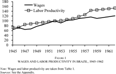
Overall trends are clear even before we take a closer look at the data. Thus Figure 1 shows that, for most of the 1945–1962 period, labor productivity exceeded real wages in Brazil's manufacturing industry. Tests of structural stability, using a regression model with dummy variables, show that there was a change in the level and the slope of Brazil's labor productivity series, indicating the existence of a structural break in 1954—an outcome not replicated by wages.9
See the Appendix for the tests.
Average rate of growth between 1950 and 1960, with data from Zerkowski and Veloso, “Seis Décadas.”
Developmentalist economic policies aimed at rapid industrialization, with foreign and domestic private capital as active partners of the state (Bielschowsky, Pensamento Econômico Brasileiro; and Sikkink, Ideas). Populist economic policies were originally defined by historians as policies implemented by charismatic politicians who, based on multiclass political coalitions, sought to establish a direct relation with the people by pursuing nationalism, state intervention, rapid industrial growth, and ameliorative distributive measures in Latin America, between the 1920s and 1960s. See Conniff, ed., Latin American Populism. For a view of the different approaches to and new uses of the concept of populism, see Knight, “Populism.”

FIGURE 1 WAGES AND LABOR PRODUCTIVITY IN BRAZIL, 1945–1962
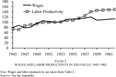
The trend is similar in São Paulo. Real wages in São Paulo lagged behind labor productivity from 1956, as can be seen in Figure 2. As in Brazil as a whole, a regression model with both intercept and slope dummy variables shows that São Paulo's labor productivity series is not stable across time, indicating the presence of a structural break in 1954 (see the Appendix). It seems that, even at the heart of the industrial transformation in Brazil, workers were not able to keep pace with rationalization and improvements in production organization by firms, which led to significant increases in labor productivity during the second half of the 1950s and early 1960s.
The behavior of wages and productivity could conceivably reflect the initial phase of the Kuznets curve, as inequality increased during the first stages of economic development. However, it seems more likely that specific, institutionally determined factors—such as inflationary macroeconomic policies, minimum-wage policies, strategies by firms, and workers' bargaining power—were the main causes shaping the distribution of wages and profits in Brazil, not only in the 1950s but also in the 1960s.12
This is what Albert Fishlow, John Wells, Rodolfo Hoffman, and others argued in a well-known debate over the increasing income concentration in Brazil between 1960 and 1970. These authors held that income concentration was mostly explained by political and institutional factors related to the military government from 1964—not by a structural increase in income concentration in the first stages of economic development (as other authors, such as Carlos Langoni, maintained). See the contributions in Tolipan and Tinelli, eds., Controvérsia.

FIGURE 2 WAGES AND LABOR PRODUCTIVITY IN SãO PAULO, 1945–1962
BRAZIL'S POLITICAL ECONOMY IN THE POSTWAR YEARS
Brazil's political economy from the 1940s to the early 1960s was deeply affected by two major developments in earlier decades. First, the demands of the growing industrial working class for economic benefits, social rights, and political participation called into question the traditional relations between state and society in Brazil. The existence of this working-class challenge was an important aspect of the political events in the 1930s, which started with the seizure of power by a coalition of forces led by Getúlio Vargas—the Revolution of 1930. At first, the new government was responsive to working-class demands and made an attempt to acknowledge the rights of emerging social forces. Between 1932 and 1937, new social legislation enacted by the government addressed many of the issues labor organizations had been fighting for since at least the 1910s.13
Gomes, Burguesia, ch. 6; and Vianna, Liberalismo, pp. 141–49, 181–97. For the changes in the state and attitudes by industrialists during and after the Revolution of 1930, see Diniz, Empresário; and Weinstein, For Social Peace.
Despite government action in the area of social rights, the limitations of the reformist zeal of the political forces that took power in the Revolution of 1930 were made clear within a few years. As trade unions and political groups independent from the government pushed forward their campaign for extended economic and social benefits, the newly founded institutional order, established by the Constitution of 1934, began to crumble. In January 1935 the government decreed a National Security Law, which heralded a period of harsh repression of labor organizations. In November 1937 Vargas and his supporters shut down Congress and consolidated their authoritarian rule, giving birth to the Estado Novo (New State) regime, which would last until October 1945. A new era of relations between the state and the workforce was then initiated, in which the “labor problem” became a matter of national security.14
Gomes, Invenção, ch. 4; and Vianna, Liberalismo, pp. 119–206.
Second, the 1930s also saw the establishment of the framework that would regulate industrial relations over the next decades. By 1939 successive government decrees had laid down a state-corporatist structure in which both employer and labor representations were defined as consultative organs attached to the state. In the end, the new legislation enforced a three-tier hierarchy in which trade unions (in cities), federations (in states), and confederations (at the national level) would represent the interest of employers and employees in a given trade. The Ministry of Labor, Industry, and Commerce (set up in 1931) held the power of authorizing, supervising, and controlling the official unions, which in turn were forbidden to declare or publicize political and religious ideas. At the same time, in 1932 the government began to set up a labor court system to mediate in the legal disputes between labor and management.15
Decrees 19,770, 19 March 1931; 24,694, 12 July 1934, and 1,403, 5 July 1939 (the latter was reviewed by Decree 2,533, 29 June 1940). On this legislation: Simão, Sindicato, ch. 4.
During the Estado Novo, the state-corporatist structure of industrial relations was further strengthened by complementary legislation. In addition to Decree 1,403 of 1939, which consolidated the intervention in trade union issues initiated in 1931, in July 1940 a mandatory union tax (imposto sindical) on all employees provided official trade unions, federations, and confederations with stable funding for their regular work as appendages of the state. In May 1939 a new Labor Justice system was set up with a three-level structure comprising local councils (Juntas de Conciliação e Julgamento), regional tribunals (Tribunais Regionais do Trabalho), and a top federal body responsible for last-instance decisions (Tribunal Superior do Trabalho). Finally, in November 1943, the Consolidated Labor Laws (Consolidação das Leis do Trabalho or CLT) brought together and expanded the social legislation enacted during the previous years. The Consolidated Labor Laws were the final step in the establishment of an authoritarian corporatist system that would regulate labor-management conflicts in the following decades in Brazil, notwithstanding the end of the Estado Novo regime in late 1945.16
Rodrigues, Sindicato, ch. 2.
This authoritarian corporatist system of industrial relations was a response to the social conflicts that marked the industrialization process in Brazil, particularly from the 1910s onwards. During the early 1930s, independent left-wing activists resisted attempts by the Ministry of Labor to co-opt the whole labor movement into the state agencies. Even when militants decided to join the official trade unions (as occurred in 1933/34), they sought to preserve their independence in the face of the government's position.17
Gomes, Invenção, pp. 150–52.
Circular FIESP, no. 68/43, 28 April 1943. The Federation of Industries of the State of São Paulo was created in 1931 immediately after the already mentioned Decree 19,770, which set up the official syndical structure. The prior organization, Centre of Industries of the State of São Paulo (Centro das Indústrias do Estado de São Paulo or CIESP), was maintained along with the Federation of Industries, although the latter became the official representative of industrialists in São Paulo. See Leme, Ideologia, ch. 1.
With regard to the economy, the overthrow of Vargas and the end of Estado Novo in October 1945 did not affect the optimism that followed the end of the Second World War. There was hope that the world economy's return to normality would ensure acknowledgement of Brazil's participation in the war and material achievements, so that the country would no longer be relegated to a marginal position in international economic and political affairs. At the same time, a smooth transition from wartime was expected, owing to the substantial trade surplus with European partners during the war.19
For Brazil's economic relations in the Second World War, see Abreu, Brasil.
The story of how such an optimistic economic outlook was frustrated in the immediate postwar years has been told by economic historians.20
Vianna, “Política Econômica Externa”; and Saretta, “Política Econômica.”
Thorp, Progress, ch. 5; and Rabe, “Elusive Conference.” On the U.S. policy towards Brazil in the postwar years, see Weiss, Cold Warriors.
Such a context of crisis, restrictive practices, and lack of foreign resources strengthened the position of those who resisted arguments in favor of markets and who favored a strategy of industrial diversification led by the state.22
For the views of, and debates between, liberals and interventionists in Brazil, see Bielschowsky, Pensamento Econômico.
Luz, Luta; Stein, Brazilian Cotton Manufacture; and Dean, Industrialization.
The population of the city of São Paulo jumped from 579,033 to 1,326,261 inhabitants between 1920 and 1940. According to the Demographic Censuses, the workers employed in the manufacturing industry made up 17.3 percent (1920) and 17.2 percent (1940) of the total population and were the largest occupational group in the city of São Paulo. Data from IBGE, Anuário Estatístico 1936, p. 56; and IBGE, Censo Demográfico 1960.
On Brazil, Leopoldi, Industrial Associations, pp. 138–40. The reception of ECLA's theses among business sectors in Argentina is examined by Sikkink, “Influence.”
Following a world-wide trend in the postwar years, the achievement of rapid industrial growth in Brazil was closely associated with planning, state intervention, and protectionism.26
On the world-wide trend, Cox, Production, ch. 7; and for Latin America and Brazil, Thorp, Progress, ch. 5.
Shapiro, Engines, ch. 2. See Evans, Embedded Autonomy, for a treatment of ideal types and historical patterns of the relations between business, states, and developmental policies, including Brazil.
Sikkink, Ideas; and Bielschowsky, Pensamento Econômico.
A noticeable outcome of the developmentalist era in Brazil were the high rates of output growth and economic diversification, which made the country one of the main newly industrializing economies at the time.29
Maddison et al., Political Economy, p. 43.
Calculated from Zerkowski and Veloso, “Seis Décadas.”
LABOR POLITICS IN THE EARLY POSTWAR YEARS
By early 1945 Brazil was experiencing all the uncertainties and social tensions of a world that had gone through years of war, material destruction, genocide, and social disruption. Although the country had not been a location of combat during the Second World War, public opinion closely followed the events, mobilized to take part in the conflict, and helped force a government sympathetic to the Axis to send the army to Europe to join the Allies. The institutional and political situation, therefore, was awkward. On the one hand, the defeat of fascist regimes in Europe fueled the expectations of a new era of democracy, popular participation, social justice, and economic development. On the other hand, the country was still under the rule of the Estado Novo dictatorship. Vargas's resignation and the end of Estado Novo in October 1945 did not solve the impasse, because a coalition of conservative groups led by Dutra, a former Ministry of War during the Estado Novo regime, ended up winning the presidential elections in December 1945. Thus, the restoration of institutional legality headed by conservative groups closely linked to the early dictatorship only reasserted the uncertainties and social tensions in Brazilian society. In particular, this situation raised serious doubts about the ability of new political and social groups to replace the authoritarian elites that traditionally held power in Brazil. As regards the outcomes, there was skepticism whether the benefits of economic development could be extended beyond the powerful landed and entrepreneurial classes.31
Maranhão, Sindicato; and Bethell, “Brazil.”
The particular political and social alignments established in the immediate postwar years, characterized by continuity with the authoritarian past, deeply marked labor relations in Brazil in the decades to come. Labor issues, as we know, continued to be regulated by the highly centralized and interventionist system of industrial relations inherited from the Estado Novo regime, which prevented trade unions from being autonomous and independent from the state. Nonetheless, labor politics in postwar Brazil shows a complex history of working-class organization and conflicts, which went far beyond the corporatist system of industrial relations. A major example were the workers' initiatives and organization on the shop floor, which, in contrast to the standard stories in Brazilian labor history, paralleled the trade unions and even clashed with them at times.32
The standard view of Brazil's labor history in the 1940s through the early 1960s has been endorsed by major works on Latin American and Brazilian industrial working class, such as Roxborough, “Urban Working Class,” pp. 340–57; Roxborough, “Labor Control,” pp. 260–61; and Humphrey, Fazendo o “Milagre,” ch. 1. Nonetheless, historical studies heavily based upon primary sources have painted a rather different picture. See Costa, Em Busca da Memória; Colistete, Labour Relations; Fontes, Trabalhadores; French, Brazilian Workers' ABC; Negro, Ford Willys; and Wolfe, Working Women, Working Men.
A repressive stance by governments and industrialists was already clear in the first months of the new Dutra government, elected in December 1945. Early in the year, there had been strikes in hundreds of factories in São Paulo which were led by workers apparently without links with the official trade unions. This first wave of strikes was followed by new demonstrations and industrial actions in the following months. It seems that the strikes and the assertive stance by the rank-and-file caused a deep impression upon the new government and the industrialists. By the end of 1945 São Paulo industrialists were already denouncing what they saw as the importation of exotic redistributive ideologies, which were being put into practice by social democratic parties in Europe (particularly in the United Kingdom, according to the industrialists) in the wake of wartime destruction. In Brazil, the Federation of Industries of the State of São Paulo pointed out that it seemed that “the workers want[ed] … to replace management, and divide what appears to them superfluous. This is the social justice preached by their attitudes. The madness is so great that it causes dismay to comment.”33
Revista Industrial de São Paulo [hereafter RISP], no. 13 (1945): 64.
RISP, no. 15 (1946): 21. For the antistrike legislation: Decree no. 9,070, 15 March 1946, Revista do Trabalho (May–June 1947).
From the outset the Dutra government was committed to the industrialists and soon showed its willingness to curb the emerging labor movement. In addition to the strike law of March 1946, the government decreed a ban on political meetings and demonstrations in cities (including São Paulo) affected by strikes in February 1946, held back long-overdue trade union elections, imprisoned trade unionists accused of being leftists, and stormed newly founded organizations backed by the communists (such as the United Movement of Workers or MUT).35
United Kingdom, Public Records Office [hereafter PRO], Foreign Office [hereafter FO] 371/61204, D. Gainer, Annual Report on Brazil – 1946, 13 January 1947, p. 11; United States, National Archives and Records Administration [hereafter NARA], E. Rowell, Monthly Labor Review (1 April to 1 May 1946), Record Group [hereafter RG] 84, 850.4, pp. 16–17, and E. Rowell, Monthly Labor Review (1 May to 1 June 1946), RG 84, 850.4, p. 8.
United Kingdom, PRO FO 371/61204, C. German, Trade Union Developments in Brazil, 9 January 1947, p. 2.
Since March 1946 at least, the U.S. government had been informed about plans to ban the Communist Party. See for example United States, NARA, E. Hoover to F. Lyon, Federal Bureau of Investigation, 8 March 1946, RG 59, 832.00B/3–846.
Eighteen months of hesitation came to an end on 7 May 1947, when the Federal Supreme Court did outlaw the Communist Party. This decision was likely to have been influenced by the Cold War confrontation, sparked off by President Truman's speech in the U.S. Congress in March 1947. A British diplomat even pointed out that the new Truman Doctrine had been seen in Brazil as a “green light to anti-communist measures.”38
United Kingdom, PRO FO 371/61204, G. Young, Outlawing of the Communist Party in Brazil, 4 May 1947, p. 2. For the Truman Doctrine, see LaFeber, America, Russia, and the Cold War, pp. 49–58.
Decree no. 23,046, 7 May 1947. United Kingdom, PRO FO 371/61205, C. German, Labour Report no. 23, 18 June 1947, p. 3.
Bethell and Roxborough, “Introduction.”
Repression also reached the workplace. The changing political situation apparently encouraged firms that resisted negotiating wage increases directly with workers to embark on a series of repressive measures on the shop floor. For example, the largest metalworking companies in the state of São Paulo confronted walkouts after February 1946 and took advantage of the strike law decreed by Dutra to fire workers on strike. As early as the end of March, in two industrial cities of Greater São Paulo, Santo André and São Bernardo do Campo, about 1,400 workers were dismissed by metalworking companies. Firms also blacklisted workers who had taken the lead in the walkouts and been fired so that they would not be able to find other jobs.41
Hoje, 8 March 1946, p. 7, and 20 March 1946, p. 8.
Hoje, 4 June 1946, p. 5.
By August 1947 well-informed sources reported that more than 170 trade unions all over Brazil had fallen under the government's new law, with their officials being replaced by appointees of the Ministry of Labor.43
This number implied that, of the estimated 460,000 workers affiliated to trade unions in Brazil, about 300,000 had been affected by the interventions. See United Kingdom, PRO FO 371/61205, C. German, Labour Report no. 26, 16 August 1947, p. 3.
Henry, “Developments,” p. 440.
United Kingdom, PRO FO 371/61205, C. German, Labour Report no. 23, 18 June 1947, appendix 1, p. 2.
The Confederation of Brazilian Workers was also important because its creation represented a fundamental schism in the trade union movement, which would characterize labor politics in Brazil throughout the 1950s. Indeed, the national congress that set up the Confederation of Brazilian Workers had originally been a result of a compromise between left-wing and independent trade unionists, on the one hand, and those directly sponsored by the Ministry of Labor, on the other. During the congress, however, the group close to the government walked out when confronted by an overwhelming majority of independent and left-wing delegates.46
Henry, “Developments,” pp. 439–40; United States, NARA, E. Rowell, Monthly Labor Review (1 August to 1 September 1946), RG 84, 850.4, p. 6, and E. Rowell, Monthly Labor Review (1 September to 1 October 1946), 16 December 1946, RG 84, 850.4, pp. 3–4. For “independent trade unionists” I mean the trade union leaders who did not follow the Ministry of Labor's orientation in labor issues and were not associated to the Communist Party.
United States, NARA, E. Rowell, Monthly Labor Review (1 October to 1 November 1946), RG 84, 850.4, p. 10.
Henry, “Developments,” p. 440; United Kingdom, PRO Ministry of Labour and National Service [hereafter LAB] 13/498, C. German, Labour Report no. 15, 3 January 1947, pp. 1–2; United Kingdom, PRO FO 371/61205, C. German, Labour Report no. 24, 26 June 1947.
The major reason for the split in the labor movement was that the Confederation of Brazilian Workers retained the allegiance of independents and left-wingers, who had progressively taken the lead in the major trade unions since 1945. While there is no firm evidence as to the extent of communist influence, one source estimated that nine out of the 15 officials of the provisional executive committee chosen in the Confederation of Brazilian Workers congress were linked to the Communist Party.49
United States, NARA, E. Rowell, Brazilian Labor Congress, 9 December 1946, RG 59, 832.504/12-946, enclosure. Rowell also mentioned estimations of the actual number of communist delegates in the Confederation of Brazilian Workers congress: 200 out of 1,500. See United States, NARA, E. Rowell, Monthly Labor Review (September 1 to October 1, 1946), RG 84, 850.4, p. 3.
On WFTU split and ICFTU composition, see Carew, “Schism” and “Conflict.” The ICFTU was founded in December 1949.
One of the chief aims of the Dutra government's labor policy was to establish a new cadre of trusted officials in labor unions who could speak to the government and to industrialists. The key figure in this policy was Figueiredo, the Federation of Industries of the State of São Paulo's representative in charge of the Ministry of Labor. When repression hit all active trade unions in beginning 1947, Figueiredo sought to replace suspected union officials with unionists (ministerialistas) affiliated with the Estado Novo apparatus. In fact, the aim of finding loyal labor leaders had been under way for some time. For example, during the strikes of 1946 the Federation of Industries of the State of São Paulo would only negotiate with workers affiliated with the Estado Novo structure. The evidence suggests, however, that industrialists and the government were not successful in consolidating a politically reliable labor leadership. Early in 1948, Figueiredo had already recognized that appointed trade unionists enjoyed little support among the rank and file and that they were not a viable alternative to the left or to independent unionists.51
United Kingdom, PRO FO 371/68167, C. German, Labour Report no. 37, 26 January 1948, p. 2.
Still, the history of labor relations in Brazil between 1945 and 1950 was not only a story of repression.52
Quantitative and qualitative data on welfare and detailed description of measures aimed to elicit workers' effort are provided in Colistete, Labour Relations.
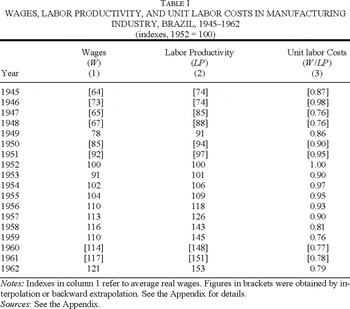
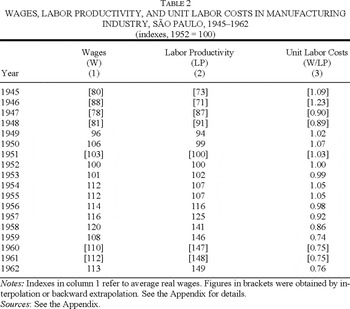
On the other hand, existing data show that there was a significant increase in industrial wages during the remaining years of the Dutra government: real wages grew at an annual compound rate of 10.0 percent in Brazil and 11.3 percent in São Paulo, between 1947 and 1950 (as calculated from Tables 1 and 2, column 1).53
The method used for calculating these and the following annual compound rates of growth is shown in the Appendix.
Wells, “Industrial Accumulation,” p. 301; and Colistete, Labour Relations, ch. 2.

The indexes in Tables 1 and 2 suggest that real wage growth was higher than labor productivity growth between 1945 and 1946, which may help explain industrialist opposition to workers' demands in such years and the use of repression in an attempt to discipline labor markets. Anyhow, there was a recovery of labor productivity in the following years. In Brazil, the unit labor costs fell from 0.98 in 1946 to 0.76 in 1947 and 1948, though it was followed by an increase to 0.86 and 0.90 in 1949 and 1950, respectively. As for São Paulo, the same index dropped from 1.23 in 1946 to 0.90 and 0.89 in 1947 and 1948, followed by an increase to 1.02 and 1.07 in 1949 and 1950, respectively. The likely implication in both cases is that firms took advantage of Dutra's labor policies to rationalize their production processes and to drive their workers to higher levels of effort. Such policies appear to have even allowed firms to partially accommodate workers' demands in the form of higher real wages, whereas in São Paulo real wages even overcame productivity in the end of the period. Partial accommodation of labor's claims, however, took place amidst a political and institutional situation that was harmful for workers' organization. Confrontation already characterized labor relations in Brazil by the end of the 1940s.

THE RECOVERY OF TRADE UNIONS
Trade unions experienced a slow recovery from the setbacks during the Dutra government. Although Vargas had been elected in the end of 1950 in the wake of a broad appeal to labor, during the first year his government took a careful line regarding the trade unions under intervention. On 1 May 1951 the Minister of Labor, Danton Coelho, officially announced his intention of holding free elections for trade union offices during the following months. In particular, Coelho promised to abolish the “ideology certificate” (certificado de ideologia), a personal document issued by the political police and aimed to identify left-wing candidates and prevent them from running for trade union office. Despite the announced liberalizing measures, the ideology certificate was officially revoked only in September 1952; in the meantime, the convocation of trade union elections went ahead slowly throughout 1951 and 1952.55
United Kingdom, PRO FO 371/103253, L. Mitchell, Labour Report no. 69, 25 February 1953, p. 7; and United States, NARA, H. Hammond, Quarterly Labor Report – Third Quarter 1951, 17 October 1951, RG 59, 832.06/10-1751, p. 14.
United States, NARA, H. Hammond, Minister of Labor's Report on Status of Syndicates, 2 March 1951, RG 59, 832.062/3-251, p. 2.
The replacement of Danton Coelho by Segadas Viana at the Ministry of Labor in September 1951 reinforced the government's ambiguous attitude towards organized labor—an attitude that combined speeches on syndical freedom and frequent interventions in trade union issues.57
United Kingdom, PRO FO 371/103253, by L. Mitchell, Labour Report no. 75, 29 October 1953, p. 11.
United States, NARA, I. Salert, Labor Report – Second Quarter 1953, 20 August 1953, RG 59, 832.06/8-2053, I. Salert, Labor Report – Third Quarter 1953, 18 November 1953, RG 59, 832.06/11-1853, pp. 2–5, and I. Salert, Labor – Last Quarter, 1953, 4 February 1954, RG 59, 832.06/2-454, pp. 1–2.
On the removal of Goulart, United Kingdom, PRO LAB 13/503, by L. Mitchell, Labour Report no. 79, 9 March 1954. For Goulart's influence over labor, United States, NARA, J. Fishburn, Annual Labor Report for 1958, 12 March 1959, RG 59, 832.06/3-1259, pp. 1–3. Running and winning again as Vice-President in the 1960 elections, Goulart achieved Brazil's Presidency after the resignation of the newly elected president, Jânio Quadros, less than seven months after being nominated. President Goulart was overthrown by the military coup of April 1964.
The result of the gradual slackening of the government's grip on trade unions, more clearly after late 1951, was a resurgence of organized labor in the Brazilian political scene. In São Paulo, the main expression of this was the setting up of the Inter-Syndical Unity Pact (Pacto de Unidade Inter-Sindical or PUI) by the largest and more militant trade unions in the state. The Inter-Syndical Unity Pact was a result of a huge industrial action, which brought Greater São Paulo to a standstill during March and April 1953. In the following years, the Inter-Syndical Unity Pact turned out to be the most representative and influential labor organization in São Paulo, despite the fact that it was never granted official recognition by successive governments. As with the Confederation of Brazilian Workers in 1946/47, the Inter-Syndical Unity Pact formed a broad coalition of independents and left-wing activists who held key positions in São Paulo's trade unions.60
For example, Notícias de Hoje [hereafter NH], 9 May 1954, front page and p. 6, 15 May 1954, pp. 6 and 8, and 2 September 1954, p. 2.
Still, the realization of trade union elections, and the creation of strong parallel organizations such as the Inter-Syndical Unity Pact, did not put an end to the threats looming over the newly reorganized labor movement. In particular, following Vargas's suicide in 1954, the short Café Filho government (August 1954–November 1955) took an uncompromising attitude towards organized labor by interfering in trade union issues. The Minister of Labor, Napoleão Guimarães, barred elected trade unionists accused of being leftists from taking office (for example, at the São Paulo Trade Union of Textile Workers); acted to quell industrial actions (for example, in the tramway industry in Rio de Janeiro); and enacted a decree banning all inter-union committees (including the Inter-Syndical Unity Pact) set up by organized labor in the previous months in Brazil.61
United States, NARA, I. Salert, Visit to Labor, Industry and Commerce Minister Alencastro Guimarães, 21 September 1954, RG 59, 832.06/9-2154, and I. Salert, Quarterly Labor Review – Third Quarter 1954, 8 October 1954, RG 59; United Kingdom, PRO LAB 13/503, by L. Mitchell, Labour Report no. 81, 14 October 1954, pp. 1–2.
Under the Kubitscheck government, trade unions became more active and influential. Overall, the Ministry of Labor refrained from exercising a tight control over trade union issues, and sought to bolster the moderate and Brazilian Labor Party wing of the labor movement—against the leftists and independents who were at the head of the most powerful official trade unions and parallel organizations. In São Paulo, this policy allowed for a substantial expansion of the Inter-Syndical Unity Pact, which by mid-1957 claimed to have about 104 affiliated trade union organizations—including the largest ones in the state of São Paulo.62
NH, 1 May 1957, p. 2.
United States, NARA, B. Sowel, Official Report on Labor, Year 1958, 16 March 1959, RG 59, 839.06/3-1659, pp. 2–3; and United Kingdom, PRO LAB 13/1339, R. Morris, Labour Report no. 16/59, 10 June 1959.
United Kingdom, PRO LAB 13/1339, R. Morris, Labour Report no. 33/59, 10 October 1959, p. 1, and R. Morris, Labour Report no. 40/59, 12 November 1959, pp. 1–2; United States, NARA, J. Fishburn, Brazilian Labor 1959, 7 December 1959, RG 59 832.06/12-759, pp. 6–7, W. Cochran, City of São Paulo Trade Union Convention, 18 April 1960, RG 59, 832.062/4-1860, and R. Burton, Goulart Appears to Have Headed Off Split in São Paulo Labor Movement, 31 August 1960, RG 59, 832.062/8-3160. For a strong criticism, by a left-wing group, of the dissolution of the Inter-Syndical Unity Pact and participation in the Trade Union Council, see Ação Socialista (October 1959), p. 3. The group was the Liga Socialista Independente.
The years 1956–1961 also witnessed growing ideological disputes within the labor movement. On the domestic scene, the hard-line trade unionists traditionally close to government remained in control of state federations and national confederations—such as the National Confederation of Industrial Workers. The influence of this group over the rank and file and intermediate labor leaders was small, so that its major activity was restricted to high-level articulation and contacts (with government officers, the U.S. embassy, and the ICFTU) aiming to contain the growth of the left in the Brazilian labor movement.65
For instance, United States, NARA, J. Fishburn, Deterioration in Leadership and Anti-Communist Unity of the Three Older Labor Confederations, 30 June 1960, RG 59, 832.062/6-3060.
On the Movimento Renovador Sindical, see Harding, “Political History,” pp. 330–43. For the Catholic militants, see Martins, Igreja, chs. 1–2. On the Brazilian Labor Party and Goulart's supporters, Benevides, PTB, chs. 5–6; and on Jânio Quadros's supporters: United States, NARA, J. Fishburn, Brazilian Labor 1959, 7 December 1959, RG 59, 832.06/12-759, pp. 6–7.
United States, NARA, W. Cochran, City of São Paulo Trade Union Convention, 18 April 1960, RG 59, 832.062/4-1860, and J. Fishburn, Third National Labor Congress, 4 August 1960, RG 59, 832.062/8-460.
United States, NARA, B. Sowell, Briefing Paper on Labor in São Paulo, 27 October 1958, RG 59, 832.06/10-2758, p. 16.
What happened to wages and productivity during the recovery of trade unions? As we know, Vargas and his followers sought to forge a closer relationship with workers between 1951 and 1954. However, real industrial wages were unstable at the time, contrary to what one would expect when the government was seeking closer ties to labor. In Brazil's manufacturing industry, an estimated real wage increase of 8.7 percent per year between 1950 and 1952 was followed by a drop of 9.0 percent in 1953, and then by an increase of 12.1 percent in 1954 (Table 1, column 1). The record of industrial wages in São Paulo was worse than in Brazil as a whole. Wages there dropped 2.8 percent between 1950 and 1952 and increased only 1 percent in 1953. Not until 1954 was there an appreciable improvement in average wage levels (10.9 percent between 1953 and 1954) (Table 2, column 1). The struggle for real wage increases continued thereafter, although there were substantial yearly variations, especially in São Paulo. In Brazil's manufacturing industry, industrial wages grew 2.8 percent per year between 1956 and 1958, fell by 5.2 percent in 1959, and increased 3.6 percent in 1960. At the end of Kubitscheck presidency, average manufacturing wages were only 3.6 percent above their level at the beginning of the government—or 10 percent if 1962 is taken as a more reliable reference year (Table 1, column 1). São Paulo's industrial wages did worse. After an increase of 3.0 percent per year between 1956 and 1958, manufacturing wages fell by 10 percent in 1959 and then rose slightly—only 1.9 percent in 1960. Overall São Paulo's manufacturing wages fell by 3.5 percent during the Kubitscheck government, or 0.9 percent if 1962 is chosen for comparison (Table 2, column 1).
Labor productivity growth was relatively slow in the early 1950s—2.7 percent per year in Brazil and 0.8 percent per year in São Paulo between 1950 and 1953. As a result, unit labor costs oscillated without a clear trend in the period: in Brazil, labor productivity grew more slowly than wages between 1950 and 1952 but regained the lost ground in 1953; in São Paulo, labor productivity did better in 1953 but was below wage levels in 1950/51 (Tables 1 and 2, columns 2). Yet, in a clear departure from its earlier performance, labor productivity exhibited a strong upward trend in the 1954–1962 period. Tables 1 and 2 indicate that labor productivity in Brazil's manufacturing industry rose 5.2 percent per year between 1954 and 1962, whereas in São Paulo the increase was of 5.0 percent per year in the same period (columns 2). Consequently, unit labor costs (columns 3) experienced a noticeable decline between 1954 and 1959: from 0.97 to 0.76 (in Brazil) and from 1.05 to 0.74 (in São Paulo), with just a slight increase between 1960 and 1962 (to 0.79 in Brazil and 0.76 in São Paulo). This was an unprecedented outcome during the postwar years and it suggests that organized labor could not keep its share of the industrial output from diminishing at a time when labor productivity was soaring.
The odds of a corporatist accommodation between labor and management, which could turn the upsurge in productivity into an equivalent increase in real wages and welfare, were slim during the 1950s and early 1960s. Industrialists and the most influential sections of the trade union movement had very different views. As a result, there were frequent disputes between industrialists and the trade union movement over setting wages. The political divide also prevented labor organizations from participating directly or indirectly in the formulation of economic and social policy. Particularly during the second half of the 1950s, the trade union movement was increasingly concerned with more general economic issues, which might have become a basis for collaboration with the government and even industrialists. Nonetheless, industrialists showed little disposition to negotiate wages and other issues that interested organized labor. For example, São Paulo industrialists systematically rejected all attempts in the 1950s to shorten the work week, grant maternity leaves, limit night work, or provide compensation for accidents.69
Boletim Informativo da FIESP, no. 98 (1951): 31, no. 156 (1952): 326, no. 223 (1954): 26–32, and no. 452 (1958): 701–02.
TRADE UNIONS AND THE COLD WAR: THE ICFTU IN BRAZIL
The conflicts among diverging orientations in the trade union movement were aggravated by the Cold War. In particular, international labor politics started to play a part in disputes and conflicts within the trade union movement in Brazil during the second half of the 1950s. The ICFTU's inter-American section, Organización Regional Interamericana de Trabajadores (or ORIT), had been set up in January 1951 at a conference in Mexico to co-ordinate the anticommunist trade unions in the Western Hemisphere. A few years later, in April 1953, an ICFTU/ORIT office was established in Rio de Janeiro with the express aim of fighting the left-wing influence in Brazil's trade unions. The office was located at the National Confederation of Industrial Workers headquarters and employed one full-time trade unionist, who was in charge of propaganda and contacts between the ICFTU/ORIT and Brazilian labor unions. A Consultative Council was initially composed of organizations that had been in liaison with ICFTU since its foundation in 1949—the national confederations of industrial and commercial workers plus five federations.70
On the foundation of the Rio Office: Netherlands, International Institute of Social History [hereafter IISH], ICFTU Archives, Regional Fund Committee, 4th meeting, Brussels, 9–11 February 1953, p. 4; South America, General Correspondence, 5319, T. Gomez to J. Oldenbroek, 18 March 1953; Brazil, General Correspondence, 5366, Arturo Jáuregui to J. Oldenbroek, 13 September 1952; Brazil, General Correspondence, 5366, T. Gomez to J. Oldenbroek, 17 August 1953. For the office's affiliates: Netherlands, IISH, ICFTU Archives, Brazil, Correspondence with/on the Rio Office, 5373, J. Araújo to J. Oldenbroek, 16 August 1954.
Despite its ambitious beginnings, the ICFTU/ORIT office in Brazil was beset with quarrels and internal disputes, so that it was ineffective throughout the rest of the 1950s. The major obstacle to the operation of the office seems to have been the cautious support provided by the small number of organizations that made up the Consultative Council. For instance, the long-standing president of the National Confederation of Industrial Workers, Deocleciano Cavalcanti, on various occasions showed his reticence in following the strict anticommunist line prescribed by the ICFTU/ORIT, and even in being publicly associated with these international organizations.71
For example, Netherlands, IISH, ICFTU Archives, Brazil, General Correspondence, 5368, D. Angelo to C. Millard, 1 December 1958; Memorandum (Confidential), 4 January 1958; R. Otero to H. de Horne, 20 January 1958.
Netherlands, IISH, ICFTU Archives, Brazil, General Correspondence, 5367, Herman to C. Millard, 17 December 1957.
The cautious approach that the leading unionists from the Brazilian Labor Party took to the ICFTU/ORIT seems to have resulted from the great influence that leftists and independents had in the postwar trade union movement in Brazil. In the highly competitive and radicalized contest for the key positions in the Brazilian labor movement during the 1950s, labor leaders could not risk being linked to an organization widely regarded as controlled by the U.S. government. Moreover, the ICFTU's activities were not tied to an aid program that could foster their influence among Brazilian labor, as happened in Europe during the implementation of the Marshall Plan.73
Carew, Labour, chs. 7–8 and 10.
The ICFTU's limited impact had important consequences for labor-management relations in the context of the highly polarized politics of the Cold War. Despite strenuous efforts, the government, industrialists, and the ICFTU were not able to consolidate a cadre of “moderate” labor leaders able to hold key positions in the larger trade unions and, in particular, among the rank and file and intermediate labor leaders. Nor was there a split in the labor movement that isolated the communists and leftists. It is true that the left and independents showed great eagerness to collaborate with the government in a program that included fast industrial growth and economic development. The majority of the labor leaders also tended to support price controls, anticyclical economic policies and protection of national industry. However, in all these cases the leadership and the rank and file did not put aside the demand for better wages, workplace improvements and social rights. Instead, trade unions and the Inter-Syndical Unity Pact advanced a view that economic development should incorporate and share its benefits with the working class, by means of increasing real wages and welfare. A leftist leadership and a trade union movement that pursued economic gains, welfare, and social reforms were hardly the sort of partners that industrialists sought. A confrontational pattern of labor relations, which had first emerged in the 1940s, became a regular feature of Brazil's political economy during the 1950s and the early 1960s.
CONCLUSIONS
The tensions and conflicts generated by the industrialization process in Brazil were directly reflected in the sensitive area of labor relations during the post–Second World War period. Notwithstanding the highly centralized system of industrial relations inherited from the Estado Novo, state intervention failed to inhibit the organization and political expression of an increasingly numerous and diversified working class. The result was the taking over of a large section of official trade unions by left-wing and independent groups and the proliferation of organizations parallel to the official corporatist structure after 1945. Compared to other historical experiences, even the powerful anticommunist forces organized world-wide by the ICFTU had little hold over Brazilian labor politics during the 1950s. As a result, Brazil never experienced a corporatist accommodation between labor and managers based on shared goals of economic growth and real wage increases tied to productivity. Instead it witnessed a widening gap between wages and productivity, and the workers' share in output fell. Prospects of eliciting labor co-operation at the firm level and in the society at large under such circumstances could be hardly achieved.
Two questions remain. First, why were left-wing groups so prominent in Brazilian trade unions? The reason partly seems to lie in the repressive stance taken by both governments and employers in the immediate postwar years. Repression alienated even moderate labor leaders and made workers in general very distrustful of the cadre of official trade unionists cultivated by governments and industrialists. The left and independents rapidly filled the gap and consolidated their positions in the labor movement, despite the hostile political environment. The communists in particular were able to establish a relatively solid foundation among the most militant sections of labor leaders and the rank and file. When the political situation changed, left-wing groups and independents occupied the main positions in the official trade union structure (and set up parallel organizations), soon becoming the most active and reliable representatives of organized labor in São Paulo and Brazil.
Second, why did industrialists tend to be so reticent about negotiating wages and welfare with organized workers? It seems that the uncompromising stance taken by industrialists was greatly reinforced by the Dutra government's full commitment to Cold War politics. The brief political liberalization between 1945 and early 1947 was marked by industrial leaders calling for order and containment of the wave of industrial actions. The opportunity to curb the re-emerging labor movement came with the Truman Doctrine of early 1947. Industrialists gave their full support to the wave of repression in trade unions and played their part at the firm level by firing workers and tightening factory discipline. Therefore, rather than accepting a new role for the working class in the Brazilian political economy, and supporting open politics and negotiating economic benefits and social rights, the industrialists backed an adjustment to the new postwar juncture that relied upon repression and large-scale intervention in labor issues.
A possible reason for such development goes beyond a deeply ingrained bent for authoritarianism by Brazilian industrialists. Productivity growth, we know, was possibly slow in the early postwar years, and that may help explain the hard-line stance by industrialists. Moreover, long-standing industrial practices, based on low wages, poor conditions, and limited training of the labor force, tended to undermine the search for incremental improvements in industrial processes and organizational structures that could lead to steady increases in productivity. Industrial companies in São Paulo and Brazil may have thus seen the containment of workers' demand for better wages, conditions, and welfare as the best way to assure their own survival as economic entities. But if such a hypothesis seems plausible for the early postwar years, the same is not true for the second half of the 1950s, when productivity soared in manufacturing industry. At that point it was peculiar developments in the trade union movement that kept industrialists from negotiating wages and welfare with organized labor. They simply did not consider the leftists and independents who had taken over the major trade unions in Brazil to be reliable partners.
The anticommunist policy promoted world-wide by the U.S. government found in Brazilian elites and governments its most dedicated supporters—to the extent that the largest country in Latin America soon became a safe area in terms of communist threat. In particular, the Dutra government's attempts to evict the communists from public life showed that the U.S. government could direct its energies to other regions less successful in their struggle against left-wingers. This situation helped to produce an unexpected outcome, at least for local elites—the exclusion of Brazil (and Latin America) from the major inflows of U.S. capital during the 1940s and 1950s. Another consequence—though less recognized today—was that independents and left-wingers established a firm foothold in Brazil's trade union movement. Only at the end of the 1950s did the U.S. government become aware of the ground it had lost to the left-wing forces in Brazilian trade unions and of the dangerous situation created for its strategic interests in Latin America.
Compared to the postwar history of Western European countries and Japan, the different outcomes of labor politics in Brazil could not be more striking. Whereas in Europe and Japan, noncommunist trade union leaders paved the way for a social democratic contract for growth, in Brazil the agenda for social reform was headed by the communists and other left-wing groups. Whereas in Western Europe and Japan management counted on “moderate” labor leaders for a productivity drive in exchange for economic and social benefits, in postwar Brazil, employers held an antilabor policy—both on the shop floor and in society at large—eschewing compromise with demands for real wage increases and welfare by the leftist labor militancy. The divided world of the Cold War made even more difficult any settlement conducive to a compact for growth in Brazil, which had the difficult task of bringing together management and communist labor leaders.
The irony is that where the U.S. anticommunist foreign policy found its most willing followers, the social basis for sustained growth and social reform turned out to be more and more unlikely. In Europe, in turn, U.S. policy-makers had to deal with consolidated social democratic groups in order to prevent the hegemony of the pro-Soviet trade union militancy. The adoption of a crude anticommunist policy gave way to bargaining large-scale resources and assistance epitomized by the Marshall Plan. Meanwhile, in Brazil and Latin America, eager cold-warriors sought to implement by all means available the anticommunist line hinted at by the Truman Doctrine. Does this mean that the social compact for growth could only become a historical reality because of the limits posed to the U.S. anticommunist thrust in Europe and Japan?
In any case, for Brazil the effects of postwar labor politics were clear. Even when conditions were favorable for economic growth and democracy, relations between industrialists and labor remained essentially hostile and antagonistic during most of the 1950s and early 1960s. Results were felt a few years later, when the acute political and social conflicts reached their climax with the military coup that, for a long time, radically altered the prospects for democracy and social reform in Brazil.
Appendix: Sources
Yearly data for Tables 1 and 2 were obtained as follows:
WAGES
1945–1948: Extrapolated from the level of real average manufacturing wages in 1949 by using the rates of growth of the industrial wages compiled by the Instituto de Aposentadoria e Pensões dos Industriários (IAPI), Brazil and state of São Paulo: Brazil, Instituto Brasileiro de Geografia e Estatística [hereafter IBGE], Anuário, 1941 to 1945, 1947, 1948, 1951. IAPI figures refer to wages paid in July.
1950 (São Paulo), 1952–1958: Registro Industrial, Brazil: Brazil, IBGE, Anuário, 1952, 1955, 1956, 1957, 1959, 1960, 1965. Registro Industrial, state of São Paulo: Brazil, IBGE, Anuário, 1952; Brazil, IBGE, Produção Industrial de São Paulo, 1952, 1953, 1954, 1955; Brazil, IBGE, Produção Industrial Brasileira, 1956, 1957, 1958. Mean wages of monthly average production workers.
1949 and 1959: Censo Industrial, Brazil and state of São Paulo: Brazil, IBGE, Anuário, 1955, 1963. Mean wages of monthly average production workers.
1950 (Brazil), 1951, 1960, 1961: estimated by interpolation using the formula of annual compound rate of growth (see below).
Nominal average wages were converted to cruzeiros at 1952 rate by using the following price indexes: Table 1-Brazil: the consumer price index (Índice Geral de Preços ao Consumidor) of the Ministry of Labor between 1948 and 1962, weighted by the share of national manufacturing output from the states (fourteen) included in the national survey; for 1945–1947, national wages were deflated by the consumer price index of São Paulo Prefecture. Table 2-São Paulo: São Paulo's consumer price index of the Ministry of Labor between 1948 and 1962; for 1945–1947, São Paulo's wages were deflated by the consumer price index of São Paulo Prefecture. Source: Brazil, IBGE, Estatísticas Históricas.
LABOR PRODUCTIVITY
1950 (São Paulo), 1952–1958, 1949 and 1959: number of workers, same sources as wages above. The labor productivity data were obtained by dividing the valor da transformação industrial (a measure similar to the industrial value added: see Brazil, IBGE, Estatísticas Históricas, p. 370) by the monthly average number of production workers.
1950 (Brazil), 1951, 1960, 1961: estimated by interpolation using the formula of annual compound rate of growth (see below).
1945–1948: number of workers, same sources and procedures as wages above. Given the lack of data similar to industrial value added for such years, measures were estimated by backward extrapolation of the annual compound rate of growth (by fitting a log-linear trend) of the real valor da transformação industrial between 1949–1952 (Brazil) and 1949–1953 (São Paulo). The annual compound rates of growth obtained were 3.8 percent (Brazil) and 5.1 percent (São Paulo). The years 1949–1952 (Brazil) and 1949–1953 (São Paulo) were chosen as the basis for extrapolation because of their relative stability before a structural break identified in Brazil and São Paulo's valor de transformação industrial series (1953 and 1954, respectively) by a dummy variable test for structural stability identical to that presented below for the labor productivity series.
Nominal valor da transformação industrial was converted to cruzeiros at 1952 rate by using the Índice de Preços por Atacado - Disponibilidade Interna, produced by Fundação Getúlio Vargas. Source: Brazil, IBGE, Estatísticas Históricas.
CALCULATING THE ANNUAL COMPOUND RATE OF GROWTH
When all values of a series were available, the annual compound rate of growth was calculated, first, by fitting a log-linear trend (with time as the explanatory variable) on all years of the relevant period and using the indexes presented in Tables 1 and 2; second, by taking the exponential of the regression coefficient, subtracting 1 and multiplying by 100. For interpolation of missing values, the following procedure was adopted: consider that the annual compound rate of growth (i) is implicitly defined by

where

Given X0 and Xt from the previous formula, the annual compound rate of growth between 0 and t may be obtained as follows

TESTING STRUCTURAL STABILITY IN LABOR PRODUCTIVITY SERIES
The following model was estimated for both Brazil and São Paulo

where LP = the 1952 index of labor productivity, Di = 0 for observations before 1954 (Brazil and São Paulo) and = 1 for observations from 1954 (Brazil and São Paulo), Xi = time, and μi = error term.
Regressions for the subperiods are

and

The results based on models 1, 2, and 3 are as follows

As the differential intercept and the differential slope coefficients (α2 and β2, respectively) are statistically significant (as indicated by t statistics) in both Brazil and São Paulo's basic models, there is strong evidence that the labor productivity series are not continuous through time—in other words, that there is a structural break in the series. The models for subperiods show the different intercept and slope coefficients for each subperiod in which the Brazil and São Paulo's series were split.
I would like to acknowledge the very helpful comments of Knick Harley, Alan Knight, Jaylson Silveira, William Summerhill, and seminar participants at the Department of Economics, Universidade Federal do Paraná, Curitiba, Brazil; the Centro de Desenvolvimento e Planejamento Regional, Universidade Federal de Minas Gerais, Belo Horizonte, Brazil; the Facultad de Ciencias Sociales, Universidad de la República, Montevideo, Uruguay; and the Latin American Center, University of California, Los Angeles. This article has been much improved thanks to the careful reading and suggestions by Philip Hoffman and two anonymous referees of this JOURNAL.