INTRODUCTION
Alien species of marine invertebrates, algae and fish are increasingly becoming important components and interactors in marine communities worldwide. In many cases, the non-indigenous species (NIS) have been noted due to increases in habitat-formers and ecosystem engineers such as invasive mussels, seagrass (Posey, Reference Posey1988), or large seaweeds (Trowbridge, Reference Trowbridge, Critchley, Ohno and Largo2006). In other cases, NIS are detected by functional changes in species interactions. Quite often, the establishment and spread of NIS is visually obvious such as with the brown alga Sargassum muticum (Yendo) Fensholt. However, if the NIS are morphologically similar to resident species, the incursion can be cryptic, requiring detailed morphological and/or molecular analyses to elucidate the invasion dynamics. An important example of such cryptic invaders is the Asian green macroalga Codium fragile, originating from Japan, which has appeared on temperate shores throughout the world (Trowbridge, Reference Trowbridge1998; Provan et al., Reference Provan, Murphy and Maggs2005, Reference Provan, Booth, Todd, Beatty and Maggs2007). In most invaded regions (except north-western Atlantic shores), this seaweed entered communities with native congeners and even non-weedy conspecifics. Untangling the invasion dynamics and documenting contemporary patterns of species occurrence is crucial to making realistic risk assessments of invasives and establishing a quantitative baseline from which future changes can be assessed.
Codium fragile ssp. tomentosoides was first collected on mainland European shores (Holland) ~1900 and described in 1955 (Silva, Reference Silva1955). Until recently, the first recognized record for the British Isles was 1939 in Devon, south-west England (River Yealm estuary) (Silva, Reference Silva1955). Exciting new molecular work, however, has demonstrated that the alga was in Ireland by 1845, Scotland by 1891 and England by 1894 (Provan et al., Reference Provan, Booth, Todd, Beatty and Maggs2007). Furthermore, based on the botanical code, the correct name of this invasive alga is Codium fragile ssp. fragile (Maggs & Kelley, Reference Maggs, Kelley, Brodie, Maggs and John2007; Provan et al., Reference Provan, Booth, Todd, Beatty and Maggs2007). For simplicity, we refer herein to this introduced alga as C. fragile. The conspecific C. fragile ssp. atlanticum (A.D. Cotton) P.C. Silva does not occur in the English Channel (see Trowbridge et al., Reference Trowbridge, Farnham and White2004 and Provan et al., Reference Provan, Booth, Todd, Beatty and Maggs2007, regarding incorrect records) so our use of the binomial C. fragile herein is restricted to the invasive C. fragile ssp. fragile.
During the 20th Century, Codium fragile proliferated on north-western and north-eastern Atlantic shores (and elsewhere). In the former region, the invasive alga now dominates many shallow areas, competing with kelp in the Gulf of Maine (Levin et al., Reference Levin, Coyer, Petrik and Good2002; Scheibling & Gagnon, Reference Scheibling and Gagnon2006; Schmidt & Scheibling, Reference Schmidt and Scheibling2006, Reference Schmidt and Scheibling2007) and seagrass in shallow lagoons (Garbary et al., Reference Garbary, Vandermeulen and Kim1997, Reference Garbary, Fraser, Hubbard and Kim2004). It has also invaded rocky intertidal pools (Bégin & Scheibling, Reference Bégin and Scheibling2003; Schmidt & Scheibling, Reference Schmidt and Scheibling2005). The interspecific interactions have been well demonstrated (e.g. Levin et al., Reference Levin, Coyer, Petrik and Good2002; Scheibling & Gagnon, Reference Scheibling and Gagnon2006; Schmidt & Scheibling, Reference Schmidt and Scheibling2005, Reference Schmidt and Scheibling2007).
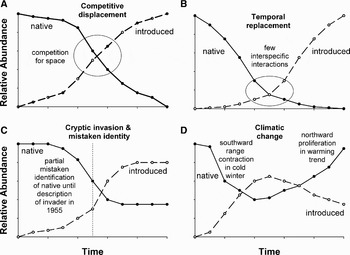
In contrast, work on north-eastern Atlantic shores has been more observational as field experiments with Codium fragile are illegal in the UK (Countryside Act of 1981). In the 1970s and 1980s, C. fragile formed extensive beds at Bembridge on the Isle of Wight (Benson et al., Reference Benson, Rutter and Cobb1983; Farnham, personal observation) and in Lough Hyne Marine Reserve, County Cork, Ireland (Norton, Reference Norton1991). Some phycologists expressed concern that the introduced C. fragile would outcompete and displace native congeners (e.g. Farnham, Reference Farnham, Price, Irvine and Farnham1980) (e.g. Figure 1A). Because there was no direct evidence of interspecific competition or a limiting resource, Trowbridge (Reference Trowbridge1998, Reference Trowbridge2001) suggested the dynamics may involve temporal species' replacement (a decline of the native and unrelated increase of the introduced species; Figure 1B). A third hypothesis is that the cryptic invasion of C. fragile led to historical over-estimation of the native population abundance and geographical range with a subsequent readjusted perception after the description of C. fragile ssp. tomentosoides by Silva (Reference Silva1955) (Figure 1C). These three models are based on scientific observation and hypothesis formulation.
Four schematic models of temporal change of native and introduced Codium spp. in the British Isles. Distinguishing between (A) competitive displacement and (B) temporal replacement depends on quantifying limiting resources (e.g. space) and interspecific interactions (or lack thereof). Phycological re-examination of historical specimens supports (C) but accurate population surveys are lacking. (D) Temporal changes of introduced and native species with known cold winters, warm summers and general climate changes have not been extensively evaluated.

The species identification problem has been further exacerbated with Codium tomentosum and C. vermilara being considered warm-water species whose northward range expansion would be expected during climate warming (e.g. Hiscock et al., Reference Hiscock, Southward, Tittley and Hawkins2004; Mieszkowska et al., Reference Mieszkowska, Leaper, Moore, Kendall, Burrows, Lear, Poloczanska, Hiscock, Moschella, Thompson, Herbert, Laffoley, Baxter, Southward and Hawkins2005) and C. fragile being considered constrained in the UK by cool summer temperatures (Elliott, Reference Elliot, Buckley, Dye and Baxter2006) when the alga already occurs north of Trondheim, Norway, and in the Canadian Maritimes. Climatic change predictions could lead to a fourth hypothetical pattern: southward range contraction of the native Codium species in cold winters (e.g. 1962/1963) and northward proliferation in warm periods (Figure 1D).
Without a detailed understanding of contemporary distributions of the native and introduced congeners, predictions about future ecological and environmental changes cannot be realistically evaluated. Our primary objective was to test the displacement hypothesis by comparing the frequency of the high-profile native and introduced Codium species at three locations within the English Channel where historical records and some historical specimens exist.
MATERIALS AND METHODS
Study regions
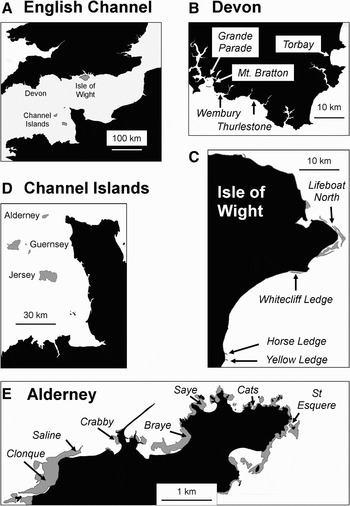
We surveyed three major regions of north-eastern Atlantic shores: the mainland of southern England, the Isle of Wight (IoW) and the Channel Islands. Of the six counties bordering the north side of the English Channel, we concentrated most of our surveys in Devon (Figure 2A, B; Table 1) due to the predominance of historical Codium records there; however, we did visit a site in Sussex (Pagham Harbour) and another in Dorset (Chesil Fleet) where the second author had previously collected Codium (Farnham, Reference Farnham and Rayner1975). The IoW, directly south of Portsmouth, is separated from the Hampshire mainland by the Solent, a deep strait. We surveyed four sites on the east coast of the IoW: Bembridge/Lifeboat Station North, Whitecliff Ledge, Horse Ledge and Yellow Ledge (Figure 2C). These sites were selected based primarily on the phycological literature (Foslie, Reference Foslie1893; Morey, Reference Morey1909; Delf & Grubb, Reference Delf and Grubb1923; Norkett, Reference Norkett1947; Jones, Reference Jones2000).
Map of the survey regions and sites in the English Channel (north-eastern Atlantic shores). Scale bars are shown in each figure panel.

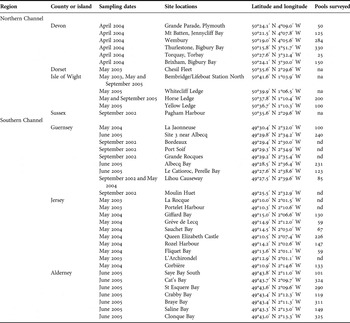
Spatial and temporal details of Codium surveys in the English Channel, north-eastern Atlantic Ocean.

na, pool habitat not available; nd, no data because pool occupancy was not measured (algal thalli were surveyed rather than pools per se).
The Channel Islands in the Bay of St Malo off the Atlantic coast of France have received considerable phycological scrutiny (e.g. Lyle, Reference Lyle1920, Reference Lyle1923, Reference Lyle1937; Marquand, Reference Marquand1901, Reference Marquand1902, Reference Marquand1908; Van Heurck, Reference Van Heurck1908; Dixon, Reference Dixon1961; Feldmann, Reference Feldmann1961; Culley et al., Reference Culley, Farnham, Thomas and Thorp1983). We surveyed the three larger islands (Jersey, Guernsey and Alderney; Figure 2D) for logistical reasons of accessibility. Some results from Jersey and Guernsey have already been published (Trowbridge & Farnham, Reference Trowbridge and Farnham2004; Trowbridge et al., Reference Trowbridge, Farnham and White2004). We concentrate herein on Alderney results, previously unpublished Guernsey and Jersey data and regional comparisons. We sampled ~1600 pools from seven Alderney sites from Clonque on the north-west shore to St Esquere on the north-east tip of the island (Figure 2E). Sites were selected based on accessibility and availability of rocky substrata.
Surveys
From September 2002–2005, we surveyed intertidal rock pools plus emergent substrata for the invasive Codium fragile and native congeners at 38 sites in the target regions (Table 1). Pools ranged in size from ~15 cm to 2–5 m in diameter with most being <1 m (notable exceptions were the vast intertidal lagoons at Bembridge, IoW). We quantified the percentage of rock pools occupied by Codium spp. at each site and, where possible, within each of four tidal levels, defined by the following zone-forming fucoids: the rockweeds Pelvetia canaliculata (Linnaeus) Decaisne & Thuret, Fucus spiralis Linnaeus, F. vesiculosus Linnaeus and F. serratus Linnaeus. At the upper end of the shore, Codium spp. were never on emergent substrata; on the lower half of the shore, Codium thalli were occasionally on emergent surfaces; we present results of pool-dwelling thalli (% occurrence) and densities of emergent thalli (based on 0.25 m2 quadrats). Our sampling methodology was, for the most part, non-destructive. Branch tips of Codium thalli (2 cm from each thallus) were harvested to identify species, based on the morphology of the utricles, using an Olympus Mic-D digital compound microscope. Digital voucher specimens were captured for large numbers of thalli. Thallus length was measured to the nearest millimetre; size–frequency distributions of thallus length were compared for different regions, using pairwise Kolmogorov–Smirnov tests.
RESULTS
Sites in southern England (mainland)
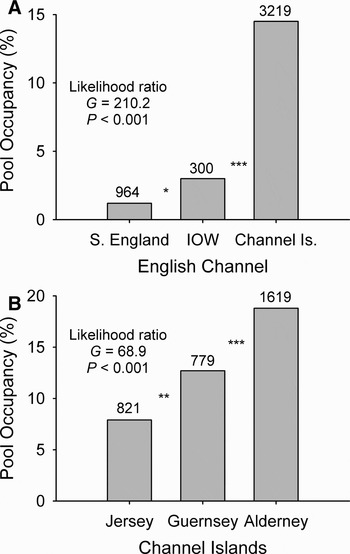
At six sites in Devon (964 pools surveyed in April–May 2004), 1.2% of pools overall contained Codium spp. (Figure 3A), and <4% contained Codium spp. at any site. Codium spp. were sparsely distributed but did occur in pools at all tidal levels. We found 16 thalli of C. fragile and 23 of C. tomentosum in six days of low-tide surveys. The algal species averaged 3.2 and 3.3 thalli per occupied pool, respectively (Student's t-test, t = 0.068, P = 0.947). We found no Codium at Pagham Harbour in Sussex, despite the available habitats being characteristic of C. fragile (small rocks, large shells and other hard substrate) and the species having been collected there previously. Within the Chesil Fleet lagoon in Dorset, we found abundant native C. vermilara and introduced C. fragile on low-shore rocks below the Ascophyllum zone. Of the 31 thalli collected on 14 September 2002, 45% were C. fragile and 55% were C. vermilara.
Pool occupancy of Codium spp. in different areas of the English Channel: southern England, Isle of Wight (IoW) and the Channel Islands (CI). Survey sites and dates are listed in Table 1. Sample sizes over each bar indicate the number of pools surveyed that were used in the analyses.

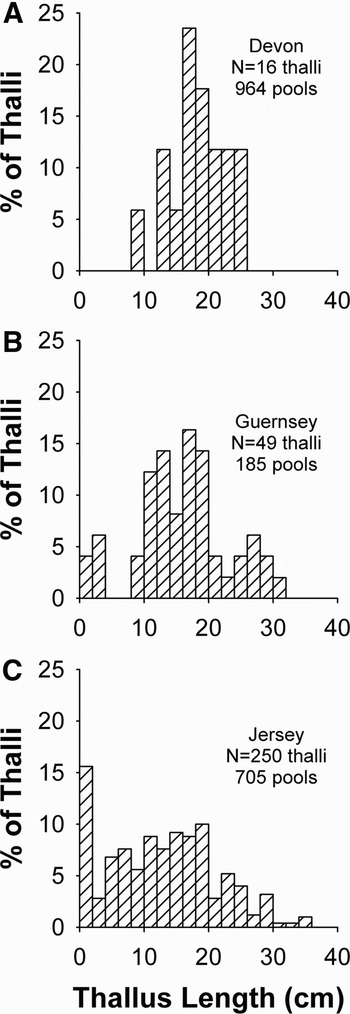
On Devon intertidal shores, a wide range of sizes was present for Codium tomentosum and C. fragile. However, what was striking was the paucity of juvenile thalli of the latter (Figure 4A): there were no thalli or fronds <8 cm long. The size-structure of C. fragile (N = 16) on Devon shores was significantly different than that on Jersey shores (Giffard, Gréve de Lecq, Castle and Sauchet) sampled during the same 2-week period (Kolmogorov–Smirnov, dmax = 0.458, P = 0.002) but not that on Lihou and La Jaonneuse on Guernsey shores (dmax = 0.283, P = 0.241) (Figure 4; Table 2). Jersey pools had large numbers of incipient fronds (0–2 cm) as well as large ones (to 35 cm). When we repeated the analysis across all collections from 2002 to 2005, we found significant differences in populations of C. fragile in the different regions (Table 2). The paucity of juveniles in Devon relative to other areas was the main distinguishing factor.
Comparison of populations of Codium fragile in three different regions of the English Channel. All data were collected between 25 April and 9 May 2004. Devon data were from Wembury and Thurlestone; Guernsey data were from Lihou Causeway and La Jaonneuse; and Jersey data were from Sauchet Bay.

Results of pairwise comparisons between regions of size distribution of Codium fragile, using Kolmogorov–Smirnov two-sample tests. Left part of table includes all data collected (N = 1159 thalli from 2002 to 2005); right part of table includes data collected from 25 April to 9 May 2004 (N = 315 thalli).

***, P < 0.001; **, P < 0.010; ns, P > 0.050.
Sites on the Isle of Wight
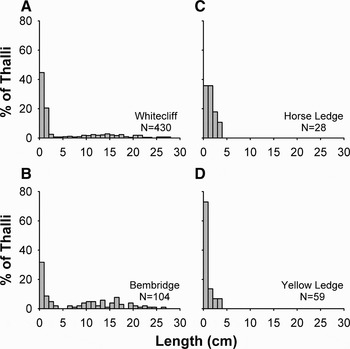
Only one species of Codium was recorded: C. fragile was widely distributed on the east side of the IoW. Thalli were large, abundant and heavily covered with epiphytes at Bembridge in the shallow lagoons and at Whitecliff on low intertidal, emergent substratum; high densities of juveniles were found under the adult canopies (Figure 5A, B). For example, at Whitecliff Bay, we recorded a mean of 3.0 large thalli and 19.0 small ones per 0.25-m2 quadrat. In contrast, thalli were small and sparsely distributed in high pools at Horse and Yellow Ledges, Shanklin (Figure 5C, D). Of 300 pools surveyed, only nine contained C. fragile (3%); this value was significantly greater than the pool occupancy in Devon (Figure 3A). The derbesioid or vaucherioid stage of Codium carpeted the bottom of the pools; utricle examination of the small fronds (Figure 5C, D), arising from the mats, confirmed that the species was C. fragile. This size-structure and the vaucherioid stage were seen again when we re-visited the sites in June and August 2007. The size–frequency distributions differed significantly between each pairwise combination of sites (Kolmogorov–Smirnov, P < 0.001 for all except one (Horse Ledge versus Whitecliff), which was P = 0.009).
Population size–frequency distributions of Codium fragile at four sites on the Isle of Wight. Data were collected in May 2005 with subsequent verification in September 2005 and June and August 2007. The number of thalli of Codium fragile sampled from each site is indicated. Identifications were confirmed by utricle examinations.

Sites on the Channel Islands
The situation on shores in the southern English Channel differed fundamentally. Three species of upright, branching Codium were recorded, and all were relatively abundant. By far the most abundant taxon was C. tomentosum that formed patchily distributed, high-density beds at many low-shore sites around Alderney. In addition, pool occupancy by Codium was greater in the Channel Islands than on Devon shores and IoW shores (except for the intertidal lagoons at Bembridge) (Figure 3A; Likelihood ratio Chi-square, G = 210.2, N = 4483, 2 df, P < 0.001). Furthermore, there was clear tidal-level variation in pool occupancy in the Channel Islands. In June 2005, Codium was present in 7% of pools surveyed on Guernsey in the high-shore, Pelvetia zone and 27% of the pools in the mid-shore, Fucus spiralis zone. This pattern was highly significant (Likelihood ratio Chi-square test, N = 594 pools, P < 0.001).
At sites on Alderney with extensive freshwater seepage from land and, thus, many ulvoid-dominated pools, Codium spp. were significantly less frequent in ulvoid than non-ulvoid pools (Likelihood ratio Chi-square test, G = 10.5, 1 df, N = 426 pools, P = 0.002). On Alderney, Codium spp. occurred in pools at all levels and on emergent substrata on lower parts of the shore. Of the ~1600 pools surveyed in June 2005, 19% contained Codium spp. (Figure 3B). There was considerable variation among sites and tidal levels. In the Pelvetia zone, the frequency of pool occupancy was high at Clonque but low elsewhere (overall: 8.2% of pools, N = 574). In the Fucus spiralis zone, Codium spp. occurred in 10–40% of the pools at all sites (overall: 24.3%, N = 609). In the F. vesiculosus zone, Codium spp. occurred in 20–60% of the pools at the four sites with pools at this tidal level (overall: 31.2%, N = 311). In the F. serratus zone, there were few pools at most sites but Codium occurred in 17.5% of the 80 surveyed. Codium tomentosum predominated in pools. On low-shore emergent substrata, we recorded a mean of 1.2 thalli per 0.25-m2 quadrat (N = 48 quadrats at Clonque Bay).
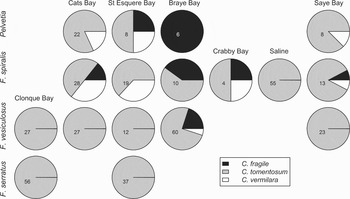
Both Codium vermilara and C. tomentosum thrived throughout the Channel Islands surveyed (Guernsey, Jersey and Alderney). On Alderney shores, C. tomentosum predominated within the Codium assemblages at most sites and tidal levels (Figure 6). Codium fragile was present at the wave-protected Braye Bay (protected by the elongate breakwater; Figure 1E) but not at many other, more exposed sites (Figure 6). Codium vermilara was frequent at two sites on the north side of the island, Cats Bay and St Esquere Bay, high on the shore.
Species composition of the Codium assemblages at seven Alderney sites and different tidal levels, based on utricle examination of thalli. Sample sizes indicate number of thalli examined microscopically. Data collected in June 2005.

DISCUSSION
At most sites surveyed in the UK and the Channel Islands, native Codium spp. were equally or more abundant and widely distributed than the invasive C. fragile; displacement or elimination of native congeners has not occurred. Codium tomentosum dominated the Codium assemblage on Alderney (Figure 6) and Guernsey (White, Reference White2003; Trowbridge et al., Reference Trowbridge, Farnham and White2004), and was the most frequent species in Devon. This alga is also frequent on rocky intertidal shores of western Ireland (Trowbridge, Reference Trowbridge2001 and unpublished data). Codium vermilara was abundant intertidally on Alderney and Jersey, and present in small amounts elsewhere in the Channel Islands; this species is abundant subtidally on the western shore of Lough Hyne, County Cork, south-western Ireland (Trowbridge et al., unpublished data). In summary: (1) the displacement and replacement scenarios (Figures 1A, B & 7) have not occurred; and (2) pool occupancy in southern England does not support interspecific competition among native and introduced congeners as a causal mechanism.
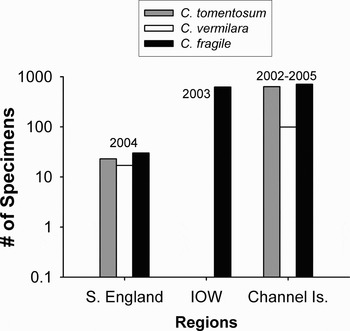
Contemporary specimens of native and introduced Codium in southern England, Isle of Wight (IoW) and the Channel Islands. Data based on surveys made at sites and locations listed in Table 1.

Sites on the Isle of Wight
The only area we surveyed that had dense populations of Codium fragile was the IoW, particularly the Bembridge to Whitecliff Bay series of intertidal lagoons. Here the invasion history of the species is unclear. Based on molecular analyses of herbarium specimens (Provan et al., Reference Provan, Booth, Todd, Beatty and Maggs2007), the first verified record of C. fragile in England was in 1894 in Swanage, Dorset. Three sets of early records on the IoW may also indicate the unrecognized incursion of the introduced alga: (1) Delf & Grubb (Reference Delf and Grubb1923) reported Vaucheria velutina C. Agardh as common on upper rocks on Shanklin Ledge (where we recorded C. fragile); (2) Vaucheria litorea C. Agardh was ‘very common on the sand-covered rocks at Horse Ledge and growing as a mat at the bottom of some rockpools’ (Norkett, Reference Norkett1947: 59); and (3) Foslie (Reference Foslie1893) collected C. tomentosum at Steephill, IoW; Morey (Reference Morey1909) referred to C. tomentosum at Steephill and West Cowes (based on the Batters ‘Catalogue’ (Batters, Reference Batters1902)); Delf & Grubb (Reference Delf and Grubb1923) reported C. tomentosum from Puckaster Cove and Shanklin Ledge in tidepools; and Kain (Reference Kain1958) reported C. tomentosum from Bembridge. The first two records may refer to the derbesioid or vaucherioid stage of Codium fragile (see Blunden et al., Reference Blunden, Fletcher, Smith, Rogers and Fish1989; Fletcher et al., Reference Fletcher, Blunden, Smith, Rogers and Fish1989; Yang et al., Reference Yang, Blunden, Huang and Fletcher1997; Trowbridge, Reference Trowbridge1998). This conjecture is based on the absence of genuine Vaucheria during our surveys, the presence of C. fragile and the known historical confusion between the two taxa. This juvenile vegetative stage can persist for years on docks or the shore. While it is possible that the vaucherioid stage could have belonged to C. tomentosum, there are no verified records of the alga at the IoW. Either Codium tomentosum (sensu stricto) occurred on the IoW historically but not now and/or C. fragile was present on the IoW by the 1890s (Foslie, Reference Foslie1893). This conclusion is based on the current absence of C. tomentosum during our surveys, the absence of verified historical specimens of the native from the IoW, the known historical confusion about C. tomentosum (sensu lato) and the contemporary occurrence of C. fragile at most of these locations. The first author has searched historical herbaria in the British Isles; the requisite specimens were not available to distinguish between the two hypotheses. Given that the invasive C. fragile was present in the British Isles by the mid to late 1800s (Provan et al., Reference Provan, Booth, Todd, Beatty and Maggs2007), there is circumstantial support for the second hypothesis.
What factors would explain the contemporary, dense populations of Codium fragile at Bembridge and Whitecliff Bay (IoW) and the comparative scarcity of the alga elsewhere? At least four possible explanations have been suggested.
(1) The habitat per se may contribute to alga's abundance at the IoW: the shallow, expansive, intertidal lagoons are ideal environments for the Codium fragile. Although the Wildlife and Countryside Act (1981) of the UK forbids experiments ‘planting’ listed species (such as C. fragile), experimental work in Korea demonstrated that growth of Codium fragile was greatest at shallow sublittoral depths (Hwang et al., Reference Hwang, Baek and Park2007).
(2) The tidal patterns around the IoW are unusual (Kain, Reference Kain1958; Collins et al., Reference Collins, Herbert and Mallinson1990) with double or prolonged high and low waters; spring high tides occur around midday. Thus, desiccation and light stress during early morning and early evening low tides would be comparatively less than in other areas that experience daytime low tides. Recent papers on desiccation tolerance (Schaffelke & Deane, Reference Schaffelke and Deane2005; Kim & Garbary, Reference Kim and Garbary2007) indicate that C. fragile is susceptible to desiccation but exhibits impressive recovery. On European shores, there is no direct experimental evidence that desiccation is a major problem. However, sunny weather does contribute to periodic thallus destruction and disintegration of Codium fragile (and congeners) in the British Isles and Japan (Trowbridge, personal observation). Similarly, cold damage to apical tips exposed to cold air in winter may influence littoral Codium distribution.
(3) Local diversity within a community might influence invasion success of some NIS (White & Shurin, Reference White and Shurin2007). Certainly, C. fragile has proliferated on north-western Atlantic shores, a region with comparatively low species richness, compared to its response on the north-eastern Atlantic shores. The local-diversity hypothesis is not supported at Bembridge as the IoW is regarded as floristically rich (Farnham, Reference Farnham1982, Reference Farnham1994), particularly on the east coast (Figure 1C) in the intertidal lagoons. The entire coastline is listed as SMAs (Sensitive Marine Areas) by English Nature and large sections of the coastline are also SSSIs (Sites of Special Scientific Interest) due to high biodiversity.
(4) The Solent appears to be a UK hotspot of introduced macroalgae (Farnham, Reference Farnham, Price, Irvine and Farnham1980; Collins et al., Reference Collins, Herbert and Mallinson1990), in part due to extensive shipping and ferry traffic among Southampton and Portsmouth ports and continental ones. Bembridge could, thus, receive a comparatively high influx of NIS propagules relative to the Devon open-coast shoreline or to the complex, Channel Island shores.
Sites on the Channel Islands
Codium vermilara and C. fragile were first recorded on the Channel Islands by Dixon (Reference Dixon1961) and Feldmann (Reference Feldmann1961). Lyle's voucher specimen of C. tomentosum (collected on 17 November 1921 and lodged in the Guernsey Museum and Galleries) is correctly identified (verified by Trowbridge). Although Kain (Reference Kain1961) made a subtidal algal collection at Braye Harbour at the breakwater, she did not record Codium spp., presumably due its intertidal location. Thus, the arrival date of C. fragile to the Channel Islands is not known.
Jersey and Guernsey both have a history of Pacific oyster cultivation, whereas Alderney does not. Given that the translocation of Pacific oysters is considered a primary vector in the spread of C. fragile, oyster mariculture activities may have contributed to the algal distributions. If this were the sole contributory factor, Alderney should have little or no C. fragile. Although Alderney does have appreciably less C. fragile than Jersey and Guernsey, it would be hard to accept that many decades of time (and generations of C. fragile) did not enable the invasive alga to disperse, establish and proliferate to most local areas.
Alternative explanations include current levels of disturbance. Jersey, as the most commercially developed of the three largest Channel Islands, presumably has the highest level of anthropogenic disturbance and it does have appreciable populations of C. fragile. Alderney, the least developed of the three islands, has substantial, thriving populations of C. tomentosum, C. vermilara and some C. fragile. However, direct experimental evidence of the stimulatory effects of anthropogenic effects (human trampling, nitrogen effluent, other pollution, mariculture and ship hull transport) has not been demonstrated anywhere in the alga's invaded range. Furthermore, the native congeners have not been experimentally manipulated to evaluate their presumed sensitivities. Anthropogenic effects do not provide a simple explanation that could account for the spatial variation in Codium populations between sides of the English Channel.
Other regional issues
Differential oceanographic conditions might account for cross-channel differences in Codium assemblages. The IoW is at a biogeographical boundary between western oceanic and eastern continental communities (Collins et al., Reference Collins, Herbert and Mallinson1990; Herbert et al., Reference Herbert, Southward, Sheader and Hawkins2007). The water masses carrying Codium propagules to Devon shores might be hydrodynamically distinct from those moving into and around the Bay of St Malo where the Channel Islands occur. Yet, it is hard to see how this mechanism could account for the flourishing population of C. fragile at Bembridge.
The three Channel Islands do have dramatically different environmental situations from southern England, including large tidal ranges (9–11 m) and rapid tidal currents (e.g. Alderney Race). Native and introduced Codium species occur intertidally in the southern English Channel where tidal ranges are huge; the species are often in lower intertidal pools and/or in subtidal areas at the northern channel sites (Devon and IoW) where tidal ranges are much smaller (3–4 m). However, western Ireland also has a small tidal range as well as a diverse and abundant assemblage of Codium on many rocky shores (e.g. Trowbridge, Reference Trowbridge2001). Thus, tidal range per se is not a sufficient regional explanation.
Regional differences in wave action may contribute to differential patterns of littoral Codium distributions. Codium fragile can propagate vegetatively via fragmentation and subsequent attachment of fragments. Perhaps the Channel Islands have comparatively higher wave exposure and Codium fragmentation than Devon or IoW shores. This testable hypothesis could account for the broad-scale patterns documented in this study.
In summary, simplistic explanations of algal distributional constraints are fraught with peril. Past accounts of temporal Codium changes have postulated anthropogenic effects and/or ecological interactions (Figure 1); while one or more of these mechanisms may be true, the hypotheses have not been well supported scientifically. Alternative oceanographic explanations such as tidal patterns, tidal range and tidal streams have never been seriously evaluated for spatial variation in the distribution of NIS on north-eastern Atlantic shores. The classical case of an introduced species displacing a native congener is still speculative after three decades of scientific study and alternative mechanisms have been generally ignored.
ACKNOWLEDGEMENTS
We greatly appreciate the assistance of numerous people, particularly Tricia Farnham and Hal Ross for field assistance and moral support. Richard and Dorothé Lord provided gracious hospitality and valuable logistical advice of Channel Island contacts, survey sites and biology. We thank Alan Howell (Guernsey Museum and Galleries) for access to the Lyle Collection of seaweeds and Moria Sleeman and Brian Bonnard for valuable discussions of Alderney shores. This paper was significantly improved by constructive comments from Colin Little, Bob Scheibling and David Garbary. This material is based upon work supported by the National Science Foundation under International Program Grant No. INT-0211186 to C.D.T., with W.F.F. as a UK collaborator.