Introduction
Eggplant or brinjal [Solanum melongena L. (2n = 24), family: Solanaceae] is an important vegetable crop grown worldwide (Aubriot and Daunay, Reference Aubriot, Daunay and Chapman2019). It is a member of the ‘spiny Solanums’ or Leptostemonum clade (Bohs, Reference Bohs, Keating, Hollowell and Croat2005). This clade has more than 578 currently recognized species (Gagnon et al., Reference Gagnon, Hilgenhof, Orejuela, McDonnell, Sablok, Aubriot, Giacomin, Gouvêa, Bragionis, Stehmann, Bohs, Dodsworth, Martine, Poczai, Knapp and Särkinen2022), mainly native to the New World (Levin et al., Reference Levin, Myers and Bohs2006) and numerous wild species from the Old World also (Kaushik et al., Reference Kaushik, Prohens, Vilanova, Gramazio and Plazas2016). Compared to African spiny Solanums, recently, more Asian type Solanum studies have been on either taxonomic (Davidar et al., Reference Davidar, Snow, Rajkumar, Pasquet, Daunay and Mutegi2015; Mutegi et al., Reference Mutegi, Snow, Rajkumar, Pasquet, Ponniah, Daunay and Davidar2015; Aubriot et al., Reference Aubriot, Singh and Knapp2016; Aubriot and Knapp, Reference Aubriot and Knapp2022) or on morphological (Ranaweera et al., Reference Ranaweera, Fonseka and Fonseka2021) and molecular characterization (Miyatake et al., Reference Miyatake, Shinmura, Matsunaga, Fukuoka and Saito2019; Yang et al., Reference Yang, Li, Cai, Gan, Wang, Li, Li, Jiang, Li, Wang and Xiong2023).
Among solanaceous crops, eggplant is the third most important crop following S. tuberosum (potato) and S. lycopersicum (tomato), with a total global production of 58.64 million tons. India is the second largest producer in the world (FAO, 2023). Eggplant contains crude protein, fibre, vitamins, minerals, phenolic compounds, anthocyanin and flavonoids (Chinedu et al., Reference Chinedu, Olasumbo, Eboji, Emiloju, Arinola and Dania2011; Gramazio et al., Reference Gramazio, Prohens, Plazas, Andújar, Herraiz, Castillo, Knapp, Meyer and Vilanova2014; Docimo et al., Reference Docimo, Francese, Ruggiero, Batelli, De Palma, Bassolino, Bassolino, Toppino, Rotino, Mennella and Tucci2016; Edeke et al., Reference Edeke, Uchendu, Omeje and Odiba2021). Its low calorific value aid blood sugar control and is also used to treat diabetes, asthma, bronchitis, arthritis and hypercholesterolemia in traditional medicine (Yarmohammadi et al., Reference Yarmohammadi, GhasemzadehRahbardar and Hosseinzadeh2021). Its yield potential varies by location and is also highly susceptible to insect pests like shoot and fruit borer (Challa et al., Reference Challa, Singh, Bharadwaj, Sharma, Gaikwad and Thakur2021) and diseases such as wilt disease (Singh et al., Reference Singh, Reddy, Reddy, Sadashiva, Pandyaraj and Manoj2019; Parihar et al., Reference Parihar, SofiMohd, Rasool, Khursheed, Bhat, Hussain, Dhekale, Zargar, Hakak, Shah, Nehvi, Bhat, Khan and Masoodi2022) and phomopsis blight (Rohini et al., Reference Rohini, Hariprasad, Singh and Niranjana2016).
Based on genetic differences (Meyer et al., Reference Meyer, Karol, Little, Nee and Litt2012; Cericola et al., Reference Cericola, Portis, Toppino, Barchi, Acciarri, Ciriaci, Sala, Rotino and Lanteri2013) and non-overlapping multiple uses (Meyer et al., Reference Meyer, Bamshad, Fuller and Litt2014), several eggplant domestication centres proposed: India, China and Malaysia. Based on genotypic and passport data points of world eggplant collection with limited genetic exchange, Barchi et al. (Reference Barchi, Aprea, Rabanus-Wallace, Toppino, Alonso, Portis, Lanteri, Gaccione, Omondi, van Zonneveld and Schafleitner2023) proposed the two main centres of domestication as Southeast Asia and the Indian subcontinent (both 12,000 years ago) in recent years. A study estimated the median minimum age of the eggplant clade [includes species from Gene Pool 1 (S. melongena; S. insanum L.) and Gene Pool 2 (S. agnewiorum Voronts.; S. aureitomentosum Bitter.; S. campylacanthum Hochst. ex A. Rich.; S. cerasiferum Dunal; S. incanum L.; S. lichtensteinii Willd.; S. linnaeanum Hepper & P.-M. L. Jaeger; S. rigidum Lam.; S. umtuma S. Knapp & Voronts.)] as 3.4 (2.7–4.1) million years ago (Särkinen et al., Reference Särkinen, Bohs, Olmstead and Knapp2013), which put forward that this eggplant clade is relatively young, hence, considerable gene flow, even amongst wild species, will be recoverable from more in-depth molecular techniques in coming years.
Though eggplant is a prominent Solanum crop where high-yielding cultivars and hybrids predominate in cultivation, most of its wild relatives remain unexplored for utilizing their considerable variation (Daunay and Hazra, Reference Daunay, Hazra, Peter and Hazra2012; Rotino et al., Reference Rotino, Sala, Toppino, Pratap and Kumar2014; Liu et al., Reference Liu, Zheng, Zhou, Feng and Zhuang2015). Being the wild progenitor and the only species included in the primary genepool of eggplant, S. insanum (Knapp et al., Reference Knapp, Vorontsova and Prohens2013; Acquadro et al., Reference Acquadro, Barchi, Gramazio, Portis, Vilanova, Comino, Plazas, Prohens and Lanteri2017; Page et al., Reference Page, Gibson, Meyer and Chapman2019) has mainly remained underutilized, despite its relationship and high potential for eggplant breeding (Syfert et al., Reference Syfert, Castañeda-Álvarez, Khoury, Särkinen, Sosa, Achicanoy, Bernau, Prohens, Daunay and Knapp2016). Since all members of eggplant clades were morphologically very analogous, some authors used prominent morphological traits for categorizing S. insanum, S. melongena and S. incanum as different taxa (Deb, Reference Deb1989; Lester and Hasan, Reference Lester and Hasan1990). However, this variability of S. insanum was identified as a partial overlap in character states between S. incanum and S. melongena (Lester and Hasan, Reference Lester, Hasan, Hawkes, Lester and Skelding1991; Daunay and Hazra, Reference Daunay, Hazra, Peter and Hazra2012). In recent years, the molecular techniques revealed these three taxa as different from one another, disproving that they were merely partial overlapping character states (Meyer et al., Reference Meyer, Karol, Little, Nee and Litt2012; Cericola et al., Reference Cericola, Portis, Toppino, Barchi, Acciarri, Ciriaci, Sala, Rotino and Lanteri2013; Mutegi et al., Reference Mutegi, Snow, Rajkumar, Pasquet, Ponniah, Daunay and Davidar2015; Aubriot et al., Reference Aubriot, Singh and Knapp2016; Barchi et al., Reference Barchi, Aprea, Rabanus-Wallace, Toppino, Alonso, Portis, Lanteri, Gaccione, Omondi, van Zonneveld and Schafleitner2023).
Since S. melongena and S. insanum are inter-fertile which led to intermediate individuals between them, Knapp et al. (Reference Knapp, Vorontsova and Prohens2013) advocated a set of criteria [stem prickles, leaf lobes, leaf base, number of long styled flower, flower type, fruit size and pulp] proper for ascribing these intermediates to an individual species category (whether belongs to either S. melongena or S. insanum) by giving more importance to reproductive traits (flower and fruit) than stem prickliness. Based on the above study, the key vegetative differences identified between the both species for their categorization while collecting individual plants were as follows: leaf base (truncate; obtuse), leaf lobe apex (acute; rounded), total calyx lobe length (5–10 mm; 10–40 mm), number of prickles [0–15; 0 (some with 30)]. In the case of fruits, their colour is not a particularly reliable character, as it changes through fruit development, whereas, its shape and size and mesocarp texture could be useful in the classification of taxa collected and for efficient plant genetic resource (PGR) management.
Modern hybrids of important crops in Solanum species, such as tomatoes, frequently contain introgression from wild species, on the other hand, no eggplant variety has been reported utilizing the wild relatives (Eshed and Zamir, Reference Eshed and Zamir1994; Díez and Nuez, Reference Díez, Nuez, Prohens and Nuez2008; Sabatini et al., Reference Sabatini, Beretta, Sala, Acciarri, Milc, Pecchioni, Liedl, Labate, Stommel, Slade and Kole2013; Caruso et al., Reference Caruso, Gomez, Ferriello, Andolfi, Borgonuovo, Evidente, Simister, McQueen-Mason, Carputo, Frusciante and Ercolano2016; Kaushik et al., Reference Kaushik, Prohens, Vilanova, Gramazio and Plazas2016; Syfert et al., Reference Syfert, Castañeda-Álvarez, Khoury, Särkinen, Sosa, Achicanoy, Bernau, Prohens, Daunay and Knapp2016; Afful et al., Reference Afful, Nyadanu, Akromah, Annor and Diawouh2018; Arnoux, Reference Arnoux2019; Solberg et al., Reference Solberg, van Zonneveld, Rakha, Taher, Prohens, Jarret, van Dooijeweert and Giovannini2022). The wild and weedy eggplant ancestor S. insanum shows admixture with domesticated S. melongena, similar to what was described for other fruit-bearing Solanaceous crops such as tomato and pepper and their wild ancestors. After domestication, migration and admixture of eggplant populations from different regions have been less conspicuous concerning tomato and pepper, thus better preserving ‘local’ phenotypic characteristics (Barchi et al., Reference Barchi, Aprea, Rabanus-Wallace, Toppino, Alonso, Portis, Lanteri, Gaccione, Omondi, van Zonneveld and Schafleitner2023). This broad diversity has great potential for exploitation to broaden the genetic diversity of eggplant, which is low, at least in the advanced cultivars (Muñoz-Falcón et al., Reference Muñoz-Falcón, Prohens, Vilanova and Nuez2009).
Germplasm curators, taxonomists and explorers in various gene banks identify and collect eggplant resources for in situ and ex situ conservation. When collecting and depositing samples, providing correct information is required for efficient germplasm maintenance in gene banks. The morphological characterization of germplasm collections is a fundamental step for further utilization of germplasm in extending the genetic base of eggplant. Hence, in-depth studies are required to utilize species diversity in eggplant improvement programmes. Keeping these in view, the present study was undertaken with the following objectives: (1) to delineate the naturally introgressed genotypes from Indian eggplant collections using morphological key traits, (2) to assess the genetic variability in eggplant collections using morphological traits.
Materials and methods
Experimental materials
A total of 157 eggplant genotypes, including cultivated species, S. melongena and its wild progenitor, S. insanum were used as experimental materials for the study. Collection site and passport information of experimental materials [except for four exotic collections (EC111092, EC316227, EC393239, EC467274) and a few unknown identities] taken from database maintained at ICAR-NBPGR, Regional Station, Thrissur and from the PGR portal or exploration database are presented in online Supplementary Table S1 and Fig. 1.
Geographical diversity of eggplant accessions based on the species identity and place of collection.

Experimental field details
Seedlings for all 157 genotypes were nursery raised in grow-bags and transplanted in the field after 28 d under Augmented Block Design with a spacing of 1.2 m between rows and 1.0 m within the row for characterization. The experiment was conducted from June to December of 2022 and 2023 at ICAR-NBPGR Regional Station, Thrissur, Kerala (India) and it was situated with a latitude of 10°55′N, longitude of 76°27′E and an elevation of 39.56 m above mean sea level. The agronomic practices were followed as recommended in KAU (2016).
Observation on descriptors
Five plants were observed per accession using IBPGR (1990) eggplant descriptors. Data were recorded on 50 morphological traits [growth and stem (7), leaf (14), flower (6), fruit (17) and seed (6)] to discriminate the introgressed genotypes from Solanum insanum and S. melongena collections. Further, 20 important morphological traits (6 quantitative and 14 qualitative) from the above 50 were selected for morphological variation to assess their diversity.
Data analysis
Two-year mean data were subjected to basic statistics for six quantitative traits and frequency distribution of 14 qualitative traits using Past3 Software (Hammer, Reference Hammer2001).
Results
Delineation of introgressed types from collected eggplant genotypes using IBPGR descriptors
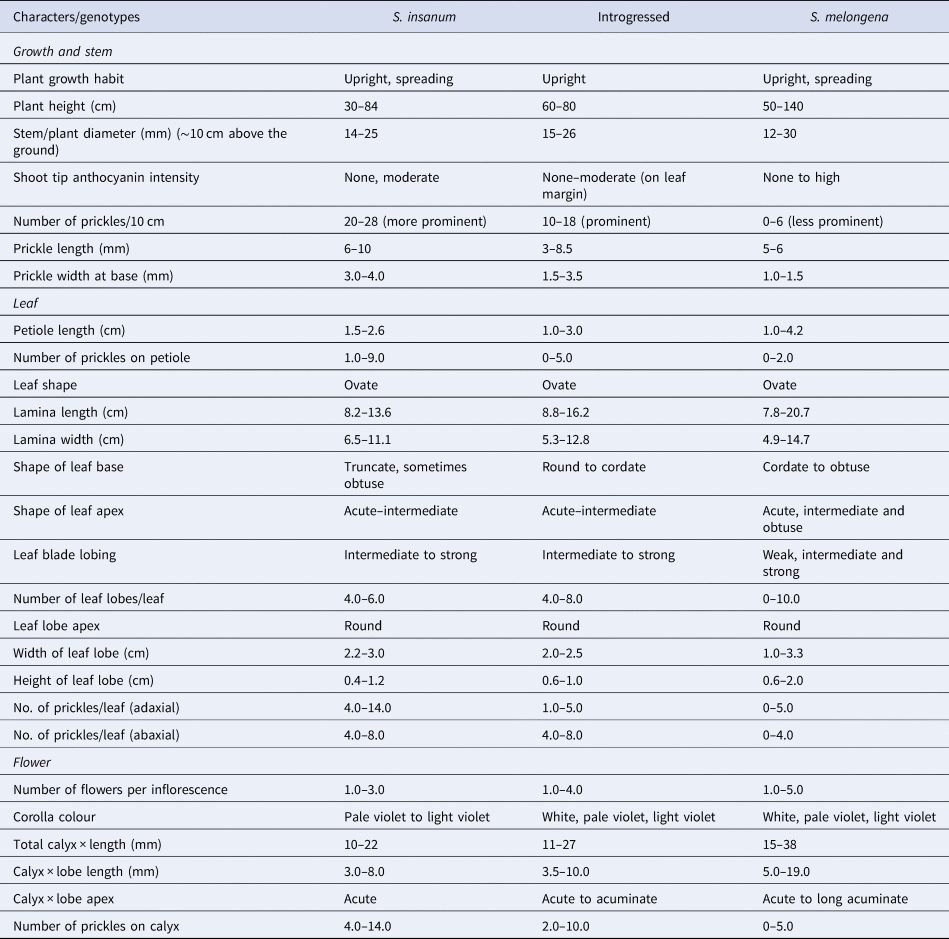
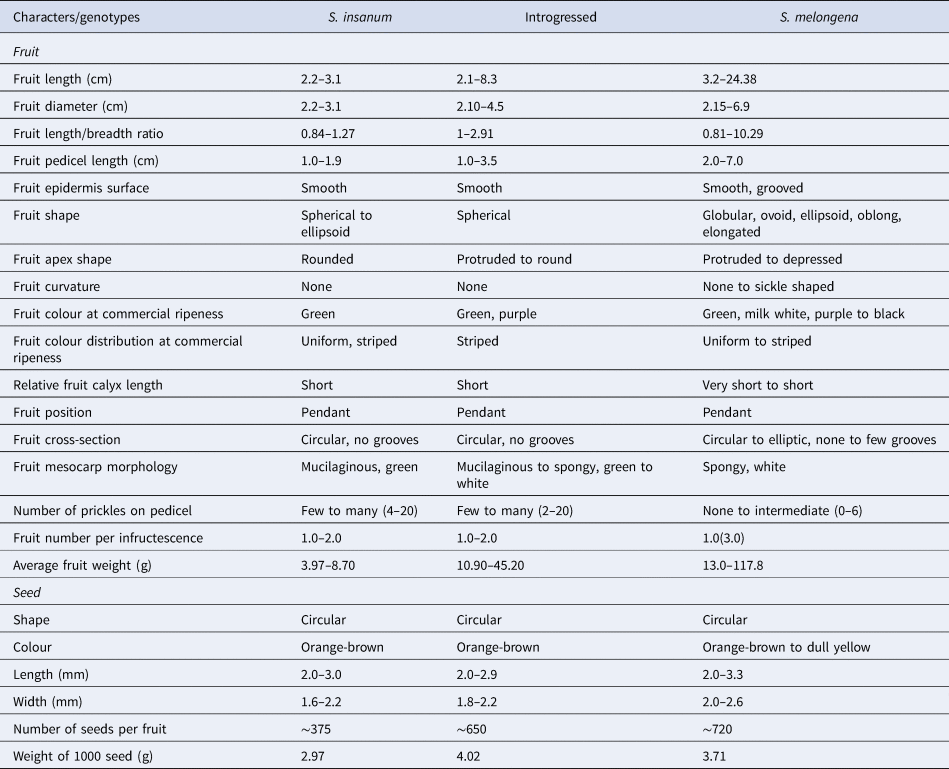
Characterization of 157 collected eggplant genotypes for 50 morphological traits using IBPGR descriptors for delineation of introgressed types from S. insanum and S. melongena collections was presented in Table 1 (growth and stem, leaf and flower) and Table 2 (fruit and seed) with range and character-states for quantitative and qualitative traits, respectively. Based on literature review available on morphological differences between S. melongena and S. insanum (Knapp et al., Reference Knapp, Vorontsova and Prohens2013), these 157 genotypes were grouped into three groups: 10 wild progenitor (S. insanum), 117 cultivated eggplant (S. melongena) accessions and 30 semi-domesticated (naturally introgressed) lines (as listed in online Supplementary Table S1). Some important morphological traits distinguishing these three groups were presented in Fig. 2. The camparison of values of these three groups presented in Tables 1 and 2 lead to delineation of introgressed types from Solanum insanum and S. melongena collections.
Comparison of Solanum insanum and introgressed genotypes with S. melongena on the basis of growth, stem, leaf and flower morphological descriptors

Comparison of Solanum insanum and introgressed genotypes with S. melongena on the basis of fruit and seed morphological descriptors

Distinguish morphological features of Solanum insanum, S. melongena with introgressed genotypes.

Number of prickles in stem (in 10 cm length), leaf petiole, floral calyx and pedicle was observed in the wild progenitor, S. insanum, cultivated S. melongena and introgressed genotypes as (20–28, 1–9, 4–14 and 4–20), (0–6, 0–2, 0–5 and 0–6) and (10–18, 1–5, 2–10 and 2–20), respectively. Prickle's nature and its length (mm) in the stem of the wild progenitor, S. insanum, cultivated S. melongena and introgressed genotypes were observed as (more prominent and 6–10), (less prominent and 5–6) and (prominent nature and 3–8.5), respectively. The shape of the leaf base observed in introgressed lines, S. insanum and S. melongena was round to cordate, truncate and cordate to obtuse, respectively. In case of calyx lobe length (mm), the wild progenitor, S. insanum, cultivated S. melongena and introgressed genotypes showed as 3.0–8.0, 5.0–19.0 and 3.5–10.0, respectively. Fruit length (cm), diameter (cm) and shape of introgressed genotypes, wild species and cultivated accessions were observed as (2.1–8.3, 2.1–4.5 and spherical), (2.1–3.1, 2.2–3.1 and spherical to ellipsoid) and (3.2–24.38, 2.1–6.9 and globular to ovoid to ellipsoid to oblong to elongated), respectively. The number of seeds per fruit showed variation among S. insanum, introgressed and S. melongena genotypes as 375, 650 and 720, respectively.
Morphological characterization using selected traits
Twenty important morphological traits (6 quantitative and 14 qualitative) from 50 IBPGR descriptors were selected for morphological variation to assess their diversity. Basic statistical analysis of six quantitative traits related to leaf and fruit of 157 eggplant genotypes revealed the presence of considerable amount of variation (CV%) among them (online Supplementary Table S2). Among all 157 genotypes, the fruit length/breadth ratio showed a higher (73.87) variation followed by fruit length (54.73) and average fruit weight (53.5). A similar trend was followed in 117 cultivated eggplant genotypes (as 73.70 for fruit length/breadth ratio, 50.02 for fruit length and 42.48 for mean fruit weight). Amid introgressed and wild progenitor S. insanum lines, mean fruit weight showed higher variation (33.29 and 29.57, respectively) followed by fruit traits [fruit length/breadth ratio (29.80) and fruit length (29.75)] in introgressed lines and leaf traits [leaf blade breadth (19.22) and leaf blade length (14.40)] in later one. Range and mean values of important traits such as fruit length and weight of all 157 eggplant genotypes were observed as 2.1–24.38 cm and 3.97–117.8 g with a mean of 6.83 cm and 40.87 g, respectively (online Supplementary Table S2). The cultivated eggplant genotypes showed more variability for these two important traits [3.2–24.38 cm (50.02%) and 13.0–117.8 g (42.48%) with a mean of 7.71 and 47.78, respectively] than introgressed ones [2.1–8.3 cm (29.75%) and 10.9–45.2 g (33.29) with a mean of 4.75 and 25.5, respectively], whereas, wild progenitor, S. insanum showed less variation [2.2–3.1 cm (9.23%) and 3.97–8.7 g (29.57%) with a mean of 2.7 and 6.2, respectively].
Frequency distribution of 14 qualitative traits (Fig. 3) related to growth, leaf, flower and fruits of 157 eggplant genotypes revealed the presence of all character states among them (Fig. 3, online Supplementary Figs S1 and S2). The eggplant collection mainly consists of accessions with upright growth habit (134) than intermediate ones (23). With respect to fruit cross-section, 146 genotypes showed circular or round fruit with no grooves followed by elliptic with no grooves (9). In contrast, only two genotypes showed few grooves (IC618016, KPSC/22-Mis-78) (online Supplementary Fig. S3) on the fruit surface. Eggplant collections exhibited five different fruit colour classes as 60% green (94), 3% milky white (5), 27% purple (42), 9% purple black (14) and 1% black (2) with a distribution pattern of these colours as uniform (49), mottled (17), netted (2) and striped (89) under the present study. The striped pattern is present in all the introgressed lines and some of the S. melongena lines (IC624237, IC626119). The study identified three accessions: Violet brinjal, Kurumbotribe and IC541210 (online Supplementary Fig. S4) having a cluster-bearing nature similar to the released variety, Pusa Purple Cluster.
Frequency distribution of 14 qualitative traits related to growth, leaf, flower and fruit of 157 eggplant genotypes.

Discussion
Globally, the genetic diversity among cultivated eggplants has been brought up by factors such as extensive human selection, mutation, domestication, hybridization and natural inter-crossing. Cultivar differences among the cultivated eggplants are mainly attributed to the agronomic and fruit quality traits: shape, colour, length, earliness, yield and biochemical composition. Characterization of 157 collected eggplant genotypes using 50 morphological traits (IBPGR descriptors) under present study grouped these genotypes into three types: naturally introgressed (30), S. insanum (10) and S. melongena (117) on the basis of morphological differences among them. The key traits identified [prickliness (nature, number of prickles and its length) on stem, petiole, calyx, pedicle; leaf base shape; fruit shape, size (length and diameter), mesocarp texture] under present study could be more useful to plant taxonomist, explorers and breeders to effectively categorize the individual plants into a solid species in a better manner than earlier. A schematic representation of these traits is presented in the form of line drawings (Fig. 4).
Schematic representation of the delineating morphological traits of Solanum insanum, S. melongena with introgressed genotypes (it also provides information on the traits that are changed during domestication). The number and density of prickles were more in S. insanum followed by introgressed genotypes and S. melongena. The shape of leaf base was truncate (S. insanum), round to cordate (introgressed genotypes) and cordate to obtuse (S. melongena).

Prickliness is a unique trait present in eggplant among the members of Solanaceae (Portis et al., Reference Portis, Cericola, Barchi, Toppino, Acciarri, Pulcini, Sala, Lanteri and Rotino2015; Miyatake et al., Reference Miyatake, Saito, Nunome, Yamaguchi, Negoro, Ohyama, Wu, Katayose and Fukuoka2020) with a long period of domestication history (Page et al., Reference Page, Gibson, Meyer and Chapman2019). In the present study, more prickliness was observed in the wild progenitor, S. insanum compared to cultivated S. melongena with intermediate prickliness in naturally introgressed genotypes among eggplant collections. Four out of six traits related to prickliness (number of prickles/10 cm of stem, prickle length at stem, leaf petiole prickle number, number of prickles on calyx, number of prickles on pedicle) showed a clear difference between naturally introgressed genotypes and the two taxa, S. insanum and S. melongena. Further, the nature of prickliness such as more prominent to less prominent could play a major role in deciphering the species categorization among individual plants. The drastic reduction in size and density of prickles on stem, leaves, calyx and pedicle was observed in the S. melongena group, indicating that evolution is still ongoing.
Although eggplant's prickliness is considered an undesirable agronomic trait due to difficulties caused during cultivation, harvesting and transportation (Miyatake et al., Reference Miyatake, Saito, Nunome, Yamaguchi, Negoro, Ohyama, Wu, Katayose and Fukuoka2020), it could also protect against damage from herbivores (Coverdale, Reference Coverdale2019). A study from Kerala Agricultural University (Puthiamadom et al., Reference Puthiamadom, Joseph, Subramanian, Pradeepkumar, Beena and Latha2021) revealed the absence of shoot damage by eggplant shoot and fruit borer in the wild genotypes bearing large number of prickles compared to the cultivated varieties (Ponni and Surya) without prickles. The cultivated eggplant varieties generally have much fewer prickles than wild types. Furthermore, improved breeding and cultivation techniques led to less/removal of prickles from the stem, leaf, petiole and pedicle, with the exception of calyx where prickles are still commonly found in many varieties (at least 63.1% of all assessed eggplants) across the world as evidenced from earlier studies (Li et al., Reference Li, Yao, Yang, Wang, Wei, Shi and Li2019; Zhang et al., Reference Zhang, Fang, Chen, Zhou, Yuan, Lei and Huang2020).
Traits related to fruits such as size and shape were used as the most distinguishing features between wild relatives and cultivated Solanum species for their taxonomic identity (Kumar et al., Reference Kumar, Meena, Kar, Tiwari, Gangopadhyay, Bisht and Mahajan2008) and they had good breeding values also (Daunay and Hazra, Reference Daunay, Hazra, Peter and Hazra2012; Portis et al., Reference Portis, Cericola, Barchi, Toppino, Acciarri, Pulcini, Sala, Lanteri and Rotino2015). Fruit size and shape of introgressed genotypes showed intermediate values with closer proximity to wild species than cultivated accessions under present study. This result indicates the dominant nature of genes controlling fruit size and shape in wild species compared to cultivated eggplants as reported earlier (Doganlar et al., Reference Doganlar, Frary, Daunay and Lester2002). A similar report of linkage drag in inter-specific hybrids involving Abelmoschus esculentus and its wild species had been reported by Suma et al. (Reference Suma, Joseph John, Bhat, Latha, Lakshmi, Pitchaimuthu, Nissar, Thirumalaisamy, Pandey, Pandey and Kumar2023). Other fruit traits such as fruit weight and mesocarp texture could also provide some clues for delineating the two closely related species [S. insanum (3.9–8.7 g, mucilaginous with green), S. melongena (13.0–117.8 g, spongy with white)] from introgressed ones (10.9–45.2 g, mucilaginous to spongy with green to white) under present study.
Introgressed lines obtained from the eggplants' collection reconfirmed the existence of gene flow and formation of spontaneous hybridization between S. melongena and S. insanum present in Southeast Asia (Davidar et al., Reference Davidar, Snow, Rajkumar, Pasquet, Daunay and Mutegi2015; Mutegi et al., Reference Mutegi, Snow, Rajkumar, Pasquet, Ponniah, Daunay and Davidar2015). This gene flow was effected by the presence of exerted stigma type in S. insanum (Davidar et al., Reference Davidar, Snow, Rajkumar, Pasquet, Daunay and Mutegi2015), which encourages out-crossing rate (5–33%) by facilitating bee visit, to create more variability among the S. insanum populations (Deb, Reference Deb, Hawkes, Lester and Skelding1979; Karihaloo and Rai, Reference Karihaloo and Rai1995; Davidar et al., Reference Davidar, Snow, Rajkumar, Pasquet, Daunay and Mutegi2015; Mutegi et al., Reference Mutegi, Snow, Rajkumar, Pasquet, Ponniah, Daunay and Davidar2015). In general, the process of domestication was the key driving force for the enhanced morphological variation (fruit in this case) observed in cultivated eggplants than in wild species (Meyer and Purugganan, Reference Meyer and Purugganan2013). This enhanced genetic variation for a trait might be due to a conscious plant selection for that particular morphological traits rather than natural selection. It was true in our eggplant collections also, as the huge fruit variability might be due to representation of genotypes from vast geographical area under eggplant cultivation.
Morphological similarity existing between S. insanum and S. melongena in many traits under the present study may also support the hypothesis that ‘this species (S. insanum) served as the wild progenitor in the evolutionary process/origin of cultivated eggplant’ (Knapp et al., Reference Knapp, Vorontsova and Prohens2013; Meyer et al., Reference Meyer, Whitaker, Littler, Wu, Kennelly, Long and Litt2015). Further, the process of domestication should be easier when genes for domestication traits from the wild species display intermediate dominance rather than full dominance. Practical significance of the traits involved in the delineation of naturally introgressed genotypes of Indian eggplant collections could be as follows: (1) provide clues to identify the individual plant at field level during exploration trip, (2) aids in preliminary classification of germplasm collections, (3) allows efficient germplasm management by gene bank curators, (4) aids plant taxonomists with grouping at lower levels. The amount of Solasodine content and anti-nutritional factors could also give some insights about genotypes, as it is higher in wild types than cultivated ones (Mennella et al., Reference Mennella, Lo Scalzo, Fibiani, D'Alessandro, Francese, Toppino, Acciarri, de Almeida and Rotino2012; Bagheri et al., Reference Bagheri, Bushehri, Hassandokht and Naghavi2017).
Morphological characterization of 157 eggplant genotypes for six selected quantitative traits revealed the presence of higher variation for the traits such as fruit length and mean fruit weight on the basis of CV%. The cultivated eggplant genotypes showed more variability for these two important traits such as fruit length and weight than introgressed ones, whereas, the wild progenitor, S. insanum showed less variation. This might be owing to more representation of cultivated types among the collection and also attributed by consumers' preferences over different fruit characteristics.
Frequency distribution study of 157 eggplant genotypes for 14 qualitative traits revealed the presence of all character states among them. Accessions with more number of upright growth habit than intermediate ones might be owing to more representation of cultivated types among the collection. The importance of upright plant growth habit was reported by Rashid and Singh (Reference Rashid and Singh2014), as an essential trait for good vigour, free/easy intercultural operations, harvesting and free air circulation resulting in easier pest and disease control. Although prickliness had been identified as a distinguishing feature (prickle density, size and colour) between wild and domesticated species of eggplant, some accessions of S. melongena showed intermediate prickles (Vengeri, IC203587, IC545901, IC636525) as an exception under the present study. Further, consumer preference is significantly influenced by the colour, size and shape of eggplant fruits at harvestable stage.
Fruit colour and its distribution pattern on fruit had played a critical role in distinguishing varieties as the range of fruit colour at marketable stage under present collection was the consequence of continuous selection by breeders during crop improvement programme as well as by farmers during their cultivation on the basis of local and regional preferences over the period. The role and importance of anthocyanin and chlorophylls in the dark violet to black coloured eggplant types were highlighted by Stommel and Dumm (Reference Stommel and Dumm2015). As per this, high chlorophyll with a very low amount of anthocyanin content might be in green fruits, low chlorophyll in white fruits, whereas both had different ranges of concentration in light violet to purple coloured fruits. Three accessions identified (Violet brinjal, Kurumbotribe and IC541210) with cluster-bearing nature could be exploited for future breeding programmes besides identifying the gene(s) responsible for this trait.
In the 21st century, the crop of wild relatives is a potential source of food security. The eggplant wild relative S. insanum has greater phenolic content (Meyer et al., Reference Meyer, Whitaker, Littler, Wu, Kennelly, Long and Litt2015) than cultivated species (S. melongena), which led to its consumption in Southeast Asia (Meyer et al., Reference Meyer, Bamshad, Fuller and Litt2014; Ranil et al., Reference Ranil, Prohens, Aubriot, Niran, Plazas, Fonseka, Vilanova, Fonseka, Gramazio and Knapp2017). So, this study's 10 accessions of S. insanum shall be evaluated and used to introduce desirable genes/alleles into cultivated species. Kaushik et al. (Reference Kaushik, Prohens, Vilanova, Gramazio and Plazas2016) made interspecific hybrids and found that interspecific hybrids are related to cultivated species. However, the introgression studies remain mostly underutilized, which may be due to the greater number of seeds for fruits, linkage drag and lack of understanding of the genetic base of complex characters.
Conclusion
The greatest morphological and genetic diversity of eggplant and regional selection pressures for plant and fruit traits cause eggplant crop variability in India. The presence of natural pollinators and the exerted stigma of eggplant promotes high out-crossing among and between the S. insanum and S. melongena. As a result, it creates natural variation and produces the genotypes with intermediate phenotypes. The collection and conservation of these materials in genebanks led to misrepresentation of the plant's genetic resources management. So, identifying key morphological traits could differentiate the primary gene pool (S. insanum and S. melongena) apart from introgressed lines to exploit their breeding values with higher acceptance and widespread adoption. In our study, the eggplant germplasm collection (157 nos.) from ICAR-NBPGR, Regional station, Thrissur (Kerala) successfully delineated 30 naturally introgressed (semi-domesticated) genotypes along with 10 wild progenitors of S. insanum and 117 cultivated eggplant accessions of S. melongena using key morphological traits identified: prickliness (nature, number of prickles and its length), fruit shape, size (length and diameter), mesocarp texture and number of seeds. Although there was partial overlap in character states between these taxa, these key traits could shed some clues or insights for distinguishing naturally introgressed genotypes from these taxa. We also noticed and recorded large morphological diversity in the experimental materials, mainly in cultivated eggplant, S. melongena. The cluster-bearing accessions (Violet brinjal, Kurumbotribe and IC541210) identified under study could be useful for future breeding programme.
Future directions
The relationships among wild, introgressed and cultivated eggplants are intricate and the finding of their evolution and migration is still difficult to understand. In the current study, we identified key morphological features to distinguish the introgressed material from the wild and cultivated materials of eggplant. In future, biochemical and molecular studies will establish how these introgressed types fit into the Leptostemonum clade and provide further insights on the genetic basis of the morphological differences.
Supplementary material
The supplementary material for this article can be found at https://doi.org/10.1017/S147926212400039X.
Acknowledgements
The first author (Ph.D. Scholar) and corresponding author greatly acknowledge ICAR-NBPGR, Regional Station, Vellanikkara for providing seed material for this study and the financial support from ICAR-NBPGR, New Delhi for facilitating the field studies. We are also grateful to the Plant Exploration and Germplasm Collection division for logistic support and to the curators of germplasm of the current study.